
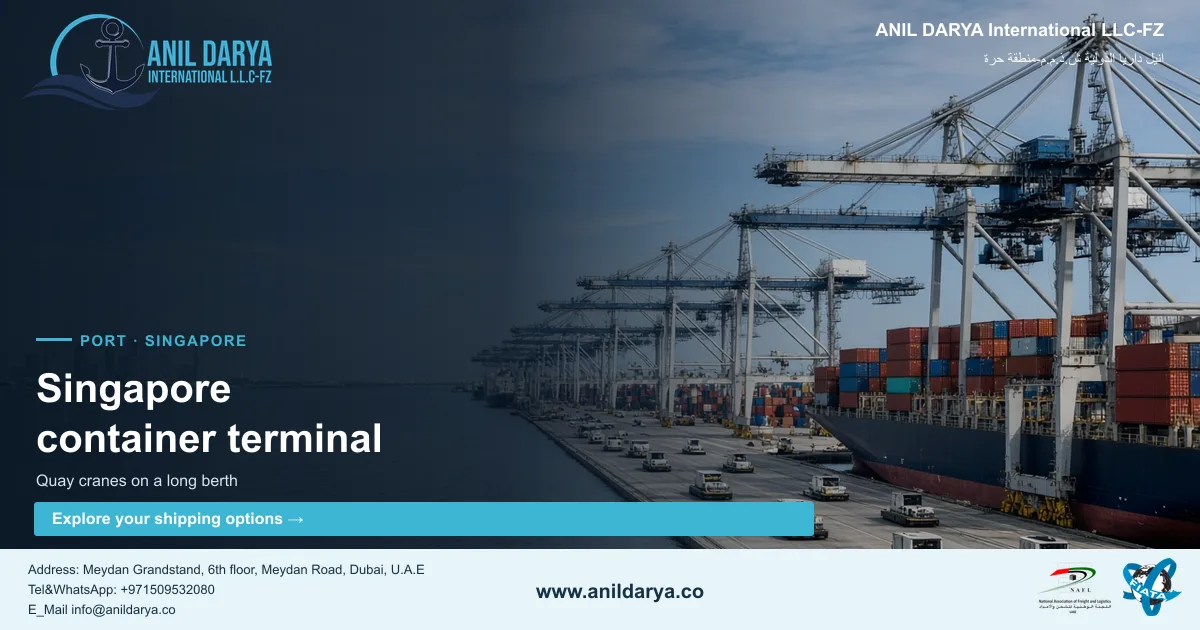
Port of Singapore shipping runs mainly through PSA's container terminals at Pasir Panjang and the new Tuas Port, with Jurong Port handling steel, cement and project cargo. Singapore charges duty on only four groups of goods, but you need a customs permit before the cargo arrives and 9% GST applies to almost everything. This guide covers the terminals, the dangerous goods and customs rules, and how we ship your cargo from Dubai to Singapore. We ship both ways: from Dubai to Singapore and from Singapore to Dubai.
Port of Singapore shipping: key facts at a glance
| Item | Detail |
|---|---|
| Port authority | Maritime and Port Authority of Singapore (MPA) |
| Container terminal operator | PSA Singapore (PSA Corporation) |
| Bulk and conventional cargo operator | Jurong Port |
| Customs authority | Singapore Customs |
| UN/LOCODE | SGSIN |
| Containers handled in 2025 | 44.66 million TEU, a record and up 8.6% on 2024 |
| Vessel arrival tonnage in 2025 | 3.22 billion gross tonnage |
| Vessel calls | Over 130,000 a year |
| Network | Connected to more than 600 ports |
| PSA container berths | 56 berths across the city terminals, Pasir Panjang and Tuas, combined capacity 46.5 million TEU |
| Tuas Port | 14 berths operating (August 2026), 18 planned by 2027, 65 million TEU a year when complete in the 2040s |
| Vehicle terminal | Pasir Panjang Automobile Terminal, 3 berths, about 20,000 car lots |
| Import tax | GST 9%; duty only on liquor, tobacco, motor vehicles and petroleum products |
| Declaration system | TradeNet customs permit, filed before the goods arrive |
| Shipping from Singapore to Dubai | Also handled: arrival at Jebel Ali, Khalifa Port or Sharjah, cleared by UAE customs with 5% duty on most goods and 5% VAT |
Who runs the Port of Singapore and where are the terminals?
The Port of Singapore is not one quay. MPA is the port authority and lists cargo terminals at Tanjong Pagar, Keppel, Brani, Pasir Panjang, Sembawang, Jurong and Tuas. Two companies do most of the cargo work: PSA for containers and vehicles, and Jurong Port for bulk and conventional cargo. Which one handles your shipment depends on how it is packed.
| Terminal | Operator | Main cargo | What to know |
|---|---|---|---|
| Tuas Port | PSA | Containers | Fully automated, opened September 2022, still adding berths |
| Pasir Panjang Terminals | PSA | Containers | Takes the largest container ships; will move to Tuas by 2040 |
| City terminals (Keppel, Brani) | PSA | Containers | Moving to Tuas by 2027 |
| Pasir Panjang Automobile Terminal | PSA | Vehicles (Ro-Ro) | Singapore's first dedicated car terminal, open since January 2009 |
| Sembawang Wharves | PSA | Breakbulk and specialised cargo | Heavy equipment, steelworks, cables; warehousing and open storage |
| Jurong Port | Jurong Port | Bulk, breakbulk, project cargo | Steel, cement, machinery, timber; 127 hectares of free trade zone |
| PSA Jurong Island Terminal | PSA | Containers by barge | 2 berths, two barge sailings a day, total capacity 400 TEU |
Tuas Port: where most containers are heading
PSA describes Tuas as the world's largest fully automated container terminal. It has handled 25 million TEU since it opened in September 2022 and had 14 berths working in August 2026, with 18 planned by 2027. All of PSA's container work will end up there. The city terminals move first, by 2027, and Pasir Panjang follows by 2040.
For you this matters in one practical way. Your arrival notice names the terminal, and the haulier and the delivery order must match it. Do not assume your box lands where the last one did.
Pasir Panjang and the city terminals
Pasir Panjang is still a major container site, and PSA says its newest facilities there and at Tuas can serve the world's largest container ships. PSA runs all its terminals as one integrated system, so lines can move boxes between them. That is why Singapore works so well as a transhipment hub: about 90% of its 2024 container throughput was transhipment cargo.
Jurong Port for steel, cement and project cargo
Jurong Port is Singapore's main bulk and conventional cargo operator. MPA lists steel products, cement, project cargo and copper slag among its cargo, moved with pipelines and conveyor systems. Jurong Port lists metals, machinery, rubber, timber, livestock and paper products as breakbulk it handles, and it has London Metal Exchange approved warehouses inside the port. If your cargo is not in a container, this is usually where it goes.
What cargo can you ship through Singapore?
| Cargo type | Where it is handled | What to plan |
|---|---|---|
| General goods in containers | PSA at Tuas or Pasir Panjang | Terminal on the arrival notice, customs permit with container and seal numbers |
| Chilled and frozen food | PSA container terminals, reefer boxes | Set temperature, food import licence from the competent authority |
| Cars and vehicles | Pasir Panjang Automobile Terminal | Duty applies to motor vehicles, plus local registration rules |
| Steel, machinery, equipment | Jurong Port or Sembawang Wharves | Lifting points, piece list, storage at the port |
| Oversized and heavy-lift pieces | Jurong Port project cargo facilities | Drawings, lift plan, road permits for the move from port |
| Chemicals and other DG | PSA or Jurong Port, declared to MPA | DG declaration at least 12 hours before arrival, terminal approval |
| Cement and dry bulk | Jurong Port bulk berths | Discharge plan and receiving facility |
Shipping from Dubai to Singapore by container: FCL or LCL?
Most cargo shipped from Dubai to Singapore moves in containers. Your two options are the same as on any lane, but the Singapore permit rules change the paperwork slightly.
- FCL (full container load). You book a whole 20ft or 40ft box. When you apply for the import permit, the container number and the shipper's seal number must be on it, so send them to the consignee as soon as the box is stuffed.
- LCL (less than container load). Your cargo shares a box with other shippers and is unpacked at a consolidator's warehouse in Singapore. Release depends on the consolidator's paperwork as well as yours.
As a rule of thumb, once your cargo fills most of a 20ft box, FCL is often cheaper per cubic metre and safer for fragile goods. Our guide to FCL vs LCL costs shows how to work out the break-even point, and our sea freight service covers both.
Your cargo can leave from Jebel Ali or from Khalifa Port in Abu Dhabi, depending on where it is in the UAE and which lines call. We compare both before we book.
[AMIR-FACT: our real port-to-port transit time Jebel Ali to Singapore and the carriers we usually book on this lane]
Published transit times on aggregator sites for this lane vary widely, so we quote the sailing and transit from the carrier's own schedule at booking. Ask for the cut-off date as well as the sailing date.
Breakbulk, heavy-lift and vehicles at Singapore
Cargo that does not fit a container has two homes in Singapore. Sembawang Wharves, run by PSA, handles breakbulk and specialised cargo such as heavy equipment, steelworks and cables, and offers warehousing and open storage. Jurong Port handles steel, machinery, project cargo and other conventional cargo across a multi-purpose terminal, and offers berth allocation, stevedores, handling equipment, cargo staging and transport as one service.
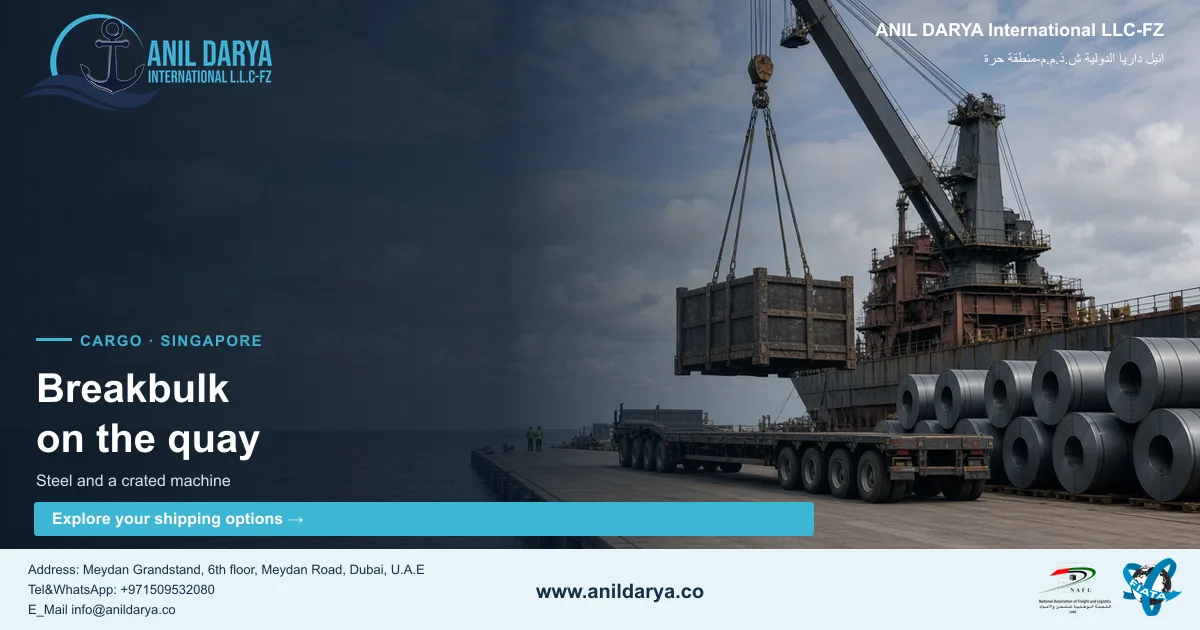
When we plan breakbulk or project cargo from the UAE to Singapore, we work in this order:
- Collect drawings, dimensions, weights and centre of gravity for every piece.
- Decide between a flat rack or open top on a container service, or conventional breakbulk tonnage.
- Agree lifting and lashing with the carrier, and confirm which Singapore terminal will receive the cargo.
- Line up the consignee's declaring agent so the import permit is ready before discharge.
- Check the road move from the port with the consignee's haulier.
A simple decision rule: if a piece fits a 40ft flat rack by size and weight, a container service usually gives you more sailings. If not, the breakbulk sailing date drives the whole plan. See our break bulk and project cargo service for what we cover from the UAE side.
Vehicles go through the Pasir Panjang Automobile Terminal, which has three dedicated berths, an open car yard and a multi-storey car store. Motor vehicles are one of the four dutiable groups in Singapore, so price the duty before you ship.
Dangerous goods into Singapore: what MPA requires
Singapore controls dangerous goods in port through MPA. The vessel's owner, agent or master must declare DG before it is discharged or loaded. As a shipper you do not file this yourself, but the carrier can only file it if your data is right and arrives on time.
| Rule | What MPA says |
|---|---|
| Where the declaration is filed | PSA PORTNET, JP-Online (Jurong Port) or digitalPORT@SG |
| Deadline at PSA or Jurong terminals | At least 12 hours before the vessel arrives, for DG being discharged or in transit |
| Bulk hazardous and noxious substances | 24 hours before arrival, through digitalPORT@SG |
| Ammonium nitrate (UN 1942, 2067, 2426) | Certificate of Analysis from a competent body |
| Radioactive material (Class 7) | Extra approval from the National Environment Agency for transhipment or transit |
| Strategic goods | TradeNet permit before export, transhipment or transit |
| Storage in the terminal | Check with the terminal operator and get approval where needed |
At Jurong Port, all DG for import, export or transit must be declared and approved by MPA and Jurong Port through JP-Online, and the approved PM4 acts as the permit for the goods to enter or leave the port.
What you need to give us for a DG booking to Singapore:
- UN number, proper shipping name, class and packing group for each product.
- A full Safety Data Sheet. MPA asks for one when the classification is unclear.
- A signed Dangerous Goods Declaration and UN-approved packaging, marks and labels.
- Any import licence the Singapore competent authority requires for the product.
Our dangerous goods shipping team checks carrier acceptance and the paperwork before you commit to a sailing.
Singapore customs clearance: permits, GST and documents
Singapore Customs works on one rule that catches many first-time shippers: the importer must get the customs permit before the goods are imported, not after. All permits go through TradeNet, the national trade system.
Register first: UEN, customs account and declaring agent
The importer needs a Unique Entity Number (UEN) from ACRA or the relevant agency, and must activate a customs account. Most importers then appoint a declaring agent to apply for permits. Duties, taxes and fees are paid by Inter-Bank GIRO, either from the importer's own account or the declaring agent's. If your buyer in Singapore has never imported before, check this early, because it takes time.
Get the permit before the goods arrive
The declaring agent applies for the permit through TradeNet. For containers, the container number and the shipper's seal number must be on the permit. Permits have a validity period, so the date on it must still be valid when the cargo is cleared.
How much GST and duty will you pay?
Singapore charges GST at 9%. It is levied on the CIF value (cost, insurance and freight) plus any duty. Customs and excise duty apply to only four groups of goods. For everything else, you pay GST only, unless an exemption or a relief scheme applies.
| Goods | Duty | GST |
|---|---|---|
| Intoxicating liquors | Yes | 9% on CIF plus duty |
| Tobacco products | Yes | 9% on CIF plus duty |
| Motor vehicles | Yes | 9% on CIF plus duty |
| Petroleum products and biodiesel blends | Yes | 9% on CIF plus duty |
| All other goods | No | 9% on CIF |
| Goods stored in a free trade zone | Suspended | Suspended until goods enter Singapore for local use |
For dutiable goods, and some temporary imports, Singapore Customs asks for security in the form of a banker's guarantee, finance company guarantee or insurance bond.
Which documents does Singapore Customs need?
For containerised sea cargo, the customs permit is the key document, and supporting documents are not needed at the inward checkpoint. But Customs can ask for the invoice, bill of lading and certificate of origin at any time, and the importer must keep supporting documents for 5 years.
| Cargo | What Singapore Customs lists | Our advice |
|---|---|---|
| Containerised sea cargo | Customs permit with container and seal numbers, supporting documents | Send invoice, packing list and bill of lading to the declaring agent before sailing |
| Conventional cargo (breakbulk) | Printed customs permit, commercial invoice, packing list, bill of lading | Piece-by-piece packing list that matches the bill of lading |
| Controlled or dutiable goods | Customs permit, bill of lading, commercial invoice, packing list | Licence from the competent authority before shipping |
| Dangerous goods | As above, plus MPA DG declaration by the carrier | SDS and DG declaration with the booking |
Controlled and prohibited goods
Some goods need a licence or approval from a competent authority before import. You can check this by searching the HS code or product description in TradeNet's product code checker, and Singapore Customs offers an official HS classification ruling for S$75 per product. Some goods cannot be imported at all. Singapore Customs lists, among others:
- Chewing gum, except HSA-approved dental and medicinal gum.
- Chewing tobacco, shisha, snuff and imitation tobacco products such as e-cigarettes.
- Rhinoceros horn and products from endangered wildlife.
- Certain telecom equipment such as scanning receivers and jamming devices.
- Controlled drugs.
Check the full list before you ship. A prohibited item in a mixed load can hold the whole container.
Free trade zones: store, re-export or tranship without paying GST
Singapore's free trade zones exist for entrepot trade and transhipment. Cargo arriving by sea or air is first deposited in a free trade zone, and duty and GST stay suspended while it is there. You pay only if the goods are used in the zone or leave it for local sale. Liquor and tobacco can stay up to 30 days before they must be transhipped or moved to licensed premises.
This matters if you use Singapore as a regional stock point. If the goods will go on to another country, ask the consignee's declaring agent whether a transhipment or free trade zone route avoids GST altogether.
How to ship from Dubai to Singapore: step by step
Here is how we handle a typical export from the UAE to Singapore. We book the space, prepare documents and handle the UAE side. A declaring agent in Singapore, appointed by the consignee, handles the import permit.
- Tell us about the cargo: commodity, HS code, weight, volume or dimensions, pickup point and the Incoterm agreed with your buyer. Our guide to Incoterms 2020 for sea freight explains who pays for what.
- Check the Singapore side early. Confirm the consignee has a UEN, an active customs account and a declaring agent, and whether the goods are controlled, dutiable or prohibited.
- Book space. We compare carrier services from Jebel Ali Port and, where it suits, Khalifa Port. For DG, reefer or out-of-gauge cargo we get carrier acceptance first.
- Stuff and seal the container. We arrange the empty, trucking and stuffing at your site or a warehouse. We then send the container and seal numbers to the consignee's agent for the import permit.
- File the UAE export or re-export declaration with Dubai Customs and gate the box in before the cut-off.
- Release the bill of lading. We check the draft against the invoice and packing list and release the final bill, or a sea waybill, after sailing.
- Import permit and GST. The declaring agent in Singapore applies for the TradeNet permit and pays GST and any duty.
- Delivery. The consignee or its haulier collects from the terminal named on the arrival notice.
How to ship from the Port of Singapore to Dubai
We also handle the other direction: shipping from Singapore to Dubai, with arrival at Jebel Ali, Khalifa Port or Sharjah port. We book the space with the carrier and run the UAE side. The Singapore export papers stay with the shipper or its Singapore agent.
The Singapore export side
- Export permit. Singapore Customs says goods need a customs export permit before export, and recommends getting it before the cargo gates in at the sea port. The exporter is usually the party that issues the commercial invoice to the overseas buyer.
- Who files. Permits go through TradeNet. The exporter can appoint a declaring agent, or register as a declaring agent itself. It needs a UEN and an activated customs account first.
- Strategic goods. Goods controlled under the Strategic Goods (Control) Act need a strategic goods permit. Under an individual permit, the application goes in 5 working days before export.
The UAE import side
For cargo cleared in Dubai, the import declaration goes to Dubai Customs with the commercial invoice, packing list, certificate of origin and any permit from the authority that controls restricted goods. The bill of lading is what releases the cargo from the shipping line. Customs duty in Dubai is 5% of the CIF value for most goods, with 50% on alcohol and 100% on cigarettes. Import VAT is 5%, charged on the customs value including freight and insurance. A VAT-registered importer that has registered its customs number with the Federal Tax Authority pays no VAT at the border and accounts for it on its next VAT return.
- Send us the shipper's details in Singapore, the cargo, the HS code and the UAE delivery address.
- We book space with the carrier from Singapore to Jebel Ali, Khalifa Port or Sharjah and send the booking and cut-offs to the shipper.
- The shipper or its trucker picks up the cargo and delivers the container to the PSA terminal named in the booking before the cut-off.
- The shipper or its Singapore agent gets the Singapore Customs export permit through TradeNet.
- We check the draft bill of lading against the invoice and packing list before the line issues it.
- We file the UAE import declaration before the vessel arrives.
- We arrange payment of the duty and VAT and collect the delivery order from the shipping line.
- We truck the container to your site in the UAE.
- We return the empty container to the line's depot within free time.
[AMIR-FACT: the carriers we actually use from Singapore to Jebel Ali, Khalifa Port or Sharjah and our real port-to-port transit days in this direction]
What affects your cost on this lane?
We do not publish fixed rates because they change with every sailing. These are the factors that move the price, and the ones you can control.
| Cost factor | Why it changes the price | What you can do |
|---|---|---|
| FCL or LCL | LCL is priced per cubic metre plus warehouse handling at both ends | Ask us to price both when you are close to filling a box |
| Container type | Reefers, flat racks and open tops cost more and have less space | Book special equipment early |
| Cargo class | DG adds surcharges and acceptance checks | Send the SDS with the enquiry |
| Origin trucking in the UAE | Distance from your site to the port | Compare Jebel Ali and Khalifa Port |
| Destination charges | Terminal handling, delivery order and agent fees in Singapore | Agree who pays them in the Incoterm |
| GST and duty | 9% GST on almost all goods, duty on four groups | Use a free trade zone if goods will be re-exported |
Checklist before you ship to Singapore
- HS code confirmed, and checked for controlled, dutiable or prohibited status in Singapore.
- Consignee has a UEN, an active customs account and a declaring agent.
- Licence from the competent authority in hand for controlled goods.
- Invoice, packing list and bill of lading show the same weights, piece counts and consignee.
- Container and seal numbers sent to the declaring agent for the permit.
- For DG: SDS, DG declaration, packaging and labels, carrier acceptance.
- For breakbulk: drawings, lifting points and the receiving terminal confirmed.
- UAE export or re-export declaration ready before the cut-off.
- Cargo insurance arranged.
Common mistakes on Singapore shipments
- Waiting for arrival to apply for the permit. Singapore expects the permit before import, so a late permit means storage charges.
- Wrong seal number on the permit. If the seal on the box does not match the permit, the container can be held.
- Assuming no tax because duty is zero. Duty may be zero, but 9% GST still applies to most goods.
- Shipping restricted items in a mixed load. One prohibited product, such as e-cigarettes, can hold the whole box.
- Late DG data. MPA needs the declaration at least 12 hours before arrival, and the carrier needs your data well before that.
- Wrong terminal on the collection. With PSA moving terminals to Tuas, check the terminal on every arrival notice.
Frequently asked questions
Who operates the terminals at the Port of Singapore?
MPA is the port authority. PSA Singapore runs the container terminals at Tuas, Pasir Panjang and the city sites, plus the vehicle terminal and Sembawang Wharves. Jurong Port runs the main bulk and conventional cargo terminal.
What is the port code for Singapore?
The UN/LOCODE for the Port of Singapore is SGSIN. You will see it on bookings, bills of lading and tracking systems.
How much cargo does the Port of Singapore handle?
Singapore handled a record 44.66 million TEU of containers in 2025, up 8.6% on 2024. It has over 130,000 vessel calls a year and connects to more than 600 ports.
What is Tuas Port and why does it matter?
Tuas Port is PSA's fully automated container terminal, open since September 2022. It had 14 berths working in August 2026 and will take over all of PSA's container work over time, with a planned capacity of 65 million TEU a year.
Do I pay import duty on goods shipped from Dubai to Singapore?
Only liquor, tobacco, motor vehicles and petroleum products carry duty in Singapore. Most other goods pay 9% GST only, calculated on the CIF value plus any duty.
Who needs to apply for the Singapore import permit?
The importer in Singapore, usually through a declaring agent. The importer needs a UEN and an active customs account, and the permit must be obtained through TradeNet before the goods are imported.
Can I ship dangerous goods to Singapore?
Yes. The carrier declares the DG to MPA through PSA PORTNET, JP-Online or digitalPORT@SG at least 12 hours before arrival. Some cargo, such as ammonium nitrate and radioactive material, needs extra documents or approval.
What goods are prohibited from import into Singapore?
Singapore Customs lists chewing gum (except approved dental and medicinal gum), chewing tobacco, shisha and imitation tobacco products, endangered wildlife products, some telecom equipment and controlled drugs, among others. Check the full list before shipping.
Where does breakbulk cargo go in Singapore?
Breakbulk and project cargo usually goes to Jurong Port or PSA's Sembawang Wharves. Both handle steel, machinery and heavy equipment, and offer storage at the port.
How do I ship from Singapore to Dubai?
The Singapore exporter or its declaring agent gets a customs export permit through TradeNet before the cargo gates in. We book the space to Jebel Ali, Khalifa Port or Sharjah, file the UAE import declaration and arrange payment of the 5% duty (on the CIF value of most goods) and the 5% import VAT.
Get a quote for shipping to the Port of Singapore
Send us the cargo details and we will come back with a routing and a price for shipping from Dubai to Singapore. Use our freight rate inquiry form, or contact our team to talk through a DG, breakbulk or project shipment first. You can also read more about our Dubai freight forwarding team.
Sources
- MPA: Cargo terminals (terminal list, PSA and Jurong Port cargo types)
- MPA: Declaring dangerous goods and HNS
- Ministry of Transport Singapore: Global maritime hub (2025 throughput, vessel calls, network)
- BritCham Singapore, reporting MPA's 2025 port figures (growth on 2024)
- PSA Singapore: Our business (berths, capacity, Tuas, PPAT, Sembawang, Jurong Island)
- PSA Singapore: Tuas Port marks 25 million TEUs (August 2026)
- Jurong Port: General and break bulk cargo
- Jurong Port: Dangerous goods process
- Singapore Customs: Importing goods overview
- Singapore Customs: Import procedures
- Singapore Customs: Documents for clearance of goods
- Singapore Customs: Duties and dutiable goods
- Singapore Customs: Controlled and prohibited goods for import
- Singapore Customs: Depositing goods in free trade zones
- IRAS: Current GST rate
- Wikipedia: Port of Singapore (UN/LOCODE, transhipment share)
- Singapore Customs: Export procedures (who is the exporter, permit timing, strategic goods)
- Singapore Customs: Obtain customs export permit (TradeNet, declaring agents)
- Dubai Customs: Submit customs declaration (invoice, packing list, certificate of origin, permits)
- UAE Government portal: Clearing customs and paying customs duty (5% of CIF, alcohol 50%, cigarettes 100%)
- Federal Tax Authority: VAT (5% rate)
- Federal Tax Authority: VAT guide, section 3.5 on VAT on imports (5%, deferral for VAT-registered importers)
Reviewed: 10 November 2026