
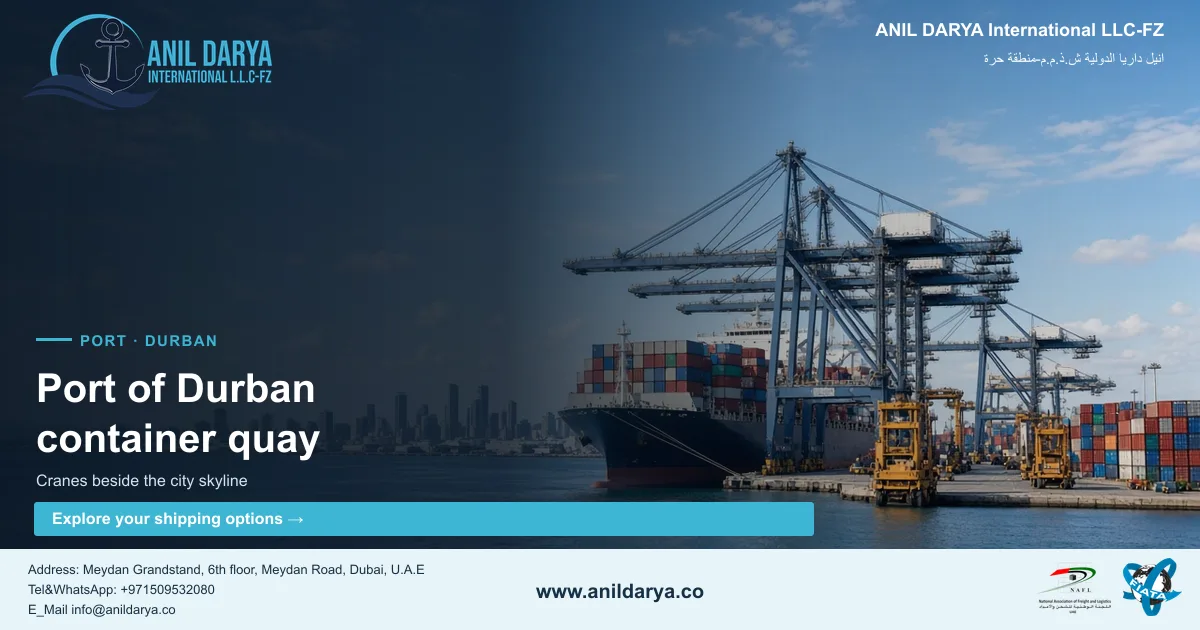
Port of Durban shipping covers most of the container cargo that enters and leaves South Africa, along with vehicles, liquid bulk and breakbulk. Transnet National Ports Authority (TNPA) runs the port as landlord, Transnet Port Terminals and other operators work the terminals, and SARS clears the cargo. This guide covers the terminals, the operator rules that affect your container, customs, and how to ship to Durban from Dubai. We ship both ways: from Dubai to Durban and from Durban to Dubai.
Port of Durban at a glance
| Item | Detail |
|---|---|
| Port authority | Transnet National Ports Authority (TNPA) |
| Main terminal operator | Transnet Port Terminals (TPT); Pier 2 run by a Transnet and ICTSI joint venture since 1 January 2026 |
| Customs authority | South African Revenue Service (SARS) |
| UN/LOCODE | ZADUR |
| Location | Durban, KwaZulu-Natal, on South Africa's east coast |
| Land and water area | 1,854 ha |
| Berths | 58, of which 41 are in operation |
| Containers handled in 2025 | 2,732,190 TEU |
| Cargo handled in 2025 (excluding vehicles) | 40.7 million tonnes |
| Vehicles handled in 2025 | 676,180 units |
| Breakbulk handled in 2025 | 4.5 million tonnes |
| Share of South African container volumes at Durban Container Terminal | 65% |
| Rail link inland | 688 km Container Corridor to Gauteng |
| Cargo types | Containers, vehicles, liquid bulk, dry bulk, breakbulk, project cargo, dangerous goods |
| Shipping from Durban to Dubai | Also handled: arrival at Jebel Ali, Khalifa Port or Sharjah, cleared by UAE customs with 5% duty on most goods and 5% VAT |
Where is the Port of Durban and how does cargo move inland?
The port sits on Durban's natural bay in KwaZulu-Natal. TNPA calls it the busiest port in Sub-Saharan Africa and South Africa's premier container, automotive and liquid bulk port, handling about 3,000 vessel calls a year.
Inland, the Transnet Container Corridor links the port with Gauteng over a 688 km rail network. Trains run to inland terminals at City Deep, Kascon, Pretcon and Kaalfontein. The rest moves by road. Durban Container Terminal introduced a Truck Appointment System in March 2020 to manage truck traffic.
TNPA provides the marine services: vessel traffic control, pilotage with pilots transferred by helicopter, and towage. Tug assistance is compulsory for every commercial vessel, and the Harbour Master decides how many tugs each ship needs.
A simple rule: if your consignee is in Johannesburg or Pretoria, ask for a rail option to City Deep as well as a road quote. If the cargo stays in KwaZulu-Natal, road from the port is the usual answer.
Which terminals does the Port of Durban have?
TNPA splits the 58 berths across six cargo areas. The terminal on your booking decides where your truck or train goes.
| Cargo area | Berths |
|---|---|
| Container precinct | 8 |
| Dry bulk | 10 |
| Breakbulk | 14 |
| Liquid bulk | 8 |
| Automotive | 3 |
| Passenger | 1 |
Pier 1 and Pier 2 at the Durban container terminal
Durban Container Terminal (DCT) opened in July 1977 and works as two terminals, Pier 1 and Pier 2. TPT says DCT handles 65% of South Africa's container volumes and is the only terminal in Africa with tandem lift cranes, carrying 80 tonnes at a time.
Pier 2 moved to a 25-year partnership between Transnet and ICTSI on 1 January 2026, with Transnet holding the majority in the new company and ICTSI operating the terminal. The government expects Pier 2 capacity to rise from 2 million to 2.8 million TEU, and gross crane moves per hour from 18 to 28. The terminal now trades as Durban Gateway Terminal and publishes its own operating procedures. Pier 1 stays with TPT.
Ro-Ro, Maydon Wharf and multipurpose terminals
The Durban Ro-Ro terminal is South Africa's largest. It has seven berths with 12.5 m draft and handles cars, trucks, buses, construction and farm machinery, plus some containers and breakbulk. TPT also runs the Durban Multipurpose Terminal and the Maydon Wharf Multipurpose Terminal for steel, granite, timber, abnormal and project cargo.
What cargo can you ship through the Port of Durban?
| Cargo type | Where it is handled | What to plan |
|---|---|---|
| General goods in containers | DCT Pier 1 or Pier 2 | Which pier your carrier uses, free storage, customs release |
| Chilled and frozen food | Reefer containers at DCT | Set temperature, food import permits |
| Cars, trucks, buses, machinery on wheels | Ro-Ro terminal, automotive berths | ITAC and NRCS rules for vehicles |
| Steel, timber, granite, machinery | Multipurpose and Maydon Wharf terminals | Lifting points, piece list, trailer type |
| Oversized and project cargo | Multipurpose terminals, or flat racks at DCT | Drawings, lift plan, terminal acceptance of out-of-gauge units |
| Fuels and chemicals in bulk | Liquid bulk berths | Receiving tank, surveys |
| Packaged dangerous goods | Containers at DCT | IMDG paperwork, terminal order, arrival notice |
Container shipping at Durban: terminal rules that affect you
Most cargo from Dubai reaches Durban in containers. Choose FCL when you fill a 20ft or 40ft box, and LCL when you share one. With LCL, your goods are released only after the consolidated box is cleared and unpacked, so send documents early. Our guide to FCL vs LCL costs shows where the crossover sits.
The Durban Gateway Terminal operating procedures that took effect on 1 January 2026 set rules that drive your costs at Pier 2:
- Delivery instructions for every import container are due within 72 hours of discharge. Uncleared cargo needs instructions to move in bond.
- Import containers that are not customs cleared, including those stopped by a government department, must leave the terminal as an overstay on the third day of free storage.
- Containers still in the terminal after free storage pay storage at the applicable rate, whatever the reason.
- If instructions are late, the terminal may move the container in bond to a SARS-licensed depot at the customer's risk and cost.
- For exports, stack dates open no more than 120 hours before the vessel's 7-day ETA and close no later than 12 hours before loading starts.
Container weight limits for road delivery
Plan the gross weight before you stuff the box in Dubai. Maersk's South Africa import page sets these maximum gross weights for road haulage, including the container tare:
| Container | Maximum gross for road haulage |
|---|---|
| 20ft dry or reefer (including genset) | 30 tonnes |
| 40ft dry | 31.5 tonnes |
| 40ft reefer (including genset) | 31.5 tonnes |
| 45ft | Not accepted in South Africa |
Other lines publish their own limits, so check the figure on your booking. A box loaded above the road limit has to be partly unpacked or moved on special transport.
The lesson is simple: have the declaration, permits and delivery order ready before the vessel berths. Our article on demurrage and detention explains how line charges add to terminal storage.
Breakbulk, heavy-lift and project cargo at Durban
Durban handled 4.5 million tonnes of breakbulk in 2025. Project cargo goes either on flat racks through the container terminal or as conventional breakbulk through the multipurpose terminals.
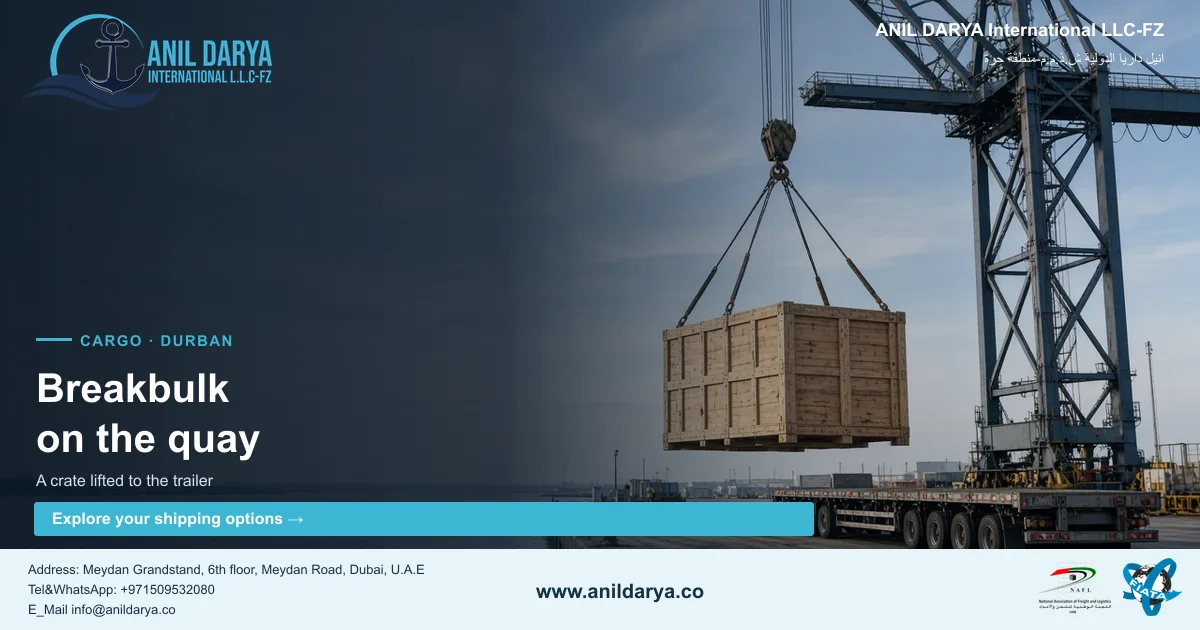
One point catches shippers out. The Pier 2 procedures define out-of-gauge containers as any box where cargo exceeds the container's outside dimensions or cannot be handled by standard equipment, and the terminal may refuse to handle them at its discretion. Confirm acceptance before you book a flat rack into Durban. Our guide to flat rack, open top and out-of-gauge cargo covers the choice between equipment types.
When we plan project cargo for Durban, we work in this order:
- Collect drawings, dimensions, weights and centre of gravity for each piece.
- Choose flat rack on a container service or breakbulk tonnage, based on size and weight.
- Get carrier and terminal acceptance in writing.
- Agree lifting and lashing with the carrier, and plan the road move from the quay with the consignee's transporter.
- Line up the SARS declaration and any permits so the cargo can leave the port quickly.
See our break bulk and project cargo service for what we handle on the UAE side.
Dangerous goods through the Port of Durban
Packaged dangerous goods move in containers under the IMDG Code. The Pier 2 procedures define IMDG cargo by reference to the IMDG Code and the South African standard SANS 10228, and require a Container Terminal Order to deliver or remove hazardous containers.
Under Port Rule 18, the vessel's owner, master or agent must give the Harbour Master at least 72 hours' written notice of arrival, and the notice must list explosives, flammable liquids or other dangerous goods on board. South Africa's Merchant Shipping (Dangerous Goods) Regulations, amended in June 2026, add packaging, labelling and stowage rules.
Some classes have extra rules at Durban. Maersk's import page, which follows the TNPA port guidelines, says:
- Class 1 and Class 4.1 (UN 1944) need police permits and move by direct delivery from the vessel. They are not stacked at the terminal.
- The police permits, DG declaration, Trem cards, stamped Container Terminal Order and transporter details must reach the line 7 days before arrival so it can apply for TNPA acceptance. Late documents mean the units stay on board, at the consignee's cost.
- Customs release is needed 48 hours before arrival for these direct-delivery units.
- Other hazardous classes need a stamped Container Terminal Order and DG declaration, and trucks need an approved cartage booking and harbour carrier permits.
For a DG booking to Durban you need:
- UN number, proper shipping name, class and packing group.
- A Safety Data Sheet for each product.
- A signed Dangerous Goods Declaration.
- UN-approved packaging, labels and container placards.
- Carrier acceptance, and any South African permit the product needs.
Our dangerous goods shipping team checks this before you commit to a sailing.
Customs clearance at the Port of Durban: documents and duty
SARS clears all cargo landed at Durban. Any person, local or foreign, who imports goods must register as an importer, and a foreign importer must nominate a registered agent in South Africa. The importer's agent lodges a goods declaration, and SARS may ask for supporting documents, hold the cargo for another agency or call a physical inspection. Containers stopped by SARS, the police or the NRCS are inspected at a depot, so the clearing agent or a representative should attend.
| Document | Why Durban needs it |
|---|---|
| Commercial invoice and proof of payment | SARS values imports on the FOB price at the port of export |
| Packing list | Weights and marks must match the bill of lading |
| Bill of lading | Its number and date go on the declaration |
| Certificate of origin | SARS lists it among documents it checks |
| ITAC import permit | Needed for all used and second-hand goods |
| NRCS letter of authority | Needed for products under compulsory specifications, such as vehicles |
Import VAT is 15% of the added tax value: the customs value plus 10%, plus any non-rebated duty. Duty depends on the tariff heading. SARS gives 7 days after landing to declare containers, 14 days for loose and break bulk cargo, and 28 days for goods in a container depot. Undeclared goods may go to the State Warehouse.
How to ship from Dubai to Durban, step by step
- Confirm the importer. The consignee needs a SARS customs client number, or the foreign importer needs a registered agent.
- Check the goods. Agree the HS code and check whether ITAC, NRCS or another agency controls the product.
- Get permits before shipping. Restricted goods without their authority are held on arrival.
- Book space from Jebel Ali Port. We book with the carrier and get acceptance first for DG, reefer or out-of-gauge cargo.
- Prepare the documents in Dubai. Invoice, packing list, certificate of origin and the UAE export or re-export declaration, all matching.
- Sail and pre-clear. The consignee's clearing agent prepares the SARS declaration before the vessel reaches Durban.
- Release and deliver. Delivery instructions go to the terminal within 72 hours of discharge, and the container leaves by road or rail.
- Return the empty within the line's free time.
We handle booking, documents and origin trucking and clearance in the UAE through our sea freight service, and work with the consignee's clearing agent in Durban.
[AMIR-FACT: Our real port-to-port transit Jebel Ali to Durban (days) and the carriers or services we actually book into Durban]
How to ship from the Port of Durban to Dubai
We also handle the other direction: shipping from Durban to Dubai, with arrival at Jebel Ali, Khalifa Port or Sharjah port. We book the space with the carrier and run the UAE side. The South African export papers stay with the shipper or its South African agent.
The South African export side
- Exporter registration. SARS says any person, local or foreign, who wants to export goods from South Africa must register as an exporter. A foreign exporter must also nominate a registered agent located in South Africa.
- Export declaration. The exporter or its clearing agent lodges the export declaration with SARS. Exporters who use a licensed clearing agent do not have to register as EDI users themselves.
- Export permits. Some goods are prohibited or restricted for export. SARS says the export permit must be produced at the time of clearance, and ITAC issues permits for restricted goods.
The UAE import side
For cargo cleared in Dubai, the import declaration goes to Dubai Customs with the commercial invoice, packing list, certificate of origin and any permit from the authority that controls restricted goods. The bill of lading is what releases the cargo from the shipping line. Customs duty in Dubai is 5% of the CIF value for most goods, with 50% on alcohol and 100% on cigarettes. Import VAT is 5%, charged on the customs value including freight and insurance. A VAT-registered importer that has registered its customs number with the Federal Tax Authority pays no VAT at the border and accounts for it on its next VAT return.
- Send us the shipper's details in Durban, the cargo, the HS code and the UAE delivery address.
- We book space with the carrier from Durban to Jebel Ali, Khalifa Port or Sharjah and send the booking and cut-offs to the shipper.
- The shipper or its trucker picks up the cargo and delivers the container to the Durban terminal named in the booking before the cut-off.
- The shipper or its South African agent files the export declaration with SARS and gets any export permit.
- We check the draft bill of lading against the invoice and packing list before the line issues it.
- We file the UAE import declaration before the vessel arrives.
- We arrange payment of the duty and VAT and collect the delivery order from the shipping line.
- We truck the container to your site in the UAE.
- We return the empty container to the line's depot within free time.
[AMIR-FACT: the carriers we actually use from Durban to Jebel Ali, Khalifa Port or Sharjah and our real port-to-port transit days in this direction]
Checklist before you ship to Durban
- Consignee registered with SARS, or a registered agent nominated.
- HS code and duty rate confirmed.
- ITAC permit or NRCS letter of authority in hand, if the goods need one.
- Invoice, packing list and bill of lading match on consignee, weights and pieces.
- Delivery plan ready to send to the terminal within 72 hours of discharge.
- Gross weight within the line's road haulage limit for the container size.
- Rail or road option to the final site priced.
- For DG: SDS, DG declaration, packaging, labels, carrier acceptance.
- For out-of-gauge cargo: terminal acceptance confirmed in writing.
- Free time agreed with the line, and cargo insurance in place.
Common mistakes when shipping to Durban
- Overweight containers. A box above the road haulage limit cannot leave the port on a standard truck.
- Arriving without permits. Goods stopped by a government department still count against free storage.
- Late delivery instructions. After 72 hours the terminal can move your box in bond to a depot at your cost.
- Booking out-of-gauge cargo without terminal acceptance. The terminal may refuse it.
- Declaring CIF instead of FOB. SARS values imports on the FOB price.
- Missing the declaration deadline. Goods can end up in the State Warehouse.
- Delivering export boxes outside the stack dates. Early or late arrival can cost extra.
Durban or another South African port: which fits your cargo?
Durban is the default for most containers from the Gulf, but it is not the only choice. TNPA figures for 2025 show how the main container ports compare.
| Port | Containers in 2025 | When to compare it with Durban |
|---|---|---|
| Durban | 2,732,190 TEU | Gauteng and KwaZulu-Natal consignees, vehicles, liquid bulk |
| Cape Town | 843,599 TEU | Western Cape consignees, fresh produce and reefer cargo |
| Ngqura | 747,847 TEU | Eastern Cape sites; 4-berth container terminal at 16 m depth |
| Port Elizabeth | 130,715 TEU | Eastern Cape breakbulk, automotive and smaller container volumes |
The cheaper sea rate is not always the cheaper landed cost. Price the inland leg from each port to the final address before you choose, and check which ports your carrier's service actually calls.
Frequently asked questions
Which company operates the Port of Durban?
Transnet National Ports Authority runs the port as landlord. Transnet Port Terminals operates most terminals, and Pier 2 of the container terminal has been run by a Transnet and ICTSI joint venture since 1 January 2026.
What is the port code for Durban?
The UN/LOCODE for the Port of Durban is ZADUR. It appears on bookings, bills of lading and tracking systems.
How many containers does Durban handle?
TNPA statistics show 2,732,190 TEU at Durban in the 2025 calendar year. TPT says Durban Container Terminal handles 65% of South Africa's container volumes.
How many berths does the Port of Durban have?
TNPA lists 58 berths, 41 of them in operation, split between container, dry bulk, breakbulk, liquid bulk, automotive and passenger areas.
What documents do I need to clear cargo at Durban?
SARS checks the declaration against the commercial invoice, bill of lading, certificate of origin and any permits. Used goods need an ITAC permit, and regulated products need an NRCS letter of authority.
How long can an uncleared container stay at Durban?
Under the Pier 2 operating procedures, import containers that are not customs cleared must leave the terminal as an overstay on the third day of free storage. Storage charges apply after free storage ends.
Can I ship dangerous goods to Durban?
Yes, in containers under the IMDG Code. The vessel must declare DG on board in its arrival notice at least 72 hours ahead, hazardous containers need a Container Terminal Order, and Class 1 and Class 4.1 (UN 1944) also need police permits and direct delivery from the vessel.
How does cargo get from Durban to Johannesburg?
By road or by rail on the 688 km Container Corridor to Gauteng inland terminals such as City Deep. Ask for both options when you book.
How do I ship from Dubai to Durban?
Your consignee needs a SARS customs client number and any ITAC or NRCS permit for the product. We book space from Jebel Ali, prepare the UAE documents and export declaration, and the consignee's clearing agent clears the cargo with SARS in Durban.
How do I ship from Durban to Dubai?
The shipper must be registered with SARS as an exporter, and it or its clearing agent files the export declaration. We book the space to Jebel Ali, Khalifa Port or Sharjah, file the UAE import declaration and arrange payment of the 5% duty (on the CIF value of most goods) and the 5% import VAT.
Get a quote for shipping to the Port of Durban
Send us the cargo details and the delivery address in South Africa, and we will come back with a routing and price into Durban. Use our freight rate inquiry form, or contact our team to talk through project or DG cargo first. You can also read more about our Dubai freight forwarding team.
Sources
- Transnet National Ports Authority: Port of Durban (berths, area, cargo, marine services)
- Transnet National Ports Authority: Port statistics, 2025 calendar year (TEU, cargo, vehicles, breakbulk)
- Transnet Port Terminals: Durban terminals (DCT, Ro-Ro, Maydon Wharf)
- Transnet Port Terminals: Container services (DCT Pier 1)
- Transnet Port Terminals: Break-bulk services
- Transnet Port Terminals: Overview
- Transnet Freight Rail: Container Corridor
- SAnews: Partnership seeks to improve DCT Pier 2 operational efficiency (December 2025)
- Durban Gateway Terminal: Standard operating procedures from 1 January 2026
- Maersk: South Africa imports (weight limits, Durban DG requirements, customs-stopped containers)
- National Ports Act, Port Rules: Rule 18 notice of arrival
- Acts Online: Merchant Shipping (Dangerous Goods) Regulations amended (June 2026)
- SARS: Imports (clearance, documents, deadlines)
- SARS: Importer registration
- SARS: Duties and taxes for importers
- SARS SC-CR-A-03: Valuation of Imports (FOB basis)
- ITAC: Import control
- NRCS: Imports and exports (letters of authority)
- Wikipedia: Port of Durban (UN/LOCODE)
- SARS: What is an exporter? (exporter registration, foreign exporters and registered agents)
- SARS: Exports (export declarations, export permits)
- Dubai Customs: Submit customs declaration (invoice, packing list, certificate of origin, permits)
- UAE Government portal: Clearing customs and paying customs duty (5% of CIF, alcohol 50%, cigarettes 100%)
- Federal Tax Authority: VAT (5% rate)
- Federal Tax Authority: VAT guide, section 3.5 on VAT on imports (5%, deferral for VAT-registered importers)
Reviewed: 10 November 2026