
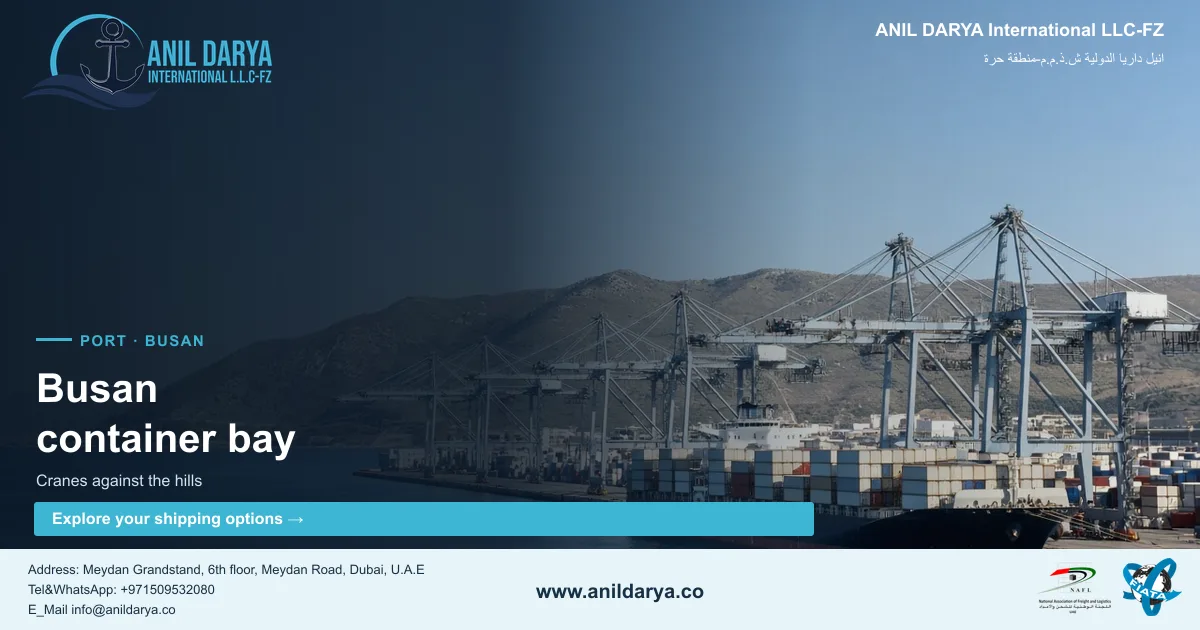
Port of Busan shipping covers most of the containers that enter and leave South Korea. The port is run by the Busan Port Authority (BPA), has two container hubs, the older North Port and the deep-water New Port, and links to 500 ports in 100 countries. This guide covers the terminals, cargo types, Korean customs and duty, and how we move your cargo from Dubai to Busan, step by step. We ship both ways: from Dubai to Busan, and from Busan to Dubai with clearance on arrival in the UAE.
Port of Busan shipping: key facts at a glance
| Item | Detail |
|---|---|
| Port authority | Busan Port Authority (BPA) |
| Customs authority | Korea Customs Service (KCS), declarations through UNI-PASS |
| UN/LOCODE | KRPUS |
| Opened | 1876 |
| Location | South-east coast, about 330 km south-south-east of Seoul; New Port about 25 km west of the city |
| Container areas | North Port (city side) and Busan New Port (Gangseo-gu and Jinhae-gu) |
| Containers handled in 2024 | About 24.4 million TEU, a record year |
| Total quay length | 30,709 m |
| Berthing capacity | 201 ships, including passenger and oil terminals |
| Water depth | 15 to 17 m across the port; more than 17 m at New Port |
| Tidal range | 1.3 m |
| Container yard area | 3,469,000 m², plus 261,000 m² of open storage |
| New Port berths | 23 container berths in operation; 45 planned (40 container, 5 general) |
| Shipping network | 500 ports in 100 countries |
| Carriers often linked to the port | HMM, SM Line, ONE, Maersk, MSC, SITC, KMTC |
| Import dwell time (February 2026) | 4.4 days on average |
| Import VAT | 10% on customs value plus duty |
| Trade agreement with UAE | UAE-Korea CEPA, in force since 1 May 2026 |
| Busan to Dubai (import) | Korean export declaration by the exporter or its broker; Dubai Customs declaration, 5% duty on CIF for most goods unless CEPA origin applies, 5% import VAT |
Where is the Port of Busan and what does it handle?
The Port of Busan is on the south-east coast of Korea. It opened in 1876, and pier construction began in 1906. Today it has two container areas run under the BPA, plus general cargo and passenger piers.
BPA positions Busan as a Northeast Asian transshipment hub. In a 2019 interview, the authority reported 11.43 million TEU of transshipment boxes, 53% of its throughput that year, and more than half of the port's box volume is still transshipment. Busan also handled 23.8 million tonnes of non-container cargo in 2022, according to BPA figures quoted by Beacon.
Weekly figures published by Cogoport for mid-February 2026 show the mix: about 452,000 TEU in one week, of which 147,000 TEU were imports, 195,000 TEU exports and 110,000 TEU transshipment. Average dwell time in February 2026 was 4.4 days for imports and 6.9 days for exports. Pilotage is compulsory for ships entering the port.
To attract transshipment cargo, BPA exempts transshipment boxes from port entrance fees and pays incentives to shipping lines that tranship more than 5,000 TEU a year.
Which terminals does Busan port have?
Your carrier's service decides the terminal. Check the berth on the arrival notice before the consignee books a truck, because North Port and New Port are separate sites.
North Port container terminals
North Port is the original harbour next to the city centre. BPA lists these container terminals there:
| Terminal | Opened | Quay length | Depth | Capacity | Quay cranes |
|---|---|---|---|---|---|
| Jaseongdae | 1978 | 1,447 m | 15 m | 1,720,000 TEU | 14 |
| Sinseondae | 1991 | 1,500 m | 15-16 m | 2,230,000 TEU | 17 |
| Gamman | 1998 | 1,400 m | 15 m | 1,600,000 TEU | 9 |
| Singamman | 2002 | 826 m | 15 m | 820,000 TEU | 7 |
| Pier 7 (TOC) | 1978 | 674 m | 7.5-11 m | 2,720,000 revenue tonnes | 2 |
Jaseongdae and Sinseondae have rail tracks of 900 m and 925 m inside the terminal, and all four main terminals have container freight station (CFS) space for LCL. North Port is also going through a large redevelopment of its old pier area.
Busan New Port
Busan New Port was built from 1995 on the coast west of the city, around Gadeokdo in Gangseo-gu and Angol-dong and Yongwon-dong in Jinhae-gu. BPA says it operates 23 container berths, with 45 planned in total. It was designed for the largest container ships, with more than 17 m of water depth, and its cranes can lift two 40ft containers at once.
New Port is split into north, south and west container terminals run by different operators, with six major container terminals of more than 2 million TEU a year each. The newest, Busan Container Terminal (BCT), is automated and opened in 2022. Two examples from the operators' own sites:
| Terminal | Location | Key figures |
|---|---|---|
| BNCT | Gangseo-gu | 4 berths, 1,400 m quay, 16-17 m depth, over 3 million TEU a year, 840,000 m² site, on-terminal rail yard of 99,000 m² |
| Hanjin Busan Newport (HJNC) | Angol-dong, Jinhae-gu | Container terminal in the New Port area; berth figures not published on its home page |
A simple rule: if your consignee is in Busan city, ask whether the terminal is North Port or New Port before you agree a delivery price.
General cargo piers
Outside the container terminals, Gamcheon Port is a multi-purpose terminal for coastal and freight cargo, including steel materials, cement and sand. South Port is the country's largest base for the fishery industry and handles 30% of Korea's commissioned fishery sales. New Port's plan also includes general and multi-purpose berths.
What cargo can you ship through Busan?
| Cargo type | How it moves | What to plan |
|---|---|---|
| General goods | FCL or LCL through North Port or New Port | Terminal on the arrival notice, free time, truck or rail |
| Chilled and frozen food | Reefer containers | Set temperature, quarantine and food checks, Korean labels |
| Machinery, steel, equipment | Flat rack, open top or breakbulk | Lifting points, lashing, receiving site |
| Steel, cement and coastal cargo | General cargo piers such as Gamcheon | Discharge plan and storage |
| Chemicals and other DG | IMDG containers | Carrier and terminal acceptance before booking |
| Electronics and consumer goods | FCL, LCL or air | KC certification and origin marking |
Shipping from Dubai to Busan: FCL, LCL and transit
Containers to Busan from the UAE normally load at Jebel Ali, which DP World says has over 80 weekly services. Our Jebel Ali port shipping guide covers export cut-offs and terminals on the Dubai side.
FCL makes sense once your cargo fills about half a 20ft container. Below that, LCL is usually cheaper, but it goes through a CFS at both ends and adds a few days. Our guide to FCL vs LCL costs shows how to find the break-even point.
| Source | Routing | Published port-to-port time |
|---|---|---|
| Shipa Freight (2021 guide) | Jebel Ali to Busan, FCL | About 24 days |
| Fluent Cargo schedule data | Khor Fakkan to Busan, quickest listed service | 20 days 7 hours, sailings every 1-2 weeks |
| Fluent Cargo schedule data | Fujairah to Busan, most frequent listed service | 27 days 20 hours, with a transfer |
| Fluent Cargo schedule data | Jebel Ali to Busan, listed services | 37 days, with a transfer, every 2-4 weeks |
These are published indications only. Direct and transhipment services can differ by a week or more.
[AMIR-FACT: our real port-to-port transit time Jebel Ali to Busan and the carriers we usually book on this lane]
Breakbulk, project cargo and dangerous goods at Busan
Breakbulk and project cargo
Pieces that fit a container frame move on flat racks or open tops through the container terminals. Larger units go as breakbulk, and Busan's general piers handle steel and other conventional cargo. The port has 261,000 m² of open storage and four landing piers.
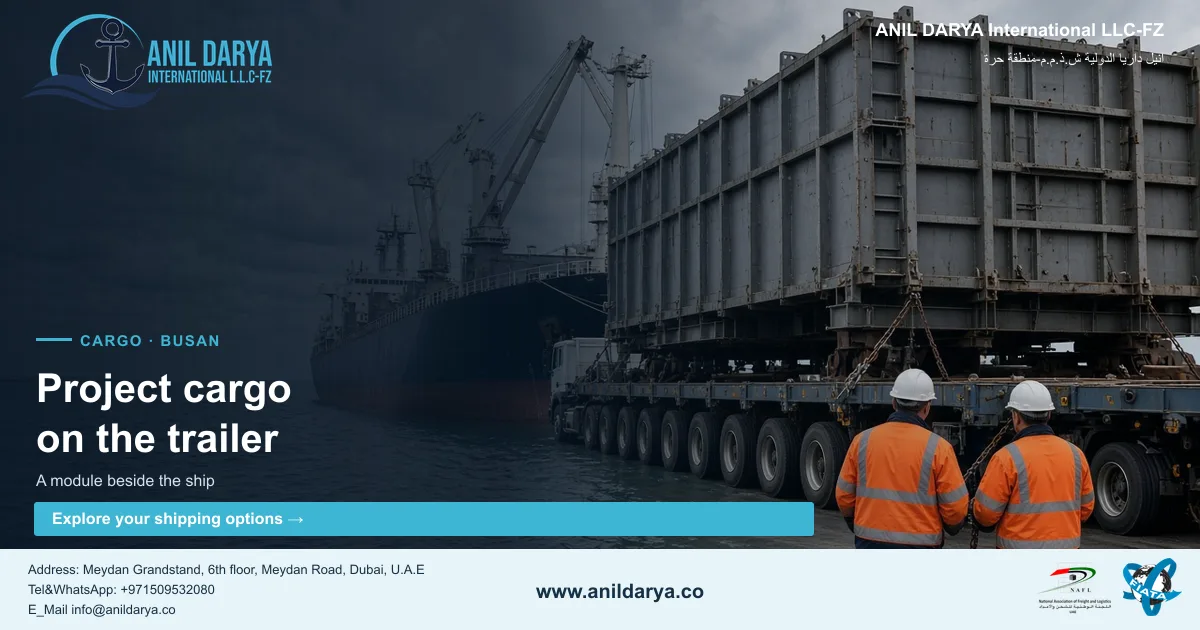
When we plan project cargo from Dubai to Busan, we follow this order:
- Collect drawings, dimensions, weights and centre of gravity for each piece.
- Choose flat rack on a container service, or breakbulk or heavy-lift tonnage.
- Agree lifting, lashing and securing with the carrier.
- Confirm the Korean consignee's receiving plan, trucking and any road permits.
- Prepare the import declaration early so the cargo leaves the quay quickly.
See our break bulk and project cargo service for what we cover on the Dubai side.
Dangerous goods
Dangerous goods to Busan move under the IMDG Code at sea. Once landed, DG containers stored at Korean port terminals also fall under the domestic Hazardous Materials Safety Management Act, which sets storage and handling rules, including outdoor storage at ports. If the terminal will not store your class in the yard, plan for direct delivery from the ship. Carriers and terminals accept DG by class and UN number, so we confirm acceptance and any direct-delivery rule for each booking before you commit. You need a correct UN number and proper shipping name, a Safety Data Sheet, a signed DG declaration, UN-approved packaging and the right labels and placards. Our dangerous goods shipping team checks all of this before sailing.
Customs clearance at Busan: documents, duty and VAT
Cargo landed at Busan goes into a bonded area first. A customs broker or the owner of the goods then files the import declaration through UNI-PASS. The declaration is normally prepared in Korean, so the consignee's broker usually handles it.
When to declare
KCS lets you declare before arrival, before the goods enter a bonded area, or after storage there. Goods declared before arrival are treated as having arrived, which speeds release. If the goods sit in a bonded warehouse, the Customs Act gives you 30 days to declare. For some goods customs may add an extra duty of up to 2% of the customs value after that.
Which documents does Korean customs need?
KCS lists the import declaration plus an invoice, packing list, bill of lading, certificate of origin and any inspection or quarantine certificate. Under Article 226 of the Customs Act, customs also checks any permit, approval or label that another Korean law requires.
| Cargo type | Core documents | Usually also needed |
|---|---|---|
| General cargo | Invoice, packing list, bill of lading, certificate of origin | Country-of-origin marking on the goods at clearance |
| UAE-origin goods under CEPA | Core set | Proof of origin under the CEPA rules |
| Food and agricultural goods | Core set | Quarantine or inspection certificate, Korean labels |
| Electrical and industrial products | Core set | KC certification where required |
| Medical devices and pharmaceuticals | Core set | MFDS registration and a licensed importer |
| Dangerous goods | Core set | DG declaration, Safety Data Sheet, product approvals |

How much duty and VAT will you pay?
Korea charges duty on the CIF value, at the rate for your HS code. Import VAT is a flat 10% on the customs value plus duty, and certain luxury and durable goods also pay a special excise tax of 10-20%. Duty and taxes are paid in Korean won within 15 days of acceptance of the duty payment declaration.
The UAE-Korea CEPA entered into force on 1 May 2026 and covers about 91.2% of tariff lines, with some cuts phased in over up to 10 years. It applies only to goods that meet the UAE rules of origin: a change in tariff classification, or at least 40% value content on the FOB price for manufactured goods. Goods simply re-exported through Dubai pay the normal rate.
Inspection and release
Customs picks goods for inspection by risk analysis. The owner of the goods pays the inspection cost. Once the declaration is accepted and duty is paid or secured, the goods leave the bonded area. Missing origin marks or approvals can hold the release.
How to ship to Busan port from Dubai: step by step
This is how we handle a typical shipment from the UAE to Busan. We book the space and handle the UAE side. Your consignee's broker clears the goods in Korea.
- Tell us about the cargo. Commodity, HS code, weight, volume or dimensions, pickup point in the UAE and the Incoterm.
- Confirm Korean requirements. Ask your buyer or their broker about KC, MFDS, quarantine and labelling before you ship.
- Get a quote and pick the routing. We compare carriers from Jebel Ali and other UAE ports to Busan, and confirm North Port or New Port.
- Book space. For DG, reefer or out-of-gauge cargo we get carrier acceptance first.
- Pick up, stuff and clear export. We arrange trucking, stuffing and the UAE export or re-export declaration.
- Check the bill of lading. We send you the draft so names, weights and HS codes match the invoice.
- Pre-file in Korea. The consignee's broker prepares the UNI-PASS declaration before the vessel berths.
- Pay, release and deliver. Duty and VAT are paid, the goods leave the bonded area and the consignee's trucker delivers.
We do not have an office in Korea. We work with your consignee or the Korean customs broker they appoint.
How to ship from Busan to Dubai
We also handle the other direction: shipping from Busan to Dubai, with arrival at Jebel Ali, Khalifa Port or Sharjah port. We book the space with the carrier and run the UAE side. The Korean export papers stay with the shipper or its Korean agent.
The South Korea export side
- Declaration. The exporter files the export declaration with the head of the customs house that controls the place where the goods are stored. Customs reviews it or inspects the cargo, and clears low-risk goods quickly.
- Loading deadline. Goods must be loaded within 30 days of acceptance of the export declaration. The period can be extended by up to a year.
- Used cars and machinery. The registration must be cancelled first, and used cars are declared after they enter the bonded area. Stolen or still-registered used cars cannot be exported.
- Controlled goods. Items under laws such as the Narcotics Control Act, the Wildlife Protection and Management Act and the Nuclear Safety Act need approval from the competent authority before export.
The UAE import side
On arrival, the declaration goes to Dubai Customs with the commercial invoice, packing list, bill of lading, certificate of origin and any permit for restricted goods. The importer needs a Dubai Customs business code, or a licensed clearing agent with the owner's authorisation files for it. Customs duty in Dubai is 5% of the CIF value for most goods, with 50% on alcohol and 100% on cigarettes. Import VAT is 5%, charged on the customs value including freight and insurance. A VAT-registered importer that has linked its customs registration number with the Federal Tax Authority accounts for it on its VAT return instead of paying at the border.
Korean goods can pay less. The UAE-Korea CEPA has been in force since 1 May 2026 and removes duty on more than 90% of tariffs over up to 10 years. Goods qualify when they meet the rules of origin, for manufactured goods a change of tariff classification or at least 40% value content of the FOB price, so ask the shipper for the CEPA certificate of origin.
- Send us the shipper's details in Korea, the cargo, the HS code and the UAE delivery address.
- We book space from Busan, confirm North Port or New Port, and send the booking and cut-off to the shipper.
- The shipper or its trucker delivers the stuffed box to the terminal before the cut-off.
- The shipper or its Korean broker files the export declaration and gets the CEPA certificate of origin if the goods qualify.
- We check the draft bill of lading against the invoice and the certificate of origin.
- We file the UAE declaration before the vessel arrives.
- We arrange payment of the duty and VAT and collect the delivery order.
- We truck the cargo to your site in the UAE.
- We return the empty container inside the carrier's free time.
[AMIR-FACT: the carriers we actually use from Busan to Jebel Ali/Khalifa/Sharjah and our real transit days in this direction]
Checklist before you ship to Busan
- HS code confirmed with the Korean importer or broker.
- Invoice, packing list and bill of lading match on weights, pieces and consignee.
- Country-of-origin marking on the goods.
- Certificate of origin issued, and CEPA origin checked if you claim the preferential rate.
- KC, MFDS, quarantine or other approvals ready before sailing.
- Terminal confirmed: North Port or New Port.
- For DG: SDS, DG declaration, packaging, labels and carrier acceptance.
- Free time at Busan agreed with the carrier.
Common mistakes on Busan shipments
- Pricing delivery without knowing the terminal. North Port and New Port are separate sites, and the truck leg changes.
- Claiming CEPA on non-UAE goods. Re-exported goods pay the normal rate, and a wrong claim leads to duty and penalties later.
- Missing origin marks. Korea requires origin labelling on commercial goods at clearance.
- Late approvals. A KC or MFDS approval applied for after arrival keeps the box in the bonded area.
- Leaving goods in bonded storage past 30 days, which can add an extra duty of up to 2% of customs value.
- Ignoring free time. Demurrage starts once free days run out. Our article on demurrage and detention explains the charges.
Busan or another Korean port: which fits your cargo?
Busan is the default for most containers from the UAE. Other ports can make sense in some cases:
| Your situation | Port to compare | Why |
|---|---|---|
| Consignee in Busan, Ulsan, Changwon or the south-east | Busan | Largest service network and short inland leg |
| Consignee in Seoul, Incheon or Gyeonggi | Incheon (KRINC), Korea's second-largest seaport | Closer to the capital area, but fewer deep-sea calls |
| Steel, petrochemical plants in South Jeolla | Gwangyang, about 125 km south-west of Busan | Deep-water port near heavy industry |
| Cargo needing the most sailing choice | Busan | Most mainline and transshipment services |
A port with fewer direct services can mean a transhipment and a longer transit, even if the truck leg is shorter. We can price more than one port so you can compare the total cost to the door.
Frequently asked questions
Who manages the port in Busan?
The Busan Port Authority manages the port. Individual container terminals at North Port and New Port are run by terminal operating companies, such as BNCT and Hanjin Busan Newport at New Port.
What is the port code for Busan?
The UN/LOCODE for Busan is KRPUS. You will see it on bookings, bills of lading and tracking systems.
How many containers does Busan handle?
Busan handled about 24.4 million TEU in 2024, its busiest year on record. It links to about 500 ports in 100 countries.
What is the difference between Busan North Port and New Port?
North Port is the original harbour by the city, with terminals such as Jaseongdae and Sinseondae at 15 to 16 m depth. New Port, west of the city, has 23 container berths with more than 17 m of depth for the largest ships.
How long does shipping from Dubai to Busan take?
Published indications are about 24 days FCL from Jebel Ali (Shipa Freight) and about 20 days on the quickest listed service from Khor Fakkan (Fluent Cargo). Add time for clearance at both ends.
What is the import VAT in Korea?
Korea charges a flat 10% VAT on imports, calculated on the customs value plus duty. Duty and VAT are due within 15 days of acceptance of the duty payment declaration.
Does the UAE-Korea CEPA lower duty on goods shipped to Busan?
Yes, for goods of UAE origin. The CEPA has been in force since 1 May 2026 and covers about 91.2% of tariff lines, with some cuts phased in over up to 10 years.
Can you handle shipping from Busan to Dubai?
Yes. We book the space with the carrier, the shipper or its Korean broker files the export declaration, and we clear the cargo through Dubai Customs and deliver it in the UAE. Most goods pay 5% duty on the CIF value plus 5% import VAT, and Korean-origin goods may pay less under the CEPA.
Can I ship dangerous goods to Busan?
Yes, under the IMDG Code and with carrier and terminal acceptance. Classification, packaging, labels and a signed DG declaration must be in order before booking.
Get a quote for Port of Busan shipping
Send us your cargo details and we will come back with a routing and a price from the UAE to Busan. Use our freight rate inquiry form, or contact our team to discuss a breakbulk, project or DG shipment. You can also read more about our Dubai freight forwarding team.
Sources
- Busan Port Authority: Busan Port overview (history, network, transshipment incentives)
- Busan Port Authority: Port facilities, overall status
- Busan Port Authority: Busan North Port terminals
- Busan Port Authority: Busan New Port development overview
- Busan Port Authority: Busan New Port development plan
- Busan Port Authority: General piers
- Busan Port Authority: English home page (23 New Port berths, 2019 transshipment figures)
- BNCT: Terminal facilities
- Hanjin Busan Newport (HJNC)
- Wikipedia: Port of Busan (2024 throughput, UN/LOCODE)
- Korea Customs Service: Export-import clearance
- Korea Customs Service: Export clearance (customs house, 30-day loading, used cars, controlled goods)
- Korea Customs Service: Tax payment reporting
- Korea Legislation Research Institute: Customs Act, English translation (Articles 226 and 241)
- Invest Korea: Customs clearance procedures
- US International Trade Administration: Korea import tariffs
- US International Trade Administration: Korea labelling and marking requirements
- US International Trade Administration: Korea import requirements and documentation
- UAE Ministry of Economy and Tourism: UAE-Korea CEPA
- Dubai Customs: Submit customs declaration (documents)
- Dubai Customs: FAQ (5% of CIF, business code, clearing agents)
- UAE Government portal: Customs duty (5% of CIF, alcohol 50%, cigarettes 100%)
- Federal Tax Authority: VAT guide (import VAT at 5%, deferral for registered importers)
- Shipa Freight: UAE to Korea shipping guide
- Fluent Cargo: UAE to South Korea schedule data
- Parcels: Port of Busan (KRPUS) sea cargo guide (carriers, transshipment share)
- Cogoport: Port of Busan profile (weekly volumes, dwell times, pilotage)
- Beacon: Largest cargo ports in South Korea (2022 non-container cargo)
- Findaport: Port of Busan (location, New Port distance)
- Port Economics, Management and Policy: Intra-port competition in Busan New Port
- Lee et al. (2020): Dangerous goods safety management in maritime terminals, Journal of the Korean Society of Industry Convergence
- Fluent Cargo: Dubai to Busan schedule data
- DP World: Jebel Ali Port
Reviewed: 10 November 2026