
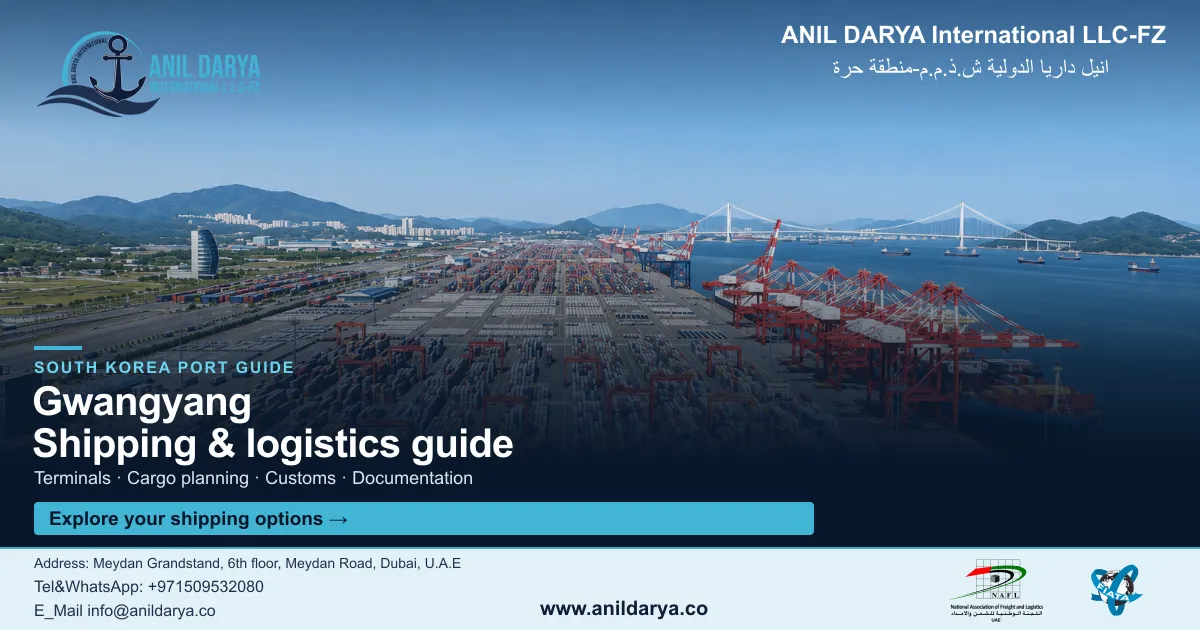
Gwangyang port shipping covers containers, steel, raw materials and petrochemicals moving through Korea's south coast. Gwangyang is Korea's second port by total cargo and third by containers, with about 2.01 million TEU in 2024, and it sits next to one of the largest steel works in the world. This guide covers the terminals, ship size limits, cargo types, a short customs summary and how we move your cargo from Dubai to Gwangyang. We ship both from Dubai to Gwangyang and from Gwangyang to Dubai.
Gwangyang port shipping: key facts at a glance
| Item | Detail |
|---|---|
| Port authority | Yeosu Gwangyang Port Authority (YGPA) |
| Customs | Korea Customs Service (KCS) |
| UN/LOCODE | KRKAN (older spelling: Kwangyang) |
| Location | Gwangyang Bay, South Jeolla Province, on Korea's south coast; north of Yeosu |
| Opened | 5 December 1986 |
| Rank in Korea (2024) | Second for total cargo, third for containers after Busan and Incheon |
| Container volume | 2.01 million TEU in 2024, up 7.8% on 2023 |
| Total cargo capacity | More than 200 million tons a year |
| Berths (whole port) | 97 |
| Ship calls | About 43,000 a year, an average of 118 a day |
| Container terminal operators | Korea International Terminals (KIT, also called Hutchison Ports Gwangyang) and Gwangyang West Container Terminal (GWCT) |
| Container berth depth | 16 m |
| Nearest airports | Yeosu (RSU) about 10 km; Gimhae (PUS) about 150 km |
| Import VAT | 10% on customs value plus duty |
| Trade agreement with UAE | UAE-Korea CEPA, in force since 1 May 2026 |
| Shipping to Dubai | We also ship from Gwangyang to Jebel Ali, Khalifa Port or Sharjah. Dubai duty is 5% of CIF for most goods, plus 5% import VAT |
Where is Gwangyang port and what makes it different?
Gwangyang Port sits at the head of Gwangyang Bay in South Jeolla Province, on Korea's south coast. The port opened on 5 December 1986. The island of Myodo divides the port in two, and it also shelters the container berths, so one port database says cargo work runs about 360 days a year.
Gwangyang is not a city port like Busan. It is an industrial port. POSCO's Gwangyang Steel Works sits on the bay, and the Yeosu petrochemical complex lies on the southern side. Most of the tonnage that crosses the quays is steel, iron ore, coal, crude oil and chemicals. Containers are a smaller but growing share.
| Port area | Main cargo | What it means for you |
|---|---|---|
| Gwangyang region, north of Myodo | Steel coil exports; ore, coal and limestone imports | Steel products for Gulf buyers often load here |
| Yeosu region, south of Myodo | Petrochemicals, fertilisers, crude oil, LNG and LPG | Liquid bulk and chemical tankers berth here |
| Container terminals | Import, export and some transshipment boxes | Where your FCL or LCL cargo lands |
The tide is mild compared with Korea's west coast. A port entry guide gives a mean range of 2.8 m, against up to about 10 m at Incheon. That means no lock gates and no tide-window berthing for normal container calls.
Which container terminals does Gwangyang have?
Two companies run the container terminals today. YGPA merged two smaller terminal operators into one integrated company, GWCT, in November 2020, cutting the number of operators from three to two. The other operator is Korea International Terminals (KIT), which Hutchison Ports markets as Hutchison Ports Gwangyang. The two terminals share an internal gate so shuttle boxes can move between them.
Your carrier's service decides the terminal. CMA CGM's newest call, for example, uses KIT. Check the terminal on your arrival notice before you book a truck.
Container terminal facts
| Item | Figure | Source type |
|---|---|---|
| Water depth at container berths | 16 m | Port database and port guide |
| Total berthing length | 4,400 m | Port database |
| Container cranes | 25 (over 30 in a later guide) | Port database; import guide |
| Handling capacity | 4.6 million TEU | Port database |
| Yard space | More than 123,000 TEU | Import guide |
| Largest container ships | Over 10,000 TEU; 13,000 TEU-class ships now call weekly | Import guide; YGPA news |
| Yard system | 100% on-dock, automated gate | Port database and import guide |
The figures come from secondary port databases, not a terminal operator page we could open, so treat them as planning numbers. On-dock means the container yard is inside the terminal, so there is no separate off-dock depot move before customs.
The automated Phase 3-2 terminal
YGPA broke ground on a fully automated container terminal in July 2026. It will have 4 berths on a 1,300 m quay and 770,000 square metres of land. Three berths take 4,000 TEU ships and one takes 2,000 TEU ships. The plan lists 8 container cranes, 32 automated rail-mounted gantry cranes and 44 automated guided vehicles, with a target capacity of 1.36 million TEU a year. Opening is targeted for 2029, and YGPA is still selecting an operator. Until then, nothing changes for your bookings.
What cargo can you ship through Gwangyang?
Gwangyang handles almost every cargo type. One port database lists these largest ship sizes by cargo type.
| Cargo type | Largest ship listed | Depth |
|---|---|---|
| Breakbulk | 50,000 DWT | 15.0 m |
| Containers | 50,000 DWT | 16.0 m |
| Ro-Ro | 50,000 DWT | 16.0 m |
| Dry bulk | 350,000 DWT | 23.5 m |
| Tankers | 320,000 DWT | 23.5 m |
| Gas carriers | 82,200 DWT | 14.0 m |
A port entry guide gives a container ship limit of 350 m length, 50 m beam and 18.5 m draught at spring tide, and says ships over 300 m may not enter or leave at night. Pilotage is compulsory for ships over 500 GT. These limits matter for charters, not normal container bookings.
Here is how each cargo type usually moves between the UAE and Gwangyang.
| Cargo | Direction | How it can move |
|---|---|---|
| Hot and cold rolled steel coils, plates | Gwangyang to the Gulf | Breakbulk on general cargo ships, or containers for smaller lots |
| Petrochemicals and polymers | Both ways | Bagged resin in containers; liquids in ISO tanks or on tankers |
| Machinery and spare parts | UAE to Gwangyang | FCL, LCL, or flat racks for oversize pieces |
| Scrap metal and raw materials | UAE to Gwangyang | Containers or bulk ships |
| Chemicals (DG) | Both ways | IMDG containers with carrier acceptance on every leg |
| LNG and LPG | To Gwangyang | Gas carriers at dedicated berths, not a forwarding job |
The port is growing on the energy side too. POSCO International completed an LNG terminal at Gwangyang in July 2024, with six tanks holding 930,000 cubic metres in total.
Shipping from Dubai to Gwangyang: FCL, LCL and transit
Gwangyang has fewer deep-sea services than Busan. YGPA itself has said customers complained about few regular sailings and limited long-haul services, and it has spent the last two years attracting new ones. We found no published direct service from Jebel Ali to Gwangyang. Most UAE cargo moves on a mainline ship to a hub, then on a feeder or a second mainline into Gwangyang.
Two newer services show where the connections are.
| Service | Started | Rotation | Ships |
|---|---|---|---|
| Maersk AE15 / Hapag-Lloyd SE3 (Gemini) | September 2025 | Gwangyang, Ningbo, Tanjung Pelepas, Port Said, Canakkale, Izmit, Ambarli, back via Port Said, Singapore and Qingdao | 15 ships of the 13,000 TEU class |
| CMA CGM PEARL AS1 | First call 21 April 2026 | Gwangyang, Qingdao, Shanghai, Ningbo, Shekou, Singapore, Nhava Sheva, Mundra, Karachi, Colombo, Singapore, Haiphong, Xiamen, Nansha, Yantian, Los Angeles | Weekly, 8,000 TEU class |
Neither calls Jebel Ali. Both link Gwangyang with Singapore and Tanjung Pelepas, which are common transshipment hubs on the Gulf to Far East trade. YGPA expects the CMA CGM service alone to add about 100,000 TEU a year.
Carrier capacity tracked at Gwangyang in March 2026 was led by Maersk with 36.6%, then HMM with 29.1% and CMA CGM with 14.1%. MSC had 3.7%, Namsung 2.3%, and Sinokor and KMTC 1.1% each. If your shipper or buyer prefers one carrier, check it has a Gwangyang call.
[AMIR-FACT: our real transit time from Jebel Ali to Gwangyang, the hub we usually tranship through, and the carriers we book on this lane]
For small loads, ask whether the LCL consolidator runs a box direct to Gwangyang or sends it to Busan with a truck or feeder leg after that. Each extra handling adds time and risk. Compare it with FCL once you pass about half a 20-foot container. Our guide to FCL vs LCL explains the break-even, and our sea freight service books both.
Dwell time is worth planning for. Import boxes stayed an average of 9.1 days at Gwangyang in February 2026 and exports 10.5 days, against 7.0 and 11.0 days in December 2025. Long dwell eats into free time, so line up clearance early.
Breakbulk, project cargo and dangerous goods at Gwangyang
Breakbulk and project cargo
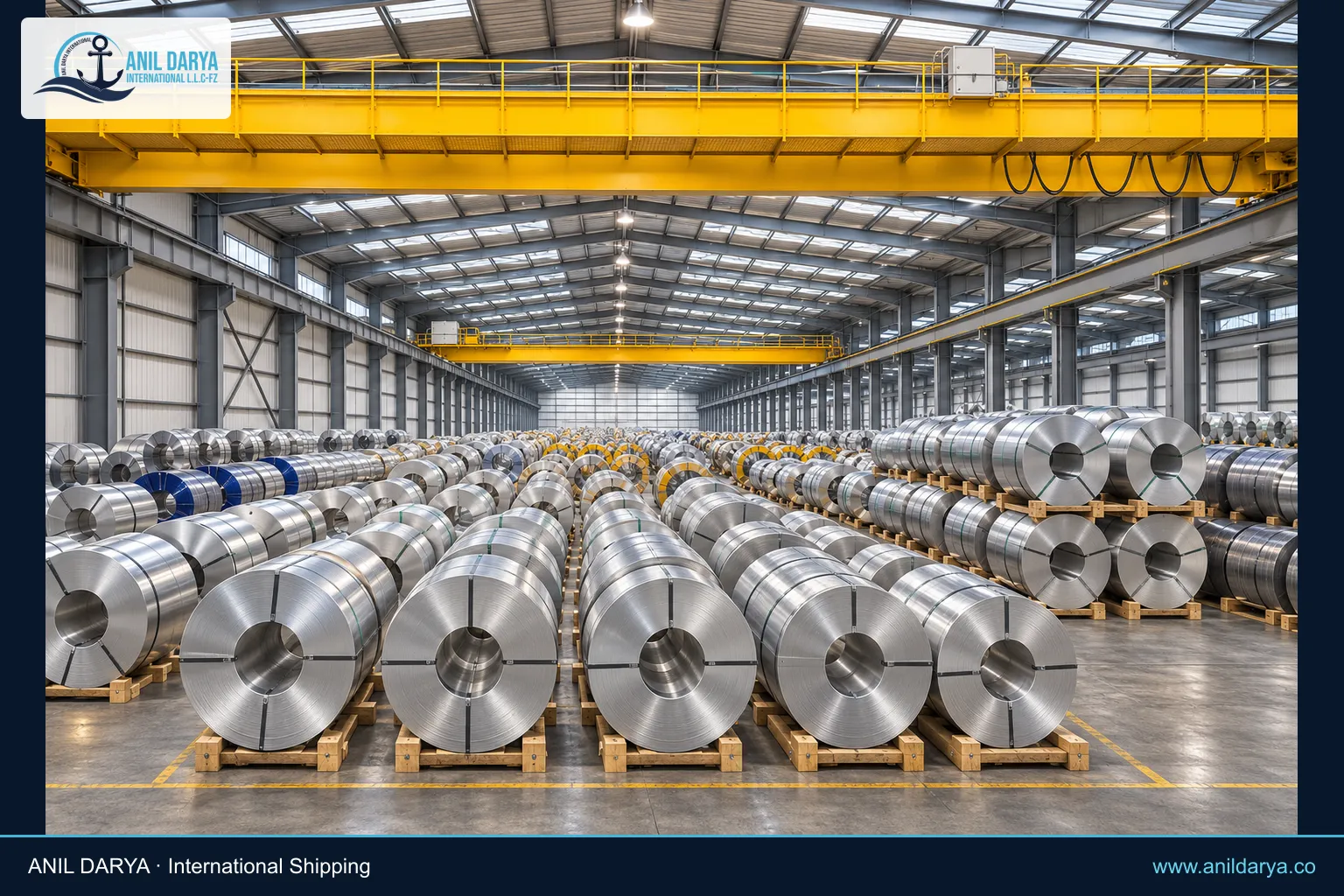
Gwangyang is a natural port for steel and heavy cargo. Breakbulk ships up to 50,000 DWT can use berths with 15 m of water, and bulk berths take much larger ships. Steel coils are the main export from the Gwangyang side of the port, and they can move as breakbulk or in containers. In the other direction, plant equipment for the steel works and the petrochemical complex arrives as project cargo.
If a piece fits a 40-foot flat rack by size and weight, a container service usually gives you more sailings. If it does not, you need breakbulk tonnage, and the sailing date drives the plan. We plan the lift, lashing and survey at the UAE end through our break bulk shipping service, and the consignee's agent books the Korean berth, cranes and road permits. Our guide to flat rack, open top and breakbulk options helps you pick.
Dangerous goods
DG moves under the IMDG Code at sea and Korean rules once landed. The Korean storage rules are the same at every port, and our Busan guide covers them. At Gwangyang the practical risk is acceptance. Your box will usually tranship at least once, and each carrier and terminal accepts DG class by class. We check acceptance on every leg before you commit.
You need a correct UN number and proper shipping name, a Safety Data Sheet, a signed DG declaration, UN-approved packaging and the right labels. Chemical cargo for the Yeosu complex is often DG, so start this early. Our dangerous goods shipping team checks the paperwork before booking.
Free trade zone and hinterland logistics at Gwangyang
Gwangyang is inside the Gwangyang Bay Area Free Economic Zone. Two areas matter for shippers.
| Area | Facts | Use it when |
|---|---|---|
| Yulchon Free Trade Zone | 344,000 square metres in Suncheon; main industries chemicals, machinery and metals | The consignee processes or re-exports goods from the zone |
| East and west port hinterland complexes | 663,000 TEU handled in the first half of 2024, a record; 100% occupied | The consignee runs a warehouse or distribution centre beside the port |
The free trade zone page lists the container pier with 34 berths, 16 in operation and 18 planned. Yeosu Airport is about 10 minutes away, and the KTX train runs from Seoul to Suncheon in about 3 hours. That helps if your team needs to visit a site in the zone.
A simple rule: if your consignee is in the bay industrial area, Gwangyang saves a long truck leg from Busan. If the consignee is in Seoul, Gwangyang rarely makes sense.
Customs clearance at Gwangyang in brief
Korean customs rules are national, and our Busan guide covers them in full. Here is the short version for cargo landed at Gwangyang.
| Rule | What it means |
|---|---|
| Authority | Korea Customs Service; inspection is selected by risk |
| Core documents | Commercial invoice, packing list, bill of lading, certificate of origin, import declaration |
| Extra documents | Permits or quarantine papers for food, plants, chemicals, medicines, medical devices, electronics and DG |
| Duty basis | CIF value, at the rate for your HS code |
| Import VAT | Flat 10% on customs value plus duty |
| Special excise tax | 10% to 20% on certain luxury and durable consumer goods |
| Payment | In Korean won, within 15 days after clearance |
The UAE-Korea CEPA entered into force on 1 May 2026. It covers about 91.2% of tariff lines, with some cuts phased in over up to 10 years. It applies only to goods that meet the UAE rules of origin, such as a change in tariff classification or at least 40% value content on the FOB price. Goods only re-exported through Dubai do not qualify, so check origin before you price the duty.

Gwangyang, Busan or another Korean port: which fits your cargo?
| Your situation | Better fit | Why |
|---|---|---|
| Consignee in the Gwangyang Bay, Yeosu or Suncheon area | Gwangyang | Short truck leg to the plant or warehouse |
| Steel, coil or plate cargo from POSCO's works | Gwangyang | Loads at the source |
| Chemicals for the Yeosu complex | Gwangyang | Chemical and tanker berths sit next to the plants |
| Fastest container transit from Dubai | Usually Busan | Far more deep-sea services |
| Consignee in Seoul or Gyeonggi | Incheon or Busan | Gwangyang adds a long inland leg |
| Small LCL lot | Check both | Depends on where the consolidator sends its box |
A common choice is to land at Busan and truck to the bay area. Compare that total cost and time with a direct box into Gwangyang before you book. We can price both.
How to ship to Gwangyang port from Dubai: step by step
- Send us the HS code, weight, dimensions, packing, DG status and the consignee's exact site.
- We compare routings into Gwangyang and, where useful, via Busan with a truck leg.
- Agree the Incoterm with your buyer, so duty, VAT and Korean port charges are clear. Our Incoterms 2020 guide for sea freight explains the options.
- Check whether the goods meet CEPA origin, and get the right proof of origin.
- We book space and confirm DG, reefer or out-of-gauge acceptance on every leg.
- Your exporter prepares the commercial invoice, packing list and certificate of origin.
- We truck the cargo to Jebel Ali Port and handle the UAE export declaration.
- We issue the bill of lading and send copies to the consignee's Korean customs broker.
- The broker files the import declaration, ideally before the ship arrives.
- The consignee pays duty and VAT, collects the box from KIT or GWCT and returns the empty on time.
How to ship from Gwangyang port to Dubai
We also handle the other direction: shipping from Gwangyang to Dubai, with arrival at Jebel Ali, Khalifa Port or Sharjah port. We book the space with the carrier and run the UAE side. The Korean export papers stay with the shipper or its Korean agent.
The Korean export side
- Export declaration. The exporter declares the goods to the head of the customs office that covers the place where the goods are stored, and loads them once the declaration is accepted.
- Loading deadline. The goods must be loaded within 30 days of acceptance. Customs can extend this by up to one year.
- Online filing. Korea Customs Service runs import and export declarations through its UNI-PASS system.
- Heavy and DG cargo. Steel and petrochemicals, the port's main cargo, often need breakbulk, flat rack or DG acceptance, so we confirm this with the carrier before booking.
The UAE import side
On arrival, the import declaration goes to Dubai Customs with the commercial invoice, packing list and certificate of origin, plus a permit from the relevant authority for restricted goods. The carrier releases the delivery order against the bill of lading. Customs duty in Dubai is 5% of the CIF value for most goods, with 50% on alcohol and 100% on cigarettes. Import VAT is 5% on top.
- Send us the shipper's details in Korea, the cargo, the HS code and the UAE delivery address.
- We book space to Jebel Ali, Khalifa Port or Sharjah and send the booking and cut-offs to the shipper.
- The shipper or its trucker delivers the cargo to KIT or GWCT before the cut-off.
- The shipper or its Korean agent files the export declaration with Korea Customs and loads within 30 days of acceptance.
- We check the draft bill of lading against the invoice and packing list before it is issued.
- We file the UAE declaration with Dubai Customs before the ship arrives.
- We arrange payment of the duty and VAT and collect the delivery order from the carrier.
- We truck the cargo to your site in the UAE and return the empty container within free time.
[AMIR-FACT: the carriers we actually use from Gwangyang to Jebel Ali/Khalifa/Sharjah and our real transit days in this direction]
Checklist before you ship to Gwangyang
- HS code checked and Korean duty rate confirmed.
- CEPA origin checked, with proof of origin ready if it applies.
- Consignee's customs broker named and given the documents early.
- Invoice, packing list and certificate of origin agree on description, quantity and value.
- Permits or quarantine papers ready for food, chemicals, electronics or medical goods.
- Arrival terminal (KIT or GWCT) passed to the trucker.
- DG acceptance confirmed on every leg, including the hub connection.
- For a chartered ship, length, draught and night-entry limits checked.
- Free time at Gwangyang agreed with the carrier, allowing for dwell time.
Common mistakes on Gwangyang shipments
- Assuming every carrier calls Gwangyang. Many Korean services call only Busan.
- Comparing only ocean freight between Gwangyang and Busan. Include the inland leg to the consignee.
- Booking LCL without asking whether the box goes to Gwangyang or to Busan.
- Claiming CEPA rates on goods that were only re-exported through Dubai.
- Sending the wrong terminal to the trucker. KIT and GWCT are separate gates.
- Treating steel coils like general cargo. Coils need proper dunnage, lashing and a survey.
- Letting boxes overstay free time. Our guide to demurrage and detention explains the costs.
Frequently asked questions
What is the port code for Gwangyang?
The UN/LOCODE for Gwangyang is KRKAN. Older documents may spell the port Kwangyang.
Who manages Gwangyang port?
The Yeosu Gwangyang Port Authority (YGPA) manages Gwangyang and Yeosu ports. The container terminals are run by two operators, Korea International Terminals (KIT) and Gwangyang West Container Terminal (GWCT).
How big is Gwangyang port?
Gwangyang was Korea's second port by total cargo and third by containers in 2024. It handled 2.01 million TEU that year and has 97 berths and capacity for more than 200 million tons of cargo a year.
Is there a direct ship from Dubai to Gwangyang?
We found no published direct service from Jebel Ali to Gwangyang. Cargo usually tranships at a hub such as Singapore or Tanjung Pelepas, or lands at Busan and moves on by truck or feeder.
What cargo is Gwangyang known for?
Steel, iron ore, coal, crude oil, petrochemicals and LNG. POSCO's Gwangyang Steel Works and the Yeosu petrochemical complex sit on the bay, and the port also handles containers.
Should I ship to Gwangyang or Busan?
Ship to Gwangyang if the consignee is in the bay industrial area or the cargo is steel or chemicals for local plants. Busan has more deep-sea services and usually suits cargo for the rest of Korea.
What import VAT applies at Gwangyang?
Korea charges a flat 10% VAT on imports, based on the customs value plus duty. Duty is assessed on the CIF value and taxes are paid in Korean won within 15 days after clearance.
Does the UAE-Korea CEPA apply to goods shipped to Gwangyang?
Yes, if the goods meet the UAE rules of origin. The CEPA entered into force on 1 May 2026 and covers about 91.2% of tariff lines.
Can you handle shipping from Gwangyang to Dubai?
Yes. We book the space from Gwangyang to Jebel Ali, Khalifa Port or Sharjah, file the Dubai Customs declaration and arrange payment of the 5% duty on the CIF value and the 5% import VAT. The shipper or its Korean agent handles the Korean export declaration at origin.
Get a quote for Gwangyang port shipping
Send us your cargo details and we will come back with a routing and a price to Gwangyang, with a Busan comparison if it helps. Use our freight rate inquiry form, or contact our team to talk through steel, DG or out-of-gauge cargo first. You can also read more about our Dubai freight forwarding team.
Sources
- Wikipedia: Port of Gwangyang (opening date, berths, ship calls, capacity, 2024 rank)
- Findaport: Port of Gwangyang (port areas, cargo by area, maximum ship size by cargo type, airports)
- World Ports Organization: Container terminal of Gwangyang Port (depth, quay length, cranes, capacity, on-dock)
- World Ports Organization: Port entry guide for Kwangyang (ship limits, pilotage, tide)
- iContainers: Port of Gwangyang (port authority, terminal names, cargo, customs documents)
- Ship4wd: Major container ports in South Korea (cranes, yard, ship size, LNG terminal)
- Cogoport: Gwangyang port statistics (carrier capacity, dwell times)
- Asia Business Daily: YGPA customer briefing (2024 throughput 2.01 million TEU)
- Asia Business Daily: Gwangyang terminal operators KIT and integrated GWCT
- Asia Business Daily: Gemini Alliance Europe-bound route to Gwangyang (September 2025)
- Asia Business Daily: CMA CGM long-haul service at Gwangyang (April 2026)
- Asia Business Daily: Gwangyang hinterland complex record cargo (July 2024)
- The Herald Business: Automated container terminal groundbreaking (July 2026)
- The Herald Business: Operator sought for Phase 3-2 automated terminal
- Korea Free Trade Zones: Yulchon Free Trade Zone
- US International Trade Administration: Korea import tariffs (CIF basis, 10% VAT, payment)
- UAE Ministry of Economy and Tourism: UAE-Korea CEPA
- Korea Customs Service: Export declaration guideline (who declares, 30-day loading rule)
- Invest Korea: Customs clearance procedures (UNI-PASS for import and export declarations)
- Dubai Customs: Submit customs declaration (invoice, packing list, certificate of origin, permits for restricted goods)
- Dubai Customs: FAQ (duty 5% of CIF value, 50% alcohol, 100% cigarettes)
- UAE Government portal: Clearing the customs and paying customs duty (5% of CIF)
- UAE Federal Tax Authority: VAT (5% rate)
Reviewed: 10 November 2026