
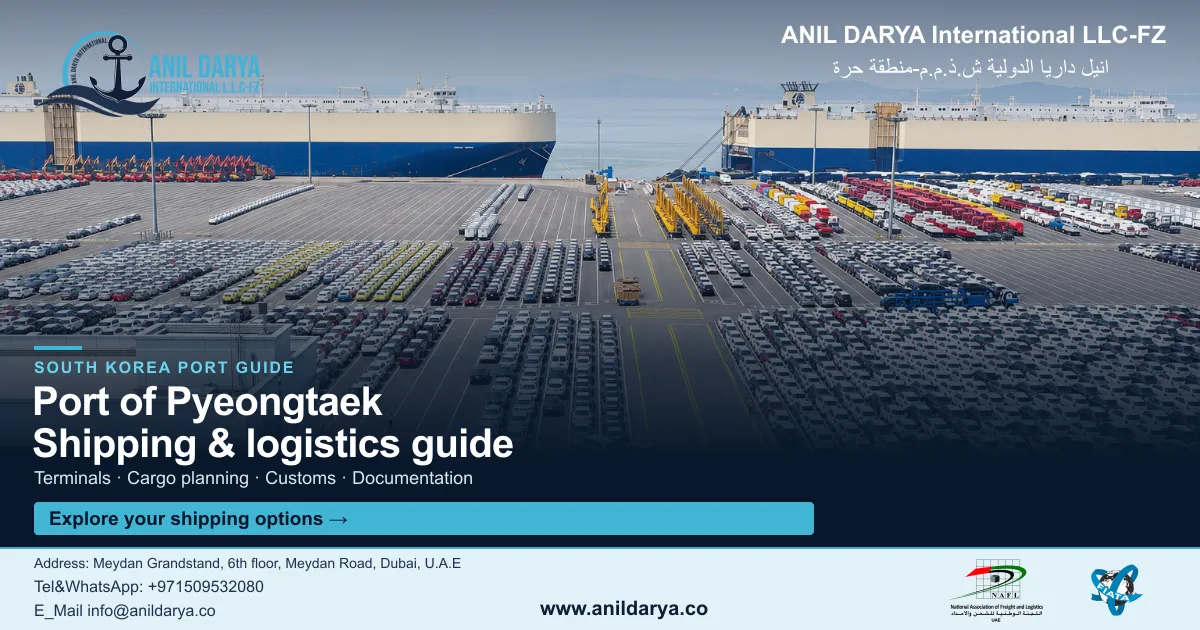
Pyeongtaek port shipping means using the Port of Pyeongtaek-Dangjin, the West Sea port closest to Seoul's southern industrial belt and Korea's busiest port for vehicles. In 2025 it handled 1,616,086 vehicles, 956,117 TEU of containers and almost 115 million tonnes of cargo in all. This guide covers the piers and terminals, the big tide, customs, and both lanes: shipping from Dubai to Pyeongtaek and shipping from Pyeongtaek to Dubai.
Pyeongtaek port shipping: key facts at a glance
| Item | Detail |
|---|---|
| Official name | Port of Pyeongtaek-Dangjin (often shortened to Pyeongtaek Port) |
| UN/LOCODE | KRPTK (Dangjin side also listed as KRTJI) |
| Location | Asan Bay on the West Sea, spanning Pyeongtaek (Gyeonggi-do) and Asan and Dangjin (Chungcheongnam-do); about 65 km south-south-west of Seoul |
| Port bodies | Pyeongtaek Regional Office of Oceans and Fisheries; Gyeonggi Pyeongtaek Port Corporation (GPPC) for port sales, statistics and hinterland |
| Customs | Pyeongtaek Customs, Korea Customs Service |
| Port area | 98,271,000 m² (90,992,000 m² water, 7,279,000 m² land) |
| Berths | 66, with handling capacity of 97,504,000 revenue tonnes a year |
| Approach channel | 40 km long, 0.5 to 4 km wide, 10 to 40 m deep |
| Tidal range | About 8 m (801.8 cm at East Pier, 795.4 cm at West Pier) |
| Container terminals | PCTC (East Pier 6 to 9) and PNCT (East Pier 14 to 16) |
| Vehicles in 2025 | 1,616,086, the largest car import and export volume in Korea |
| Containers in 2025 | 956,117 TEU (924,758 TEU in 2024) |
| Total cargo in 2025 | 114,986,269 tonnes |
| Container network | 17 regular services (January 2026), to China, Vietnam, Thailand, Hong Kong, the Philippines, Indonesia and Japan |
| Import VAT in Korea / UAE | 10% on customs value plus duty / 5% |
| Car carriers to the UAE | EUKOR and Hyundai Glovis, calling Jebel Ali and Abu Dhabi |
| Trade agreement with UAE | UAE-Korea CEPA, in force since 1 May 2026 |
Where is Pyeongtaek port and why do shippers use it?
The port sits on Asan Bay, with Pyeongtaek on the north bank and Dangjin on the south bank. Findaport puts it about 65 km south-south-west of Seoul, with Gimpo airport about 75 km away and Incheon International Airport about 105 km away.
That location is the main reason to use it. The port is a short truck run from the factories and warehouses south of Seoul. PCTC lists the Gyeongbu and Seohaean expressways, an industrial rail line from the port to Anjung and Pyeongtaek, and the West Coast railway among its land links. Shipa Freight describes Pyeongtaek as the Korean port closest to China, about 350 km from the Chinese mainland, which explains why so many of its container services run to Chinese ports.
GPPC lists it as a designated Type 1 port and one of Korea's three major national ports. It is a mixed port: cars and containers on the East Pier, steel, coal and iron ore on the Dangjin side, LNG and LPG at dolphin berths, and grain, cement and sand on their own piers.
The tide and the channel: what they mean for your cargo
Asan Bay has a very large tide: GPPC gives 801.8 cm at the East Pier and 795.4 cm at the West Pier, and ships reach the berths through a 40 km channel. For you, that means two things. Feeder arrivals can shift by hours, so do not book a truck for the hour of berthing. And for breakbulk, the lift plan has to allow for the ship rising and falling against the quay. Ask the carrier for the berthing window, not just the date.
Which piers and terminals does Pyeongtaek port have?
GPPC publishes pier data for the whole port. Each berth group is run by a different operating company, so the berth on your booking tells you who handles your cargo.
East Pier: cars, containers and general cargo
| Berths | Ships accepted | Capacity (thousand tonnes a year) | Cargo | Operator listed by GPPC |
|---|---|---|---|---|
| 1 | 30,000 to 50,000 DWT | 3,620 | Vehicles | Hyundai Glovis Pyeongtaek International Terminal |
| 2 to 3 | 7,240 | Vehicles | Pyeongtaek International Ro-Ro Terminal (PIRT) | |
| 4 to 5 | 7,190 | Vehicles | Kia, Pyeongtaek Port | |
| 6 to 9 | Five ships of 30,000 DWT | 10,288 | Containers | Pyeongtaek Container Terminal (PCTC) |
| 10 to 12 | Three ships of 30,000 DWT | 2,220 | General cargo | Pyeongtaek Port Co. (PTOC) |
| 13 | One ship of 30,000 DWT | 1,100 | Steel | Yusung TNS |
| 14 to 16 | Two ships of 50,000 DWT | 6,456 | Containers | Pyeongtaek Dongbang i-Port (PNCT) |
West Pier, Songak and Godae piers
| Pier | Berths | Ships accepted | Capacity (thousand tonnes a year) | Cargo |
|---|---|---|---|---|
| West Pier, Pyeongtaek side | 8 to 9 | Two of 50,000 DWT | 3,240 | Grain |
| West Pier, Dangjin side | 1 to 3 | Three of 30,000 DWT | 6,000 | Cement |
| West Pier, Dangjin side | 4 to 7 | Four of 30,000 DWT | 3,080 | General cargo |
| Songak Pier | 3 to 5 | Up to 200,000 DWT | 13,980 | Iron ore |
| Songak Pier | 6 to 7, 9 | Two of 30,000 and one of 50,000 DWT | 9,830 | Coal |
| Songak Pier | 12, 14 | Two of 30,000 DWT | 3,020 | Steel |
| Godae Pier | 1 to 6, 9, 10 | Up to 50,000 DWT | 9,580 (berths 1 to 6 and 9) | Steel |
| Godae Pier | 7 to 8 | One of 30,000 and one of 50,000 DWT | 1,490 | General cargo |
The Dangjin side is heavy industry, which is why the port moves well over 100 million tonnes a year while its container volume stays under one million TEU.
Liquid and gas berths
Dolphin berths serve their owners: LNG berths for ships of 70,000 and 127,000 tonnes, LPG berths of 70,000 and 55,000 tonnes, plus berths for oils and fats and for bunker C fuel oil. Packed liquids from the UAE for other buyers go in ISO tanks or drums through the container terminals.
Container shipping at Pyeongtaek: PCTC and PNCT
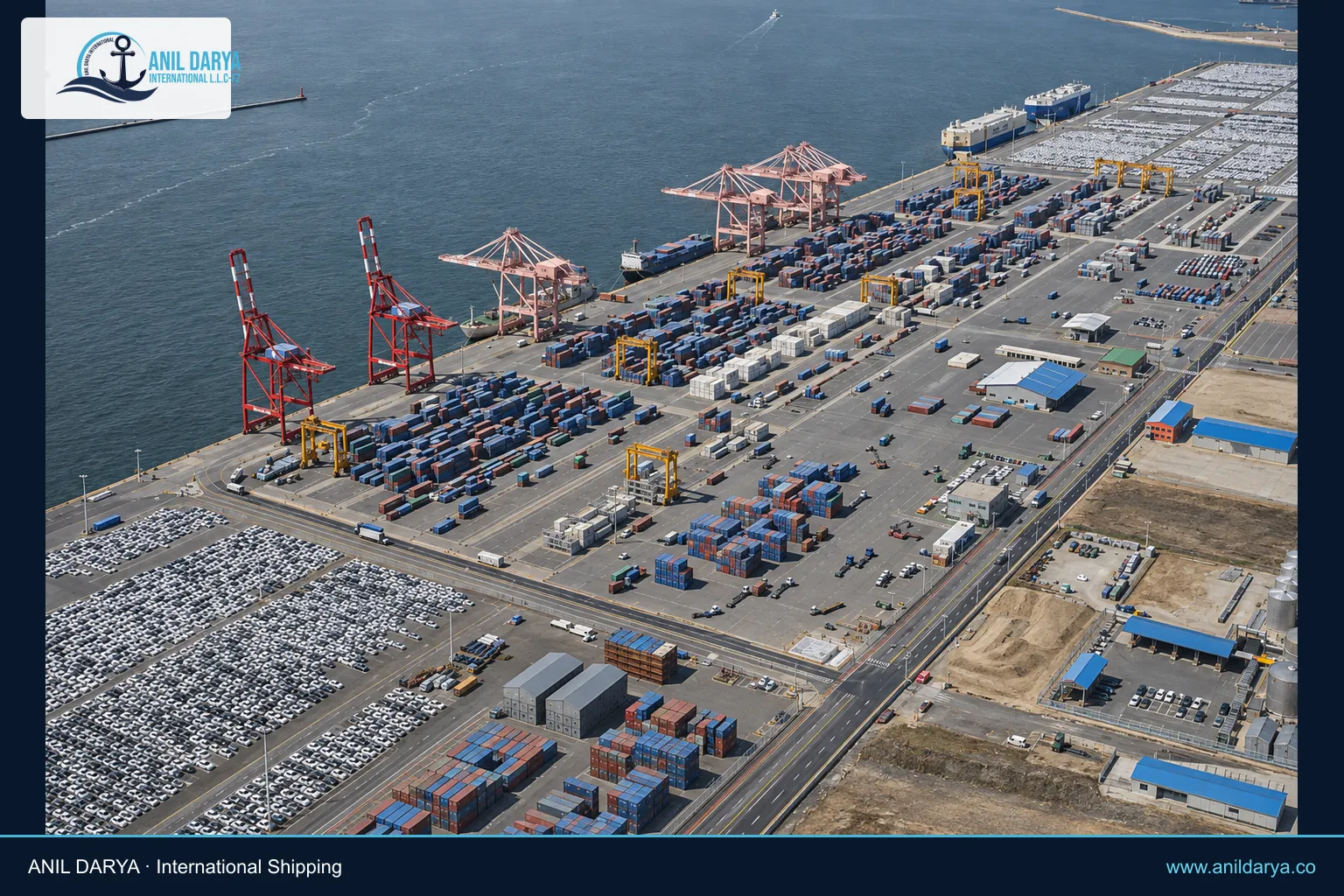
The PCTC terminal at East Pier 6 to 9
PCTC presents itself as Hanjin Pyeongtaek Container Terminal. Its own figures:
| Berth | Length | Depth alongside | Largest ship | Reefer plugs |
|---|---|---|---|---|
| 6 | 280 m | 14 m | 50,000 DWT | Not listed |
| 7 | 280 m | 14 m | 50,000 DWT | 100 |
| 8 | 240 m | 12 m | 30,000 DWT | Not listed |
| 9 | 240 m | 12 m | 30,000 DWT | 288 |
The terminal covers 416,000 m² with 1,040 m of quay. PCTC says it can handle more than 1,000,000 TEU a year and has 388 reefer plugs. Its equipment list shows 4 post-Panamax gantry cranes (50 tonnes under the spreader, 75 tonnes with a hook beam), 11 rubber-tyred transfer cranes, 7 reach stackers and 21 yard tractors. PCTC also runs a CFS for LCL cargo.
The PNCT terminal at East Pier 14 to 16
GPPC lists Pyeongtaek Dongbang i-Port as the operator of East Pier 14 to 16, with room for two 50,000 DWT ships. Two Korea-China car ferries also use berths 14 and 15.
Which services call, and where they go
GPPC listed 17 regular container services in January 2026. All are short-sea services, mostly weekly, to 13 Chinese ports, Hai Phong, Ho Chi Minh, Laem Chabang, Bangkok, Manila, Jakarta, Surabaya, Davao, Hong Kong, Osaka and Nagoya. None goes to the Gulf. Carriers include Sinokor (Janggeum), Namsung, Dongjin, Koryo, SITC, Duwoo and Maersk. Vietnam is a major partner: Pyeongtaek-Vietnam container volume reached 44,516 TEU in the first eight months of 2026.
Shipping from Dubai to Pyeongtaek: routing and transit
Because Pyeongtaek's container services are all regional, a box from Jebel Ali reaches it in two legs: a mainline ship from the Gulf to a hub, then a feeder to Pyeongtaek. On GPPC's January 2026 list, most loops reach Pyeongtaek from Chinese, Hong Kong or South-East Asian ports. Busan and Gwangyang appear too, but usually just after the ship leaves Pyeongtaek, so the hub depends on the carrier.
| Leg | Published figure | Source |
|---|---|---|
| Jebel Ali to Busan, FCL | At least 24 days | Shipa Freight guide |
| Jebel Ali to Incheon, FCL | About 27 days | Shipa Freight guide |
| Hub to Pyeongtaek feeder | Weekly loops from China, Hong Kong and South-East Asia | GPPC route list, January 2026 |
We found no reliable published Jebel Ali to Pyeongtaek time. Add the hub wait and feeder leg to the mainline time, and ask for the full routing.
[AMIR-FACT: our real transit time from Jebel Ali to Pyeongtaek, the Korean or Chinese hub we usually tranship through, and the carriers we book on this lane]
Our Jebel Ali port shipping guide covers export cut-offs on the Dubai side, and our sea freight service books both legs on one bill of lading where the carrier offers it.
For LCL, ask where the box is unpacked. PCTC runs a CFS, but some consolidators open the box at Busan or Incheon and truck your pallets on. Our guide to FCL vs LCL costs shows where the break-even sits.
How to ship from Pyeongtaek to Dubai: cars and containers
We also handle the reverse lane, shipping from Pyeongtaek to Dubai, for UAE buyers of Korean goods. Two flows dominate.
- Vehicles and Ro-Ro cargo. GPPC lists EUKOR and Hyundai Glovis car carrier routes from Pyeongtaek to the Middle East, calling Jebel Ali, Dubai, Abu Dhabi, Sohar, Hamad, Dammam, Kuwait, Bahrain and Doha. For new or used cars, buses and wheeled machinery, this is a direct sea route to the UAE without a container.
- Containers. Pyeongtaek's container loops are regional, so boxes go out on a feeder to a hub in China, South-East Asia or Korea and then on a mainline ship to Jebel Ali or Khalifa Port.
[AMIR-FACT: our real transit time from Pyeongtaek to Jebel Ali for containers and for Ro-Ro cars, and the carriers we book on this import lane]
Export side in Korea
The Korean shipper or its origin agent handles the export side. KCS says the exporter files the export declaration with the customs house where the goods are stored, and the goods must be loaded within 30 days of acceptance. Used cars must have their Korean registration cancelled before export and can be checked to confirm they are not stolen. We book the space with the carrier and agree the cut-off with the shipper.
Arrival and clearance in the UAE
On arrival at Jebel Ali, Dubai Customs asks for an invoice, packing list, certificate of origin and any permit for restricted goods, with the bill of lading and the line's delivery order. Duty in Dubai is 5% of the CIF value for most goods, and the Federal Tax Authority's standard VAT rate is 5%. The importer needs a customs business code, or a licensed clearing agent can file with the owner's authorisation. Korean-origin goods with valid CEPA proof of origin may qualify for lower UAE duty, so ask the supplier for it. We clear the cargo and deliver it to your site; our Khalifa Port guide covers the Abu Dhabi option.
- Send us the supplier's address, the cargo details and the Incoterm (FOB Pyeongtaek suits most buyers).
- We book a car carrier or a container routing and confirm the cut-off with the shipper.
- The shipper clears Korean export and delivers to the terminal; we check the draft bill of lading.
- We prepare the UAE declaration before arrival, pay duty and VAT, and deliver.
Vehicles and Ro-Ro: Korea's leading car port
Pyeongtaek has been Korea's top port for car imports and exports for years. Gyeonggi Province reported it as number one for four straight years by 2013, and in 2025 the port again recorded the largest automotive volume in the country, with 1,616,086 vehicles.
| Year | Vehicles (imports and exports) |
|---|---|
| 2022 | 1,635,790 |
| 2023 | 1,616,558 |
| 2024 | 1,560,628 |
| 2025 | 1,616,086 |
East Pier berths 2 to 5 are dedicated to vehicles, with 1,110 m of quay for ships of 30,000 to 50,000 DWT. Berth 1 is Hyundai Glovis's international terminal, berths 2 and 3 are the Pyeongtaek International Ro-Ro Terminal (PIRT) and berths 4 and 5 are Kia's. In 2026 Hyundai Glovis broke ground on a further car carrier terminal at the port.
For machinery on wheels going from the UAE to Korea, ask us whether a Ro-Ro sailing fits your dates before you plan a flat rack.
Breakbulk, project cargo and bulk at Pyeongtaek
Breakbulk and project cargo
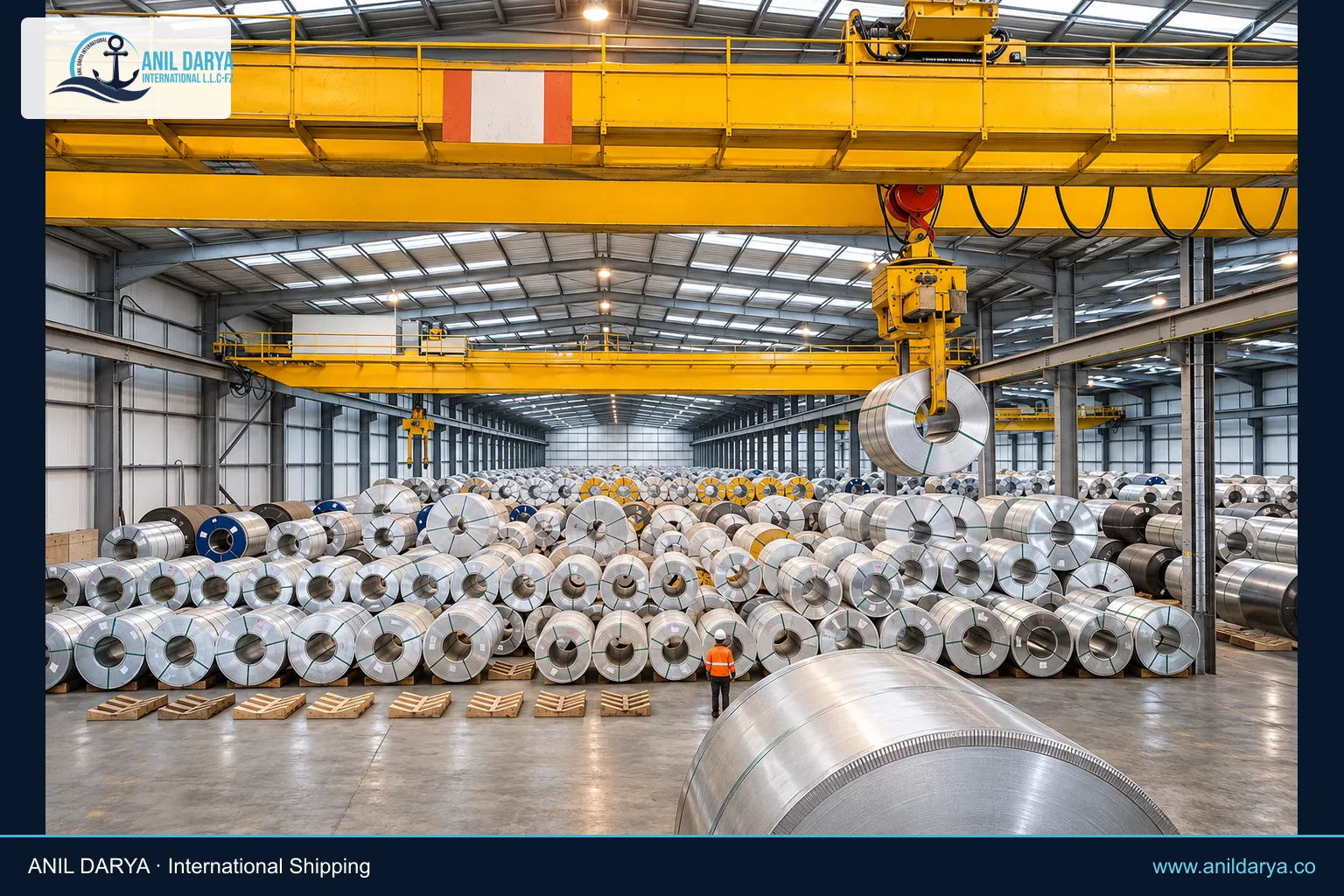
General cargo berths sit at East Pier 10 to 12, West Pier (Dangjin) 4 to 7 and Godae 7 to 8. Shipnext's port data lists a 300-tonne harbour crane on the East Wharf and a 350-tonne crane on the West Wharf, but confirm crane availability with the berth operator for your date, because port data sites are not always current. PCTC's gantry cranes lift 75 tonnes with a hook beam, which covers many flat-rack pieces.
A simple rule: if a piece fits a 40ft flat rack by size and weight, ship it on a container service through a hub. If it does not, you need breakbulk tonnage to Pyeongtaek or another Korean port, and the sailing date drives the whole plan. Our guide to break bulk and project cargo covers drawings, lashing and the UAE road move to the quay.
Dry bulk
Dry bulk here is mostly industrial: ore and coal at Songak, cement at Dangjin, grain at West Pier 8 and 9 and sand at the sand pier. Findaport gives the largest bulk ship as 200,000 DWT at 14.0 m draft. For bulk from the UAE, the receiver's berth and discharge rate decide the vessel size. Our bulk cargo shipping team can check that before you fix a charter.
Dangerous goods at Pyeongtaek
Dangerous goods in containers move under the IMDG Code at sea, and every carrier on the route must accept them, including the feeder operator from the hub. Packaged DG from the UAE goes through PCTC or PNCT like any other container, and our Busan guide covers Korea's on-port DG storage rules. For each booking you need a correct UN number and proper shipping name, a Safety Data Sheet, a signed DG declaration, UN-approved packaging and the right labels and placards. Our dangerous goods shipping team gets acceptance from each carrier before you commit to a sailing.
Customs at Pyeongtaek port in brief
Korean customs rules are national and our Busan guide covers them in full. Here is the short version.
| Point | What applies |
|---|---|
| Customs office | Pyeongtaek Customs: import and export clearance, duty collection, bonded cargo and bonded areas |
| Who files | A customs broker or the owner of the goods, online through UNI-PASS |
| When | After arrival in principle, but you may declare before arrival to speed release |
| Documents | Import declaration, invoice, packing list, bill of lading, certificate of origin, quarantine certificate where needed |
| Inspection | Chosen by risk analysis; the owner of the goods pays the cost |
| Duty and tax | Duty on CIF value at the HS rate; 10% VAT on customs value plus duty; 10 to 20% special excise on some luxury and durable goods |
| Payment | In Korean won within 15 days of clearance |
| CEPA | UAE-origin goods that meet the rules of origin can claim reduced duty |
Food and farm goods have their own checks at the port. GPPC lists a Pyeongtaek imported food inspection office of the Ministry of Food and Drug Safety and a Pyeongtaek office of the Animal and Plant Quarantine Agency. Food from the UAE is checked there, so the Korean importer should prepare before the ship arrives.
The UAE-Korea CEPA has been in force since 1 May 2026 and covers about 91.2% of tariff lines, with some cuts phased in over up to 10 years. Goods qualify through a change in tariff classification or at least 40% value content on the FOB price. Goods made elsewhere and re-exported through Dubai pay the normal Korean rate.
Pyeongtaek, Incheon or Busan: which Korean port fits your cargo?
| Your situation | Port to compare | Why |
|---|---|---|
| Consignee in Pyeongtaek, Asan, Dangjin, Cheonan or southern Gyeonggi-do | Pyeongtaek | Shortest truck leg; two container terminals |
| Consignee in Seoul, Incheon or northern Gyeonggi-do | Incheon | Closer to the capital; also tranships |
| Urgent cargo, most sailing choice | Busan | Most mainline calls from the Gulf; truck onward |
| Vehicles or Ro-Ro cargo | Pyeongtaek | Korea's largest car port, with four car berths |
| Steel, coal or ore for the Dangjin industrial area | Pyeongtaek-Dangjin (Songak, Godae) | Dedicated industrial berths up to 200,000 DWT |
A shorter truck leg can cost you days in feeder time, so we price Pyeongtaek against Busan plus truck.
How to ship to Pyeongtaek port from Dubai: step by step
- Send us the cargo details and the Incoterm, and confirm Korean requirements (food, KC certification, labelling) with your buyer.
- Choose the routing. We compare carriers from Jebel Ali to a hub with a Pyeongtaek feeder, and Busan with a truck, and confirm PCTC or PNCT.
- Book space. For DG, reefer or out-of-gauge cargo we get acceptance from the mainline and the feeder carrier.
- Pick up, stuff and clear export in the UAE. We arrange trucking, stuffing and the export or re-export declaration.
- The consignee's broker pre-files in UNI-PASS before the feeder reaches Pyeongtaek.
- Duty and VAT are paid and the consignee's trucker collects from the terminal.
We do not have an office in Korea. We work with your consignee or the customs broker they appoint.
Checklist before you ship to Pyeongtaek
- Pyeongtaek confirmed as the right port for the delivery address.
- Terminal known: PCTC (East Pier 6 to 9) or PNCT (East Pier 14 to 16).
- HS code agreed with the Korean importer or broker.
- Invoice, packing list, bill of lading and certificate of origin match, and CEPA origin checked if you claim it.
- Food, quarantine or KC approvals ready before sailing.
- For DG: SDS, DG declaration, packaging, labels and acceptance from every carrier.
- Free time at the hub and at Pyeongtaek agreed with the carrier.
Common mistakes on Pyeongtaek shipments
- Getting DG acceptance from the mainline only. The feeder carrier must accept it too.
- Booking a truck for the berthing hour. Tide and channel times move feeder arrivals.
- Claiming CEPA on goods made outside the UAE, which leads to duty and penalties later.
- Ignoring free time at the hub. A missed feeder can use it up before the box reaches Pyeongtaek. Our article on demurrage and detention shows how the charges build.
Frequently asked questions
What is the port code for Pyeongtaek?
The UN/LOCODE for Pyeongtaek is KRPTK. The Dangjin side of the port is also listed as KRTJI.
What is Pyeongtaek port known for?
Vehicles. It handled 1,616,086 vehicles in 2025, the largest car import and export volume in Korea. It also moves steel, coal, iron ore, LNG, grain and about 956,000 TEU of containers a year.
Which container terminals does Pyeongtaek have?
Two: PCTC at East Pier 6 to 9, with 1,040 m of quay at 12 to 14 m depth, and PNCT at East Pier 14 to 16, for ships up to 50,000 DWT.
How do I ship a car from Pyeongtaek to Dubai?
Book it on a car carrier. GPPC lists EUKOR and Hyundai Glovis routes from Pyeongtaek to Jebel Ali and Abu Dhabi. A used car's Korean registration must be cancelled before export, and Dubai Customs then charges 5% duty on the CIF value.
Is there a direct ship from Dubai to Pyeongtaek?
Not for containers. Pyeongtaek's 17 regular container services run to China, South-East Asia, Hong Kong and Japan, so cargo from Jebel Ali tranships at a hub on the way.
How long does shipping from Dubai to Pyeongtaek take?
No reliable published port-to-port figure exists. Shipa Freight gives at least 24 days from Jebel Ali to Busan, and you need to add the hub wait and the feeder leg to Pyeongtaek.
Does the UAE-Korea CEPA apply to goods shipped to Pyeongtaek?
Yes, for goods of UAE origin that meet the rules of origin. The CEPA has been in force since 1 May 2026 and covers about 91.2% of tariff lines.
Get a quote for Pyeongtaek port shipping
Send us your cargo details and the delivery address in Korea, and we will come back with a routing and a price to Pyeongtaek, and to Busan or Incheon for comparison. Use our freight rate inquiry form, or contact our team to talk through a breakbulk, Ro-Ro or DG shipment. You can also read more about our Dubai freight forwarding team.
Sources
- Gyeonggi Pyeongtaek Port Corporation: Pier facilities (berths, ship sizes, capacity, cargo)
- Gyeonggi Pyeongtaek Port Corporation: Pyeongtaek port location conditions (area, berths, channel, tide)
- Gyeonggi Pyeongtaek Port Corporation: Port operation statistics 2016 to 2025
- Gyeonggi Pyeongtaek Port Corporation: Container and car carrier routes (January 2026)
- Gyeonggi Pyeongtaek Port Corporation: Port support organisations and berth operators
- Gyeonggi Pyeongtaek Port Corporation: International car ferry terminal and berths
- Pyeongtaek Regional Office of Oceans and Fisheries: Container shipping
- PCTC (Hanjin Pyeongtaek Container Terminal): Facilities
- PCTC: Equipment
- PCTC: Terminal features and land links
- Asia Business Daily: Eco-friendly car carrier at Pyeongtaek Port (July 2026, car berths 2 to 5)
- Asia Business Daily: Pyeongtaek port sales in Vietnam (October 2026)
- Money Today: Hyundai Glovis car carrier terminal ground-breaking (September 2026)
- Gyeonggi Province: Pyeongtaek Port ranked no. 1 in car imports and exports (2014)
- Wikipedia: Port of Pyeongtaek-Dangjin (UN/LOCODE)
- Findaport: Port of Pyeong Taek (location, airports, maximum ship sizes)
- Shipnext: Pyeongtaek port data (harbour cranes)
- Korea Customs Service: Export-import clearance
- US International Trade Administration: Korea import tariffs
- UAE Ministry of Economy and Tourism: UAE-Korea CEPA
- Korea Customs Service: Export declaration guideline
- Dubai Customs: Submit customs declaration (documents)
- Dubai Customs: FAQ (duty rate, business code, clearing agents)
- Federal Tax Authority: VAT (standard rate)
- Shipa Freight: UAE to Korea shipping guide (transit, Pyeongtaek distance to China)
Reviewed: 10 November 2026