
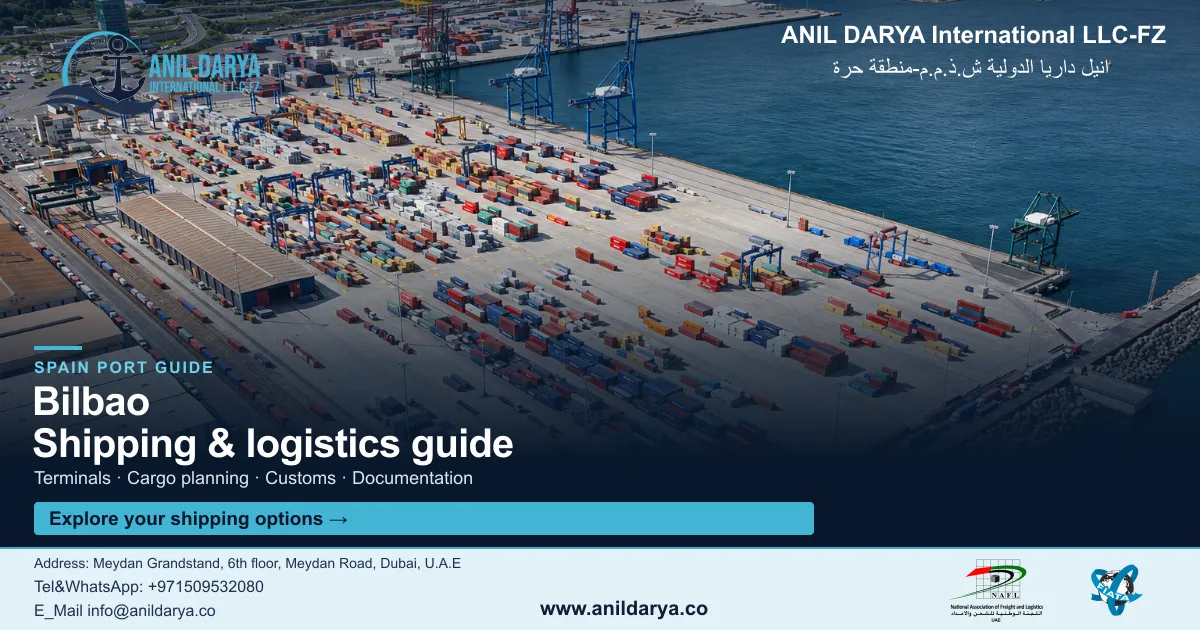
Port of Bilbao shipping is the main sea gateway for northern Spain and the Basque Country. The port sits in the outer bay of Abra, about 15 km west of Bilbao city, and its container traffic goes through one terminal, CSP Iberian Bilbao, with 21 m of water and its own rail yard. This guide covers the terminal, the cargo the port handles, rail and inland links, the customs points specific to Bilbao, and how we ship your cargo there from the UAE. We ship both from Dubai to Bilbao and from Bilbao to Dubai.
Port of Bilbao: key facts at a glance
| Item | Detail |
|---|---|
| Port authority | Port Authority of Bilbao (Autoridad Portuaria de Bilbao), within the Puertos del Estado system |
| Location | Outer Abra bay, mainly in Santurtzi and Zierbena, about 15 km west of Bilbao |
| Port code | ESBIO |
| Port area | 3.13 km2 of land, 16.94 km2 of water, 17 km of waterfront |
| Traffic January to September 2026 | 25.3 million tonnes, up 6.3% |
| Main container terminal | CSP Iberian Bilbao Terminal (COSCO Shipping Ports Spain) |
| Container quay and depth | 1,155 m, two berth lines, 21 m depth |
| Container capacity | 700,000 TEU a year |
| Reefer plugs | 540 |
| On-terminal rail | 4 tracks of 550 m, over 180,000 TEU a year |
| Ferries | Brittany Ferries to Portsmouth and Rosslare |
| Customs | Spanish Tax Agency (AEAT), under EU customs law |
| Import VAT in Spain | 21% standard, 10% reduced |
| Bilbao to Dubai | EU export declaration by the shipper or its agent; UAE duty 5% of CIF for most goods, plus 5% VAT |
Where is the Port of Bilbao and who runs it?
The port lies on the Bay of Biscay at the mouth of the Bilbao estuary. Most cargo facilities are now in the outer Abra bay, built out between 1991 and 2011, in the municipalities of Santurtzi and Zierbena. The Port Authority of Bilbao manages the land and water, and private companies run the terminals.
Bilbao is the main port of northern Spain and ranks fourth in Spain, according to the Spanish Wikipedia entry. If your buyer is in the industrial north of Spain, Bilbao usually means a much shorter truck leg than Valencia or Barcelona.
The port is growing again. It handled 17.3 million tonnes in the first half of 2026, up 12.3% and its best half-year growth in 22 years, helped by the Petronor refinery working at full rate again. By September the total was 25.3 million tonnes, up 6.3%, with liquid bulk driving the growth.
Which terminal handles containers at Bilbao?
Deep-sea containers at Bilbao go through CSP Iberian Bilbao Terminal. It is part of the COSCO Shipping Ports (Spain) group. The terminal publishes these figures:
| Feature | CSP Iberian Bilbao Terminal |
|---|---|
| Total area | 43.8 ha, of which 39.5 ha stacking |
| Quay | 1,155 m with two berth lines |
| Depth | 21 m |
| Annual capacity | 700,000 TEU |
| Quay cranes | 3 Super Post Panamax (twin lift) and 4 Panamax |
| Yard equipment | 18 RTGs (6 hybrid), 2 automated rail cranes, 6 reach stackers |
| Reefer plugs | 540 |
| Rail terminal | 4 tracks of 550 m on 41,800 m2, over 180,000 TEU a year |
| Heavy and oversized cargo | One dedicated station |
| Gates | 7 in, 3 out, 1 for special loads, with OCR |
| Ship operations | 24 hours, in 6-hour shifts, 361 days a year |
| Land-side operations | Monday to Friday, 08:00 to 20:00 |
| Customs status | Customs warehouse on site; full AEO certification (AEO-C and AEO-S) |
Two of those lines matter most for planning. First, ships are worked round the clock, but trucks and land-side handling run on weekdays from 08:00 to 20:00. A container that lands on a Friday evening will usually wait for Monday, and free time is still running. Second, the terminal has a customs warehouse, which helps if your consignee needs time to clear or wants to store goods under customs control.
What cargo can you ship through the Port of Bilbao?
Bilbao is a general port with terminals for containers, ro-ro, breakbulk, liquid bulk and solid bulk, plus a cruise terminal at Getxo.
| Cargo type | How it moves at Bilbao | What to plan |
|---|---|---|
| General goods in containers | FCL or LCL through CSP Iberian Bilbao | Arrival day versus land-side hours, free time |
| Chilled and frozen food | Reefers on the terminal's 540 plugs | Set temperature, health certificates, border control checks |
| Steel, machinery, project pieces | Flat racks at the container terminal, or breakbulk ships at the general cargo quays | Lifting points, lashing, road permits |
| Trailers and vehicles | Ro-ro and ferry services to the UK and Ireland | Only relevant for onward moves |
| Oil, gas and chemicals in bulk | Liquid bulk berths, including the Petronor refinery and the BBG LNG plant | Receiving terminal, survey, discharge plan |
| Packaged dangerous goods | IMDG containers at the container terminal | Carrier acceptance, DG declaration, SDS |
For most shippers from the UAE the relevant options are containers, reefers and project cargo. Our sea freight team books the container side from the UAE.
FCL and LCL shipping to Bilbao
Use this as a starting point:
- Choose FCL if you fill most of a 20ft box, ship heavy or DG cargo, or plan to send the box inland by rail. You control the stuffing, and the box can go straight onto a train at the terminal.
- Choose LCL for a few pallets. Ask whether the consolidator delivers LCL into Bilbao itself or into a larger Spanish hub with a truck to Bilbao, because that changes the transit and the customs office.
- Choose a reefer for chilled or frozen food, and have the health certificates ready before loading.
Our guide to FCL vs LCL costs shows where the break-even point usually falls.
Breakbulk and project cargo through Bilbao
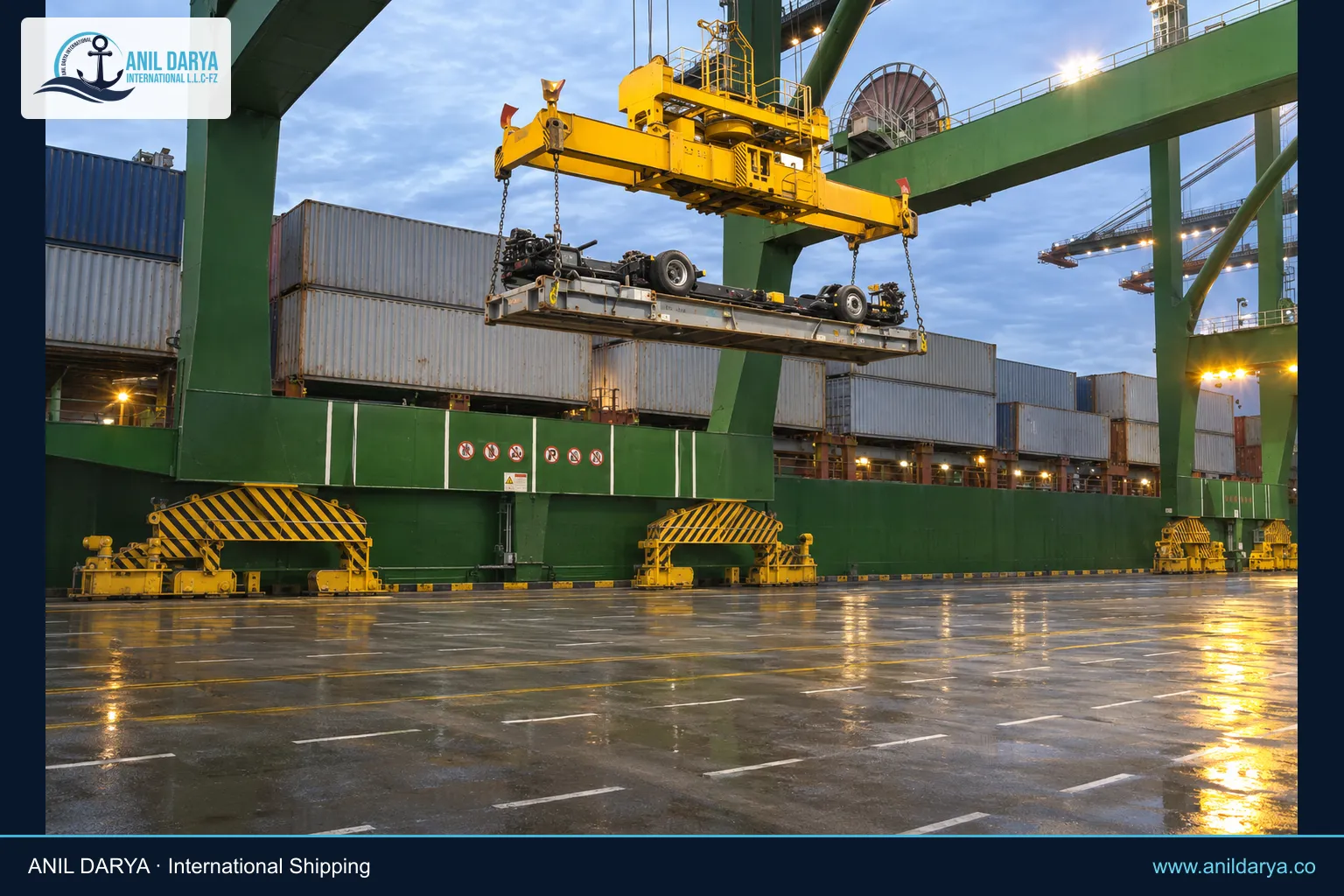
The Basque Country has a large steel, energy and machinery industry, and much of Bilbao's general cargo is steel and heavy equipment. The container terminal has its own station for oversized and extra-heavy units, so pieces on flat racks or open tops can be handled there.
A simple decision rule: if each piece fits a 40ft flat rack by size and weight, a container service into the CSP terminal usually gives more sailings. If it does not, you need a breakbulk or heavy-lift ship, and the sailing date drives the whole plan.
When we ship project cargo to Bilbao, we:
- Collect drawings, weights, dimensions and centre of gravity for each piece.
- Choose flat rack, breakbulk or heavy-lift tonnage and confirm the berth at Bilbao.
- Agree lifting, lashing and securing with the carrier.
- Have the consignee's Spanish agent plan the road move from the quay, with any special transport permits.
- Send the customs documents before arrival so the cargo can leave the quay quickly.
See our break bulk and project cargo service and our article on flat racks, open tops and out-of-gauge cargo.
Dangerous goods to the Port of Bilbao
Packaged dangerous goods from the UAE arrive at Bilbao in containers under the IMDG Code. The carrier must accept the class on the service before you book, and Spanish port rules may set limits on how long some classes can stay at the terminal. We confirm both before we fix the sailing.
What you need for a DG container to Bilbao:
- UN number, proper shipping name, class and packing group for each product.
- A Safety Data Sheet for each product. The Spanish importer will often ask for a Spanish version.
- A Dangerous Goods Declaration signed by a trained person.
- UN-approved packaging, labels and container placards.
- Carrier acceptance for the class on the service and at the discharge port.
Our dangerous goods shipping team handles the declaration and the Dubai Customs export side, and our guide to dangerous goods classes explains what each class means for packing.
Rail and road: moving cargo inland from Bilbao
Bilbao's rail links are one of its strengths for inland Spain. The CSP terminal can make up complete trains to any destination in Spain and is directly connected to the rail network. Its rail yard handles more than 180,000 TEU a year.
| Link | What it offers | Good for |
|---|---|---|
| Terminal rail yard | 4 tracks of 550 m, full trains to destinations in Spain | Full containers to inland terminals |
| Júndiz rail terminal near Vitoria-Gasteiz | Awarded in October 2026 to a consortium including the ports of Bilbao and Pasaia and Medlog | Cargo for Alava and the Ebro valley |
| Road | Direct access to the Spanish motorway network from the quays | Most deliveries in the Basque Country and nearby regions |
| Ferry and ro-ro | Brittany Ferries to Portsmouth and Rosslare | Trailers onward to the UK or Ireland |
One limit to know: the rail line out of the port shares track with commuter trains, and Wikipedia notes that a new rail connection is needed. For urgent cargo going a short distance, the truck is usually simpler. For heavy boxes going further inland, ask the consignee's agent to price rail before you decide.
Customs at the Port of Bilbao: what is specific to this port
Spanish customs rules are the same at every port, and our Valencia guide covers them in full. The short version:
- The carrier files the EU entry summary declaration at least 24 hours before your container is loaded in the UAE.
- The importer needs an EORI number. Non-EU companies can apply through the AEAT customs portal without a Spanish tax number.
- The declaration is filed electronically with the AEAT, by the importer or a representative. It gets a green channel (release once duty is paid or guaranteed), orange (document check) or red (documents and physical inspection).
- Duty follows the EU TARIC rate for your goods code. There is no EU-UAE trade agreement in force (negotiations were launched on 28 May 2025), so UAE-origin goods pay the normal third-country rate.
- Import VAT in Spain is 21%, with a 10% reduced rate for some goods.
Here is what is specific to Bilbao:
| Item | At Bilbao |
|---|---|
| Customs warehouse | On site at the CSP container terminal, so goods can be stored under customs control |
| AEO terminal | The container terminal holds full AEO certification (customs and security) |
| Land-side hours | Monday to Friday, 08:00 to 20:00 at the container terminal; plan inspections and collections inside those hours |
| Port Community System | A new cloud-based system awarded to Indra in September 2026, built to match the European Maritime Single Window |
| Food, plant and animal goods | Checked at an EU border control post before release; the consignee's agent books the check |
Our Dubai freight forwarding team sends the full document set to the consignee's Spanish customs agent before the vessel leaves the UAE, so the declaration can be ready before arrival.

How long does shipping from Dubai to Bilbao take?
Published schedule data from Fluent Cargo shows these options. Services change often, so check the schedule on your booking.
| Route | Quickest time listed | Transfers | Frequency | Carrier listed |
|---|---|---|---|---|
| Sea: Khor Fakkan to Bilbao | About 55 days 2 hours | 2 | Every 1 to 2 weeks | MSC |
| Air: Dubai (DXB) to Bilbao (BIO) | About 15 hours 9 minutes | 1 | 2 to 4 times a week | Several airlines |
[AMIR-FACT: our real port-to-port transit days from Jebel Ali to Bilbao and the carriers or services we actually book on this lane]
The published sea option involves two transshipments. If the delivery date matters more than the inland truck cost, compare a sailing into a larger Spanish hub with a truck or train to the north. Our air cargo service is the option for urgent parts.
How to ship from Dubai to the Port of Bilbao: step by step
- Agree the Incoterm with your Spanish buyer, so it is clear who books the freight and who clears customs at Bilbao.
- Check the goods code in TARIC for the duty rate and any measures, and confirm the importer has an EORI number and a customs representative.
- Send us the cargo details: goods, HS codes, weight, volume or dimensions, packing and the delivery address in Spain.
- We compare services from Jebel Ali, Khor Fakkan and other UAE ports, confirm that the box discharges at Bilbao, and book space. DG, reefer and out-of-gauge cargo need carrier acceptance first.
- We check the invoice, packing list, certificate of origin and draft bill of lading, so names, weights and codes match.
- We truck the cargo to the UAE port, file the Dubai Customs export declaration and gate in before the cut-off. Our Jebel Ali port shipping guide covers that end.
- We send the document set to the consignee's agent, who files the import declaration with the AEAT before arrival.
- The container is discharged at the CSP terminal, released and collected by truck or loaded onto a train within the terminal's land-side hours.
How to ship from the Port of Bilbao to Dubai
We also handle shipping from Bilbao to Dubai, with arrival at Jebel Ali, Khalifa Port or Sharjah port. We book space with the carrier from CSP Iberian Bilbao and run the UAE side. The Spanish export papers stay with the shipper or its Spanish agent, as we have no office in Spain.
The Spain export side
- Export declaration. Union goods leaving for a country outside the EU need an export declaration. In Spain it can be lodged by the exporter or through a representative, by electronic means, with the Agencia Tributaria.
- EU system. The EU says the declaration goes in electronically through the Automated Export System (AES), at the customs office responsible for where the exporter is established.
- Exit. The goods are then presented at the customs office of exit, here Bilbao, which checks them against the declaration and supervises their departure.
- Pickup. The shipper or its trucker delivers the box to CSP Iberian Bilbao, by road or rail, inside the carrier's receiving window.
The UAE import side
Dubai Customs takes the import declaration with the commercial invoice, the packing list, the certificate of origin and any permit from the authority that controls restricted goods. The carrier releases the cargo against the bill of lading. The importer needs a Dubai Customs business code, or a licensed clearing agent files with its own code and the owner's authorisation. Customs duty in Dubai is 5% of the CIF value for most goods, with 50% on alcohol and 100% on cigarettes. Import VAT is 5%. A VAT-registered importer that has linked its customs registration number with the Federal Tax Authority reports the VAT on its return instead of paying it at release; other importers pay it before the goods are released.
- Send us the shipper's details in the Basque Country or northern Spain, the cargo, the HS code, the Incoterm and the UAE delivery address.
- We book space from CSP Iberian Bilbao to Jebel Ali, Khalifa Port or Sharjah and send the booking and cut-offs to the shipper.
- The shipper or its trucker collects the empty, stuffs it and delivers the box to the terminal before the cut-off.
- The shipper or its Spanish customs agent files the export declaration and any permit, and customs releases the cargo for loading.
- We check the draft bill of lading against the invoice and packing list, with the UAE consignee named correctly.
- We file the UAE declaration before the vessel arrives.
- We arrange payment of the duty and VAT.
- We collect the delivery order from the carrier.
- We truck the box to your site, free zone or warehouse, and return the empty within free time.
[AMIR-FACT: the carriers and hubs we actually use from Bilbao to Jebel Ali, Khalifa Port or Sharjah, and our real port-to-port transit days in this direction]
Which Spanish port fits: Bilbao, Valencia, Barcelona or Algeciras?
| Your situation | Port to look at first | Why |
|---|---|---|
| Consignee in the Basque Country or elsewhere in northern Spain | Bilbao | Short truck leg from the port |
| Heavy boxes for northern Spain by rail | Bilbao | On-terminal rail yard with trains to destinations in Spain |
| Madrid, central or eastern Spain | Valencia | Large container hub on the Mediterranean |
| Catalonia and the north-east | Barcelona | Shorter inland leg to Catalonia |
| Andalusia or transshipment | Algeciras | Southern hub with many deep-sea services |
The cheapest ocean freight is not always the lowest cost to the door. We can price Bilbao against another Spanish port plus a truck or train so you can compare.
Checklist for Port of Bilbao shipping
- HS code confirmed and duty checked in TARIC.
- Importer has an EORI number and a Spanish customs representative.
- Invoice, packing list and bill of lading show the same weights, pieces and consignee.
- Certificate of origin issued in the UAE.
- Discharge port confirmed as Bilbao, not a hub with a truck leg you did not plan for.
- Arrival day checked against the terminal's weekday land-side hours.
- For reefer cargo: set temperature and health certificates.
- For DG: SDS, DG declaration, packaging and labels, carrier acceptance.
- For project cargo: drawings, lifting points and a road route plan.
- Free time agreed with the carrier, and cargo insurance arranged.
Common mistakes on the Dubai to Bilbao lane
- Assuming a direct sailing. The published sea routing from the UAE has two transshipments. Build the extra days into your delivery promise.
- Forgetting weekend hours. A box released on a Friday night may not leave the terminal until Monday, while free time keeps running. Our article on demurrage and detention shows how fast it adds up.
- No EORI or representative. Without them the declaration cannot be filed, and the container sits.
- Mismatched documents. A different weight on the invoice and the bill of lading can push the declaration into the orange or red channel.
- Treating DG as general cargo. Undeclared dangerous goods can be refused, delayed or fined.
- Choosing a port by ocean rate alone. A cheaper sailing to another Spanish port can cost more once the truck to the north is added.
Frequently asked questions
What is the port code for Bilbao?
The port code for Bilbao is ESBIO. You will see it on bookings, bills of lading and tracking systems.
Who operates the container terminal at Bilbao?
CSP Iberian Bilbao Terminal, part of COSCO Shipping Ports (Spain), runs the container terminal. The Port Authority of Bilbao manages the port as a whole.
How deep is the Port of Bilbao container terminal?
The CSP Iberian Bilbao container terminal has 21 m of depth along 1,155 m of quay with two berth lines, and an annual capacity of 700,000 TEU.
Where exactly is the Port of Bilbao?
Most of the port is in the outer Abra bay, in Santurtzi and Zierbena, about 15 km west of Bilbao city. It covers 3.13 km2 of land and 16.94 km2 of water.
How long does shipping from Dubai to Bilbao take?
Fluent Cargo lists a quickest sea option of about 55 days from Khor Fakkan to Bilbao with two transshipments on MSC services, and about 15 hours by air from Dubai to Bilbao with one transfer. Check current schedules on your booking.
Can containers leave Bilbao by train?
Yes. The container terminal has its own rail yard with four 550 m tracks, handles more than 180,000 TEU a year by rail, and can make up full trains to destinations in Spain.
What is the import VAT for goods arriving in Bilbao?
Spain's standard VAT rate is 21%, with a 10% reduced rate for some goods. It is charged at import on top of any customs duty from the EU tariff.
Can I ship dangerous goods to Bilbao?
Yes, packaged dangerous goods move to Bilbao in containers under the IMDG Code. You need the carrier's acceptance for the class, a DG declaration, an SDS and correct packaging and labels before the booking is confirmed.
Can you handle shipping from Bilbao to Dubai?
Yes. We book the space from Bilbao, the shipper or its Spanish agent files the EU export declaration, and we clear the cargo through UAE customs and deliver it. Most goods pay 5% duty on the CIF value plus 5% import VAT in Dubai.
Get a quote for Port of Bilbao shipping
Send us your cargo details and we will come back with a routing and a price to Bilbao. Use our freight rate inquiry form, or contact our team to talk through a DG, reefer or project shipment first.
Sources
- CSP Spain: CSP Iberian Bilbao Terminal (quay, depth, capacity, cranes, rail, hours, AEO)
- Wikipedia: Port of Bilbao (location, area, ferries, rail)
- Wikipedia (Spanish): Puerto de Bilbao (ranking, terminals, Rosslare ferry)
- Ports Europe: Bilbao port handles 25.3 million tonnes in January to September 2026
- Ports Europe: Bilbao posts best half-year growth in 22 years (July 2026)
- Ports Europe: Adif awards Júndiz rail terminal (October 2026)
- Ports Europe: Port of Bilbao awards Indra contract for its Port Community System (September 2026)
- iContainers: Port of Bilbao (UN/LOCODE ESBIO)
- Cogoport: Port of Bilbao (ESBIO)
- Fluent Cargo: Dubai to Bilbao (sea and air schedules)
- AEAT: Customs declaration and control channels
- AEAT: EORI registration
- European Commission Access2Markets: Customs clearance documents and procedures (ENS timing)
- European Commission: EU Customs Tariff (TARIC)
- European Commission: EU-UAE agreement negotiations
- Your Europe: VAT rates in EU countries
- Agencia Tributaria: Customs declarations (export declaration, in person or through a representative, electronic)
- European Commission: What is exportation (AES, customs office of export and exit)
- Dubai Customs: Submit customs declaration (invoice, packing list, certificate of origin, permits)
- Dubai Customs: FAQ (customs business code, clearing agents with owner authorisation, 5% of CIF)
- UAE Government portal: Clearing customs and paying customs duty (5% of CIF in Dubai, alcohol 50%, cigarettes 100%)
- UAE Federal Tax Authority: VAT guide, import VAT at 5% and deferral for registered importers
Reviewed: 10 November 2026