
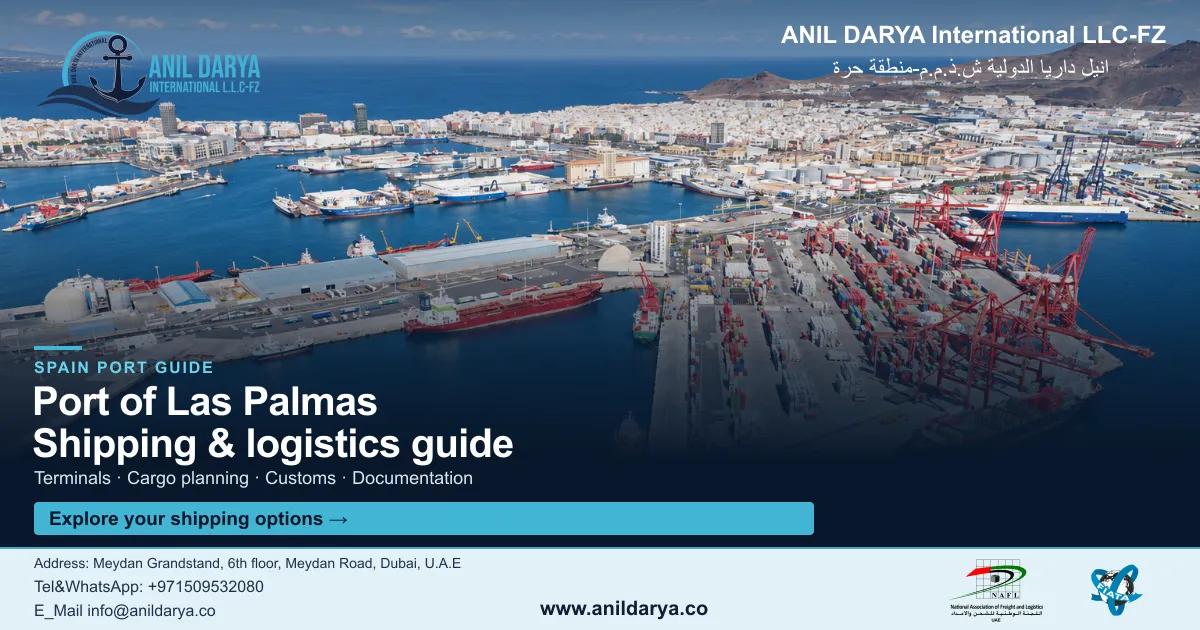
Port of Las Palmas shipping means a big Atlantic hub with its own tax rules. The port, on Gran Canaria, handled 1,220,326 TEU in 2024, and the port authority's five ports passed 1.6 million TEU in 2025. Goods landed here pay the Canary Islands tax IGIC instead of Spanish VAT. This guide covers the terminals, cargo, taxes, dangerous goods, and how we handle shipping from Dubai to Las Palmas and shipping from Las Palmas to Dubai.
Port of Las Palmas at a glance
| Item | Detail |
|---|---|
| Port authority | Autoridad Portuaria de Las Palmas (manages Las Palmas, Salinetas, Arinaga, Arrecife and Puerto del Rosario) |
| Also known as | Puerto de La Luz |
| UN/LOCODE | ESLPA |
| Location | North-east Gran Canaria, Canary Islands, Spain |
| Entrance channel | 745 m wide, 30 m deep |
| Total listed quay length | 20,352 m in total |
| Containers, Port of Las Palmas, 2024 | 1,220,326 TEU |
| All five ports, 2025 | 36,513,572 tonnes (+14.9%), over 1.6 million TEU (+16.7%) |
| Transshipment, 2025 | 0.95 million TEU (+27.5%) |
| Bunkers supplied, 2025 | 2.6 million tonnes |
| Largest ship in 2024 | MSC New York, 399 m long, 16.02 m draft |
| Container terminal operators | Operaciones Portuarias Canarias (OPCSA) and La Luz S.A., Boluda container terminal |
| Indirect tax on imports | IGIC (Canary Islands tax), not Spanish VAT, plus AIEM on some goods |
| Free zone | Zona Franca de Gran Canaria, created in 2001 |
Where is the Port of Las Palmas and what role does it play?
The Port of Las Palmas lies in the city of Las Palmas de Gran Canaria, on the north-east coast of the island. The port authority describes it as a logistics platform between Europe, Africa and America, and as the main gateway for goods into West Africa.
That shapes how the port works. In 2025, 0.95 million of the authority's 1.6 million TEU were transshipment boxes, moved from one ship to another without entering the islands. The rest is cargo for the Canary Islands' own population and businesses, plus inter-island and mainland Spain trade.
The port authority also runs four smaller ports. Salinetas, about 10 miles south, takes liquid bulk. Arinaga, 18 miles south, serves the Arinaga industrial estate. Arrecife on Lanzarote and Puerto del Rosario on Fuerteventura handle the cargo for those islands. The GC-1 motorway links the Port of Las Palmas with Gran Canaria airport, 24 km south.
Container quays and terminals at Las Palmas
Two companies run the container quays, and other licensed firms handle general and bulk cargo. The port authority's 2024 annual report lists Gesport Terminal Maritima, Gramelcan, La Luz S.A. (Boluda container terminal) and Operaciones Portuarias Canarias (OPCSA) as cargo handlers.
| Quay | Length | Depth | Use |
|---|---|---|---|
| Muelle Cristobal Colon (bollards 1 to 22) | 438 m | 17 m | Containers |
| Muelle Cristobal Colon (bollards 22 to 44) | 515 m | 16 m | Containers |
| Muelle Leon y Castillo (bollards 38 to 84) | 1,044 m | 10 to 13.5 m | Containers |
| Muelle Virgen del Pino and Naciente | 505 m and 377 m | 13 m and 14 m | Containers |
| Muelle Gran Canaria | 434 m | 11.5 m | Containers |
| Dique Reina Sofia, southern extension | 1,448 m | 20 m | Multipurpose |
| Muelle de Astican | 549 m and 899 m | 18 m and 23 m | Multipurpose |
| Muelle Grande | 1,143 m | 7 to 14 m | Multipurpose |
| Dique Nelson Mandela | 1,303.5 m | Up to 24.5 m | Fuels |
Container cranes by operator
| Operator | Quay | Gantry cranes |
|---|---|---|
| OPCSA | Leon y Castillo and its eastern side | 6 Paceco cranes of 40 t plus 2 Malacca-max cranes of 65 t added in 2023 |
| La Luz S.A. (Boluda) | Muelle Gran Canaria and Virgen del Pino | 7 Paceco cranes of 35 to 40 t |
| GTM | Muelle Gran Canaria | 2 Mague cranes of 45 t |
The two Malacca-max cranes at OPCSA are sized for the largest container ships. That matches the port's record caller in 2024, the 399 m MSC New York. Your carrier's service decides which terminal your box uses, so check it on the arrival notice.
What cargo can you ship through Las Palmas?
| Cargo type | Where it goes | What to plan |
|---|---|---|
| General goods in containers | OPCSA or Boluda container quays | Terminal on the booking, IGIC and AIEM at import |
| Frozen and chilled food | Reefer boxes, cold stores such as Frioluz Coldstore (80,000 cubic metres at Muelle Grande) | Health certificates, border inspection post check |
| Vehicles and trailers | Ro-Ro ramps; 248,080 Ro-Ro units at the port in 2024 | Vehicle documents, IGIC on vehicles |
| Steel, machinery, project cargo | Multipurpose quays such as Reina Sofia and Astican | Lifting plan, mobile cranes, island road permits |
| Dry bulk | Muelle Grande and Arinaga | Discharge rate, silo or warehouse booking |
| Fuels and liquid bulk | Dique Nelson Mandela and Salinetas | Receiving terminal, tank booking |
The port supplied 2,649,624 tonnes of ship fuel in 2024, second in Spain, and it has a long history as a fishing base. The port authority recorded 280,862 tonnes of frozen fish at Las Palmas in 2024. Confirm an authorised border control post and its approval for your specific food product before booking.
FCL, LCL and transshipment at Las Palmas
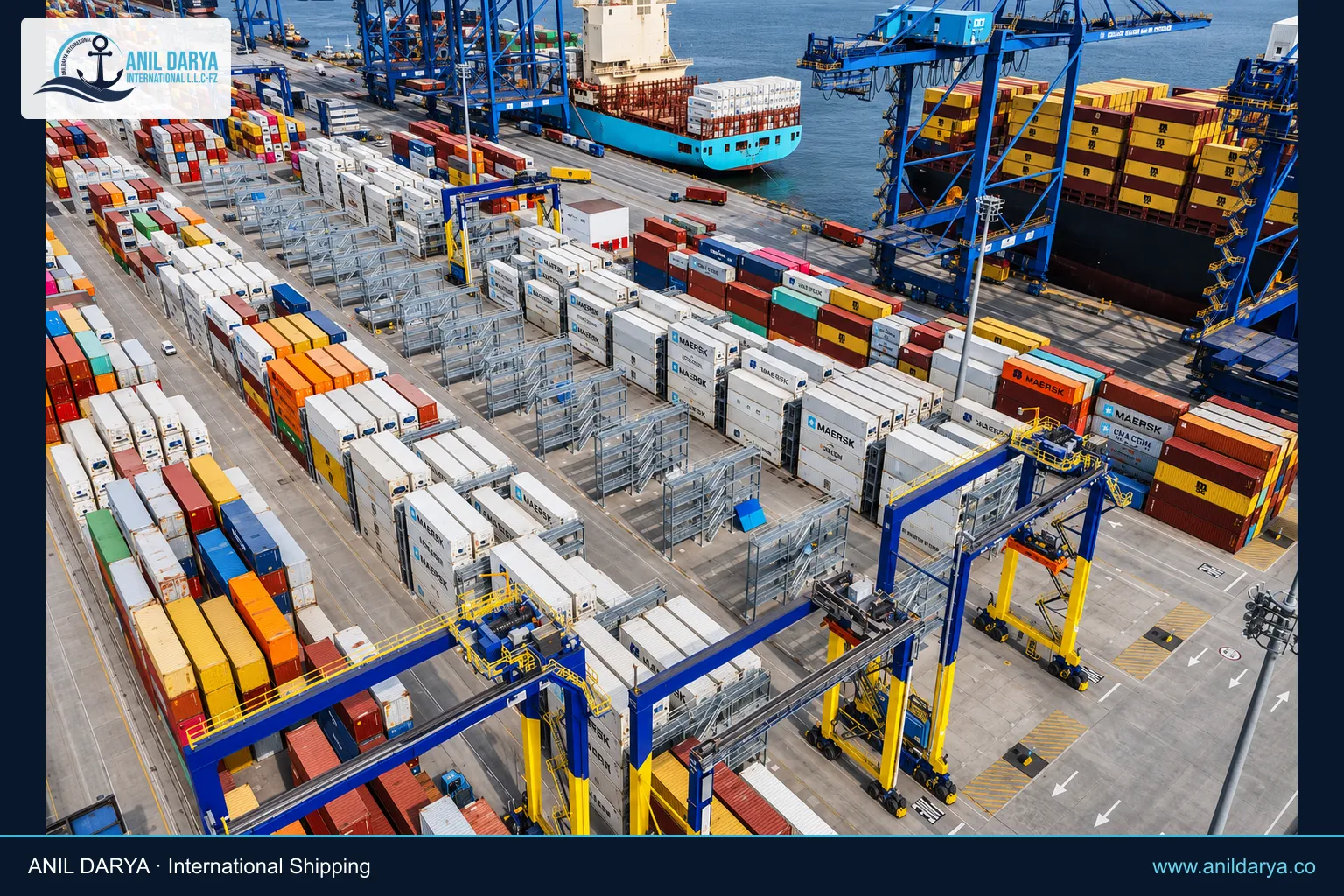
- FCL (full container load). You book a whole 20ft or 40ft box. This suits most cargo between the UAE and the Canary Islands, because island volumes are small and a sealed box avoids extra handling.
- LCL (less than container load). Your cargo shares a box and is unpacked in Las Palmas. Consolidation on this lane is thin, so ask us about frequency before you plan around it.
Transshipment is a big part of the port's traffic. Some boxes for West Africa or the Atlantic islands change ships here. If your cargo goes through Las Palmas on a through bill of lading to another port, tell us at booking so the routing and documents show the final destination. Our guide to FCL vs LCL costs shows where the break-even sits, and our sea freight service page explains what we book.
Dangerous goods at the Port of Las Palmas
Las Palmas handles IMDG dangerous goods under Spain's national port rules, Royal Decree 145/1989 on admission, handling and storage of dangerous goods in ports. The key rule for you: the shipper or consignee must ask the port director for admission in writing 48 hours before the goods arrive. No DG may enter the port’s land area without that written authorisation. Article 13.2 provides a shorter-notice procedure where the loading-port departure is less than 48 hours before arrival; the local agent must confirm the applicable process.
What you need for any DG shipment to or from Las Palmas:
- UN number, proper shipping name, class and packing group where applicable.
- A Safety Data Sheet for each product.
- A Dangerous Goods Declaration signed by a trained person.
- Packaging meeting the applicable IMDG requirements, marks, labels and container placards.
- Data sent early enough for the 48-hour admission request in Las Palmas.
Our dangerous goods shipping team checks the paperwork and gets carrier acceptance before you commit to a sailing.
Customs and taxes at Las Palmas: why the Canary Islands are different
This is the part that catches most shippers out. Our Valencia guide covers the mainland Spanish rules. Las Palmas follows the same EU customs law but not the same tax.
| Charge | Mainland Spain port | Las Palmas |
|---|---|---|
| EU customs duty | EU tariff (TARIC) | EU tariff (TARIC), with some exemptions under Canary Islands measures |
| Indirect tax at import | Spanish VAT | IGIC, collected under the Canary Islands tax system |
| Extra local tax | None | AIEM on some goods, at 5%, 10% or 15% |
Customs duty
The Canary Islands are inside the EU customs union, so duty comes from the EU tariff. Look up your 10-digit TARIC code. The EU and the UAE launched free trade talks on 28 May 2025, but no agreement is in force, so UAE-origin goods pay the standard third-country rate. Spain's tax agency also lists two Canary Islands schemes: the Special Supply Regime (REA), with exemptions and aid for some products, and Specific Tariff Measures, which let some industrial products enter free of import duty.
IGIC instead of VAT
Spain's VAT law excludes the Canary Islands from the VAT territory. Instead, the islands charge IGIC, which taxes imports of goods into the Canaries whoever the importer is. The Agencia Tributaria Canaria's table of common imports shows rates of 0%, 3%, 5%, 7%, 15% and 20%. For example, it lists books and non-motor bicycles at 0%, shoes at 3%, sunglasses at 7% and perfumes at 15%.
AIEM on some goods
The AIEM is a one-off tax on imports of goods into the islands that compete with local production, at 5%, 10% or 15%. The same ATC table lists roasted coffee at 15% AIEM and chocolate at 10%, on top of IGIC. Check both columns for your goods.

The rest of the EU rules
- Commercial importers normally need an EORI number; confirm any applicable exception with the customs agent.
- For containers, the carrier files the EU entry summary declaration normally at least 24 hours before loading onto the vessel bringing the goods into the EU for deep-sea container traffic; route-specific exceptions and house-level filing responsibilities must be checked.
- Goods wait in temporary storage under customs control for no longer than 90 days.
- Cargo sent on from the Canaries to mainland Spain leaves the IGIC area and enters the VAT area, so plan a second set of formalities.
The Gran Canaria free zone
The port authority set up the Zona Franca de Gran Canaria in 2001, and a consortium of the national, regional and other public bodies runs it. If your buyer stores goods for re-export to West Africa, ask its customs agent whether the free zone fits.
How to ship from Dubai to Las Palmas: step by step
This is how we handle shipping from Dubai to Las Palmas. We book space, prepare documents, and arrange UAE trucking and export. A customs agent in the Canary Islands, appointed by the consignee, clears the goods and pays the island taxes.
- Tell us about the cargo. Commodity, TARIC code, weight, volume or dimensions, and the Incoterm agreed with your buyer.
- Check the taxes. The buyer's agent confirms duty, IGIC and any AIEM for the codes, so nobody is surprised at clearance.
- Pick the service. We compare carrier routings from Jebel Ali to Las Palmas and confirm the transshipment port and the terminal.
- Book space. DG, reefer and out-of-gauge cargo need carrier acceptance, and DG data must reach Las Palmas in time for the 48-hour admission request.
- Send full shipping instructions early so the carrier can file the entry summary declaration before loading.
- Stuff, seal and export. We arrange pickup, stuffing, the UAE export declaration and gate-in. Our Jebel Ali port shipping guide covers this end.
- Clear in Las Palmas. The consignee's agent files the import declaration and pays duty, IGIC and AIEM.
- Deliver. The box leaves the terminal by truck, or goes on by inter-island feeder to Lanzarote or Fuerteventura.
How long does shipping from Dubai to Las Palmas take?
The schedule data checked lists MSC transshipment options of about 41 days 14 hours from Khor Fakkan and 36 days 18 hours from Sohar in Oman. These are indicative port-to-port schedules, excluding any move from Dubai to the loading port. Treat these as a sign that routings are long and change often, not as a promise. Confirm the days on your booking.
Request a dated carrier offer showing the transfer ports, terminal, sailing frequency and estimated port-to-port duration in each direction before booking.
How to ship from Las Palmas to Dubai
Shipping from Las Palmas to Dubai covers goods made or stored in the Canary Islands, frozen seafood, and cargo re-exported from the free zone. We book the space with the carrier, coordinate the origin side with the shipper or its agent, then clear and deliver the cargo in the UAE. We have no office in the Canary Islands, so export formalities there are done by the seller or the seller's agent.
- Agree the Incoterm. Under FOB Las Palmas the seller delivers to the ship and handles export clearance. Our guide to Incoterms 2020 for sea freight explains the split.
- Book space. We book with the carrier from Las Palmas to Jebel Ali or Khalifa Port and confirm the hub, the terminal and the cut-offs.
- Pickup and stuffing. The empty is released at the terminal, stuffed at the shipper's premises or a cold store, and returned full before the cut-off.
- Export declaration. The shipper or its customs agent files it electronically in the EU's Automated Export System.
- Documents for the UAE. Commercial invoice, packing list, certificate of origin and bill of lading, plus health certificates for food and any permit for restricted goods.
- UAE clearance. We file the import declaration, or a licensed clearing agent does it with your authorisation. Customs duty in Dubai is 5% of the CIF value for most goods, and import VAT is normally 5% on customs value including freight and insurance, plus customs duty and applicable excise tax, subject to exemptions.
- Delivery. We collect the delivery order, book the truck and deliver to your site, cold store or free zone.
An eligible VAT-registered UAE importer with its customs registration linked to the Federal Tax Authority can normally account for import VAT through its VAT return; confirm eligibility before arrival. For reefer cargo, agree the set temperature and the free time at both ends before the box is released. If the goods are for Abu Dhabi, compare a routing into Khalifa Port in Abu Dhabi.
Checklist for Port of Las Palmas shipping
- TARIC code confirmed for every item going to the Canaries, or the UAE HS code for cargo coming to Dubai.
- IGIC and AIEM rates checked for each code.
- Importer named, with an EORI number in the Canaries or a customs business code in the UAE.
- Terminal (OPCSA or Boluda) confirmed on the booking.
- Invoice, packing list and bill of lading show the same weights, piece counts and parties.
- Full goods description ready before loading for the EU entry summary declaration.
- For DG: SDS, DG declaration, carrier acceptance and the 48-hour admission request.
- For food: health certificates and a border inspection post check booked.
- Onward plan for other islands or mainland Spain, if the cargo does not stay on Gran Canaria.
- Free time on the container agreed with the carrier at both ends.
Common mistakes with Las Palmas shipments
- Pricing the landed cost with Spanish VAT. The Canaries charge IGIC, and AIEM can apply on top.
- Forgetting the second tax step when goods move on to mainland Spain.
- Late DG data. Without the required admission authorisation, dangerous goods cannot enter the port area; confirm the normal 48-hour notice or applicable exception.
- Assuming a fast direct route. The checked options use transshipment; confirm the routing before booking.
- Assuming a preferential EU duty rate for UAE goods. No agreement is in force.
- Wrong Incoterm on the Las Palmas to Dubai leg, so nobody files the export declaration in time.
- Ignoring free time. Every extra day adds demurrage or detention. Our article on demurrage and detention shows how it builds up.
Frequently asked questions
What is the port code for Las Palmas?
The UN/LOCODE for the Port of Las Palmas is ESLPA. Locally it is also called Puerto de La Luz.
Do you pay VAT on imports into Las Palmas?
No. The Canary Islands are outside the Spanish VAT territory. Imports pay IGIC, the Canary Islands tax, at the rate for the goods, plus AIEM on some goods, on top of any EU customs duty.
Is the Port of Las Palmas in the EU customs union?
Yes. The Canary Islands are inside the EU customs union, so EU customs duty from the TARIC tariff applies. They are outside the EU VAT territory and also have specific excise-tax arrangements.
How many containers does the Port of Las Palmas handle?
The Port of Las Palmas handled 1,220,326 TEU in 2024. In 2025 the port authority's five ports handled more than 1.6 million TEU, with 0.95 million TEU of transshipment.
Who operates the container terminals at Las Palmas?
Operaciones Portuarias Canarias (OPCSA) and La Luz S.A., Boluda's container terminal, run the container quays. OPCSA added two Malacca-max cranes of 65 tonnes in 2023.
How long does shipping from Dubai to Las Palmas take?
The checked schedule data lists transshipment options of about 42 days from Khor Fakkan and 37 days from Sohar. Confirm the complete routing, origin trucking and estimated transit on your booking.
Can you arrange shipping from Las Palmas to Dubai?
Yes. We book the space from Las Palmas to Jebel Ali or Khalifa Port, work with the shipper or its agent on the export side, then clear the goods through UAE customs and deliver them.
Can I ship dangerous goods to Las Palmas?
Yes, under IMDG rules and Spain's Royal Decree 145/1989. The normal admission request is due 48 hours before arrival, with the short-voyage exception described above.
Get a quote for Port of Las Palmas shipping
Send us your cargo details, the delivery island and the direction (Dubai to Las Palmas or Las Palmas to Dubai), and we will come back with a routing and a price. Use our freight rate inquiry form, or contact our team about a DG or reefer move. You can also read more about our Dubai freight forwarding team.
Sources
- Autoridad Portuaria de Las Palmas: Annual report 2024 (quays, depths, cranes, operators, TEU, bunkers, free zone)
- Puertos del Estado: Statistical yearbook 2025 (Las Palmas traffic, entrance channel)
- Wikipedia: Port of Las Palmas (location, UN/LOCODE, frozen fish, border inspection post)
- iContainers: Port of Las Palmas
- Fluent Cargo: Dubai to Las Palmas routes and transit data
- BOE: Royal Decree 145/1989 on dangerous goods in ports
- BOE: Law 37/1992 on VAT, Article 3 (Canary Islands outside the VAT territory)
- Agencia Tributaria Canaria: IGIC
- Agencia Tributaria Canaria: AIEM
- Agencia Tributaria Canaria: IGIC and AIEM rates for common imports
- Spanish Tax Agency (AEAT): Canary Islands customs specifics (REA, Specific Tariff Measures)
- European Commission: Canary Islands AIEM
- European Commission Access2Markets: Customs clearance documents and procedures
- European Commission: What is exportation (Automated Export System)
- European Commission: EU-UAE agreement negotiations
- Dubai Customs: Frequently asked questions (duty rate, business code, clearing agents)
- Federal Tax Authority: VAT guide (5% rate, import VAT and deferral)
Reviewed: 15 November 2026