
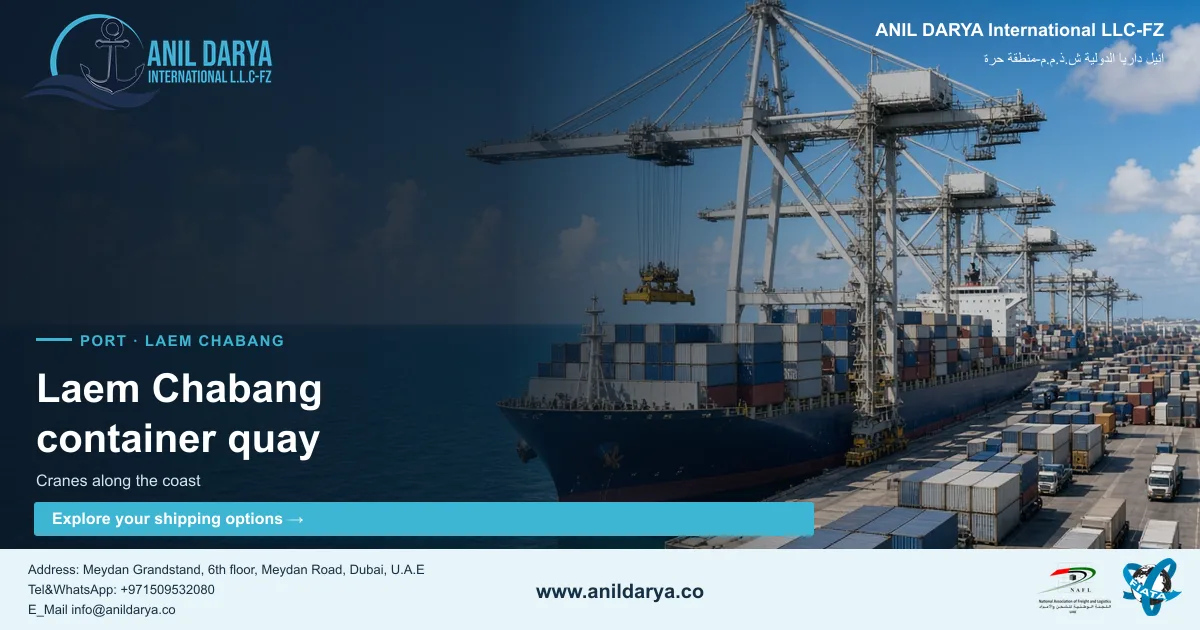
Laem Chabang port shipping covers most of the container cargo that enters and leaves Thailand. The port is Thailand's largest, run by the Port Authority of Thailand (PAT) with private terminal operators, and sits in Chonburi province about 130 km south of Bangkok. This guide covers the basins and terminals, the rules for LCL and dangerous goods, Thai Customs, and how we ship your cargo there from Dubai. We ship both ways: from Dubai to Laem Chabang, and from Laem Chabang to Dubai with clearance on arrival in the UAE.
Laem Chabang Port at a glance
| Item | Detail |
|---|---|
| Port authority | Port Authority of Thailand (PAT) |
| Terminal operators | Private companies on PAT concessions, terminal by terminal |
| UN/LOCODE | THLCH |
| Location | Chonburi province, about 130 km south of Bangkok |
| In operation since | 1991 (construction began 1987) |
| Basin 1 | Seven container terminals plus multipurpose, passenger, general cargo and car terminals; 14 m alongside |
| Basin 2 | Six container terminals plus a general cargo terminal; 16 m alongside |
| Current terminals (EECO count) | 11 container, 4 multipurpose, 2 Ro-Ro car, 1 bulk, 1 cruise |
| Container capacity | About 11 million TEU a year, rising to 18 million TEU with Phase 3 |
| Phase 3 | Terminal F1 due to open in 2027, F2 in 2031 |
| Rail | State Railway of Thailand link to the Lat Krabang inland container depot |
| Nearest major airport | Suvarnabhumi, about 120 km |
| Customs | Thai Customs Department, with an office at the port |
| Import VAT | 7% on CIF value plus duty plus any excise |
| Laem Chabang to Dubai (import) | Thai export goods declaration by the exporter or its customs broker; Dubai Customs declaration, 5% duty on CIF for most goods, 5% import VAT |
Where is Laem Chabang Port and how does cargo reach it?
Laem Chabang is a deep-water port in Chonburi province, about 130 km south of Bangkok. Construction started in 1987 and the first two terminals, B1 and B3, opened in 1991. PAT has guided its development since then and is now building Phase 3.
The port has three land links you can use:
- Road. The terminals are within 2 km of the main highway between Bangkok and the eastern region, and several trucking lines serve the port.
- Rail. The State Railway of Thailand runs a direct line to the Lat Krabang inland container depot (ICD) in eastern Bangkok, about 110 km away.
- Air. Suvarnabhumi Airport is about 120 km from the port, which helps with sea-air plans and urgent split shipments.
A simple rule: if your consignee is in the Eastern Economic Corridor (Chonburi, Rayong and nearby), clear and truck straight from the port. If the consignee is in Bangkok, compare direct trucking against rail to Lat Krabang and clearance there.
Which terminals does Laem Chabang Port have?
PAT owns the port and gives concessions to private operators for each terminal. Terminals are named by basin letter and number. Your carrier's service decides the terminal, so read it on the booking and the arrival notice before you plan a truck.
Basins and terminal layout
| Basin | Terminals | Depth alongside | Vessel size |
|---|---|---|---|
| Basin 1 (Phase 1, 1987-1998) | Container: A2, A3, B1 to B5. Also A0 multipurpose and coastal, A1 passenger, A4 general cargo, A5 car terminal | 14 m | Up to about 6,500 TEU |
| Basin 2 (Phase 2, 1998-2008) | Container: C1 to C3, D1 to D3. Also C0 general cargo | 16 m | Some of the largest vessels in service |
| Phase 3 (in development) | Terminals F1 and F2, later E0, E1 and E2, in a U-shaped basin 800 m wide and 2,000 m long | 18 m alongside, 18.5 m dredged channel | Super post-Panamax, over 10,000 TEU |
Basin 1 also offers pilotage, ship repair and a floating dock of 140,000 DWT capacity.
Container terminal details
Two operators publish full terminal data. The figures below come from their own pages.
| Terminal | Operator | Quay length | Depth | Reefer plugs | Capacity or volume |
|---|---|---|---|---|---|
| A2 (multipurpose, from 2002) | Hutchison Ports Thailand | 400 m | 14 m | 384 | About 0.4 million TEU and 0.6 million tonnes a year; vessels up to 50,000 DWT |
| A3 (multipurpose, from 2006) | Hutchison Ports Thailand | 350 m | 14 m | 408 | About 0.4 million TEU a year |
| B3 (container) | ESCO | 300 m | 14 m draft | 430 | Yard for 6,000 TEU dry, plus 3,200 TEU off-site |
| C1 and C2 (container, from 2007) | Hutchison Ports Thailand | 1,200 m | 16 m | 864 | About 2.4 million TEU a year |
| D1 to D3 (container, from 2019) | Hutchison Ports Thailand | 1,700 m when complete | 16 m | 1,860 | About 3.5 million TEU a year when complete |
Terminal D's first phase, with 1,000 m of berth, 6 super post-Panamax quay cranes and 20 yard cranes, has worked in full since October 2019. When complete it will have 17 quay cranes and 43 rubber-tyred gantry cranes, all remote-controlled. Other terminals, such as B1, B5 and C3, are run by other operators. ESCO also holds stakes in A0 and B1.
Services inside the terminals
| Service | What the operators list |
|---|---|
| Container handling | Vessel loading and discharge, gate receiving and delivery, 24 hours a day |
| Documentation | One-stop receipt and delivery desks at the terminal |
| CFS | Container freight stations at A2 (1,000 sq m), A3 (3,000 sq m) and C1 and C2 (4,200 sq m) |
| General cargo and Ro-Ro | Handled at multipurpose terminals A2 and A3, plus the dedicated general cargo and car terminals |
| Gates | At B3, six gates with two container weighing machines and an average processing time of three minutes per container |
| Tracking | Online container, booking and bill of lading tracking, and the Hutchison Ubi app |
How busy is Laem Chabang, and what is Phase 3?
The Eastern Economic Corridor Office (EECO), the Thai government body for the region, publishes the port's current size. Its latest figures list total container capacity of about 11 million TEU a year, 9.4 million TEU of containers handled, 95.2 million tonnes of cargo, 1.34 million cars and 12,123 ship calls. Imports and exports are almost even, at 50.2% and 49.8%. EECO ranks the port 16th in the world and 14th in Asia.
Most cargo still leaves the port by road. EECO's hinterland split, based on PAT data, is 87.7% truck, 6.6% coastal ship and 5.7% rail. Expect road traffic at the gates in peak periods and book truck slots early.
Phase 3 is PAT's expansion to take container capacity from 11 to 18 million TEU a year. The main facts from EECO:
| Item | Phase 3 detail |
|---|---|
| Terminal F1 | 1,000 m quay, 2 million TEU a year, opening 2027 |
| Terminal F2 | 1,000 m quay, 2 million TEU a year, opening 2031 |
| Terminals E0, E1, E2 | E0 multipurpose; E1 and E2 together 3 million TEU a year; dates not set |
| Operator of F1 and F2 | GPC International Terminal, 35-year concession signed 25 November 2021 |
| Total investment | 110,924 million baht, 44% PAT and 56% private |
| Rail target | Rail share of port freight from 7% to 30%, through a rail transfer centre |
For shippers in 2026, Phase 3 changes nothing yet. Your cargo will use the Basin 1 and Basin 2 terminals until F1 opens.
Should you use Laem Chabang or the Bangkok river port?
Thailand has two PAT container ports, and they work very differently. Bangkok Port at Khlong Toei is a river port inside the city that takes only smaller ships, so most international services from the UAE call at Laem Chabang instead. Laem Chabang has 14 to 16 m alongside and handles far more containers.
| Point | Laem Chabang | Bangkok Port (Khlong Toei) |
|---|---|---|
| Type | Deep-water sea port | River port in central Bangkok |
| Ships | Large mainline vessels | Smaller feeder vessels |
| Best for | Most cargo from Dubai, DG, breakbulk, cargo for the east | Cargo for central Bangkok on a service that calls there |
| Link to Bangkok | 130 km by road, or rail to Lat Krabang ICD | Inside the city; Lat Krabang ICD is 30 km away |
Your bill of lading decides the port. If you need Bangkok Port, confirm at booking that the service actually calls there.
What cargo can you ship through Laem Chabang?
| Cargo type | How it moves | What to plan |
|---|---|---|
| General goods | FCL or LCL at the container terminals | Terminal on the booking, delivery order, truck or rail |
| Chilled and frozen food | Reefer containers on terminal plug-in points | Set temperature, Thai FDA permit before arrival |
| Vehicles | Ro-Ro via the car terminal, or in containers | Import permits, inspection |
| Steel, machinery, project cargo | General cargo terminals or multipurpose berths, or flat racks | Lifting points, lashing, road permits |
| Dangerous goods | IMDG containers, direct delivery | Clearance and truck ready at berthing |
FCL and LCL shipping to the port of Laem Chabang
FCL is the simplest route. Your box is discharged at the terminal, the consignee clears it, and a truck or train takes it out. FCL suits anything that fills most of a 20ft or 40ft, and any cargo that needs a single seal from Dubai to the door.
LCL works differently. The consolidated box goes to a container freight station, where it is unpacked and each shipper's cargo is released separately. Terminal rules limit what CFS can take. ESCO, for example, publishes these conditions:
- Cargo must be in cases or on pallets, no heavier than 4.5 tonnes, and movable by forklift.
- CFS service is for consolidated containers only.
- Loose powder, chemicals that could pollute, cars, machinery, unpacked steel pipe and dangerous goods are not accepted as CFS cargo.
- For export, CFS cargo closes 30 hours before vessel berthing at Laem Chabang, or 6 hours before the CY cut-off at the Lat Krabang ICD.
If your cargo breaks these rules, book FCL or breakbulk instead. Our guide to FCL vs LCL costs shows where the break-even usually falls, and our sea freight service books both.
One more detail worth knowing: ESCO limits its liability for damage it causes during unstuffing to 50,000 baht per cargo and 500,000 baht per container. Insure high-value LCL cargo separately.
Should you clear at the port or at Lat Krabang ICD?
Many containers that land at Laem Chabang are cleared and delivered at the Lat Krabang ICD in eastern Bangkok instead. ESCO's Lat Krabang depot sits 10 km from Suvarnabhumi Airport, 30 km from Bangkok Port and 110 km from Laem Chabang, and runs rail transfers to its B3 terminal. Thai Customs keeps an office at both sites.
| Your consignee is | Clear at | Why |
|---|---|---|
| In Chonburi, Rayong or the Eastern Economic Corridor | Laem Chabang | Short truck leg from the terminal |
| In Bangkok or north of it | Lat Krabang ICD | Rail or truck to the ICD, then a short final delivery |
| Shipping DG | Laem Chabang | DG moves by direct delivery from the ship |
| Receiving LCL near Bangkok | Check the consolidator's CFS | The CFS location decides where you collect |
Ask the carrier at booking which delivery point is on the bill of lading. Changing it after sailing can cost money and time.
Breakbulk and project cargo at Laem Chabang
Laem Chabang has a dedicated general cargo terminal in each basin (A4 and C0), a car terminal (A5) and multipurpose terminals that work containers and general cargo at the same quay. A2 alone handles about 0.6 million tonnes of goods a year. That gives you options for steel, machinery, transformers and vehicles.
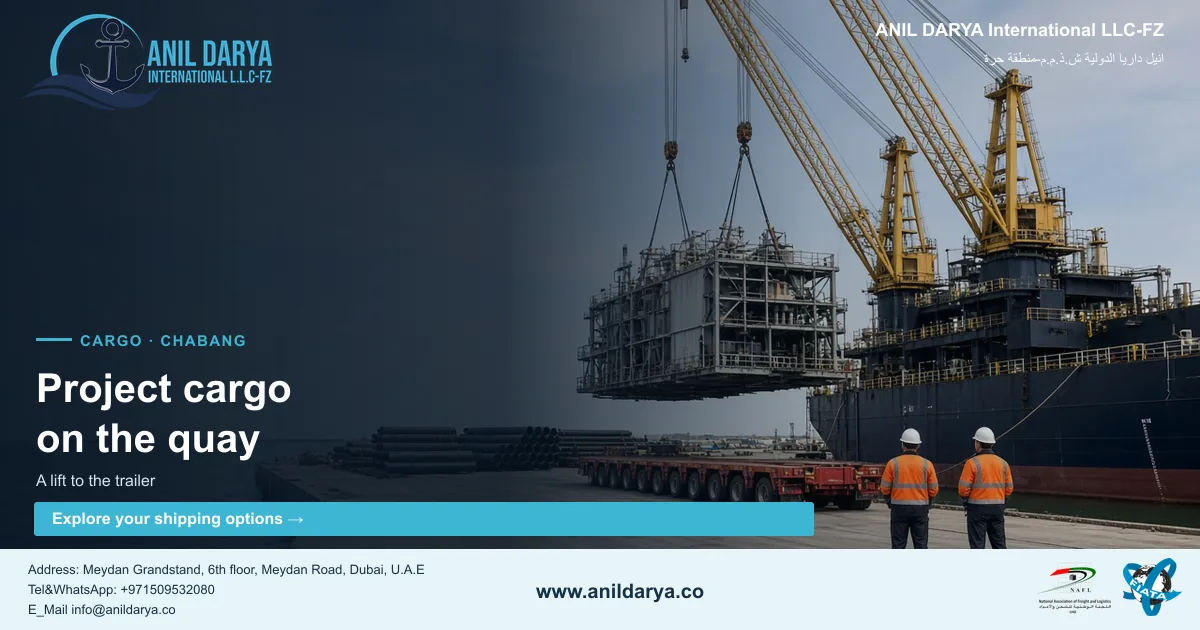
When we plan project cargo from the UAE to Laem Chabang, we work in this order:
- Collect drawings, weights, dimensions and lifting points for each piece.
- Decide between a flat rack on a container service and breakbulk tonnage.
- Agree lashing and securing with the carrier, and the discharge berth with the consignee's agent.
- Have the consignee check permits for used machinery and road permits for oversized pieces.
- Prepare the Thai declaration so the cargo leaves the quay quickly.
Read more on our break bulk and project cargo service.
Dangerous goods at Laem Chabang
DG containers at Laem Chabang are handled as direct delivery. ESCO's published procedure states that DG moves straight from ship to truck chassis on import and from chassis to ship on export. Plan on no yard storage for DG.
That has three practical results:
- The consignee must lodge the import declaration and pay duty and VAT before the vessel berths, or arrange a guarantee.
- Any Thai permit for the substance must be in hand before arrival.
- A truck with a driver trained for DG must be at the terminal when the box comes off the ship.
DG cannot travel as LCL through a terminal CFS, so ship it FCL. On the UAE side you need the UN number, proper shipping name, class, packing group, an English SDS, a signed DG declaration, UN packaging, labels, placards and carrier acceptance. Our dangerous goods shipping team checks all of this before cargo leaves Dubai.
Customs clearance at Laem Chabang: documents, duty and VAT
Thai Customs clears cargo at Laem Chabang under the Customs Act B.E. 2560 (2017). Declarations are lodged electronically, and electronic customs records carry the same legal weight as paper.
What the law requires
- A sea import is complete when the vessel enters the port of discharge.
- Goods leave customs custody only after a goods declaration is lodged and the full duty is paid or a guarantee is lodged.
- The declaration states the type of goods, quantity, weight and quality, customs value, and the countries of departure and destination.
- Customs value includes insurance, freight and loading costs up to the customs house.
- You can request an advance ruling on value, origin or tariff classification, and appeal a duty assessment within 30 days.
Which documents do you need?
| Document | Purpose |
|---|---|
| Commercial invoice | Value, Incoterm, HS codes |
| Packing list | Weights, pieces, marks |
| Bill of lading | Title to the cargo; consignee must match the Thai importer |
| Freight and insurance amounts | Part of the customs value |
| Certificate of origin | Proof of origin |
| Permit or licence | For restricted goods such as food, medicine, cosmetics, plants, animals, vehicle parts, alcohol, tobacco and radio equipment |
| SDS and DG declaration | Dangerous goods only |
| Delivery order | Issued by the carrier's local agent after charges are paid |
How much are duty and VAT?
Import duty depends on the HS code in the Thai customs tariff, which Thai Customs publishes through its tariff database. There is no UAE-Thailand trade deal in force yet: negotiations on an economic partnership agreement concluded in October 2026, but it still has to be signed and brought into force.
Import VAT is 7%, collected by Customs at import, on the CIF price plus import duty plus any excise and other fees. Importers pay it whether or not they are VAT-registered. The 7% rate has been extended to 30 September 2027.
What if cargo is not cleared?
Goods left more than 30 days in customs custody without a declaration or duty payment, after Customs has notified the transporter and 15 days have passed, become un-cleared goods. Customs can sell them at auction, destroy them or order them re-exported. Storage and container charges run the whole time.
How to ship from Dubai to Laem Chabang Port, step by step
This is how we handle a typical export from the UAE to Laem Chabang. We book space, prepare documents, arrange UAE trucking and export clearance, and work with your consignee or its Thai customs broker on arrival.
- Tell us about the cargo: commodity, HS code, weight, volume or dimensions, pickup point, Thai delivery address and Incoterm.
- Check Thai rules with your consignee: duty rate, permits and the delivery point (Laem Chabang or Lat Krabang).
- Get a quote and choose the service. Most sailings load at Jebel Ali; see our Jebel Ali Port shipping guide. Some services use Khalifa Port in Abu Dhabi.
- Book space. For DG, reefer and out-of-gauge cargo we get carrier acceptance first.
- Collect, stuff and seal the container, file the UAE export or re-export declaration and gate in before the cut-off.
- Check the draft bill of lading against the invoice and packing list, then release the final bill.
- Send the document set to the consignee so it can lodge the Thai declaration before the vessel berths.
- The consignee pays duty, VAT and local charges, collects the delivery order and takes delivery at the terminal or the ICD.
[AMIR-FACT: the carriers or services we actually book from Jebel Ali to Laem Chabang, which Laem Chabang terminal each uses, and our typical port-to-port days]
How to ship from Laem Chabang Port to Dubai
We also handle the other direction: shipping from Laem Chabang to Dubai, with arrival at Jebel Ali, Khalifa Port or Sharjah port. We book the space with the carrier and run the UAE side. The Thai export papers stay with the shipper or its Thai agent.
The Thailand export side
- Declaration. Under the Customs Act B.E. 2560, an exporter must submit a goods declaration and pay any duty or lodge a guarantee before the goods leave Thailand. The declaration states the goods, quantity and weight, customs value, and the countries of departure and destination.
- Who files. The exporter, or an authorized agent registered with Thai Customs under section 99 of the Act, usually a customs broker.
- Completion. An export by sea counts as complete when the vessel leaves its last Thai port.
- Permits. Restricted goods need a permit from the agency in charge, and the permit must be presented during customs formalities.
- Terminal. The shipper or its trucker delivers the box to the terminal named on the booking before the cut-off, or rails it from the Lat Krabang ICD.
The UAE import side
On arrival, the declaration goes to Dubai Customs with the commercial invoice, packing list, bill of lading, certificate of origin and any permit for restricted goods. The importer needs a Dubai Customs business code, or a licensed clearing agent with the owner's authorisation files for it. Customs duty in Dubai is 5% of the CIF value for most goods, with 50% on alcohol and 100% on cigarettes. Import VAT is 5%, charged on the customs value including freight and insurance. A VAT-registered importer that has linked its customs registration number with the Federal Tax Authority accounts for it on its VAT return instead of paying at the border.
- Send us the shipper's details in Thailand, the cargo, the HS code and the UAE delivery address.
- We book space from Laem Chabang and send the booking, terminal and cut-off to the shipper.
- The shipper or its trucker collects the empty, stuffs it and delivers it to the terminal or the ICD.
- The shipper or its Thai customs broker files the export goods declaration with any permit.
- We check the draft bill of lading against the invoice and the certificate of origin.
- We file the UAE declaration before the vessel arrives.
- We arrange payment of the duty and VAT and collect the delivery order.
- We truck the cargo to your site in the UAE.
- We return the empty container inside the carrier's free time.
[AMIR-FACT: the carriers we actually use from Laem Chabang to Jebel Ali/Khalifa/Sharjah and our real transit days in this direction]
Free time, demurrage and detention at Laem Chabang
Carriers give a set number of free days for their containers. After that, demurrage runs while the full box stays in the terminal, and detention runs while you keep it outside. Free days and daily rates vary by carrier and container type, so read them on the quote and arrival notice.
Three habits keep these costs down: file the declaration before arrival, have permits ready before the vessel berths, and book the truck or rail move before free time starts. Ask for extra free time at booking if you expect slow clearance. Our article on demurrage and detention explains how the charges add up.
Checklist before you ship to Laem Chabang
- HS code and Thai duty rate checked with the consignee.
- Permit applied for if the goods are restricted.
- Invoice, packing list and bill of lading match on names, weights and pieces.
- Delivery point agreed: Laem Chabang terminal or Lat Krabang ICD.
- Terminal known from the booking.
- LCL cargo palletised or cased, under 4.5 tonnes per piece, and not DG.
- DG: SDS, DG declaration, labels, carrier acceptance and a direct-delivery plan.
- Free time agreed and cargo insurance arranged.
Common mistakes
- Shipping DG as LCL. Terminal CFS rules do not accept it.
- No truck at berthing for DG. Direct delivery means the box cannot wait in the yard.
- Wrong delivery point on the bill of lading. Switching between the port and the ICD after sailing costs time.
- Late permits. Food, cosmetics and telecom gear sit in the yard until the permit arrives.
- Using a FOB value for duty. Thai customs value includes freight and insurance.
- Expecting a UAE trade preference. The partnership agreement is not in force yet.
Frequently asked questions
Who runs the port of Laem Chabang?
The Port Authority of Thailand (PAT) is responsible for the port and grants concessions to private companies that run each terminal. Hutchison Ports Thailand, which runs A2, A3, C1, C2 and Terminal D, describes itself as the largest terminal operator there.
What is the port code for Laem Chabang?
The UN/LOCODE is THLCH. You will see it on bookings, bills of lading and tracking systems.
How deep is the water at Laem Chabang?
Basin 1 has 14 m alongside and Basin 2 has 16 m. PAT's Phase 3 development is planned with 18 m alongside for the largest container ships.
How many containers does Laem Chabang handle?
The Eastern Economic Corridor Office lists about 9.4 million TEU of containers handled against a capacity of about 11 million TEU a year. Phase 3 is planned to lift capacity to 18 million TEU, with Terminal F1 due in 2027.
How far is Laem Chabang from Bangkok?
About 130 km. The Lat Krabang inland container depot in eastern Bangkok is about 110 km from the port and linked to it by rail, and Suvarnabhumi Airport is about 120 km away.
Can I clear my container in Bangkok instead of at Laem Chabang?
Yes, if the bill of lading shows the Lat Krabang ICD as the delivery point. Thai Customs has an office at Lat Krabang, and containers move there from the port by rail or truck.
Can I ship dangerous goods to Laem Chabang?
Yes, as FCL under the IMDG Code. Terminals handle DG as direct delivery from the ship, so the declaration, permits and truck must be ready before the vessel berths.
What import VAT applies at Laem Chabang?
Import VAT is 7%, collected by Thai Customs, on the CIF value plus import duty plus any excise and fees. The rate has been extended to 30 September 2027.
Can you handle shipping from Laem Chabang to Dubai?
Yes. We book the space with the carrier, the shipper or its Thai customs broker files the export declaration, and we clear the cargo through Dubai Customs and deliver it in the UAE. Most goods pay 5% duty on the CIF value plus 5% import VAT.
Can LCL cargo be any size?
No. At ESCO's CFS, LCL cargo must be cased or palletised, no heavier than 4.5 tonnes per piece and movable by forklift. Heavy machinery, cars and DG must go FCL or breakbulk.
Get a quote for Laem Chabang port shipping
Send us your cargo details and we will come back with a routing and a price from the UAE to Laem Chabang or the Lat Krabang ICD. Use our freight rate inquiry form, or contact our team to discuss a DG, breakbulk or project shipment first. You can also read about our Dubai freight forwarding team.
Sources
- Hutchison Ports Thailand: Laem Chabang Port (history, basins, depths, Phase 3)
- Hutchison Ports Thailand: Facilities (terminal areas, berth lengths, depths)
- Hutchison Ports Thailand: Terminal A2
- Hutchison Ports Thailand: Terminal A3
- Hutchison Ports Thailand: Terminal C1 and C2
- Hutchison Ports Thailand: Terminal D
- Hutchison Ports Thailand: Connectivity (road, rail, air)
- Hutchison Ports Thailand: Services
- Eastern Economic Corridor Office: Laem Chabang Port Phase 3 (current capacity, throughput, Phase 3 terminals, investment, timeline)
- ESCO: Terminal B3 (berth, draft, yard, reefer, gates)
- ESCO: Procedures (CFS rules, cut-offs, DG direct delivery, liability)
- ESCO: Lat Krabang ICD (distances, rail, customs offices)
- Thai Customs Department: Customs Act B.E. 2560 (2017), unofficial English translation
- Thai Customs Department: Restricted and prohibited items
- Thai Customs Department: Customs tariff service
- Dubai Customs: Submit customs declaration (documents)
- Dubai Customs: FAQ (5% of CIF, business code, clearing agents)
- UAE Government portal: Customs duty (5% of CIF, alcohol 50%, cigarettes 100%)
- Federal Tax Authority: VAT guide (import VAT at 5%, deferral for registered importers)
- Revenue Department of Thailand: Value added tax
- Nation Thailand: 7% VAT extended to September 2027
- Khaleej Times: UAE, Thailand complete CEPA talks (October 2026)
- Fluent Cargo: UAE to Thailand (Laem Chabang port code)
- Swift Cargo: Laem Chabang vs Bangkok Port (river port vessel limits, citing PAT)
Reviewed: 10 November 2026