
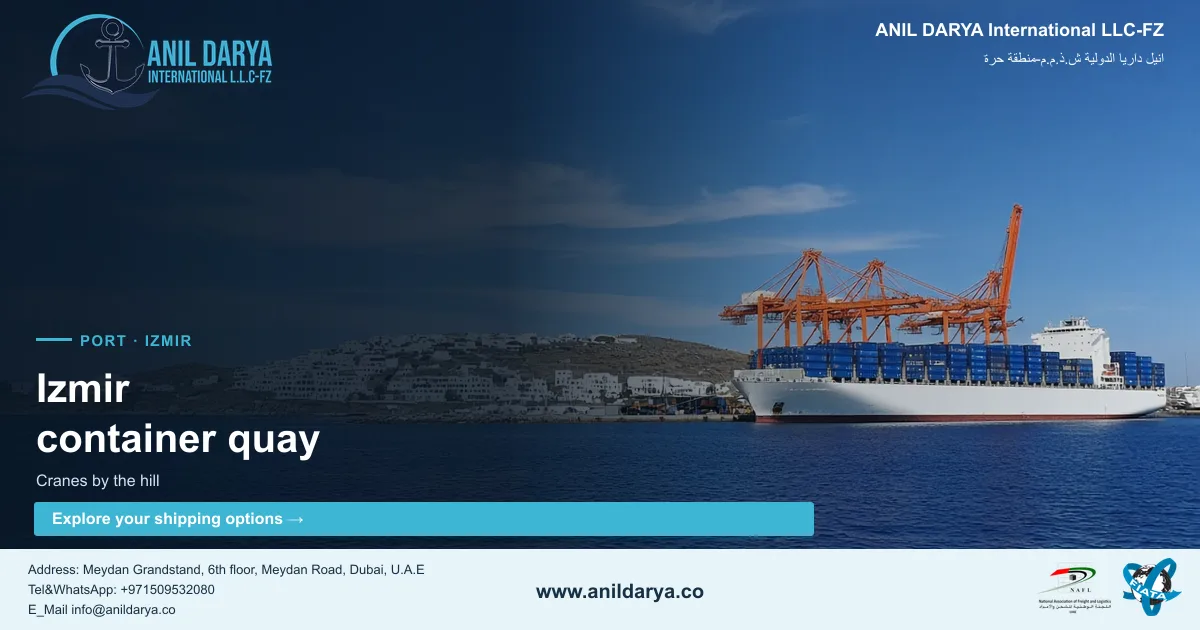
Izmir port shipping runs through two places: Alsancak, the city port of Izmir, and the deep-water terminals at Aliaga and Nemrut Bay, about 40 km to the north. Alsancak passed from Turkish State Railways (TCDD) to a new operator on 1 August 2026, while most large container ships now call at Aliaga, where port facilities handled 1.70 million TEU in 2025. This guide explains which terminal fits your cargo, what each handles and how we ship to Izmir from Dubai. We ship both ways: from Dubai to Izmir and from Izmir to Dubai.
Izmir port guide: key facts at a glance
| Item | Detail |
|---|---|
| Port areas | Alsancak (Izmir city) and Aliaga with Nemrut Bay (north of the city) |
| UN/LOCODE | TRIZM (Izmir, Alsancak), TRALI (Aliaga) |
| Alsancak owner and operator | Owned by the Turkiye Wealth Fund (TVF); cargo operations run by Alport since 1 August 2026 |
| Alsancak quay | 3,386 m, room for 18 ships, average depth 11 m |
| Alsancak container capacity | About 1 million TEU a year, target 1.6 million TEU after dredging |
| Main Aliaga container terminals | SOCAR Terminal, Nemport, TCE Ege |
| Containers in 2025 (Aliaga port authority area) | 1.70 million TEU, fifth in Turkey |
| Total cargo in 2025 (Aliaga port authority area) | 89.51 million tonnes, the most of any port area in Turkey |
| Deepest container berth listed | Nemport, maximum depth 19 m |
| Free zone | Aegean Free Zone (ESBAS) in Gaziemir, Izmir |
| Customs | Turkish Ministry of Trade, BILGE electronic declarations |
| Import VAT | 20% general rate, reduced rates of 10% and 1% |
| Izmir to Dubai | Export declaration in BILGE, approved by the exporters' association; 5% UAE duty on CIF for most goods plus 5% VAT |
Where are the Izmir ports and which areas do they serve?
Alsancak sits at the head of the Gulf of Izmir, inside the city. Aliaga and Nemrut Bay lie up the coast to the north. Data aggregators put Aliaga about 41 km from Izmir port, and the IFC describes Nemrut Bay as about 45 km northwest of Izmir city.
Both port areas serve the Aegean region: Izmir and its industrial zones, Manisa, Aydin, Denizli, Usak and the farming belt behind them. Aliaga is also Turkey's heavy industry coast, with a petrochemical complex, fuel and chemical jetties and a fertiliser plant port on the bay.
A simple rule: the delivery address in greater Izmir does not decide the port by itself. The carrier's service does. Many deep-sea services call at Aliaga, and the box then travels south by road.
Alsancak port: the Izmir city port
Alsancak is the Port of Izmir proper, with LOCODE TRIZM. Its first quay dates from 1869, and the modern port opened in 1959. It has 3,386 m of quay for 18 ships, an average depth of 11 m and a land area of 902,000 m2. Port directories list maximum depths of 13.0 m at the container and Ro-Ro berths and 10.6 m at the breakbulk and bulk berths, with berthing allowed 24 hours a day.
What changed in August 2026
TCDD ran the port for decades. On 1 August 2026, operations passed to the Turkiye Wealth Fund, which keeps ownership, and Alport Alsancak took over the cargo side: containers, bulk, Ro-Ro and hold operations. Turkish press reports say cargo operations will run around the clock and tariffs will not rise before 1 January 2027.
The owner plans a two-phase investment of about USD 1.5 billion. Dredging of the approach channel is planned to start in the first quarter of 2027 and take about two years, so that 400 m ships can enter. Container capacity is about 1 million TEU a year today, with a target of 1.6 million TEU after dredging. A cruise berth with structural problems closes in early 2027 for renewal.
What this means for you: Alsancak suits smaller container ships, Ro-Ro and general cargo for the city. Expect works and possible changes to procedures while the upgrade runs, and check the current tariff and gate rules with the carrier before you book.
Aliaga and Nemrut Bay terminals
Aliaga is the busiest cargo area in Turkey by weight. In 2025 port facilities there handled 89,507,150 tonnes, of which 72,953,676 tonnes (81.5%) were foreign trade, 14.80 million tonnes cabotage and 1.76 million tonnes transit. Container volume in the same area reached 1.70 million TEU. Three container terminals do most of that work.
| Terminal | Quay | Depth | Container capacity | Other cargo |
|---|---|---|---|---|
| SOCAR Terminal | 700 m container quay, plus a 150 m general cargo berth | 16 m minimum (10 m at the general cargo berth) | 1.5 million TEU a year | Project cargo storage when needed |
| Nemport | 1,689 m | 19 m maximum | 1,750,000 TEU a year | General and project cargo, 2,000,000 tonnes a year |
| TCE Ege | 725 m berth inside the Ege Gubre port facility | Not published on the pages we checked | Not published on a current page | Container terminal on leased stacking areas |
| Petkim port | Quay III 190 m, Jetty V 221 m | 11.49 m and 10.5 m | Not a container terminal | Liquid chemicals, fuels, LPG, 1,500,000 tonnes a year |
SOCAR Terminal: quay, depth and storage
SOCAR Terminal received its first ship in 2016 and has been under SOCAR Turkiye since 2018. Its single 700 m quay with a minimum depth of 16 m can take ships of 18,000 TEU. The container yard covers 42 hectares, with a 6 hectare back service area and up to 3 hectares more for project cargo when needed. The operator names healthcare supplies, pharmaceuticals and food among its focus cargo.
Nemport terminal in Nemrut Bay
Nemport has the longest quay in the bay at 1,689 m, with a maximum depth of 19 m and a 350,000 m2 site, including 245,000 m2 of open customs area. Equipment includes 5 ship-to-shore cranes of 65 t, 5 mobile harbour cranes (four of 100 t and one of 140 t) and 15 electric RTGs. It handles containers, general cargo and project cargo, which makes it a strong option for heavy pieces.
TCE Ege and the liquid terminals
TCE Ege runs a container terminal inside the Ege Gubre port facility in Nemrut Bay, with a 725 m berth, under a long-term lease of the stacking areas and priority use of the piers. Around the bay, Petkim and other industrial jetties handle liquid chemicals, fuels and gases for the refinery and petrochemical plants.
What cargo can you ship to Izmir?
| Cargo type | Port to look at | What to plan |
|---|---|---|
| General goods in containers (FCL) | Aliaga terminals or Alsancak, set by the carrier | Port of discharge, free time, truck to the consignee |
| Small shipments (LCL) | Consolidator's CFS near the discharge port | Carton marks and packing list |
| Food and pharmaceuticals | SOCAR Terminal or the port on the reefer service | Health certificates, set temperature |
| Machinery and project cargo | Nemport (mobile harbour cranes), SOCAR Terminal | Drawings, lift plan, road permits |
| Steel and general cargo | Nemport, Alsancak breakbulk berths | Lashing, discharge rate, open storage |
| Liquid chemicals in bulk | Petkim and other Aliaga jetties | Receiving facility, tank compatibility |
| Dangerous goods in containers | Container terminal that accepts your class | Terminal acceptance before booking |
| Vehicles | Alsancak Ro-Ro berths, or cars in containers | Conformity documents and permissions |
Container shipping to Izmir port: FCL and LCL
Most cargo from the UAE to the Izmir region moves in containers. FCL suits regular volumes and factory consignees. LCL suits small orders, but the box is unpacked at a CFS first, so release depends on the consolidator's paperwork too.
Check the port of discharge on every booking. A quote that says "Izmir" can discharge at Aliaga or at Alsancak, and the truck leg, the terminal tariff and the customs office differ. Data aggregators list 28 carriers serving Aliaga, with MSC, CMA CGM and Hapag-Lloyd calling several times a week, and 10 carriers serving Alsancak, most of them only every one to two weeks. That pattern is why deep-sea cargo from the Gulf often lands at Aliaga.
[AMIR-FACT: Our real transit time from Jebel Ali to Aliaga or Izmir (Alsancak), and the carriers and transshipment hubs we actually use on this lane]
Our FCL vs LCL cost guide shows where the break-even point usually falls. We book both through our sea freight service and compare more than one carrier and terminal for each quote.
Project cargo and breakbulk to Izmir
The Aegean region imports machinery for its factories, energy plants and the Aliaga industrial zone. Nemport's mobile harbour cranes of up to 140 t, its 19 m depth and its open customs area make it the obvious first call for heavy pieces. SOCAR Terminal can add up to 3 hectares of project cargo storage, and Alsancak has breakbulk berths in the city itself.
How we plan a heavy piece from the UAE to Izmir:
- Collect drawings, weights and centre of gravity for each piece.
- Choose flat rack or open top on a container service, or conventional breakbulk tonnage.
- Confirm crane capacity and quay space at the discharge terminal.
- Check the road route from Aliaga or Alsancak to the site, with permits and escorts.
- Line up the consignee's broker so the cargo leaves the bonded area fast.
If the piece fits a 40ft flat rack, a container service usually gives more sailings. If not, the breakbulk sailing date drives the plan. See our break bulk and project cargo service for what we handle at the UAE end.
Dangerous goods to Izmir port
Aliaga is a chemical and energy cluster, so DG moves here in containers and in bulk. Each Turkish terminal publishes its own dangerous cargo handling guide, and the classes accepted differ. If your carrier's terminal refuses your class, the box can be rolled or rerouted, so we confirm acceptance before you commit to a sailing.
What you need for any DG booking from the UAE:
- UN number, proper shipping name, class and packing group.
- A Safety Data Sheet for each product.
- A signed Dangerous Goods Declaration.
- UN-approved packaging, labels and container placards.
- Any Turkish permit or control certificate, arranged by the consignee.
Our dangerous goods shipping team checks the papers and the carrier's acceptance before booking.
Customs clearance at Izmir: a short summary
Clearance at Alsancak and Aliaga follows the national Turkish process. What changes is the terminal's bonded area and the customs office that handles it.
- A summary declaration is lodged before the vessel arrives.
- For sea cargo, a customs treatment must be given within 45 days of the summary declaration, such as release for free circulation, free zone entry or re-export.
- The importer needs a Turkish tax number. Declarations are filed in BILGE, usually by a licensed customs broker.
- Goods are classified with the 12-digit GTIP code. The first 6 digits match the HS code on your UAE invoice.
- Products under TAREKS, the Ministry of Trade's risk-based control system, need an application before release.
Which documents does the consignee need?
| Cargo | Core documents | Often also needed |
|---|---|---|
| General cargo | Commercial invoice, packing list, bill of lading, certificate of origin | TAREKS approval if the GTIP is listed |
| UAE-origin goods | Core set | Proof of origin to claim CEPA rates |
| Food and farm products | Core set | Control, health, phytosanitary or veterinary certificates |
| Medicines and cosmetics | Core set | Ministry of Health certificates |
| Chemicals and DG | Core set | SDS, DG declaration, control certificates where listed |
| Used goods and vehicles | Core set | Ministry of Trade permission |
Duty and VAT in brief
Turkey's tariff follows the EU Common Customs Tariff for industrial goods. Goods of UAE origin can claim the UAE-Turkiye CEPA, in force since 1 September 2023 and covering 80% of tariff lines, with valid proof of origin. Goods made elsewhere and shipped from Dubai pay the rate for their real origin. Import VAT is 20% for most goods, charged on the CIF value plus duty and other charges. Special consumption tax is added on fuel, vehicles, tobacco, alcohol and luxury goods. Our main Turkey port guide covers the full process.
Aegean Free Zone or free circulation?
The Aegean Free Zone, run by ESBAS, is in Gaziemir on the south side of Izmir. Goods can enter a Turkish free zone as a customs treatment instead of being released for free circulation. Choose the free zone if the consignee holds a licence there and plans to store, process or re-export, and choose free circulation if the goods will be sold in Turkey.

How to ship from Dubai to Izmir port: step by step
This is how we handle shipping from Dubai to Izmir. We book space with carriers, prepare UAE documents and export clearance, and work with the consignee's customs broker in Turkey.
- Send us the cargo details. Commodity, HS code, weight, volume or dimensions, the delivery town and the Incoterm. Our Incoterms 2020 guide for sea freight explains who pays what.
- Choose Aliaga or Alsancak. We check which port each carrier's service discharges at and compare the truck leg to the consignee.
- Confirm Turkish requirements. The consignee's broker checks GTIP, duty, TAREKS and permits before you ship.
- Book space. For DG, reefer or out-of-gauge cargo we get carrier and terminal acceptance first.
- Collect and export from the UAE. We arrange trucking to Jebel Ali port, UAE export clearance and gate-in before the cut-off.
- Issue documents. Invoice, packing list, certificate of origin or CEPA proof of origin, and the bill of lading, checked for matching names, weights and HS codes.
- Arrival and clearance. The summary declaration is lodged, the broker files in BILGE and the consignee pays duty and VAT.
- Delivery and empty return. The consignee's trucker collects at the right terminal and returns the empty within free time.
How to ship from Izmir to Dubai
We also handle the other direction: cargo from Aliaga or Alsancak to Jebel Ali, Khalifa Port or Sharjah port. We book the space with the carrier, check the papers and run the UAE side. The Turkish export formalities stay with the shipper or its Turkish customs broker.
The Turkey export side
- Who can export. Any company or person with a Turkish tax ID that is a member of the exporters' association for the product.
- Export declaration. The goods are declared to customs on a customs declaration prepared in the BILGE system. The exporter can do this itself or through a customs broker, and both must be registered in the Ministry of Trade's Declarant Registration and Tracking System.
- Association approval. The exporters' association the shipper belongs to must approve the declaration before customs processes it. The invoice is attached, or e-invoice users quote its 23-digit code.
- Tariff code. Each item needs its 12-digit code from the Turkish customs tariff on the declaration.
- Permits. Licences or letters of conformity required by Turkish law should be in place before clearance; most run through the Single Window System. Strategic goods, such as military and dual-use items, need permission from the competent authority.
The UAE import side
Before the ship reaches the UAE, the import declaration goes to Dubai Customs. Dubai Customs lists the documents as the commercial invoice, the packing list, the certificate of origin and a permit from the controlling authority for restricted goods. The original or released bill of lading is what the carrier needs before it issues the delivery order. Customs duty in Dubai is 5% of the CIF value for most goods, with 50% on alcohol and 100% on cigarettes. The UAE-Turkiye CEPA, in force since 1 September 2023, covers 80% of tariff lines with concessions, so check whether your HS code qualifies and have proof of origin issued in Turkey. Import VAT is 5% of the import value, which includes the customs value, freight, insurance and the duty paid. A VAT-registered importer accounts for it on its VAT return under the reverse charge; an importer that is not registered settles it at import.
- Send us the shipper's details in Turkey, the cargo, the HS code and the UAE delivery address.
- We book space from Aliaga or Alsancak and send the booking and cut-offs to the shipper.
- The shipper or its trucker collects the empty, loads it and delivers the box to the terminal before the cut-off.
- The shipper or its customs broker files the export declaration in BILGE, after approval by the exporters' association.
- We check the draft bill of lading against the invoice, packing list and proof of origin.
- We file the Dubai Customs import declaration before the ship arrives.
- We arrange payment of the duty and VAT and collect the delivery order from the carrier's UAE agent.
- We truck the box to your site and return the empty to the carrier's depot inside free time.
[AMIR-FACT: the carriers we actually use from Aliaga or Alsancak to Jebel Ali, Khalifa Port or Sharjah, and our real port-to-port transit days in this direction]
Free time and storage at Izmir terminals
Carriers give free days on their containers, and each terminal charges storage after its own free period. Both differ by carrier, terminal and cargo type, so read them on the quote and arrival notice. At Alsancak, tariffs are frozen only until 1 January 2027, so recheck terminal charges for cargo arriving after that date. Our guide to demurrage and detention explains how the charges add up.
Izmir port or another Turkish port: which fits your cargo?
| Consignee or cargo | Port area to compare | 2025 containers |
|---|---|---|
| Aegean region: Izmir, Manisa, Aydin, Denizli | Aliaga (Izmir) | 1.70 million TEU |
| Kocaeli, Gebze or the Asian side of Istanbul | Izmit Bay (Kocaeli) | 2.50 million TEU |
| European side of Istanbul or Thrace | Ambarli | 3.43 million TEU |
| Tekirdag or Corlu | Tekirdag | 2.14 million TEU |
| Southern or central Turkey | Mersin | 1.97 million TEU |
The right port depends on the delivery address, the carriers on the lane and the cargo type. We can price more than one port so you can compare the full cost to the door.
Checklist before you ship to Izmir
- Port of discharge on the booking says Aliaga or Izmir (Alsancak), and the terminal is named.
- Consignee has a Turkish tax number and a licensed broker.
- 12-digit GTIP confirmed and TAREKS status checked.
- CEPA proof of origin ready if the goods are of UAE origin.
- Invoice, packing list and bill of lading match on weights and piece counts.
- Food, medicine, chemical or used-goods permits applied for before sailing.
- DG class accepted at the discharge terminal.
- Lift plan and road route ready for heavy pieces.
- Free time agreed, and current Alsancak tariffs checked.
- Cargo insurance arranged.
Common mistakes
- Assuming "Izmir" means the city port. Many services discharge at Aliaga, about 40 km north.
- Ignoring the Alsancak upgrade. Works and new procedures can change berthing windows and charges.
- Assuming every terminal takes every DG class.
- Using only the 6-digit HS code when duty and controls follow the 12-digit GTIP.
- Claiming CEPA rates for goods that are not of UAE origin.
- Booking a heavy piece without checking crane capacity at the discharge terminal.
Frequently asked questions
Is Izmir port the same as Alsancak?
Yes, the Port of Izmir is also called Alsancak port, with LOCODE TRIZM. Most container traffic for the Izmir region, though, goes through the separate terminals at Aliaga and Nemrut Bay, LOCODE TRALI.
Who operates Izmir Alsancak port?
Since 1 August 2026 the Turkiye Wealth Fund owns the port and Alport Alsancak runs the cargo operations. Turkish State Railways (TCDD) operated it before that.
Which container terminals are at Aliaga?
The main ones are SOCAR Terminal, Nemport and TCE Ege, all on or near Nemrut Bay. Together, the Aliaga port authority area handled 1.70 million TEU in 2025.
How deep is Izmir port?
Alsancak has an average depth of 11 m, and port directories list 13.0 m at its container berths. In Aliaga, SOCAR Terminal lists a 16 m minimum depth and Nemport a 19 m maximum depth.
How does shipping from Dubai to Izmir work?
We book space from Jebel Ali to Aliaga or Alsancak, clear the cargo for export in the UAE and send the documents to the consignee's customs broker in Turkey. The broker files the import declaration in BILGE and the consignee pays Turkish duty and VAT.
Can you ship cargo from Izmir to Dubai?
Yes. The shipper or its Turkish customs broker files the export declaration, approved by the exporters' association, and we book the space, clear the cargo through Dubai Customs and deliver it in the UAE. Most goods pay 5% UAE duty on the CIF value plus 5% import VAT.
Can I ship heavy machinery to Izmir?
Yes. Nemport handles project cargo with mobile harbour cranes of up to 140 t, and SOCAR Terminal has extra storage for project cargo. Confirm the lift plan and road route before booking.
Can I ship dangerous goods to Izmir?
Yes, but each Turkish terminal sets the DG classes it accepts in its own handling guide. Confirm acceptance at the discharge terminal before you book the sailing.
What is the import VAT for goods arriving in Izmir?
Most goods pay 20% import VAT, with reduced rates of 10% and 1% for some products. It is charged on the CIF value plus duty and other charges.
Is there a free zone near Izmir port?
Yes. The Aegean Free Zone, run by ESBAS, is in Gaziemir, Izmir. Goods can enter it as a customs treatment instead of being released into free circulation.
Get a quote for Izmir port shipping
Send us your cargo details and the delivery address in Turkey, and we will come back with a routing and price through Aliaga or Alsancak. Use our freight rate inquiry form, or contact our team to talk through a project, DG or reefer shipment. You can also read more about our Dubai freight forwarding team.
Sources
- Ministry of Transport and Infrastructure: Maritime statistics bulletin 2025 (Aliaga 89.51 million tonnes and 1.70 million TEU, other port areas)
- Baird Maritime: Izmir port USD 1.5 billion upgrade, dredging from 2027 (October 2026)
- YatirimX: Izmir port handed to the Turkiye Wealth Fund, Alport operations (August 2026, Turkish)
- Wikipedia: Port of Izmir (history, quay, depth, area, LOCODE)
- Findaport: Port of Izmir (maximum depths by berth type, 24-hour berthing)
- SOCAR Turkiye: SOCAR Terminal (quay, depth, capacity, storage, cargo focus)
- TURKLIM: Nemport (berth, depth, capacity, equipment, areas)
- TURKLIM: Petkim port (berths, depth, cargo, capacity)
- IFC: TCE Ege container terminal project (location, berth, lease)
- Fluent Cargo: Aliaga TRALI (carriers, distances)
- Fluent Cargo: Izmir TRIZM (carriers)
- ESBAS: Aegean Free Zone (location)
- Ministry of Trade: Import regime FAQ (summary declaration, 45 days, free zone treatment, tax number)
- Ministry of Trade: Tariff FAQ (12-digit GTIP)
- Ministry of Trade: UAE CEPA (in force 1 September 2023, 80% of tariff lines)
- Investment Office of the Presidency of Turkiye: Tax guide (VAT rates, special consumption tax)
- US International Trade Administration: Turkiye import tariffs (EU CCT basis, VAT base)
- US International Trade Administration: Turkiye import requirements (documents, TAREKS, certificates)
- Ministry of Trade: Export regime (who can export, exporters' association, strategic goods)
- Ministry of Trade: Export information sheet (BILGE, customs broker, association approval, 12-digit code, Single Window)
- Dubai Customs: Submit customs declaration (documents)
- UAE Government portal: Customs duty (5% of CIF, alcohol 50%, cigarettes 100%)
- Federal Tax Authority: VAT Decree-Law No. 8 of 2017 as amended (5% rate, import value, reverse charge, unregistered importers)
Reviewed: 10 November 2026