
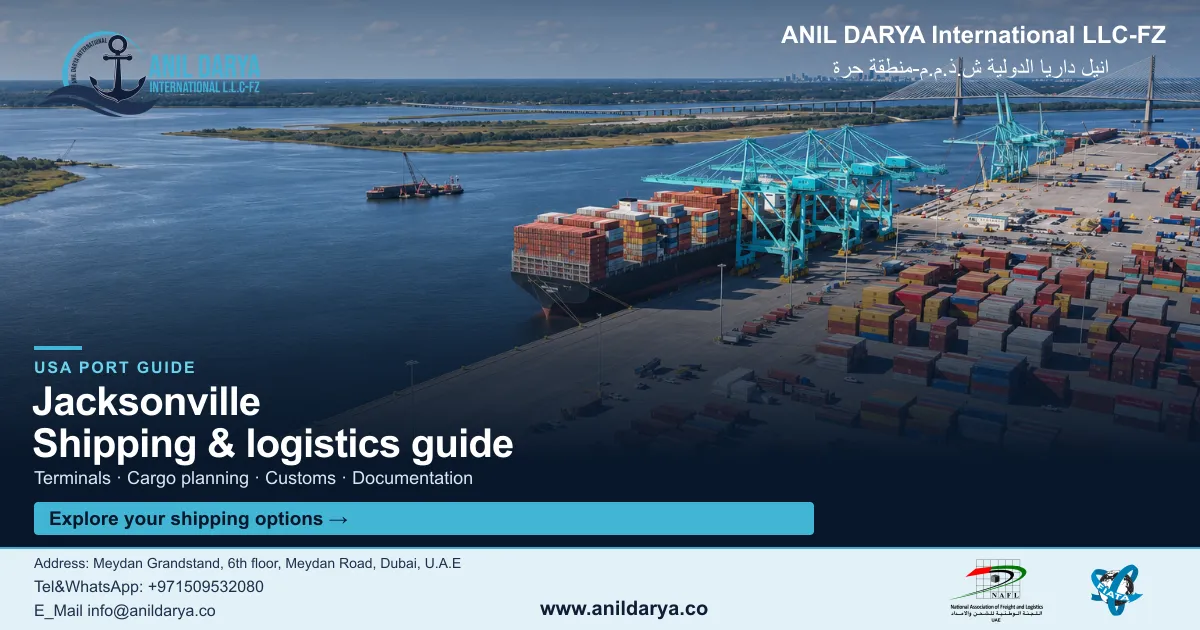
Port of Jacksonville shipping means moving your cargo through JAXPORT, the Jacksonville Port Authority, on the St. Johns River in northeast Florida. Most containers from the UAE land at the SSA Jacksonville Container Terminal on Blount Island, while vehicles, machinery and breakbulk use Blount Island, Dames Point and Talleyrand. This guide covers each terminal, the channel and bridge limits, rail links, the short version of US customs at Jacksonville, and how we ship your cargo there from Dubai. We ship in both directions: from Dubai to Jacksonville, and from Jacksonville to Dubai with clearance in the UAE.
Port of Jacksonville at a glance
| Item | Detail |
|---|---|
| Port authority | JAXPORT (Jacksonville Port Authority), which owns, maintains and markets the public terminals; private tenants run cargo operations |
| Location | St. Johns River, Jacksonville, Florida, US East Coast |
| UN/LOCODE | USJAX |
| US Census / CBP port code | 1803 (Jacksonville, FL) |
| Public marine terminals | Blount Island, Dames Point, Talleyrand |
| Main container terminal | SSA Jacksonville Container Terminal on Blount Island, over 650,000 TEU a year after a 2025 modernization |
| Channel depth | 47 ft through Blount Island; 40 ft project depth up to and including Talleyrand |
| Bridge and power line clearance | Dames Point Bridge 174 ft; Blount Island power lines 175 ft (April 2026), being raised to give 205 ft operational clearance |
| FY2025 volume | 1,388,841 TEU and 506,237 vehicles; 10,230,114 tons in total |
| Rail | CSX and Norfolk Southern, with Florida East Coast Railway near Talleyrand; two intermodal yards (Dames Point and Talleyrand) |
| Network | Direct cargo services to 140 ports in 70 countries, per JAXPORT |
| Terminal access | TWIC card plus a JAXPORT Business Purpose Credential for regular terminal users |
| Advance filing for ocean imports | ISF 10+2, no later than 24 hours before loading at the UAE port |
| Jacksonville to Dubai | EEI filed in the AES by the US shipper or its agent 24 hours before loading; Dubai Customs declaration on arrival at Jebel Ali, Khalifa Port or Sharjah |
What is the Port of Jacksonville and who runs it?
JAXPORT is a public port authority. It owns about 1,500 acres of seaport land and three marine terminals, and leases them to private operators. JAXPORT says more than 99 percent of port jobs are with private companies, and it employs about 150 people itself. In practice this means the terminal operator on your arrival notice, not JAXPORT, sets the gate hours, free time and pickup rules for your container.
The terminals sit along the St. Johns River, not on the open coast. Blount Island is 12.5 nautical miles from the sea buoy, Dames Point is 14.2 nautical miles and Talleyrand is 20.9 nautical miles. The further upriver the berth, the shallower the water, so the largest container ships call at Blount Island.
Jacksonville is a big vehicle port as well as a container port. In fiscal year 2025 (October 2024 to September 2025) JAXPORT handled 1,388,841 TEU and 506,237 vehicles. Breakbulk came to 975,928 tons and bulk to 1,486,514 tons, for a total of 10,230,114 tons across all cargo.
Which terminals does the Port of Jacksonville have?
Your carrier's service decides the terminal. The arrival notice names it, and your trucker needs it before going to the gate. JAXPORT terminals are open every day of the year, but each tenant sets its own operating hours.
SSA Jacksonville Container Terminal: the main box terminal on Blount Island
This is the main container terminal for deep-sea services. SSA Marine operates it on JAXPORT's Blount Island land, and a $72 million modernization finished in 2025 lifted capacity by 150 percent.
| SSA Jacksonville item | Published figure |
|---|---|
| Annual capacity | More than 650,000 TEU |
| Terminal area | 103 acres |
| Rebuilt berth | 3,500 linear ft |
| Container cranes | Nine: six 65-ton 100-gauge and three 50-ton 50-gauge |
| Reefer plugs | 250 |
| Channel and turning basin | 47 ft; basin 2,672 ft by 1,500 ft |
| Gate | Six inbound and six outbound truck lanes |
| Rail | Near-dock CSX connection |
| Highways | Minutes from I-295, with links to I-95 and I-10 |
Blount Island Marine Terminal: containers, Ro-Ro and heavy lift
Blount Island is JAXPORT's largest terminal at 754 acres. Beyond the SSA container yard, it has 7,094 linear feet of deepwater berths, 11 container cranes including six super post-Panamax units, two dedicated Ro-Ro berths and one heavy-lift berth rated to 2,000 pounds per square foot. It has on-terminal rail and sits close to the Dames Point intermodal yard. JAXPORT lists vehicles, containers, Ro-Ro, heavy lift, breakbulk and liquid bulk here.
Dames Point Marine Terminal: containers, autos and bulk
Dames Point is just west of the Dames Point Bridge. It has 5,002 linear feet of berths, six post-Panamax container cranes and six 40-ton rubber-tyred gantries. JAXPORT lists containers (including a direct South America service), autos and bulk here. The Dames Point intermodal yard next door (FIRMS code LC77) is served by CSX with two daily trains, each carrying up to 200 containers.
Talleyrand Marine Terminal: breakbulk, autos and on-dock rail
Talleyrand is JAXPORT's oldest terminal and the furthest upriver. It has 4,780 linear feet of berths, three post-Panamax and three Panamax cranes, and more than 700,000 square feet of warehousing. Cargo includes containers, autos, breakbulk such as steel, lumber, paper and frozen or chilled goods, and liquid bulk such as molasses and vegetable oils. Its on-dock rail yard has direct switching to CSX and Norfolk Southern through a 10-mile short line run by Jacksonville Port Terminal Railroad (Watco), and it is close to the Florida East Coast Railway ramp. Puerto Rico carrier Crowley is a Talleyrand tenant.
Channel depth and air draft: what fits up the St. Johns River
The federal channel is 47 feet deep through Blount Island. Water upriver of that, including Talleyrand, has a 40-foot project depth. Shoaling changes the working depth, so pilots and carriers plan each call against current surveys. An April 2026 port update showed the entrance to Blount Island berth 30 at 46 feet against the 47-foot project depth.
Height matters as much as depth. The same update listed 174 feet of air draft under the Dames Point Bridge and 175 feet under the Blount Island high wires. JEA and JAXPORT are raising the transmission lines at Fulton Cut to give 205 feet of operational clearance so larger ships can reach Blount Island. In July 2026 JAXPORT said helicopter work would continue over the following several months.
| Terminal | Distance from sea buoy | Water | What it means for you |
|---|---|---|---|
| Blount Island (incl. SSA) | 12.5 nm | 47 ft channel | Largest container ships on Asia and transshipment services |
| Dames Point | 14.2 nm | 40 ft at the berths in the April 2026 update | Mid-size container, auto and bulk ships |
| Talleyrand | 20.9 nm | 40 ft project depth | Puerto Rico, Caribbean, breakbulk and auto services |
Rail and road: how far Jacksonville reaches
Jacksonville sells itself on reach into Florida and the Southeast. The port has two intermodal yards and three railroads: CSX, Norfolk Southern and the Florida East Coast Railway. The SSA terminal is minutes from I-295, which links to I-95 north and south and to I-10 west.
| Rail point | Railroads | Serves |
|---|---|---|
| Dames Point intermodal yard | CSX | Northside terminals including Blount Island and Dames Point |
| Talleyrand intermodal yard | CSX and Norfolk Southern via a 10-mile short line | Containers, autos, chemicals, food and paper products |
| Florida East Coast Railway ramp | FEC | Near-dock link south toward central and south Florida |
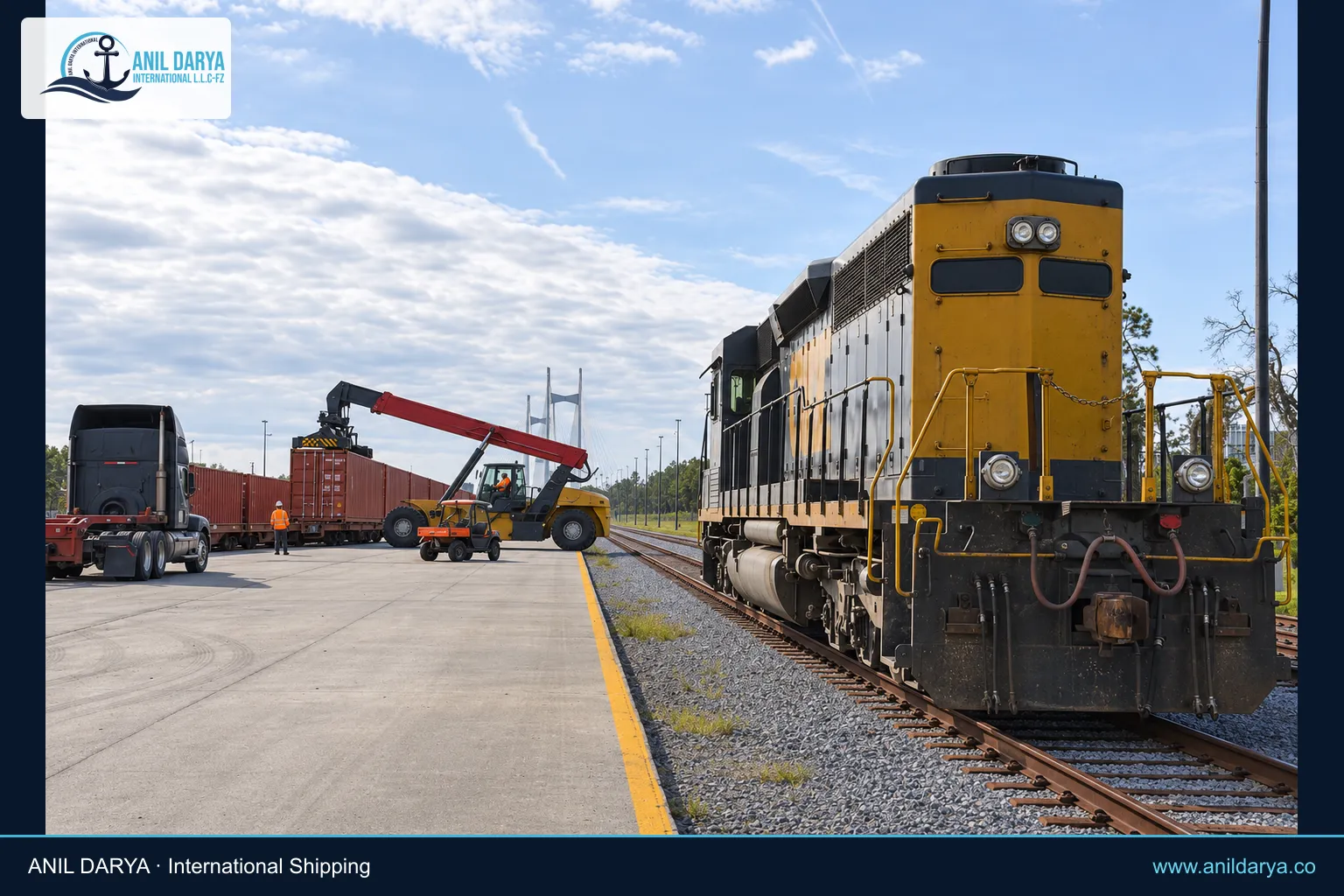
JAXPORT does not hire or arrange truckers. Your consignee, the carrier or a logistics provider books the drayage. Drivers who go to the terminals regularly need a TWIC card and a JAXPORT Business Purpose Credential, so check that your US trucker is set up before the ship arrives.
What cargo can you ship from the UAE to Jacksonville?
Here is how the main cargo types JAXPORT lists usually move through the port.
| Cargo type | Usual terminal | What to plan |
|---|---|---|
| General goods in containers | SSA Blount Island or Dames Point | Terminal on the arrival notice, ISF, trucker credentials |
| Chilled and frozen food | SSA (250 plugs) or Talleyrand cold cargo | Set temperature, FDA prior notice, plug availability |
| Vehicles and wheeled machinery | Blount Island or Dames Point Ro-Ro and auto berths | Ro-Ro service availability from the Gulf, vehicle import rules |
| Steel, lumber, paper | Talleyrand breakbulk | Covered storage, lashing, river depth for the vessel |
| Transformers and heavy units | Blount Island heavy-lift berth | Lift plan, rail or road permits, survey |
| Liquid bulk | Talleyrand and Blount Island liquid berths | Receiving terminal, surveys, tank cleanliness |
Shipping from Dubai to Jacksonville: routes and published transit indications
There is no Jacksonville-only service from the UAE in the sources we checked. Your container usually moves from Jebel Ali or Khalifa Port to a transshipment hub, then on a transatlantic or Caribbean feeder string to Jacksonville. JAXPORT lists the Gemini Florida Shuttle, the Premier Alliance EC3 and the ZCP Amberjack among its Asia container services, and a "North America to Middle East and Asia" Ro-Ro and breakbulk service.
| Published indication | Figure | Source type |
|---|---|---|
| Quickest listed sea route | Khor Fakkan to Jacksonville, about 46 days 5 hours | Schedule aggregator (Fluent Cargo) |
| Carrier on that route | MSC, with two transfers, every 1 to 2 weeks | Schedule aggregator |
| Example service chain | Shikra, then INDUSA, then Bahamas Express | Schedule aggregator |
| Air option shown | Dubai (DXB) to Orlando (MCO), about 16 hours direct | Schedule aggregator |
Treat these as indications, not promises. Transshipment connections change, and a missed connection can add a week or more.
[AMIR-FACT: the carrier services we actually book from Jebel Ali or Khalifa Port to Jacksonville, the transshipment hub they use, and our real port-to-port transit days on this lane]
We book space through our sea freight service and load at Jebel Ali Port or Khalifa Port, depending on where your cargo sits and which carrier offers the better connection.
FCL or LCL to Jacksonville?
FCL means you book a whole 20ft or 40ft container. LCL means your cargo shares a container with other shippers. For LCL, ask where the container is unpacked: at a warehouse in Jacksonville, or at another US gateway with your cargo trucked on from there.
| Situation | Usual choice | Why |
|---|---|---|
| A few pallets for a Florida consignee | LCL | Lower cost for small volumes, but extra handling and release steps |
| Over roughly half a container of goods | Price both | FCL often wins once handling fees at both ends are added |
| Fragile, high-value or food cargo | FCL | Fewer touches, one seal from Dubai to door |
| Cargo going inland by rail | FCL | Rail moves full containers |
Our guide to FCL vs LCL costs walks through the break-even point.
US customs at the Port of Jacksonville: the short version
US customs rules are the same at every US seaport. These are the points that matter for Jacksonville. For the full ISF data list and entry tables, see our Port of Los Angeles guide.
| Step | Rule | Who acts |
|---|---|---|
| ISF 10+2 | Filed no later than 24 hours before the cargo is loaded in the UAE; stuffing location and consolidator no later than 24 hours before US arrival | ISF importer, often its customs broker |
| Entry documents | Within 15 calendar days of arrival | Importer of record or licensed customs broker |
| Entry summary and estimated duty | Within 10 working days of entry | Importer of record or broker |
| Harbor maintenance fee | 0.125% of the CBP appraised value of imported cargo | Importer of record |
Jacksonville specifics: entries are filed at port 1803, which sits in the Tampa customs district. The local CBP office is at 10426 Alta Drive, Jacksonville. Duty depends on the HTSUS code and origin of each product, so the broker checks the rate in force on the arrival date. A late or wrong ISF can bring penalties, more inspections and delays.
Ro-Ro, breakbulk and project cargo at Jacksonville
JAXPORT handled 975,928 tons of breakbulk in FY2025 and pushes heavy electrical and project cargo hard. Its heavy-lift berth at Blount Island is rated to 2,000 pounds per square foot and has on-dock rail with high-and-wide clearances. JAXPORT reports a 331,000-pound generator moved there straight from ship to rail. Stevedores and terminal operators for project cargo include Enstructure, SSA Marine, AMPORTS, First Coast Terminals and APS Stevedoring.
JAXPORT's own project cargo checklist asks for the same things we ask for before booking:
- Verified weight, dimensions, centre of gravity, lifting points and drawings, sent early.
- A lift plan that names who is responsible: carrier, terminal or stevedore.
- A check with your cargo insurer on whether a marine warranty survey is needed.
- Lashing and seafastening planned to the vessel's Cargo Securing Manual.
- ISPM 15 compliant wood packaging with the IPPC mark.
- The same description and classification on the invoice, packing list and bill of lading.
- Florida oversize and overweight permits started alongside ocean planning.
- Vessel space secured early, with a reliable cargo-ready date.
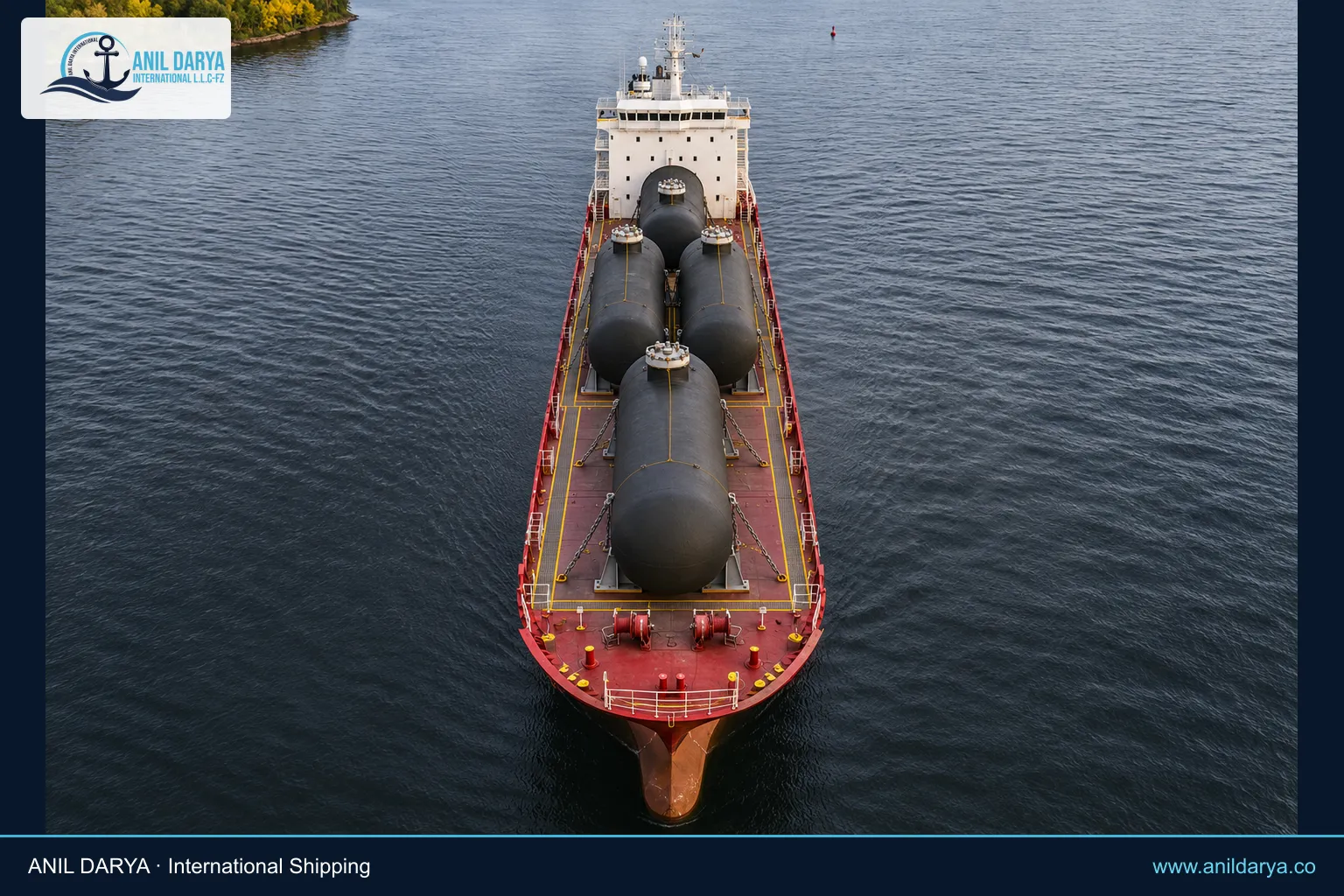
From our side we handle the UAE leg: drawings, carrier engineering approval, flat rack or breakbulk booking, and loading at the UAE port. See our break bulk and project cargo service and the guide to flat rack, open top and out-of-gauge cargo.
Dangerous goods to the Port of Jacksonville
We did not find a published JAXPORT rule set for dangerous goods in containers. Acceptance runs through the carrier and the terminal operator named on your booking. That means two approvals: the carrier's DG desk and the terminal tenant in Jacksonville, plus any transshipment port on the way.
From Dubai we prepare the IMDG dangerous goods declaration, check the safety data sheet, packing group and segregation, and confirm acceptance for the whole route before the container is stuffed. Your US consignee and broker should confirm that their trucker can carry the class you are shipping. Our dangerous goods shipping team handles the UAE side.
How to ship from Dubai to the Port of Jacksonville: step by step
- Send us the commodity, HS code, weight, volume, cargo-ready date and the consignee's city in the US.
- We check carrier routings to Jacksonville and whether the cargo should land there or at another US port.
- Your US importer appoints a customs broker and confirms its bond.
- We book space, release the empty container and arrange trucking in the UAE.
- We prepare the invoice, packing list and certificate of origin, and file the UAE export declaration with Dubai Customs.
- We send the ISF data to the importer's broker so it is filed at least 24 hours before loading.
- The container loads at Jebel Ali or Khalifa Port and moves via the transshipment hub.
- The broker files entry at port 1803 and pays duty and fees.
- The consignee's trucker collects from the terminal named on the arrival notice, inside free time.
Free time and demurrage are set by the carrier and the terminal tenant, not by JAXPORT. Our explainer on demurrage and detention shows how charges add up.
How to ship from the Port of Jacksonville to Dubai
We also handle the other direction: cargo from Jacksonville to Dubai, with arrival at Jebel Ali, Khalifa Port or Sharjah port. Containers from Blount Island, vehicles and Ro-Ro units, and breakbulk from Talleyrand all fit this lane. We book the space with the carrier and run the UAE side. The US export papers stay with the shipper or its US agent.
The US export side
- Electronic Export Information (EEI). The US Principal Party in Interest (USPPI) or its authorized agent files it in the AES. For vessel cargo, the EEI is filed and the filing citation given to the carrier 24 hours before the cargo is loaded at the US port.
- Exemptions. EEI is generally not needed when the goods under one Schedule B number, from one USPPI to one consignee, are valued at $2,500 or less. Each code is judged on its own value, so the shipper's agent checks this for every shipment.
- Pickup. The shipper or its trucker delivers the box to the terminal named in the booking, usually SSA Jacksonville Container Terminal on Blount Island, inside the receiving window. Regular terminal drivers need a TWIC card and a JAXPORT Business Purpose Credential.
The UAE import side
On arrival, the declaration goes to Dubai Customs with the commercial invoice, packing list, bill of lading, certificate of origin and any permit for restricted goods. A company with a Dubai Customs business code can file it, or a licensed clearing agent with the owner's authorisation. Customs duty is 5% of the CIF value for most goods, with 50% on alcohol and 100% on cigarettes. Import VAT is 5%, and a VAT-registered importer whose customs number is linked to its tax registration accounts for it on the VAT return instead of paying at the border.
- Send us the shipper's details in the US, the cargo, the HS code, the weight or volume and the UAE delivery address.
- We book space from the JAXPORT terminal the carrier uses and send the booking and cut-offs to the shipper.
- The shipper or its US agent files the EEI, or confirms the exemption.
- The shipper's trucker or the railroad delivers the cargo to the terminal before the cut-off.
- We check the draft bill of lading against the invoice and packing list, and track the hub connection.
- We file the UAE declaration before the ship arrives.
- We arrange payment of the duty and VAT, and collect the delivery order.
- We truck the cargo to your site and return the empty container inside free time.
[AMIR-FACT: the carriers and hub we actually use from Jacksonville to Jebel Ali, Khalifa Port or Sharjah, and our real port-to-port transit days in this direction]
Jacksonville or another US East Coast port?
Jacksonville is the natural choice when your consignee is in north or central Florida, south Georgia, or when you ship vehicles and Ro-Ro cargo. For cargo heading deeper inland or to the Northeast, a larger gateway with more direct calls from the Gulf may be faster.
| If your cargo is | Consider |
|---|---|
| For a Jacksonville, Orlando or Tampa area consignee | Jacksonville |
| Vehicles or high-and-heavy Ro-Ro | Jacksonville, subject to Ro-Ro service from the Gulf |
| For Atlanta or the wider Southeast by rail | Savannah or Charleston |
| For south Florida | PortMiami or Port Everglades |
Checklist before you ship to Jacksonville
- Your US importer of record, customs broker and bond are confirmed.
- ISF data is complete and the broker knows the loading date.
- The commercial invoice shows the full description, value, origin and HS code.
- Wood packaging is ISPM 15 treated and marked.
- The terminal on the arrival notice is passed to the trucker.
- The trucker holds TWIC and a JAXPORT credential.
- Food cargo has FDA prior notice arranged by the importer.
- Heavy or oversized cargo has drawings, a lift plan and Florida road permits in progress.
Common mistakes when shipping to Jacksonville
- Assuming JAXPORT arranges trucking. It does not; your consignee or carrier must.
- Sending the trucker to the wrong terminal. Blount Island, Dames Point and Talleyrand are miles apart.
- Filing ISF late because the loading date in the UAE moved forward.
- Booking a large ship service for Talleyrand without checking the 40-foot river depth.
- Planning tall project cargo without checking air draft under the bridge and power lines.
- Missing free time because the broker started entry after the ship arrived.
Frequently asked questions
Who runs the terminals at the Port of Jacksonville?
JAXPORT, the Jacksonville Port Authority, owns and markets the public terminals at Blount Island, Dames Point and Talleyrand. Private tenants such as SSA Marine run the cargo operations and set their own gate hours.
Which terminal will my container from Dubai use?
Most deep-sea containers use the SSA Jacksonville Container Terminal on Blount Island, but your carrier's service decides. The arrival notice names the terminal.
How deep is the water at the Port of Jacksonville?
The federal channel is 47 feet through Blount Island. Upriver, including Talleyrand, the project depth is 40 feet.
What is the port code for Jacksonville?
The US Census and CBP port code is 1803, in the Tampa district. The UN/LOCODE is USJAX.
How long does shipping from Dubai to Jacksonville take?
One schedule aggregator lists about 46 days from Khor Fakkan with two transfers. Real times depend on the carrier and connection, so ask for a current routing.
Can my container go inland by rail from Jacksonville?
Yes. CSX serves the Dames Point intermodal yard, and Talleyrand has on-dock rail to CSX and Norfolk Southern, with the Florida East Coast Railway nearby.
Does Jacksonville handle vehicles and heavy-lift cargo?
Yes. It handled 506,237 vehicles in FY2025, has two Ro-Ro berths at Blount Island, and a heavy-lift berth rated to 2,000 pounds per square foot.
Does Anil Darya have an office in Jacksonville?
No. We handle booking, documents, UAE trucking and export clearance, and work with your US customs broker or the consignee's clearing agent at Jacksonville.
Can you ship cargo from Jacksonville to Dubai?
Yes. The US shipper or its agent files the EEI in the AES, or confirms an exemption. We book the space, file the Dubai Customs declaration before arrival, arrange payment of the 5% duty and 5% VAT, and deliver to your site.
Get a quote for Port of Jacksonville shipping
Send your cargo details through our freight rate inquiry form or contact our team at info@anildarya.co or +971 50 953 2080. Our Dubai freight forwarding team will check routings to Jacksonville and come back with options.
Sources
- JAXPORT: Cargo FAQ (140 ports in 70 countries, credentials, trucking, CBP office, staff)
- JAXPORT: Facilities (1,500 acres, Blount Island 754 acres, cargo by terminal, FIRMS LC77)
- JAXPORT: SSA Jacksonville Container Terminal (capacity, cranes, berth, reefer plugs, 47 ft, turning basin)
- JAXPORT: Blount Island Marine Terminal (berths, cranes, Ro-Ro, heavy-lift berth)
- JAXPORT: Dames Point Marine Terminal (berths, cranes, ICTF trains)
- JAXPORT: Talleyrand Marine Terminal (berths, cranes, warehousing, rail)
- JAXPORT: Tech specs (distance from sea buoy)
- JAXPORT: Hours of operation and tenant list
- JAXPORT: Statistics (FY2025 TEU, vehicles, tonnage)
- JAXPORT: Asia ocean services
- JAXPORT: Planning heavy electrical and project cargo (heavy-lift berth, checklist)
- JAXPORT: Fulton Cut power line project (July 2026, 205 ft clearance)
- Moran Shipping: Jacksonville port update, April 2026 (depths, air draft)
- Florida Ports Council: JAXPORT (47 ft channel, railroads, highways)
- US Census Bureau: District and port codes (Jacksonville 1803)
- iContainers: Port of Jacksonville (UN/LOCODE USJAX)
- Fluent Cargo: Dubai to Jacksonville (published transit indications)
- 19 CFR 149.2: Importer Security Filing timing
- 19 CFR 24.24: Harbor maintenance fee
- CBP: Entry summary (15 calendar days, 10 working days)
- CBP: Importer Security Filing 10+2
- Dubai Customs: Submit customs declaration (export documents)
- 15 CFR 30.4: EEI filing timelines (24 hours before loading for vessel cargo, USPPI or authorized agent)
- 15 CFR 30.37: EEI exemptions ($2,500 or less per Schedule B number)
- Dubai Customs: FAQ (5% of CIF, alcohol and cigarettes, business code, clearing agents)
- UAE Government portal: Clearing the customs and paying customs duty
- Federal Tax Authority: Taxable person guide for VAT (5% import VAT, reverse charge for registered importers)
Reviewed: 10 November 2026