
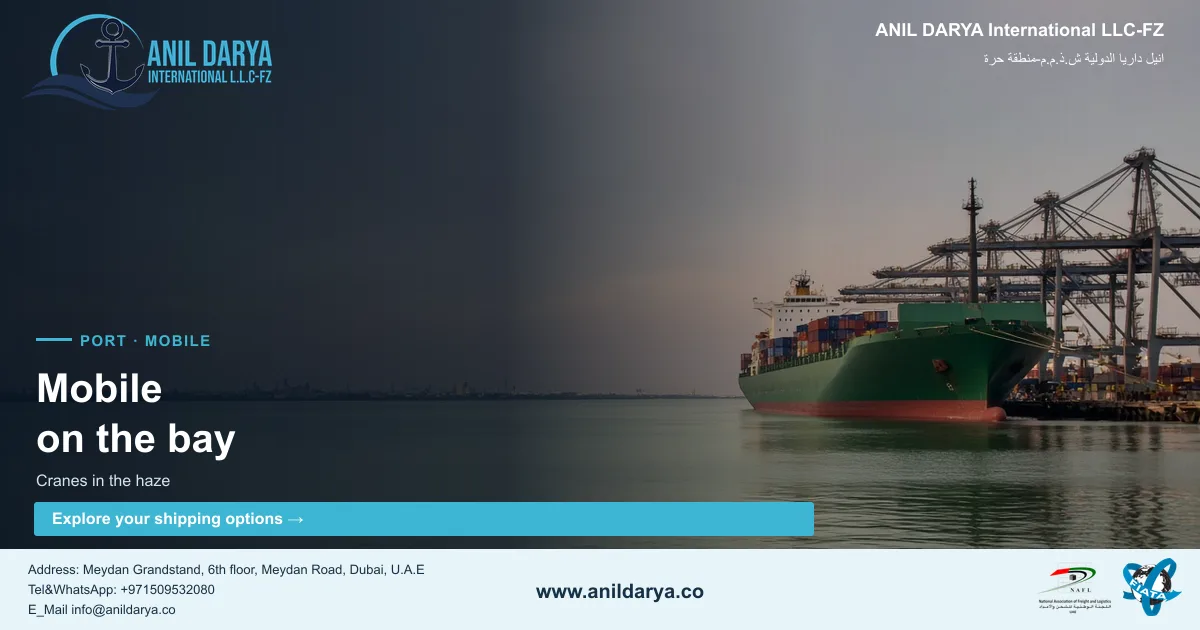
Port of Mobile shipping means cargo through the seaport of the city of Mobile, Alabama, on the US Gulf Coast. It is Alabama's only deep-water port, run by the Alabama Port Authority, with one container terminal operated by APM Terminals and large public terminals for forest products, steel, project cargo and vehicles. This guide covers the terminals, the new 50-foot channel, rail and river links, a short version of US customs, and how we ship your cargo from Dubai to Mobile. We ship in both directions: from Dubai to Mobile, and from Mobile to Dubai with clearance in the UAE.
Port of Mobile at a glance
| Item | Detail |
|---|---|
| Location | City of Mobile, Alabama, where the Mobile River meets Mobile Bay on the Gulf of Mexico |
| Governing body | Alabama Port Authority (APA), 250 N. Water Street, Mobile |
| Container terminal operator | APM Terminals, at Mobile since 2008, lease extended to 2058 |
| UN/LOCODE | USMOB |
| CBP port code | 1901, "Mobile (Including Theodore)", New Orleans field office |
| Ship channel depth | 50 ft, reached on 3 October 2025 |
| Container terminal | 149 acres, 2,400 ft berth at 50 ft, 6 ship-to-shore cranes, 325 reefer plugs |
| Container volume | Over 500,000 TEU a year (APA) |
| Largest container ships | Up to 15,000 TEU at the berth today (APA) |
| General cargo | 18 piers at 40 ft, 2.4 million sq ft of warehousing, over 55 acres of laydown |
| Rail | Five Class I railroads, on-dock intermodal rail (ICTF) |
| Highways | I-10 (east-west) and I-65 (north-south) |
| Inland waterways | Tennessee-Tombigbee Waterway, Gulf Intracoastal Waterway and the wider inland river system |
| Foreign-trade zone | FTZ 82, granted to the City of Mobile |
| Advance filing for ocean cargo | ISF 10+2, no later than 24 hours before loading at the UAE port |
| Mobile to Dubai | EEI filed in the AES by the US shipper or its agent 24 hours before loading; Dubai Customs declaration on arrival at Jebel Ali, Khalifa Port or Sharjah |
What is the Port of Mobile, and which Mobile is it?
People search for "Mobile port" and get results about phones and apps, so to be clear: this is the seaport of Mobile, a city in southern Alabama, USA. The port sits on the Mobile River at the head of Mobile Bay, about where the river opens to the Gulf of Mexico. Wikipedia describes it as the only deep-water port in Alabama.
The Alabama Port Authority is the governing body. It owns the public terminals and runs the general cargo, forest products, project cargo and rail side itself. Containers are handled by APM Terminals, which has operated the container terminal since 2008. Private operators run some bulk terminals, such as the McDuffie coal terminal, which are not covered here.
The port is spread along the river and the bay. A forwarder's port guide we read splits it into three zones, which helps you picture where your cargo goes:
- Upper port: Blakeley Island, for breakbulk and general cargo.
- Main harbor: the steel terminals and the AutoMobile International Terminal for finished vehicles.
- Lower harbor: the APM container terminal, the intermodal rail yard (ICTF), the McDuffie coal terminal and the Pinto Island steel terminal.
Further south, the Theodore industrial canal (40 ft) serves oil, gas, chemical and agricultural project cargo, and Middle Bay Port handles liquid bulk. Both fall under the same customs port code, 1901.
The 50-foot channel: what changed for Port of Mobile shipping
The Mobile Ship Channel reached its authorized 50-foot depth on 3 October 2025, and the project was formally completed in mid-October 2025. APM Terminals says the channel now has a three-mile passing lane for two-way traffic and no air-draft restrictions. The APA says 168 vessels with a draft over 45 feet used the channel in the months after it reached full depth.
What this means for you:
- Bigger container ships can call fully loaded. APM Terminals talks about ultra-large ships of 12,000 to 16,000 TEU, and the APA says the berth takes ships up to 15,000 TEU today.
- No bridge limits the height of ships. That matters for heavy-lift ships with tall cargo on deck.
- Steel and bulk berths on the 50-foot channel can take deeper-loaded ships, while general cargo piers stay at 40 ft.
More container capacity is on the way. APM Terminals and the APA plan a third berth of about 1,300 ft at the south end of the terminal, with a 33-acre yard expansion and a rail bridge for on-dock rail. Maritime Executive reported a 2026 start and 2028 finish, which would let the terminal work three large ships at once and lift capacity to about 1.4 million TEU a year.
Container shipping through APM Terminals Mobile
All containers at the Port of Mobile go through one terminal, so you do not need to guess the gate. Here is what the APA and APM Terminals publish about it.
| Container terminal item | Published figure |
|---|---|
| Area | 149 acres (APA) |
| Berth | 2,400 ft (732 m) of deep-water berth |
| Depth alongside | 50 ft (15.2 m) |
| Ship-to-shore cranes | 4 Super Post-Panamax and 2 Post-Panamax |
| Reefer plugs | 325 |
| Intermodal yard (ICTF) | 80 acres, 250,000 TEU capacity, two operating tracks and a loop track (APM Terminals) |
| Ship to rail | Within one business day; about 3 days ship to Chicago (APA) |
| Truck turn time | Average under one hour in and out (APA) |
| Room to grow | Up to 2.5 million TEU a year (APA) |
Carriers listed on the APM Terminals Mobile site are CMA CGM, MSC, Maersk, COSCO, Evergreen, OOCL, ONE, Yang Ming, Hapag-Lloyd and HMM. A listed carrier does not mean a service from the UAE: most of these lines reach Mobile through transshipment hubs, so we check the routing for each booking.
Useful terminal services for importers: container weighing, a container freight station for stuffing and stripping on the terminal, and handling and storage for breakbulk and out-of-gauge pieces. Trucks book import and export appointments through the TERMPoint system, and terminal charges can be paid online through PayCargo. Truck drivers need a terminal ID and a valid TWIC card to enter.
FCL or LCL to Mobile?
- FCL suits a full 20ft or 40ft load and anything going inland by rail. The box stays sealed from the UAE to the inland ramp.
- LCL suits small volumes, but the box is unpacked first at the terminal CFS or a warehouse. That adds handling, another party to the release and a few days.
If you choose LCL into Mobile, every house bill in the consolidated box needs its own ISF, on top of the CFS unpacking before release. Our article on FCL vs LCL shipping costs shows where the break-even point usually sits.
Rail, road and river: getting cargo inland from Mobile
Mobile's main selling point is the inland reach. The APA says the port connects to five Class I railroads; a forwarder guide names them as BNSF, CPKC, CN, CSX and Norfolk Southern. The APA lists rail destinations including Memphis, Chicago, Detroit, Toronto and Montreal.
| Inland mode | What the port offers | When it fits |
|---|---|---|
| Rail (containers) | On-dock ICTF, ship to rail within one business day, rail dwell up to 24 hours and rail in-transit storage up to 30 days (APM Terminals) | Consignee in the Midwest, Tennessee valley or Canada |
| Rail (breakbulk) | On-dock rail at general cargo, forest products and steel terminals | Steel, paper, pulp and heavy pieces for inland plants |
| Truck | I-10 east to Jacksonville and west to New Orleans and Houston; I-65 north to Birmingham, Nashville and Chicago | Consignee in Alabama, Mississippi, Florida panhandle, Georgia or Tennessee |
| Barge | Tennessee-Tombigbee Waterway and Gulf Intracoastal Waterway; the APA puts the reach at about 15,000 miles of inland waterways | Heavy project pieces for river-side sites, steel, bulk |
A forwarder guide gives rough truck times of about 2.5 hours to Birmingham, 5 hours to Nashville and 5.5 hours to Atlanta. The APA also plans a Montgomery Inland Rail Port, 175 miles north of Mobile, due to open in spring 2027.
A simple rule: if your final address is in the Southeast or Midwest, compare Mobile against an East Coast or Texas port on the total cost to the door, not on the ocean freight alone.
Forest products, steel and general cargo at the Port of Mobile
Mobile is a big breakbulk port. Wikipedia calls it the largest breakbulk forest products port in the US, and the APA calls it the nation's second-largest steel port. Here is how the public general cargo side is set up.
| Terminal or facility | Main cargo | Published facts |
|---|---|---|
| General cargo terminals | Steel, forest products, machinery, wind turbine parts, bags, boxes and barrels | 18 piers, 40 ft draft, Gottwald cranes, Ro-Ro ramps, 2.4 million sq ft warehousing, over 55 acres laydown |
| Forest products | Lumber, kraft linerboard, wood pulp, paper rolls, fluff pulp | 218 acres of general cargo facilities, 2.4 million sq ft covered and 2.4 million sq ft open storage, clamp trucks, rail-served sheds |
| Alabama Steel Terminal | Imported steel slabs | On the 50 ft channel |
| Pinto Island Marine Terminal | Steel coils | 40 ft of water, rail-mounted shore cranes, barge staging |
| AutoMobile International Terminal | Finished vehicles, Ro-Ro | 57 acres, 150,000 vehicles a year, 7,000 spaces, 40,000 sq ft processing center, rail ramp for 2,000 vehicles |
For a UAE shipper, the general cargo side matters for steel products, machinery, equipment and anything that will not fit in a box. Forest products mostly come from the Americas and Europe, so it is less likely to be your lane, but it shows the port has the warehouse space and handling skill for sensitive breakbulk.
Project cargo and heavy lift to Mobile
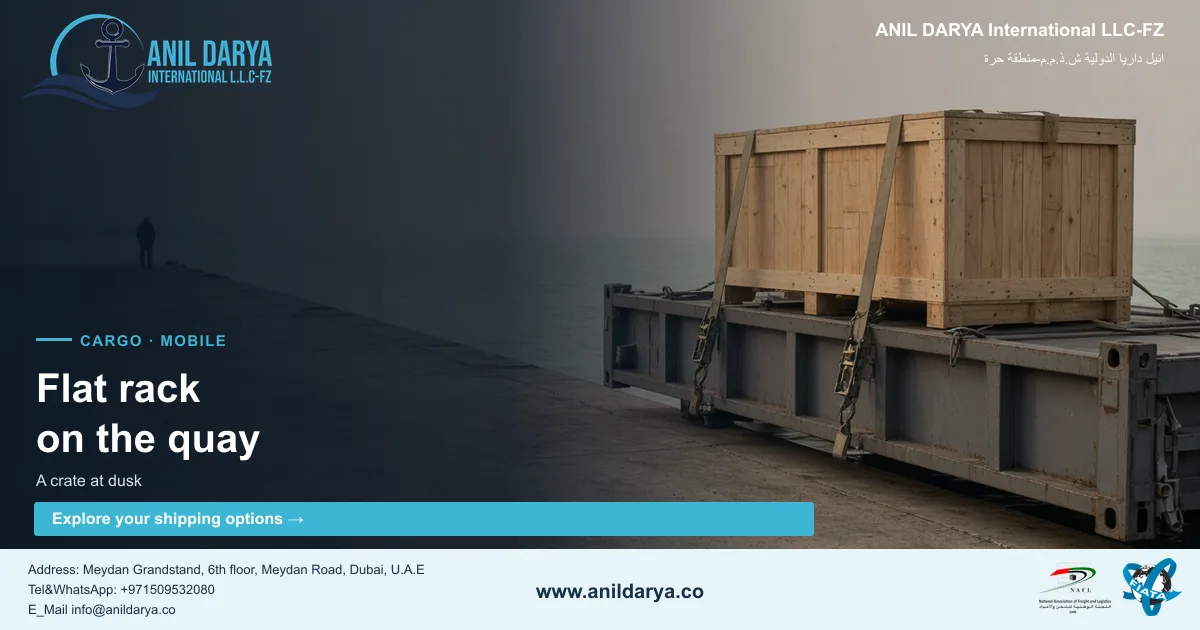
The APA lists one Gottwald seven-axle mobile harbor crane that lifts up to 110 short tons at 75 ft, Ro-Ro ramps, quay areas rated up to 1,500 lb per sq ft, and Buchanan Yard for long-term project storage away from the berth. Pieces can leave the quay by rail, truck or barge.
For heavy pieces, we plan in this order:
- Collect drawings, weights, dimensions and centre of gravity for each piece.
- Pick the vessel: flat rack on a container ship, Ro-Ro, or conventional breakbulk or heavy-lift tonnage.
- Check the heaviest lift against the 110 short ton port crane. Above that, plan for a vessel with its own heavy gear.
- Choose road, rail or barge for the inland leg. Barge often avoids long oversize road permits for river-side sites.
- Tell the US customs broker and trucker early, because oversize moves need permits and a set route.
Our break bulk and project cargo service handles the UAE side, and our heavy-lift shipping guide explains lift plans and vessel choice.
Shipping from Dubai to Mobile: routes and transit
There is no direct liner service from the UAE to Mobile. Cargo transships at least once, usually at a hub in the Mediterranean, Europe or the Caribbean, and then reaches Mobile on a Gulf of Mexico service. One route search site shows a Jebel Ali to Mobile routing with CMA CGM at about 71 days with two transfers, sailing every 2 to 4 weeks. Treat this as one aggregator snapshot, not a schedule. Real transit depends on the hub and the connection.
[AMIR-FACT: the carrier and transshipment hub we actually use from Jebel Ali or Khalifa Port to Mobile, and our real transit days on this lane]
For breakbulk or project cargo, sailings follow the ship, not a weekly loop, so we look for liner breakbulk or heavy-lift tonnage calling the US Gulf for each shipment. For urgent parts, air freight into a large US hub and a truck on to Alabama is often quicker. Our sea freight team compares the options for your cargo ready date.
US customs at the Port of Mobile: the short version
US customs rules are the same at every US seaport. For the full ISF data list and entry tables, see our Port of Los Angeles guide. These are the points that matter at Mobile.
| Step | Rule | Who acts |
|---|---|---|
| ISF 10+2 | No later than 24 hours before loading in the UAE for containers; for exempt breakbulk, no later than 24 hours before arrival in the US | ISF importer, usually through a customs broker |
| Entry documents | Within 15 calendar days of arrival | Importer of record or licensed customs broker |
| Entry summary and estimated duty | Within 10 working days of entry | Importer of record or broker |
| Bond | Needed for the entry; ISF failures can bring liquidated damages of $5,000 per violation | Importer of record, or the broker's bond |
| Fees on imports | Harbor maintenance fee 0.125% of cargo value; merchandise processing fee 0.21% ad valorem on formal entries | Importer of record |
Mobile specifics: entries are filed under CBP port 1901, which reports to the New Orleans field office. A forwarder guide says document review usually takes 1 to 2 days and a physical exam 3 to 7 business days, with the consignee paying exam costs. Duty depends on the HTSUS code and origin of each product, so the broker checks the rate in force on the arrival date.
If you want to defer duty, FTZ 82 covers the Mobile area. The City of Mobile is the grantee, and goods in the zone can be stored, processed or re-exported before duty is paid.
Dangerous goods through the Port of Mobile
For dangerous goods, the IMDG Code covers the sea leg and US hazardous materials rules cover the truck and rail legs. You need the UN number, proper shipping name, class and packing group, a Safety Data Sheet, a signed DG declaration, and UN-approved packaging with labels and placards. Every carrier and every transshipment port on the route must accept the class, so acceptance is checked for the whole chain, not just Mobile. Machinery with fuel or batteries can count as DG, so declare it. Our dangerous goods shipping team checks this before you commit to a sailing.
How to ship from Dubai to the Port of Mobile: step by step
- Send us the cargo details: commodity, HS code, weight, dimensions, cargo ready date, UAE pickup address and your Incoterm.
- Give us the final US address. That decides whether Mobile is the right port and whether rail, truck or barge makes sense.
- Confirm the US side: importer of record, customs broker and bond.
- Pick the mode: container, Ro-Ro or breakbulk. We compare carrier routings from Jebel Ali or Khalifa Port via the hubs that connect to Mobile.
- Book space. For DG, reefer or out-of-gauge cargo we get carrier acceptance first.
- Send ISF data to the US broker well before loading.
- Clear export in the UAE. We file the declaration with the invoice, packing list, certificate of origin and any permit for restricted goods, then deliver to the terminal before the cut-off.
- Check the bill of lading against the invoice and ISF, then release it after sailing.
- Track the transshipment. We watch the connection at the hub and warn you if the box rolls to a later ship.
- US entry and pickup. The broker files the entry, and the trucker books a TERMPoint slot or the railroad collects at the ICTF within free time.
Most of our US cargo starts at Jebel Ali Port.
How to ship from the Port of Mobile to Dubai
We also handle the other direction: cargo from Mobile to Dubai, with arrival at Jebel Ali, Khalifa Port or Sharjah port. Containers from APM Terminals Mobile, forest products, steel and project cargo all fit this lane. We book the space with the carrier and run the UAE side. The US export papers stay with the shipper or its US agent.
The US export side
- Electronic Export Information (EEI). The US Principal Party in Interest (USPPI) or its authorized agent files it in the AES. For vessel cargo, the EEI is filed and the filing citation given to the carrier 24 hours before the cargo is loaded at the US port.
- Exemptions. EEI is generally not needed when the goods under one Schedule B number, from one USPPI to one consignee, are valued at $2,500 or less. Each code is judged on its own value, so the shipper's agent checks this for every shipment.
- Pickup. The shipper or its trucker delivers the box to APM Terminals Mobile inside the carrier receiving window, or breakbulk to the public terminals by the cargo cut-off.
The UAE import side
When cargo from Mobile reaches the UAE, the Dubai Customs declaration goes in with the US shipper's commercial invoice and packing list, the bill of lading issued at Mobile, a certificate of origin and any permit needed for restricted goods. The filer is a company holding a Dubai Customs business code, or a licensed clearing agent acting with the owner's authorisation. Most goods pay 5% customs duty on the CIF value, alcohol pays 50% and cigarettes 100%. Import VAT is 5%. If the importer is VAT-registered and its customs number is linked to its tax registration, it accounts for the VAT on its VAT return rather than paying at the border.
- Send us the shipper's details in the US, the cargo, the HS code, the weight or volume and the UAE delivery address.
- We book space from APM Terminals Mobile or the public terminals and send the booking and cut-offs to the shipper.
- The shipper or its US agent files the EEI, or confirms the exemption.
- The shipper's trucker or the railroad delivers the cargo to the terminal before the cut-off.
- We check the draft bill of lading against the invoice and packing list, and track the hub connection.
- We file the UAE declaration before the ship arrives.
- We arrange payment of the duty and VAT, and collect the delivery order.
- We truck the cargo to your site and return the empty container inside free time.
[AMIR-FACT: the carriers and hub we actually use from Mobile to Jebel Ali, Khalifa Port or Sharjah, and our real port-to-port transit days in this direction]
Free time and demurrage at Mobile
Free days and daily charges are set by the carrier and the terminal tariff, and they differ by container type. Rail boxes get their own clock: APM Terminals lists a rail dwell of up to 24 hours. Since transit from the UAE involves transshipment, the arrival date can move, so book the truck or rail only once the vessel is confirmed. Our article on demurrage and detention explains how the charges build up.
Mobile or another US Gulf port?
| Your situation | Port to look at first | Why |
|---|---|---|
| Containers for Alabama, Mississippi, Tennessee or the Midwest by rail | Mobile | On-dock rail to five Class I railroads, short truck turns |
| Steel, forest products or heavy pieces for a river-side site | Mobile | Large breakbulk terminals and barge access to inland waterways |
| Containers or project cargo for Texas and the oil and gas sector | Houston | Larger service network and Texas hinterland |
| Containers for Georgia or the Carolinas | Savannah or Charleston | More direct East Coast services and shorter inland legs |
We can price more than one US port so you compare the total cost to your door.
Checklist before you ship to Mobile
- Final US address confirmed, and truck, rail or barge chosen.
- Importer of record named, customs broker appointed and bond in place.
- HS code checked against the HTSUS.
- ISF filed at least 24 hours before loading (or the breakbulk rule confirmed with the broker).
- Commercial invoice, packing list and certificate of origin issued in the UAE.
- For breakbulk: drawings, weights, lifting points and lashing plan sent to the carrier, and the lift checked against the port crane.
- For DG: SDS, DG declaration, packaging, labels and acceptance at every port on the route.
- Free time and the transshipment hub confirmed on the booking.
Common mistakes when shipping to Mobile
- Confusing the port with something else. Write "Mobile, Alabama, USA (USMOB)" on the booking and documents so nobody routes it wrong.
- Expecting a direct sailing. Every UAE container routing we have seen transships, so plan for the extra days.
- Assuming every berth is 50 ft. The channel and container berth are, but general cargo piers are 40 ft.
- No lift plan for heavy pieces above the port crane's 110 short tons.
- Late ISF data. A late or wrong ISF can cost $5,000 per violation.
- Booking the truck before the vessel is confirmed after transshipment, then losing the slot.
Frequently asked questions
Where is the Port of Mobile located?
It is in the city of Mobile, Alabama, USA, on the Mobile River at the head of Mobile Bay on the Gulf of Mexico. It is Alabama's only deep-water port.
Who runs the terminals at the Port of Mobile?
The Alabama Port Authority governs the port and runs the public general cargo terminals. APM Terminals operates the container terminal under a lease that now runs to 2058.
How deep is the water at the Port of Mobile?
The ship channel and the container berth are 50 feet deep since October 2025. The general cargo piers are 40 feet, and the Theodore industrial canal is 40 feet.
What is the port code for Mobile, Alabama?
The UN/LOCODE is USMOB, used on bookings and bills of lading. The CBP port code for customs entries is 1901, which also covers Theodore.
Which shipping lines call at the Port of Mobile?
APM Terminals Mobile lists CMA CGM, MSC, Maersk, COSCO, Evergreen, OOCL, ONE, Yang Ming, Hapag-Lloyd and HMM. Cargo from the UAE reaches Mobile through transshipment on these networks.
How long does shipping from Dubai to Mobile take?
There is no direct service. One route search site showed about 71 days from Jebel Ali with two transfers, but the real time depends on the hub and connection, so ask for live sailings.
Can my container go inland by rail from Mobile?
Yes. The terminal has an on-dock intermodal rail yard linked to five Class I railroads, and the APA says containers move from ship to rail within one business day, with about 3 days to Chicago.
Does the Port of Mobile handle breakbulk and project cargo?
Yes. It has 18 general cargo piers, 2.4 million sq ft of warehousing, a 110 short ton mobile harbor crane, Ro-Ro ramps, and rail, truck and barge links from the quay.
Can you ship cargo from Mobile to Dubai?
Yes. For a container or breakbulk shipment leaving Mobile, Alabama, the US shipper or its agent files the EEI in the AES, or confirms that an exemption applies. We book the space from Mobile, file the Dubai Customs declaration before the ship arrives, arrange payment of the 5% duty and 5% VAT, and deliver to your site in the UAE.
Get a quote for Port of Mobile shipping
Send us your cargo details and final US address, and we will come back with container, Ro-Ro or breakbulk options and a price from the UAE to Mobile, Alabama. Use our freight rate inquiry form, or contact our team to talk through a heavy-lift, DG or first-time US shipment. You can also read about our Dubai freight forwarding team.
Sources
- Alabama Port Authority: home (50 ft depth date, vessels over 45 ft, rail, I-10 and I-65, Montgomery Inland Rail Port)
- Alabama Port Authority: Port of Mobile (governing body, address, cargo types)
- Alabama Port Authority: Containers (acres, berth, cranes, reefers, vessel size, volume, ICTF, truck turns, rail destinations)
- Alabama Port Authority: General cargo (piers, draft, warehousing, laydown, inland waterways)
- Alabama Port Authority: Forest products (storage, cargo types)
- Alabama Port Authority: Steel (terminals, depths, second-largest steel port)
- Alabama Port Authority: Project cargo (mobile harbor crane, floor rating, Buchanan Yard)
- Alabama Port Authority: Finished automotive (Ro-Ro terminal figures)
- APM Terminals Mobile: home (carriers, services, TERMPoint, PayCargo)
- APM Terminals Mobile: Our terminal (ICTF size and capacity, operating since 2008)
- APM Terminals Mobile: Intermodal services (rail dwell, in-transit storage)
- APM Terminals Mobile: Channel deepening (passing lane, no air draft limit, vessel sizes, third berth)
- Maritime Executive: Port of Mobile container terminal expansion (2026-2028, 1.4 million TEU, lease to 2058)
- Wikipedia: Port of Mobile (location, only deep-water port in Alabama, forest products ranking, UN/LOCODE)
- Goodhope Logistics: Port of Mobile terminal guide (CBP port 1901, port zones, railroads, truck times, FTZ 82, exam timing)
- Fluent Cargo: route listing showing Jebel Ali to Mobile (transit indication)
- CBP: ISF frequently asked questions 2.0 (24-hour timing, breakbulk rule, $5,000 liquidated damages)
- CBP: Importing into the United States (entry deadlines, bond, harbor maintenance and merchandise processing fees)
- Dubai Customs: Submit customs declaration (export documents)
- 15 CFR 30.4: EEI filing timelines (24 hours before loading for vessel cargo, USPPI or authorized agent)
- 15 CFR 30.37: EEI exemptions ($2,500 or less per Schedule B number)
- Dubai Customs: FAQ (5% of CIF, alcohol and cigarettes, business code, clearing agents)
- UAE Government portal: Clearing the customs and paying customs duty
- Federal Tax Authority: Taxable person guide for VAT (5% import VAT, reverse charge for registered importers)
Reviewed: 10 November 2026