
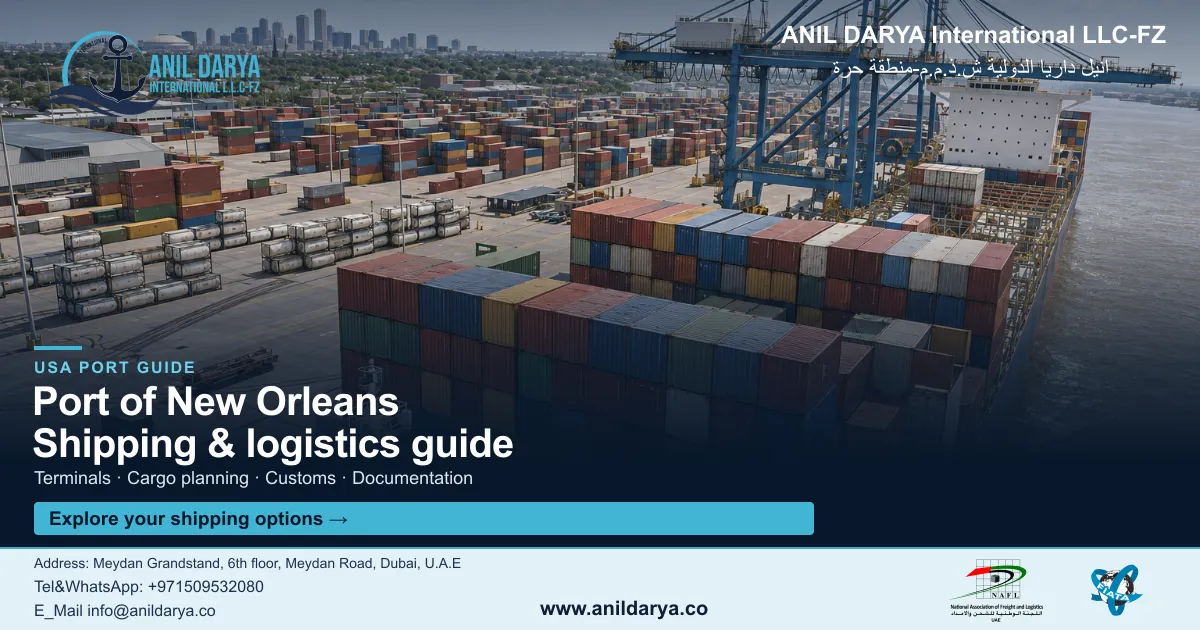
Port of New Orleans shipping means moving your cargo through Port NOLA's river terminals on the Mississippi, about 100 miles upriver from the Gulf of Mexico. Containers from the UAE land at the Napoleon Avenue Container Terminal, while steel, machinery, project cargo and frozen food use the breakbulk and cold storage wharves along the same riverfront. This guide covers each terminal, the river and bridge limits, rail and barge links, the short version of US customs at New Orleans, and how we ship your cargo there from Dubai. We ship both from Dubai to New Orleans and from New Orleans to Dubai.
Port of New Orleans at a glance
| Item | Detail |
|---|---|
| Port authority | Port NOLA (Board of Commissioners of the Port of New Orleans), self-funded, no tax dollars |
| Location | Mississippi River, New Orleans, Louisiana, about 100 miles upriver from the Gulf of Mexico |
| UN/LOCODE | USMSY |
| US Census / CBP port code | 2002 (New Orleans, LA) |
| Container terminal | Napoleon Avenue, run by Ports America and New Orleans Terminal; 2,000 ft of berth at 50 ft |
| Container capacity | 840,000 TEU on Port NOLA's terminals page and 1 million TEU on its capabilities page; expansion room to 1.5 million TEU |
| Breakbulk | Six dedicated terminals, more than 13,500 ft of berths, 1.6 million sq ft of transit sheds |
| Cold storage | Henry Clay Avenue and Jourdan Road, run by Lineage; more than 900 reefer plugs port-wide |
| Rail | New Orleans Public Belt Railroad (port-owned), linking six Class I railroads; on-dock Mississippi River Intermodal Terminal |
| Container volume | 263,961 TEU in the first half of 2025, up 2% on the first half of 2024 |
| Foreign-trade zone | FTZ No. 2, established in 1946 |
| Advance filing for ocean imports | ISF 10+2, no later than 24 hours before loading at the UAE port |
| Shipping from New Orleans to Dubai | EEI filed in the AES by the USPPI or its agent; UAE duty 5% of CIF for most goods, import VAT 5% |
What is the Port of New Orleans and who runs it?
Port NOLA is a state port authority run by a board of seven unpaid commissioners. It owns the public wharves along the Mississippi in New Orleans and leases them to private terminal operators. It also owns the New Orleans Public Belt Railroad. The port says it receives no tax dollars and funds itself from cargo, rail, cruise and real estate income.
Two things make New Orleans different from a coastal port. First, ships sail about 100 miles up the river before they berth, so the river stage and the bridges downstream shape what ships can call. Second, the port sits at the bottom of the inland waterway system, so cargo can move on by barge as well as by rail and truck.
Port NOLA reported 263,961 TEU for the first half of 2025, and said schedule reliability had improved to 83 percent.
Which terminals does the Port of New Orleans have?
Your carrier and cargo type decide the wharf. Containers all go to Napoleon Avenue. Breakbulk and project cargo use one of the general cargo terminals, and the booking or arrival notice names it.
Napoleon Avenue: the only container terminal
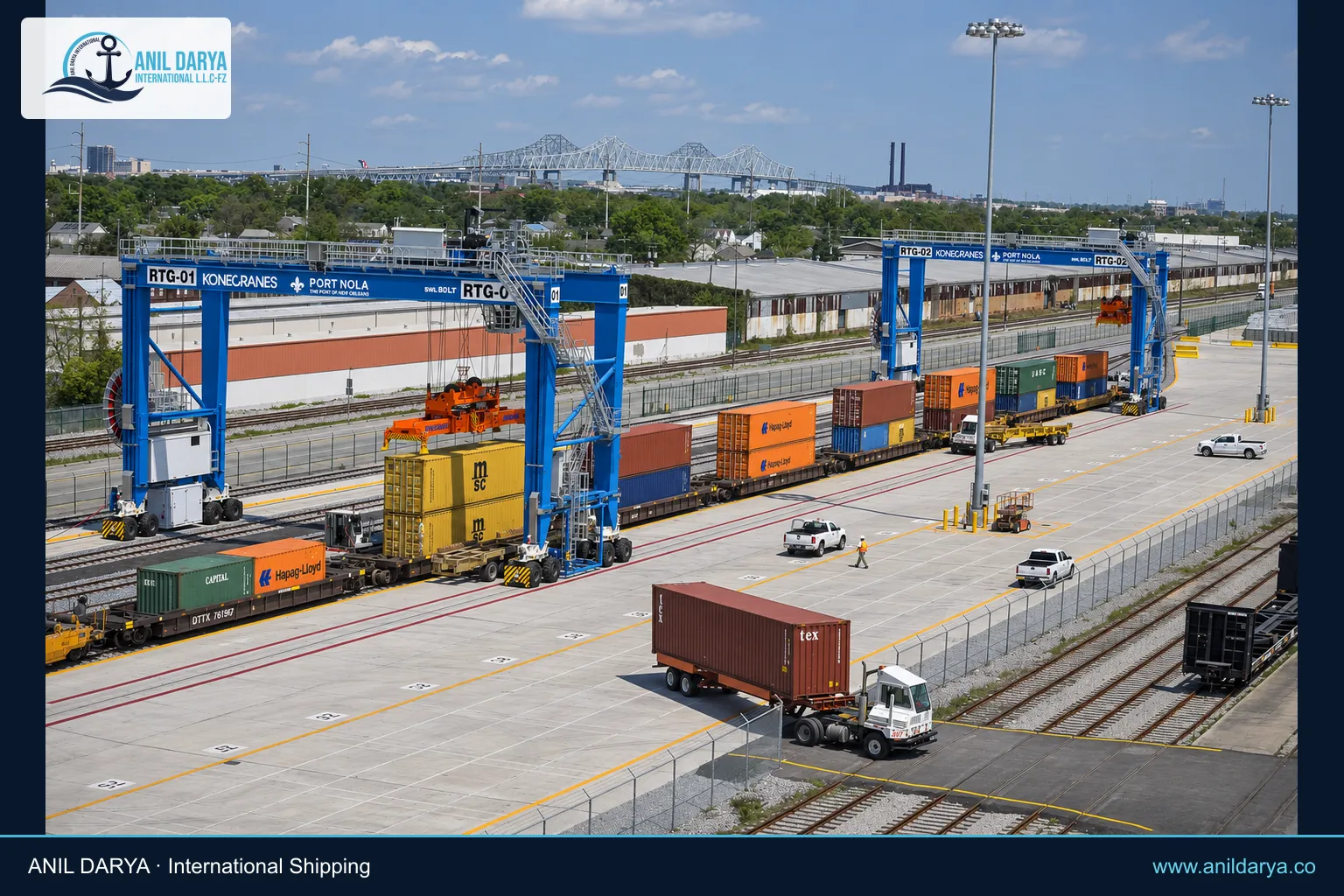
Napoleon Avenue is the only container terminal in the port. Ports America and New Orleans Terminal run it, and each carrier uses one of the two. Port NOLA spent about $100 million on an expansion that added four 100-foot-gauge gantry cranes able to work ships of up to 10,000 TEU.
| Napoleon Avenue item | Published figure |
|---|---|
| Berth | 2,000 ft in total |
| Depth alongside | 50 ft (15.24 m) |
| Marshalling yard | 48 acres |
| Gantry cranes | Six listed on the terminals page |
| Reefer plugs | 304 (40-foot units) |
| Rail | On-dock at the Mississippi River Intermodal Terminal |
| FIRMS code | Q795 |
The on-dock rail yard and Milan Street freight station
The Mississippi River Intermodal Terminal sits next to Napoleon Avenue and moves containers between ship and train. It has 6,000 linear feet of working track and two electric rubber-tyred gantries. Milan Street, run by New Orleans Terminal, has 1,772 feet of berth at 35 feet, sheds of about 107,000 and 200,000 square feet, and 18 acres for empties and chassis. It is also the container freight station for Napoleon Avenue, which matters for LCL cargo.
Breakbulk and project cargo wharves
| Terminal | Operator | Berth | Depth | Notes |
|---|---|---|---|---|
| Nashville Avenue | Ports America | 4,345 ft | 35 to 50 ft by section | Heavy lift and project; 1,077,600 sq ft shed; three mobile harbor cranes up to 150 tons |
| Louisiana Avenue | Ports America | 4,458 ft | 35 ft | 431,021 sq ft of warehouses |
| First Street | QSL New Orleans | 1,280 ft | 35 ft | Breakbulk, 140,655 sq ft shed |
| Alabo Street | Sunrise Foods International | 1,732 ft | 38 ft | Breakbulk, Norfolk Southern rail |
| Seventh Street and Harmony | QSL New Orleans | 1,195 ft and 1,231 ft | 35 ft and 32 ft | Breakbulk |
Cold storage: Henry Clay Avenue and Jourdan Road
Lineage runs both cold stores. Henry Clay Avenue has 1,441 feet of berth at 38 feet and a 95,020 square foot refrigerated warehouse. Jourdan Road has 1,400 feet of berth at 29 feet and a refrigerated warehouse for 55 million pounds of cargo. Port NOLA says its dockside blast freezers can bring meat to 0°F within 24 hours.
River depth and bridges: what fits at New Orleans
The berth at Napoleon Avenue is 50 feet deep. The breakbulk wharves are shallower, mostly 32 to 38 feet, so ask the carrier which wharf it will use before you plan a deep-laden breakbulk vessel.
Ships reach Napoleon Avenue by passing under the Crescent City Connection bridge. That bridge sets the height limit for container ships, and the clearance changes with the river stage. Published figures differ between sources, so carriers plan each call against the current stage. This is why Port NOLA is building the Louisiana International Terminal downriver of the bridges.
Violet and the planned Louisiana International Terminal
The Louisiana International Terminal (LIT) is a planned container terminal at Violet in St. Bernard Parish. The project site says it will have no bridge height limits and naturally deep water at the dock. The US Army Corps of Engineers has issued its federal permit, and the project lists construction starting in 2026, subject to change, with a first berth opening before the rest of the terminal is phased in. It is not open yet, so all UAE containers today still go to Napoleon Avenue.
Rail, barge and road: how far New Orleans reaches
The New Orleans Public Belt Railroad is owned by the port and connects the wharves with six Class I railroads: BNSF, CN, CPKC, CSX, Norfolk Southern and Union Pacific. That lets a container or a steel coil reach the Midwest, Texas or Canada without changing ports.
| Mode | How it works at New Orleans | When it fits |
|---|---|---|
| Rail | NOPB to six Class I railroads; on-dock at the intermodal terminal | FCL containers and heavy steel to inland states |
| Barge | Transfer to the inland waterway system on the Mississippi | Steel, project and bulk cargo for river towns |
| Truck | Local drayage from Napoleon Avenue or the breakbulk wharves | Louisiana, Mississippi and nearby consignees |
Which carriers serve New Orleans from the Middle East and India?
Port NOLA publishes a list of the container lines that call, their trade lanes and their terminal operator. All the services it lists are weekly. Here are the lines that name the Middle East or India among their lanes.
| Carrier | Lanes that matter for UAE cargo | Terminal operator |
|---|---|---|
| CMA CGM | Middle East, India Subcontinent | Ports America |
| Hapag-Lloyd | Middle East, India | Ports America |
| MSC | Middle East, India Subcontinent | New Orleans Terminal |
| Evergreen Line | India | Ports America |
| OOCL | India | Ports America |
Port NOLA's list also includes COSCO, HMM, Maersk, ONE, Yang Ming, ZIM and others on Asia, Europe and Latin America lanes. A listed lane does not mean a direct call from the UAE. In practice, cargo from Jebel Ali usually connects through a hub in the Mediterranean, Europe or the Caribbean.
Shipping from Dubai to New Orleans: routes and transit indications
We did not find a reliable published direct transit time from the UAE to New Orleans. The schedule aggregator we checked routed its quickest option to Mobile, Alabama, not New Orleans, so we do not quote it here. Ask us for current routings instead of relying on a single published figure.
[AMIR-FACT: the carrier services we actually book from Jebel Ali or Khalifa Port to New Orleans, the transshipment hub they use, and our real port-to-port transit days on this lane]
We book space through our sea freight service and load at Jebel Ali Port or Khalifa Port, depending on where your cargo sits and which carrier offers the better connection to Napoleon Avenue.
FCL or LCL to New Orleans?
FCL means you book a whole container. LCL means you share one. At New Orleans, LCL containers are unpacked at a container freight station such as Milan Street, so your release also depends on the consolidator's paperwork.
| Situation | Usual choice | Why |
|---|---|---|
| A few pallets for a Louisiana consignee | LCL | Lower cost for small volumes |
| Over roughly half a container of goods | Price both | FCL often wins once handling fees are added |
| Cargo going on by rail | FCL | Rail moves full containers |
| Steel or long pieces | Breakbulk or flat rack | Covered sheds and heavy cranes at the general cargo wharves |
Our guide to FCL vs LCL costs walks through the break-even point.
US customs at the Port of New Orleans: the short version
US customs rules are the same at every US seaport. These are the points that matter for New Orleans. For the full ISF data list and entry tables, see our Port of Los Angeles guide.
| Step | Rule | Who acts |
|---|---|---|
| ISF 10+2 | Filed no later than 24 hours before the cargo is loaded in the UAE; stuffing location and consolidator no later than 24 hours before US arrival | ISF importer, often its customs broker |
| Entry documents | Within 15 calendar days of arrival | Importer of record or licensed customs broker |
| Entry summary and estimated duty | Within 10 working days of entry | Importer of record or broker |
| Harbor maintenance fee | 0.125% of the CBP appraised value of imported cargo | Importer of record |
New Orleans specifics: entries are filed at port 2002 in the New Orleans customs district. If your importer wants to delay duty on goods it will store, process or re-export, ask its broker about Foreign-Trade Zone No. 2, which Port NOLA administers. Duty depends on the HTSUS code and origin of each product, so the broker checks the rate in force on the arrival date.
Breakbulk and project cargo at New Orleans
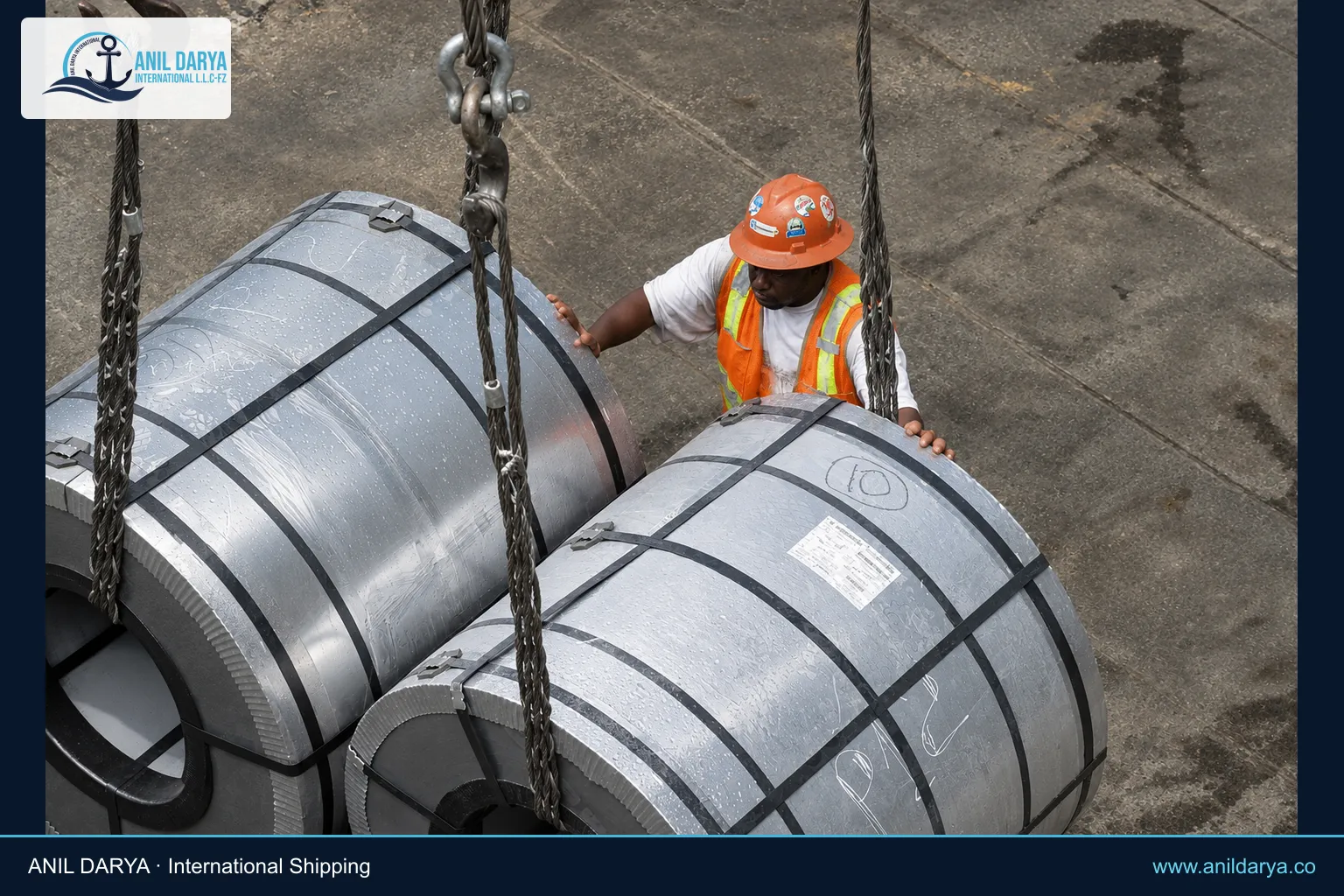
Breakbulk is where New Orleans is strongest. Six terminals give more than 13,500 feet of berth and 1.6 million square feet of transit sheds, much of it with rail at the front or rear of the wharf. Nashville Avenue handles heavy lift and project cargo with mobile harbor cranes of up to 150 tons.
Typical cargo that suits these wharves includes steel coils and pipe, machinery, plant equipment and lumber. If a piece is too heavy for one mobile crane, the vessel's own gear or a tandem lift is planned with the stevedore.
For heavy pieces from the UAE we plan in this order:
- Collect drawings, weights, dimensions, centre of gravity and lifting points.
- Choose flat rack, open top or conventional breakbulk based on size and carrier options.
- Get carrier engineering approval and a lashing plan before booking is confirmed.
- Check the discharge wharf, its depth and crane capacity with the carrier.
- Agree the inland mode in the US (truck, rail or barge) with the consignee early.
See our break bulk and project cargo service and the guide to flat rack, open top and out-of-gauge cargo.
Dangerous goods to the Port of New Orleans
We did not find a published Port NOLA rule set for dangerous goods in containers. Acceptance runs through the carrier and the terminal operator at Napoleon Avenue (Ports America or New Orleans Terminal), plus every transshipment port on the route.
From Dubai we prepare the IMDG dangerous goods declaration, check the safety data sheet, packing group and segregation, and confirm acceptance for the whole route before the container is stuffed. Your US consignee should confirm that its trucker or rail provider can carry the class. Our dangerous goods shipping team handles the UAE side.
How to ship from Dubai to the Port of New Orleans: step by step
- Send us the commodity, HS code, weight, volume, cargo-ready date and the consignee's city in the US.
- We check which carriers connect to Napoleon Avenue or the breakbulk wharves, and whether another Gulf port fits better.
- Your US importer appoints a customs broker and confirms its bond.
- We book space, release the empty container and arrange trucking in the UAE.
- We prepare the invoice, packing list and certificate of origin, and file the UAE export declaration with Dubai Customs.
- We send the ISF data to the importer's broker so it is filed at least 24 hours before loading.
- The container loads at Jebel Ali or Khalifa Port and moves via the transshipment hub.
- The broker files entry at port 2002 and pays duty and fees.
- The consignee's trucker or railroad collects from the terminal operator named on the arrival notice, inside free time.
Free time and demurrage are set by the carrier and the terminal operator. Our explainer on demurrage and detention shows how charges add up.
How to ship from the Port of New Orleans to Dubai
We also handle the other direction: shipping from New Orleans to Dubai, with arrival at Jebel Ali, Khalifa Port or Sharjah port. We book the space with the carrier and run the UAE side. The export papers at origin stay with the shipper or its agent there.
The US export side
- Electronic Export Information (EEI). The US Principal Party in Interest (USPPI) or its authorized agent files it in the AES. For vessel cargo the filing citation must reach the carrier 24 hours before the cargo is loaded at the US port.
- Exemptions. EEI is generally not needed when the goods under each Schedule B number are worth $2,500 or less, subject to the conditions in the rules. The shipper's agent confirms this for each shipment.
- Pickup. The shipper or its trucker delivers the box to Napoleon Avenue Container Terminal inside the carrier's receiving window and cut-off.
The UAE import side
For cargo discharged at Jebel Ali, the import declaration goes to Dubai Customs. It asks for the commercial invoice, the packing list, a certificate of origin and, for restricted goods, the approval of the authority that controls them. The carrier's agent releases the cargo against the bill of lading with a delivery order. Customs duty in Dubai is 5% of the CIF value for most goods, with 50% on alcohol and 100% on cigarettes. Import VAT is 5% of the customs value, which takes in insurance and freight, plus customs fees and any excise tax. A VAT-registered importer whose customs number is registered with the Federal Tax Authority can account for that VAT on its VAT return instead of paying it at clearance.
- Send us the shipper's details in New Orleans, the cargo, the HS code and the delivery address in the UAE.
- We book space from New Orleans with the carrier and send the booking and cut-off dates to the shipper.
- The shipper or its trucker delivers the cargo to Napoleon Avenue Container Terminal inside the receiving window.
- The shipper or its US agent files the EEI in the AES.
- We check the draft bill of lading against the invoice and packing list before the carrier issues it.
- We file the UAE import declaration before the ship arrives.
- We arrange payment of the duty and VAT and collect the delivery order from the carrier's agent.
- We truck the cargo to your site in the UAE.
- We return the empty container to the carrier's depot inside free time.
[AMIR-FACT: the carriers and hub we actually use from New Orleans (Napoleon Avenue) to Jebel Ali, Khalifa or Sharjah, and our real port-to-port transit days in this direction]
New Orleans or another US Gulf port?
New Orleans fits when your cargo is breakbulk, steel or frozen food, when the consignee is along the Mississippi, or when you want one railroad switch to reach any Class I network. For containers going to Texas, compare routings into Houston as well.
| If your cargo is | Consider |
|---|---|
| Steel, pipe or project cargo for the central US | New Orleans breakbulk wharves |
| Frozen or chilled food for the South | New Orleans cold storage |
| Containers for Texas | Houston |
| Containers for the Southeast | Savannah |
Checklist before you ship to New Orleans
- Your US importer of record, customs broker and bond are confirmed.
- ISF data is complete and the broker knows the loading date.
- The commercial invoice shows the full description, value, origin and HS code.
- Wood packaging is ISPM 15 treated and marked.
- The terminal operator (Ports America or New Orleans Terminal) is passed to the trucker.
- Breakbulk cargo has a named discharge wharf and its depth checked.
- Food cargo has FDA prior notice arranged by the importer.
- The inland leg (truck, rail or barge) is agreed before the ship sails.
Common mistakes when shipping to New Orleans
- Assuming every listed carrier calls direct from the UAE. Most UAE cargo transships.
- Sending the trucker to the wrong operator at Napoleon Avenue.
- Filing ISF late because the loading date in the UAE moved forward.
- Planning a breakbulk call without checking the wharf depth, which is mostly 32 to 38 feet.
- Expecting the Louisiana International Terminal to be open. It is still in development.
- Leaving the inland mode to the last minute, when rail and barge need booking ahead.
Frequently asked questions
Who runs the Port of New Orleans terminals?
Port NOLA owns the public wharves and leases them to operators. Ports America and New Orleans Terminal run Napoleon Avenue, and QSL, Lineage and others run breakbulk and cold storage wharves.
Which terminal handles containers in New Orleans?
Napoleon Avenue Container Terminal is the only container terminal. Your carrier uses either Ports America or New Orleans Terminal there.
How deep is the water at the Port of New Orleans?
Napoleon Avenue is 50 feet alongside. Most breakbulk wharves are 32 to 38 feet, and Nashville Avenue varies from 35 to 50 feet by section.
What is the port code for New Orleans?
The US Census and CBP port code is 2002, in the New Orleans district. The UN/LOCODE is USMSY.
How long does shipping from Dubai to New Orleans take?
We did not find a reliable published figure. Cargo usually transships, so ask for a current routing and transit time for your sailing date.
Can my container go inland by rail from New Orleans?
Yes. The port-owned New Orleans Public Belt Railroad links to six Class I railroads, with on-dock rail next to Napoleon Avenue.
Is the Louisiana International Terminal open?
No. The federal permit is issued and construction is listed to start in 2026, subject to change. Containers use Napoleon Avenue today.
Does Anil Darya have an office in New Orleans?
No. We handle booking, documents, UAE trucking and export clearance, and work with your US customs broker or the consignee's clearing agent at New Orleans.
Can you ship from New Orleans to Dubai?
Yes. We book the space out of Napoleon Avenue, the shipper or its US agent files the EEI and delivers the box, and we clear the cargo at Jebel Ali, Khalifa or Sharjah and deliver it. Duty in Dubai is 5% of CIF value for most goods, and import VAT is 5%.
Get a quote for Port of New Orleans shipping
Send your cargo details through our freight rate inquiry form or contact our team at info@anildarya.co or +971 50 953 2080. Our Dubai freight forwarding team will check routings to New Orleans and come back with options.
Sources
- Port NOLA: Terminals (Napoleon Avenue, MRIT, breakbulk and cold storage wharves, operators, berths, depths)
- Port NOLA: Capabilities (1 million TEU, breakbulk berths and sheds, reefer plugs, blast freezers, rail)
- Port NOLA: Ocean carriers (lines, trade lanes, frequency, terminal operator)
- Port NOLA: $100M Napoleon Avenue expansion (new cranes, 10,000 TEU ships)
- Louisiana International Terminal: project site (Violet, permit, 2026 construction, no bridge limits)
- Professional Mariner: Port NOLA first-half 2025 volumes and schedule reliability
- Wikipedia: Port of New Orleans (governance, 100 miles upriver, FTZ 1946, funding)
- Goodhope Freight: New Orleans port guide (NOPB Class I railroads, FTZ No. 2)
- Freight Forwarder Services: Napoleon Avenue Terminal (FIRMS code Q795)
- iContainers: Port of New Orleans (UN/LOCODE USMSY)
- Fluent Cargo: Dubai to New Orleans (routing shown ends at Mobile)
- US Census Bureau: District and port codes (New Orleans 2002)
- 19 CFR 149.2: Importer Security Filing timing
- 19 CFR 24.24: Harbor maintenance fee
- CBP: Entry summary (15 calendar days, 10 working days)
- CBP: Importer Security Filing 10+2
- Dubai Customs: Submit customs declaration (export documents)
- 15 CFR 30.4: EEI filing timeframes (24 hours before loading for vessel cargo)
- 15 CFR 30.37: EEI exemptions ($2,500 per Schedule B number)
- UAE Government portal: Customs duty (5% of CIF, alcohol 50%, cigarettes 100%, GCC-origin goods)
- Federal Tax Authority: VAT (5% rate)
- Federal Tax Authority: VAT guide, section 3.5 (import VAT at 5%, accounting on the VAT return)
Reviewed: 10 November 2026