
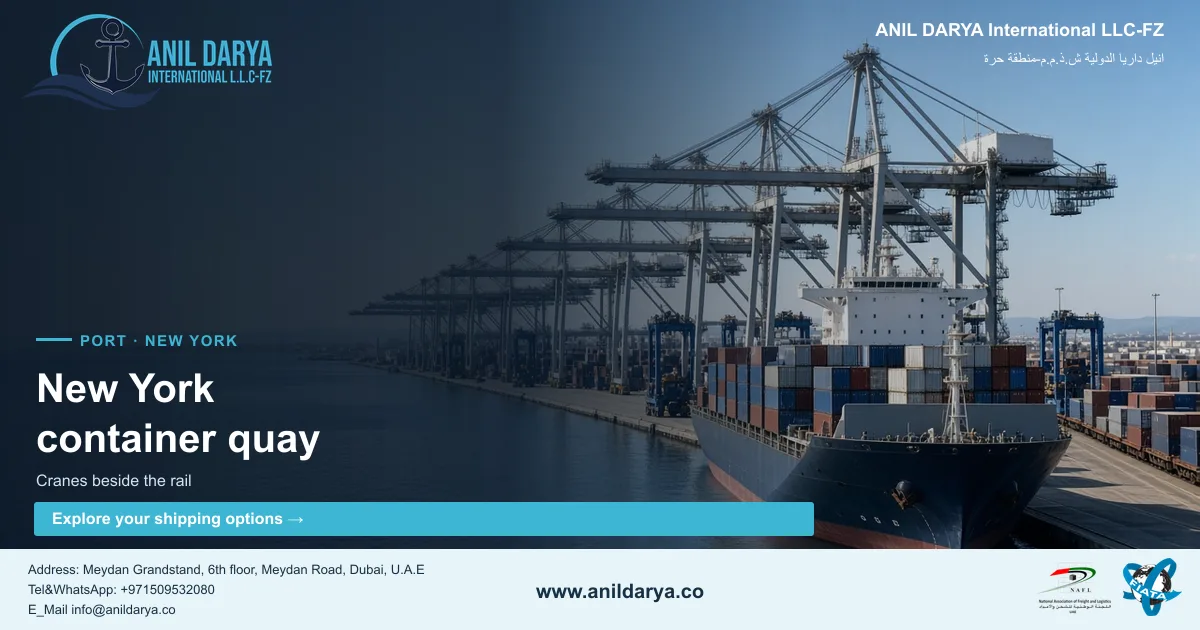
Port of New York and New Jersey shipping means moving your cargo through the largest container port on the US East Coast, with five main container terminals in New Jersey and Staten Island and an on-dock rail network that reaches inland markets. If you are shipping from Dubai to New York, your container lands at one of these terminals, clears US Customs and Border Protection (CBP), and leaves by truck, rail or barge. Below: the terminals, the CBP rules that matter most, cargo exams, and how we prepare a UAE shipment so it clears on time. We ship both from Dubai to New York and from New York and New Jersey to Dubai.
Port of New York and New Jersey: key facts at a glance
| Item | Detail |
|---|---|
| Port authority | Port Authority of New York and New Jersey (bi-state agency created by a compact signed in 1921) |
| Customs authority | US Customs and Border Protection (CBP) |
| UN/LOCODE | USNYC (Newark also appears as USNWK) |
| Container volume 2025 | 8.9 million TEU |
| Ranking | No. 1 port on the US East Coast and No. 3 in the US |
| Main container terminals | Five: Port Newark Container Terminal, Maher Terminals, APM Terminals, Port Liberty New York, Port Liberty Bayonne (plus Red Hook Container Terminal with barge service) |
| Shipping channel and air draft | 50 ft channel, 215 ft air draft (Bayonne Bridge) |
| On-dock rail | ExpressRail: four rail facilities serving all five marine terminals, CSX and Norfolk Southern connections |
| Rail lifts | 718,942 annual lifts, capacity of more than 1.5 million |
| Inland reach by rail | More than 50 direct inland markets, some in as little as two days |
| Cargo types | Containers (dry and reefer), dimensional cargo, general cargo, breakbulk, Ro-Ro at the Port Liberty terminals |
| Physical customs exams | At three Centralized Examination Stations (CES), plus on-terminal exams at Red Hook |
| Advance filing for ocean cargo | Importer Security Filing (ISF 10+2), no later than 24 hours before the cargo is loaded on the vessel |
| Entry deadline | Entry documents within 15 calendar days of arrival; entry summary and duty deposit within 10 working days of entry |
| New York and New Jersey to Dubai | Shipper or its agent files the EEI in AES; UAE duty 5% of CIF for most goods plus 5% import VAT |
Port of New York and New Jersey explained: what it is and who runs it
The Port of New York and New Jersey is a group of marine terminals around New York Harbor, overseen by the Port Authority of New York and New Jersey. Private companies operate the container terminals. Most container capacity sits in New Jersey, at Port Newark and Elizabeth on Newark Bay, with further terminals at Bayonne and on Staten Island.
The port opened what it describes as the world's first container port at Elizabeth in 1962. Today the Port Authority reports 8.9 million TEU handled in 2025 and the most first port calls of any US East Coast port.
For a Dubai shipper, "New York" on a booking usually means a New Jersey terminal. The terminal on the arrival notice decides where your trucker goes and which rail ramp your box uses.
Which container terminals does the port have?
The Port Authority lists five main container terminals. All five handle containers, dimensional cargo, general cargo and breakbulk. The two Port Liberty terminals also handle Ro-Ro. The figures below are from the Port Authority's terminal pages.
| Terminal | Location | Area | Berth length | Container cranes | Depth at dock | Reefer plugs |
|---|---|---|---|---|---|---|
| Maher Terminals | Elizabeth, NJ | 450 acres | 10,128 ft | 24 | 50 ft | 1,200 |
| APM Terminals | Elizabeth, NJ | 350 acres | 6,001 ft | 15 | 45 to 50 ft | 1,564 |
| Port Newark Container Terminal (PNCT) | Port Newark, NJ | 272 acres plus 37 off-dock acres | 4,400 ft | 13 | 40 to 50 ft | 688 (plus 160 wheeled) |
| Port Liberty New York | Staten Island, NY | 210 acres | 3 berths: 712 ft, 1,100 ft, 1,200 ft | 6 | 35 ft, 41 ft, 52 ft by berth | 481 |
| Port Liberty Bayonne | Jersey City, NJ | 167 acres | 3 berths: 2,678 ft, 2,678 ft, 1,400 ft | 12 | 50 ft | 776 |
Red Hook Container Terminal in Brooklyn runs a cross-harbor barge service between Brooklyn and its barge terminal in Port Newark. CBP still performs on-terminal exams for freight arriving at Red Hook, while the other terminals send exam boxes to a CES.
What cargo moves through the port, and how?
| Cargo type | How it usually moves | What to plan |
|---|---|---|
| General goods in containers | FCL or LCL through one of the five terminals | Terminal on the arrival notice, ISF, customs bond, trucker appointment |
| Food and chilled cargo | Reefer containers on terminal plugs | Set temperature, FDA or USDA requirements, prompt pickup |
| Machinery and steel | Flat racks or open tops, or breakbulk at terminals that list it | Lifting points, lashing, US road permits for oversize loads |
| Vehicles and rolling equipment | Ro-Ro at the Port Liberty terminals, or in containers | Vehicle documents, admissibility rules of other US agencies |
| Dangerous goods | IMDG-declared containers with carrier acceptance | UN number, SDS, DG declaration, hazmat-qualified trucker on the US side |
| Cargo for the Midwest or Canada | Container discharged then railed by ExpressRail | Through bill of lading or rail booking, in-bond or local clearance choice |
Should you ship FCL or LCL from Dubai to New York?
Most cargo from the UAE to New York moves in containers. You have two options.
- FCL (full container load). You book a whole 20ft or 40ft container. It suits larger volumes, fragile goods and anything you want sealed from origin to door.
- LCL (less than container load). Your cargo shares a container with other shippers. The container is unpacked at a warehouse in the port area after clearance, then your cargo is released. It suits small volumes but adds handling and one more party to the release.
LCL matters for the ISF. When several shippers share a box, each house bill of lading needs its own ISF, and the consolidator (stuffer) and the container stuffing location are two of the ten data elements. We supply those details to the US broker as soon as the box is stuffed. Our guide to FCL vs LCL shipping costs shows where the break-even point usually sits. Ask us to price both if you are close to it.
Shipping from Dubai to New York: what we handle and what we need from you
We work from the UAE side. We book space with carriers from Jebel Ali or Khalifa Port, prepare and check the export documents, arrange trucking to the port and UAE export clearance, and plan DG and breakbulk cargo. In the US, clearance is filed by the importer of record or a licensed US customs broker, and we work with the consignee's broker or a clearing agent they choose.
[AMIR-FACT: the carrier services we book from Jebel Ali to New York and New Jersey, which terminal they usually discharge at, and our typical port-to-port and door-to-door transit days on this lane]
If you want the wider lane view, covering all US ports and air options, see our USA route guide.
ISF 10+2: the filing that has to happen before your cargo sails
The Importer Security Filing, known as 10+2, applies to import cargo arriving in the US by ocean vessel. It does not apply to air cargo. CBP uses it to screen shipments before they are loaded abroad, so the timing starts at Jebel Ali, not New York.
Who files the ISF and when?
The ISF Importer files it, or their agent such as a licensed customs broker. CBP defines the ISF Importer as the party causing the goods to arrive in the US by vessel, typically the owner, purchaser, consignee or their agent. For a normal import, the ISF must be filed no later than 24 hours before the cargo is laden aboard the vessel bound for the US. For break bulk cargo that is exempt from the 24-hour rule, the ISF is due 24 hours before arrival. Bulk cargo does not need an ISF.
What are the 10 data elements?
| No. | Data element | Who usually has the information |
|---|---|---|
| 1 | Seller | UAE shipper or seller |
| 2 | Buyer | US importer |
| 3 | Importer of record number or FTZ applicant ID | US importer or broker |
| 4 | Consignee number(s) | US importer or broker |
| 5 | Manufacturer (or supplier) | UAE shipper |
| 6 | Ship to party | US importer |
| 7 | Country of origin | UAE shipper (from the certificate of origin) |
| 8 | HTSUS commodity number, 6-digit level | Broker, checked with the shipper |
| 9 | Container stuffing location | Forwarder or shipper at origin |
| 10 | Consolidator (stuffer) | Forwarder or consolidator at origin |
The "+2" is the carrier's part: the vessel stow plan and container status messages. The stuffing location and consolidator may be sent later, but no later than 24 hours before arrival at the first US port.
What happens if the ISF is late or wrong?
CBP may issue liquidated damages of $5,000 per violation for an inaccurate, incomplete or late filing. It can also withhold release of the cargo, refuse a permit to unlade, or issue a "do not load" order at origin. The ISF also needs bond coverage: a continuous bond, a single transaction bond or an ISF stand-alone bond. A practical rule: send the US broker the seller, manufacturer, HS code and origin details at booking, not at sailing.
CBP entry, bond and duty for cargo landing in New York
US entry has two parts: release of the goods, then the entry summary for duty and statistics. A licensed customs broker normally files both electronically.
Which documents does CBP need?
Within 15 calendar days of the shipment's arrival at a US port of entry, entry documents must be filed. CBP lists them as:
- Entry manifest (CBP Form 7533) or application for immediate delivery (CBP Form 3461), or another release form the port director requires.
- Evidence of the right to make entry, such as the bill of lading.
- Commercial invoice, or a pro forma invoice when the commercial invoice cannot be produced.
- Packing lists, if appropriate.
- Any other documents needed to decide whether the goods may enter.
Goods may only be entered by their owner, purchaser or a licensed customs broker. CBP notes that the importer of record stays responsible for the correctness of the entry, even when a broker files it.
Customs bond and entry summary
The entry must be backed by a bond posted with CBP to cover duties, taxes and charges, and a broker may let you use its bond. The entry summary (CBP Form 7501) is filed and estimated duties are deposited within 10 working days of entry.
How are duty and fees worked out?
Duty depends on the HTSUS classification of each product and its origin. Check the current rate for your exact code in the Harmonized Tariff Schedule, including any additional duties in force when your goods arrive, because rates can change between booking and arrival. On top of duty, CBP collects a merchandise processing fee on formal entries (an ad valorem fee with a minimum and maximum per entry) and a harbor maintenance fee of 0.125 percent of the cargo value, paid at entry on imports through ports that benefit from Army Corps of Engineers maintenance.
| Step | Deadline | Filed by |
|---|---|---|
| ISF 10+2 | No later than 24 hours before loading at origin | ISF Importer or its agent |
| Stuffing location and consolidator | No later than 24 hours before arrival at the first US port | ISF Importer, with data from origin |
| Entry documents (release) | Within 15 calendar days of arrival | Owner, purchaser or licensed customs broker |
| Entry summary (CBP Form 7501) and duty deposit | Within 10 working days of entry | Importer of record or broker |
Customs exams at the Port of New York and New Jersey
CBP can stop any shipment for inspection. At this port, all physical cargo exams take place at three Centralized Examination Stations, except for freight at Red Hook, where CBP still examines on terminal.
| Point | What the Port Authority says |
|---|---|
| Exam sites | East Coast Warehouse, GCT CES, and H&M International Warehousing |
| Exam types | Anti-terrorism contraband enforcement (ATCET), non-intrusive inspection (NII), agricultural, trade compliance |
| Who pays | Shippers bear the cost of cargo exams |
| Transfer time | Moving a container to a CES usually happens within one business day of CBP's transfer authorization |
| Who picks the CES | The ocean carrier designates exam sites, and can pick different ones for New York and New Jersey calls |
| Multiple containers on one bill | Can move to the CES with the container being examined |
| CTPAT members | Get preferential treatment |
Other federal agencies also oversee some cargo here, including the FDA, USDA (APHIS and FSIS) and US Fish and Wildlife. Budget time and cost for exams on first shipments.
Dangerous goods, breakbulk and out-of-gauge cargo to New York
All five main terminals list breakbulk and dimensional cargo among the cargo they handle, and the two Port Liberty terminals add Ro-Ro. Cargo that is too tall or wide for a standard box usually goes on a flat rack or open top. Cargo that does not fit a container needs conventional breakbulk tonnage, and fewer sailings offer it.
When you ship project cargo to New York with us, we plan it in this order:
- Collect drawings, weights, dimensions and centre of gravity for each piece.
- Choose flat rack, open top or breakbulk, and get carrier acceptance.
- Tell the US broker and trucker early, because oversize road moves in New Jersey and New York need permits.
- Line up customs before arrival so the cargo leaves the terminal quickly.
For dangerous goods, the IMDG Code governs the sea leg. You need a correct UN number, proper shipping name, class and packing group, a Safety Data Sheet, a signed DG declaration, UN-approved packaging, labels and placards. The truck leg from the terminal falls under US hazardous materials rules, so the consignee's trucker must be able to carry your class. Our dangerous goods shipping team confirms carrier acceptance before you commit to a sailing.
Getting your container out: trucks, rail and barge
Once CBP and the carrier release the cargo, the container can leave the terminal in three ways.
- Truck. Most local deliveries move by drayage truck. The trucker needs a terminal appointment and must check for any freight, customs or terminal holds before pickup.
- Rail. ExpressRail has four on-dock and near-dock facilities: ExpressRail Elizabeth (serving APM Terminals and Maher Terminals), ExpressRail Newark (Port Newark Container Terminal), ExpressRail Staten Island (Port Liberty New York) and ExpressRail Port Jersey (Port Liberty Bayonne). It connects to both CSX and Norfolk Southern.
- Barge. Red Hook's cross-harbor barge links Brooklyn and Port Newark.
A decision rule: for the New York metro area, truck from the terminal. For the Midwest, ask whether your carrier's service offers a rail move, and decide early whether to clear in New York or move in bond to an inland port of entry, which CBP allows.
How to ship from Dubai to the Port of New York and New Jersey: step by step
- Send us the cargo details. Commodity, HS code, weight and volume or dimensions, packing, cargo ready date, UAE pickup address and the Incoterm you agreed with your buyer.
- Confirm the US side. Who is the importer of record, who is their customs broker, and does the importer have a continuous bond or need a single transaction bond.
- Choose a service. We compare carrier services from Jebel Ali or Khalifa Port and the terminal each one uses.
- Book space. For DG, reefer or out-of-gauge cargo, we get carrier acceptance first.
- Send ISF data. The seller, manufacturer, origin and HS details go to the US broker well before loading, and we add the stuffing location and consolidator.
- Export clearance in the UAE. We file the export or re-export declaration with the invoice, packing list and certificate of origin, and gate the container in before the carrier's cut-off.
- Bill of lading. We check the draft against the invoice and ISF, then release the final bill once the vessel sails.
- US entry. The broker files the entry and entry summary, pays duty and fees, and handles any exam request.
- Pickup and delivery. The consignee's trucker books the terminal appointment, delivers the container and returns the empty within free time.
Our article on Incoterms 2020 for sea freight explains who pays for which of these steps under FOB, CFR, CIF and DAP.
How to ship from the Port of New York and New Jersey to Dubai
We also handle the other direction: shipping from New York to Dubai, with arrival at Jebel Ali, Khalifa Port or Sharjah port. We book the space and run the UAE side; the US export papers stay with the shipper or its US agent.
The US export side
- Electronic Export Information (EEI). The US Principal Party in Interest (USPPI) or its authorized agent files it in the Automated Export System (AES). For vessel cargo, the filing citation must reach the carrier 24 hours before the cargo is loaded at the US port.
- Small shipments. EEI is generally not needed when the goods under one Schedule B number, from one USPPI to one consignee, are worth $2,500 or less.
- Pickup. The shipper or its trucker brings the box to the terminal on the booking inside the receiving window.
The UAE import side
The import declaration goes to Dubai Customs. A company with a Dubai Customs business code can file it, or a licensed clearing agent with the owner's authorisation. Dubai Customs asks for the commercial invoice, packing list, certificate of origin and any permit from the authority that controls restricted goods, and the carrier's agent needs the bill of lading before it issues the delivery order. Customs duty in Dubai is 5% of the CIF value for most goods, with 50% on alcohol and 100% on cigarettes. Import VAT is 5% of the customs value, and a VAT-registered importer accounts for it on its VAT return through the reverse charge.
- Send us the shipper's details in the US, the cargo, the HS code, the Incoterm and the UAE delivery address.
- We book space from New York and New Jersey to Jebel Ali, Khalifa Port or Sharjah and send the booking and cut-offs to the shipper.
- The shipper or its trucker collects the empty, stuffs it and delivers the box to the terminal on the booking before the cut-off.
- The shipper or its US agent files the EEI in AES and gives the carrier the filing citation 24 hours before loading.
- We check the draft bill of lading against the invoice and packing list before the carrier issues it.
- We file the UAE import declaration before the ship arrives.
- We arrange payment of the duty and VAT.
- We collect the delivery order from the carrier's agent in the UAE.
- We truck the cargo to your site and return the empty container inside free time.
[AMIR-FACT: the carriers we actually use from New York and New Jersey to Jebel Ali/Khalifa/Sharjah and our real transit days in this direction]
Free time, demurrage and detention in New York and New Jersey
Carriers give a number of free days for their containers, and terminals set their own free storage. After that, demurrage runs while the full container sits in the terminal and detention while you keep it outside. Free days and daily rates vary by carrier, terminal and container type, so read them on your quote and arrival notice.
File the ISF and entry early, and book the truck before free time starts. A CES exam can eat into free time, so ask for extra free days on a first shipment. Our article on demurrage and detention shows how the charges build up.
Checklist before you ship to New York
- US importer of record named, with a customs broker appointed.
- Customs bond in place, covering both the ISF and the entry.
- HS code checked against the HTSUS at 6 digits for the ISF and at full length for the entry.
- Seller, buyer, manufacturer, ship-to party and country of origin agreed and identical on all documents.
- ISF filed at least 24 hours before loading, with stuffing location and consolidator sent in time.
- Commercial invoice, packing list and certificate of origin issued in the UAE.
- Goods marked with their country of origin where CBP requires it.
- Other agency approvals checked for food, plants or wood packaging.
- For DG: SDS, DG declaration, packaging, labels, carrier acceptance and a US trucker who can carry the class.
- Terminal, free time and pickup method (truck, rail or barge) confirmed before arrival.
Common mistakes on the Dubai to New York lane
- Late ISF. Filing after loading risks $5,000 in liquidated damages and a hold on the cargo.
- Different parties on different documents. If the ISF, invoice and bill of lading name different sellers or manufacturers, expect questions from CBP.
- No bond. Without a bond, the broker cannot file the entry and the box sits.
- Wrong terminal on the truck booking. The trucker goes to the wrong gate and loses the appointment.
- Not budgeting for exams. Shippers pay CES exam costs, and an exam can use up free time.
New York and New Jersey or Los Angeles: which US port fits your cargo?
| Your situation | Port to look at first | Why |
|---|---|---|
| Consignee in the New York metro area or the Northeast | New York and New Jersey | Short truck leg from the terminal |
| Consignee in the Midwest or eastern Canada | New York and New Jersey, with ExpressRail | On-dock rail to more than 50 inland markets |
| Consignee in California or the western states | Los Angeles | Avoids a long cross-country inland move |
We can price more than one US port so you can compare the total cost to your door.
Frequently asked questions
Who runs the Port of New York and New Jersey terminals?
The Port Authority of New York and New Jersey, a bi-state agency created in 1921, oversees the port. Private companies operate each container terminal.
How many container terminals does the port have?
Five: Maher Terminals and APM Terminals in Elizabeth, Port Newark Container Terminal, Port Liberty Bayonne in Jersey City, and Port Liberty New York on Staten Island. Red Hook in Brooklyn adds a barge service.
Do I need an ISF for a shipment from Dubai to New York?
Yes, for ocean cargo. The ISF must be filed by the ISF Importer or its broker no later than 24 hours before the cargo is loaded on the vessel at the UAE port. Air cargo does not need an ISF.
What is the penalty for a late ISF?
CBP may issue liquidated damages of $5,000 per violation for a late, inaccurate or incomplete ISF. It can also hold the cargo or issue a "do not load" order at origin.
How long do I have to clear cargo after it arrives in New York?
Entry documents are due within 15 calendar days of arrival, and the entry summary with estimated duties within 10 working days of entry. File before arrival to avoid demurrage.
Where are customs exams done at the port?
Physical exams take place at three Centralized Examination Stations chosen by the ocean carrier, except at Red Hook, where CBP examines on terminal. The shipper pays the exam costs.
Can my container go inland by rail from New York?
Yes. ExpressRail serves all five marine terminals and connects to CSX and Norfolk Southern, reaching more than 50 inland markets. Ask your carrier whether a rail move is available on your service.
Can you ship from New York to Dubai?
Yes. We book space from the port to Jebel Ali, Khalifa Port or Sharjah, the shipper or its US agent files the EEI, and we clear the cargo through UAE customs and deliver it. Most goods pay 5% customs duty on the CIF value plus 5% import VAT.
Get a quote for shipping to the Port of New York and New Jersey
Send us your cargo details and we will come back with sailing options and a price from the UAE to New York and New Jersey. Use our freight rate inquiry form, or contact our team to talk through a DG, breakbulk or first-time US shipment. You can also read about our Dubai freight forwarding team, how we use Jebel Ali Port as the main origin, and our sea freight service.
Sources
- Port Authority of NY and NJ: Container terminals (area, berths, cranes, depth, reefer plugs, cargo types)
- Port Authority of NY and NJ: Rail and ExpressRail (2025 TEU, ranking, rail lifts, inland markets)
- Port Authority of NY and NJ: Our Port (history, port development, 50 ft channel, 215 ft air draft)
- Port Authority of NY and NJ: Containers (refrigerated cargo, Red Hook barge)
- Port Authority of NY and NJ: Customs examinations (CES sites, exam types, costs)
- Port Authority of NY and NJ: Facility volumes for September 2025
- CBP: Importer Security Filing 10+2
- CBP: Importer Security Filing and Additional Carrier Requirements (timing, ISF Importer, $5,000 liquidated damages)
- CBP: ISF FAQ 2.0 (10 data elements, bonds, updates)
- CBP: Importing into the United States (entry documents, 15 days, 10 working days, bond, user fees)
- CBP: Importer and exporter tips (importer of record, brokers, HTS)
- Dubai Customs: Submit customs declaration (export documents)
- iContainers: Port of New York and New Jersey (UN/LOCODE)
- 15 CFR 30.4: EEI filing timeframes (24 hours before loading for vessel cargo)
- 15 CFR 30.37: EEI exemptions ($2,500 per Schedule B number)
- Dubai Customs: FAQ (customs business code, clearing agents with owner authorisation)
- UAE Government portal: Customs duty (5% of CIF, alcohol 50%, cigarettes 100%)
- Federal Tax Authority: VAT guide (5% import VAT on the customs value, reverse charge)
Reviewed: 10 November 2026