
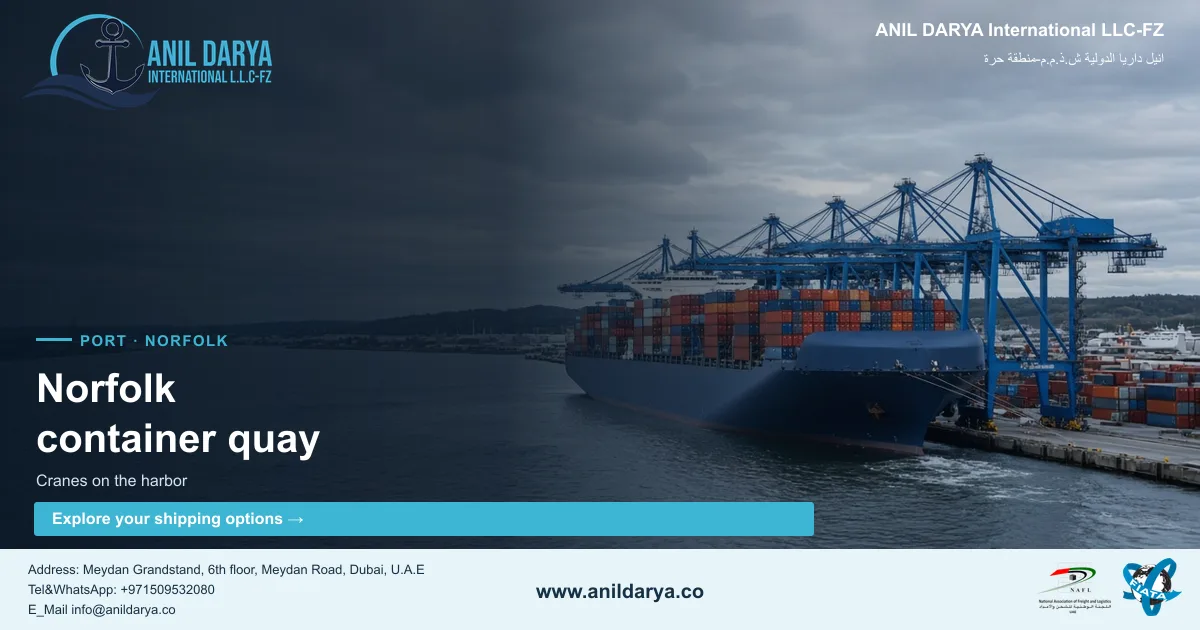
Port of Norfolk shipping means moving cargo through The Port of Virginia, the state-owned port group in Hampton Roads whose biggest container terminal sits in Norfolk. Since early 2026 the harbor has a 55-foot channel, the deepest on the US East Coast, and two Class I railroads run on dock. This guide covers the terminals, free time, dangerous goods rules, US customs in short, and how we ship your cargo from Dubai to Norfolk. We ship both from Dubai to Norfolk and from Norfolk to Dubai.
Port of Norfolk shipping: key facts at a glance
| Item | Detail |
|---|---|
| Official name | The Port of Virginia |
| Owner | Virginia Port Authority (VPA), a state agency |
| Terminal operator | Virginia International Terminals, LLC (VIT) |
| UN/LOCODE | USORF (Norfolk) |
| Main container terminals | Norfolk International Terminals (NIT) in Norfolk, Virginia International Gateway (VIG) in Portsmouth |
| Other terminals | Newport News Marine Terminal (breakbulk, Ro-Ro), Portsmouth Marine Terminal (heavy lift), Richmond Marine Terminal (barge), Virginia Inland Port (rail, Front Royal) |
| Channel depth | 55 feet, dredging finished 28 February 2026 |
| Air draft | No air draft restriction on the breakbulk and Ro-Ro route, 18 miles from open ocean |
| Container volume | About 3.4 million TEU a year (port figure, April 2026) |
| Planned capacity | 5.8 million TEU a year once the NIT North Berth opens (scheduled mid-2027) |
| Rail | Norfolk Southern and CSX, rail capacity of 2 million TEU a year |
| Import free time at the terminal | 7 days for dry containers, 5 days for reefers (VIT schedule of rates) |
| Customs authority | US Customs and Border Protection (CBP) |
| Norfolk to Dubai | USPPI or its agent files the EEI in AES; arrival at Jebel Ali, Khalifa Port or Sharjah, 5% UAE duty on CIF for most goods plus 5% VAT |
What is the Port of Norfolk, and who runs it?
When shippers say "Port of Norfolk" they usually mean The Port of Virginia. It is not one quay. It is a group of terminals around the Hampton Roads harbor, plus an upriver barge terminal and an inland rail port.
The Virginia Port Authority owns the terminals. It is a state agency that reports to the Virginia Secretary of Transportation. Virginia International Terminals, LLC (VIT) operates them and publishes the schedule of rates that sets free time, storage and dangerous goods rules at the gate.
Your bill of lading may show Norfolk (USORF) even when the box lands at VIG in Portsmouth. The arrival notice names the actual terminal.
Which terminals does The Port of Virginia have?
Six facilities make up the port. Two of them handle almost all container cargo from the UAE.
| Facility | Location | What it handles | Key figures |
|---|---|---|---|
| Norfolk International Terminals (NIT) | Norfolk, off Interstate 64 | Containers, largest terminal | More than 90 stacking cranes, 3.6 million TEU capacity after expansion, on-dock Norfolk Southern rail, CSX intermodal access |
| Virginia International Gateway (VIG) | Portsmouth, by Interstate 164 | Containers | More than 50 stacking cranes, 2.2 million TEU capacity, nearly 30,000 ft of rail track, on-dock Norfolk Southern and CSX |
| Newport News Marine Terminal (NNMT) | Newport News | Breakbulk and Ro-Ro | 60 acres outside storage, over 1 million sq ft covered storage, on-dock CSX rail |
| Portsmouth Marine Terminal (PMT) | Portsmouth | Heavy lift, offshore wind components | USD 220 million conversion completed March 2025 |
| Richmond Marine Terminal (RMT) | Richmond, on the James River | Barge service to and from Hampton Roads | Three barges in rotation |
| Virginia Inland Port (VIP) | Front Royal, Northern Virginia | Rail-served inland terminal | 200 miles inland, on-terminal rail capacity raised by 40% |
NIT and VIG: where your container lands
Both container terminals use semi-automated stacking cranes, with trucks served at transfer zones. At NIT a USD 650 million North Berth renovation is under way, with four new low-profile ship-to-shore cranes. It is scheduled for mid-2027 and will give the port its fifth berth for ultra-large container vessels. Today NIT South and VIG each have two such berths.
The carrier's service decides the terminal, so check the arrival notice before booking a truck or rail move.
The 55-foot channel
The port finished dredging the Norfolk Harbor channel to 55 feet on 28 February 2026, part of a USD 450 million project. Widening for two-way traffic of ultra-large ships was completed in February 2024. The port calls the channel restriction-free. For you, the practical effect is that the largest ships on Asia and Europe services can call fully loaded, which keeps Norfolk on direct mainline rotations rather than feeder legs.
How much cargo moves through the port?
At its April 2026 State of the Port event, the port reported container volume of 3.4 million TEU, up 20% since 2021, and placed itself sixth among US container hubs. It also reported an average truck gate transaction time of 36 minutes.
Capacity is growing faster than volume. With the North Berth finished, annual capacity will reach 5.8 million TEU, and the USD 83 million Central Rail Yard expansion at NIT (August 2024) lifted rail capacity to 2 million TEU a year.
What cargo can you ship through Norfolk?
| Cargo | Where it goes | What to plan |
|---|---|---|
| General goods in dry containers | NIT or VIG | Terminal on the arrival notice, ISF, customs bond, truck reservation |
| Chilled and frozen food | NIT or VIG reefer areas | Only 5 days terminal free time, FDA and USDA rules, power at origin and on the truck |
| Containers for the Midwest | Discharged at NIT or VIG, then double-stack rail | Rail routing on the booking, in-bond or local clearance decision |
| Steel, machinery, vehicles | NNMT (breakbulk and Ro-Ro) | Lifting points, trailer type, 10 days terminal free time for non-containerized cargo |
| Heavy lift and project cargo | PMT or NNMT | Drawings, lift plan, berth and crane booking, road permits |
| Dangerous goods | NIT or VIG, under VIT hazardous cargo rules | Carrier notice to VIT 10 days before arrival, 30 days for radioactive |
Shipping from Dubai to Norfolk: routings and transit
There is no single answer to how long shipping from Dubai to Norfolk takes, because the routing is set by the carrier's network. Schedule aggregator Fluent Cargo lists the lane with one transshipment on every option it shows, from several UAE load ports:
| Load port | Listed duration | Listed frequency | Carriers named |
|---|---|---|---|
| Khor Fakkan | About 37 days | Every 2-4 weeks | Maersk, Hapag-Lloyd |
| Fujairah | About 41 days | Every 1-2 weeks | ONE, COSCO, Hapag-Lloyd, Maersk |
| Jebel Ali | About 59 days | Every 2-4 weeks | ONE, CMA CGM |
These are third-party indications, not a quote. Ask for the transit and transshipment port on every quote you compare.
[AMIR-FACT: our real door-to-port transit Jebel Ali to Norfolk (or Khor Fakkan/Fujairah to Norfolk), the carriers we actually book on this lane, and typical booking lead time]
For urgent cargo, air is the other option. Norfolk's own airport is small for freight, so most air cargo from Dubai lands at a major gateway. Fluent Cargo lists a direct Dubai to Washington Dulles flight of about 14.5 hours, then a truck to Hampton Roads. Our air cargo service from Dubai covers that option.
FCL or LCL to Norfolk?
Most UAE cargo to Norfolk moves FCL. LCL suits small volumes, but on this lane it means consolidation at origin, a transshipment and devanning at a container freight station in Hampton Roads, and each step adds a handler and days. For fragile, high-value or DG cargo, price FCL; otherwise price both. Our guide to FCL vs LCL costs shows where the break-even point usually falls. We book both through our sea freight service from Dubai.
Free time at Norfolk terminals: how many days do you get?
VIT's schedule of rates (effective 1 October 2026) sets the terminal free time for loaded containers. This free time is granted to the ocean carrier, and storage charges start when it runs out. Your carrier's own demurrage and detention terms are separate, so read both.
| Cargo | Terminal free time | When the clock starts |
|---|---|---|
| Import, dry container | 7 consecutive days | Midnight after discharge from the vessel, ends when the box leaves the terminal |
| Import, reefer | 5 consecutive days | Midnight after discharge |
| Export, dry container by truck | 7 consecutive days | Midnight after gate-in, ends at loading |
| Export, dry container by rail | 10 consecutive days | Midnight after arrival at the terminal |
| Export, reefer | 5 consecutive days | Midnight after gate-in |
| Non-containerized cargo (breakbulk) | 10 consecutive calendar days | First 8:00 a.m. after the cargo is received |
Two points catch importers out. Free time resets if a container moves from one VIT terminal to another, and it is counted in consecutive days, weekends included. File customs before arrival so the box can leave inside the window. Our article on demurrage and detention explains how carrier charges stack on top.
Getting cargo out: trucks, rail and barge
Trucks at NIT and VIG need a reservation in the port's PRO-PASS system during the mandatory reservation hours on weekdays. The port's gate page lists weekday truck gates at both container terminals and shows them closed at weekends. Gate hours change, so your trucker should check the live page before each move.
Rail is the strength of this port. Norfolk Southern and CSX both reach the container terminals, so Midwest cargo often goes by rail. The Virginia Inland Port at Front Royal brings containers 200 miles inland by rail for northern Virginia. The Richmond barge service moves containers up the James River.
A decision rule: truck for Virginia, rail for deep inland, and decide early whether to clear in Norfolk or move in bond.
Breakbulk, heavy-lift and project cargo at Norfolk
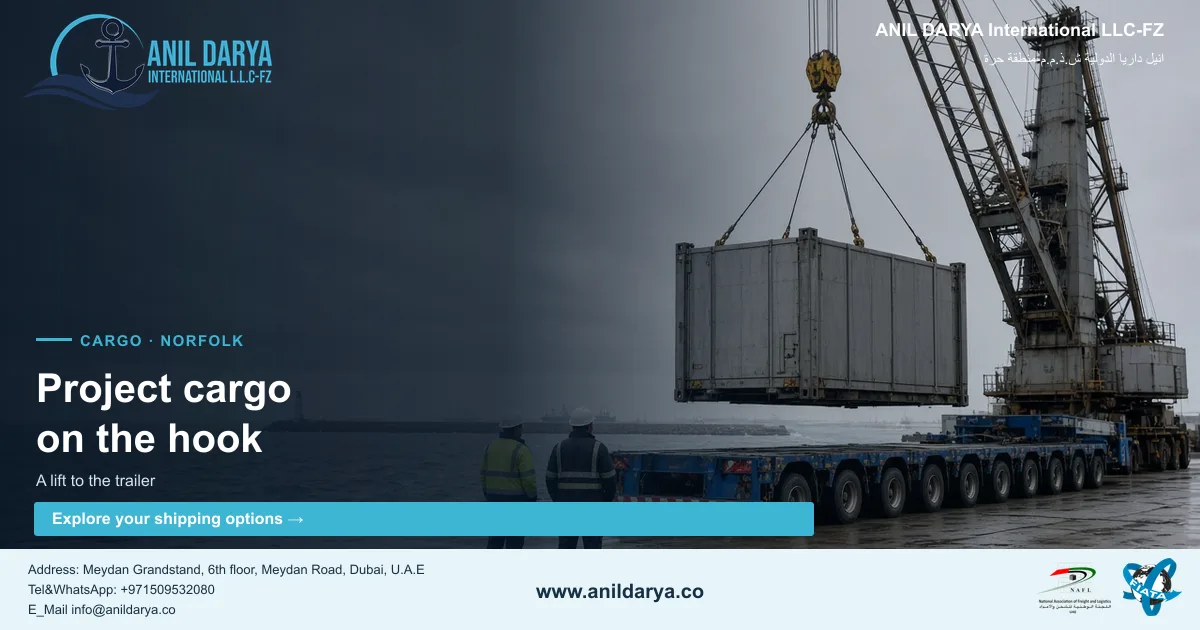
Non-container cargo does not go to the big container terminals. The port's breakbulk and Ro-Ro work is centred on Newport News Marine Terminal, which has 60 acres of outside storage, over 1 million sq ft of covered storage and on-dock CSX rail. Portsmouth Marine Terminal was rebuilt into a heavy-lift facility for offshore wind components in a USD 220 million project finished in March 2025. The port lists heavy-lift berths, a heavy-lift crane and outside storage at its breakbulk terminal, with no air draft restriction on the way in.
Our planning order for any heavy piece from the UAE:
- Collect dimensions, weights, centre of gravity and lifting points for every piece.
- Choose flat rack or open top on a container service, or breakbulk tonnage.
- Confirm with the carrier which Virginia terminal will discharge it.
- Plan the road move from the quay, including any oversize permits.
- Line up customs so the piece leaves inside the 10-day free time for non-containerized cargo.
If a piece fits a 40ft flat rack by size and weight, a container service usually gives more sailings. Our guide to flat rack, open top and breakbulk options sets out the limits. See also our break bulk and project cargo service.
Dangerous goods at the Port of Norfolk
VIT's schedule of rates (item 267) adds terminal rules on top of the IMDG Code and US hazardous materials law. The ones that affect planning:
- The carrier must notify VIT at least 10 days before DG cargo arrives at a terminal, with an exact description of the goods and quantity.
- Radioactive cargo needs at least 30 days' notice.
- VIT may refuse DG cargo or set extra handling conditions, and the carrier pays the extra cost.
- DG containers may not be transshipped at the terminal without the terminal manager's prior written consent.
- Explosives are worked on chassis for direct loading or discharge only, under a pre-approved plan and a signed US Coast Guard Form 4260. The shipper's hazardous declaration and related documents must reach VIT at least 5 days before the operation.
Because the notice runs through the carrier, your DG paperwork must be complete when you book, not when you sail. For a UAE export, that means a correct UN number, proper shipping name, class and packing group, a Safety Data Sheet, a signed dangerous goods declaration and IMDG packaging and labels. Our dangerous goods shipping team checks carrier acceptance before you commit to a sailing.
US customs at Norfolk: the short version
CBP rules are the same at every US seaport, so here is only the short version.
- ISF 10+2. The importer, or its customs broker, files the Importer Security Filing no later than 24 hours before the cargo is loaded on the vessel at the UAE port. Late, wrong or missing filings can bring liquidated damages of USD 5,000 per violation. Breakbulk exempt from the 24-hour rule files 24 hours before arrival.
- Entry. Entry documents are due within 15 calendar days of arrival, and the entry summary within 10 working days of entry.
- Bond. The entry must be backed by a customs bond. A broker can let you use its bond.
- Duty. The rate depends on the HTSUS code and origin of each product. Check the official tariff for your exact code when the goods arrive.
- In bond. Goods can move in bond from Norfolk to another US port of entry and be cleared there.
What we need from you before sailing
| Document or data | Why Norfolk needs it | Who provides it |
|---|---|---|
| Commercial invoice and packing list | CBP entry and duty | Seller (you) |
| Seller, manufacturer, HS code, country of origin | ISF, due 24 hours before loading | Seller to the US broker |
| Container stuffing location and consolidator | ISF data due before arrival | Us, from the UAE side |
| Bill of lading | Release from the carrier | Carrier, through us |
| UAE export declaration | Export clearance in Dubai | Us or our clearing agent |
| DG declaration and SDS | Carrier acceptance and the 10-day VIT notice | Shipper, checked by us |
How to ship from Dubai to the Port of Norfolk: step by step
This is how we handle a shipment from Dubai to Norfolk. We book space and handle the UAE side. The US importer's customs broker clears the cargo at Norfolk.
- Send us the cargo details. Commodity, HS code, weight, volume or dimensions, pickup point and the Incoterm you agreed with your buyer.
- Get the routing and quote. We compare carrier services from Jebel Ali and other UAE ports to Norfolk and confirm the transshipment port and the Virginia terminal.
- Book space. For DG, reefer or out-of-gauge cargo we get carrier acceptance first, so the 10-day DG notice to VIT can be met.
- Send ISF data to the broker. Seller, manufacturer, HS codes and origin go at booking so the ISF is filed before loading.
- Pick up, stuff and clear export. We truck the empty, stuff and seal the box, and file the UAE export declaration. Our Jebel Ali port guide covers that side.
- Arrival in Norfolk. The broker files entry, the carrier releases the box, and the trucker books a PRO-PASS slot at NIT or VIG within the 7-day free time.
How to ship from the Port of Norfolk to Dubai
We also handle the other direction: shipping from Norfolk to Dubai, with arrival at Jebel Ali, Khalifa Port or Sharjah port. We book the space with the carrier and run the UAE side. The US export filing stays with the shipper or its US agent.
The US export side
- Electronic Export Information (EEI). The US Principal Party in Interest (USPPI) or its authorized agent files it in the AES. For vessel cargo, the filing citation must reach the carrier 24 hours before the cargo is loaded at the US port.
- Exemptions. EEI is generally not needed when each Schedule B number in the shipment is valued at $2,500 or less, subject to the conditions in the rules. The shipper's agent confirms this for each shipment.
The UAE import side
On arrival, the declaration goes to Dubai Customs with the commercial invoice, the packing list, the certificate of origin and any permit from the authority that controls restricted goods. The carrier then releases the cargo against the bill of lading with a delivery order. Customs duty in Dubai is 5% of the CIF value for most goods, with 50% on alcohol and 100% on cigarettes. Import VAT is 5%, charged on the customs value including freight, insurance and customs fees. A VAT-registered importer that meets the Federal Tax Authority conditions accounts for it on its VAT return instead of paying at the border.
- Send us the shipper's details in Norfolk, the cargo, the HS code and the UAE delivery address.
- We book space from Norfolk to Jebel Ali, Khalifa Port or Sharjah and send the booking and cut-offs to the shipper.
- The shipper or its trucker delivers the container to the terminal on the booking, Norfolk International Terminals or Virginia International Gateway, inside the receiving window.
- The shipper or its US agent files the EEI in AES before the cut-off.
- We check the draft bill of lading against the invoice and packing list before it is issued.
- We file the UAE declaration before the vessel arrives, so clearance can start when it berths.
- We arrange payment of the duty and VAT and collect the delivery order from the carrier.
- We truck the cargo to your site and return the empty container inside the free time.
[AMIR-FACT: the carriers we actually use from Norfolk to Jebel Ali, Khalifa Port or Sharjah, and our real port-to-port transit days in this direction]
Norfolk or another US port?
| Your situation | Port to look at | Why |
|---|---|---|
| Consignee in Virginia, the Carolinas or the Mid-Atlantic | Norfolk | Short truck leg, 55 ft channel, two on-dock railroads |
| Cargo for Ohio, the Midwest or Chicago by rail | Norfolk | Double-stack rail from both container terminals |
| Consignee in New York, New Jersey or New England | New York and New Jersey | Shorter final truck move |
| Project cargo for Texas or the Gulf states | Houston | Breakbulk terminals close to the site |
| Consignee on the US West Coast | Los Angeles or Oakland | Avoids a cross-country rail or truck leg |
We can price more than one US port so you compare total cost to the consignee's door, not just ocean freight.
Checklist before you ship to Norfolk
- HS code confirmed for every item, and the same code on invoice, packing list and ISF data.
- Importer of record, US customs broker and bond confirmed.
- ISF data sent to the broker at booking.
- Transshipment port and Virginia terminal (NIT or VIG) known before sailing.
- For reefers, a delivery plan that fits 5 days of terminal free time.
- For DG, carrier acceptance in hand early enough for the 10-day VIT notice (30 days for radioactive).
- For breakbulk, drawings and weights sent, and the road route checked.
- Trucker set up with PRO-PASS for the container terminals.
- Carrier demurrage and detention terms read, not only the terminal free time.
Common mistakes when shipping to Norfolk
- Assuming Norfolk means NIT. Your box may discharge at VIG in Portsmouth. Book the truck to the terminal on the arrival notice.
- Late ISF data. If the seller sends manufacturer and HS details after loading, the broker files late and the cargo can be held.
- Counting free time in working days. Terminal free time runs in consecutive days from midnight after discharge.
- Booking DG late. Without 10 days' notice to VIT, the terminal can refuse the cargo.
- No truck reservation. Trucks without a PRO-PASS slot in mandatory hours lose time at the gate.
Frequently asked questions
Is the Port of Norfolk the same as The Port of Virginia?
Yes, in practice. The Port of Virginia is the official name for the state-owned terminals around Hampton Roads, and Norfolk International Terminals is the largest of them. Shippers and bills of lading often call the whole port Norfolk.
How deep is the channel at the Port of Norfolk?
The Norfolk Harbor channel was dredged to 55 feet, with dredging finished on 28 February 2026. The port describes it as the deepest commercial channel on the US East Coast.
What is the port code for Norfolk?
The UN/LOCODE for Norfolk is USORF. You will see it on bookings, bills of lading and tracking tools.
How many free days do containers get at Norfolk?
Under the VIT schedule of rates effective 1 October 2026, import dry containers get 7 consecutive days of terminal free time and reefers get 5, counted from midnight after discharge. Carrier demurrage and detention terms are separate.
Can I ship dangerous goods to Norfolk?
Yes. The carrier must notify the terminal operator at least 10 days before DG cargo arrives, or 30 days for radioactive material, and explosives are only worked by direct loading or discharge on chassis.
How long does shipping from Dubai to Norfolk take?
It depends on the carrier's routing. A schedule aggregator lists options from about 37 days from Khor Fakkan to about 59 days from Jebel Ali, all with one transshipment. Ask for the transit on each quote.
Do I need an ISF for cargo from Dubai to Norfolk?
Yes, for ocean cargo. The importer or its broker must file the ISF no later than 24 hours before the cargo is loaded at the UAE port, and CBP can charge USD 5,000 per violation.
Can containers go inland by rail from Norfolk?
Yes. Norfolk Southern and CSX serve the container terminals with on-dock or intermodal rail, and the Virginia Inland Port at Front Royal takes rail cargo 200 miles inland.
How do I ship from Norfolk to Dubai?
The USPPI or its agent files the EEI in AES at least 24 hours before loading, and the shipper delivers the box to the terminal. We book the space, file the Dubai Customs declaration before arrival, arrange payment of the 5% duty and 5% VAT, and deliver to your site.
Get a quote for Port of Norfolk shipping
Send us your cargo details and we will come back with a routing and a price from the UAE to Norfolk. Use our freight rate inquiry form, or contact our team to talk through a breakbulk, project or DG shipment first. You can also read more about our Dubai freight forwarding team.
Sources
- The Port of Virginia: Facilities (NIT, VIG, NNMT, PMT, RMT, VIP figures)
- The Port of Virginia: Capabilities (breakbulk, Ro-Ro, heavy lift)
- The Port of Virginia: Construction complete on deepest East Coast channel (18 March 2026)
- AJOT: Port of Virginia debuts deepest harbor, North Berth progress (June 2026)
- FreightWaves: State of the Port 2026 (3.4 million TEU, 36-minute gate transactions)
- The Port of Virginia: Breakbulk and Ro-Ro (18 miles to open ocean, no air draft restriction)
- Virginia International Terminals: Schedule of Rates No. 1, effective 1 October 2026 (items 267, 456, 500)
- The Port of Virginia: Terminal gate hours and PRO-PASS reservations
- Wikipedia: Virginia Port Authority (governance, terminals)
- iContainers: Port of Norfolk (UN/LOCODE USORF)
- Fluent Cargo: Dubai to Norfolk routes (listed ocean durations and carriers, air via Dulles)
- CBP: Importer Security Filing and Additional Carrier Requirements (24 hours, USD 5,000)
- CBP: Importing into the United States (15 days, 10 working days, bond, in bond)
- 15 CFR 30.4: EEI filing by the USPPI or its agent, 24 hours before vessel loading
- 15 CFR 30.37: EEI exemption for each Schedule B number valued at $2,500 or less
- Dubai Customs: Submit customs declaration (invoice, packing list, certificate of origin, permits)
- Dubai Customs: FAQ (5% of CIF value, alcohol and cigarettes)
- UAE Government portal: Clearing customs and paying customs duty (5% of CIF in Dubai)
- Federal Tax Authority: VAT guide, section 3.5 on import VAT (5%, customs value, registered importers)
Reviewed: 10 November 2026