
|
Getting your Trinity Audio player ready...
|
Dry Bulk Market Holds Firm Despite Growing Demand Risks
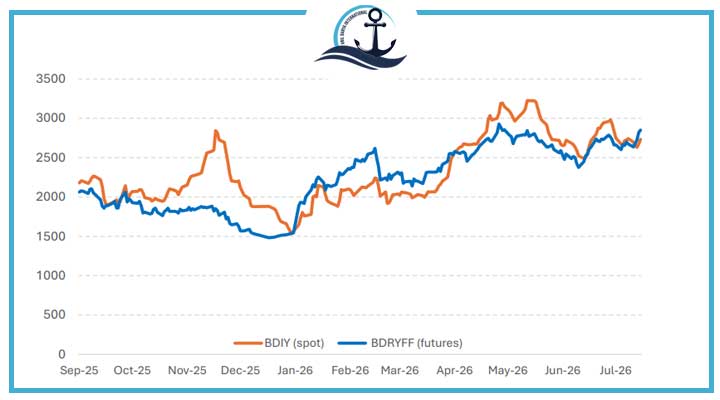
The global dry bulk shipping market continues to trade at historically strong freight rate levels, even as market volatility falls to multi-year lows. While tight vessel availability continues to support spot earnings, weakening iron ore demand in China is emerging as the biggest risk to the market's medium-term outlook.
According to the latest Breakwave Dry Bulk Shipping Report, the balance between constrained vessel supply and slowing cargo demand remains the defining factor shaping freight markets during the second half of 2026.
Strong Spot Rates Continue to Support the Market
Dry bulk freight rates have remained at elevated levels with no immediate signs of a broad market correction.
The report attributes this resilience primarily to structural supply constraints rather than accelerating cargo demand. Continued geopolitical disruptions have reduced effective vessel availability, while an intensive global drydocking programme has temporarily removed additional ships from active service.
Together, these factors have tightened capacity across the dry bulk fleet, allowing owners to maintain healthy spot earnings despite softer demand signals from some commodity markets.
Freight Rate Volatility Falls to Multi-Year Lows
One of the report's most notable findings is the sharp decline in freight rate volatility.
Although freight markets remain strong, daily price swings have narrowed significantly, indicating a period of relative price stability.
The report notes that this stability should not be interpreted as evidence that downside risks have disappeared. Freight markets remain fundamentally driven by cargo demand, and without sustained growth in commodity shipments, the current balance between supply and demand could gradually weaken.
While identifying the precise trigger for a market correction remains difficult, the report argues that broader macroeconomic conditions will ultimately determine the next phase of the freight cycle.
Chinese Iron Ore Demand Becomes the Main Concern
Iron ore continues to dominate the outlook for the dry bulk sector.
According to the report, iron ore prices have fallen towards the lower end of the US$90–100 per tonne range, remaining close to their lowest levels in two years.
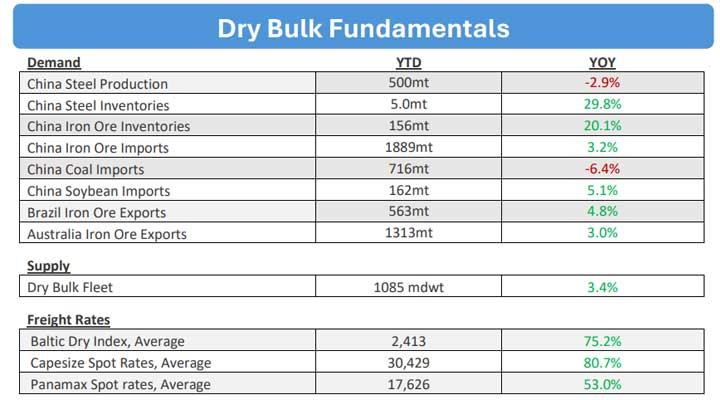
Weak steel demand in China and elevated inventories at Chinese ports have continued to weigh on prices despite relatively resilient import volumes during the first half of the year.
The report suggests that maintaining current import levels through the second half of 2026 may prove difficult unless China introduces a significant economic stimulus programme capable of reviving industrial activity and steel production.
Higher Costs Challenge Mining Economics
Mining companies are also facing increasing financial pressure.
Several years of elevated inflation, higher fuel prices and historically strong freight rates have raised production costs well above the averages seen during the previous decade.
For some Atlantic Basin producers, declining iron ore prices are approaching levels that could significantly reduce profitability once operating costs and overheads are taken into account.
Should prices continue to weaken, the report suggests some producers may reduce output, potentially leading to lower seaborne iron ore volumes during the remainder of the year.
Any sustained decline in export cargoes would directly affect demand for dry bulk vessels.
Shipowners Enter a Potential Downturn from a Strong Position
Despite growing demand risks, the report highlights that today's market differs substantially from previous industry downturns.
After several consecutive years of strong freight earnings, many shipowners have accumulated healthy cash reserves and significantly stronger balance sheets.
Unlike the shipping crisis that followed the 2010 market collapse, many companies are now considered better prepared to withstand periods of weaker freight demand without facing immediate financial distress.
This stronger financial position could help limit the scale of any future market disruption even if freight rates begin to soften.
Long-Term Outlook Still Supported by Structural Factors
Looking beyond current market conditions, Breakwave believes geopolitical developments will continue influencing vessel availability and global trade patterns.
Disruptions affecting key shipping routes have reduced effective fleet capacity, while relatively measured fleet growth has prevented a significant oversupply of vessels.
The report also points to the possibility of a longer-term recovery in China's economy following recent economic weakness. If industrial activity improves, demand for major bulk commodities could strengthen, providing additional support for dry bulk shipping.
Although short-term uncertainty remains elevated, the longer-term outlook continues to be supported by relatively stable demand for bulk commodities together with disciplined fleet growth.
Market Balance Will Depend on China and Global Trade
The report concludes that the dry bulk market remains fundamentally supported by constrained vessel supply, but demand-side risks are becoming increasingly important.
Future freight market performance will depend largely on developments in China's industrial economy, the direction of iron ore demand and the broader geopolitical environment affecting global shipping.
As long as vessel supply remains constrained, freight rates are likely to remain resilient. However, sustained weakness in commodity demand could eventually shift the market balance and place greater pressure on freight earnings across the dry bulk sector.