
Shipping from Australia to Dubai is a long-haul container lane: published schedules show about 26 to 36 days by sea with one transshipment, or a direct flight of 11 to 14 hours for air cargo. The Australian side needs an export declaration to the Australian Border Force for most commercial shipments, plus Department of Agriculture approvals for food and farm goods. At the Dubai end you need a customs business code, a Dubai Customs declaration, 5% duty on the CIF value unless the Australia-UAE CEPA removes it, and 5% import VAT.
Australia to Dubai shipping at a glance
| Item | Detail |
|---|---|
| Main Australian load ports | Melbourne, Sydney (Port Botany), Brisbane, Fremantle; also Adelaide and Darwin |
| Main UAE arrival ports | Jebel Ali for Dubai; Khor Fakkan and Fujairah on the east coast appear on many published routings |
| Published sea transit | Fremantle to Fujairah about 25 days 14 hours; Melbourne to Khor Fakkan about 28 days 15 hours; Sydney to Fujairah about 35 days 13 hours; all with 1 transfer (Fluent Cargo) |
| Published air transit | Perth to Dubai about 10 h 56 m direct; Sydney to Dubai about 14 h 21 m direct (Fluent Cargo) |
| Modes | FCL, LCL, reefer, breakbulk and project cargo, dangerous goods, air cargo |
| Australian export filing | Export declaration to the ABF through the Integrated Cargo System, for goods over AUD 2,000 or needing a permit |
| Australian export controls | Department of Agriculture, Fisheries and Forestry for meat, dairy, fish, eggs, plants, grain, live animals and other prescribed goods |
| Trade agreement | Australia-UAE CEPA, in force since 1 October 2025 |
| UAE customs authority (Dubai) | Dubai Customs; importer needs a customs business code |
| UAE customs duty | 5% of CIF value for most goods; alcohol 50%, cigarettes 100% |
| UAE import VAT | 5%, deferred to the VAT return for registered importers who link their customs number with the FTA |
| Free zone next to the port | Jafza, over 11,000 businesses |
How the lane works: export, voyage, UAE clearance
Every shipment has three parts. The goods are cleared for export in Australia, carried by sea or air, then cleared for import in the UAE and delivered. Who handles each part depends on the Incoterm in your purchase contract.
- Origin. The Australian supplier, or its customs broker, prepares the goods, lodges the export declaration and gets any farm or food export certificates.
- Main carriage. A shipping line or airline carries the cargo. We book that space with carriers when you buy on FOB or EXW terms.
- Destination. The consignee in the UAE, or a licensed clearing agent with its authorisation, files the Dubai Customs declaration. We arrange payment of the duty and VAT, collect the delivery order and deliver.
Under FOB, the supplier clears export and loads the goods at the Australian port. Under EXW, the buyer's side must arrange pickup and export filing in Australia through the supplier or an Australian broker. Under CIF or CFR, the supplier books the sea freight and we take over at the UAE port. Agree the term in writing before the supplier books anything.
Which Australian port should you ship from?
Ship from the port closest to where the goods are made or stored. Australian distances are long, and trucking across states can cost more than you expect. The table uses figures from each port's own operator or state government.
| Australian port | What the operator says | Best for cargo from |
|---|---|---|
| Melbourne | Australia's largest container and general cargo port, more than 3 million TEU a year and over a third of national container trade | Victoria, southern New South Wales, Tasmania via coastal links |
| Sydney (Port Botany) | About 2.8 million TEU a year across three container terminals, with on-dock rail at all three | New South Wales |
| Brisbane | About 1.62 million TEU in 2024-25, more than 20 shipping lines | Queensland, northern New South Wales |
| Fremantle | 920,521 TEU in 2025-26, more than 99% of Western Australia's container trade | Western Australia |
| Adelaide (Outer Harbor) | Flinders Adelaide Container Terminal, 660 m of quay and 7 direct services | South Australia |
| Darwin (East Arm Wharf) | 4 berths and 865 m of quay; 377,371 head of livestock exported in 2024-25 | Northern Territory, live cattle, project cargo |
Fremantle has the shortest published sea time to the UAE in the schedule data we checked, because it faces the Indian Ocean. East coast cargo either sails from Melbourne, Sydney or Brisbane on a longer rotation, or moves by rail or road to another port. Price both before you decide.
Which UAE port should your cargo arrive at?
Jebel Ali is the default for Dubai and for Jafza, the free zone next to it. DP World runs four container terminals there and handles breakbulk, project cargo and IMDG dangerous goods. Our Jebel Ali port guide covers the terminals and port rules.
Many published routings from Australia end at Khor Fakkan or Fujairah on the UAE east coast, where carriers connect to services into the Gulf ports. If your bill of lading names Jebel Ali as the place of delivery, the carrier moves the box on. If it names an east coast port, you need a truck or feeder from there. Check the place of delivery before you book.
- Consignee in Dubai or Jafza: Jebel Ali.
- Site in Abu Dhabi: compare Khalifa Port in Abu Dhabi to cut the truck leg.
- Consignee on the east coast or in Fujairah: see our Fujairah port guide.
Sea freight from Australia to Dubai: transit times and sailings
The schedule data below comes from Fluent Cargo route pages, port to port, quickest option listed. Real sailings vary with the carrier, the transshipment hub and the season, so treat these as a starting point, not a promise.
| Route | Quickest published transit | Transfers | Frequency | Carriers named |
|---|---|---|---|---|
| Fremantle to Fujairah | 25 days 14 hours | 1 | Every 2 to 4 weeks | CMA CGM |
| Melbourne to Khor Fakkan | 28 days 15 hours | 1 | Every 2 to 4 weeks | MSC, ONE, Maersk |
| Sydney to Fujairah | 35 days 13 hours | 1 | Every 1 to 2 weeks | OOCL, COSCO, CMA CGM |
Add time at both ends: export cut-offs and receival windows in Australia, then the Dubai declaration, delivery order and truck slot. A box that misses its cut-off waits for the next sailing, which on some routings is two to four weeks away.
[AMIR-FACT: our real port-to-port transit from Melbourne, Sydney, Brisbane and Fremantle to Jebel Ali, and the carriers and transshipment hubs we actually book on this lane]
FCL or LCL from Australia?
FCL (a full 20ft, 40ft or high cube) is sealed at origin and released as one unit in Dubai. LCL shares a box with other shippers. It costs less for a few pallets, but your goods wait until the consolidator's container is unpacked in Dubai and every consignee's paperwork is in order. On a 30-day lane, a missed LCL consolidation can add weeks. If your volume is close to a 20ft, price both. Our guide to FCL vs LCL costs explains the break-even, and our sea freight service page shows how we book containers.
Reefer cargo: meat, dairy and produce
Chilled and frozen food is a large part of what Australia sells to the Gulf. Reefer boxes need a set temperature on the booking, power at the Australian terminal before loading and a plug at the UAE terminal on arrival. The food permit and the Australian export certificate must both be ready before the vessel berths, or the box sits on power at your cost.
Breakbulk, project cargo and dangerous goods
Machinery and project cargo
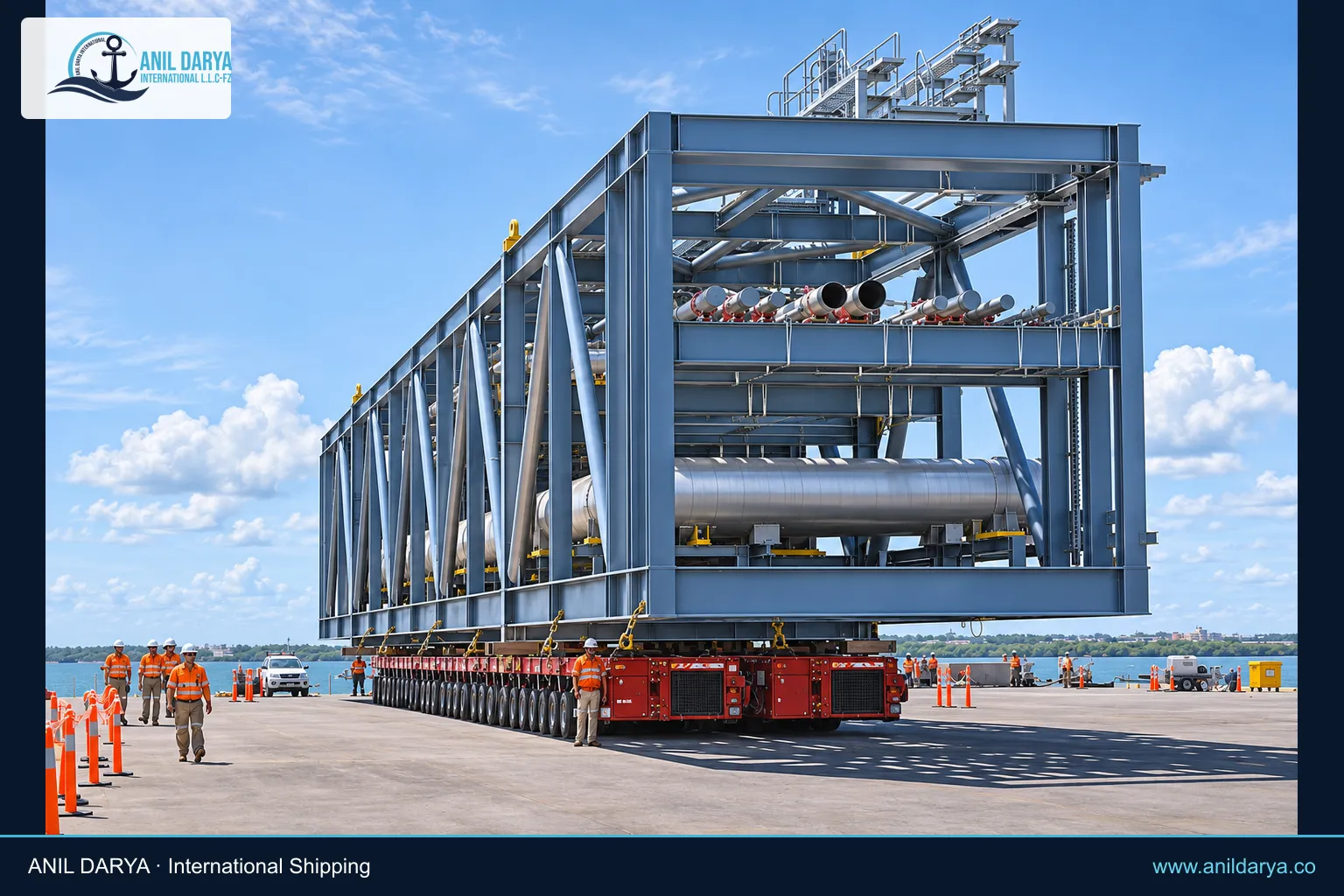
Mining equipment, used plant, steel and project pieces move from Australia on flat racks, open tops or breakbulk vessels. A piece that fits a 40ft flat rack by size and weight gets more sailing options on container services. Anything larger depends on breakbulk or heavy-lift tonnage, and that sailing date drives the whole plan. At the UAE end we plan the discharge, the trailer and any road permit for oversized loads. See our break bulk and project cargo service.
Dangerous goods from Australia to Dubai
Chemicals, paints, gases, aerosols and lithium batteries need a safety data sheet, a DG declaration, UN packaging and labels, and carrier acceptance for every leg, including the transshipment port. Australian ports set their own DG notification rules for cargo in the port, so the shipper's side and the terminal handle that before loading. At the UAE end, have the Dubai declaration and delivery ready for the day the vessel berths, so DG cargo does not wait in the port. Our guide to dangerous goods customs clearance in the UAE explains the Dubai side.
When air freight beats a month at sea
For samples, spares, chilled food and urgent stock, air is often worth the cost. Fluent Cargo lists Perth to Dubai at about 10 hours 56 minutes direct, every 1 to 2 days, and Sydney to Dubai at about 14 hours 21 minutes direct, 2 to 4 times a day, with Emirates among the carriers. It lists Melbourne to Abu Dhabi at about 13 hours 50 minutes direct. The Dubai customs process is the same as for sea cargo: a declaration under a customs code, 5% duty and import VAT. Our air cargo service covers what we book.
What the Australian exporter must do
The Australian side is your supplier's job, but a delay there lands on your timeline. Ask about these points before you agree a ship date.
Export declaration to the Australian Border Force
The ABF says goods must be reported on an export declaration if they are worth more than AUD 2,000, need an export permit at any value, are subject to a duty drawback claim, or are dutiable or excisable goods with the duty unpaid. Smaller consignments under AUD 2,000 are exempt, as are personal effects.
- The exporter, the owner of the goods or their agent lodges it, electronically in the Integrated Cargo System or at an ABF counter on form B957.
- It can be lodged up to six months before export, one declaration per consignor-to-consignee consignment.
- The ABF returns an export entry advice, which is the authority to deal with the goods for export, sometimes on condition that a permit is obtained.
- If the goods are not exported within 30 days of the intended date, the declaration must be withdrawn within seven days after that.
- Records must be kept for five years.
The ABF recommends using a licensed customs broker. There are no customs duties on export from Australia, and exports are generally GST-free when the conditions are met.
Farm and food exports: DAFF controls
The Department of Agriculture, Fisheries and Forestry controls agricultural exports under the Export Control Act 2020. Prescribed goods include milk and dairy, eggs, fish, live animals, meat and poultry, organic products, plants and plant products, and wood. For these, the goods must be prepared or stored in a registered establishment, and the department issues the export permit and certificates through its export documentation system. Non-prescribed goods such as honey, processed foods, cosmetics, pet food and wool can still get government certificates when the importing country asks for them.
DAFF publishes each importing country's requirements in its Manual of Importing Country Requirements (Micor). It says Micor is a guide only, and exporters must confirm the requirements with their importer or the importing country's authority. In practice that means you, as the UAE buyer, should tell your supplier which certificates the UAE authority asks for on your product.
| Australian export document | Who provides it | When it is needed |
|---|---|---|
| Export declaration and export entry advice | Exporter or customs broker, through the ABF | Over AUD 2,000, or any permit goods |
| Commercial invoice and packing list | Exporter | Every shipment |
| Bill of lading or air waybill | Carrier or forwarder | Every shipment |
| Export permit and health or phytosanitary certificate | DAFF, on the exporter's application | Prescribed farm and food goods |
| Certificate or proof of origin | Exporter or issuing body | Needed by Dubai Customs; also for CEPA duty relief |
| SDS and DG declaration | Exporter | Dangerous goods |
Clearing Australian cargo through Dubai Customs
Australian boxes that reach Jebel Ali, whether direct or on a connection from Khor Fakkan or Fujairah, are cleared by Dubai Customs. Before the ship berths, decide which regime the Australian goods go under: local import, free zone transfer, transit or temporary admission. That choice decides whether duty is paid now, later or never.
Do you need a customs code to import into Dubai?
Yes. A UAE company buying Australian meat, grain or machinery needs a customs business code, and Dubai Customs expects the declaration to be filed under it. A clearing agent holding a Dubai Economic Department clearing and forwarding licence and its own business code can file for you with the goods owner's written authorisation. First-time buyers from Australia often have no code yet, so we arrange the clearance through a licensed agent while the voyage is under way.
Which documents does Dubai Customs need?
For an Australian consignment, Dubai Customs wants the supplier's invoice, packing list and certificate of origin, plus a UAE permit when the goods are restricted. Food from Australia also travels with the DAFF certificate, and sea cargo needs the bill of lading and the line's delivery order in Dubai.
| Document | Who provides it | Why Dubai needs it |
|---|---|---|
| Commercial invoice | Australian exporter | Customs value and HS code |
| Packing list | Australian exporter | Inspection and LCL release |
| Certificate of origin | Exporter or issuing body in Australia | Origin and, under CEPA, the duty rate |
| Bill of lading or air waybill | Carrier or forwarder | Title to the goods |
| Delivery order | Shipping line in the UAE | Releasing the container |
| Permit | UAE authority for the product | Restricted goods only |
| Health or phytosanitary certificate | DAFF | Food, meat, dairy and plant goods |

Which declaration should you use?
| What happens to the goods | Declaration | Duty and VAT |
|---|---|---|
| Sold or used in the UAE mainland | Import for local use | Duty and VAT at import |
| Delivered into Jafza | Transfer into the free zone | Due only if the goods later enter the mainland |
| Brought in for a time, then sent back | Temporary admission | Deposit equal to the duty, refunded on re-export in time; no deposit under an ATA carnet |
| Passing through to another country | Transit | Not imported into the UAE |
How much is duty and VAT on goods from Australia to Dubai?
The UAE Government portal sets the Dubai tariff at 5% of the CIF value, except alcohol at 50% and cigarettes at 100%. The duty varies for some goods according to the tariff, so check your HS code. CIF means the value of the goods plus freight and insurance up to the place of import.
The Federal Tax Authority charges import VAT at 5% on the customs value, including insurance, freight and any customs fees and excise tax paid on import. How you pay depends on your status:
- VAT-registered importer whose customs registration number is registered with the FTA: no VAT is charged at the border. It is pre-filled in your VAT return and you can recover it as input tax if eligible.
- Importer not registered for VAT: VAT is paid to the FTA before customs releases the goods.
| Charge | Rate | Base |
|---|---|---|
| Customs duty, most goods | 5% | CIF value |
| Customs duty, alcohol | 50% | CIF value |
| Customs duty, cigarettes | 100% | CIF value |
| Import VAT | 5% | Customs value plus customs fees and excise tax |
| CEPA-qualifying Australian goods | Zero, or falling to zero in stages | With proof of Australian origin |
Does the Australia-UAE CEPA cut Dubai duty?
Yes, for goods that qualify. Austrade says the Australia-UAE CEPA entered into force on 1 October 2025 and eliminates over 99% of tariffs on Australia's exports to the UAE by value. Most tariffs were removed or locked at zero on entry into force. Others fall to zero over 3 or 5 stages, including:
- Farm goods: dairy, red meat, wine, canola seeds, grains and oilseeds, pulses, horticulture and honey.
- Industrial goods: aluminium, gold, vehicle parts, pharmaceuticals, cosmetics and jewellery.
So check two things for your HS code: whether the UAE rate is already zero, and if not, which stage applies this year. The goods must also meet the agreement's origin rules. A product only shipped from Australia, but made elsewhere, does not qualify. Ask your supplier for the origin evidence before the goods sail, and confirm with the clearing agent which form Dubai Customs accepts, so you can claim the rate when the declaration is filed.
Restricted goods for import into the UAE
Dubai Customs says some goods need approval from the competent authority before release, and that approval goes in with the other clearance documents. On this lane, the groups that need the most planning are:
- Meat, dairy, seafood and other food: UAE food safety approvals, plus the Australian export health certificate.
- Fresh produce, grain, seeds and plants: agricultural approvals and a phytosanitary certificate.
- Live animals: veterinary import permits and the matching Australian export approvals.
- Medicines, supplements and cosmetics: health authority approval or product registration.
- Alcohol and cigarettes: 50% and 100% duty.
- Chemicals and dangerous goods: permits for some products and port approvals for some classes.
- Rough diamonds: duty exempt, but Dubai Customs needs a Kimberley Process certificate or the shipment is impounded.
Apply for UAE permits before the vessel leaves Australia. On a 30-day voyage there is time, but only if someone starts on the day of booking.
Re-exporting Australian goods through Jafza
Many Australian goods are bought by a Dubai or Jafza trader and sold on to other markets. Jafza, next to Jebel Ali Port, has grown from 19 companies in 1985 to over 11,000. Deliver into Jafza under a free zone transfer, and duty applies only if the goods later enter the UAE mainland. The goods stay Australian-origin, and CEPA rates apply only in the UAE market. For the next buyer, Dubai Chambers issues certificates of origin for exported and re-exported goods for AED 100, with a two-hour processing time. Our guide to Jafza re-export covers bulk and breakbulk cargo.
Shipping from Australia to Dubai step by step
- Send us the cargo details: goods, HS codes, weight, volume, packing, the Australian pickup point and the delivery address in the UAE.
- Agree the Incoterm with your supplier. Under FOB or EXW we book the sea or air freight. Under CIF or CFR the supplier books it and we take over in the UAE.
- Get your UAE side ready: customs business code, VAT number linked with your customs registration, and permits for restricted goods.
- Check CEPA. Confirm the UAE rate for your HS code and ask the supplier for proof of Australian origin.
- For food, meat, dairy or plant goods, the supplier applies for the DAFF export permit and certificate.
- Book space. We compare routings from the nearest Australian port, confirm the transshipment port and the place of delivery in the UAE. DG, reefer and out-of-gauge cargo get carrier approval first.
- The supplier or its broker lodges the ABF export declaration and the goods are loaded.
- Check documents before arrival. Invoice, packing list, bill of lading, origin evidence and certificates must match on names, weights and HS codes.
- The Dubai declaration is filed through a licensed agent before the vessel berths.
- We arrange payment of the duty and VAT if due and the line's charges, collect the delivery order, deliver to your site or Jafza warehouse and return the empty within free time.
[AMIR-FACT: one real Australia to Dubai shipment we handled, with cargo type, Australian load port, mode, total days and how clearance went at Jebel Ali, cleared for publication]
What decides the cost on this lane?
Rates change every week, so we quote each shipment. These are the parts of the total:
| Cost factor | Effect |
|---|---|
| Australian load port | Fremantle has the shortest published sea time; east coast ports run longer rotations |
| Inland transport in Australia | Truck or rail from the supplier to the port can be a large share of the cost |
| Container type | Reefer, flat rack and open top cost more than dry boxes |
| Australian origin charges | Terminal handling, export declaration, DAFF certificates |
| UAE arrival port | An east coast discharge may need a truck or feeder to Dubai |
| UAE destination charges | Terminal handling, delivery order, clearance, trucking, CFS for LCL |
| Duty and VAT | 5% duty unless CEPA applies; 5% VAT unless deferred |
| Free time | Demurrage and detention once free days run out |
The biggest avoidable cost is waiting at the UAE port. Our article on demurrage and detention explains how it adds up.
Checklist before cargo leaves Australia
- Customs business code active, and VAT registration linked with your customs number.
- HS code agreed with the supplier and checked for UAE duty, CEPA stage and restrictions.
- Proof of Australian origin requested for CEPA.
- UAE permits applied for on restricted goods.
- DAFF export permit and certificate ready for prescribed food and farm goods.
- ABF export declaration lodged by the supplier or its broker.
- Place of delivery in the UAE confirmed: Jebel Ali or an east coast port.
- Declaration type chosen: local import, free zone, temporary admission or transit.
- DG documents and carrier approval for every leg.
- Cargo insurance arranged for a long sea voyage.
Common mistakes on the Australian lane
| Mistake | What happens | How to avoid it |
|---|---|---|
| No customs code in the UAE | Goods wait at the port until someone authorised files | Get a customs business code before the goods ship |
| VAT not linked to the customs number | Import VAT paid in cash before release | Register the customs number with the FTA |
| No origin evidence for CEPA | 5% duty paid that could have been zero | Ask the supplier for it before sailing |
| Food shipped without the DAFF certificate or UAE approval | Hold at the UAE port, reefer power and storage costs | Start both on the day of booking |
| Assuming Jebel Ali when the box ends at Khor Fakkan or Fujairah | Extra truck or feeder cost and delay | Read the place of delivery on the booking |
| Mismatched documents | A different weight or HS code holds the clearance | Check all documents before arrival |
Frequently asked questions
How long does shipping from Australia to Dubai take by sea?
Fluent Cargo's schedule data lists about 25 days 14 hours from Fremantle to Fujairah, 28 days 15 hours from Melbourne to Khor Fakkan and 35 days 13 hours from Sydney to Fujairah, each with one transfer. Add time for export cut-offs in Australia and clearance in Dubai.
Which Australian port is best for shipping to Dubai?
The one nearest the cargo. Fremantle has the shortest published sea time to the UAE. Melbourne and Sydney have the most services on the east coast, and Brisbane suits Queensland shippers.
What is the customs duty on goods from Australia to Dubai?
Dubai charges 5% of the CIF value for most goods, 50% on alcohol and 100% on cigarettes. Under the Australia-UAE CEPA, in force since 1 October 2025, most Australian-origin goods enter at zero, and the rest fall to zero in stages.
Do I pay VAT on imports from Australia into the UAE?
Yes. Australian goods pay 5% UAE import VAT even when CEPA brings the duty to zero. If your company is VAT-registered and its customs number is registered with the FTA, the VAT goes into your return instead of being paid before release.
Does my Australian supplier need an export declaration?
Yes, if the consignment is worth more than AUD 2,000 or needs an export permit. The exporter or its broker lodges it with the Australian Border Force, usually through the Integrated Cargo System.
Can I import Australian meat or dairy into Dubai?
Yes, with the right papers. The Australian supplier needs DAFF export approval and certificates for these prescribed goods, and the UAE side needs the food safety approvals for the product before the box arrives.
Can goods from Australia go into a Dubai free zone without paying duty?
Yes. Goods delivered into Jafza under a free zone declaration pay duty only if they later enter the UAE mainland.
Can I send air cargo from Australia to Dubai?
Yes. Schedule data lists direct flights from Perth to Dubai of about 11 hours and from Sydney to Dubai of about 14 hours. The Dubai customs process is the same as for sea cargo.
Can you collect cargo from my supplier in Australia?
We book the sea or air freight with carriers. Pickup and the export declaration in Australia are done by your supplier or its customs broker, and we take over the documents and the UAE side.
Get a quote for shipping from Australia to Dubai
Send us the cargo, the Australian pickup point and your delivery address in the UAE, and we will come back with a routing and a price, including clearance at the Dubai end. Use our freight rate inquiry form or contact our team. You can also read more about our Dubai freight forwarding team.
Sources
- Australian Border Force: Export requirements (AUD 2,000 rule, exemptions, no export duty)
- Australian Border Force: Export declaration (ICS, B957, timing, withdrawal, records)
- Department of Agriculture, Fisheries and Forestry: Exporting from Australia (prescribed goods)
- Department of Agriculture, Fisheries and Forestry: Manual of Importing Country Requirements (Micor)
- Department of Agriculture, Fisheries and Forestry: Export (documentation systems)
- Austrade: Australia-UAE CEPA
- Ports Victoria: Port of Melbourne
- NSW Ports: Port Botany network connections
- Port of Brisbane
- Government of Western Australia: Fremantle container volumes 2025-26
- Westport: Fremantle share of WA container trade
- Flinders Ports: Port Adelaide
- Darwin Port
- Fluent Cargo: Melbourne to Dubai
- Fluent Cargo: Sydney to Dubai
- Fluent Cargo: Perth to Dubai
- DP World: Jebel Ali Port
- Dubai Customs: Submit customs declaration (documents)
- Dubai Customs: Frequently asked questions (business code, agents, duty, temporary admission, diamonds)
- UAE Government portal: Customs duty and tariff
- Federal Tax Authority: VAT guide (import VAT)
- Jafza: About Jebel Ali Free Zone
- Dubai Chambers: Issuing a certificate of origin
Reviewed: 10 November 2026