
Shipping from Belgium to Dubai usually means a container from Antwerp or Zeebrugge to Jebel Ali, with an EU export declaration filed in Belgium and a Dubai Customs declaration filed at arrival. Most goods pay 5% UAE duty on the CIF value plus 5% import VAT, and no EU-UAE trade agreement cuts that rate today. This guide covers the ports on both ends, the modes, the paperwork on each side and the order in which to do it.
Belgium to Dubai shipping at a glance
| Item | Detail |
|---|---|
| Main Belgian load port | Port of Antwerp-Bruges (Antwerp and Zeebrugge platforms) |
| Port size, 2025 | 266.5 million tonnes and 13.6 million TEU |
| Other Belgian option | Ghent (North Sea Port) for bulk and breakbulk |
| Main UAE arrival port | Jebel Ali (DP World), four container terminals |
| Other UAE arrival ports | Khalifa Port (Abu Dhabi) and Sharjah |
| Modes | FCL, LCL, Ro-Ro, breakbulk and project cargo, dangerous goods, air cargo |
| Export filing in Belgium | EU export declaration lodged with Belgian customs by the exporter or its declarant |
| Export licences | Needed only for controlled goods, such as dual-use items under Regulation (EU) 2021/821 |
| UAE importer ID (Dubai) | Customs business code, registered online through Dubai Trade |
| UAE customs duty | 5% of CIF for most goods; alcohol 50%, cigarettes 100% |
| UAE import VAT | 5%, deferred to the VAT return for registered importers with a linked customs number |
| Trade agreement | None in force; the EU and UAE agreed to launch talks on 10 April 2025 |
| Free zone at arrival | Jafza, next to Jebel Ali Port, over 11,000 businesses |
How the Belgium to Dubai route works
Most cargo on this lane is European industrial and consumer goods: machinery, chemicals, steel products, vehicles, food and spare parts. It leaves Belgium in containers, on Ro-Ro ships or as breakbulk, and arrives at Jebel Ali for Dubai and the free zone, or at Khalifa Port for Abu Dhabi.
The job has two halves. In Belgium, the seller or its declarant files the export declaration and gets the goods to the terminal before the cut-off. In the UAE, the buyer needs a customs code, a declaration, duty and VAT, and a delivery plan. We book the space with the carrier, check the documents against the Dubai requirements and handle clearance and delivery at the UAE end. Pickup at the Belgian factory and the export filing are done by the shipper or its own forwarder or agent in Belgium.
Sailings and transit times on this lane
Services between North Europe and the Gulf change often. Some call Jebel Ali direct and some tranship. Read the rotation and the transhipment port before you book, not only the sailing date, and ask for the arrival terminal at Jebel Ali.
[AMIR-FACT: the carriers we actually book from Antwerp to Jebel Ali in 2026, direct or with transhipment, and our real port-to-port days on each service]
Which Belgian port should you ship from?
For most shippers the answer is Antwerp. The Port of Antwerp-Bruges handled 266.5 million tonnes and 13.6 million TEU in 2025, and runs two platforms: Antwerp on the Scheldt and Zeebrugge on the coast. Pick the platform by cargo type.
| Port | What it handles best | Ship from here when |
|---|---|---|
| Antwerp | Containers, steel and breakbulk, project cargo, chemicals | You ship containers, steel, machinery or DG from anywhere in Belgium, the south of the Netherlands or north-east France |
| Zeebrugge | Ro-Ro (new cars, trucks, high and heavy), containers | You ship vehicles, rolling machinery or trailers |
| Ghent (North Sea Port) | Dry bulk, liquid bulk, breakbulk, steel | Your cargo is bulk or breakbulk produced near the Ghent-Terneuzen canal |
Rolling cargo is a real strength of the port. In 2025 Antwerp-Bruges handled 3,186,000 new cars, and the port reports growth in trucks and in high and heavy equipment. If your cargo drives or can be towed, compare a Ro-Ro booking with a flat rack before you decide.
Which UAE port should your cargo arrive at?
Jebel Ali is the default. DP World runs four container terminals there with over 80 weekly services connecting more than 150 ports, and the port handles breakbulk, out-of-gauge project cargo, Ro-Ro, reefers and IMDG dangerous goods. Our Jebel Ali port guide covers the terminals and port rules.
- Consignee in Dubai or in Jafza: arrive at Jebel Ali.
- Site or warehouse in Abu Dhabi: compare Khalifa Port in Abu Dhabi, which saves the long truck leg.
- Consignee in Sharjah or the northern emirates: ask whether a Sharjah arrival is on offer for your service.
Sea freight from Belgium to Dubai: FCL, LCL and Ro-Ro
| Mode | Use it when | What to plan for the Dubai end |
|---|---|---|
| FCL (20ft, 40ft, high cube) | You fill most of a container | Declaration before arrival, delivery order, truck slot, empty return |
| LCL | A few pallets or crates | Release after the shared box is unpacked; your documents must match the consolidator's |
| Reefer | Chilled or frozen food, pharma | Food or health approval before arrival, power at the terminal |
| Ro-Ro | Cars, trucks, tractors, wheeled machinery | Vehicle documents, a delivery plan from the Ro-Ro berth |
| Flat rack, open top, breakbulk | Machinery, steel, project pieces | Lifting plan, trailer, road permit for oversized loads |
| Dangerous goods | Chemicals, paints, gases, batteries | Carrier acceptance and UAE port rules for the class |
FCL or LCL from Antwerp?
FCL is sealed at the factory or the Belgian warehouse and released in Dubai as one unit. LCL costs less for small volumes, but your cargo waits at the Dubai container freight station until the whole consolidated box is unpacked and every consignee's paperwork is in order. If your volume is near a 20ft box, price both. Our guide to FCL vs LCL explains the break-even.
Breakbulk, project cargo and dangerous goods from Antwerp
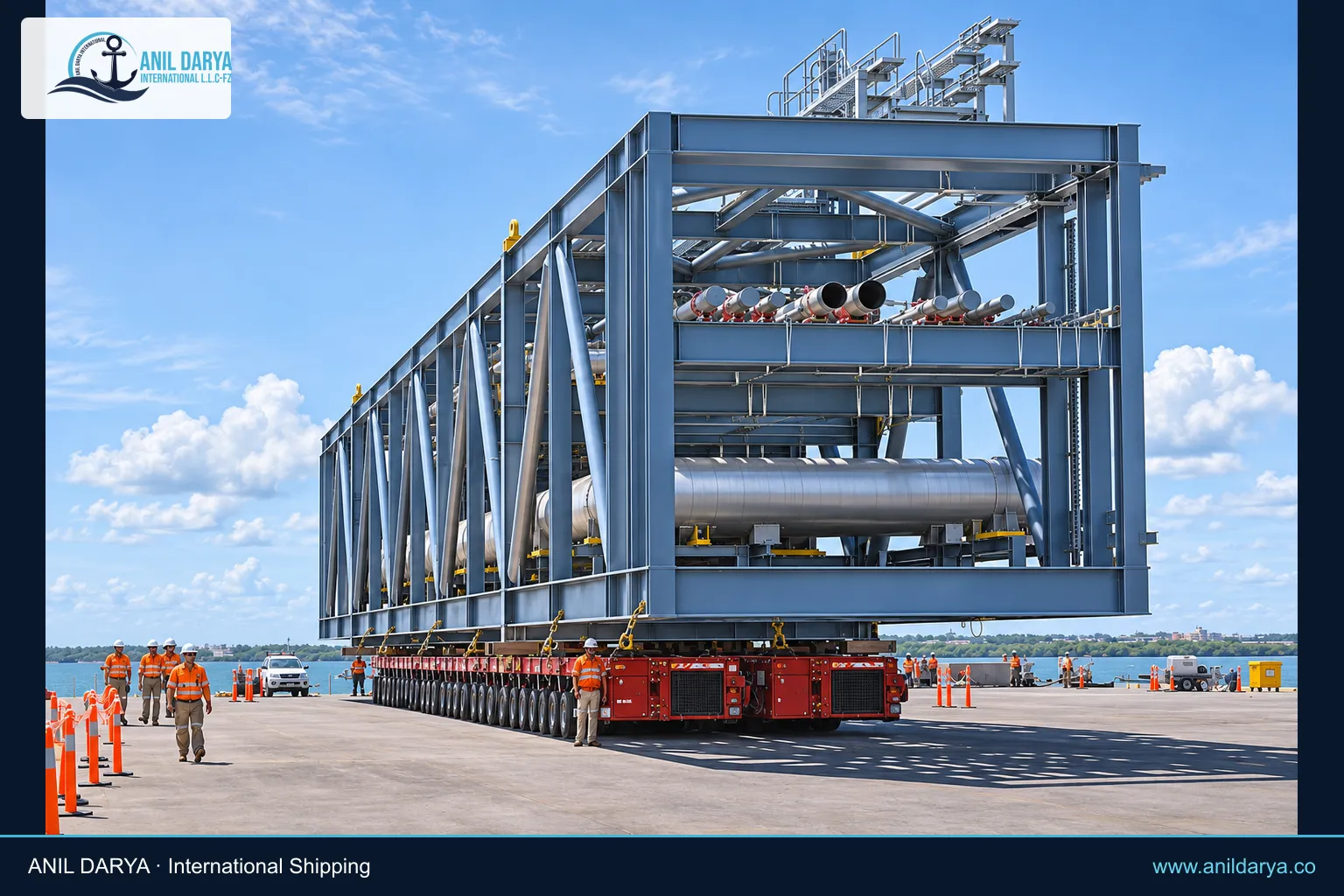
Antwerp is a natural choice for heavy and awkward cargo. PSA Breakbulk's project cargo terminal at Churchill Dock has a 750-tonne quay crane, a 13 m draught with tide-free access to the sea, a 140,000 m² yard and self-propelled modular transporters of up to 40 axle lines. That kind of set-up lets a heavy piece arrive by barge or road and go straight onto the ship.
For pieces that fit a 40ft flat rack or open top, a container service gives you more sailings and simpler handling at Jebel Ali. Anything bigger needs a breakbulk or heavy-lift vessel. At the Dubai end we plan the discharge, the trailer and any road permit before the ship arrives. See our break bulk and project cargo service for how we handle the UAE side.
Dangerous goods from Belgium
Belgium's chemical industry sends a lot of DG cargo to the Gulf. The shipper needs a Safety Data Sheet, a DG declaration, UN-approved packaging and labels, and the carrier's DG acceptance before the box is stuffed. The Port of Antwerp-Bruges also requires DG cargo to be notified to the Harbour Master's Office at least 24 hours in advance, which the forwarder or shipping agent in Belgium handles. At Jebel Ali some classes have strict limits on how long they may stay in the port, so the Dubai declaration and the truck must be ready at berthing. Our dangerous goods shipping service page explains how we plan it.
Air cargo from Brussels and Liège
For spare parts, samples, pharma and urgent shipments, air is often worth the cost. Belgian cargo usually flies from Brussels Airport or Liège Airport into Dubai International or Al Maktoum International, which sits close to Jafza. The UAE side is the same as for sea freight: a Dubai Customs declaration under a customs code, 5% duty and 5% import VAT. Airlines charge on the greater of actual and volume weight, so light, bulky cargo is expensive by air. See our air cargo service for how we handle airport clearance in Dubai.
The Belgian export side: who files what
Export formalities in Belgium are the seller's job, or the job of whoever the Incoterm puts in charge. Delays there land on your timeline, so check them early.
- EORI number. Anyone who exports from the EU needs one. It is issued by the customs authority of the member state where the business is established and does not expire.
- Export declaration. The exporter or its declarant lodges it electronically with the customs office of export, in the country where the goods are packed or loaded or where the exporter is established. It carries the commodity code, customs value, quantity, invoices, transport documents and any licence.
- Customs office of exit. The goods leave the EU at the port, where customs checks them against the data from the office of export and supervises their departure.
- Safety and security data. The pre-departure data is usually part of the export declaration. If not, the carrier makes sure an exit summary declaration is lodged.
- Export licences. Some goods are controlled: weapons, some chemicals, certain medicines and dual-use items. Dual-use goods fall under Regulation (EU) 2021/821 and need an authorisation from a national competent authority before export.
Belgian customs is part of FPS Finance. Its own pages were not reachable when we prepared this guide, so we have described the EU rules that apply in every member state. Your seller's declarant will know the Belgian filing system in detail.
Which Incoterm should you use when buying from Belgium?
Under EXW the buyer takes on the EU export formalities, which a buyer in Dubai usually cannot do without a European agent. FCA or FOB Antwerp keeps the export declaration with the seller and lets you control the sea freight. Under CFR or CIF the seller books the freight and we take over at Jebel Ali. Our guide to Incoterms 2020 for sea freight covers who pays which leg.
Dubai customs clearance for cargo from Belgium
Dubai Customs clears cargo arriving at Jebel Ali. Each declaration falls under a regime: import, export, transit, transfer or temporary admission. Choose the regime by what happens to the goods next.
Do you need a customs code to import into Dubai?
Yes. Dubai Customs says a licence holder must get a customs business code, which is done online through Dubai Trade with no office visit. A clearing agent with a Dubai Economic Department clearing and forwarding licence can also file, using its own code and the goods owner's authorisation. If you have no code yet, we arrange clearance through a licensed agent.
Which documents does Dubai Customs need?
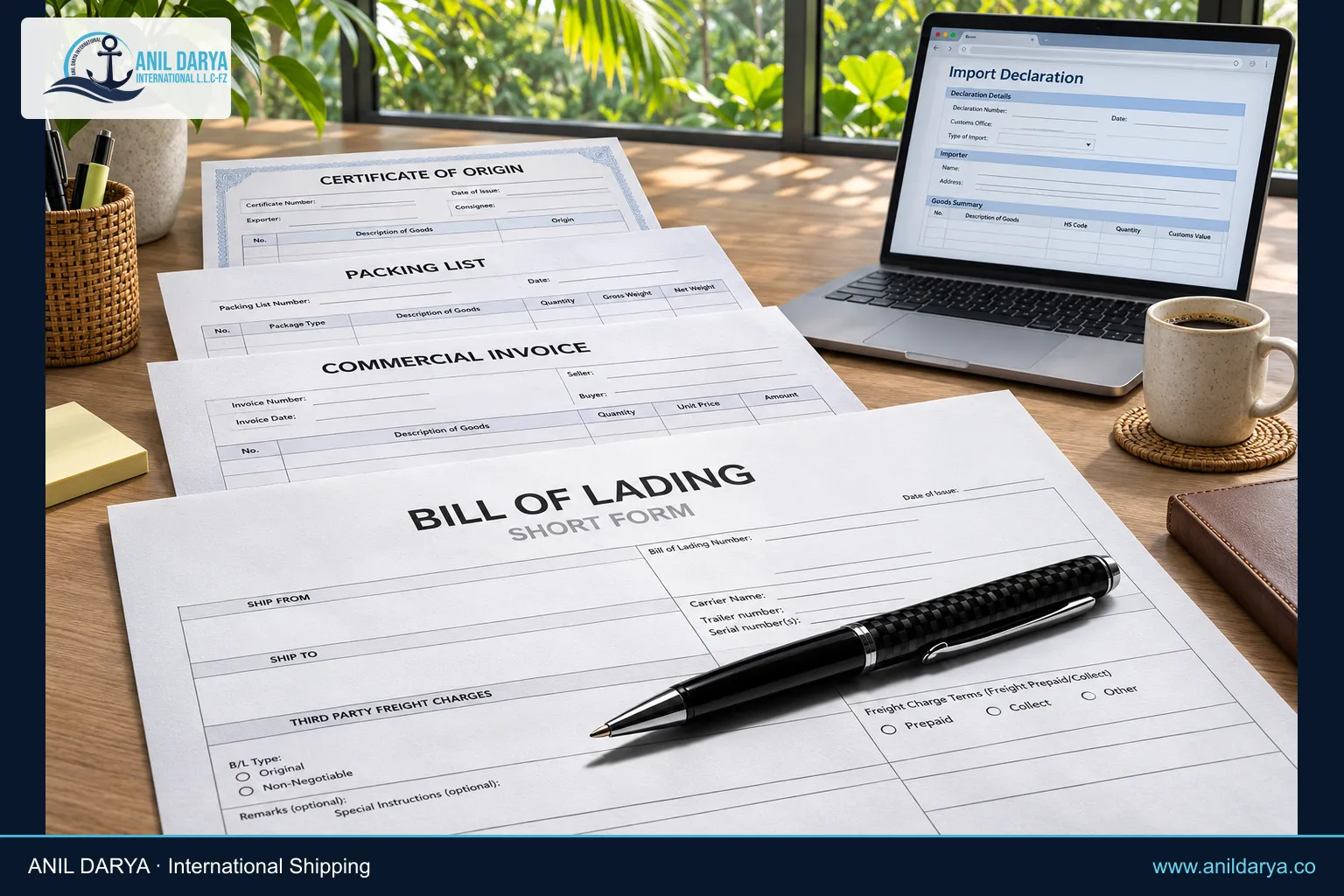
Dubai Customs lists four documents for a declaration: invoice, packing list, certificate of origin and a permit from the restriction entity where the goods are restricted. For sea cargo you also need the bill of lading and the line's delivery order.
| Document | Who provides it | Why it matters in Dubai |
|---|---|---|
| Commercial invoice addressed to the UAE importer | Belgian seller | Customs value and HS code |
| Packing list with weights, packing and HS code per item | Belgian seller | Inspection and LCL release |
| Certificate of origin | Seller, approved by a chamber of commerce in Belgium | Proves where the goods were made |
| Bill of lading or air waybill | Carrier or forwarder | Title to the goods and release |
| Delivery order | Shipping line in Dubai | Releases the container from the terminal |
| Permit | UAE authority for the product | Restricted goods only |
| SDS and DG declaration | Belgian seller | Dangerous goods only |
The US Commercial Service guide to UAE imports also notes that the certificate of origin should be approved by the chamber of commerce in the country of origin, that food needs a health certificate, and that attestation of invoices and shipping documents goes through the UAE Ministry of Foreign Affairs. Ask your clearing agent whether attestation applies to your shipment before the seller sends the originals.
Which declaration should you file?
| What happens to the goods | Declaration | Duty and VAT |
|---|---|---|
| Sold or used in the UAE mainland | Import for local use | Paid or accounted for at import |
| Stored or traded in Jafza | Transfer into the free zone | Due only if the goods later enter the mainland |
| Trade fair or project equipment that goes back | Temporary admission | Deposit equal to the duty, refunded on re-export in time; no deposit with an ATA carnet |
| Passing through to another country | Transit | Not imported into the UAE |
How much is UAE duty and VAT on goods from Belgium?
Dubai Customs charges 5% of the CIF value for most goods. CIF is the value of the goods plus insurance and freight to the UAE. Alcohol pays 50% and cigarettes 100%. The UAE government portal notes that tariffs range from 0 to 5%, so some goods pay less. Check your HS code before you price the deal.
Import VAT is 5%. The Federal Tax Authority says it is charged on the customs value, including insurance, freight and any customs fees and excise tax paid on import. How you pay it depends on your status:
- VAT-registered importer whose customs registration number is registered with the FTA: no VAT is charged at the border. The import VAT is prepopulated in your VAT return and can be recovered as input tax if you are eligible.
- Importer not registered for VAT: the VAT is paid to the FTA before customs releases the goods.
| Charge | Rate | Base |
|---|---|---|
| Customs duty, most goods | 5% | CIF value |
| Customs duty, alcohol | 50% | CIF value |
| Customs duty, cigarettes | 100% | CIF value |
| Import VAT | 5% | Customs value plus customs fees and excise tax |
Is there a trade agreement that cuts duty on Belgian goods?
Not yet. Belgium trades under EU rules, and the European Commission announced on 10 April 2025 that the EU and the UAE had agreed to launch negotiations on a free trade agreement. Until an agreement is signed and in force, Belgian goods pay the normal UAE rates above. An EU preference certificate such as an EUR.1 does not reduce UAE duty.
We arrange payment of the duty and VAT at clearance and send you the customs receipts, so your accounts and VAT return match.
Free zone and re-export from Dubai
Many Belgian goods do not stay in the UAE. A Dubai trader buys in Europe, stores the goods in Jafza and sells them on to the Gulf, Africa or South Asia. Jafza sits next to Jebel Ali Port and close to Al Maktoum International Airport, and hosts over 11,000 businesses. Goods delivered into the free zone under a transfer declaration pay UAE duty only if they later enter the mainland. Our guide to Jafza re-export explains the flow for bulk and breakbulk.
The goods keep their Belgian origin when you re-export them, so keep the original certificate of origin and invoice on file for your next buyer.
Restricted and prohibited goods for the UAE
Restricted goods need prior approval from the competent UAE authority, and Dubai Customs will not release them without it. Abu Dhabi Customs publishes the list by authority. Groups that matter most for Belgian exports:
- Food products: approval from the food safety authority, plus the origin health certificate.
- Medicines, medical devices and lab solutions: Ministry of Health and Prevention.
- Pesticides, fertilisers, seeds, live animals and animal products: Ministry of Climate Change and Environment.
- Telecom, radio and GPS devices: Telecommunications and Digital Government Regulatory Authority.
- Vehicles, new tyres, lubricants, paints, lifting and weighing equipment, household appliances and cables: Ministry of Industry and Advanced Technology.
- Chemicals that can be used to make chemical weapons: Executive Office for Control and Non-Proliferation.
- Radioactive materials and some high-capacity transformers and heat exchangers: Federal Authority for Nuclear Regulation.
The prohibited list includes narcotics, counterfeit currency, gambling machines, ozone-depleting substances, asbestos sheets and pipes, hazardous waste and used or refurbished tyres. Apply for any permit before the ship leaves Antwerp. A permit that arrives after the vessel means storage and demurrage at Jebel Ali.
Shipping from Belgium to Dubai step by step
- Send us the cargo details. Commodity, HS code, weight, volume, pickup address in Belgium and delivery address in the UAE.
- Agree the Incoterm with the seller. FCA or FOB if you want us to book the sea freight; CFR or CIF if the seller books it.
- Prepare the UAE side. Customs business code active, VAT registration linked to it, permits applied for.
- Book space. We pick the service, confirm the arrival terminal and get carrier approval for DG, reefer or out-of-gauge cargo.
- Origin pickup. The seller or its Belgian forwarder trucks or barges the cargo to the terminal before the cut-off.
- Belgian export declaration. The seller's declarant files it and the goods are released for export.
- Document check. Invoice, packing list, certificate of origin and bill of lading must match on names, weights and HS codes.
- Dubai declaration. We file it through a licensed agent before the vessel berths.
- Duty, VAT and release. We arrange payment of the duty, any VAT due and the line's charges, and collect the delivery order.
- Delivery. We book the truck slot, deliver to your site or Jafza warehouse and return the empty container inside free time.
[AMIR-FACT: one real Belgium to Dubai shipment we handled (cargo, Belgian load port, mode, days to Jebel Ali, how clearance went), cleared for publication]
What decides the cost of shipping from Belgium to Dubai?
Ocean rates on this lane move week to week, so we quote each shipment. These are the factors that change the price:
| Cost factor | How it changes the price |
|---|---|
| Service type | Direct calls and transhipment services price differently |
| Equipment | Reefer, flat rack and open top cost more than dry boxes |
| Belgian origin charges | Trucking or barge to Antwerp, terminal handling, export declaration, certificate of origin |
| Cargo type | DG and out-of-gauge cargo carry surcharges and need approvals |
| Dubai destination charges | Terminal handling, delivery order, clearance, CFS for LCL, trucking |
| Duty and VAT | 5% duty on CIF and 5% VAT, unless you defer VAT or use the free zone |
| Free time | Demurrage and detention start once free days run out |
The largest avoidable cost is waiting at Jebel Ali for a permit or a document. Our article on demurrage and detention shows how fast it adds up.
Checklist before cargo leaves Belgium
- Your customs business code is active and your VAT registration is linked to it.
- HS code agreed with the seller and checked for UAE restrictions.
- Permits for restricted goods applied for.
- The seller has an EORI number and a declarant for the export filing.
- Export licence checked for dual-use or other controlled goods.
- Certificate of origin ordered and approved by the chamber of commerce.
- Invoice addressed to the UAE importer, with values that match the packing list.
- Declaration type chosen: local import, free zone transfer, temporary admission or transit.
- DG: SDS, DG declaration, carrier approval and a delivery plan that fits UAE port limits.
- Cargo insurance arranged for the full door-to-door leg.
Common mistakes buyers make with Belgian cargo
- Buying EXW from Belgium with nobody in the EU to file the export declaration.
- Expecting an EU preference certificate to cut UAE duty.
- Invoices addressed to a European entity when the UAE importer is someone else.
- Applying for a UAE permit after the ship has sailed.
- Booking LCL for a volume close to a full 20ft box.
- Not checking whether the service calls Jebel Ali or Khalifa Port.
- Shipping trade fair equipment as a normal import instead of temporary admission.
Frequently asked questions
How long does shipping from Belgium to Dubai take?
It depends on the carrier's service and whether it tranships on the way. Ask for the rotation and the arrival terminal when you book. We confirm current port-to-port days with each quote.
Which Belgian port is best for cargo to Dubai?
Antwerp for containers, steel, machinery and chemicals. Zeebrugge for cars, trucks and other Ro-Ro cargo. Ghent suits bulk and breakbulk produced near the canal zone.
What customs duty applies to Belgian goods in Dubai?
Most goods pay 5% of the CIF value. Alcohol pays 50% and cigarettes 100%, and some goods are lower or exempt. There is no EU-UAE trade agreement in force, so Belgian origin does not reduce the rate.
Do I pay VAT on imports from Belgium into the UAE?
Yes, 5% import VAT applies. A VAT-registered importer that has registered its customs number with the Federal Tax Authority accounts for it in the VAT return instead of paying at the border.
Who files the export declaration in Belgium?
The exporter or its declarant, with the customs office of export. The exporter needs an EORI number, and controlled goods such as dual-use items also need an export authorisation.
What documents do I need to import cargo from Belgium into Dubai?
A commercial invoice, packing list, certificate of origin, bill of lading and the line's delivery order, plus a permit for restricted goods. DG cargo also needs an SDS and a DG declaration.
Can I ship from Belgium into a Dubai free zone without paying duty?
Yes. Goods transferred into Jafza pay UAE duty only if they later enter the mainland. Many traders store Belgian goods there and re-export them.
Can I import cars or machinery from Belgium to Dubai by Ro-Ro?
Yes. Zeebrugge is a large Ro-Ro platform and Jebel Ali has Ro-Ro facilities. Vehicles are restricted goods in the UAE, so check the approval needed for your model before shipping.
Get a quote for shipping from Belgium to Dubai
Send us the cargo, the Belgian pickup point and your UAE delivery address, and we will come back with a routing and price, including clearance at Jebel Ali. Use our freight rate inquiry form or contact our team. You can also read more about our Dubai freight forwarding team.
Sources
- Port of Antwerp-Bruges: Factsheet throughput figures 2025 (tonnes, TEU, new cars, high and heavy)
- AJOT: PSA Breakbulk project cargo ecosystem in Antwerp (crane, draught, yard, SPMT)
- Port of Antwerp-Bruges: Notification of dangerous goods (24 hours)
- DP World: Jebel Ali Port (terminals, services, cargo types)
- Your Europe: Customs duties and procedures on exports (EORI, export declaration, exit, licences)
- European Commission: Exporting dual-use items (Regulation (EU) 2021/821)
- European Commission: EU and UAE agree to launch free trade talks (10 April 2025)
- Dubai Customs: Submit customs declaration (documents and regimes)
- Dubai Customs: FAQ (duty, business code, clearing agents, temporary admission, restricted goods)
- UAE Government portal: Customs duty and tariff
- Federal Tax Authority: VAT guide (import VAT)
- Abu Dhabi Customs: Restricted and banned commodities
- US Commercial Service: UAE import requirements and documentation
- Jafza: About Jebel Ali Free Zone
Reviewed: 10 November 2026