
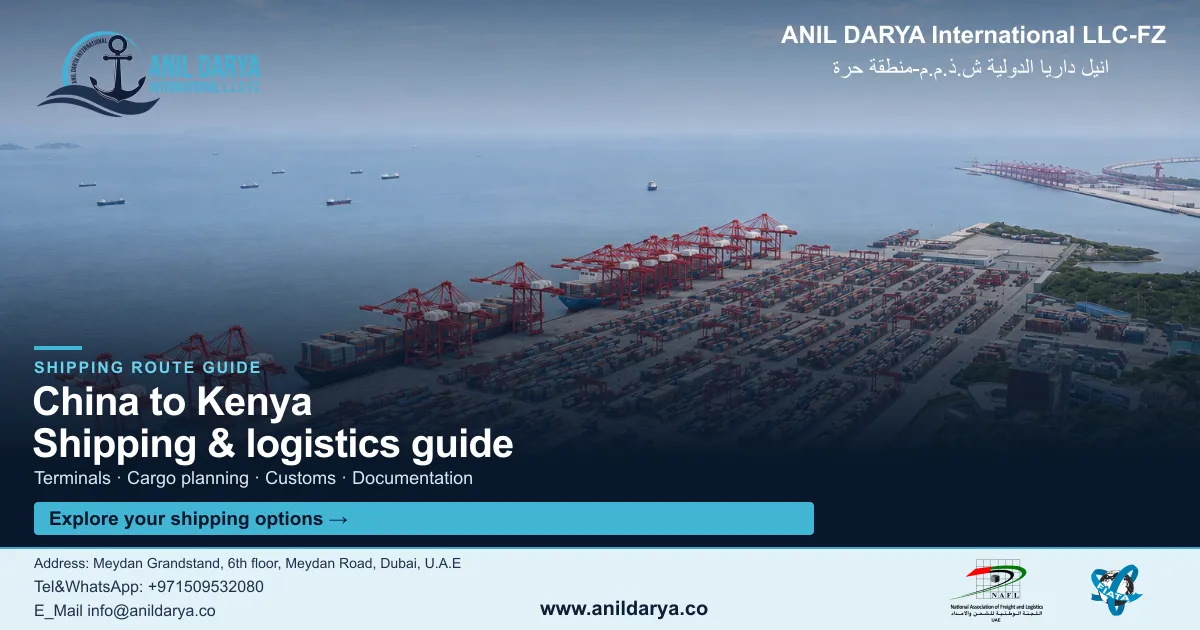
Shipping from China to Kenya almost always means a container loaded at Shanghai, Ningbo, Shenzhen, Nansha or Qingdao and discharged at Mombasa, Kenya's main seaport. Before the box is loaded, the Chinese exporter must file the China export declaration, get a KRA Advance Cargo Declaration (ACD) code and, for regulated products, a KEBS certificate of conformity. We book the ocean freight from Dubai, release the carrier's bill of lading to you and coordinate the supplier in China and your clearing agent in Kenya.
Shipping from China to Kenya at a glance
| Item | Detail |
|---|---|
| Main modes | Sea FCL, sea LCL, reefer, flat rack and breakbulk, dangerous goods by sea |
| Common Chinese load ports | Shanghai, Ningbo, Shenzhen (Yantian, Shekou), Guangzhou (Nansha), Qingdao, Tianjin, Xiamen |
| Main Kenyan discharge port | Mombasa (KEMBA): 22 berths, two container terminals, 2.3 million TEU a year |
| Second Kenyan port | Lamu: three operational berths of 400 m each, 1.2 million TEU a year |
| Inland link | Standard Gauge Railway from Mombasa to ICD Nairobi and ICD Naivasha |
| China export filing | Consignor (usually the supplier) or its customs broker, with China Customs, 24 hours before loading |
| Kenya pre-loading step | ACD reference code from acd.kra.go.ke, endorsed on the bill of lading (from 3 August 2026) |
| Product conformity | KEBS PVoC certificate of conformity, issued in China before shipment for regulated goods |
| Kenya customs system | KRA iCMS, filed by a licensed clearing agent; permits through the KenTrade single window |
| Duty and tax | EAC Common External Tariff (0%, 10%, 25%, 35%, higher for sensitive items) plus 16% VAT |
| Who clears in Kenya | The consignee's own customs broker, agreed before the cargo ships |
How a cross-trade booking from China to Kenya works
This is a cross-trade lane. The cargo need not touch the UAE, but we run the booking from Dubai. Three parties share the work.
- The shipper in China, or its origin agent, packs the goods, trucks them to the port or a consolidation warehouse and files the Chinese export declaration.
- We book the ocean freight with the shipping line, check the documents against Kenyan rules and coordinate everyone until the box is discharged.
- The consignee's customs broker in Kenya files the import entry, pays duty and taxes from the consignee's funds and arranges delivery.
The bill of lading is the shipping line's own bill of lading. Anil Darya acts as agent for many shipping lines, so the carrier's B/L is issued and released to you through us.
Your Incoterm decides who pays for each leg. FOB China is the cleanest choice for most Kenyan buyers. The supplier handles the Chinese export side, which it knows, and you control the freight and the Kenyan side. CIF needs care on this lane because Kenya now wants marine insurance from a Kenyan-licensed insurer (more on that below). Our guide to Incoterms 2020 for sea freight shows where cost and risk pass in each term.
Which Chinese ports to load at
Ship from the port nearest the factory. Trucking a box across China to catch one sailing costs more than it saves.
| Supplier region | Usual load port | Notes for Kenya cargo |
|---|---|---|
| Guangdong (Shenzhen, Dongguan, Foshan, Guangzhou) | Yantian, Shekou, Nansha | Nansha is often the last Chinese call before the ship heads west, as on the FHX rotation below |
| Zhejiang and Jiangsu, including Yiwu | Ningbo, Shanghai | Strong LCL consolidation for mixed small orders |
| Shandong and north China | Qingdao, Tianjin | Check whether the service calls direct or feeds to a southern port first |
| Fujian | Xiamen | Fewer direct East Africa calls; ask for the routing on every quote |
Mombasa or Lamu: where your cargo lands
Mombasa takes most of Kenya's container imports. The Kenya Ports Authority lists 22 berths split between conventional and container terminals, two container terminals with 2.3 million TEU of yearly capacity, and dedicated berths for grain, clinker, soda ash and petroleum. Berths 1 and 2 also take steel and RoRo ships, which matters if you import steel or vehicles from China.
Lamu is the newer deep-water port north of Mombasa. KPA says its first three berths are in service, each 400 m long, able to take ships above 10,000 TEU, with 1.2 million TEU of yearly capacity. Few China services call there, so treat Lamu as an option you check with the carrier, not a default.
Where the container is cleared
Where the box is cleared changes the B/L you need. KPA moves imports straight from Mombasa to ICD Nairobi or ICD Naivasha on a through bill of lading by the Standard Gauge Railway. If your buyer is in Nairobi, ask us to book the carrier B/L with ICD Nairobi as the place of delivery. Since a KPA notice of 4 December 2025, domestic containers are no longer cleared inside the port of Mombasa. A container freight station must be nominated at the port of loading, and through bill of lading cargo is not affected. Agree the CFS or the ICD with your clearing agent before we confirm the booking, because it goes on the booking and the B/L.
Direct sailings or transhipment?
Most China to Kenya services are long loops that load at several Chinese ports and then call Southeast Asia on the way west. Emirates Shipping Line, for example, publishes its Fahari (FHX) weekly service as Qingdao, Shanghai, Ningbo, Nansha, Port Klang, then Mombasa as its only East African call. Other bookings tranship: the container is discharged at a hub and loaded on a second ship to Mombasa.
| Routing | What happens | When it suits you |
|---|---|---|
| Same vessel, multi-port loop | Loads in China, calls Southeast Asia, discharges at Mombasa | Most FCL cargo; fewer handling points |
| Transhipment at an Asian hub | Box changes ship once on the way | When the direct loop is full or your load port has no direct call |
| Via Jebel Ali, Dubai | China to Jebel Ali, then a Gulf to East Africa service on to Mombasa | Combining with cargo already in Dubai, or holding stock in a free zone |
[AMIR-FACT: the carriers we actually book from China to Mombasa, whether each is direct or transhipped (and where), and our real port-to-port transit days from Shanghai/Ningbo and from Shenzhen/Nansha]
Sea freight from China to Kenya: FCL, LCL and reefer
Choose the container by what you are buying, not only by volume.
| Option | Best for | Watch on the Kenya side |
|---|---|---|
| FCL 20ft | Tiles, steel parts, cables, dense building materials | Weight limits for trucking from Mombasa or rail to Nairobi |
| FCL 40ft / 40ft high cube | Furniture, solar panels, household goods, mixed stock from one factory | Free time at Mombasa and the nominated CFS |
| LCL | First orders, samples, small mixed lots | Each supplier's goods may need its own PVoC certificate |
| Reefer | Chilled or frozen food, some pharmaceuticals, temperature-sensitive chemicals | The import permit must be ready before arrival |
| Flat rack / open top | Machinery slightly over container height or width | Lashing, carrier acceptance, inland route to site |
If you buy from several suppliers in one Chinese region, consolidate them into one FCL at a warehouse near the load port. You get one ACD code, one B/L and one Kenyan entry instead of several. Our FCL vs LCL guide shows where the switch usually pays. For booking and equipment, see our sea freight service.
Dangerous goods, breakbulk and project cargo
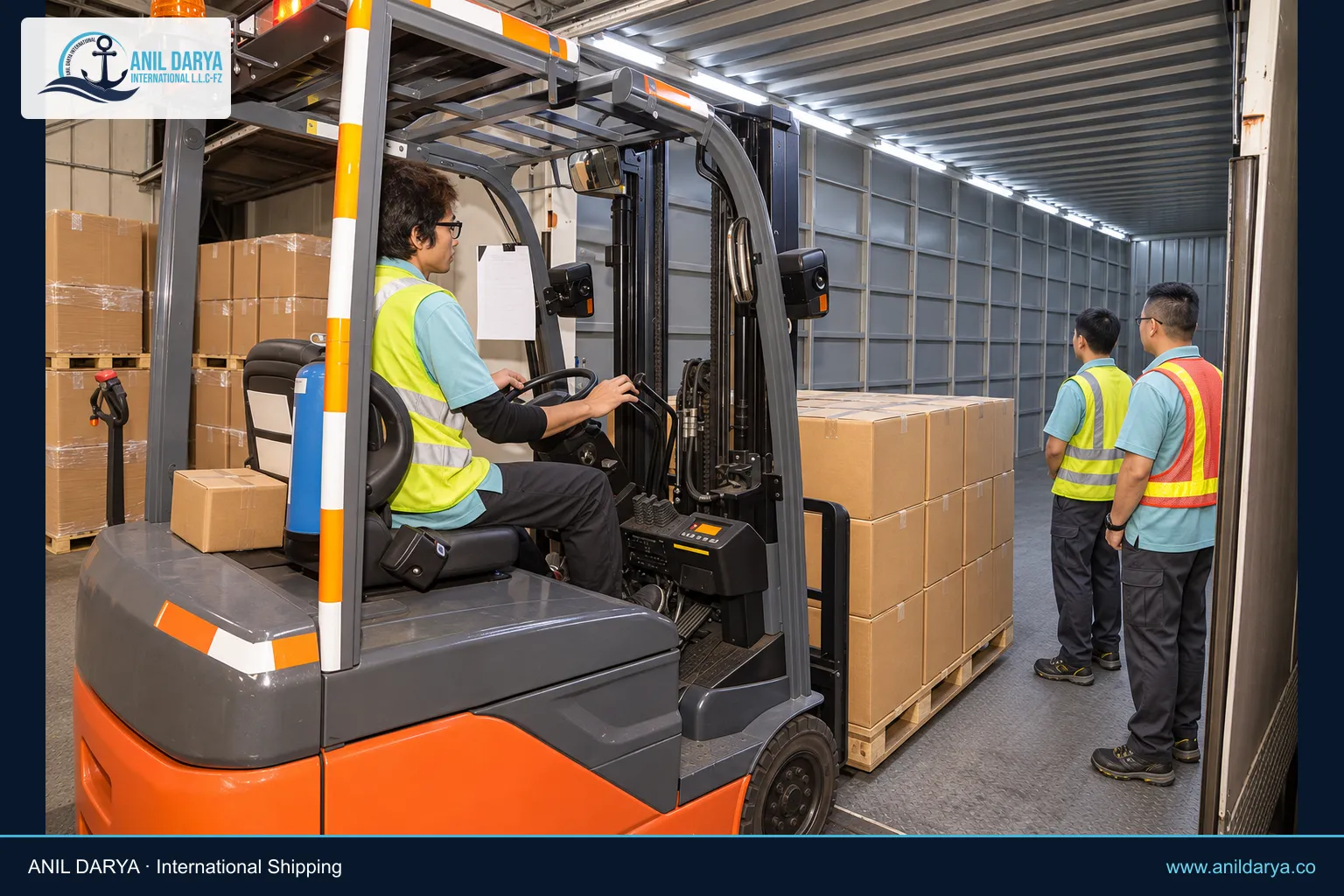
A lot of what Kenya buys from China counts as dangerous goods: lithium batteries for solar systems, paints, adhesives, cleaning chemicals, aerosols. Sea DG moves under the IMDG Code, and the 2024 edition (Amendment 42-24) has been mandatory since 1 January 2026. Make sure the supplier's Safety Data Sheet and DG declaration follow it.
China Customs inspects the packaging used for exported dangerous goods. Packaging needs a performance appraisal for its type and a use identification for the actual filled packages. Ask your supplier for these certificates before you book, because the carrier will not accept a DG booking at a Chinese port without them. KPA handles dangerous cargo at Mombasa under international maritime rules, so the papers must match from end to end. Our dangerous goods team checks the UN number, class and packing group against the carrier's acceptance before you commit, and our article on dangerous goods classes explains what each class means for booking.
Machinery, steel structures, transformers and plant equipment for Kenyan projects often do not fit a standard box. Pieces that fit a flat rack can ride container ships. Bigger or heavier pieces move as breakbulk on general cargo or heavy-lift vessels. For these, we need drawings, weights, dimensions and lifting points for each piece first, then we choose the vessel type and plan discharge at Mombasa. See our break bulk and project cargo service.
The China export side: who files what
Export filing in China belongs to the consignor. Under China Customs rules, as set out by the Shanghai municipal government, the consignor or its customs broker declares the goods once they reach the customs supervision area and at least 24 hours before loading. The consignor needs market entity status and registration as a foreign trade operator, which can be done online through the China International Trade Single Window.
- The supplier, or its origin agent, arranges pickup, stuffing and the export declaration. We coordinate dates and cut-offs with them.
- The export declaration must match the commercial invoice the Kenyan broker will file. Different values or descriptions are a common reason for a query at Mombasa.
- Keep a copy of the export declaration. It is one of the four documents for the ACD code, and Kenya's Finance Act 2026 requires importers to obtain and keep the export declaration from the country of export for at least five years, from 1 September 2026.
If you buy EXW, someone in China still has to act as exporter of record. A Kenyan buyer cannot normally file a Chinese export declaration, so FOB is usually the safer term.
The ACD code: a new step before loading
From 3 August 2026, KRA requires an Advance Cargo Declaration for all containerised cargo heading to Kenyan ports. The exporter gets the reference code at the point of loading through acd.kra.go.ke by uploading four documents:
- The draft bill of lading.
- The commercial invoice.
- The freight invoice.
- The export declaration.
The ACD reference code is then endorsed on the bill of lading before the shipment heads to Kenya. On a cross-trade booking this is where our coordination matters. We send the supplier the draft carrier B/L and the freight invoice in time for the upload, and we make sure the code is on the B/L before it is issued. A B/L without the code is the kind of error that is cheap to fix in China and expensive at Mombasa.
KEBS PVoC: inspection in China before the box is sealed
Kenya checks product conformity in the country of supply, not at Mombasa. Under the KEBS Pre-Export Verification of Conformity (PVoC) programme, regulated goods need a certificate of conformity (CoC) issued before shipment. KEBS contracted nine inspection firms for three years from 19 February 2026, and the work is split by zones of the world. Intertek, for example, lists mainland China, Hong Kong, Taiwan and Mongolia as one of its zones, with certification based on the country of supply.
- Check early whether your product is on the KEBS regulated list. Ask the PVoC agent in China with the HS code and a product description.
- The supplier or you apply to an appointed agent in China. The agent reviews documents, inspects, tests where required and issues the CoC.
- KEBS says each consignment should travel with its CoC. Goods arriving without one face penalties under Legal Notice No. 78 of 2002.
- Personal-use imports up to USD 100 in customs value are exempt, but not used vehicles, used spare parts or used clothing.
[AMIR-FACT: the typical lead time we see from PVoC request to CoC issue for China-origin cargo bound for Kenya, and which PVoC agents our shippers usually use in China]
Kenya import customs, documents and insurance
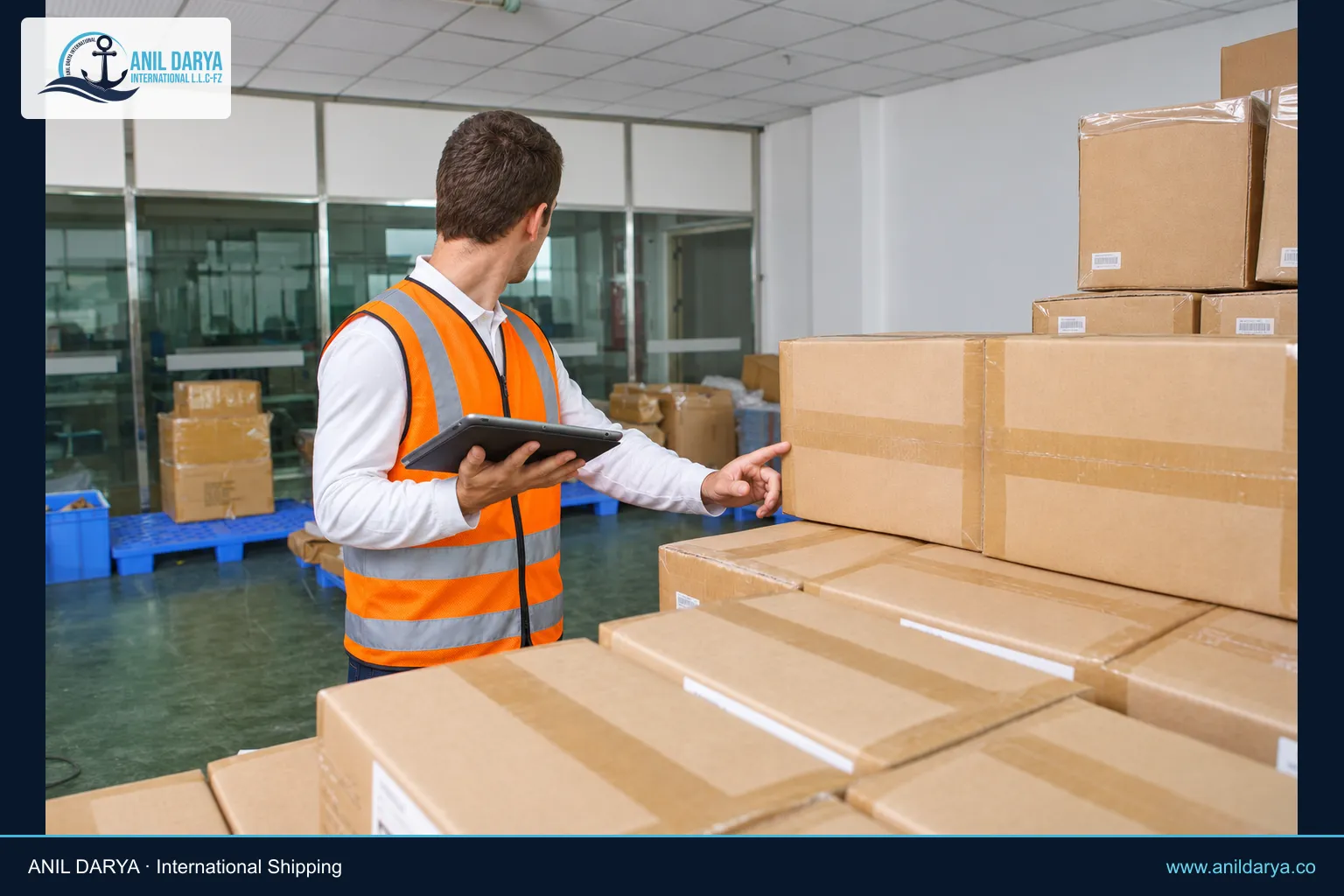
Kenyan import entries go through KRA's integrated customs system, iCMS, and are filed by a licensed clearing agent. Permits from other agencies run through KenTrade's National Electronic Single Window System. We do not sell customs clearance in Kenya. The consignee's broker does this, and we agree the plan with them before we confirm your booking.
| Document | Who provides it | What to check |
|---|---|---|
| Commercial invoice and packing list | Chinese supplier | HS code, values and weights match the export declaration and B/L |
| Carrier bill of lading | Shipping line, released through us | Consignee, notify party, ACD code, place of delivery (Mombasa, CFS or ICD) |
| Certificate of origin | Competent authority in China | Mandatory since 1 October 2025 for most goods |
| Certificate of conformity | KEBS PVoC agent in China | Matches the goods and the shipment |
| Import entry and Import Declaration Form | Consignee's clearing agent in iCMS | Lodged against the manifest before the vessel arrives |
| Import Standardisation Mark or sector permits | Consignee, through the agency concerned | Applied for before shipment where the product needs them |
| Marine cargo insurance certificate | IRA-licensed insurer in Kenya | Transmitted to iCMS before the entry is lodged |
The certificate of origin rule took effect on 1 July 2025 under section 44A of the Tax Procedures Act, with full enforcement from 1 October 2025. Used goods and samples without commercial value are among KRA's exemptions.
Marine cargo insurance is the other rule that catches new importers. From 1 November 2026 KRA enforces it digitally: every incoming consignment must be covered by a policy issued by an insurer licensed by Kenya's Insurance Regulatory Authority, and consignments without it are blocked from clearance. Insurance bought by a Chinese supplier under CIF does not meet the rule unless it comes from such an insurer, which is one more reason to buy FOB or CFR.
Duty, VAT and levies at Mombasa
Kenya applies the East African Community Common External Tariff. Duty and taxes at destination are paid by the consignee or its broker, not by the shipper in China and not by us.
| Charge | Rate or basis | Source |
|---|---|---|
| Import duty, raw materials and capital goods | 0% | EAC CET |
| Import duty, intermediate goods not made in the region | 10% | EAC CET |
| Import duty, intermediate goods made in the region | 25% | EAC CET |
| Import duty, finished goods also made in the region | 35% | EAC CET |
| Sensitive items | Above 35%, listed in Schedule 2 of the CET | EAC CET |
| VAT on imports | 16% | KRA |
| Import Declaration Fee and Railway Development Levy | Percentages of customs value; confirm the current rate with your agent | KRA |
The exact rate depends on the HS code, so get the code agreed with your broker before you place the order. Duty is assessed on the customs value, which includes freight and insurance to Mombasa. The Finance Act 2026 added IDF and RDL exemptions for selected goods, so ask your broker.
Restricted and prohibited goods in Kenya
Kenya's prohibited and restricted list sits in the Second Schedule of the East African Community Customs Management Act 2004, which KRA publishes. Part A lists goods that cannot be imported at all. Part B lists goods that need a permit or licence. On the China lane, a few product groups come up again and again.
- Used motor vehicles older than eight years are not allowed in, under KEBS standard KS 1515:2000.
- Used goods such as used clothing and used spare parts do not benefit from the small-value PVoC exemption.
- Goods listed in Part B, and products controlled by a sector regulator, need the permit or Import Standardisation Mark in place before shipment. Your broker can check the HS code against the list.
Routing via Dubai: Jebel Ali transhipment, consolidation and re-export
For most China to Kenya cargo, a direct sailing to Mombasa is the simplest choice. Dubai becomes useful when your supply chain already runs through the UAE. Jebel Ali has weekly services on to East Africa. Emirates Shipping Line's Gulf India Africa Express (GIA), for example, calls Jebel Ali's DP World Terminal 3 every week and publishes 10 days from Jebel Ali to Mombasa. Read our Jebel Ali port guide for terminals and services.
| Option | How it works | What to watch |
|---|---|---|
| Transhipment at Jebel Ali | The box arrives from China and connects to a Mombasa-bound vessel | Dubai Customs treats transit as its own regime, separate from import; extra port days |
| Consolidation in Dubai | Goods from China, and from other origins, are combined in one container for Kenya | Each item still needs its PVoC certificate; origin documents must match the goods |
| Free zone stock and re-export | You hold stock in Jafza and ship to Kenya as orders come in | The PVoC zone follows the country of supply; Dubai Chambers issues origin certificates for re-exports |
Cargo that only changes ships at Jebel Ali moves under Dubai Customs' transit regime, not as a UAE import, and the UAE VAT rules suspend VAT on goods in transit. Where cargo is landed, consolidated or re-exported from Dubai, we handle UAE customs clearance for a fee. The Jebel Ali Free Zone sits next to the port, and our article on re-exporting through Jafza explains the steps.
[AMIR-FACT: whether we route China to Kenya cargo via Jebel Ali in practice (transhipment or Dubai consolidation), with the carriers used and the real extra days compared with a direct sailing]
Typical cargo on this lane and what each needs
The cargo type decides which extra papers you need, so check this before you book.
| Cargo | Usual equipment | Extra papers to plan |
|---|---|---|
| Electronics, phones, small appliances | FCL or LCL | PVoC CoC; sector type approval for telecom items; DG rules if batteries are packed separately |
| Solar panels, inverters, lithium batteries | FCL 40ft high cube | Batteries shipped as DG with SDS and packaging certificates; PVoC CoC |
| Building materials, tiles, sanitary ware, steel | FCL 20ft (heavy) or breakbulk for long steel | PVoC CoC; check weight limits for inland transport |
| Textiles, garments, footwear | FCL 40ft or LCL | PVoC CoC; used clothing has its own rules |
| Machinery and plant equipment | FCL, flat rack or breakbulk | Drawings and piece list; PVoC for regulated items; capital goods are often at the 0% band |
| Chemicals, paints, adhesives | FCL, DG-approved | Full DG paperwork; Kenyan permit where the product is restricted |
Step by step: shipping from China to Kenya with Anil Darya
- Send us the cargo details: product, HS code if known, weight, volume, supplier city, ready date and the delivery point in Kenya.
- Name your clearing agent in Kenya. We agree the clearance plan with them, including CFS or ICD nomination, before we confirm the booking.
- Agree the Incoterm with your supplier. For most buyers that is FOB China with Kenyan insurance from an IRA-licensed insurer.
- Check PVoC, the certificate of origin and any Kenyan permit. Book the PVoC inspection for before the stuffing date.
- We book space with the shipping line and give the supplier the booking, cut-offs and the draft carrier B/L.
- The supplier or its origin agent stuffs the container, files the Chinese export declaration and gets the ACD code from KRA.
- We check that the ACD code, consignee, notify party and place of delivery are right on the B/L before the carrier issues it.
- The vessel sails, the carrier B/L is released to you through us, and your broker lodges the entry in iCMS and clears the box at the CFS or ICD.
[AMIR-FACT: one real China to Kenya cross-trade shipment we handled (cargo, load port, Kenyan port or ICD, carrier, what we coordinated and the outcome), cleared for publication]
What drives the cost of container shipping from China to Kenya?
We do not publish prices because they change with each sailing. These are the parts of the total and what moves each one.
| Cost part | What moves it | Usually paid by |
|---|---|---|
| Origin charges in China | Pickup distance, export filing, terminal handling, LCL consolidation | Supplier under FOB |
| PVoC inspection and CoC | Route, number of items, testing needs | Supplier or buyer, as agreed |
| Ocean freight | Container type, season, carrier, direct or transhipped, surcharges | Buyer under FOB |
| DG and out-of-gauge | DG surcharges, flat rack or breakbulk premiums, lashing | Buyer under FOB |
| Destination charges | Terminal handling at Mombasa, CFS or ICD fees, delivery order | Consignee |
| Duty, VAT and levies | HS code and customs value | Consignee or its broker |
| Kenyan marine insurance | Cargo value and type | Consignee |
| Storage and detention | Late papers, late permits, slow clearance | Whoever caused the delay, under your contract |
A late PVoC certificate or a missing ACD code can cost more in storage than the freight saving. If you want a second check on a quote, our Dubai freight forwarding team can walk through each line with you.
Checklist before the cargo leaves China
- Incoterm written in the contract, and Kenyan marine insurance arranged.
- HS code agreed with your Kenyan broker, and the duty band checked.
- Clearing agent named, CFS or ICD nominated and written on the booking.
- PVoC certificate of conformity issued, or confirmation the goods are not regulated.
- Kenyan permits or Import Standardisation Mark in place where needed.
- Chinese export declaration filed, with values matching the invoice.
- ACD code obtained and endorsed on the carrier B/L.
- For DG: UN number, SDS, Chinese packaging certificates, DG declaration and carrier approval.
Mistakes that hold cargo at Mombasa
- Shipping before destination clearance is agreed. If no Kenyan broker has accepted the job, the box sits at the port while you find one.
- No ACD code on the B/L. The code has to be obtained at loading and endorsed on the bill of lading.
- No PVoC certificate. A missing CoC for regulated goods leads to penalties and delay.
- CIF insurance from a Chinese insurer. Kenya now blocks clearance without cover from an IRA-licensed insurer.
- Wrong place of delivery. A B/L to Mombasa when the buyer wanted ICD Nairobi on a through bill of lading means extra handling.
- Used goods assumed exempt. Used vehicles over eight years old are banned, and used parts and clothing have their own rules.
Frequently asked questions
Which port do containers from China arrive at in Kenya?
Most arrive at Mombasa, Kenya's main port, with 22 berths and two container terminals. Lamu has three working berths but fewer China calls. From Mombasa, cargo can go by Standard Gauge Railway to ICD Nairobi or ICD Naivasha.
How long does sea freight from China to Kenya take?
It depends on the load port, the carrier and whether the box is transhipped. Ask for the routing and the published transit on every quote, and add time for export filing in China, PVoC inspection, clearance at Mombasa and inland delivery.
What is the ACD code for Kenya?
It is KRA's Advance Cargo Declaration reference, required for containerised cargo to Kenyan ports from 3 August 2026. The exporter gets it at loading through acd.kra.go.ke by uploading the draft B/L, commercial invoice, freight invoice and export declaration. The code is endorsed on the bill of lading.
Do goods from China need a PVoC certificate for Kenya?
Regulated products do. A KEBS-appointed agent in China inspects the goods, tests them where needed and issues a certificate of conformity before shipment. Goods that need one and arrive without it face penalties.
What import duty and VAT apply to goods from China?
Kenya uses the EAC Common External Tariff, with bands of 0%, 10%, 25% and 35%, and higher rates for sensitive items. VAT on imports is 16%. The Import Declaration Fee and Railway Development Levy are also charged, so confirm the current rates and your HS code with your clearing agent.
Does Anil Darya clear customs in Kenya?
No. The consignee's customs broker clears the goods in Kenya, and duty and taxes are paid by the consignee or its broker. We agree the plan with that broker before we confirm the booking, then coordinate documents and arrival.
Can I route China to Kenya cargo through Dubai?
Yes, where it helps. Cargo can tranship at Jebel Ali, be consolidated in Dubai with goods from other origins, or be held in a free zone and re-exported. Jebel Ali has weekly East Africa services, and we handle UAE customs clearance for a fee when the cargo is landed in Dubai.
Get a quote for sea freight from China to Kenya
Send us the supplier city, the cargo and the ready date, and name your clearing agent in Kenya. We will come back with a routing, the carrier and a price. Use our freight rate inquiry form, or contact our team to plan a DG, breakbulk or project shipment first.
Sources
- Kenya Ports Authority: Port of Mombasa (berths, container terminals, capacity)
- Kenya Ports Authority: Port of Lamu (berths, capacity)
- Kenya Ports Authority: Inland Container Depots and through bill of lading
- Kenya Ports Authority: FAQ (dangerous cargo)
- Maersk: Mombasa domestic cargo clearance at CFS (KPA notice of 4 December 2025)
- KRA public notice: Advance Cargo Declaration platform for containerised cargo (14 July 2026)
- KRA public notice: Enforcement of marine cargo insurance (22 October 2026)
- KRA public notice: Mandatory certificate of origin on imports
- KRA: Finance Act 2026, what it means for you
- KRA: How to import
- KRA: Customs FAQ (VAT 16%, vehicle age limit)
- KRA: Prohibited and restricted goods under the EACCMA 2004
- East African Community: Customs union and the CET bands
- KenTrade: National Electronic Single Window System
- The Kenya Times: KEBS lists nine PVoC inspection firms (February 2026)
- Intertek: Appointed for Kenya PVoC, zones including China (February 2026)
- Shanghai Municipal Government: Customs registration and export declaration
- CIRS: China Customs inspection of DG packaging for export
- IMO: IMDG Code 2024 edition (Amendment 42-24)
- Emirates Shipping Line: Fahari (FHX) Far East to Mombasa service
- Emirates Shipping Line: Gulf India Africa Express (GIA) advisory and schedule (July 2025)
- Dubai Customs: Customs declaration regimes and documents
- Dubai Chambers: Certificate of origin for exported and re-exported goods
- Federal Tax Authority: VAT guide (suspension for goods in transit)
- Jafza: About the Jebel Ali Free Zone
Reviewed: 11 November 2026