
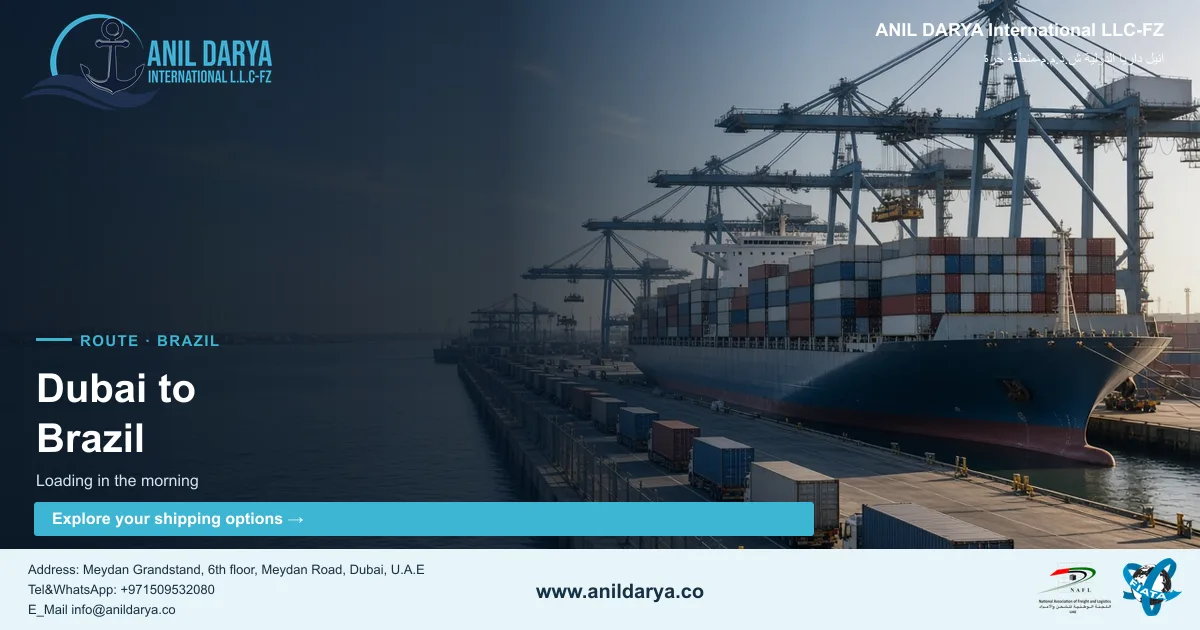
Shipping from Dubai to Brazil usually means a container from Jebel Ali to Santos or another Brazilian port, with air cargo for urgent goods and breakbulk for machinery and project cargo. The harder part sits in Brazil: the importer must be registered with the Receita Federal to trade (the habilitation still called RADAR), the declaration is filed in the Portal Unico Siscomex, and import taxes stack on top of each other. This guide covers modes, ports, Brazilian registration, the Duimp, taxes and the order in which to do things.
Shipping from Dubai to Brazil at a glance
| Item | Detail |
|---|---|
| Main UAE load port | Jebel Ali, Dubai (over 80 weekly services to more than 150 ports) |
| Main Brazilian gateway | Port of Santos, Sao Paulo state, about 70 km from Sao Paulo city |
| Other Brazilian ports buyers use | Paranagua, Itajai and Navegantes, Rio de Janeiro, Suape, Salvador, Vitoria, Rio Grande, Manaus |
| Modes on this lane | FCL, LCL, breakbulk and project cargo, dangerous goods, vehicles, air cargo |
| Customs authority | Receita Federal do Brasil |
| Trade system | Portal Unico de Comercio Exterior (Siscomex) |
| Import declaration | Duimp in the Portal Unico; the older DI is being switched off in phases |
| Importer registration | Habilitation in the Habilita system: expressa, limitada (US$50,000 or US$150,000 per six months) or ilimitada |
| Customs value | Usually FOB value plus international freight and insurance |
| Federal charges | Import duty (II), IPI, PIS-Importacao 2.10%, COFINS-Importacao 9.65%, AFRMM 8% of sea freight, Siscomex fee |
| State tax | ICMS, rate set by each state |
| Wood packaging | Must meet ISPM 15 |
How cargo moves from Dubai to Brazil
Most sea cargo for Brazil is loaded at Jebel Ali. DP World runs more than 80 weekly services from the port to over 150 ports, so you can choose between several carriers and port pairs. Some services discharge in Brazil directly and others transship at a hub on the way. The port of discharge on the bill of lading decides where the goods clear customs and how long the truck or rail leg is inside Brazil.
A practical rule: pick the Brazilian port by the consignee's address, not by the freight rate alone. Sao Paulo state consignees usually take cargo through Santos. Buyers in Parana and Santa Catarina often use Paranagua, Itajai or Navegantes. Factories in the northeast look at Suape or Salvador. If the cheapest ocean rate lands in the wrong state, the inland truck and the state tax rules can cost more than you saved.
Ports and gateways on both ends
| Gateway | Side | What it is good for |
|---|---|---|
| Jebel Ali Port | UAE | Containers, breakbulk, project cargo and DG; widest choice of carriers |
| Khalifa Port, Abu Dhabi | UAE | Cargo that starts in Abu Dhabi, if a Brazil service calls there |
| Port of Santos | Brazil | Containers, breakbulk, liquid and dry bulk, vehicles; a record 186.4 million tonnes in 2025 |
| Paranagua, Itajai, Navegantes | Brazil | Southern Brazil consignees |
| Rio de Janeiro, Vitoria | Brazil | Southeast consignees outside Sao Paulo state |
| Suape, Salvador, Pecem | Brazil | Northeast consignees |
| Sao Paulo Guarulhos (GRU) and Viracopos (VCP) | Brazil | Main air cargo gateways for Sao Paulo |
Sea freight from Dubai to Brazil: FCL or LCL?
Most general cargo on this lane moves in containers. Choose by volume, value and how much handling your goods can take.
- FCL (full container load). You book a whole 20ft or 40ft box. It suits stock orders, building materials, chemicals in drums and anything you want sealed from your warehouse to the consignee.
- LCL (less than container load). Your cargo shares a box with other shippers and is unpacked at a bonded warehouse in Brazil. It suits small volumes, but each extra handling and storage day in a Brazilian terminal adds cost, and storage charges also feed into the state tax base.
Reefer containers carry chilled and frozen goods. Open tops and flat racks carry cargo too tall or wide for a standard box. We explain where the cost crossover sits in our guide to FCL vs LCL shipping costs, and our sea freight service covers booking, documents and trucking to the port in Dubai.
Transit times and sailings
Transit times change with the service. A direct call at Santos is faster than a routing that transships at a hub, and ports further from the first Brazilian call take longer. Online calculators on this lane disagree with each other by weeks, so we do not repeat their numbers. Ask for the port-to-port days of the actual vessel when you book, then add time for the Duimp, any licence, and the inland leg.
[AMIR-FACT: Our real port-to-port transit Jebel Ali to Santos (days), whether the service is direct or transships, and the carriers we actually book on this lane]
Breakbulk, project cargo and vehicles to Brazil
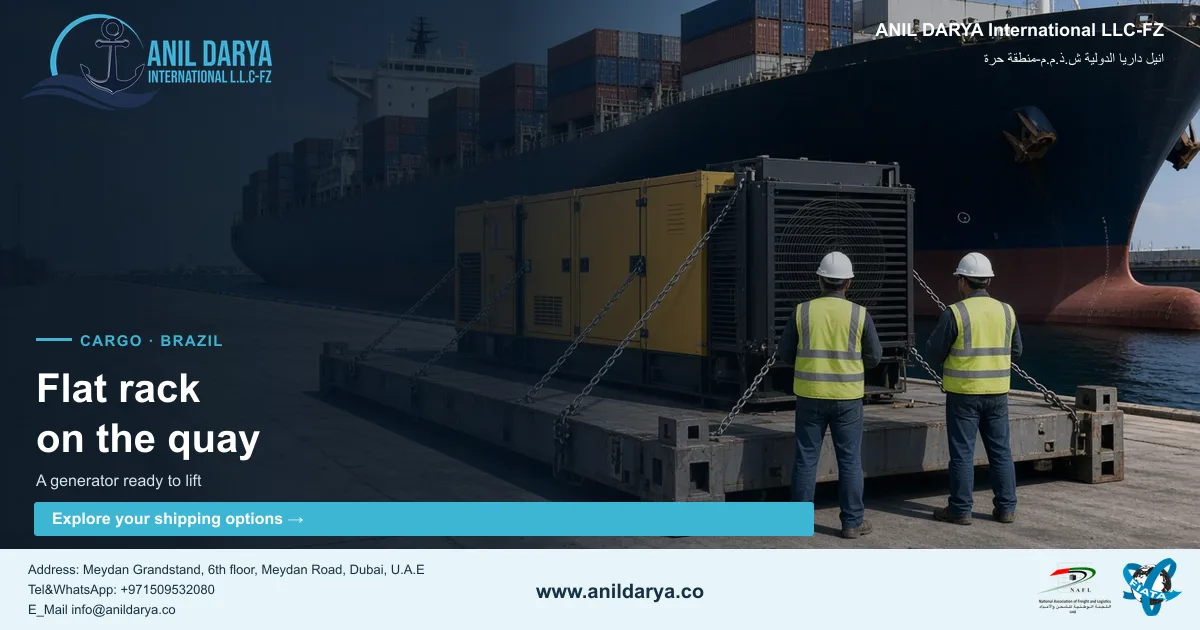
Generators, transformers, steel structures and construction machinery often go as breakbulk or on flat racks. In Santos, DP World's terminal on Barnabe Island lists breakbulk and out-of-gauge project cargo among the cargo it handles, next to containers.
| Cargo | Usual method | What to plan |
|---|---|---|
| Pieces that fit a 40ft flat rack | Flat rack or open top on a container service | Out-of-gauge acceptance by the carrier and both terminals, lashing |
| Pieces too large or heavy for a flat rack | Conventional breakbulk or heavy-lift vessel | Lift plan, vessel gear, a Brazilian port with a multipurpose berth |
| Steel coils, plates, pipes | Breakbulk or containers | Dunnage, moisture protection, piece-by-piece packing list |
| Used machinery | Container or breakbulk | Check Brazilian rules on used goods with the importer before you sell |
| Vehicles | Ro-Ro or container | Brazilian vehicle and emission rules; the importer confirms eligibility first |
We plan these moves with our break bulk and project cargo team: drawings, weights and centre of gravity first, then vessel type, then lashing and the road move to the quay in Dubai.
Dangerous goods from Dubai to Brazil
Chemicals, paints, batteries, aerosols and gases ship under the IMDG Code. DP World Santos lists IMDG dangerous goods among its cargo types, so DG containers can be discharged at Santos when the carrier accepts them on that service.
What you need for a DG booking:
- UN number, proper shipping name, class and packing group for each product.
- A Safety Data Sheet for each product.
- A signed Dangerous Goods Declaration.
- UN-approved packaging, marks, labels and container placards.
- Carrier acceptance before you commit to a sailing, and any Brazilian licence the product needs, confirmed by the importer.
Many chemicals also need consent from a Brazilian agency before clearance, so the importer should check the product's NCM code before you load. Our dangerous goods shipping team checks the documents and the carrier's acceptance on the UAE side.
Air cargo from Dubai to Brazil
Air cargo suits samples, spare parts, electronics, medicines and urgent stock. Sao Paulo's Guarulhos and Viracopos airports take most air freight for the Sao Paulo region, with Rio de Janeiro Galeao for Rio consignees. The same habilitation, licences and import taxes apply as for sea cargo, but AFRMM does not, because it is charged on waterborne freight only. Ask us to compare air against sea when cargo is light, valuable or late, through our air cargo service.
Who can import into Brazil? RADAR and the Habilita system
Before a Brazilian company can register an import, it must be enabled to operate in foreign trade with the Receita Federal. Traders still call this RADAR, the name of the old system. Today the request is made, as a rule, in the Habilita system inside the Portal Unico Siscomex. The system sets the modality and the limit automatically, based on an estimate of the company's financial capacity, and some requests are sent to a tax officer for review.
The three habilitation modalities
| Modality | Who it is for | Import limit |
|---|---|---|
| Expressa | Publicly listed companies and their wholly owned subsidiaries, public companies and mixed-capital companies | No limit |
| Limitada | Companies whose estimated financial capacity is at or below US$150,000 | US$50,000 or US$150,000 in each consecutive six-month period |
| Ilimitada | Companies whose estimated capacity is above the limitada ceiling | No limit |
The limitada ceiling is measured on customs value plus freight and insurance to the port of discharge, not on the invoice alone. That matters on this lane. A buyer with a US$50,000 limit who orders goods worth US$45,000 can run out of room once you add the ocean freight. Ask your buyer for its modality and remaining limit before you confirm a large order.
What this means for you as the seller in Dubai
- Sell to a Brazilian company that is already habilitated. If it is not, the goods can arrive before the importer can legally file.
- Agree the Incoterm in writing. Under a DDP sale you would need a Brazilian importer of record anyway, so most UAE sellers ship FOB, CFR or CIF and let the buyer clear.
- Ask which customs broker (despachante aduaneiro) will clear the goods, and send documents to that broker early.
Our guide to Incoterms 2020 for sea freight helps you split costs and risk before the sale.
Customs clearance in Brazil: Duimp and the Portal Unico
Brazil is moving every import onto the Duimp (Declaracao Unica de Importacao). The Duimp runs in the Portal Unico de Comercio Exterior and replaces the old Siscomex LI and DI. Migration began on 1 October 2024. The Ministry of Finance reported that average import times had already fallen from 17 to 9 days under the Portal Unico, with a target of about 5 days.
The DI is being switched off in phases, and the schedule keeps moving. The official Siscomex schedule moved the DI shutdown for bulk maritime cargo to 11 October 2026 and set 10 December 2026 for a further group of operations. Your buyer's broker will know which declaration applies to your shipment on the day it lands.
How clearance works
- The importer is habilitated, and any licence or permit (LPCO) the goods need is requested in the Portal Unico.
- The cargo arrives and is manifested in the Portal Unico's cargo and transit control module (CCT Importacao). The Duimp can be registered once the cargo is manifested there.
- The importer or its broker fills in the Duimp in the Portal Unico: identification, cargo, documents, items, administrative treatment, then a diagnostic check before registration.
- Supporting documents are uploaded in the Anexacao system.
- Taxes are paid and the declaration is risk-assessed. It is released or selected for a document check or a physical inspection.
- After release, the terminal delivers the cargo and the container goes back empty.
Many imports need no licence, but some do. The Receita Federal names agricultural products and medicines as examples, and Inmetro, the standards body, gives its consent for controlled products through LPCO requests in the Portal Unico. If a licence is needed and missing, the importer faces a fine for importing without it.
Documents for an import into Brazil
The federal government's service page lists the documents common to every import declaration: bill of lading, commercial invoice, packing list, proof of origin, cargo manifest and documents that prove the commercial transaction.
| Document | Who issues it | Notes |
|---|---|---|
| Commercial invoice | Seller in Dubai | Price, Incoterm, full description and NCM code of each item; the broker uses it for the Duimp |
| Packing list | Seller | Weights, piece counts and marks must match the invoice and bill of lading |
| Bill of lading or air waybill | Carrier | Consignee name and CNPJ must match the importer |
| Proof of origin (certificate of origin) | Chamber of commerce in the UAE | On the government's list of required documents |
| Licence or permit (LPCO) | Brazilian agency, requested by the importer | Only for controlled products; obtain it before shipping |
| Payment and contract documents | Buyer and seller | Proof of the commercial transaction |
| UAE export declaration | Filed in Dubai | Export or re-export, depending on the goods |
Ask the broker whether it wants product descriptions in Portuguese on the invoice, and how detailed. Vague lines such as "spare parts" or "chemicals" slow down classification.
Import taxes in Brazil on goods from Dubai
The federal trade portal lists the charges on imports: import duty (II), IPI, PIS and COFINS, AFRMM, CIDE-Combustiveis on fuels, the state ICMS, and the Siscomex usage fee. Each one builds on the customs value, and some build on each other.
How each tax is calculated
| Charge | Level | Base | Rate |
|---|---|---|---|
| Customs value | - | Usually FOB value plus international freight and insurance | - |
| Import duty (II) | Federal | Customs value | Set by the Mercosur common external tariff (TEC) for the NCM code |
| IPI | Federal | Customs value plus II | Set by the IPI table (TIPI) for the product |
| PIS-Importacao | Federal | Customs value | 2.10% for almost all imports |
| COFINS-Importacao | Federal | Customs value | 9.65% for almost all imports |
| AFRMM | Federal | Ocean freight on international (long-haul) shipping | 8% |
| ICMS | State | Customs value, II, IPI, PIS, COFINS, ICMS itself and customs expenses such as storage, terminal handling and AFRMM | Set by each state |
Two points catch exporters out. First, freight and insurance sit inside the customs value, so a higher freight rate raises every tax. Second, ICMS is calculated "inside" its own base, which makes the effective burden higher than the headline state rate.
Worked example (illustration only)
The table assumes an import duty of 10%, IPI of 5% and an ICMS rate of 18%. Real rates depend on the NCM code and the state, so your buyer's broker must run the actual figures.
| Step | Amount (US$) |
|---|---|
| Customs value (FOB 20,000 + freight 2,500 + insurance 100) | 22,600 |
| Import duty at the assumed 10% | 2,260 |
| IPI at the assumed 5% on 24,860 | 1,243 |
| PIS-Importacao at 2.10% | 474.60 |
| COFINS-Importacao at 9.65% | 2,180.90 |
| AFRMM at 8% of the 2,500 freight | 200 |
| Sum before ICMS | 28,958.50 |
| ICMS base (28,958.50 divided by 0.82) | 35,315.24 |
| ICMS at the assumed 18% | 6,356.74 |
In this example, taxes and AFRMM add about US$12,700 to a US$20,000 FOB order, before broker fees, terminal storage and the Siscomex fee. That is why Brazilian buyers care so much about the declared freight and about clearing fast.
Restricted and controlled goods
Check with the importer before you produce or load anything in these groups. In most cases the licence is requested in Brazil, by the importer, before the goods ship.
| Goods | What to check |
|---|---|
| Food, plants, seeds, animal products | Agricultural licensing and health certificates from origin |
| Medicines, cosmetics, health products | Health agency consent before shipment |
| Electrical goods, toys, tyres and other certified products | Inmetro consent through an LPCO in the Portal Unico |
| Chemicals and dangerous goods | Agency consent for the NCM code, plus IMDG rules |
| Used goods and used machinery | Restrictions on used imports; get written confirmation from the importer |
| Wood pallets, crates and dunnage | ISPM 15 treatment and marking |
Wood packaging is the easiest one to get right and the most annoying to get wrong. Use ISPM 15 marked pallets and crates, or switch to plastic or metal.
What drives the cost of shipping from Dubai to Brazil
We do not publish rates because they change with each sailing. These are the factors that move your total landed cost:
- Ocean or air freight, which also raises the customs value and every tax built on it.
- Port of discharge and the inland leg to the consignee's state.
- Container type: dry, reefer, flat rack or open top.
- Cargo class: DG and out-of-gauge cargo cost more to book and handle.
- Terminal storage in Brazil while the Duimp is processed.
- Broker fees, the Siscomex fee and licence costs.
- Container free time and the risk of demurrage and detention, which our article on demurrage and detention charges explains.
How to ship from Dubai to Brazil: step by step
- Confirm the buyer. Check the Brazilian importer's habilitation modality and remaining limit, and the broker it uses.
- Classify the goods. Agree the NCM code for each item with the importer, and ask whether any licence or LPCO is needed.
- Agree the Incoterm and the Brazilian port of discharge.
- Get a quote. We compare carriers from Jebel Ali to the chosen port and confirm direct or transshipment routing.
- Book space. For DG, reefer or out-of-gauge cargo we get carrier acceptance first.
- Prepare documents. Invoice, packing list and certificate of origin, with matching weights, NCM codes and the consignee's CNPJ.
- Pack and load. ISPM 15 wood packaging, DG labels where needed, container stuffing and seal.
- File the UAE export or re-export declaration and gate the container in before the cut-off.
- Release the bill of lading and send the document set to the Brazilian broker before arrival.
- The broker registers the Duimp once the cargo is manifested, pays taxes and clears the goods for delivery.
[AMIR-FACT: One real Dubai to Brazil shipment we handled: cargo type, mode, port pair and what we did, cleared for publication]
Checklist before you ship cargo from Dubai to Brazil
- Importer habilitated in the Portal Unico, with enough limit for the full customs value.
- NCM code agreed for every item.
- Licences or LPCO granted for controlled goods before loading.
- Invoice, packing list and bill of lading show the same weights, pieces, consignee and CNPJ.
- Certificate of origin issued in the UAE.
- Wood packaging ISPM 15 marked.
- For DG: SDS, DG declaration, packaging and labels, carrier acceptance.
- For project cargo: drawings, lifting points and a lashing plan.
- Free time agreed with the carrier, and cargo insurance arranged.
Common mistakes on the Dubai to Brazil lane
- Shipping before the buyer is habilitated or before a licence is granted. The cargo sits in a bonded terminal and storage runs up.
- Ignoring the limitada ceiling. Freight and insurance count against the six-month limit.
- Vague invoice descriptions. The broker cannot classify the goods and the Duimp is delayed.
- Mismatched weights or consignee details across documents.
- Untreated wooden pallets or crates.
- Choosing the port by freight rate alone and paying more for the inland leg and state tax.
- Treating DG like general cargo. Undeclared dangerous goods can be rejected, delayed or fined.
Frequently asked questions
How long does shipping from Dubai to Brazil take?
It depends on the carrier, the port of discharge and whether the service transships. Ask for the vessel's port-to-port days at booking, then add time for the Duimp, any licence and the inland leg in Brazil.
What does RADAR mean for Brazilian imports?
RADAR is the common name for the Receita Federal habilitation a company needs to import or export. Today it is requested in the Habilita system in the Portal Unico Siscomex, in the expressa, limitada or ilimitada modality.
What is the Duimp?
The Duimp (Declaracao Unica de Importacao) is Brazil's single import declaration in the Portal Unico. It replaces the older Siscomex LI and DI, which are being switched off in phases.
Which taxes are paid on imports into Brazil?
Import duty (II), IPI, PIS-Importacao at 2.10% and COFINS-Importacao at 9.65% for almost all goods, AFRMM at 8% of sea freight, the Siscomex fee, and the state ICMS. All are calculated from the customs value, which usually includes freight and insurance.
Can a company in Dubai import into Brazil on its own?
The import declaration is filed by a habilitated importer in Brazil or its legal representative. A Dubai seller normally ships to a Brazilian buyer who clears the goods through its own customs broker.
Which Brazilian port should I ship to?
Choose the port closest to the consignee. Santos suits Sao Paulo state, Paranagua, Itajai and Navegantes suit the south, and Suape or Salvador suit the northeast.
Do I need ISPM 15 pallets for Brazil?
Yes. Wood packaging in international trade must meet ISPM 15. Use treated and marked wood, or switch to plastic or metal pallets.
Can I ship dangerous goods from Dubai to Brazil?
Yes, under the IMDG Code with carrier acceptance. You need the SDS, a DG declaration and UN packaging, and the Brazilian importer must confirm any agency consent the product needs.
Get a quote for shipping from Dubai to Brazil
Send us the cargo details, the Brazilian port or city and your Incoterm, and we will come back with a routing and a price. Use our freight rate inquiry form, or contact our team to talk through a breakbulk, project or DG shipment first. You can also read more about our Dubai freight forwarding team.
Sources
- Receita Federal: Habilitation via the Habilita system
- Receita Federal: IN RFB 1,984/2020 text (habilitation modalities and limits, art. 16 and 17)
- Receita Federal: What is the expressa modality?
- Receita Federal: Preparing the Duimp
- Receita Federal: Portal Unico de Comercio Exterior
- Ministry of Finance: Duimp enters operation (October 2024)
- Siscomex: DI and DSI shutdown schedule
- Gov.br: Declare imported goods (documents and who can declare)
- Invest and Export Brasil: Tax treatment on imports
- Receita Federal import simulator glossary (tax bases, PIS and COFINS rates, customs value, licensing)
- Ministry of Ports and Airports: AFRMM
- Inmetro: Import consent in the Portal Unico
- IPPC: ISPM 15, Regulation of wood packaging material in international trade
- DP World: Jebel Ali Port
- DP World: Santos terminal (cargo types)
- Ministry of Ports and Airports: Santos handles 186.4 million tonnes in 2025
- Wikipedia (Portuguese): Porto de Santos (distance to Sao Paulo)
Reviewed: 10 November 2026