
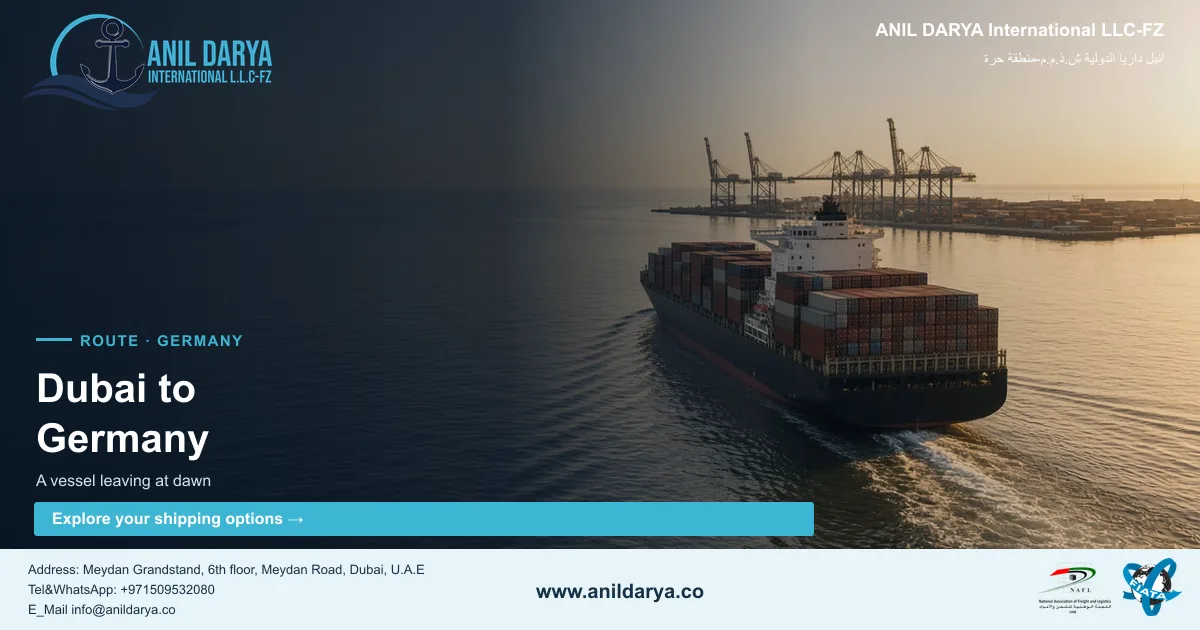
Shipping from Dubai to Germany usually means a container from Jebel Ali to Hamburg or Bremerhaven, with air cargo into Frankfurt or another German airport for urgent goods. On arrival, the German importer needs an EORI number, files an electronic import declaration in the customs system ATLAS, and pays EU customs duty from the TARIC tariff plus import VAT of 19% (7% for some goods). This guide covers ports, modes, documents, duty and VAT, product rules and each step from Dubai to your consignee's door.
Shipping from Dubai to Germany at a glance
| Item | Detail |
|---|---|
| Main UAE load port | Jebel Ali (AEJEA), with Abu Dhabi, Sharjah and the east coast ports as alternatives |
| Main German sea ports | Hamburg (Germany's largest seaport, 8.3 million TEU in 2025) and Bremerhaven |
| Main German cargo airports | Frankfurt, Leipzig/Halle, Munich, Cologne Bonn, Hamburg |
| Modes | FCL, LCL, flat rack and breakbulk, dangerous goods, air cargo |
| Customs authority | German customs (Zoll), applying EU customs law |
| Declaration system | ATLAS, electronic; paper only as an emergency fallback |
| Importer ID | EORI number, issued by German customs to EU-based operators |
| Tariff code | 11-digit German customs tariff number, built on the EU Combined Nomenclature |
| Duty rates | EU Common Customs Tariff, published in TARIC |
| Trade agreement | None in force; EU and UAE agreed to launch free trade talks on 10 April 2025 |
| Import VAT | 19% standard, 7% reduced (for example some food and books) |
| Safety filing before loading | Entry summary declaration by the carrier, at least 24 hours before a container is loaded |
| Temporary storage limit | 90 days to place goods under a customs procedure or re-export them |
Which mode should you use to ship from Dubai to Germany?
Most cargo from Dubai to Germany moves by sea in containers. Air cargo is for urgent, light or high-value goods. There is no practical road or rail option for most shippers on this lane, so this guide does not cover them.
| Your cargo | Best mode | Why |
|---|---|---|
| A full container or more of general goods | FCL by sea | Lowest cost per unit, box stays sealed to destination |
| A few pallets or cartons | LCL by sea | You pay for the space you use |
| Machinery, steel, vehicles, oversized pieces | Flat rack, open top or breakbulk | Fits cargo that does not go in a standard box |
| Chemicals, batteries, aerosols, perfumes | DG container or DG air | Needs carrier acceptance before booking |
| Samples, spare parts, urgent stock | Air cargo | Days instead of weeks, higher cost per kilo |
A simple rule: if the goods must be in Germany within about a week, price air. If not, start with sea.
Sea freight from Dubai to Germany: FCL and LCL
Sea freight from Dubai to Germany normally loads at Jebel Ali. Our Jebel Ali port shipping guide covers the terminals, cut-offs and export steps there. On the German side, the right port depends on where your consignee is and which carrier service you book.
Which German port should your cargo go to?
| German port | What to know | Good fit for |
|---|---|---|
| Hamburg | Germany's largest seaport: 114.6 million tonnes and 8.3 million TEU in 2025. Large rail network to the hinterland, with 2.0 million TEU moved by rail in the first nine months of 2025 | Northern and eastern Germany, Berlin, and rail moves to the south |
| Bremerhaven | Container port of the Bremen ports group on the North Sea coast | North-west Germany, Lower Saxony, Bremen |
The practical question is the service: which German port your carrier calls, how often, and how far that port is from the delivery address. A cargo for Munich can still go through Hamburg if the rail connection and price work.
FCL or LCL?
FCL means you book a whole 20ft or 40ft container. LCL means your cargo shares a container and is unpacked at a container freight station in Germany before release, so your release also depends on the consolidator's paperwork.
- Choose FCL when your cargo fills most of a 20ft box, is heavy, or should not be handled with other goods.
- Choose LCL for a few pallets, when you are testing a new buyer, or when the consignee wants smaller, more frequent deliveries.
- Price both when you are in the middle. The break-even point shifts with the rate of the week.
Our guide to FCL vs LCL costs walks through the maths, and our sea freight service page covers container types.
Transit times and sailings
Carriers change their Europe services, port calls and transhipment hubs during the year, so check the current schedule on the booking, not an old web page.
[AMIR-FACT: our real port-to-port and door-to-door transit days Jebel Ali to Hamburg and to Bremerhaven (FCL and LCL), and the carriers we actually book on this lane]
When you compare offers, ask whether the service is direct or tranships, which German port it uses, and the Jebel Ali cut-off.
Breakbulk, project cargo and dangerous goods to Germany
Breakbulk and project cargo
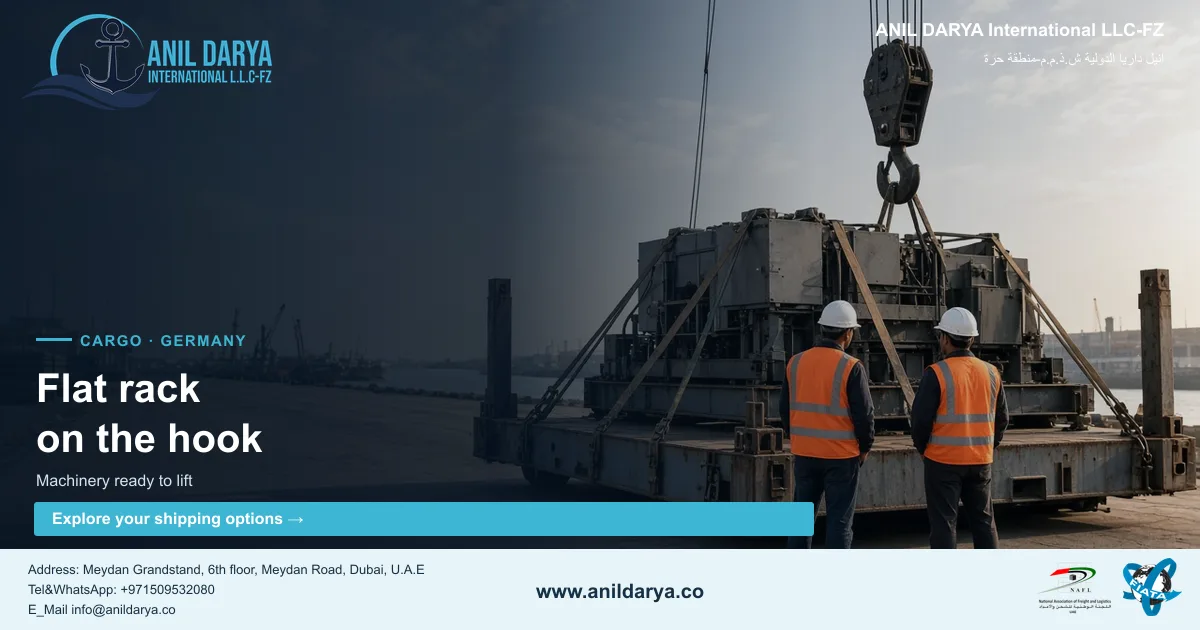
Machinery, steel structures, generators and plant parts often do not fit a standard container. If a piece fits a 40ft flat rack by size and weight, a container service usually gives you more sailings. If it does not, you need breakbulk or heavy-lift tonnage, and the vessel date drives the whole plan.
For project cargo we collect drawings, weights and lifting points, agree lashing with the carrier, and plan the UAE road move and export clearance. The German consignee or its agent arranges heavy transport permits in Germany, so give them the dimensions early. See our break bulk and project cargo service for what we cover.
Dangerous goods
Chemicals, lithium batteries, paints, aerosols and perfumes are dangerous goods under the IMDG Code by sea and the IATA rules by air. Each carrier must accept the booking before you load.
- Correct UN number, proper shipping name, class and packing group.
- A Safety Data Sheet (SDS) for each product, in a form the German consignee can use.
- UN-approved packaging, marks, labels and container placards.
- A signed dangerous goods declaration from a trained person.
Check with your buyer that the product and its labels meet EU chemicals rules before you ship. Our dangerous goods shipping team checks the paperwork and carrier acceptance first, and our guide to dangerous goods classes explains the nine classes.
Air cargo from Dubai to Germany
Air cargo from Dubai leaves from Dubai International (DXB) or Al Maktoum International (DWC) on passenger and freighter flights to German gateways such as Frankfurt, Leipzig/Halle, Munich, Cologne Bonn and Hamburg. Pick the airport nearest the consignee that the airline serves.
- Airlines charge on the greater of actual weight and volume weight, so bulky light cargo costs more than you expect.
- Long-haul flights into the EU need the entry summary declaration at least four hours before arrival. The airline files it, but it needs correct data from you in time.
Our air cargo service books space with the airlines and handles DG air shipments.
German customs: EORI, ATLAS and the import declaration
Germany applies EU customs law. German customs (Zoll) runs the declaration system and collects duty and import VAT.
Who needs an EORI number?
An EORI number is the EU customs ID for a business. German customs states that EORI numbers must be quoted on customs declarations, including the declarant, any customs representative and, on import, the consignee. It is also used for proof of import VAT payment in ATLAS.
- A business established in the EU applies in the Member State where it is based. In Germany, applications go to the Generalzolldirektion in Dresden.
- A UAE exporter selling to a German buyer does not need its own EORI number. German customs says a third-country exporter or importer does not need one; a non-EU operator registers only if it will act as declarant or carrier.
- If you plan to sell DDP and act as importer yourself, you will need an EORI number and usually a German or EU customs representative. Decide this before you quote the buyer.
How clearance works in Germany
- Before loading. The carrier files the entry summary declaration in the EU import control system, at least 24 hours before a container is loaded in Dubai. Bulk and breakbulk cargo must be declared at least four hours before the vessel reaches the first EU port.
- Arrival and temporary storage. The goods are presented to customs and go into temporary storage at the port or a customs warehouse. They must be placed under a customs procedure or re-exported within 90 days.
- Import declaration. The importer or its customs broker files an electronic declaration in ATLAS. Written declarations are only an emergency measure. Clearance can be handed to a customs agent or freight forwarder in Germany.
- Checks. Customs may check documents or inspect the goods. Food, plants, animal products and some other goods also need checks by other authorities.
- Payment and release. Duty and import VAT are settled and the goods are released for free circulation in the EU.
We file the UAE export declaration and prepare the shipping documents. The German side is cleared by your consignee's own broker or a German clearing agent they appoint, and we send them the documents before the vessel arrives.
What documents do you need to ship to Germany?
| Document | Who provides it | Notes |
|---|---|---|
| Commercial invoice | Exporter in the UAE | Full description, value, currency, Incoterm, HS code |
| Packing list | Exporter | Weights, piece count and marks matching the bill of lading |
| Bill of lading or air waybill | Carrier, via us | Consignee and notify party exactly as the importer is registered |
| Transport invoice | Carrier or forwarder | Can change the customs value, depending on the Incoterm |
| Customs value declaration | German importer or broker | For goods with ad valorem duty; customs may waive it under 10,000 euros per delivery |
| Certificate of origin | UAE chamber of commerce | Where German or EU rules require it |
| Import licence or permit | German importer | Only for goods that need one, issued by BAFA or BLE |
| UAE export declaration | Us, on Dubai Trade | Dubai Customs asks for invoice, packing list and certificate of origin |
| DG documents | Exporter and us | SDS, DG declaration, packing certificate |
The Hamburg Chamber of Commerce lists these as the core import documents for goods from outside the EU. A value, weight or consignee name that differs between the invoice and the bill of lading is a common cause of delay.
The tariff number
For the German import declaration you need an 11-digit customs tariff number. The first eight digits come from the EU Combined Nomenclature, which is revised every year on 1 January. The German electronic customs tariff (EZT) shows the duty, any quantity limits and any bans or restrictions for that number and country of origin. Give your buyer the HS code you used on the UAE export, and let their broker confirm the full German code.
Customs duty and import VAT on goods from Dubai to Germany
Customs duty and EU TARIC
Customs duty in Germany is EU duty. The rates are in TARIC, the EU's integrated tariff database. TARIC holds third-country duty rates, tariff preferences, suspensions, quotas, anti-dumping and countervailing duties, and import bans and restrictions. It is free to search, and national customs systems take its data every day.
There is no EU trade agreement with the UAE in force. The EU and the UAE agreed to launch negotiations on 10 April 2025, so for now goods from the UAE pay the normal third-country duty shown in TARIC for their code.
Most EU duty is a percentage of the customs value. The customs value is the price of the goods plus transport, insurance and handling costs up to the point where the goods enter the EU. Transport after entry, for example the truck from Hamburg to Munich, is not included in the customs value.
| Incoterm on your invoice | What the importer adds for customs value |
|---|---|
| EXW or FCA Dubai | UAE inland and export costs, sea or air freight and insurance up to the EU entry point |
| FOB Jebel Ali | Sea freight and insurance up to the EU entry point |
| CFR or CIF Hamburg | Usually nothing more; freight and, for CIF, insurance are already in the price |
| DAP or DDP buyer's door | The share of freight after EU entry can be taken out, if shown separately |
Our guide to Incoterms 2020 for sea freight explains who pays what under each term.
Import VAT (Einfuhrumsatzsteuer)
Import VAT in Germany is 19%, with a reduced 7% rate for selected goods such as food and books. German customs calculates it on the customs value plus customs duty, and excise duty where it applies. A German business entitled to deduct input tax can claim the import VAT back in full; a business that is not entitled bears it as a cost.
A worked example with simple numbers: goods invoiced at 10,000 euros FOB, with 1,000 euros of freight and insurance to the EU port, have a customs value of 11,000 euros. If the TARIC rate for the code were 2%, duty would be 220 euros, and import VAT at 19% would be charged on 11,220 euros. Use your real TARIC rate; the 2% here is only for the arithmetic.
Excise goods such as tobacco, spirits, beer, sparkling wine, coffee and energy products carry German excise on top. Anti-dumping or countervailing duty can apply to some steel, aluminium, chemical and other products, which TARIC shows by code and origin.
Restricted items and product rules in Germany
Several EU and German rules decide whether your goods can be sold in Germany at all. Check them before you ship.
| Rule | What it covers | What to check |
|---|---|---|
| TARIC prohibitions and restrictions | Bans, quotas, surveillance and licence needs by code | Search your code and country of origin in TARIC |
| CE marking | Toys, electrical and electronic equipment, machinery, some pressure equipment, gas appliances, batteries, PPE, medical devices and more | Declaration of conformity and CE mark in place before import |
| Import permits | Some goods from some countries, issued by BAFA (commercial goods) or BLE (agricultural goods) | Whether your code needs a licence |
| Food, plants and animal products | Official controls on arrival, health and plant health certificates | Certificates and pre-notification by the importer |
| Protected species | Animals, plants and some leather goods under international protection | CITES permits |
| Medicines | Need special authorisation to import | Importer's licence |
| Packaging Act | Anyone placing packaged goods on the German market | Registration in the LUCID packaging register |
| Electrical equipment (ElektroG) | Producers of electrical and electronic equipment | WEEE registration with stiftung ear, or an authorised representative for companies abroad |
| Wooden packaging | Pallets, crates and dunnage | ISPM 15 heat treatment mark |
CE marking is the manufacturer's responsibility, but the importer must also make sure the product complies. If your product does not fall under an EU rule that requires CE marking, it must not carry the mark.
What affects the cost of shipping from Dubai to Germany?
Rates on this lane change with the carrier, the week and the cargo, so we quote per shipment. These factors move your total:
- Mode and volume: FCL is priced per container, LCL per cubic metre or tonne, air per chargeable kilo.
- Container type: flat racks, open tops, reefers and DG containers cost more than a standard dry box.
- German port and inland leg: a cheaper sea rate to one port can be wiped out by a long truck or rail leg.
- Origin charges: trucking in the UAE, export clearance, terminal handling and documentation.
- Destination charges: terminal handling, delivery order, customs brokerage, inspection and storage in Germany.
- Duty and import VAT, set by the TARIC rate and the customs value.
- Free time: demurrage and detention start once the carrier's free days run out. Our guide to demurrage and detention shows how they add up.
For a like-for-like quote, give us the Incoterm, the German delivery address and whether to include German clearance.
How to ship cargo from Dubai to Germany: step by step
- Agree the Incoterm with your buyer. It decides who books freight, who clears German customs and who pays duty and import VAT.
- Confirm the importer. Your buyer needs an EORI number and a German customs broker. If you sell DDP, you need both.
- Check the goods. HS code, TARIC duty and restrictions, CE marking, product labels and any permit.
- Send us the cargo details. Commodity, HS code, weight, volume or dimensions, packing, pickup address in the UAE and delivery address in Germany.
- Choose mode and port. We compare FCL, LCL or air, and the German ports the carriers serve.
- Book space. For DG, reefer or out-of-gauge cargo we get carrier acceptance first.
- Pack and load. Heat-treated wooden packaging, correct marks and, for FCL, a sealed container.
- Submit shipping instructions on time. The carrier needs complete data early enough to file the entry summary declaration 24 hours before loading.
- Clear UAE export. We file the export or re-export declaration with Dubai Customs and deliver the container to the terminal before the cut-off.
- Send documents to Germany. Invoice, packing list, bill of lading, certificate of origin and any permit go to the consignee's broker before arrival.
- Clear and deliver in Germany. The broker files in ATLAS, duty and VAT are settled, and the consignee's haulier collects the cargo within free time.
[AMIR-FACT: one real Dubai to Germany shipment we handled (cargo, mode, German port, what we solved), cleared for publication]
Checklist before you ship to Germany
- Incoterm agreed and written on the invoice.
- German importer has an active EORI number and a customs broker.
- HS code checked against TARIC and the German tariff, including duty, anti-dumping and restrictions.
- CE marking, labels and declarations of conformity ready where the product needs them.
- Packaging registration in LUCID and WEEE registration in place if the goods need them.
- Invoice, packing list and bill of lading show the same weights, pieces, values and consignee.
- Certificate of origin issued if the buyer or a rule needs it.
- Wooden packaging ISPM 15 marked.
- For DG: SDS, DG declaration, UN packaging and carrier acceptance.
- Shipping instructions sent before the carrier's documentation cut-off.
- Free time agreed, delivery truck planned and cargo insurance arranged.
Common mistakes on the Dubai to Germany lane
- No EORI number on the consignee. The broker cannot file the declaration until it is sorted.
- Late or incomplete shipping data. Without a correct entry summary declaration the container cannot be loaded.
- Selling DDP without a plan. You become liable for German duty and VAT and need your own EORI number and representative.
- Wrong customs value. Leaving freight to the EU border out of an FOB value leads to corrections.
- Missing CE marking or German labels. Goods can be held or refused even after duty is paid.
- Untreated wooden pallets. Non-ISPM 15 packaging can be rejected or treated at your cost.
- Ignoring the 90-day temporary storage limit on slow clearances. Customs can sell or destroy goods left too long.
- Choosing the port on sea rate alone. The inland leg in Germany can cost more than the difference.
Frequently asked questions
Which German port is best for cargo from Dubai?
Hamburg is Germany's largest seaport and has strong rail links to the rest of the country, so it suits most destinations. Bremerhaven suits north-west Germany. The best choice depends on the carrier's service and the delivery address.
Do I need an EORI number to ship from Dubai to Germany?
The German importer needs one, because EORI numbers must be quoted on the import declaration. A UAE exporter does not, unless it acts as importer or declarant itself, for example when selling DDP.
What is ATLAS in German customs?
ATLAS is German customs' electronic system for declarations. Import declarations are filed in it electronically, usually by a customs broker or forwarder, and paper declarations are only an emergency fallback.
What import VAT applies to goods shipped from Dubai to Germany?
Import VAT is 19%, or 7% for selected goods such as food and books. It is charged on the customs value plus customs duty, and businesses entitled to deduct input tax can reclaim it.
Is there a trade agreement between the UAE and the EU?
No agreement is in force. The EU and the UAE agreed to launch free trade negotiations on 10 April 2025, so UAE goods currently pay the standard EU third-country duty shown in TARIC.
Where can I find the customs duty rate for my product?
Search the product's code in the EU TARIC database, or the German electronic customs tariff (EZT). Both show duty, anti-dumping measures and any bans or restrictions by country of origin.
How long can goods stay in a German port before clearance?
Goods in temporary storage must be placed under a customs procedure or re-exported within 90 days. Carrier free time on the container usually runs out much earlier, so clear quickly.
Can I ship dangerous goods from Dubai to Germany?
Yes, by sea under the IMDG Code or by air under IATA rules, with carrier acceptance before booking. You need an SDS, a DG declaration and UN-approved packaging, and the product must meet EU chemicals rules.
Get a quote for shipping from Dubai to Germany
Send us the commodity, weight and volume, the Incoterm and the German delivery address, and we will come back with a routing and a price. Use our freight rate inquiry form, or contact our team to talk through a project or DG shipment first. You can also read more about our Dubai freight forwarding team.
Sources
- German customs (Zoll): Using the EORI number
- German customs (Zoll): Deadlines for lodging the entry summary declaration
- German customs (Zoll): Lodging the entry summary declaration
- German customs (Zoll): Assessment of taxes and duties (import VAT rates and basis)
- Hamburg Chamber of Commerce: Import of goods from third countries
- European Commission: EU customs tariff (TARIC)
- European Commission: Temporary storage (90 days, Article 149 UCC)
- Spanish Tax Agency (EU customs): Transaction value adjustments (transport costs up to EU entry)
- European Commission: EU and UAE agree to launch free trade talks (10 April 2025)
- Your Europe: CE marking
- Central Agency Packaging Register: LUCID registration
- stiftung ear: WEEE registration
- Port of Hamburg: Throughput figures for 2025 at a glance (19 February 2026)
- Port of Hamburg: Throughput January to September 2025 (rail volumes)
- Dubai Customs: Submit customs declaration
Reviewed: 10 November 2026