
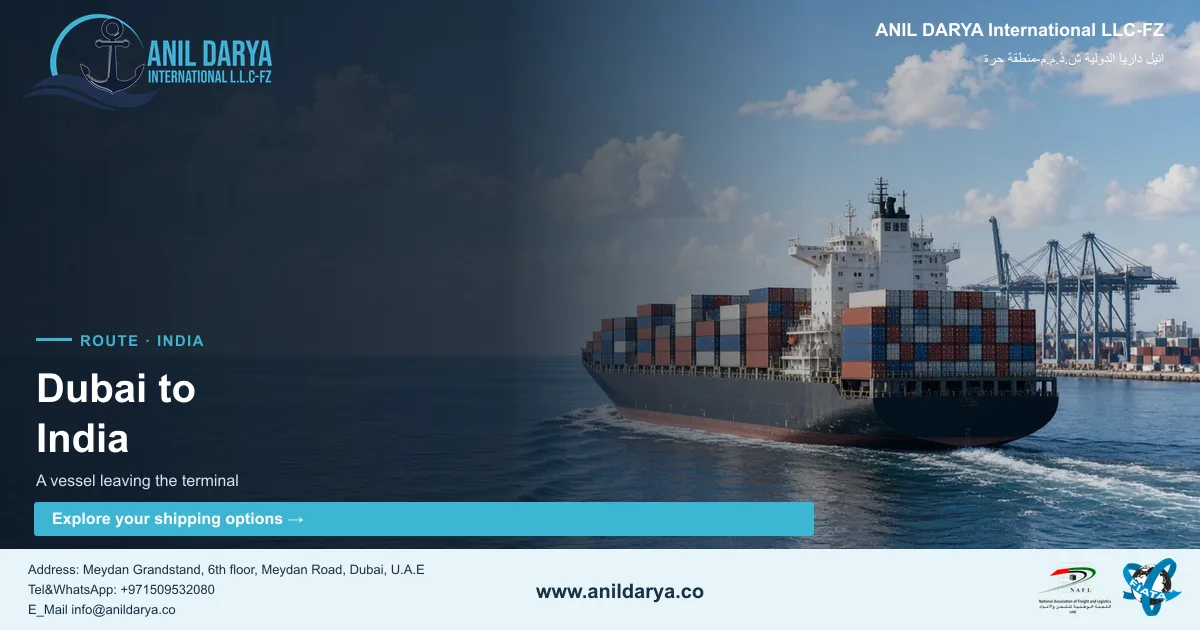
Shipping from Dubai to India is a short sea lane: most cargo leaves Jebel Ali and lands at Nhava Sheva or Mundra on India's west coast, with Chennai, Cochin and Kolkata covering the south and east. The sea leg is the easy part. What decides your cost and delivery date is the Indian import side: the consignee's IEC, a bill of entry filed on ICEGATE before the ship arrives, basic customs duty plus IGST, and, if the goods qualify, a CEPA certificate of origin that can cut the duty.
Dubai to India shipping at a glance
| Item | Detail |
|---|---|
| Main UAE load port | Jebel Ali (DP World), four container terminals, over 80 weekly services to more than 150 ports |
| Main Indian container gateways | Nhava Sheva (JNPA, Navi Mumbai) and Mundra (Gujarat) |
| Other Indian gateways | Hazira, Chennai, Cochin (Vallarpadam ICTT), Kolkata and Haldia |
| Modes | FCL, LCL, breakbulk and project cargo, dangerous goods, air cargo |
| Published transit indication | About 12 days average FCL transit UAE to India, observed range 6.4 to 14.3 days (Cogoport lane data, port to port) |
| Indian customs authority | CBIC (Central Board of Indirect Taxes and Customs) |
| Import filing system | ICEGATE, bill of entry filed electronically |
| Bill of entry deadline | Before the end of the day before the vessel arrives; can be filed up to 30 days in advance |
| Importer ID in India | IEC (Importer-Exporter Code), 10 characters, same as the importer's PAN |
| Taxes at import | Basic customs duty (BCD) by HS code, Social Welfare Surcharge on BCD, IGST, plus any cess or anti-dumping duty |
| Preferential duty | India-UAE CEPA, in force since 1 May 2022, with a certificate of origin valid 12 months |
| UAE export paperwork | Dubai Customs export or re-export declaration, invoice, packing list, certificate of origin |
How the Dubai to India sea freight lane works
The lane is short. Cogoport's lane data puts typical FCL transit at about 12 days port to port. Some services sail direct to India; others call at other Gulf ports first, which adds days. Check the port rotation, not just the sailing date.
Most of the cargo we see on this lane falls into three groups:
- Goods made or packed in the UAE, which may qualify for CEPA duty rates in India.
- Goods re-exported from Dubai or Jafza that were made in a third country. These pay India's normal duty, because they do not originate in the UAE.
- Machinery, steel, project cargo and chemicals moving to Indian plants and project sites.
Which group your cargo is in decides the paperwork from day one, so tell us at the quote stage.
[AMIR-FACT: our real port-to-port transit time Jebel Ali to Nhava Sheva and to Mundra, and the carriers we usually book on this lane]
Which Indian port should your cargo go to?
Pick the port closest to where the goods are used, not the cheapest freight rate. An extra 1,000 km of trucking in India can cost more than the sea leg.
| Port | Coast | What the operator says | Best for consignees in |
|---|---|---|---|
| Nhava Sheva (Jawaharlal Nehru Port Authority, JNPA) | West, Navi Mumbai | Five container terminals; handles around 50% of the containerised cargo of India's major ports | Maharashtra, Mumbai, Pune and central India |
| Mundra (Adani Ports) | West, Gujarat | Four container terminals with 7.5 million TEU capacity, more than 35 services, rail sidings handling 80 rakes a day; also bulk, breakbulk, project cargo, liquids and Ro-Ro | Gujarat, Rajasthan, Delhi NCR and north India |
| Hazira (Adani Ports) | West, Gujarat | Container and liquid terminal near Surat | South Gujarat |
| Cochin (Vallarpadam ICTT) | South-west, Kerala | Maximum draft at the container terminal 14.5 m | Kerala and parts of Tamil Nadu |
| Chennai | South-east, Tamil Nadu | Major port with container terminals | Tamil Nadu, Karnataka and south India |
| Kolkata and Haldia (Syama Prasad Mookerjee Port) | East, West Bengal | Two systems: Kolkata Dock System and Haldia Dock Complex | East and north-east India |
A practical rule: Nhava Sheva for Mumbai and Pune, Mundra for Gujarat and the north, and an east or south port only when the consignee is there. If your Indian buyer runs an inland container depot (ICD) near the factory, ask whether the carrier offers a through bill of lading to that ICD. Customs clearance then happens inland instead of at the seaport.
On the UAE side, most India cargo loads at Jebel Ali. Our Jebel Ali port guide covers the terminals and port rules. For cargo from Abu Dhabi, compare services from Khalifa Port in Abu Dhabi to save the truck leg.
Shipping options: FCL, LCL, breakbulk, DG and air
| Mode | Use it when | What to watch |
|---|---|---|
| FCL (20ft, 40ft, 40ft high cube) | You fill most of a container or want it sealed from origin to door | Free days at the Indian port and the consignee's unloading time |
| LCL (shared container) | Small volumes, a few pallets | Extra handling at the container freight station in India, release depends on the consolidator's paperwork |
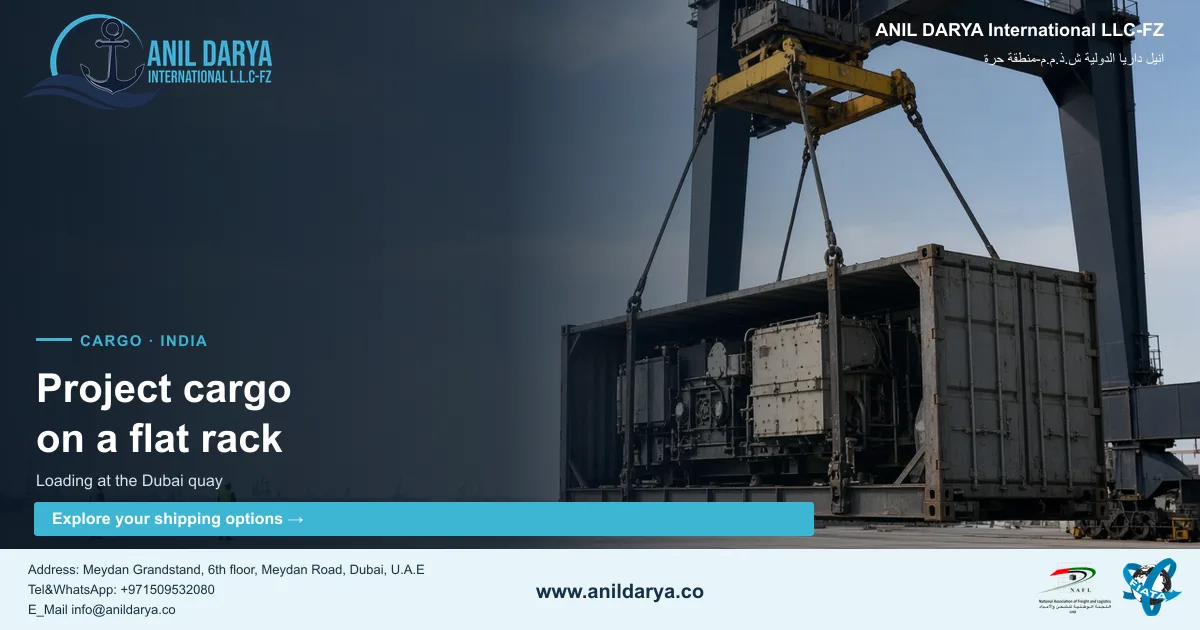
| Flat rack or open top | Cargo too wide or tall for a closed box | Lashing, lifting points, fewer available units |
| Breakbulk and project cargo | Pieces that do not fit any container | Vessel availability, port handling and road permits in India |
| Dangerous goods (IMDG) | Chemicals, paints, batteries, gases | Carrier acceptance, SDS, Indian port storage rules |
| Air cargo | Urgent spares, samples, high value per kg | Chargeable weight and the same customs filing in India |
FCL and LCL sea freight from Dubai to India
FCL gives you a sealed box and fewer touch points. LCL saves money on small loads but adds a deconsolidation step in India. If your LCL shipment is close to a full 20ft in volume, price both. Our guide to FCL vs LCL costs shows where the break-even usually falls. You can see how we book and handle containers on our sea freight service page.
Breakbulk and project cargo to India
Mundra lists breakbulk, steel and project cargo among the cargo it handles, which makes it a common choice for heavy pieces bound for north and west India. For pieces that fit a 40ft flat rack by size and weight, a container service usually gives you more sailings. Anything bigger needs breakbulk or heavy-lift tonnage, and the vessel date then drives the plan. We collect drawings, weights and centre of gravity, agree lashing with the carrier and plan the quay-to-site move with the consignee's Indian transporter. See our break bulk and project cargo service.
Dangerous goods from Dubai to India
DP World lists IMDG dangerous goods among the cargo Jebel Ali handles. For India, the carrier must accept the booking and the Indian port and consignee must be ready to take the container quickly, as DG boxes face tighter storage rules than general cargo. You need the UN number, class, packing group, a Safety Data Sheet, a signed DG declaration and UN-approved packaging with labels. Our dangerous goods shipping team checks these and gets carrier approval before you commit to a sailing.
Air cargo when sea is too slow
For urgent spares, air is the usual answer, with the same IEC and bill of entry rules in India. See our air cargo service for how we book it from Dubai.
India customs clearance: IEC, ICEGATE and the bill of entry
India's customs is run by CBIC. Imports are declared electronically on ICEGATE, the Indian Customs national trade portal, through a bill of entry. Your Indian consignee (or their customs broker) files it, not the shipper in Dubai. Your job is to give them correct documents early.
Who needs an IEC?
The Directorate General of Foreign Trade (DGFT) says an IEC is a 10-character code that is mandatory for any import or export activity. Since GST, the IEC is the same as the entity's PAN. CBIC also advises importers to quote their GSTIN in the bill of entry, which is how they claim credit for the IGST they pay. If your buyer has no IEC, the goods cannot be cleared in their name. Check this before you ship.
When must the bill of entry be filed?
Under Section 46 of the Customs Act, 1962, the importer must present the bill of entry before the end of the day (including holidays) before the vessel arrives. It can be filed up to 30 days before the expected arrival. Late filing without sufficient cause brings a late presentation charge. ICEGATE confirms that an advance bill of entry stays valid if the vessel arrives within 30 days.
So your documents must reach the consignee within days of sailing, not when the ship lands.
How duty is paid and goods released
- The carrier files the Import General Manifest (IGM) for the vessel.
- The consignee's broker files the bill of entry on ICEGATE with the invoice, packing list, bill of lading and any certificate of origin.
- Customs assesses it. Under Section 47, self-assessed duty is due on the day the bill of entry is presented. If customs reassesses it, duty is due within one day of the bill being returned, and late payment carries interest.
- Customs may release on risk assessment or order an examination.
- After the out-of-charge order and the shipping line's delivery order, the consignee takes delivery.
What import duty and IGST does India charge on goods from Dubai?
India does not have one flat duty rate. The total depends on the HS code. A typical import pays:
| Charge | How it is worked out | Can the importer recover it? |
|---|---|---|
| Basic customs duty (BCD) | Rate from the Customs Tariff for the HS code, on the assessable value | No |
| Social Welfare Surcharge (SWS) | Percentage of BCD (10% of BCD in CBIC's own worked example) | No |
| IGST | Levied under Section 3(7) of the Customs Tariff Act on the assessable value plus BCD and other customs duties | Yes, as input tax credit if the GSTIN is quoted |
| GST compensation cess | Only on some goods, for example tobacco products and motor vehicles | Yes, as credit |
| Anti-dumping or safeguard duty | Only on goods and origins named in a notification; also included in the IGST base | No |
CBIC's guidance says IGST credit flows down the supply chain but BCD credit does not. BCD is a real cost to your buyer, which is where CEPA helps. Ask the consignee's broker to confirm the rate for your HS code before you price the sale.
Using CEPA to cut Indian duty on UAE-made goods
The UAE-India economic partnership agreement (CEPA) entered into force on 1 May 2022. The UAE Ministry of Economy says it reduces or removes tariffs on more than 80% of products for UAE exports to India. India gives the reduced rate only when the goods originate in the UAE and the importer can prove it.
What the CEPA origin rules say
- Proof of origin is a certificate of origin from the competent authority, a fully digitised certificate, or an origin declaration from an approved exporter.
- A certificate is valid for 12 months from issue and covers one import only.
- The goods must be transported directly between the two countries. Transit through a third country is allowed only if the goods stay under customs control there and only unloading, reloading, storage or similar handling takes place.
- Where a product rule uses value addition, India's rules give 40% on an FOB basis as the example (35% if the ex-works price is used).
- If the importer claims the rate without the original certificate, Indian customs may deny it or ask for a guarantee.
How to get the certificate in the UAE
The UAE Ministry of Economy issues the preferential certificate for India online. The factory must be registered in the ministry's Factory Registration service. A trading company also needs the factory's commercial purchase certificate and its own commercial invoice. Fees run from AED 10 to AED 200 depending on invoice value, and the ministry quotes about one working day.
Goods that only pass through Dubai, or that Jafza companies buy from a third country and resell, do not become UAE-origin. For those, a non-preferential certificate from Dubai Chambers is the usual document. Dubai Chambers covers exported and re-exported goods, charges AED 100 and quotes two hours.
| Your goods | Certificate | Indian duty |
|---|---|---|
| Made in the UAE and meet the CEPA product rule | Preferential certificate for India (Ministry of Economy) | CEPA rate |
| Made in a third country, re-exported from Dubai | Non-preferential certificate (Dubai Chambers) | Normal rate for the true origin |
| Made in the UAE but fail the product rule | Non-preferential certificate | Normal rate |
Documents for shipping from Dubai to India
| Document | Who issues it | Used for |
|---|---|---|
| Commercial invoice | Shipper in Dubai | UAE export declaration and Indian valuation |
| Packing list | Shipper | Both customs, LCL and breakbulk handling |
| Bill of lading or air waybill | Carrier or forwarder | Title to the goods, Indian bill of entry |
| UAE export or re-export declaration | Filed with Dubai Customs | Clearing the goods out of the UAE |
| Certificate of origin | Ministry of Economy (CEPA) or Dubai Chambers | Duty rate in India |
| Insurance certificate | Insurer | Cover and, where needed, valuation |
| Bill of entry | Indian importer or broker on ICEGATE | Indian import clearance |
| Permits or licences | Indian authority for the product | Restricted goods only |
| SDS and DG declaration | Shipper | Dangerous goods only |
Dubai Customs lists the invoice, packing list, certificate of origin and any permit for restricted goods as the documents for a declaration. Any business using Dubai Customs services needs a customs business code, registered online through Dubai Trade. A licensed clearing agent with its own code can file for you with your authorisation.

Restricted and prohibited goods for India
India's import policy is set by the ITC(HS) schedule under the Foreign Trade Policy. Items are free, restricted (import only with an authorisation) or prohibited. Even free items must meet India's domestic laws, technical standards and safety norms, the same as goods made in India. Watch these groups:
- Second-hand desktop computers, refurbished laptop and PC spares, air conditioners and diesel generating sets are restricted and need an authorisation.
- Second-hand electronics and IT goods covered by the Compulsory Registration Order need an authorisation, and unregistered products are prohibited.
- Other second-hand goods that are not capital goods are restricted.
- Refurbished spares of capital goods are free only with a chartered engineer certificate showing at least 80% residual life.
- Metal scrap must not contain hazardous, toxic or radioactive waste, or any arms, shells or explosive material.
Personal effects for someone moving home to India are cleared under India's Baggage Rules as unaccompanied baggage, which have their own allowances and conditions. Check CBIC's current passenger guide before you pack.
Shipping from Dubai to India step by step
- Share the cargo details. Commodity, HS code, weight, volume or dimensions, value, and the consignee's city in India.
- Agree the Incoterm with your buyer. Under FOB, the buyer picks the carrier. Under CIF or CFR, we book the sea freight for you. Our guide to Incoterms 2020 for sea freight explains who pays what.
- Check the buyer is ready. Valid IEC, GSTIN, a customs broker at the Indian port, and any licence for restricted goods.
- Decide on origin. Apply for the CEPA certificate if the goods qualify, or a Dubai Chambers certificate if they do not.
- Book space. We pick a service to the right Indian port and confirm cut-offs. DG, reefer and out-of-gauge cargo get carrier approval first.
- Stuff and truck to the port. We arrange the empty, stuffing, sealing and the gate-in at Jebel Ali or your UAE port.
- File the UAE export or re-export declaration. We file it with Dubai Customs, or through a licensed agent.
- Send documents early. The draft bill of lading, invoice, packing list and certificate go to the consignee right after sailing so their broker can file the bill of entry before arrival.
- Release the bill of lading. Original, telex release or sea waybill, as agreed in the sales contract.
- Clearance and delivery in India. The consignee's broker clears the goods and the consignee collects them. We stay in contact with them until the container is out.
[AMIR-FACT: one real Dubai to India shipment we handled, with cargo type, Indian port, mode and what we solved, cleared for publication]
What drives the cost of sea freight from Dubai to India?
Rates change weekly, so we quote per shipment. These factors move the price:
| Cost factor | Why it changes the price |
|---|---|
| Container type and size | 20ft, 40ft, high cube, flat rack and reefer are priced differently |
| Indian port | Direct services cost less than services with extra calls or a transhipment |
| Cargo type | DG, out-of-gauge and reefer carry surcharges and special handling |
| UAE origin charges | Trucking to the port, terminal handling, export clearance, certificate fees |
| Indian destination charges | Terminal handling, delivery order, CFS charges for LCL, broker fees |
| Duty and IGST | Paid by the importer in India, set by HS code and origin |
| Free time | Demurrage and detention after the free days run out |
| Season and space | Rates move with demand and equipment supply |
Delays at the Indian end usually cost more than the freight. Our article on demurrage and detention shows how these charges build up.
Checklist before you ship to India
- HS code confirmed with the Indian broker, and the duty rate checked.
- Consignee's IEC and GSTIN match the name on the invoice and bill of lading.
- Item checked against India's import policy: free, restricted or prohibited.
- Licence or product approval in hand for restricted goods.
- CEPA certificate applied for if the goods are UAE-made and meet the product rule.
- Routing is direct, or the transhipment keeps the goods under customs control.
- Invoice, packing list and bill of lading show the same weights, piece counts and values.
- Documents sent to the consignee in time for the bill of entry before arrival.
- DG: SDS, DG declaration, packaging and carrier acceptance in place.
- Free time at the Indian port agreed with the carrier.
- Cargo insurance arranged.
Common mistakes on the Dubai to India lane
- Claiming CEPA on re-exported goods. Third-country goods do not become UAE-origin by passing through Dubai. A wrong claim can lead to duty demands later.
- Late documents. If the bill of entry misses the deadline, a late charge applies and clearance slips while free time runs.
- Buyer without an IEC. The goods sit at the port until the importer of record is sorted out.
- Wrong HS code. A different code on the invoice and the bill of entry means reassessment and delay.
- Shipping second-hand goods without checking policy. Many are restricted and need an authorisation.
- Choosing the port on freight alone. A cheap rate to the wrong coast is often wiped out by Indian trucking.
- Indirect routing with a CEPA claim. If the goods leave customs control in a third country, the preference can be lost.
Frequently asked questions
How long does shipping from Dubai to India take by sea?
Cogoport's lane data shows typical FCL transit from the UAE to India of about 12 days, with an observed range of 6.4 to 14.3 days port to port. Add time for Indian clearance and inland delivery. Your exact time depends on the carrier's rotation and the Indian port.
Which Indian port is best for cargo from Dubai?
Nhava Sheva suits Mumbai, Pune and central India. Mundra suits Gujarat, Rajasthan and north India. Chennai, Cochin and Kolkata make sense only when the consignee is in the south or east.
What documents does India need for imports from Dubai?
The Indian importer files a bill of entry on ICEGATE with the commercial invoice, packing list, bill of lading or air waybill, and a certificate of origin if claiming CEPA. Restricted goods also need a licence or product approval.
Does the Indian importer need an IEC?
Yes. DGFT says an IEC is mandatory for any import or export activity. It is a 10-character code, the same as the importer's PAN.
What duty does India charge on goods from Dubai?
Basic customs duty depends on the HS code, with Social Welfare Surcharge charged on the BCD. IGST is then charged on the value plus those duties. The importer can claim IGST as input tax credit but not BCD.
Can goods shipped from Dubai get CEPA duty rates in India?
Only if they originate in the UAE under the CEPA product rules and travel directly, with a valid certificate of origin or an approved exporter declaration. Third-country goods re-exported from Dubai pay the normal rate.
How long is a CEPA certificate of origin valid?
India's CEPA origin rules say a certificate of origin is valid for 12 months from the date of issue and covers one import. The UAE Ministry of Economy issues it online.
Can I ship second-hand machinery from Dubai to India?
Most second-hand capital goods are free to import, but some items, such as second-hand desktop computers, air conditioners and diesel generating sets, are restricted. Refurbished spares need a chartered engineer certificate showing at least 80% residual life.
Get a quote for shipping from Dubai to India
Send us the cargo, the Indian port or city and your Incoterm, and we will come back with a routing and price. Use our freight rate inquiry form, or contact our team to talk through a CEPA, project or DG shipment first. You can also read more about our Dubai freight forwarding team.
Sources
- DP World: Jebel Ali Port (terminals, services, cargo types)
- Dubai Customs: Submit customs declaration
- Dubai Customs: Frequently asked questions (business code, clearing agents)
- Dubai Chambers: Issuing a certificate of origin
- UAE Ministry of Economy: Certificate of origin for India
- UAE Ministry of Economy: UAE-India CEPA
- CBIC Notification 39/2022-Customs (N.T.): CEPA origin rules (text of the notification)
- CBIC: Customs Act, 1962 (Sections 46 and 47)
- ICEGATE: Frequently asked questions
- CBIC: Guidance note for importers and exporters on IGST
- CBIC: Customs clearance of passengers at a glance (SWS as a share of BCD)
- DGFT: Foreign Trade Policy 2023, Chapter 2 (IEC, restricted goods, second-hand goods, metal scrap)
- Jawaharlal Nehru Port Authority: Overview
- Adani Ports: Mundra Port
- Adani Ports: Operational performance 2026 (Mundra, Hazira)
- Cochin Port Authority: tender document (ICTT draft)
- Syama Prasad Mookerjee Port, Kolkata
- Cogoport: UAE to India trade lane data (transit indication)
Reviewed: 10 November 2026