
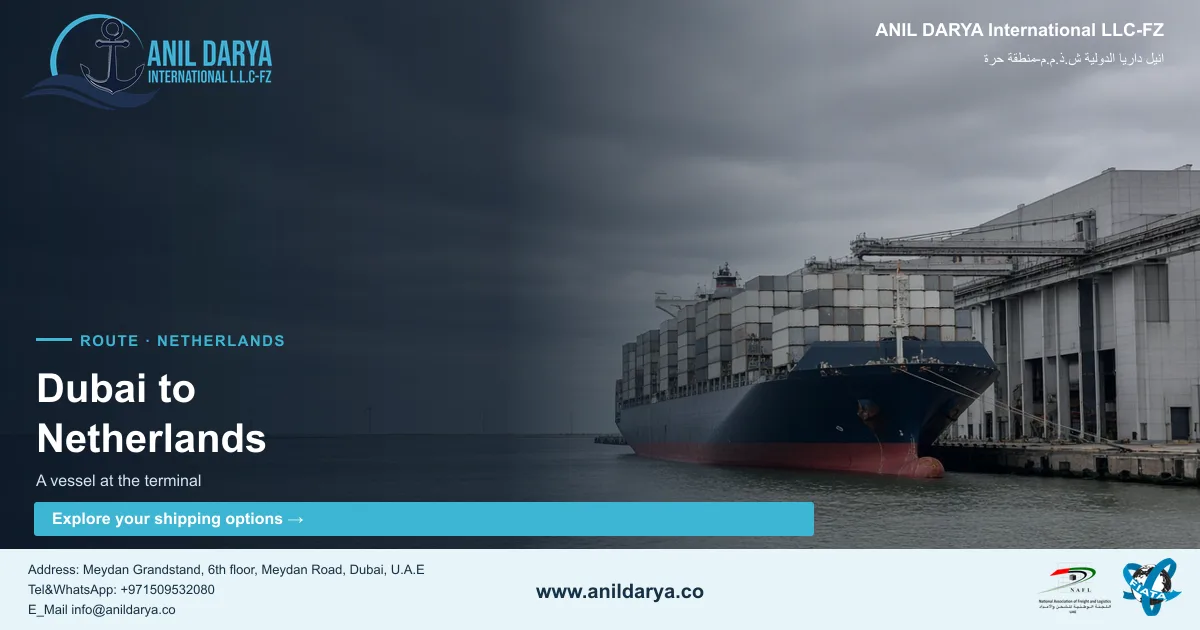
Shipping from Dubai to the Netherlands usually means a container from Jebel Ali to Rotterdam, with air cargo into Amsterdam Schiphol for urgent goods. On arrival, the Dutch importer needs an EORI number, the goods are declared to Dutch Customs (Douane), and import duty is set by the EU TARIC code and the country of origin, with import VAT of 21% or 9% on top. This guide covers ports, modes, transit indications, documents, duty and VAT, controlled goods and each step from Dubai to the consignee.
Shipping from Dubai to the Netherlands at a glance
| Item | Detail |
|---|---|
| Main UAE load port | Jebel Ali, with over 80 weekly services to more than 150 ports (DP World) |
| Main Dutch port | Rotterdam (NLRTM): 14.2 million TEU and 428.4 million tonnes handled in 2025 |
| Gulf container flow at Rotterdam | About 155,000 TEU a year, mainly via Jebel Ali and Khalifa Port, on three liner services (Port of Rotterdam) |
| Main cargo airport | Amsterdam Schiphol (AMS) |
| Modes | FCL, LCL, flat rack and breakbulk, dangerous goods, air cargo |
| Customs authority | Dutch Customs (Douane), part of the Dutch Tax Administration |
| Declaration system | DMS, filed electronically, usually by a forwarder or customs representative |
| Importer ID | EORI number, free, valid in every EU member state |
| Tariff | EU TARIC, the integrated tariff of the European Union |
| Trade agreement with the UAE | None in force; EU-UAE free trade talks have been running since 2025 |
| Import VAT | 21% general rate, 9% for food, medicines and books |
| VAT deferment | Article 23 permit lets you pay import VAT through your VAT return |
| Port release message | Container Release Message (CVB) for all non-EU goods through a Dutch port |
Which mode should you use?
Most cargo from Dubai to the Netherlands moves by sea in containers. Air cargo suits urgent, light or high-value goods. Road is not a practical option on this lane, so this guide does not cover it.
| Your cargo | Best mode | Why |
|---|---|---|
| A full container or more of general goods | FCL by sea | Lowest cost per unit, the box stays sealed to destination |
| A few pallets or cartons | LCL by sea | You pay only for the space you use |
| Machinery, steel, oversized pieces | Flat rack, open top or breakbulk | Fits cargo that does not go in a standard box |
| Chemicals, batteries, aerosols, perfumes | DG container or DG air | Needs carrier and terminal acceptance before booking |
| Samples, spare parts, urgent stock | Air cargo | Hours in the air instead of weeks at sea, higher cost per kilo |
Sea freight from Dubai to the Netherlands: FCL and LCL
Sea freight from Dubai to the Netherlands normally loads at Jebel Ali. Our Jebel Ali port shipping guide covers the terminals, cut-offs and export steps there. If your cargo starts in Abu Dhabi, shipping through Khalifa Port can shorten the truck leg, since the Port of Rotterdam names Khalifa Port as one of the two main Gulf ports in its Gulf container flows.
Which Dutch port should your cargo go to?
Rotterdam takes most deep-sea containers bound for the Netherlands. The Port Authority says it handles about 30% of Northwest European containers. Amsterdam and smaller Dutch ports see far fewer direct deep-sea calls from the Gulf, so most Amsterdam-bound containers still discharge in Rotterdam and move on by truck, barge or rail.
| Rotterdam fact | Figure | What it means for you |
|---|---|---|
| Containers handled in 2025 | 14.2 million TEU, up 3.1% | Wide choice of carriers and sailings |
| Hinterland record | Over 1 million TEU in November 2025 | Plan truck or barge slots early in busy months |
| Inland shipping | Daily barge links to more than 100 European destinations | Barge is an option for inland Dutch, German and Belgian addresses |
| Rail | Cargo crosses the German border within three hours | Rail suits steady volumes to Germany and beyond |
FCL or LCL to the Netherlands?
- FCL (full container load). You book a whole 20ft or 40ft box. It suits larger shipments and goods you do not want handled with other cargo.
- LCL (less than container load). Your cargo shares a container. It is unpacked at a warehouse in the Netherlands before release, so your timing also depends on the other shippers' paperwork.
The break-even point is often lower than people think. Our guide to FCL vs LCL costs walks through the maths. If you are unsure, ask us to price both. Read more about our sea freight service from the UAE.
How long does shipping from Dubai to the Netherlands take?
Transit depends on the carrier, the service and whether the box is transhipped. Published route data gives a starting point, not a promise.
| Route | Published indication | Frequency shown | Source |
|---|---|---|---|
| Sea: Jebel Ali to Rotterdam, quickest route | About 27 days port to port, 1 transfer | Every 2 to 4 weeks for that routing | Fluent Cargo route data |
| Air: Dubai International (DXB) to Amsterdam (AMS) | About 7.5 hours flight time | 2 to 4 times a day | Fluent Cargo route data |
| Air: Al Maktoum International (DWC) to Amsterdam (AMS) | About 7 hours flight time | 1 to 2 times a day | Fluent Cargo route data |
These figures cover the sailing or the flight only. Add time for booking, trucking to Jebel Ali, UAE export clearance, Dutch clearance and delivery. Air cargo also waits for the next flight with space, and LCL waits for the consolidation to close.
[AMIR-FACT: our real port-to-port and door-to-door days from Jebel Ali to Rotterdam for FCL and LCL, and the carriers we actually book on this lane]
Air cargo from Dubai to the Netherlands
Air cargo from Dubai usually lands at Amsterdam Schiphol. Fluent Cargo lists direct flights from Dubai International and Al Maktoum International, with several departures a day between them.
Airlines charge on chargeable weight, which is the higher of the actual weight and the volume weight. Light, bulky cartons cost more by air than their scale weight suggests, so send dimensions with your enquiry. The same Dutch customs steps, duty and VAT apply as for sea cargo. Our air cargo service from Dubai covers booking, DG acceptance and airport handling in the UAE.
Breakbulk, project cargo and dangerous goods to the Netherlands
The Port of Rotterdam calls itself Europe's breakbulk hub. It lists heavy lift and project cargo, steel, forest products and non-ferrous metals among the breakbulk it handles, and says breakbulk from Rotterdam can reach Europe's main industrial areas within 24 hours by inland shipping and rail. Other breakbulk through the port grew 4.6% to 6.1 million tonnes in 2025.
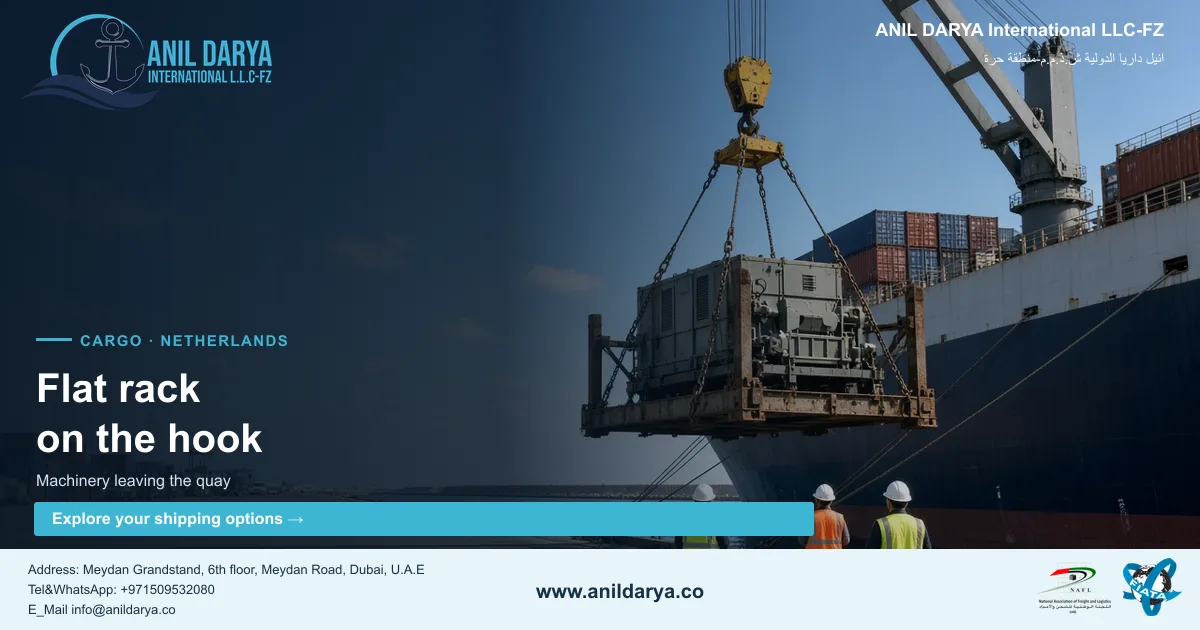
For a single heavy piece, the choice is usually between a flat rack on a container service and conventional breakbulk tonnage. If the piece fits a 40ft flat rack by size and weight, a container service usually gives you more sailings. If it does not, the breakbulk sailing date drives the plan. Read our guide to flat rack, open top and breakbulk cargo before you choose.
Dangerous goods move under the IMDG Code by sea and the IATA rules by air. At Rotterdam, every ship over 300 GT with dangerous goods on board must report them to the Harbour Master through Portbase, as soon as possible after leaving the previous port. For your part, you supply:
- The UN number, proper shipping name, class and packing group for each product.
- A Safety Data Sheet for each product.
- A signed dangerous goods declaration.
- UN-approved packaging, marks and labels.
We confirm carrier and terminal acceptance for each class before booking. See our dangerous goods shipping service for what we handle in the UAE.
Dutch customs clearance: what happens when your cargo arrives
Goods from outside the EU must be declared to Dutch Customs. Customs then works out the duty and checks whether other rules apply, such as safety, health, economic and environmental rules. Here is how the process runs for sea cargo from Dubai.
| Stage | What happens | Who does it |
|---|---|---|
| Before loading or arrival | Entry summary declaration (ENS) in the EU's ICS2 security system | Carrier, with data from the shipper |
| Arrival and unloading | Goods go into temporary storage at the terminal | Terminal and carrier |
| Port release | Container Release Message (CVB) for non-EU goods through a Dutch port | Forwarder or customs representative |
| Import declaration | Filed electronically in DMS with the TARIC code, value and origin | Customs representative or the importer |
| Checks | Document check, scan or physical inspection if selected | Dutch Customs |
| Payment and release | Duty, VAT and any excise paid or deferred, goods released | Importer |
Under the CVB rules on business.gov.nl, the import declaration is submitted after the goods are unloaded. Have the invoice, packing list and HS codes ready before the vessel arrives, so the declaration can go in the same day.
Who needs an EORI number?
The Dutch importer does. An EORI number is mandatory for the consignee, the representative and the declarant on an import declaration, except for private individuals. In the Netherlands it is free and has the prefix NL. You apply once, in the country where your business is established, and it is valid in all EU member states. A Dutch company that files its own declarations can build it from its RSIN; others apply to Dutch Customs.
A non-EU business, such as a Dubai exporter, needs an EORI only in specific situations set by EU customs law. If you sell from Dubai on DDP terms and act as importer of record, check this with your customs representative before you ship.
Inspections and AEO status
Customs selects some containers for checks. iContainers reports that most checks at Rotterdam are scans, while a physical inspection can include measuring the container for hazardous gases. Transport to the scan, handling and any degassing are charged to the cargo, so a clean, matching document set saves money. Dutch importers can apply to Customs for Authorised Economic Operator (AEO) status free of charge, which brings easier passage and fewer inspections.
Documents for shipping from Dubai to the Netherlands
| Document | Who provides it | Why it matters |
|---|---|---|
| Commercial invoice | Exporter in Dubai | Basis for the customs value and duty |
| Packing list | Exporter | Matches cartons, weights and marks to the invoice |
| Bill of lading or air waybill | Carrier, through us | Transport contract and release document |
| Certificate of origin | Exporter, via the UAE issuing body | Proves where goods were made; duty depends on origin |
| UAE export declaration | Exporter or our clearing team | Needed by Dubai Customs to load the cargo |
| Importer's EORI number | Dutch consignee | Mandatory on the import declaration |
| Import licence or certificate | Importer | Plants, flowers, animal feed, medicine, CITES species, strategic goods |
| Health certificate | Exporter | Some plants and plant-based products |
| DG declaration and SDS | Exporter | Any dangerous goods |
On the UAE side, Dubai Customs asks for the invoice, packing list, certificate of origin and any permit from a restriction authority.
Import duty and VAT on goods from Dubai
The Netherlands applies the EU's common tariff, so you find the duty rate in TARIC. TARIC holds the third-country duty, tariff preferences, suspensions, quotas, anti-dumping duties and import prohibitions for each product code. It does not hold VAT or excise, which are national.
How the duty is worked out
- The rate depends on the product code (HS code) and the country of origin, not the country you ship from.
- Some goods carry no duty, for example books, laptops and phones.
- Goods returned in the same condition within 3 years may be exempt.
- Scarce raw materials can qualify for a tariff suspension or quota.
- Anti-dumping duties can apply on top of the normal rate.
Origin matters on this lane because much of the cargo leaving Dubai was made elsewhere. A machine made in Germany and re-exported from Jebel Ali is still German origin.
Is there a trade agreement between the EU and the UAE?
Not yet. The EU and the UAE agreed in April 2025 to start free trade talks, and the fifth round was held in Dubai, with both sides aiming to conclude during 2026. Until an agreement is in force, goods of UAE origin pay the standard third-country rate in TARIC.
Import VAT and the Article 23 permit
| VAT item | Rule |
|---|---|
| General rate | 21% |
| Reduced rate | 9%, for example food products, medicines and books |
| Normal payment | Paid to Dutch Customs at import, then deducted as input tax if you are eligible |
| Article 23 permit | Import VAT goes through your periodic VAT return instead of being paid at the border |
| Import scheme | For B2C goods up to EUR 150 per delivery, VAT can be declared and paid monthly |
A cash-flow rule: if you import regularly, ask your accountant about an Article 23 permit before the first container lands. Without it, you pre-finance 21% VAT on every shipment.
Excise and other charges
Excise applies to alcohol, tobacco and fuels. A consumption tax applies to some non-alcoholic drinks such as fruit juice. Imported cars pay BPM, the Dutch motor vehicle tax. Iron, steel, cement, hydrogen and other carbon-intensive goods fall under the EU's CBAM rules, which need an authorisation, a CBAM declaration and a payment for the CO2 emitted in production.
Business.gov.nl also notes that from 1 July 2026, duty applies to e-commerce shipments from outside the EU valued up to EUR 150, which used to be exempt.
Restricted and controlled goods
Most general cargo ships without a licence. Check these groups before you book:
| Goods | What is needed |
|---|---|
| Plants, flowers and plant products | Health certificate or licence |
| Animal feed and medicine | Licence or certificate |
| Endangered animal and plant species | CITES licence or certificate |
| Weapons and other strategic goods | Licence or certificate |
| Consumer products | Must meet EU product safety rules |
| Branded goods | Need the trademark owner's permission, or it is illegal parallel import |
| Products linked to deforestation rules | From 30 December 2026, only deforestation-free products may enter the EU |
| Iron, steel, cement, hydrogen | CBAM authorisation and declaration |
The EU's Access2Markets database shows the documents needed for a specific product. If the goods are controlled, the licence must be in place before the vessel arrives, or the container sits in the terminal running up storage.
What drives the cost of shipping to the Netherlands?
We do not publish rates, because they change with each sailing. These are the factors that move your price:
| Cost factor | What changes it |
|---|---|
| Ocean or air freight | Carrier, season, space and container type |
| Surcharges | Fuel and other carrier surcharges on the booking |
| Origin charges in Dubai | Trucking to Jebel Ali, terminal handling, export clearance |
| Destination charges | Terminal handling in Rotterdam, CVB, customs declaration, delivery order |
| Duty, VAT and excise | HS code, origin, customs value, Article 23 status |
| Inland delivery | Truck, barge or rail, and the distance from the port |
| Waiting costs | Demurrage, detention and storage if clearance is late |
| Cargo type | DG, reefer, flat rack or breakbulk handling |
Waiting costs are the easiest to avoid. Our guide on demurrage and detention charges shows how they build up. The Incoterm decides who pays which line, so agree it in the sales contract.
How to ship from Dubai to the Netherlands step by step
- Send us the cargo details: commodity, HS code, weight, dimensions, packing, Incoterm and the Dutch delivery address.
- Confirm the HS code and origin with the Dutch importer, and check TARIC for the duty rate and any licence.
- Make sure the importer has an EORI number and, if it imports often, an Article 23 permit.
- We book space with the carrier from Jebel Ali or another UAE port, or on a flight from DXB or DWC.
- We arrange trucking to the port and UAE export clearance with Dubai Customs.
- The carrier files the security data for the EU, using the details on your documents.
- We send the bill of lading, invoice and packing list to the consignee's customs representative before arrival.
- On arrival in Rotterdam, the representative handles the CVB and the import declaration in DMS.
- The importer pays or defers duty and VAT, and the goods are released.
- The container is delivered by truck, barge or rail, unpacked, and the empty is returned within free time.
We work with the consignee's own customs representative or a destination clearing agent they appoint. We do not have an office in the Netherlands.
[AMIR-FACT: one real Dubai to Netherlands shipment we handled (cargo, mode, Dutch port, door-to-door days and any problem solved)]
Checklist before your cargo leaves Dubai
- HS code agreed with the importer and checked in TARIC.
- Country of origin confirmed and certificate of origin ordered.
- Importer's EORI number on file.
- Licence or certificate in place for controlled goods.
- Invoice, packing list and bill of lading show the same weights, values and descriptions.
- Incoterm agreed, with a clear split of origin, freight and destination charges.
- Customs representative in the Netherlands appointed.
- For DG: SDS, DG declaration, labels and carrier acceptance.
- Free time agreed with the carrier.
Common mistakes on the Dubai to Netherlands lane
- Declaring the UAE as origin for goods made elsewhere. Duty follows the true origin, and a wrong origin can mean back duty and penalties.
- No EORI number. The declaration cannot be filed, and the container waits at the terminal.
- Paying VAT at the border every time. Regular importers without an Article 23 permit tie up cash for weeks.
- Ignoring CBAM or deforestation rules for steel, cement or wood-based goods.
- Booking DG without checking acceptance. Some classes need extra approvals at the terminal.
- Late delivery booking. Rotterdam terminals were congested in 2025, so book the truck or barge before the vessel arrives.
Frequently asked questions
How long does shipping from Dubai to the Netherlands take?
Published route data shows about 27 days port to port from Jebel Ali to Rotterdam on the quickest routing with one transfer. Add time for trucking, clearance and delivery. Air freight from Dubai to Amsterdam is about 7 to 7.5 hours of flight time.
Which port in the Netherlands should I ship to?
Rotterdam, in most cases. It handled 14.2 million TEU in 2025 and receives the Gulf liner services. Cargo for Amsterdam or other Dutch cities usually discharges in Rotterdam and moves on by truck, barge or rail.
Do I need an EORI number to import into the Netherlands?
Yes, a business importer needs one. The EORI number is mandatory for the consignee, representative and declarant on a Dutch import declaration. It is free, starts with NL and is valid across the EU.
What is the import VAT rate in the Netherlands?
The general rate is 21% and the reduced rate is 9%, which covers goods such as food, medicines and books. With an Article 23 permit, you account for import VAT in your VAT return instead of paying it at the border.
Is there a free trade agreement between the EU and the UAE?
No agreement is in force yet. Talks started after an agreement in April 2025 and both sides aim to finish during 2026. Until then, UAE-origin goods pay the standard EU third-country duty shown in TARIC.
Where do I find the duty rate for my product?
In the EU TARIC database, using the product code. The rate depends on the code and the country of origin, and TARIC also shows anti-dumping duties, quotas and import restrictions for that code.
What documents do I need to ship from Dubai to the Netherlands?
A commercial invoice, packing list, bill of lading or air waybill and certificate of origin, plus the importer's EORI number. Controlled goods also need a licence or certificate, and dangerous goods need a DG declaration and SDS.
Can I ship dangerous goods from Dubai to the Netherlands?
Yes, if they are packed and declared to the IMDG Code by sea or the IATA rules by air, and the carrier and terminal accept the class. The ship reports DG cargo to the Rotterdam Harbour Master through Portbase.
Get a quote for shipping from Dubai to the Netherlands
Send us your cargo details and the Dutch delivery address, and we will come back with a routing and price for sea or air. Use our freight rate inquiry form, or contact our team to talk through a DG, project or breakbulk shipment first. You can also read about our Dubai freight forwarding team.
Sources
- Business.gov.nl: Importing products from a non-EU country (EORI, CVB, tariff, duties, VAT, Article 23, excise, CBAM, licences)
- Business.gov.nl: Declaring goods to customs (DMS, CVB, EORI, AEO, EUDR)
- Business.gov.nl: Import documents (origin, transport documents, health certificates, CITES)
- Business.gov.nl: VAT rates and exemptions (21% and 9%)
- Dutch Customs: When an EORI number is required in customs processes
- KVK Netherlands Chamber of Commerce: What is an EORI number?
- European Commission: EU customs tariff (TARIC)
- European Commission: Import Control System 2 (ICS2)
- European Commission: EU and UAE agree to launch free trade talks (10 April 2025)
- UAE Mission to the EU: Fifth round of UAE-EU FTA negotiations held in Dubai
- US International Trade Administration: Netherlands import requirements and documentation
- Port of Rotterdam: Throughput 2025 (14.2 million TEU, 428.4 million tonnes, breakbulk)
- Port of Rotterdam: Rotterdam's 2025 container year under review (Gulf flows, congestion, capacity)
- Port of Rotterdam: Inland shipping
- Port of Rotterdam: Rail transport
- Port of Rotterdam: Breakbulk
- Port of Rotterdam: Port Information Guide, January 2026 (dangerous goods reporting)
- iContainers: Rotterdam port customs inspection
- DP World: Jebel Ali Port
- Dubai Customs: Submit customs declaration (required documents)
- Fluent Cargo: Dubai to Rotterdam route data
- Fluent Cargo: Dubai to Amsterdam route data
Reviewed: 10 November 2026