
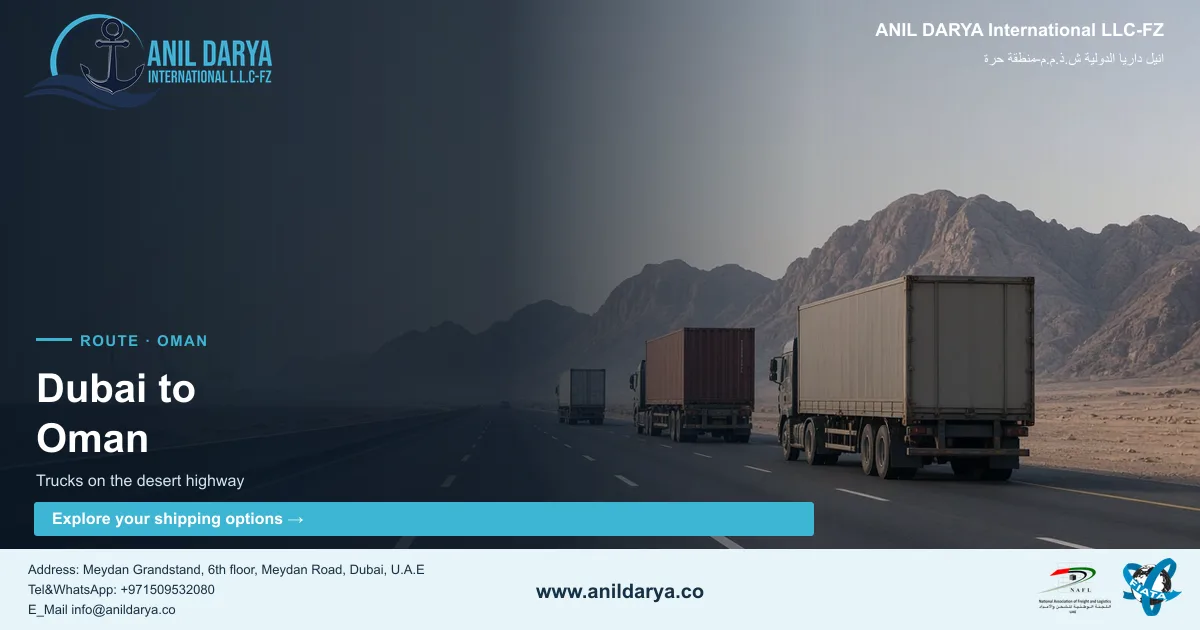
Shipping from Dubai to Oman usually means a truck across a land border, a container on a sea service to Sohar or Salalah, or air cargo for urgent goods. Oman Customs, part of the Royal Oman Police, clears every shipment through its Bayan system, and the right documents decide whether your cargo crosses in hours or waits at the border. This guide covers the modes, the ports, customs, duty and VAT, and the steps we follow for your shipment.
Shipping from Dubai to Oman at a glance
| Item | Detail |
|---|---|
| Main modes | Road freight (full or shared truck), sea freight (FCL, LCL, breakbulk), air cargo |
| Dubai land customs centre for Oman | Hatta Customs Center, open round the clock |
| Omani land crossings with the UAE (examples) | Al Wajajah and Khatmat Milaha |
| Main Omani seaports | Sohar (north), Salalah (south), Duqm (central coast) |
| Muscat's old cargo port | Port Sultan Qaboos stopped commercial cargo calls in 2014; cargo moved to Sohar |
| Customs authority in Oman | Directorate General of Customs, Royal Oman Police |
| Declaration system | Bayan (import, export and transit declarations) |
| Bayan declaration fee | OMR 15 for companies, OMR 5 for individuals |
| Customs duty on foreign goods | GCC common external tariff of 5%, with listed exemptions |
| Goods of GCC national origin | Exempt from duty with invoice and proof of origin |
| VAT in Oman | 5% standard rate |
| Sohar container terminal by road | Within four hours of Dubai, Muscat and Abu Dhabi (terminal operator) |
How can you ship cargo from Dubai to Oman?
You have three realistic options. The right one depends on volume, cargo type, where in Oman the goods are going and how fast you need them.
| Mode | Best for | What to plan |
|---|---|---|
| Road, full truck (FTL) | Pallets, building materials, machinery, food, retail stock going to Muscat, Sohar, Nizwa or Buraimi | Truck type, border crossing, Bayan declaration filed before the truck arrives |
| Road, shared truck (LTL) | A few pallets or cartons | Consolidation date, packing list per consignee, clear carton marks |
| Sea, FCL | Full 20ft or 40ft containers, heavy cargo, goods for southern Oman | Carrier service to Sohar or Salalah, free time, inland delivery in Oman |
| Sea, LCL | Small sea shipments that are not urgent | Consolidator's sailing, CFS unpacking at the Omani port |
| Breakbulk and project cargo | Oversized or very heavy pieces | Vessel type, lifting plan, road permits for abnormal loads in Oman |
| Air cargo | Urgent parts, samples, high-value goods | Airport of arrival (Muscat or Salalah), chargeable weight, DG acceptance |
For most commercial cargo going to northern Oman, road is the default because the two countries share land borders. Sea freight makes more sense for full containers that are already in a UAE port, for heavy or oversized cargo, and for consignees in the south near Salalah.
Road freight via the UAE-Oman land borders
Trucks leaving Dubai for Oman clear UAE customs at a land customs centre, cross the border, and clear Oman Customs on the Omani side. Dubai Customs runs the Hatta Customs Center at the Hatta crossing, which it describes as a key link between the UAE and Oman. The centre works round the clock and uses smart scanning equipment. In the first half of 2023 it cleared 46,965 cargo trucks, an average of about 260 a day, mostly carrying foodstuffs. Other goods moved by land include fruit and vegetables, electronics, marble, ceramics, engines, heavy machinery and cement.
On the Omani side, Al Wajajah and Khatmat Milaha are two of the land crossings with the UAE named by the Royal Oman Police in 2026. Which crossing your truck uses depends on the loading point in the UAE and the delivery address in Oman. Ask for the crossing to be named on the quote, because the Bayan declaration is filed for a specific customs post.
Two permits matter for trucks. Oman's Ministry of Transport, Communications and Information Technology issues permits for the entry and exit of foreign land vehicles, and a separate permit for exceptional heavy loads. If your cargo is wide, tall or heavy enough to need a lowbed trailer, the abnormal load permit must be in place before the truck reaches the border.
[AMIR-FACT: our real door-to-door road transit time Dubai to Muscat (and to Sohar), including border clearance, and the border crossing we normally use]
Sea freight: FCL, LCL and breakbulk
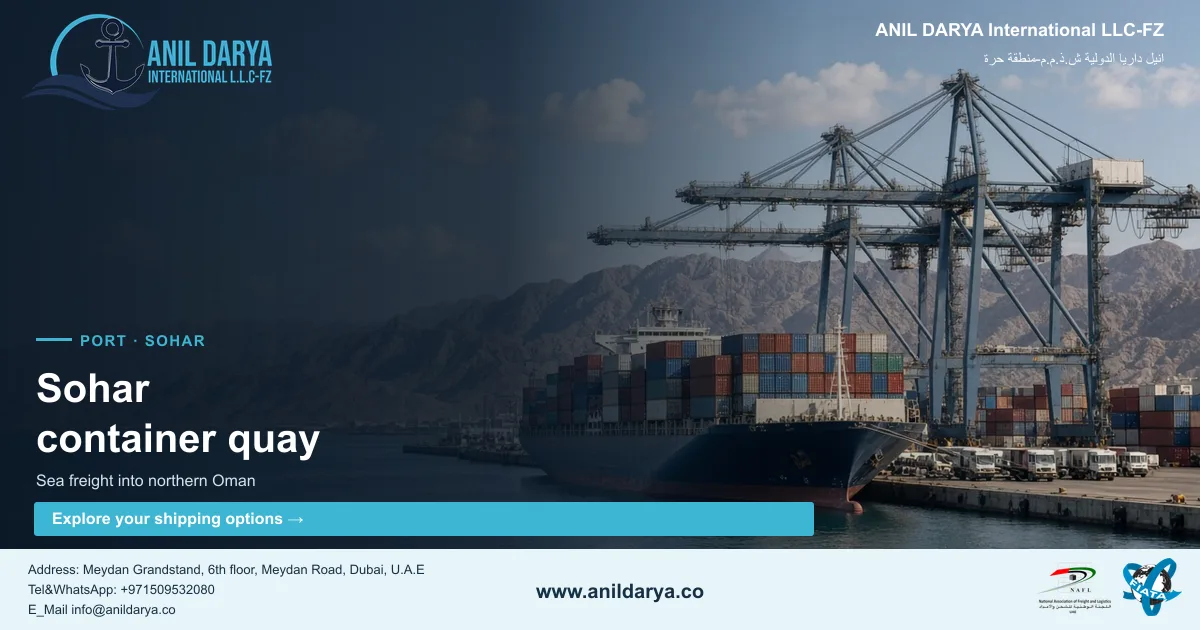
Sea freight from the UAE to Oman lands mainly at two ports. Sohar Port, in the north, handles containers through Hutchison Ports Sohar, a terminal with 2 million TEU of annual capacity and an 18 m draft. General cargo, breakbulk, Ro-Ro and dry bulk go through C. Steinweg Oman. The Port of Salalah, in the south, has a container terminal with a 6 million TEU capacity and a general cargo terminal with 13 berths.
Container sea freight suits you if the cargo is already in a UAE port or free zone, if you ship full containers regularly, or if your consignee is in Dhofar near Salalah. For Muscat, note that Port Sultan Qaboos stopped taking commercial cargo vessels on 31 August 2014, and commercial activity moved to Sohar. A Muscat consignee receiving sea cargo therefore usually gets it through Sohar plus a truck.
LCL works for small sea shipments, but it adds unpacking at the destination container freight station. Our guide to choosing between FCL and LCL shows where the break-even point usually sits. Carrier choice, sailing frequency and the loading port in the UAE all change the price, so we compare sea freight options from the UAE before you book.
[AMIR-FACT: the carriers or feeder services we actually book from Jebel Ali to Sohar and Salalah, with their real port-to-port transit time]
Air cargo from Dubai to Oman
Air cargo is the fastest option for urgent goods. Oman's main airports for cargo are Muscat International Airport and Salalah Airport, which sits next to the Port of Salalah. Oman Air Cargo also runs a daily road feeder service between Dubai and Muscat that moves perishables, general cargo and larger shipments that do not fit on narrowbody aircraft. Our air cargo team compares direct flights and trucked air cargo for your shipment.
Breakbulk, project cargo and dangerous goods
Heavy machinery, steel and project cargo can go by lowbed truck if the size and weight fit Omani road rules, or by sea to Sohar, where C. Steinweg Oman handles project cargo, steel and Ro-Ro on 4 berths with 16 m water depth. Our break bulk and project cargo service plans the lift, lashing and route.
Dangerous goods need extra approvals. In March 2026 the Port of Salalah advised that vessel operators must get prior approval from the Ministry of Transport, Communications and Information Technology before calling any Omani port with Class 1, 2.1, 3, 4.3, 5.1 or 5.2 goods on board. Chemicals also need an Environment Authority permit, and explosives and fireworks need a Royal Oman Police permit. Our dangerous goods shipping team checks the class, packaging and permits before you commit to a sailing or a truck.
Which Omani port or city is your cargo going to?
Oman is a large country, so the delivery address often decides the mode before price does.
| Destination area | Usual gateway | Why |
|---|---|---|
| Sohar and Al Batinah North | Road, or sea into Sohar Port | Short road distance from the UAE border; Sohar has the container and general cargo terminals |
| Muscat | Road, or sea into Sohar plus truck | Port Sultan Qaboos no longer takes commercial cargo |
| Buraimi and the interior | Road | Close to the land border |
| Salalah and Dhofar | Sea into the Port of Salalah, or air | Salalah has a large container terminal next to the free zone and the airport |
| Duqm and Al Wusta | Sea into Duqm, or road | Duqm is one of the ports in the Asyad group; check carrier calls before booking |
On the UAE side, most containers load at Jebel Ali. Depending on where the cargo sits, a different UAE port can cut the trucking leg. See our guides to Jebel Ali port shipping and Fujairah port shipping.
Oman customs clearance: how Bayan works
All customs declarations in Oman, whether import, export or transit, are created in Bayan, the electronic system of the Directorate General of Customs at the Royal Oman Police. The declarant signs in, creates the declaration, selects the correct code, attaches the documents, submits and pays. The service fee is OMR 15 for companies and OMR 5 for individuals.
Oman Customs offers a pre-import value check. The importer can ask customs, through Bayan, to confirm the value, HS code and country of origin of goods, including the CIF value, before the shipment starts. Customs may ask for a sample, a catalogue or photos. This is worth doing for new products or goods with unclear classification.
At the Port of Salalah, Bayan is linked to the terminal system. Since 27 May 2024, inspection requests and release messages pass electronically between customs and the port, and paperwork is no longer accepted for those steps. The port asks that bill of lading details are submitted correctly from origin, because errors delay Bayan processing.
What documents does Oman Customs need?
For a Bayan declaration, Oman Customs lists commercial invoices, a certificate of origin from the manufacturer's country, and a declaration issued by the exporting country. Permits are added when the goods require them. In practice, a shipment from Dubai needs the set below.
| Document | Who provides it | Notes |
|---|---|---|
| Commercial invoice | Seller | Values, HS codes and descriptions must match the packing list |
| Packing list | Seller | Weights and piece counts per package |
| Certificate of origin | Dubai Chambers (for goods exported or re-exported from Dubai) or the manufacturer's country | Needed for duty treatment; GCC-origin goods need proof of origin |
| UAE export declaration | Exporter or its clearing agent, through Dubai Customs | This is the "declaration issued by the exporting country" Oman Customs asks for |
| Bill of lading, air waybill or truck consignment note | Carrier or trucker | Consignee name must match the Bayan declaration |
| Import permit | Omani importer, from the competent ministry | Only for restricted goods (see below) |
| DG declaration and SDS | Shipper | For dangerous goods by any mode |
Dubai Chambers issues certificates of origin to its members online, usually within two hours. The fee is AED 100. For goods made in the UAE it asks for the industrial licence and the factory invoice.
The UAE export side
Before the cargo leaves Dubai, an export declaration is filed with Dubai Customs. Dubai Customs lists an invoice, packing list, certificate of origin and any permit from a restriction entity as the documents for a declaration, with completion in about 2 working hours. Goods that came into Dubai from abroad and are now leaving again need the right declaration type, so tell us whether your goods are UAE-made, imported for local use, or held in a free zone.
Customs duty and VAT on goods shipped to Oman
Oman applies the GCC unified customs law. Since 1 January 2003, the GCC common external tariff has been 5% on foreign goods imported from outside the GCC, with 417 goods on an exemption schedule. Duty is collected at the first point of entry into the GCC.
Goods produced in a GCC state are treated as national goods in all member states. Oman Customs exempts GCC products from duty when they come with a purchase invoice and an indication of origin. Loose or liquid materials also need a Gulf origin certificate.
| Your goods | Likely duty in Oman | What proves it |
|---|---|---|
| Made in the UAE (GCC national product) | Exempt | Invoice and certificate of origin; Gulf origin certificate for loose or liquid materials |
| Foreign goods shipped from Dubai to Oman | Depends on whether duty was already paid at first GCC entry | UAE customs records for the original import; confirm with the Omani clearing agent |
| Foreign goods held in a UAE free zone | GCC tariff, usually 5% of value | Invoice, origin certificate, free zone exit documents |
| Goods on the exemption schedule | Exempt | HS code check against the GCC tariff |
VAT in Oman is 5% on most goods and services, including goods imported into Oman. Exports are zero-rated. Oman's Tax Authority has clarified that a UAE supplier shipping goods directly to Oman, with an export declaration, can treat the supply as a zero-rated export, which avoids paying VAT twice.
Use the Oman Customs duty calculator for an estimate by HS code and value, and confirm the rate for your product before you price the deal.
Restricted and permit-controlled goods in Oman
Oman Customs does not allow goods that are prohibited internationally or locally, counterfeit goods, goods that infringe intellectual property, or goods that do not meet approved standards. Many other goods need a permit before clearance. The table lists common examples from the Oman Customs permit list.
| Goods | Issuing authority |
|---|---|
| Explosives, fireworks, ammonium nitrate | Royal Oman Police (Special Task Force) |
| Drones, night-vision devices, dual-use products | Royal Oman Police (Operations) |
| Alcoholic beverages, weapons | Royal Oman Police |
| Chemicals, radioactive materials, ozone-depleting substances | Environment Authority |
| Telecom and controlled electronic goods | Telecom Regulatory Authority |
| Live animals, meat, animal feed, plants, pesticides, fertilisers | Ministry of Agriculture, Fisheries and Water Resources |
| Paints, LPG cylinders, toys, tyres, low-voltage electrical goods, cosmetics | Ministry of Commerce (Standards and Metrology) |
| Petroleum products | Ministry of Energy and Minerals |
| Books and artworks | Ministry of Information |
Pork products and alcoholic beverages are restricted. Meat and meat products need halal certificates. Check your product in the Oman Customs import and export requirements search before you ship.
What affects the cost of shipping from Dubai to Oman?
We do not publish fixed prices, because the same cargo can cost very different amounts on different days. These are the factors that move the price:
- Mode and load type. A full truck, a shared truck, an FCL and an LCL are priced in different units.
- Delivery city. Salalah and Duqm are much further by road than Sohar or Muscat.
- Truck type. Reefer trucks, lowbeds and flatbeds cost more than dry box trucks.
- Cargo nature. DG, oversized and temperature-controlled goods need permits and special handling.
- Customs charges. The Bayan fee, any duty and VAT, and clearing agent fees on both sides.
- Waiting time. Trucks waiting at the border for missing documents add daily charges.
- Port charges. For sea freight, local charges at both ends, plus demurrage if the container overstays.
Ask for a quote that names the mode, border crossing or port, who pays duty and VAT, and the Incoterm. Our guide to Incoterms 2020 for sea freight explains who pays what.
How to ship from Dubai to Oman: step by step
- Send us the cargo details. Commodity, HS code, weight, dimensions, pickup address in the UAE, delivery address in Oman, and the Incoterm.
- Choose the mode. We compare road, sea and air for your volume and deadline.
- Check permits. If the goods are restricted in Oman, the Omani importer applies for the permit before shipping.
- Prepare documents. Invoice, packing list and certificate of origin, with matching values, weights and HS codes.
- File the UAE export declaration. We arrange it through Dubai Customs.
- Book the truck or the sailing. For road, we book the right truck type. For sea, we book space and confirm free time.
- Pre-file in Oman. The Omani clearing agent files the Bayan declaration so it is ready when the truck or vessel arrives.
- Clear and deliver. After duty and VAT are settled and any inspection is done, the cargo is released and delivered.
We book space with carriers, prepare the documents, arrange trucking and export clearance in the UAE, and work with your consignee's clearing agent or a destination clearing agent in Oman.
[AMIR-FACT: one real Dubai to Oman shipment we handled (cargo, mode, route and outcome) to use as a short case example]
Checklist before you ship to Oman
- HS code confirmed for every line item.
- Invoice, packing list and transport document show the same consignee, weights and piece counts.
- Certificate of origin issued; GCC origin proof ready if you want duty exemption.
- Omani importer registered in Bayan, or a customs broker authorised to file.
- Import permit in hand for restricted goods.
- UAE export declaration filed.
- Border crossing or port of entry agreed and named on the quote.
- Truck permits arranged for abnormal loads.
- DG documents and approvals ready for dangerous goods.
- Duty and VAT payer agreed under the Incoterm.
- Cargo insurance arranged.
Common mistakes on the Dubai to Oman lane
- Shipping restricted goods before the permit is issued. The truck waits at the border and charges add up.
- Mismatched documents. A different weight on the invoice and the consignment note holds the Bayan declaration.
- No export declaration. Oman Customs asks for a declaration from the exporting country, and a supplier without one may also lose zero-rating for VAT.
- Assuming all goods are duty-free inside the GCC. Only GCC national products are exempt by origin; foreign goods follow the common tariff rules.
- Booking sea freight to Muscat. Commercial cargo goes through Sohar, then by road.
- Ignoring the monsoon in the south. The Port of Salalah applies monsoon controls in summer, when waves can reach 4 m.
- Treating DG like general cargo. Some classes need ministry approval before the vessel calls in Oman.
Frequently asked questions
What is the cheapest way to ship from Dubai to Oman?
For northern Oman, a shared or full truck is often the cheapest for general cargo, because the countries share land borders. For full containers already in a UAE port, or cargo going to Salalah, sea freight can work out cheaper. Compare both on a full door-to-door quote.
Which border crossing do trucks use from Dubai to Oman?
Dubai Customs clears trucks at the Hatta Customs Center, which links the UAE and Oman and works round the clock. Al Wajajah and Khatmat Milaha are two of the Omani crossings with the UAE. The crossing on your quote depends on the loading and delivery points.
Do I pay customs duty on goods shipped from Dubai to Oman?
Goods made in a GCC country are exempt from Omani duty with an invoice and proof of origin. Foreign goods fall under the GCC common external tariff of 5% with listed exemptions, and duty is collected at the first point of entry into the GCC.
Is there VAT on imports into Oman?
Yes. Oman charges VAT at 5% on most goods, including imports. A UAE supplier who ships directly to Oman with an export declaration can zero-rate the sale, so the goods are not taxed twice.
What documents do I need to ship to Oman?
Oman Customs asks for the commercial invoice, a certificate of origin and the export declaration from the exporting country, plus any permit the goods need. You also need a packing list and the bill of lading, air waybill or truck consignment note.
What is the Bayan customs system in Oman?
Bayan is the electronic customs system of Oman's Directorate General of Customs. Import, export and transit declarations are created and paid there, at OMR 15 per declaration for companies and OMR 5 for individuals.
Can I ship by sea to Muscat?
Port Sultan Qaboos in Muscat stopped taking commercial cargo vessels in 2014, and that activity moved to Sohar Port. Sea cargo for Muscat normally lands at Sohar and goes on by truck.
Can I ship dangerous goods from Dubai to Oman?
Yes, with the right documents and approvals. Vessels carrying Class 1, 2.1, 3, 4.3, 5.1 or 5.2 goods need prior approval from Oman's transport ministry before calling an Omani port, and chemicals and explosives need permits from the Environment Authority or the Royal Oman Police.
Can I send oversized machinery to Oman by road?
Yes, if the load fits the permit rules. Oman's transport ministry issues permits for exceptional heavy loads, and the truck needs them before it reaches the border. Very large pieces can go by sea to Sohar instead.
Get a quote for shipping from Dubai to Oman
Send us the cargo details and the delivery address in Oman, and we will come back with the mode, the routing and a price. Use our freight rate inquiry form, or contact our team to talk through a project, DG or oversized shipment first. You can also read more about our Dubai freight forwarding team.
Sources
- Dubai Media Office: Hatta Customs Center figures (July 2023)
- Gulf News: Royal Oman Police decision naming Al Wajajah and Khatmat Milaha crossings (October 2026)
- Oman Customs: Request to apply a customs declaration (Bayan, documents, fees)
- Oman Customs: Before imports (advance value, HS code and origin)
- Oman Customs: Customs exemptions (GCC products, unified customs law)
- Oman Customs: Permits by issuing authority
- Oman Customs: Import of goods (prohibited goods, documents)
- Oman Customs: Customs duty calculator
- UAE Federal Authority for Identity, Citizenship, Customs and Port Security: GCC customs union
- Oman Tax Authority: VAT FAQs (5% standard rate, imports, zero-rated exports)
- Gulf News: Oman Tax Authority clarifies VAT rules for imports from the UAE (October 2025)
- US International Trade Administration: Oman import requirements
- Dubai Customs: Submit customs declaration
- Dubai Chambers: Issuing a certificate of origin
- Asyad: Hutchison Ports Sohar
- C. Steinweg Oman: Sohar terminal
- Port of Salalah: Container terminal
- Port of Salalah: General cargo terminal
- Port of Salalah: Marine services (monsoon waves)
- Port of Salalah: Customer advisory 05/26, DG pre-approvals (March 2026)
- Port of Salalah: Customer advisory 04/24, Bayan integration (May 2024)
- Asyad: Salalah Port (Salalah Airport and free zones nearby)
- MarineLink: Sultan Qaboos Port to stop cargo trade (October 2013)
- Air Cargo Week: Oman Air Cargo daily road feeder service Dubai-Muscat (June 2026)
Reviewed: 10 November 2026