
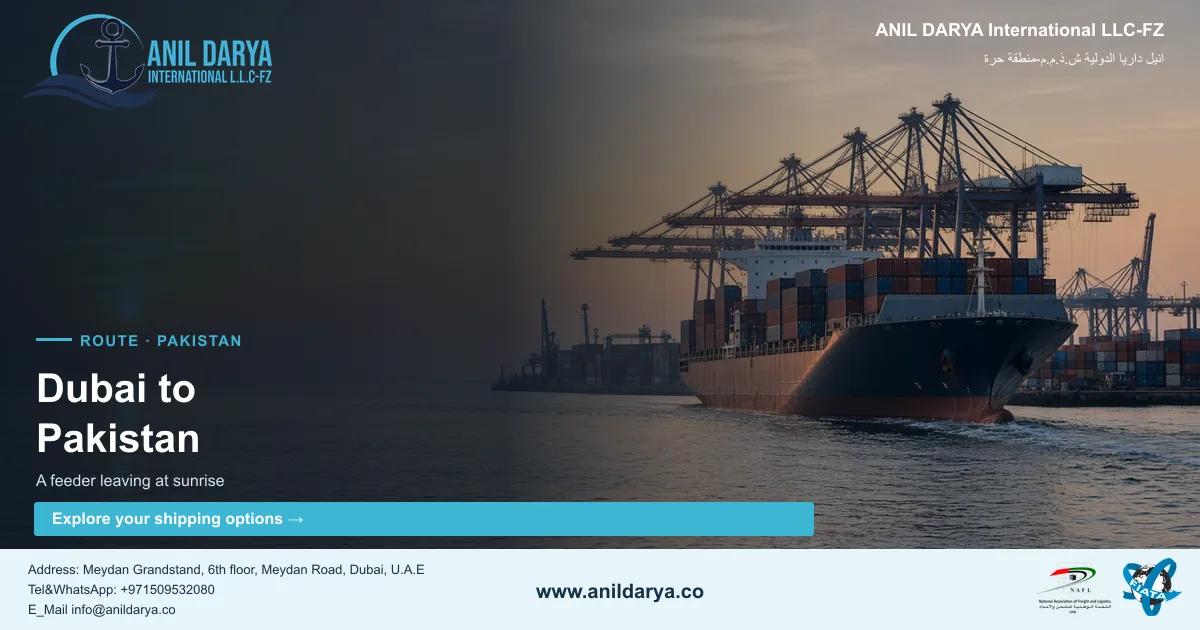
Shipping from Dubai to Pakistan is one of the shortest sea lanes out of the UAE. Most cargo sails from Jebel Ali to Karachi Port or Port Qasim, the two big ports in Karachi, and is cleared by Pakistan Customs through the Pakistan Single Window (PSW) and WeBOC systems. This guide covers the ports, the modes, published transit indications, the documents, the duties and taxes your consignee will pay, and the steps we follow to move your cargo.
Shipping from Dubai to Pakistan at a glance
| Item | Detail |
|---|---|
| Main UAE loading port | Jebel Ali (AEJEA), with Khalifa Port, Sharjah and Fujairah as options |
| Main Pakistan ports | Karachi Port (PKKHI) and Port Muhammad Bin Qasim, also called Port Qasim (PKBQM) |
| Karachi Port size | 34 berths on three wharves, three dedicated container terminals, three oil piers |
| Karachi Port volume, FY 2023-24 | 51.65 million tons of cargo and 2.28 million TEU |
| Port Qasim access | 49 km buoyed channel, vessels up to 13 m draught day and night, 18 berths |
| Published carrier transit, Jebel Ali to Karachi | 3 days on one carrier's published transit table (February 2024) |
| Modes | FCL, LCL, breakbulk and project cargo, dangerous goods, air cargo |
| Customs authority | Pakistan Customs, part of the Federal Board of Revenue (FBR) |
| Customs systems | WeBOC (customs management system) and PSW (single window for traders) |
| Sales tax on imported goods | 18% of the value |
| Income tax collected at import | 1% to 6% for importers on the Active Taxpayers List, double for others |
| Duty currency | Pakistani rupees |
Which ports handle cargo from Dubai to Pakistan?
On the UAE side, most sailings to Pakistan start at Jebel Ali. If your cargo is in Abu Dhabi, Sharjah or on the east coast, a closer port can save a truck leg. See our guides to shipping through Jebel Ali Port and Khalifa Port in Abu Dhabi if you are choosing a loading port.
On the Pakistan side, almost all containers from Dubai land in Karachi. The city has two separate ports with separate customs collectorates, so the port on your booking matters.
| Pakistan port | Authority | What it handles | Main container terminals |
|---|---|---|---|
| Karachi Port | Karachi Port Trust (KPT) | Containers, dry bulk, general cargo, liquid cargo at three oil piers | KICT, KGTL and SAPT |
| Port Qasim | Port Qasim Authority (PQA) | Containers, coal, grain, fertiliser, chemicals, LNG, LPG, vehicles, project cargo | QICT (two terminals) |
Karachi Port handled 51.65 million tons in FY 2023-24, of which 57% was containerised. Port Qasim says it handles 51% of Pakistan's sea trade and has an annual handling capacity of 89 million tons. Cargo for inland cities such as Lahore, Faisalabad or Sialkot usually still enters through one of these two ports and moves inland by road or rail.
A simple rule: let the carrier's service decide the port, but tell your consignee the port before the vessel sails. Their clearing agent files with the collectorate for that port, and changing it later costs time.
Sea freight Dubai to Pakistan: FCL, LCL and breakbulk
Sea freight carries most cargo on this lane. You choose between full containers, shared containers and conventional breakbulk.
| Mode | Best for | What to plan |
|---|---|---|
| FCL (20ft, 40ft, 40ft high cube) | Trade cargo, machinery, building materials, anything that fills most of a box | Terminal at destination, free time, PSW filing before arrival |
| LCL | Small commercial shipments and samples | Consolidator's paperwork, carton marks, release at a container freight station |
| Reefer | Chilled and frozen food, some chemicals | Set temperature, food permits, plug-in time at the terminal |
| Flat rack and open top | Out-of-gauge machinery, vehicles, steel | Lashing plan, carrier acceptance, inland trailer |
| Breakbulk and project cargo | Pieces too large or heavy for any container | Vessel type, lift plan, port approvals, road permits in Pakistan |
| Dangerous goods (IMDG) | Chemicals, batteries, paints, gases | DG declaration, SDS, carrier and terminal acceptance |
FCL is usually the cleanest option because the box is sealed at your door in the UAE and opened only by the consignee or customs. LCL saves money on small volumes but adds a step: the shared container is unpacked at a container freight station before your cargo is released. If you are near the break-even point, our guide to FCL vs LCL costs shows how to compare.
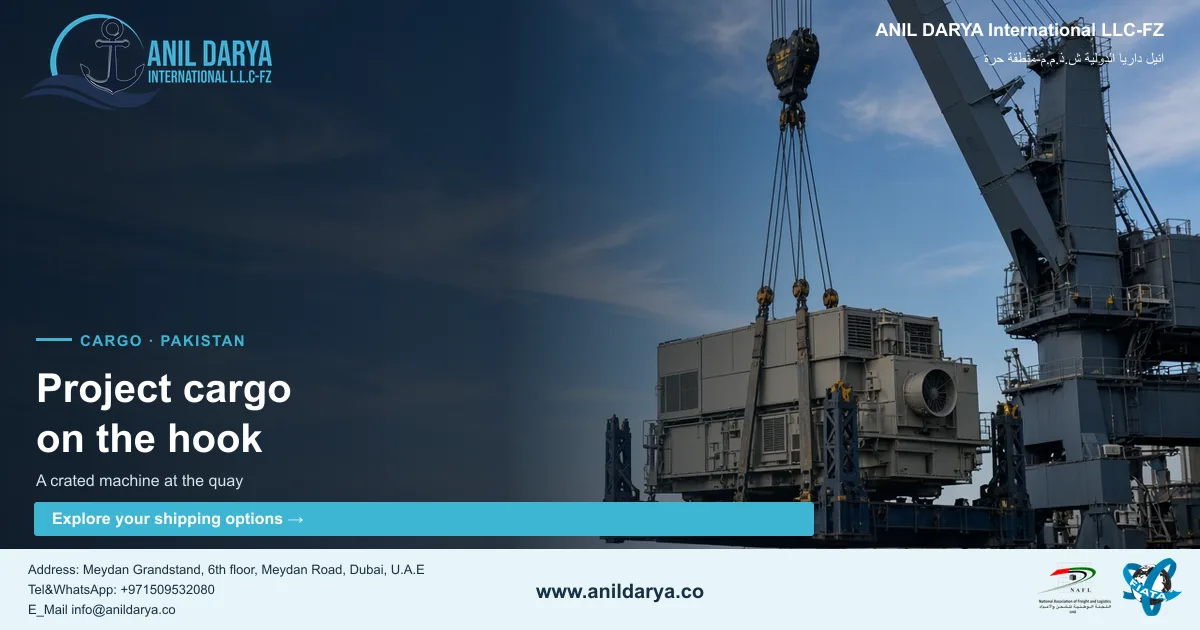
For heavy machinery, transformers or plant, conventional breakbulk is often the only choice. Karachi Port's multipurpose terminal on the East Wharf accepts breakbulk and heavy lifts, and Port Qasim's Marginal Wharf handles vehicles, machinery, equipment and project cargo. We plan these moves through our break bulk and project cargo service.
Dangerous goods to Pakistan
You can ship IMDG cargo on this lane, but it needs more lead time. Karachi Port lists dangerous cargo handling at packing stations among its services. At the KGTML terminal on the East Wharf, Class 1 (explosives) and Class 7 (radioactive) cargo is restricted and needs prior clearance. Port Qasim has dedicated chemical, LPG and LNG terminals for bulk liquids.
For any DG booking you need the UN number, proper shipping name, class and packing group, a Safety Data Sheet, a signed DG declaration and UN-approved packaging with labels. Some chemicals also need a licence, permit or certificate in Pakistan before they land. Our dangerous goods shipping team checks carrier acceptance before you commit to a sailing.
Air cargo from Dubai to Pakistan
Air cargo suits urgent spare parts, samples, documents and high-value goods. The flight is short, so the time on the ground in Dubai and in Pakistan decides the total. Import clearance by air goes through the same PSW and customs process as sea cargo, so the documents below still apply. See our air cargo service for what we arrange at the Dubai end.
There is no practical road option for most shippers on this lane, so the choice is between sea and air.
How long does shipping from Dubai to Pakistan take?
The sea leg itself is short. Emirates Shipping Line's February 2024 advisory for its Gulf Pakistan Shuttle shows 3 days from Jebel Ali to Karachi and 3 days from Karachi back to Jebel Ali, on a 14-day round voyage of Jebel Ali, Karachi, Jebel Ali, Kuwait and Dammam. In January 2025, DP World and Pakistan's National Logistics Cell also launched a weekly feeder service from Jebel Ali to Karachi.
Carrier schedules change often, so treat these as published indications, not a promise. The sea days are only part of the time door to door.
| Stage | What decides the time |
|---|---|
| Booking to sailing | Space on the next vessel, the cut-off for documents and gate-in |
| Sea transit | Direct or with a call on the way, port of discharge |
| Discharge and customs | Whether the declaration was filed before arrival, any permit or examination |
| Delivery | Truck or rail to the consignee, inland dry port clearance if used |
[AMIR-FACT: Our real door-to-door and port-to-port transit time from Jebel Ali to Karachi and to Port Qasim, and the carriers we usually book on this lane]
Two habits shorten the total more than any carrier choice: file the declaration on PSW before the vessel arrives, and have every permit ready before the cargo sails.
Cargo from Dubai to Pakistan: customs, WeBOC and the Pakistan Single Window
Pakistan Customs is part of the Federal Board of Revenue. It runs WeBOC, its core customs management system. The Pakistan Single Window is the main interface for traders and links customs with other government departments and banks. Pakistan Customs is the lead agency for PSW.
What this means for your shipment:
- If the goods need a licence, permit or certificate from another government body, the declaration must be filed through PSW as a Single Declaration.
- If no such requirement applies, the trader can file through WeBOC or PSW. PSW says every WeBOC function for traders is also on PSW.
- PSW allows filing and clearance before the cargo arrives. Under the older WeBOC habit, most goods declarations were filed after arrival.
- Licences, permits, certificates and other documents (PSW calls them LPCOs) from government organisations are applied for on PSW.
The consignee in Pakistan, or their licensed clearing agent, files the import declaration. We prepare and send the shipping documents from the UAE so that filing can start before the vessel berths.
After discharge, containers can also move under customs control to a licensed off-dock terminal. The FBR authorises these terminals under section 78 of the Customs Act, 1969 to take FCL and LCL cargo straight from the wharves of Karachi Port and Port Qasim for clearance. Ask your consignee whether their cargo will clear at the port terminal or at an off-dock terminal.
Which documents do you need?
The US Department of Commerce's guide for Pakistan lists the documents required for imports: bills of lading, invoices, packing lists, certificates of origin, copies of letters of credit and insurance certificates. The table shows what to add by cargo type.
| Cargo type | Core documents | Usually also needed |
|---|---|---|
| General trade cargo | Commercial invoice, packing list, bill of lading, certificate of origin | Letter of credit copy if paid by LC, insurance certificate |
| Food and reefer cargo | Core set | Health or phytosanitary certificates from origin, labels that meet Pakistan's rules |
| Dangerous goods | Core set | DG declaration, SDS, any LPCO for the product |
| Machinery and project cargo | Core set with piece-by-piece packing list | Drawings, weights and lifting points for the terminal |
| Used goods | Core set | Proof the item is allowed in used condition under the Import Policy Order |
| Regulated goods (medicines, some chemicals, telecom items) | Core set | LPCO applied for on PSW before arrival |
Make sure the consignee name, HS code, weights and piece counts match on every document. A mismatch between the invoice and the bill of lading is a common reason for a hold.
Exporting from the UAE side
Your cargo also needs an export or re-export declaration in the UAE before it sails. Use an export declaration for goods made or bought in the UAE, and a re-export declaration for goods that came in from abroad, including goods moving out of a free zone. We file this on your behalf and send the carrier the bill of lading instructions. If you hold goods in Jafza for the Pakistan market, our guide to Jafza re-export explains the paperwork.
What duties and taxes apply in Pakistan?
Duties are charged ad valorem and paid in Pakistani rupees, and rates change often. The rate for your goods depends on the PCT code (Pakistan's version of the HS code) in the Customs Tariff. These are the main charges at import:
| Charge | How it works | Recent changes |
|---|---|---|
| Customs duty (CD) | Rate set per PCT code | FY 2025-26 budget introduced 5%, 10% and 15% slabs, abolished 3%, 11% and 16%, and extended 0% to 916 more codes |
| Additional customs duty (ACD) | Extra duty linked to the CD slab | FY 2026-27 budget cut ACD from 6% to 4% on 449 lines, 4% to 2% on 2,107 lines, and 2% to 0% on 569 lines |
| Regulatory duty (RD) | Applies to listed codes only | FY 2025-26 cut the maximum from 90% to 50%; FY 2026-27 capped RD at 20% on 359 lines |
| Sales tax | 18% of the value of goods imported | Some goods have other rates or exemptions |
| Income tax at import (section 148) | 1%, 2%, 3.5%, 5.5% or 6% for importers on the Active Taxpayers List, depending on the goods and whether the importer is commercial | Non-ATL importers pay double: 2% to 12% |
Customs duty, ACD and RD come from the tariff for your PCT code. Sales tax and income tax are charged under their own laws, each with its own value base. Ask your consignee's clearing agent for a full estimate on your PCT code before you ship, not just the customs duty rate.
Two points that change the bill. First, the importer's tax status matters: an importer not on the Active Taxpayers List pays double the income tax rate at import. Second, rates change with each year's Finance Act. The 2025 tariff changes took effect on 1 July 2025, and the FBR's current rate card is updated to 30 June 2026, so a duty estimate from last year may be out of date.
Restricted and banned items
Pakistan's Ministry of Commerce sets import bans and conditions in the Import Policy Order, 2022. The order is grouped into appendices:
| Appendix | What it covers | What it means for you |
|---|---|---|
| Appendix A | Banned items | Do not ship, except narrow government exemptions |
| Appendix B | Restricted items | Allowed only if the listed conditions are met |
| Appendix C | Items banned in used or second-hand condition | Check before shipping any used machinery or goods; personal baggage schemes are treated separately |
| Appendix F | Ozone-depleting substances | Imported under environment ministry policy or quota |
| Appendix N | Goods that must meet listed standards | Product must meet the specification on arrival |
Counterfeit goods are banned. Since July 2019, importers of certain goods listed in the Third Schedule of the Sales Tax Act must print the retail price on the goods at import. Packaged medicines must meet Pakistan's drug labelling rules.
The order is amended several times a year, so check the current text for your PCT code before you buy the goods, not after they are packed.
What affects the cost of shipping from Dubai to Pakistan?
We do not publish prices because they change with every sailing. These are the factors that move your quote:
- Container type and size, or weight and volume for LCL and breakbulk.
- Loading port in the UAE and the trucking distance to it.
- Port of discharge: Karachi Port or Port Qasim, and the terminal.
- Cargo type: reefer, DG and out-of-gauge cargo carry surcharges and need acceptance.
- Carrier local charges at both ends, such as terminal handling and documentation fees.
- Free time on the container and any demurrage or detention after it.
- Duties, sales tax and income tax in Pakistan, paid by the importer unless you agree delivered duty paid terms.
- Cargo insurance.
Your Incoterm decides who pays which part. Under FOB Jebel Ali the buyer pays the sea freight; under CFR or CIF Karachi you do. Our guide to Incoterms 2020 for sea freight sets out who pays what.
How we ship your cargo from Dubai to Pakistan, step by step
We book space with carriers, prepare the documents, arrange trucking and export clearance in the UAE, and work with your consignee's clearing agent in Pakistan. We do not have an office in Pakistan.
- Tell us about the cargo. Commodity, HS code, weight, volume or dimensions, pickup point in the UAE, consignee city in Pakistan and the Incoterm.
- Check the import rules. Your consignee confirms the PCT code, any Import Policy Order condition and any LPCO needed on PSW.
- Get a quote and choose the port. We compare services to Karachi Port and Port Qasim and confirm the terminal.
- Book space. For DG, reefer or out-of-gauge cargo we get carrier acceptance first.
- Pick up and stuff. We arrange the empty container, stuffing at your site or a warehouse, the seal and the truck to the port.
- Export clearance in the UAE. We file the export or re-export declaration and gate the container in before the cut-off.
- Bill of lading. We send the instructions, check the draft with you and release the original or a sea waybill.
- Send documents to the consignee. Invoice, packing list, certificate of origin and bill of lading go to the consignee's clearing agent so they can file on PSW before arrival.
- Arrival and clearance. The clearing agent files, pays duties and taxes and collects the delivery order from the carrier's agent.
- Delivery and empty return. The consignee takes delivery and returns the empty container within free time.
[AMIR-FACT: One real shipment we handled from Dubai to Pakistan (cargo, port, mode and what we solved), approved for publication]
Checklist before you ship
- PCT or HS code confirmed with the consignee's clearing agent.
- Goods checked against the Import Policy Order, including used-goods rules.
- Any licence, permit or certificate applied for on PSW before sailing.
- Consignee registered on PSW, or a licensed clearing agent appointed.
- Importer's tax status known, because it changes the income tax at import.
- Invoice, packing list, certificate of origin and bill of lading show the same names, weights and piece counts.
- Port of discharge and terminal agreed with the consignee.
- UAE export or re-export declaration type chosen.
- For DG: SDS, DG declaration, packaging, labels and carrier acceptance.
- For breakbulk: drawings, weights, lifting points and the inland route in Pakistan.
- Free time agreed with the carrier.
- Cargo insurance arranged.
Common mistakes on the Dubai to Pakistan lane
- Shipping before the permit. A missing LPCO means the goods declaration cannot be cleared, and port storage starts running.
- Wrong PCT code. A different code can mean a different duty, ACD and RD, and a reassessment.
- Used goods without checking Appendix C. Some items are banned in used condition and cannot be cleared.
- Mismatched documents. Different weights on the invoice and the bill of lading cause holds.
- Ignoring the importer's tax status. A non-ATL importer pays double the income tax at import, which can upset a DDP price.
- Late documents. If the originals or scans reach the consignee after the vessel arrives, filing starts late and free time is lost. Our article on demurrage and detention shows how fast those charges add up.
- Undeclared dangerous goods. Batteries, aerosols and some chemicals are DG even in small amounts.
Frequently asked questions
Which port in Pakistan do ships from Dubai use?
Most container ships from Dubai discharge in Karachi, at either Karachi Port or Port Qasim. Karachi Port has three container terminals (KICT, KGTL and SAPT), and Port Qasim has the QICT terminals.
How long does sea freight from Dubai to Pakistan take?
The sea leg is short. One carrier's published table from February 2024 shows 3 days from Jebel Ali to Karachi. Booking, customs and delivery add time, so ask for a door-to-door estimate on your cargo.
What is WeBOC and do I still need it?
WeBOC is Pakistan Customs' customs management system. The Pakistan Single Window is now the main interface for traders and offers every WeBOC trader function, and goods that need a permit or certificate must be declared through PSW.
What documents does Pakistan Customs need for imports?
The usual set is the bill of lading, commercial invoice, packing list, certificate of origin, insurance certificate and a copy of the letter of credit if one is used. Regulated goods also need the relevant licence, permit or certificate through PSW.
What is the sales tax on goods imported into Pakistan?
The standard sales tax rate on goods imported into Pakistan is 18% of the value, under section 3 of the Sales Tax Act, 1990. Some goods have other rates or exemptions.
How much customs duty will my goods pay in Pakistan?
It depends on the PCT code. Customs duty, additional customs duty and any regulatory duty are set per code and change with each budget, so get an estimate from the consignee's clearing agent before you ship.
Can I ship used machinery from Dubai to Pakistan?
Possibly. Appendix C of the Import Policy Order, 2022 lists items banned in used condition, so check your item and its conditions before you ship.
Who pays duty when shipping from Dubai to Pakistan?
The importer in Pakistan pays duties and taxes unless you agree delivered duty paid terms. The Incoterm in your sales contract decides this.
Can you clear my cargo in Pakistan?
We handle the UAE side: booking, documents, trucking and export clearance. Import clearance in Pakistan is done by the consignee or their licensed clearing agent, and we work directly with them.
Get a quote for shipping from Dubai to Pakistan
Send us your cargo details and we will come back with a routing and a price to Karachi Port or Port Qasim. Use our freight rate inquiry form, or contact our team to talk through a breakbulk, project or DG shipment first.
Sources
- Pakistan Single Window: WeBOC to PSW (Single Declaration, pre-arrival filing, LPCOs)
- Pakistan Single Window: About PSW
- US International Trade Administration: Pakistan import requirements and documentation (February 2026)
- US International Trade Administration: Pakistan customs regulations (Finance Bill 2025 tariff slabs effective 1 July 2025)
- US International Trade Administration: Pakistan import tariffs (February 2026)
- FBR: Sales Tax Act, 1990, updated to 30 June 2026 (section 3, 18% rate)
- FBR: Withholding tax rate card, updated to 30 June 2026 (section 148 imports)
- FBR: Budget 2025-26 salient features (customs)
- FBR: Budget 2026-27 salient features (customs)
- FBR: SRO 1788 of 2024 (off-dock terminal under section 78, Customs Act 1969)
- JETRO: Pakistan trade control system and Import Policy Order 2022 (February 2026)
- Ministry of Maritime Affairs: Karachi Port Trust Year Book 2023-24
- Port Qasim Authority: Introduction
- Port Qasim Authority: Port operational complex
- Karachi Gateway Terminal: KGTML multipurpose terminal
- Emirates Shipping Line: GPS and JBX service launch advisory (February 2024)
- Radio Pakistan: DP World and NLC start feeder service from Jebel Ali to Karachi (January 2025)
- Wikipedia: Port Qasim (UN/LOCODE)
- Wikipedia: Port of Karachi (UN/LOCODE)
Reviewed: 10 November 2026