
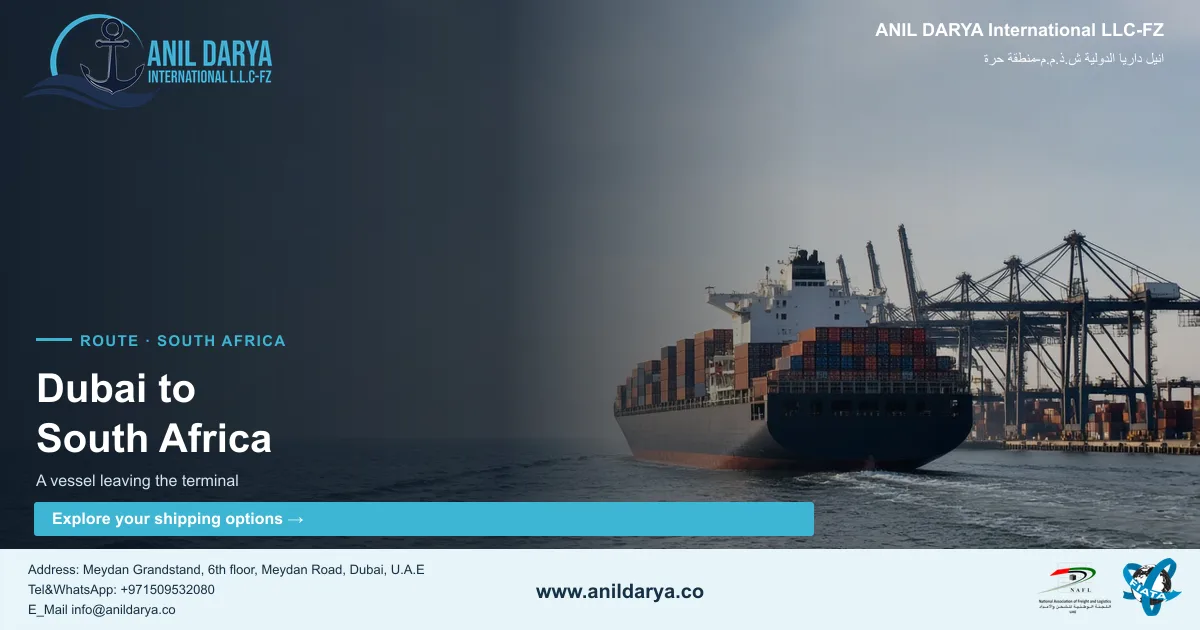
Shipping from Dubai to South Africa usually means sea freight from Jebel Ali to Durban, Cape Town, Ngqura or Port Elizabeth, with air cargo for urgent goods and breakbulk for steel, machinery and project cargo. On the South African side, the South African Revenue Service (SARS) clears the goods, and other agencies such as ITAC and the NRCS issue the permits and letters of authority that many products need before they arrive. This guide covers the ports, each mode, the paperwork, duties and VAT, and the order in which to do things.
Shipping from Dubai to South Africa at a glance
| Item | Detail |
|---|---|
| Main UAE load port | Jebel Ali (Dubai) |
| Main South African sea ports | Durban, Cape Town, Ngqura and Port Elizabeth, all run by Transnet National Ports Authority (TNPA) |
| Busiest container port | Durban, 2,732,190 TEU invoiced in 2025 |
| Inland link from Durban | 688 km rail corridor to Gauteng inland terminals such as City Deep |
| Modes on this lane | FCL, LCL, breakbulk and project cargo, dry and liquid bulk, dangerous goods, vehicles, air cargo |
| Customs authority | SARS Customs and Excise |
| Importer registration | Required for any person, local or foreign, who imports into South Africa |
| Customs value basis | FOB price at the port of export |
| Import VAT | 15% of the added tax value (customs value plus 10%, plus non-rebated duty) |
| Used or second-hand goods | ITAC import permit needed |
| Products under compulsory specifications | NRCS letter of authority needed before import or sale |
| Deadline to declare after landing | 7 days, or 14 days for loose and break bulk cargo, 28 days in a container depot |
How cargo moves from Dubai to South Africa
Most cargo leaves the UAE through Jebel Ali and sails down the East African coast to Durban, then on to the Eastern Cape and Cape Town ports. Some services call at one South African port only, and others transship. The port of discharge on your booking decides where the goods are cleared and how far they travel inland.
A practical rule: pick the port by the consignee's address, not by the freight rate alone. Gauteng consignees usually take cargo through Durban and the rail or road link inland. Western Cape buyers do better through Cape Town. Eastern Cape factories often use Ngqura or Port Elizabeth.
Ports and gateways on both ends
| Gateway | Side | What it is good for |
|---|---|---|
| Jebel Ali Port | UAE | Containers, breakbulk, project cargo and DG; most sailings to Africa |
| Port of Durban | South Africa | Containers, vehicles, liquid bulk, breakbulk; 58 berths, 41 in operation |
| Port of Cape Town | South Africa | Containers, fresh produce, breakbulk; 42 berths; 843,599 TEU in 2025 |
| Port of Ngqura | South Africa | Deepwater container port in Algoa Bay; 4-berth container terminal at 16 m; 747,847 TEU in 2025 |
| Port of Port Elizabeth | South Africa | Multi-cargo port with 15 berths; 130,715 TEU in 2025 |
| OR Tambo International, Johannesburg | South Africa | Main air cargo gateway for Gauteng |
| Cape Town and King Shaka (Durban) airports | South Africa | Air cargo for coastal consignees |
If your cargo starts in Abu Dhabi, compare loading at Khalifa Port in Abu Dhabi against trucking to Jebel Ali. The right answer depends on which services call where that month.
Sea freight from Dubai to South Africa: FCL or LCL?
Most general cargo on this lane moves in containers. Choose by volume and by how much handling your goods can take.
- FCL (full container load). You book a whole 20ft or 40ft box. It suits stock orders, building materials, tyres, food and anything you want sealed from the loading point to the consignee.
- LCL (less than container load). Your cargo shares a box with other shippers and is unpacked at a container freight station in South Africa. It suits small volumes, but release depends on the whole consolidated container clearing.
Reefer containers carry chilled and frozen goods. Open tops and flat racks carry cargo that is too tall or wide for a standard box. We explain where the cost crossover sits in our guide to FCL vs LCL shipping costs, and our sea freight service covers booking, documents and trucking to the port in Dubai.
Transit times and sailings
Transit times on this lane change with the service. A direct call at Durban is faster than a routing that transships at another hub, and Cape Town is further down the coast than Durban. Online aggregators publish estimates that disagree by more than a week, so we do not repeat them here. Ask for the port-to-port days of the actual vessel when you book, and add time for customs and the inland leg.
[AMIR-FACT: Our real port-to-port transit Jebel Ali to Durban and to Cape Town (days), and the carriers or services we actually book on this lane]
Breakbulk, bulk and project cargo to South Africa
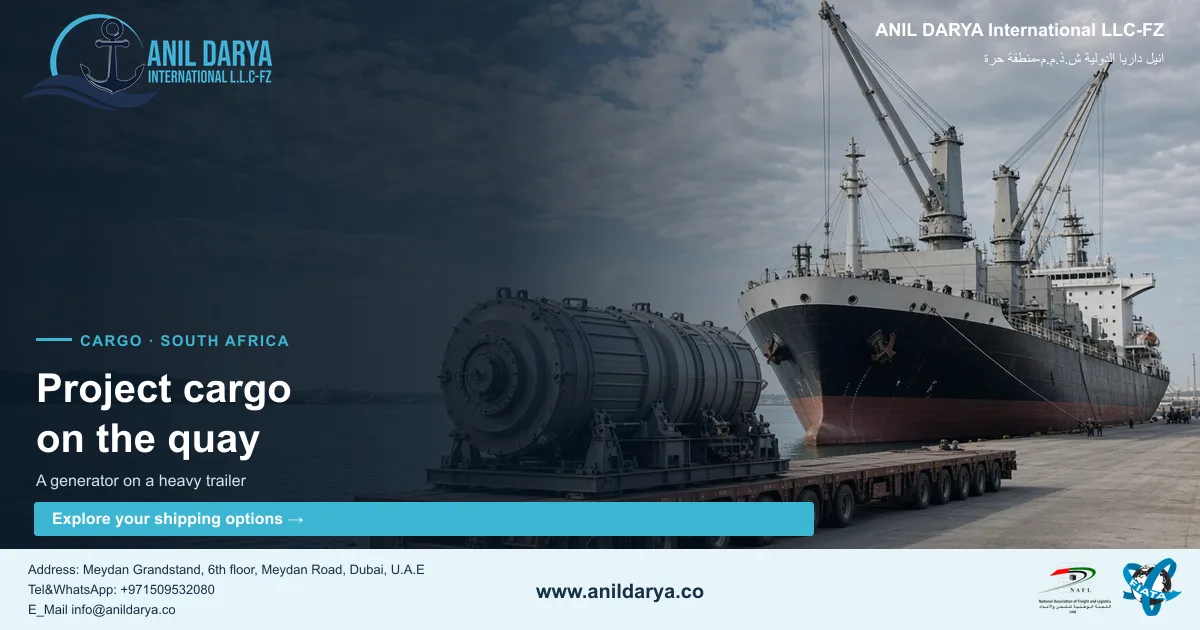
Steel, machinery, generators, transformers and construction equipment often go breakbulk. Transnet Port Terminals runs multipurpose terminals at Durban, Maydon Wharf, Port Elizabeth, East London, Cape Town, Richards Bay and Saldanha that handle steel, granite, timber, abnormal and project cargo. Durban alone handled 4.5 million tonnes of breakbulk in 2025.
| Cargo | Usual method | What to plan |
|---|---|---|
| Pieces that fit a 40ft flat rack | Flat rack or open top on a container service | Lashing, out-of-gauge acceptance at both terminals |
| Pieces too large or heavy for a flat rack | Conventional breakbulk or heavy-lift vessel | Lift plan, vessel gear, port of discharge with a multipurpose terminal |
| Steel coils, plates, pipes | Breakbulk or containers | Dunnage, moisture protection, piece-by-piece packing list |
| Bulk minerals, fertiliser, grain | Bulk carrier | Discharge rate, surveys, receiving facility |
| Vehicles and machinery on wheels | Ro-Ro or container | ITAC and NRCS rules for vehicles, see restricted goods below |
We plan these moves with our break bulk and project cargo team. For the wider picture of bulk and breakbulk demand on Africa lanes, read our article on Dubai to Africa bulk shipping.
Dangerous goods from Dubai to South Africa
Chemicals, paints, batteries, gases and other hazardous cargo ship under the IMDG Code. In South Africa the Merchant Shipping (Dangerous Goods) Regulations set packaging, labelling, stowage and carriage rules, and amendments came into force in June 2026. The vessel's agent must also declare the dangerous goods on board in the arrival notice to the Harbour Master, which is due at least 72 hours before the ship arrives.
What you need for a DG booking:
- UN number, proper shipping name, class and packing group for each product.
- A Safety Data Sheet for each product.
- A signed Dangerous Goods Declaration.
- UN-approved packaging, marks, labels and container placards.
- Carrier acceptance before you commit to a sailing, and any South African permit the product needs.
At Durban's Pier 2 container terminal, hazardous containers need a Container Terminal Order for delivery and collection, so the clearing agent should have the paperwork ready before discharge. Our dangerous goods shipping team checks the documents and the carrier's acceptance on the UAE side.
Air cargo from Dubai to South Africa
Air cargo suits samples, spare parts, electronics and urgent stock. Johannesburg's OR Tambo airport is the main cargo gateway, with Cape Town and King Shaka in Durban for coastal consignees. The same SARS importer registration, permits and VAT apply as for sea cargo. Ask us to compare air against sea when the cargo is light, valuable or late, through our air cargo service.
Importing into South Africa: SARS registration and customs process
SARS says any person, local or foreign, who imports goods into South Africa must register as an importer. A foreign importer must also nominate a registered agent located in South Africa, and that agent takes on full liability for the foreign principal's dealings with Customs. Without an approved agent, the application is suspended.
Importers register through the Registration, Licensing and Accreditation (RLA) platform on SARS eFiling, or on the manual DA 185 form with the 4A1 importer annexure at a Customs branch office. SARS asks for proof of address, company registration documents, tax reference letters and proof of bank details. Successful applicants receive a customs client number, which must appear on declarations and on authorisations given to agents.
How clearance works
- The importer or its agent lodges a goods declaration with SARS.
- SARS checks the declaration against the supporting documents if it asks for them.
- SARS replies with a status message. The cargo is released, held for another government agency, or stopped for a physical inspection, which the agent books at the port.
- Duty and VAT are paid, unless a rebate or deferment applies.
- The shipping line issues the release and the terminal delivers the container.
Timing matters. SARS gives 7 days after landing to declare the goods, 14 days for loose and break bulk cargo, and 28 days for goods in a container depot. Undeclared goods may be moved to the State Warehouse. At the Durban Gateway Terminal (DCT Pier 2), the operator's January 2026 procedures also say import containers that are not customs cleared must leave the terminal as an overstay on the third day of free storage.
Documents for an import into South Africa
| Document | Who issues it | Notes |
|---|---|---|
| Commercial invoice | Seller | Price, quantity and description; SARS uses it for valuation |
| Packing list | Seller | Weights and marks must match the invoice and bill of lading |
| Bill of lading or air waybill | Carrier | Its number and date go on the goods declaration |
| Certificate of origin | Chamber of commerce in the UAE | SARS lists it among the documents it checks |
| Import permit | ITAC or the relevant agency | Must be produced at clearance for restricted goods |
| NRCS letter of authority | NRCS | For products under compulsory specifications |
| Proof of payment | Buyer's bank | Supports the declared value |
| UAE export declaration | Filed in Dubai | Export or re-export, depending on the goods |
Check that the consignee name, weights and HS codes match across every document. A mismatch is the fastest way to turn a release into a query. Our guide to Incoterms 2020 for sea freight helps you agree who pays for what before the sale.
SARS duties and import VAT on goods from Dubai
SARS lists three kinds of charges on imports: customs duties (including extra ad valorem duty on some luxury or non-essential goods), anti-dumping and countervailing duties on dumped or subsidised goods, and VAT. The duty amount depends on the customs value, the quantity and the tariff heading of the goods.
How the customs value is set
South Africa uses the FOB price at the port or place of export as the basis for valuation. That means sea freight and insurance from the UAE are not part of the dutiable value. If you sell ex works, SARS can ask for a breakdown of the costs to bring the goods to the export port, so keep the trucking and handling invoices from Dubai.
How import VAT is worked out
VAT is 15% of the added tax value (ATV). SARS sets the ATV as the customs value plus 10% of it, plus any non-rebated duty. The 10% uplift does not apply to goods from Botswana, Lesotho, Namibia or Eswatini, so it does apply to goods from the UAE.
| Step | Example (illustration only, duty rate assumed at 10%) |
|---|---|
| Customs value (FOB Jebel Ali) | R100,000 |
| 10% uplift | R10,000 |
| Customs duty at the assumed 10% | R10,000 |
| Added tax value | R120,000 |
| Import VAT at 15% | R18,000 |
Your real duty rate comes from the SARS tariff for your HS code. Check it before you quote a landed price, because a wrong tariff heading changes both duty and VAT.
ITAC, NRCS and other permits for restricted goods
SARS enforces controls on behalf of other government agencies. Under its prohibited and restricted goods policy, some goods are banned outright, others need an authority before import, and every declaration must state whether goods are new, used or second hand. The importer must apply to the relevant agency before the goods are imported, and a temporary import still needs the authority.
| Agency | What it controls | What you need |
|---|---|---|
| ITAC (International Trade Administration Commission) | All used and second-hand goods, waste and scrap, plus listed goods such as new pneumatic tyres, some chemicals, gambling devices and fossil fuels | Import permit; ITAC gives an average turnaround of 3 to 5 working days |
| NRCS (National Regulator for Compulsory Specifications) | Products covered by compulsory specifications, including vehicles, electrical goods, some chemicals and building materials | Letter of authority, issued once the product meets the specification |
| Other agencies on the SARS list | Food, plants, animals, medicines and other controlled goods | Permit, certificate or authority as listed |
Three rules catch Dubai shippers most often:
- Used goods need an ITAC permit, and ITAC says it issues no permits for used vehicles imported for commercial or resale purposes.
- Clothing, textiles and footwear must meet labelling rules. Non-compliant goods are detained, and if the problem cannot be fixed they must be re-exported off the African continent or destroyed at the importer's cost.
- Rejected declarations leave goods uncleared, and they go to the State Warehouse.
Goods in transit through South Africa to another country do not need the authority.
What drives the cost of shipping from Dubai to South Africa?
We do not publish rates, because they move every few weeks. These are the factors that change your quote.
| Cost factor | Why it matters | How to control it |
|---|---|---|
| Port of discharge | Durban, Cape Town and the Eastern Cape ports have different services and inland costs | Price the port nearest the consignee |
| Container type | Reefers, flat racks and open tops cost more than dry boxes | Use a dry box when the cargo allows |
| FCL or LCL | LCL is priced per cubic metre and adds handling at both ends | Compare both near the crossover point |
| Direct or transshipped service | Transshipment can be cheaper but adds days and handling | Weigh the price against the delivery date |
| Duty and VAT | Charged on the FOB value and ATV | Classify goods correctly, keep valuation evidence |
| Storage and container charges | Start once free time ends | Have permits and the declaration ready before arrival |
| Inland transport | Rail or road from the port to Gauteng or other inland sites | Book the inland leg with the sea freight |
| DG and out-of-gauge surcharges | Carrier and terminal extras | Get acceptance and surcharges in writing at booking |
How to ship from Dubai to South Africa, step by step
- Confirm the importer. The South African consignee needs a SARS customs client number, or a foreign importer needs a registered agent in South Africa.
- Classify the goods. Agree the HS code with the consignee and check the duty rate and whether ITAC, NRCS or another agency controls the product.
- Apply for permits early. Used goods, regulated products and controlled goods need their authority before shipment.
- Pick the port and mode. Choose the South African port by the final address, and FCL, LCL, breakbulk or air by volume and deadline.
- Book space. We book with the carrier and get acceptance first for DG, reefer or out-of-gauge cargo.
- Prepare documents in Dubai. Invoice, packing list, certificate of origin and the UAE export or re-export declaration, all matching.
- Load and sail. We arrange trucking to the port, gate-in before the cut-off and the bill of lading.
- Clear in South Africa. The consignee's clearing agent lodges the declaration, answers any SARS query and pays duty and VAT.
- Deliver. The container leaves the terminal by road or rail, and the empty goes back to the line within free time.
We work with the consignee's clearing agent or a destination agent of their choice. We do not clear goods in South Africa ourselves.
[AMIR-FACT: One real Dubai to South Africa shipment we handled: cargo type, mode, port pair and what we did, cleared for publication]
Checklist before you ship to South Africa
- Consignee holds a SARS customs client number, or a foreign importer has a registered agent.
- HS code and duty rate confirmed with the consignee.
- ITAC permit in hand for any used or second-hand goods.
- NRCS letter of authority in hand for regulated products.
- Clothing, textiles and footwear labelled to South African rules.
- Invoice, packing list and bill of lading show the same consignee, weights and piece counts.
- Certificate of origin issued in the UAE.
- Proof of payment and export-side cost breakdown kept for valuation.
- For DG: SDS, DG declaration, packaging, labels and carrier acceptance.
- For project cargo: drawings, weights, lifting points and an inland route plan.
- Free time agreed with the carrier and cargo insurance arranged.
Common mistakes on the South Africa lane
- Shipping before the permit. Restricted goods without an ITAC permit or NRCS letter of authority are held, and storage runs while you apply.
- Treating used goods as new. Every declaration states new, used or second hand, and used goods need a permit.
- Declaring a CIF value. South Africa values imports on FOB, so build the declared value on the FOB price.
- Forgetting the 10% uplift. Landed cost estimates that skip it understate the VAT.
- Missing the declaration deadline. Goods not declared in time can be moved to the State Warehouse.
- Wrong port for the consignee. A Cape Town buyer whose cargo lands in Durban pays for a long inland leg.
- Non-compliant clothing labels. Goods are detained and may have to be re-exported off the continent or destroyed.
Frequently asked questions
How do I ship goods from Dubai to South Africa?
Most goods go by sea from Jebel Ali to Durban, Cape Town, Ngqura or Port Elizabeth, in FCL, LCL or breakbulk. The South African importer needs a SARS customs client number, any permits the goods require, and a clearing agent to lodge the declaration.
Which port in South Africa receives cargo from Dubai?
Durban is the busiest container port, with 2,732,190 TEU invoiced in 2025, and it links by a 688 km rail corridor to Gauteng. Cape Town, Ngqura and Port Elizabeth also take containers from the Middle East, depending on the service.
Do I need to register with SARS to import into South Africa?
Yes. SARS says any person, local or foreign, who imports goods must register as an importer. Foreign importers must also nominate a registered agent in South Africa who takes on liability for them.
How is import VAT calculated in South Africa?
VAT is 15% of the added tax value. The added tax value is the customs value plus 10% of it, plus any non-rebated duty. The customs value is based on the FOB price at the port of export.
Do I need an ITAC permit for goods from Dubai?
You need an ITAC import permit for all used and second-hand goods, and for certain listed goods such as new pneumatic tyres and some chemicals. ITAC gives an average processing time of 3 to 5 working days.
What is an NRCS letter of authority?
It is the approval the National Regulator for Compulsory Specifications issues once a product meets its compulsory specification. Products such as vehicles and many electrical goods need it before they can be imported or sold in South Africa.
Can I ship a used car from Dubai to South Africa?
Only in narrow cases. Used vehicles need an ITAC import permit, ITAC issues no permits for used vehicles imported for commercial or resale purposes, and vehicles also need an NRCS letter of authority.
Can I ship dangerous goods from Dubai to South Africa?
Yes, under the IMDG Code with an SDS, a DG declaration, correct packaging and labels, and carrier acceptance. South Africa's Merchant Shipping (Dangerous Goods) Regulations also apply, and the vessel must declare DG on board in its arrival notice.
How long do I have to clear goods in South Africa?
SARS gives 7 days after landing to declare goods, 14 days for loose and break bulk cargo, and 28 days for goods in a container depot. Undeclared goods may be moved to the State Warehouse.
Get a quote for shipping from Dubai to South Africa
Send us the commodity, HS code, weight, volume, the South African delivery address and your Incoterm, and we will come back with a routing and a price. Use our freight rate inquiry form, or contact our team to talk through a breakbulk, project or DG shipment first. You can also read more about our Dubai freight forwarding team.
Sources
- SARS: Imports (clearance, documents, declaration deadlines, State Warehouse)
- SARS: Importer registration (local and foreign importers, registered agent, documents)
- SARS: Registration, Licensing and Accreditation (RLA on eFiling, DA 185)
- SARS: Duties and taxes for importers (duty types, VAT formula, 10% uplift)
- SARS FAQ: How is VAT calculated on imported goods?
- SARS SC-CR-A-03: Valuation of Imports, effective 11 December 2025 (FOB basis)
- SARS SC-CC-32: Prohibited and Restricted Goods, effective 17 February 2025
- ITAC: Import control (used goods, controlled goods, turnaround)
- ITAC: Frequently asked questions
- ITAC: Guidelines for importing used or second-hand vehicles
- NRCS: Imports and exports (letters of authority)
- Transnet National Ports Authority: Our ports (Durban, Cape Town, Ngqura, Port Elizabeth)
- Transnet National Ports Authority: Port statistics, 2025 calendar year
- Transnet Port Terminals: Break-bulk services
- Transnet Freight Rail: Container Corridor (Durban to Gauteng)
- Durban Gateway Terminal: Standard operating procedures from 1 January 2026
- National Ports Act, Port Rules: Rule 18 notice of arrival
- Acts Online: Merchant Shipping (Dangerous Goods) Regulations amended (June 2026)
Reviewed: 10 November 2026