
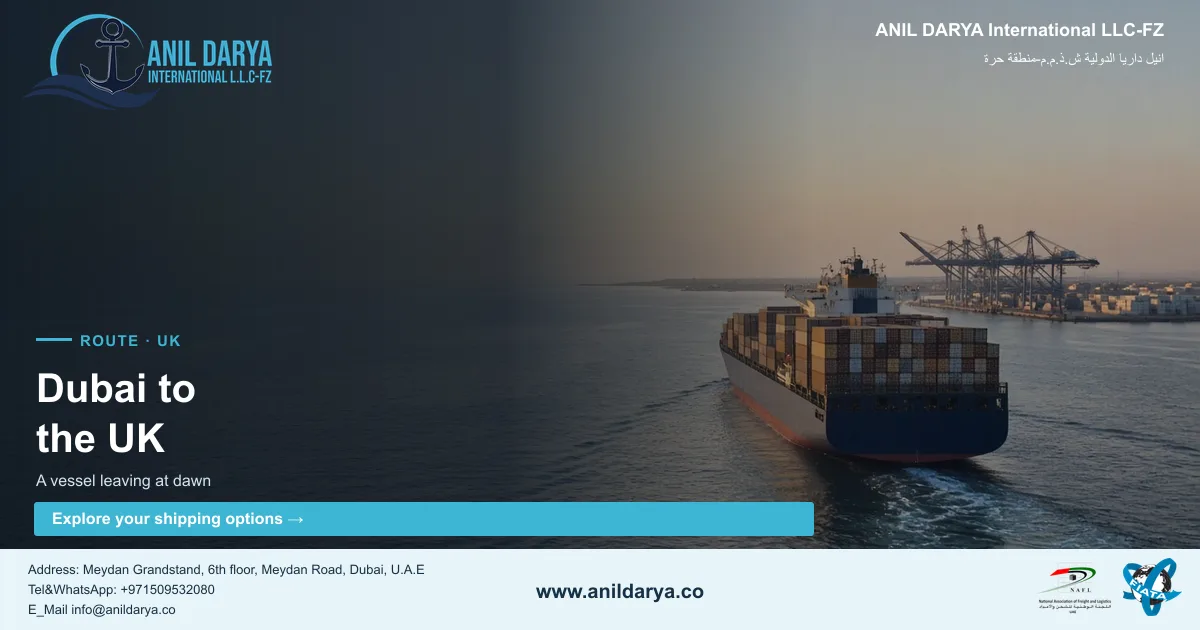
Shipping from Dubai to the UK usually means a container from Jebel Ali to Felixstowe, Southampton or London Gateway, with air cargo for urgent or high-value goods. On arrival, the UK importer needs an EORI number starting with GB, the goods are declared to HMRC on the Customs Declaration Service (CDS), and duty from the UK Global Tariff plus import VAT is paid or deferred. This guide covers ports, modes, documents, duty and VAT, restricted goods and each step from Dubai to your UK consignee.
Shipping from Dubai to the UK at a glance
| Item | Detail |
|---|---|
| Main UAE port of loading | Jebel Ali (UN/LOCODE AEJEA), with Khalifa Port and Khor Fakkan as alternatives |
| Main UK container ports | Felixstowe (GBFXT), Southampton (GBSOU), London Gateway (GBLGP) |
| Modes | Sea FCL and LCL, breakbulk and project cargo, dangerous goods, air cargo |
| UK customs authority | HM Revenue and Customs (HMRC) |
| Import declaration system | Customs Declaration Service (CDS) |
| Importer registration | EORI number starting with GB (England, Wales, Scotland) |
| Safety and security filing | Entry summary declaration on S&S GB, made by or for the carrier before arrival |
| Commodity code on import | 10 digits (8 in data element 6/14, plus 2 in 6/15) |
| Customs duty | Rate from the UK Trade Tariff, charged on a customs value that includes freight and insurance to the UK port |
| Import VAT | Same rate as a UK sale: 20% standard, 5% reduced, 0% zero rate |
| VAT cash flow options | Postponed VAT accounting, or a duty deferment account (paid on the 16th of the following month) |
| Trade agreement | UK-GCC deal concluded 20 May 2026, not in force until ratified |
| Wood packaging | Must meet ISPM 15 and carry the mark |
Which mode should you use from Dubai to the UK?
Pick the mode by size, value, urgency and cargo type. This table is the short version.
| Cargo | Usual mode | Why |
|---|---|---|
| A full load, or more than about half a container | Sea FCL from Jebel Ali | Lowest cost per unit, your goods stay in one sealed box |
| A few pallets or cartons | Sea LCL (groupage) | You pay for the space you use, but release depends on the whole consolidated box |
| Machinery, steel, oversized pieces | Flat rack, open top or breakbulk | Pieces that do not fit a standard box |
| Chemicals, batteries, aerosols, paints | Sea or air as dangerous goods | Needs carrier acceptance and correct DG paperwork |
| Urgent spares, samples, high-value goods | Air cargo | Fastest, priced on chargeable weight |
| Parcels and documents | Express courier | Door to door with the courier's own clearance |
If a late arrival stops a production line, compare air. Otherwise start with sea.
Sea freight from Dubai to the UK: ports and services
Most sea cargo for the UK leaves from Jebel Ali, which has the largest set of carrier services in the region. Our sea freight service books FCL and LCL space with the carriers and handles the export side in Dubai.
Which UAE port should your cargo leave from?
- Jebel Ali. The default for containers from Dubai, Jafza and the northern emirates. See our Jebel Ali port shipping guide for terminals and port rules.
- Khalifa Port. Worth comparing if the cargo is in Abu Dhabi, because it can cut the truck leg. Read our Khalifa Port guide.
- Khor Fakkan on the east coast. Some services load here.
Which UK port should your cargo go to?
Choose the port nearest your consignee.
| UK port | Code | Usually suits |
|---|---|---|
| Felixstowe, Suffolk | GBFXT | Most deep-sea containers, rail to the Midlands and the North |
| Southampton, Hampshire | GBSOU | South and South West England |
| London Gateway, Essex | GBLGP | London and the South East |
| Other ports (for example Liverpool, Immingham, Teesport, Grangemouth, Belfast) | Varies | Northern England, Scotland and Northern Ireland, often by feeder or transshipment |
Felixstowe also runs daily container trains to inland terminals, which can beat a long truck run to the North.
FCL or LCL to the UK?
- FCL. You book a whole 20ft, 40ft or 40ft high cube container. It suits larger loads and goods you do not want handled with other cargo.
- LCL. Your pallets share a container. It is consolidated in Dubai and unpacked at a UK container freight station, so your release waits for the whole box to be cleared and devanned.
Send clean LCL documents early, with carton marks that match the packing list. Our guide to FCL vs LCL costs shows where the break-even usually falls.
How long does sea freight from Dubai to the UK take?
Published schedules for Jebel Ali to UK ports vary by carrier, service and transshipment hub, and third-party schedule sites disagree with each other. Ask us for the current sailing and the carrier's published days for your booking.
[AMIR-FACT: the carriers we actually book from Jebel Ali to Felixstowe, Southampton and London Gateway, and our real port-to-port and door-to-door days for FCL and LCL]
[AMIR-FACT: whether we run our own LCL consolidation to the UK or use a co-loader, and how often LCL cargo departs from Dubai]
Breakbulk, project cargo and dangerous goods to the UK
Breakbulk and project cargo
Machinery, steel structures, transformers and vehicles that do not fit a standard box move on flat racks, open tops or conventional breakbulk ships. The plan starts with drawings, weights and the centre of gravity of each piece. Then we agree lifting and lashing with the carrier and confirm the UK port can receive the piece and that the road route from the quay works. Our break bulk and project cargo team plans this before you commit to a sailing.
Dangerous goods
DG cargo by sea follows the IMDG Code, and by air the IATA Dangerous Goods Regulations. The carrier must accept the booking before you load. You need:
- UN number, proper shipping name, class and packing group for each product.
- A Safety Data Sheet for each product.
- A signed dangerous goods declaration.
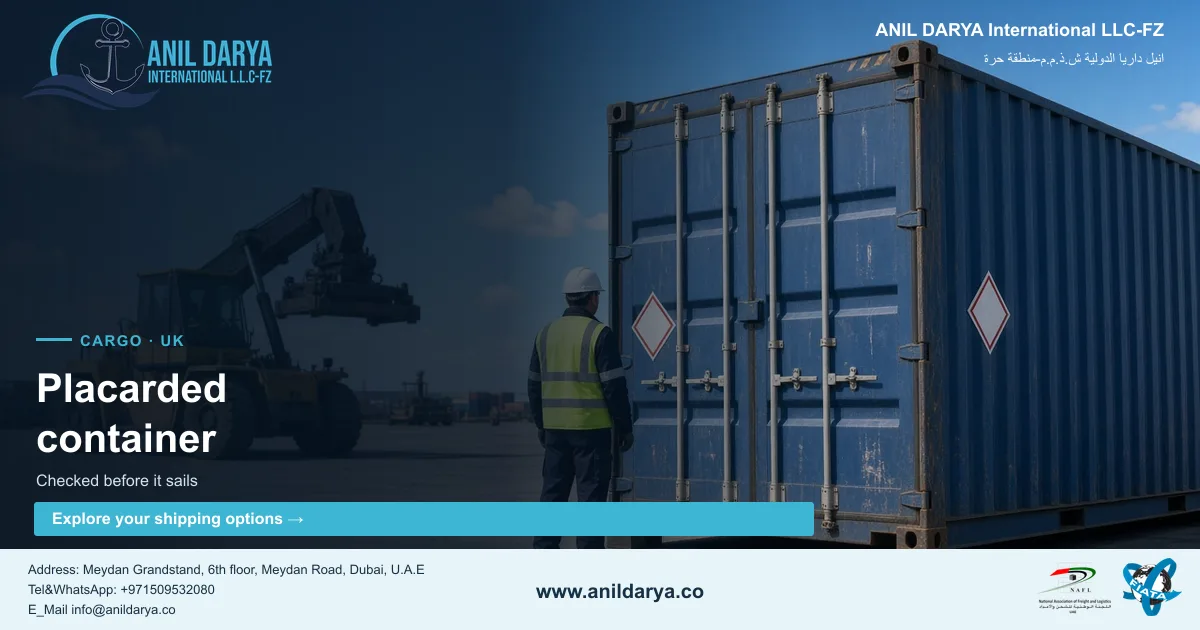
- UN-approved packaging, marks and labels, and placards on the container.
- Any UK licence for controlled chemicals (see restricted goods below).
Declare lithium batteries, perfumes and aerosols at booking. Our dangerous goods shipping team checks the paperwork and carrier acceptance first.
Air cargo from Dubai to the UK
Air suits urgent parts, samples, electronics and goods with a high value per kilo. Cargo leaves from Dubai International (DXB) or Al Maktoum International (DWC) and most often lands at London Heathrow, with Manchester, Birmingham and other airports also used. Air freight is priced on chargeable weight, the higher of actual weight and volumetric weight, so light bulky cargo can cost more than you expect.
The same UK customs rules apply, with an air waybill instead of a bill of lading. Our air cargo service books space and prepares the export side in Dubai.
UK customs: how clearance works with HMRC
HMRC sets out the same core steps for every importer into Great Britain: EORI number, customs agent, commodity code, value, licences, then the import declaration.
| Stage | What happens | Who does it |
|---|---|---|
| Before arrival | Entry summary (safety and security) declaration on S&S GB, up to 200 days ahead and before the goods arrive | Carrier, or a third party for it |
| Before or on arrival | Import declaration on CDS with commodity code, value, origin and procedure | Importer or its customs agent |
| Checks | Documentary checks, and physical or port health checks if selected | HMRC, Border Force, port health |
| Payment | Duty and import VAT paid, deferred, or VAT postponed to the VAT return | Importer |
| Release | Goods released for collection from the terminal | Haulier collects |
Do you need an EORI number to ship to the UK?
Yes, for commercial imports. The UK importer needs an EORI number that starts with GB to import into England, Wales or Scotland. You do not need one for goods that are both uncontrolled and for personal use only.
The business usually has to be established in the UK to get one. A business that is not established there cannot make the import declaration itself in most cases and must appoint someone established in the UK to handle customs. If you sell to the UK on DDP terms from Dubai, plan this before you quote the buyer.
Who files the UK import declaration?
Most importers use a customs agent or freight forwarder in the UK. HMRC requires written instructions that show whether the agent acts directly (in your name) or indirectly (in its own name, sharing liability). Anyone dealing with customs for you must be established in the UK. We work with your UK customs agent or the consignee's broker and send them the export documents and shipment data from Dubai.
Why does the commodity code matter?
The commodity code sets the duty and VAT rate, any anti-dumping duty or quota, and whether you need a licence. On a CDS import declaration, the first 8 digits go in data element 6/14 and digits 9 and 10 in data element 6/15, so imports carry a 10-digit code. Only the first 6 digits are the same worldwide, so a UAE export code is a starting point, not the answer. Look it up in the UK Trade Tariff.
What documents do you need to ship from Dubai to the UK?
| Document | Issued by | Notes |
|---|---|---|
| Commercial invoice | Seller | Value, currency, Incoterm, full description, commodity code |
| Packing list | Seller | Weights, dimensions and marks that match the invoice |
| Bill of lading or air waybill | Carrier | Consignee and notify party must match the UK importer |
| Certificate of origin | UAE chamber or authority | Proves where goods were made; Dubai Customs lists it for declarations |
| UAE export declaration | Filed with Dubai Customs | Required to load the cargo in Dubai |
| Importer's EORI and agent authority | UK importer | Written instructions to the customs agent |
| Licences or certificates | UK or UAE authority | Only for controlled goods, see below |
| DG declaration and SDS | Shipper | Only for dangerous goods |
UK import duty and VAT when you ship from Dubai
How is the customs value worked out?
Duty is charged on the customs value. For sea cargo, HMRC says you include transport and insurance costs up to the place of introduction, which is the UK port of importation. Inland delivery after the port can be left out if it is shown separately. So a FOB Jebel Ali price is not the customs value. Add the ocean freight and insurance.
Customs duty and the UK Global Tariff
The UK Global Tariff is the UK's own standard set of import duty rates, published in the UK Trade Tariff. There you find the commodity code, the duty rate, any suspension or quota and whether import VAT applies. Many goods have a duty rate of zero and many do not, so check the exact 10-digit code before you price the sale.
| Charge | Calculated on |
|---|---|
| Customs duty | Customs value (goods plus freight and insurance to the UK port) x tariff rate for your code |
| Import VAT | Customs value plus duty, plus incidental costs such as transport and insurance to the first UK destination, x VAT rate |
| Excise duty | Only for goods such as alcohol and tobacco |
Is there a UK trade deal with the UAE?
The UK and the Gulf Cooperation Council, which includes the UAE, concluded a free trade agreement on 20 May 2026. The GOV.UK summary, last updated 10 June 2026, says the legal text was still being finalised and that the deal enters into force only after the UK and the GCC states complete ratification. Under the deal, the UK will cut tariffs on current GCC exports from day one, but only for goods that meet the rules of origin. Until it is in force, goods from the UAE pay the standard UK Global Tariff rate. Check the status on GOV.UK before you rely on a preference.
Import VAT and postponed VAT accounting
Imported goods are charged VAT at the same rate as if they were sold in the UK: 20% standard, 5% reduced and 0% zero rate. The base is the customs value plus duty and incidental costs.
If the importer is VAT-registered in the UK, it can use postponed VAT accounting. It declares the import VAT on its VAT return and reclaims it on the same return, so no cash leaves the business at the border. No approval is needed. The option is chosen on the import declaration, and the VAT number goes in data element 3/40. It cannot be changed after submission. Monthly postponed import VAT statements are downloaded through CDS.
A business without a UK establishment must use a customs agent, who selects the option for it.
Can you pay duty later?
Regular importers can open a duty deferment account. Duty and import VAT declared on CDS are then collected by Direct Debit on the 16th of the month after the accounting period, which HMRC says gives an average of 30 days credit. Without postponed VAT or deferment, VAT and duty are paid in full at import before release.
What about small consignments of £135 or less?
For goods sold directly to customers in Great Britain in consignments of £135 or less, the seller charges UK VAT at the point of sale. Above £135, normal import rules apply. This mostly affects e-commerce parcels.
Restricted goods, licences and UK border checks
HMRC lists goods that may need a licence or certificate to import, including:
- Animals and animal products, plants, and high-risk food.
- Veterinary and human medicines, controlled drugs, tissues and cells.
- Waste, F gas products, and precursor and hazardous chemicals.
- Nuclear material, weapons, and goods that could be used for torture or capital punishment.
Food, feed, animal products and medium or high-risk plants must be pre-notified on IPAFFS, the Defra system, before they arrive. At the port, port health and plant health teams may inspect them at a border control post.
Solid wood packaging, including pallets, crates and dunnage, must meet ISPM 15 and carry the mark. Heat treatment means 56°C for at least 30 continuous minutes through the wood. Non-compliant packaging can be rejected or destroyed.
The UAE side: export from Dubai
Every shipment needs an export or re-export declaration with Dubai Customs before it loads. Dubai Customs lists an invoice, packing list, certificate of origin and any permit for restricted goods as the documents for a declaration. Its published export declaration fees range from AED 15 to AED 100, depending on declaration type and channel. Use a re-export declaration for goods that came into Dubai from abroad, such as stock held in Jafza.

What does shipping from Dubai to the UK cost?
Lane prices change with every sailing. These factors move your landed cost.
| Cost element | What drives it |
|---|---|
| Ocean or air freight | Container type, volume or chargeable weight, carrier, season |
| Origin charges in Dubai | Trucking to the port, terminal handling, export declaration, documents |
| UK destination charges | Terminal handling, delivery order fees, port and CFS charges for LCL |
| Customs and taxes | Duty rate for your code, import VAT, agent fee |
| Inland UK delivery | Truck or rail distance from the port, tail-lift or timed delivery needs |
| Delays | Demurrage, detention and storage if clearance is late |
| Insurance | Cargo value and cover level |
Your Incoterm decides which of these you pay. Under FOB or FCA the UK buyer pays the freight and all UK costs. Under DAP you pay to the door but not duty or VAT. Under DDP you pay everything, including UK import VAT, which only works if someone can act as UK importer. Our guide to Incoterms 2020 for sea freight explains the split, and our article on demurrage and detention shows how delay charges build up.
How to ship cargo from Dubai to the UK: step by step
- Share the cargo details. Commodity, weight, volume or dimensions, pickup address, UK delivery address and the Incoterm.
- Confirm the commodity code and duty. The UK importer or its agent checks the 10-digit code and any licence in the UK Trade Tariff.
- Check the UK importer is ready. EORI number starting with GB, a customs agent appointed in writing, and VAT registration if it wants postponed VAT accounting.
- Choose mode and port. We compare FCL, LCL or air and the UK port nearest the consignee.
- Book space. For DG, reefer or out-of-gauge cargo we get carrier acceptance first.
- Prepare documents. Invoice, packing list, certificate of origin, ISPM 15 packaging, and any licence or IPAFFS notification.
- Pick up and export. We truck the cargo or container to the port, file the Dubai Customs export declaration and meet the cut-off.
- Release the bill of lading. We check the draft and release the original or a sea waybill as agreed.
- UK clearance. The carrier files the entry summary declaration; the UK agent files the CDS import declaration before or on arrival.
- Pay or defer duty and VAT, then deliver. The haulier collects from the terminal and the empty container goes back within free time.
[AMIR-FACT: one real Dubai to UK shipment we handled (cargo, mode, UK port, door-to-door days, and any problem we solved)]
Checklist before you ship to the UK
- UK importer has an EORI number starting with GB.
- Customs agent appointed in writing, direct or indirect.
- 10-digit commodity code checked in the UK Trade Tariff.
- Duty, VAT and any licence costed before the price is agreed.
- Invoice, packing list and bill of lading match on weights, pieces and consignee.
- Certificate of origin issued in the UAE.
- Pallets and crates ISPM 15 marked.
- IPAFFS notification made for food, feed, animal or plant products.
- DG documents and carrier acceptance in place, if relevant.
- Postponed VAT accounting selected on the declaration, if the importer is VAT-registered.
- Cargo insurance arranged.
Common mistakes on the Dubai to UK lane
- Declaring duty on the FOB price. The customs value includes freight and insurance to the UK port.
- Using the UAE commodity code. The UK code has 10 digits and may give a different rate.
- Selling DDP without a UK importer. A Dubai seller with no UK establishment cannot simply clear the goods itself.
- Forgetting postponed VAT accounting. A VAT-registered importer then pays 20% VAT up front for no reason.
- Unmarked wooden pallets. Non-ISPM 15 packaging can be rejected or destroyed.
- Undeclared batteries or perfumes. The carrier can refuse or fine misdeclared DG.
- Assuming the UK-GCC deal is already in force. Check GOV.UK before quoting a duty-free price.
Frequently asked questions
Which UK port is best for cargo from Dubai?
Felixstowe, Southampton and London Gateway take most deep-sea containers. Pick the one closest to your consignee, and consider rail from Felixstowe for the Midlands and the North.
Do I need an EORI number to import from Dubai to the UK?
Yes, for commercial goods. The UK importer needs an EORI number starting with GB for imports into England, Wales or Scotland. It is not needed for uncontrolled goods for personal use only.
Is there customs duty on goods shipped from Dubai to the UK?
It depends on the commodity code. Duty is the UK Global Tariff rate for your code, charged on the value including freight and insurance to the UK port. Some codes are zero-rated for duty.
What is the VAT rate on imports into the UK?
Import VAT is charged at the same rate as a UK sale: 20% standard, 5% reduced or 0%. It is calculated on the customs value plus duty and incidental costs.
What is postponed VAT accounting?
It lets a UK VAT-registered importer declare and reclaim import VAT on the same VAT return instead of paying it at the border. It is selected on the import declaration and needs no approval.
Does the UK-GCC trade agreement make imports from the UAE duty-free?
Not yet. The deal was concluded on 20 May 2026 and enters into force only after ratification by the UK and the GCC states. Until then, standard UK Global Tariff rates apply.
What is CDS?
The Customs Declaration Service is HMRC's system for import declarations. Duty deferment payments and postponed import VAT statements are also handled through it.
Can I ship dangerous goods from Dubai to the UK?
Yes. Sea DG follows the IMDG Code and air DG the IATA rules. You need the UN number, SDS, a signed DG declaration, approved packaging and carrier acceptance before loading.
Get a quote for shipping from Dubai to the UK
Send us the cargo details, the UK delivery address and your Incoterm, and we will come back with a routing and price for sea or air. Use our freight rate inquiry form, or contact our team to talk through DG, breakbulk or a DDP sale first. You can also read about our Dubai freight forwarding team.
Sources
- GOV.UK: Import goods into the UK, step by step
- GOV.UK: Get an EORI number
- GOV.UK: Appoint someone to deal with customs on your behalf
- GOV.UK: Making an entry summary declaration (S&S GB)
- GOV.UK: Using commodity codes in the Customs Declaration Service
- GOV.UK: Finding commodity codes for imports or exports
- GOV.UK: Look up commodity codes, duty and VAT rates (UK Trade Tariff)
- GOV.UK: Delivery costs to include in the customs value
- GOV.UK: VAT on imports
- GOV.UK: VAT rates
- GOV.UK: Postponed VAT accounting
- GOV.UK: How to use your duty deferment account
- GOV.UK: VAT and overseas goods sold directly to customers in the UK (£135 rule)
- GOV.UK: UK-GCC trade deal conclusion summary (updated 10 June 2026)
- GOV.UK: UK-GCC trade deal collection
- GOV.UK: Import of products, animals, food and feed system (IPAFFS)
- GOV.UK: Wood packaging material for import and export (ISPM 15)
- Dubai Customs: Submit customs declaration (documents and fees)
- DP World: Shipping to the United Kingdom (UK port codes)
Reviewed: 10 November 2026