
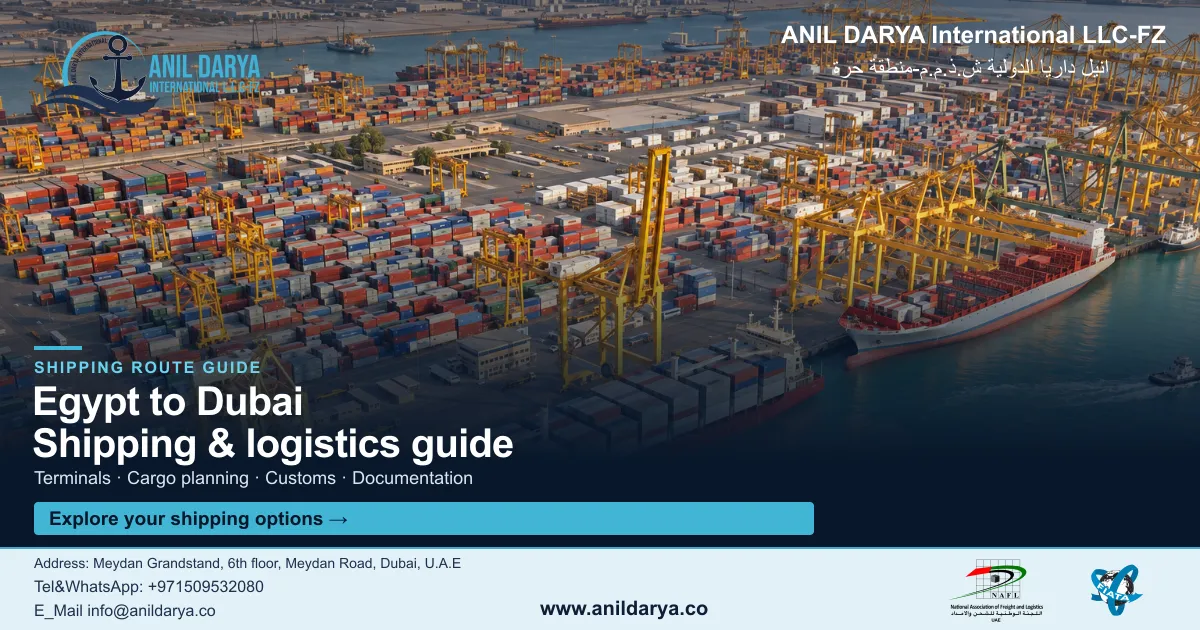
Shipping from Egypt to Dubai normally means a container loaded at Alexandria, Damietta, Port Said or Sokhna and discharged at Jebel Ali, with air cargo from Cairo for urgent goods. Your Egyptian supplier must be on the Exporters Register and file the export on Nafeza. In Dubai you need a customs business code, a declaration with Dubai Customs, 5% duty on the CIF value for most goods and 5% import VAT.
Egypt to Dubai shipping at a glance
| Item | Detail |
|---|---|
| Egyptian load ports | Alexandria and Dekheila, Damietta, East and West Port Said, Ain Sokhna |
| Main UAE discharge port | Jebel Ali (DP World), four container terminals, over 80 weekly services |
| Other UAE options | Khalifa Port (Abu Dhabi), Sharjah ports |
| Main air gateway in Egypt | Cairo International Airport (CAI) |
| Modes | FCL, LCL, breakbulk and project cargo, dangerous goods, air cargo |
| Egyptian export filing | Nafeza single window; a Unique Consignment Reference (UCR) for each shipment |
| Who may export from Egypt | Only firms on the Exporters Register (GOEIC) |
| UAE customs authority (Dubai) | Dubai Customs |
| Importer ID in Dubai | Customs business code, registered online on Dubai Trade |
| Customs duty | 5% of CIF for most goods; 50% alcohol; 100% cigarettes |
| Import VAT | 5%, deferred to the VAT return for registered importers with a linked customs number |
| Bilateral UAE-Egypt CEPA | None on Abu Dhabi Customs' list of agreements |
| Free zone at the port | Jafza, over 11,000 businesses |
How the sea route works and what sets the transit time
Egypt has two port groups that matter for this lane. The Mediterranean ports (Alexandria, Dekheila, Damietta and Port Said) serve the Nile Delta, Cairo and the industrial cities around them. Ain Sokhna sits on the Gulf of Suez and is often the closer gateway for factories east of Cairo.
Most sea cargo arrives at Jebel Ali. Some services sail direct, others relay through a hub, and the call order on the way decides how many days the box spends at sea. Published lane figures vary a lot from one service to the next, so we do not quote a single transit number here. Check the actual rotation of the vessel you are booked on.
What changes the transit time from Egypt?
| Factor | Effect | What to do |
|---|---|---|
| Load port | Mediterranean ports and Sokhna sit on different services | Compare both if the factory is near Cairo |
| Direct or relay service | A transhipment adds a port call and a vessel change | Ask for the full rotation, not only the sailing date |
| Egyptian export checks | GOEIC inspects some goods before loading | Book the inspection before the gate-in cut-off |
| Holidays | Public holidays in Egypt and the UAE slow factories, trucks and offices | Book space and permits a week earlier |
| Dubai clearance | A missing permit holds the box at the terminal | File the Dubai declaration before berthing |
[AMIR-FACT: our real port-to-port transit days from Alexandria, Damietta, Port Said and Sokhna to Jebel Ali, and the carriers we usually book on this lane]
Which load port should you ship from?
Pick the port that saves the most trucking from the factory, then check which one has the better service to Jebel Ali that week.
| Egyptian port | What the operator or authority says | Good for suppliers in |
|---|---|---|
| Alexandria and Dekheila | Alexandria Port Authority runs both; it says they handle about 60% of Egypt's import and export volume | Alexandria and the western Delta |
| Damietta | Damietta Alliance Container Terminals started commercial operations on 14 February 2026, with a 1,670 m quay and 18 m water depth | Damietta and the eastern Delta |
| East Port Said (SCCT) | APM Terminals container terminal with a 3,355 m quay and 17 m depth alongside | Port Said, Ismailia, the canal zone |
| West Port Said | City-side port with container, multipurpose, general cargo and bulk berths | Smaller ships and general cargo |
| Ain Sokhna | DP World Sokhna, with 17 m depth alongside its container berths and 584 reefer points at Berth 1 | Cairo and the Suez area |
If you import from Egypt to Dubai in reefers, such as citrus, grapes or frozen food, the cargo needs plug points at the load port and on the vessel. Ask about reefer space before you confirm the sailing.
Which UAE port should your cargo arrive at?
For a consignee in Dubai or in the Jebel Ali Free Zone, Jebel Ali is the natural choice. DP World lists four container terminals there, over 80 weekly services, and handling for breakbulk, project cargo, reefers and IMDG dangerous goods. Read our Jebel Ali port guide for terminal details.
- Warehouse or site in Abu Dhabi: compare a call at Khalifa Port in Abu Dhabi to shorten the truck leg.
- Consignee in Sharjah or the northern emirates: compare Sharjah port shipping.
- Goods for re-export: keep them in Jafza next to Jebel Ali and decide the next market later.
Sea freight from Egypt to Dubai: FCL, LCL and special cargo
| Mode | When it fits | What to plan in Dubai |
|---|---|---|
| FCL (20ft, 40ft, high cube) | You fill most of a box | Declaration before arrival, delivery order, truck slot, empty return |
| LCL | A few pallets | Release after the shared box is unpacked at the CFS |
| Reefer | Fruit, vegetables, frozen and chilled food | Food import approval ready before discharge, plug time at the terminal |
| Flat rack, open top, breakbulk | Machinery, steel, marble blocks, project pieces | Lifting plan, trailer, road permit for oversized loads |
| Dangerous goods | Chemicals, paints, solvents, batteries | Carrier approval and short port stay for some classes |
| Air cargo | Samples, spares, urgent or high-value goods | Same Dubai Customs declaration, duty and VAT |
FCL or LCL from Egypt?
FCL is sealed at the factory and released as one unit. LCL costs less for small loads, but the box is only unpacked when every consignee's paperwork is in order, so one late file delays everyone. If your cargo is close to a 20ft, price both. Our guide to FCL vs LCL shows where the break-even usually sits.
Marble, furniture, machinery and project cargo
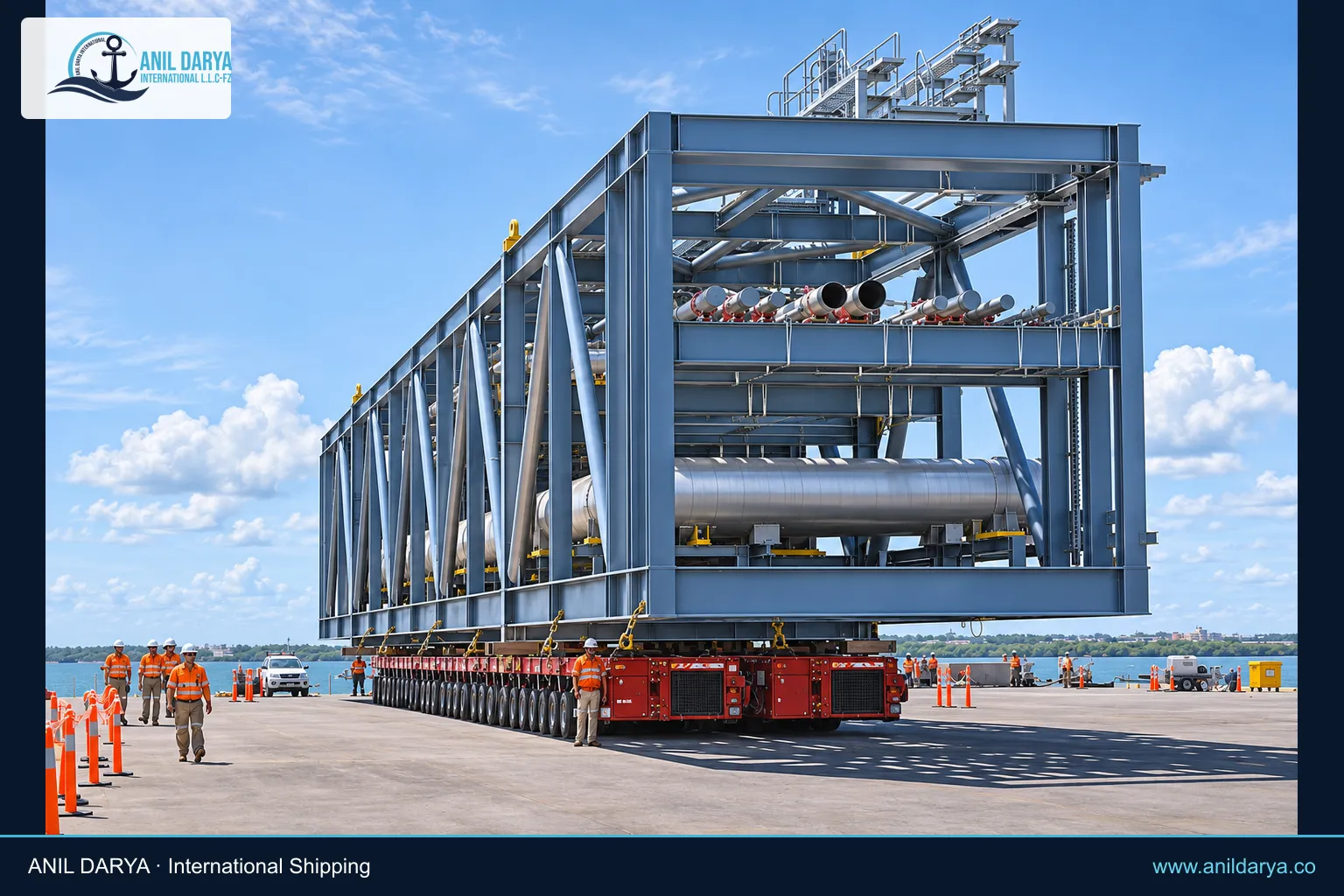
Marble slabs, granite and steel are heavy for their volume, so a 20ft often hits its weight limit before it is full. Check the payload with the carrier before loading. Oversized machinery moves on flat racks or as breakbulk. At the Dubai end we plan the discharge, the trailer and any road permit before the vessel berths. See our break bulk and project cargo service.
Dangerous goods from Egypt to Dubai
Paints and solvents are on GOEIC's list of goods it inspects at export, so the Egyptian side needs time for that check as well as the carrier's DG approval. Jebel Ali handles IMDG cargo, but port rules limit how long some classes may stay in the port. Have the Safety Data Sheet, the DG declaration, UN packaging and labels in order, and the Dubai declaration ready to file. Our guide to dangerous goods customs clearance in the UAE covers the Dubai side.
Air cargo from Egypt to Dubai
Cairo International (CAI) is the main air gateway. Fluent Cargo's route data lists flights from Cairo to Dubai International (DXB), Sharjah (SHJ) and Abu Dhabi (AUH). Air suits samples, spare parts, pharma and short-life perishables. Clearance in Dubai is the same as for sea freight: a declaration under your customs code, 5% duty and import VAT.
What your supplier must do before export
The export side belongs to your supplier or its customs broker. We book the space with the carrier, and the shipper or its origin agent handles pickup and export filing. Delays there still land on your schedule, so check these points before you place the order.
| Requirement | What the official source says | Why it matters to you |
|---|---|---|
| Exporters Register | Article 39 of Import and Export Regulation 770/2005: only those on the register may export (GOEIC) | A supplier not on the register cannot ship |
| Export declaration | Nafeza's Advanced Export System: exporters and customs brokers issue a UCR for each shipment | The UCR is the reference for the export file |
| Export inspection | GOEIC inspects goods such as leather, marble, furniture, paints and solvents, some mining materials and fertilisers at its port branches | Allow time before the cut-off |
| Certificate of origin | GOEIC issues preferential certificates, including the Arab League form; chambers of commerce issue non-preferential certificates | Dubai Customs asks for a certificate of origin |
Ask which certificate your supplier will issue, and make sure the exporter name, consignee, HS codes and weights match the invoice. Note that GOEIC says free zone products cannot get the chambers' non-preferential certificate, so a supplier inside an Egyptian free zone should confirm its route to a certificate early.
Clearing the cargo with Dubai Customs
Dubai Customs clears cargo arriving at Jebel Ali and Dubai's other entry points. You file online, and each declaration falls under one regime: import, export, transit, transfer or temporary admission.
Who can file the Dubai declaration?
Dubai Customs says every business that uses its services must hold a customs business code, and registration is done online on Dubai Trade. A clearing agent with a Dubai Economic Department clearing and forwarding licence can also clear the cargo, using its own code and your authorisation in the system. If you have no code yet, we arrange clearance through a licensed agent.
Which documents does Dubai Customs ask for?
Dubai Customs lists the invoice, the packing list, the certificate of origin and, for restricted goods, a permit from the controlling authority. For sea cargo you also need the bill of lading and the line's delivery order.
| Document | Who provides it | Used for |
|---|---|---|
| Commercial invoice | Egyptian exporter | Customs value and HS code |
| Packing list | Egyptian exporter | Inspection, LCL release |
| Certificate of origin | GOEIC or an Egyptian chamber of commerce | Origin of the goods |
| Bill of lading or air waybill | Carrier or forwarder | Title and release |
| Delivery order | Shipping line in Dubai | Collecting the container |
| Permit | UAE authority for the product | Restricted goods only |
| SDS and DG declaration | Egyptian exporter | Dangerous goods only |

Which declaration fits your goods?
| Plan for the goods | Declaration | Duty and VAT |
|---|---|---|
| Sell or use in the UAE mainland | Import for local use | Paid or accounted for at import |
| Store in Jafza and sell on | Transfer into the free zone | Due only if the goods later enter the mainland |
| Show, test or repair, then send back | Temporary admission | Deposit equal to the duty, refunded on re-export in time |
| Pass through to another country | Transit | Not imported into the UAE |
Customs duty and VAT on goods shipped from Egypt to Dubai
Dubai Customs charges 5% of the CIF value for most goods. CIF is the value of the goods plus insurance and freight to the UAE, so a low FOB price does not lower the base if the freight is high. Alcohol pays 50% and cigarettes 100%. The UAE government portal says tariffs in the country range from 0 to 5%, so check the rate for your HS code.
Import VAT is 5%. The Federal Tax Authority says it is charged on the customs value, including insurance, freight and any customs fees and excise tax paid on import.
- VAT-registered importer with its customs number registered with the FTA: no VAT at the border. The VAT shows in your return and you recover it as input tax if eligible.
- Importer without VAT registration: VAT is paid before Dubai Customs releases the goods.
| Charge | Rate | Base |
|---|---|---|
| Customs duty, most goods | 5% | CIF value |
| Customs duty, alcohol | 50% | CIF value |
| Customs duty, cigarettes | 100% | CIF value |
| Import VAT | 5% | Customs value plus customs fees and excise tax |
Is there a trade agreement for Egyptian goods?
Abu Dhabi Customs publishes the UAE's bilateral CEPAs, and Egypt is not on that list. So there is no CEPA certificate to ask for on this lane. Egypt and the UAE both take part in the Greater Arab Free Trade Area. Abu Dhabi Customs notes that GAFTA claims use their own exemption code (No. 47) in the UAE declaration and a GAFTA certificate template. If your supplier issues the Arab League certificate through GOEIC, ask us to confirm with Dubai Customs how it applies to your HS code before you price the goods on it.
Re-exporting the goods through Jafza
A lot of cargo on this lane does not stay in the UAE. A Dubai or Jafza trader buys in Egypt, holds stock and sells to other Gulf or African markets. Three choices decide the cost.
- Declaration type. A free zone transfer into Jafza or a transit declaration keeps duty off goods that leave again.
- Location. Jafza, operating since 1985 next to Jebel Ali Port and close to Al Maktoum International Airport, hosts over 11,000 businesses.
- Paperwork for the next buyer. The goods stay Egyptian origin, and the next market will ask for its own documents.
Our guide to Jafza re-export explains the free zone route for bulk and breakbulk goods.
Temporary imports for exhibitions and projects
Machines or display goods that come from Egypt for an exhibition or a project and then go back can enter under temporary admission. Dubai Customs takes a deposit equal to the duty and refunds it when the goods are re-exported in the allowed period. Goods on an ATA carnet need no deposit. List serial numbers on the packing list, because customs checks them on exit.
Restricted and prohibited goods for the UAE
Restricted goods clear only with a permit from the competent UAE authority. On this lane the groups that need the most planning are:
- Fresh produce, juices, dairy and other food: food safety approval and an origin health certificate.
- Plants, seeds and fertilisers: agricultural approval.
- Medicines and medical devices: health authority approval.
- Cosmetics and personal care products: product registration.
- Chemicals and dangerous goods: permits for some products and port approval for some classes.
- Radio and telecom equipment: type approval.
Prohibited goods cannot be imported at all. Check the HS code before your supplier produces the order, and apply for any permit before the vessel sails from Egypt.
How to ship from Egypt to Dubai: step by step
- Send us the details. Commodity, HS code, weight, volume, pickup city in Egypt and the delivery address in the UAE.
- Agree the Incoterm. Under FOB we book the sea freight from the Egyptian port. Under CFR or CIF the supplier books it and we take over at Jebel Ali. See our guide to Incoterms 2020 for sea freight.
- Check the supplier. It must be on the Exporters Register, and GOEIC inspection must be booked if the goods are on its list.
- Prepare the Dubai side. Customs business code, VAT number linked to it, and permits for restricted goods.
- Book space. We confirm the load port, the service and the arrival terminal. Reefer, DG and out-of-gauge cargo need carrier approval first.
- Export clearance in Egypt. The supplier or its broker files on Nafeza under the shipment's UCR and gets the box loaded.
- Check documents before arrival. Invoice, packing list, bill of lading and certificate of origin must match on names, weights and HS codes.
- File the Dubai declaration. We file through a licensed agent before the vessel berths.
- Pay and release. We arrange payment of the duty, VAT if due and the line's charges, then collect the delivery order.
- Deliver. We book the truck slot, deliver to your site or Jafza warehouse and return the empty within free time.
[AMIR-FACT: one real Egypt to Dubai shipment we handled, with cargo type, Egyptian load port, mode, how the Dubai clearance went and total days, cleared for publication]
What decides the landed cost?
Rates change every week, so we quote each shipment. These are the drivers you can control:
| Cost factor | Effect |
|---|---|
| Load port and service | A direct service usually costs less than a relay with extra handling |
| Container type | Reefer, flat rack and open top cost more than dry boxes |
| Weight | Heavy cargo such as marble may need more boxes than its volume suggests |
| Incoterm | Decides who pays each leg and which local charges |
| Egyptian origin charges | Trucking, terminal handling, export clearance, inspection, certificate |
| Dubai destination charges | Terminal handling, delivery order, clearance, trucking, CFS for LCL |
| Duty and VAT | 5% duty on CIF and 5% VAT unless VAT is deferred |
| Free time | Demurrage and detention once the free days run out |
DAP or DDP: who pays the Dubai duty?
Under DAP the Egyptian seller delivers to your door and you clear the goods and pay duty and VAT. Under DDP the seller pays them, but an entity with a Dubai customs code must still act as importer. A seller without a UAE company usually cannot do that, so write into the contract whose code is used and who recovers the VAT.
The cost most buyers can avoid is waiting at the terminal. Our article on demurrage and detention shows how fast it adds up.
Checklist before cargo leaves Egypt
- Your customs business code is active and linked to your VAT registration.
- HS code agreed with the supplier and checked for duty and restrictions in the UAE.
- Supplier confirmed on the Exporters Register.
- GOEIC export inspection booked if the product needs it.
- Certificate of origin type agreed and requested.
- UAE permits applied for (food, cosmetics, chemicals, telecom).
- Declaration type chosen: local import, free zone, temporary admission or transit.
- Invoice, packing list and bill of lading match each other.
- DG: SDS, DG declaration, carrier approval and a delivery plan for the port stay limit.
- Free time at Jebel Ali agreed and delivery booked.
- Cargo insurance in place.
Common mistakes when shipping from Egypt to Dubai
- Buying from a trader who is not on the Exporters Register. The goods cannot leave Egypt.
- Forgetting the GOEIC inspection for marble, furniture, paints or leather. The box misses the vessel.
- No customs code in Dubai. The cargo waits until an authorised party can file.
- Food or cosmetics shipped before UAE approval. These are the most common holds on food lanes.
- Overweight containers of stone or steel. The line refuses the box or charges for the overweight.
- Pricing goods on an assumed duty preference without checking it for the HS code first.
- Declaring goods for local use that were meant for re-export. That costs duty you did not need to pay.
Frequently asked questions
Which Egyptian port is best for shipping to Dubai?
It depends on the factory. Alexandria, Damietta and Port Said serve the Delta and the north. Ain Sokhna is often closer for factories east of Cairo. Compare the trucking cost and the sailings to Jebel Ali for that week.
How long does shipping from Egypt to Dubai take by sea?
It depends on the service. Direct sailings are faster than services that relay through a hub. Ask for the vessel rotation when you book, and add time for Egyptian export checks and Dubai clearance.
What is the customs duty on goods from Egypt to Dubai?
Dubai Customs charges 5% of the CIF value for most goods, 50% on alcohol and 100% on cigarettes. Import VAT of 5% also applies.
Is there a UAE-Egypt CEPA that cuts duty?
No. Egypt is not on Abu Dhabi Customs' list of UAE bilateral CEPAs. GAFTA claims use their own code in the UAE declaration, so check with Dubai Customs how it applies to your HS code.
Who files the export declaration in Egypt?
The exporter or its customs broker files on Nafeza and issues a UCR for each shipment. The exporter must be on GOEIC's Exporters Register.
Do I need a customs code to import from Egypt into Dubai?
Yes. Every business using Dubai Customs services needs a customs business code from Dubai Trade. A licensed clearing agent can file with your authorisation.
Can I ship from Egypt to a Dubai free zone without paying duty?
Yes. Goods transferred into Jafza pay duty only if they later enter the UAE mainland.
What documents are needed to clear Egyptian cargo in Dubai?
An invoice, packing list, certificate of origin, bill of lading and delivery order, plus a permit for restricted goods. Dangerous goods also need an SDS and a DG declaration.
Get a quote for shipping from Egypt to Dubai
Tell us the cargo, the pickup city in Egypt and the delivery address in the UAE, and we will reply with a routing and a price that includes clearance in Dubai. Use our freight rate inquiry form or contact our team. You can also read how our Dubai freight forwarding team works.
Sources
- DP World: Jebel Ali Port (terminals, weekly services, cargo types)
- Dubai Customs: FAQ (5% of CIF, alcohol and cigarettes, business code, clearing agents, deposits)
- Dubai Customs: Submit customs declaration (regimes and documents)
- UAE Government portal: Customs duty
- Federal Tax Authority: VAT guide, section 3.5 (import VAT)
- Abu Dhabi Customs: Bilateral customs agreements (list of UAE CEPAs)
- Abu Dhabi Customs: UAE-Jordan CEPA page (GAFTA code No. 47 and certificate template)
- Jafza: About Jebel Ali Free Zone
- GOEIC: Exporters Register (Regulation 770/2005, Article 39)
- GOEIC: Exports and origin (inspection, certificates of origin)
- Nafeza: Advanced Export System and UCR
- Alexandria Port Authority
- Baird Maritime: Damietta Alliance Container Terminals starts commercial operations
- APM Terminals: Suez Canal Container Terminal (SCCT)
- SCZONE: West Port Said port
- DP World Sokhna: Infrastructure facts
- Egypt Maritime Transport Sector: Sokhna port
- Greater Arab Free Trade Area (membership)
- Fluent Cargo: Egypt to Dubai (air gateways)
- Fluent Cargo: Egypt to United Arab Emirates (air gateways)
Reviewed: 10 November 2026