
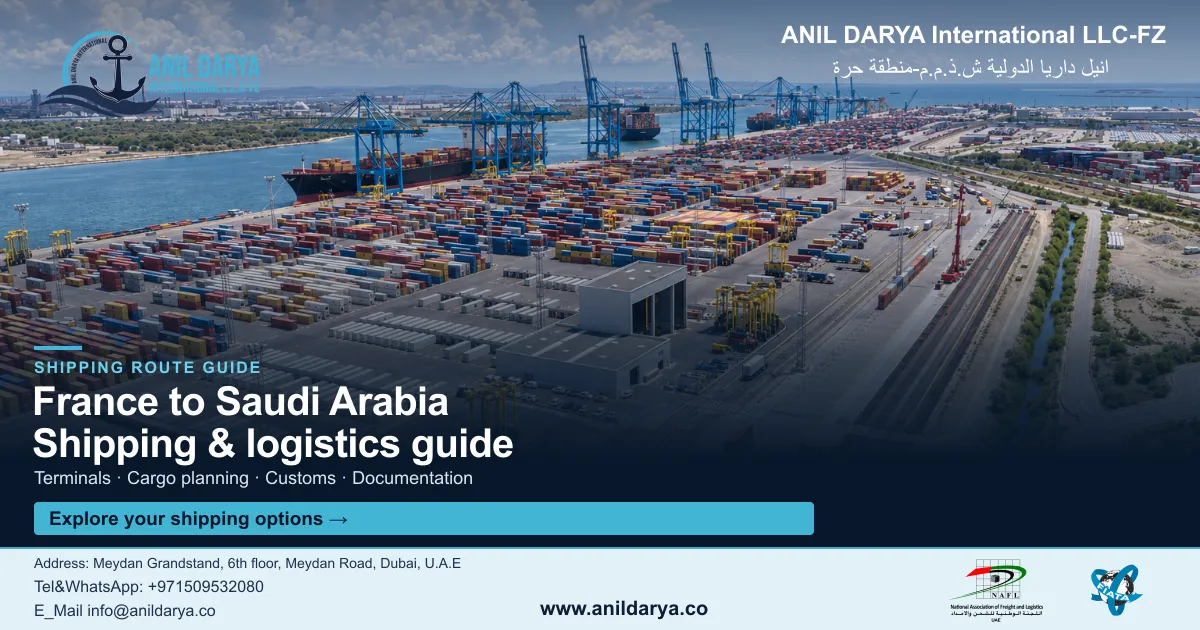
Shipping from France to Saudi Arabia usually means a container loaded at Marseille-Fos, Le Havre or Dunkirk and discharged at Jeddah or King Abdullah Port on the Red Sea, or at Dammam when the goods are for Riyadh or the Eastern Province. The French exporter lodges the export declaration in French customs' DELTA services, while the Saudi importer's broker files on Fasah with a SABER shipment certificate and pays duty plus 15% VAT. Anil Darya books this lane from Dubai as a cross-trade: we secure space with the shipping line and keep the French shipper, the carrier and the Saudi broker on one timeline.
France to Saudi Arabia shipping at a glance
| Item | Detail |
|---|---|
| Usual mode | Sea freight: FCL, LCL, flat rack and breakbulk for machinery; DG containers for perfume and chemicals; reefer for some medicines and foods |
| French load ports | Marseille-Fos for the south and the Rhone valley; Le Havre and Dunkirk for Paris and the north; Nantes Saint-Nazaire for heavy pieces from the west |
| Saudi discharge ports | Jeddah Islamic Port and King Abdullah Port on the Red Sea; King Abdulaziz Port Dammam and Jubail on the Gulf coast |
| Routing | Some Mediterranean services call Fos and a Saudi Red Sea port on one loop; northern French cargo and Gulf-coast cargo often connect at a hub. Confirmed per booking |
| French export filing | Electronic declaration in DELTA (DELTA IE for exports since 4 November 2025), EORI number needed |
| Origin papers | Certificate of origin from a French chamber of commerce through the GEFI platform; legalisation if the Saudi side asks for it |
| Saudi import filing | Fasah declaration at least 48 hours before the vessel arrives, by the importer or its licensed broker |
| Conformity | SABER product certificate for regulated goods and a shipment certificate per consignment, applied for before the customs declaration |
| Duty | Ad valorem on CIF value; GCC common external tariff of at least 5% on most goods; revised Saudi tariff since 27 November 2025 |
| Import VAT | 15% |
| Who clears in Saudi Arabia | The consignee or its Saudi customs broker, confirmed before we confirm the booking |
How a France to Saudi Arabia cross-trade is split
The container goes from a French terminal to a Saudi terminal. It does not pass through the UAE unless you choose a Dubai option, and our part is run from our Dubai office.
| Job | Who does it |
|---|---|
| Choosing the sailing, booking space and equipment with the line | Anil Darya |
| Collection in France, packing, stuffing and the DELTA export declaration | The French seller or its transitaire (customs agent); we send them the cut-off times and vessel details |
| Bill of lading | The shipping line's own bill of lading, issued and released to you through us as the line's agent |
| SABER certificates, SFDA or ministry approvals | The Saudi importer, using technical files from the French maker |
| Fasah declaration, duty and VAT | The consignee or its Saudi customs broker |
We are agent for many shipping lines, so the document you receive is the carrier's bill of lading covering French port to Saudi port. Before it is issued, we compare the draft against the French commercial invoice, the packing list and the Saudi importer's legal name. A wrong consignee name on a bill of lading for Jeddah is a slow fix once the ship has sailed.
Most French exporters sell FCA or FOB, which leaves the ocean freight with the Saudi buyer and makes our booking the buyer's booking. On CFR or CIF Jeddah the French side pays freight, but Saudi duty, VAT and terminal charges stay with the buyer. DDP rarely works here, because a French company normally cannot act as importer of record in the Kingdom. Read our guide to Incoterms 2020 in sea freight before you sign the sales contract.
Which French port suits your cargo?
France has two shipping coasts, and the choice changes the services on offer. A plant in Lyon or Provence is usually best served from Fos. A warehouse near Paris or Lille usually goes from Le Havre or Dunkirk, even when the sea leg is longer, because the trucking is shorter.
| French port | What the port reports | Usual catchment |
|---|---|---|
| Marseille-Fos | 1.45 million TEU in 2025, with 16% of containers moved by rail and 5% by river | Provence, the Rhone valley, Lyon, Occitanie |
| Le Havre (HAROPA PORT) | HAROPA PORT handled a record 3.2 million TEU in 2025; Le Havre moved 145,000 TEU by train to and from the hinterland | Paris region, Normandy, the centre and north |
| Dunkirk | Terminal des Flandres has 1,600 m of deep-water quay, two berths dredged to 17.50 m and 700 reefer plugs | Hauts-de-France, the north-east |
| Nantes Saint-Nazaire | Container terminal at Montoir; also used for heavy pieces | Western France |
If the Fos sailing is better that week, a box from the Paris region can still reach it by train, so ask for the through cost.
Which Saudi port should French cargo go to?
Saudi Arabia is wide. Jeddah and Riyadh are roughly a country apart, so pick the port by the final delivery address, not by the first Saudi call on the rotation.
| Saudi port | Coast | What the operator or official source says | Best for |
|---|---|---|---|
| Jeddah Islamic Port | Red Sea | Red Sea Gateway Terminal lists 6.2 million TEU of container capacity on 3,300 m of quay, plus a multipurpose terminal with 12 berths and 2,500 m of quay | Jeddah, Makkah, Madinah, the west |
| King Abdullah Port | Red Sea | Owned and developed by Ports Development Company; current container capacity 5.5 million TEU, Ro-Ro 200,000 CEU, a bonded and re-export zone | Rabigh, King Abdullah Economic City, vehicles |
| King Abdulaziz Port, Dammam | Gulf | 43 berths, a container terminal and two general cargo terminals, 105 million tonnes of capacity, rail to the Riyadh dry port | Riyadh, Dammam, Khobar, the Eastern Province |
| Jubail | Gulf | Commercial and industrial ports beside Jubail Industrial City | Petrochemical plant parts and project cargo |
For a Riyadh consignee, price two options side by side: a Red Sea port plus a long truck haul, and Dammam plus rail or road. The shorter sea voyage does not always give the earlier delivery.
Direct calls or a connection: sea freight from France to Saudi Arabia
From the south of France, some deep-sea services call Fos and a Saudi Red Sea port on the same loop. Liner rotations change often, so we check the current one before quoting.
From Le Havre and Dunkirk, and to Dammam or Jubail from any French port, the box more often changes ship at a hub. The carrier's bill of lading still runs from the French load port to the Saudi discharge port. Ask which hub is used and track the second vessel as well as the first.
We do not print a general transit figure for this lane. The time depends on the coast you load on, the service and the connection, so each quote names the vessel and the carrier's current schedule.
[AMIR-FACT: the shipping lines we actually book from Marseille-Fos, Le Havre and Dunkirk to Jeddah, King Abdullah Port and Dammam in 2026, which sail direct and which connect (and at which hub), and our real port-to-port days for FCL and LCL]
Container shipping from France to Saudi Arabia by cargo type
DataSaudi puts Saudi imports from France at 25.9 billion riyals in 2025. Machinery and mechanical appliances led at 9.6 billion, pharmaceutical products followed at 2.8 billion, and essential oils, perfumes and toilet preparations came third at 1.9 billion. Those three groups need very different handling.
FCL, LCL and consolidation
A 20ft or 40ft box suits a factory load, a range of spare parts or a full order of packaged goods. LCL works for a few pallets, but every lot still needs its own invoice, certificate of origin and SABER shipment certificate in Saudi Arabia. If you buy from several French suppliers, collecting them into one FCL at a French warehouse often costs less than several LCL bookings. Our article on FCL vs LCL shows where the break-even sits, and our sea freight service lists the equipment we book.
Palletising for Saudi ports
The US International Trade Administration reports that from 8 May 2025 all containerised imports at Saudi ports must be palletised, phased in over 12 months. Non-palletisable bulk goods, heavy machinery and oversized items can be exempt, subject to approval. French shippers used to floor-loading cartons should plan for fewer cartons per box and agree the pallet type and wood marks with the Saudi broker.
Perfume, cosmetics and other dangerous goods
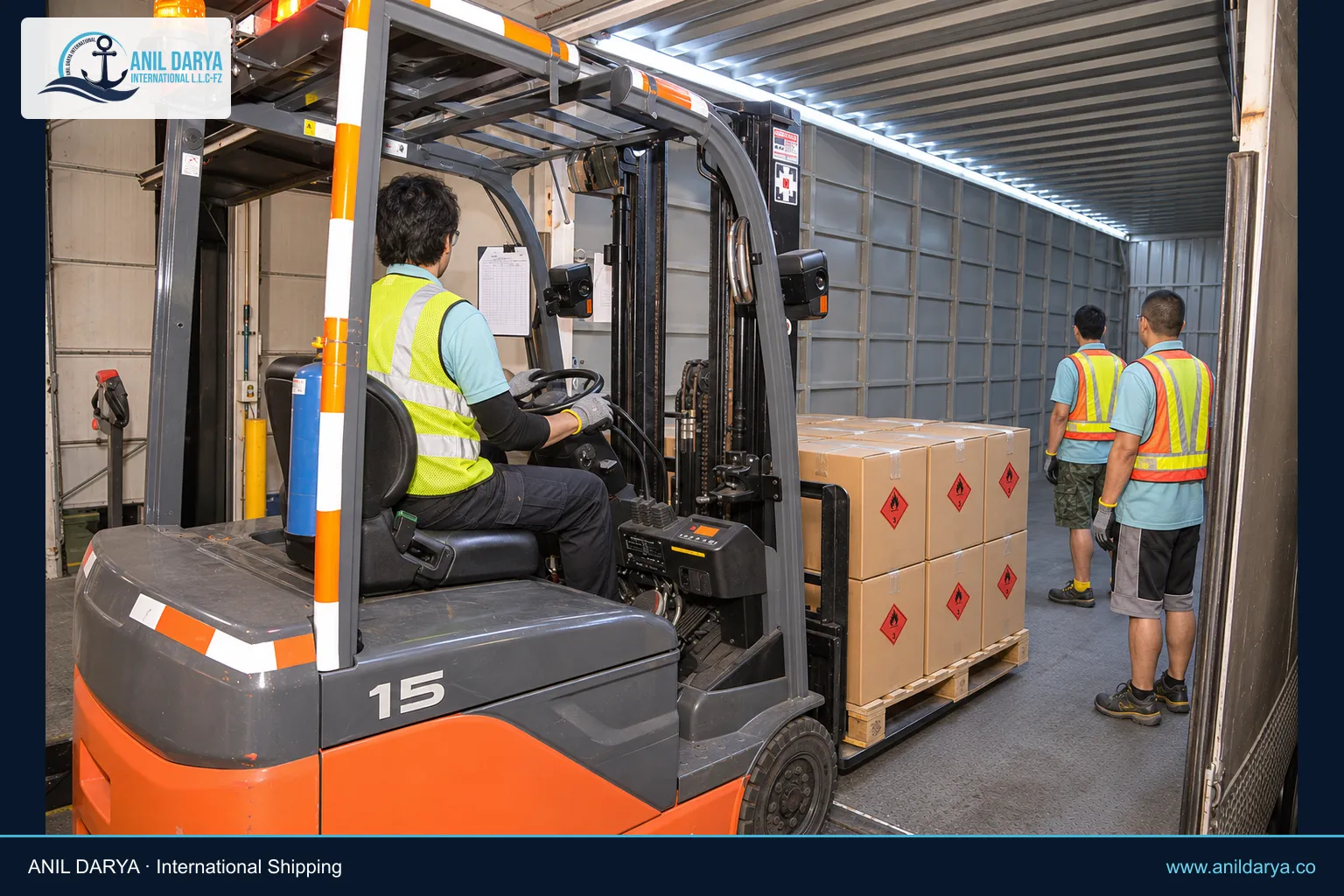
Fine fragrance and many cosmetics contain alcohol and travel as flammable liquids. Aerosols, paints, adhesives and machines with lithium batteries are also dangerous goods. By sea they follow the IMDG Code, whose 2024 edition (Amendment 42-24) is mandatory from 1 January 2026. The French shipper supplies the UN number, class, packing group, Safety Data Sheet and a signed DG declaration, and the line must accept the booking before stuffing. Our dangerous goods desk handles carrier acceptance, and our guide to dangerous goods classes explains the labels.
The Saudi side has its own step for beauty products. The Saudi Food and Drug Authority says importers register products and obtain licences in its GHAD system, then submit clearance requests through its FASEH service, and SFDA completes the review before the shipment reaches port. Start that early for a new fragrance line.
Machinery and project pieces
Machine tools, packaging lines, pumps and plant modules are the largest group on this lane. Anything that fits a flat rack or open top keeps the full choice of container sailings. Larger units need breakbulk space, and Jeddah's multipurpose terminal and Dammam's general cargo terminals handle it. Send drawings, weights and lifting points before the piece is finished, and get the line's written acceptance before it leaves the plant. See our break bulk and project cargo service.
Medicines and temperature-controlled cargo
Pharmaceuticals are the second largest import group from France. State the set temperature at booking and make sure the Saudi product approval is in place before the box is loaded.
French export formalities: what the shipper files
The French seller, or its customs agent, handles the export side. We work with them on dates, data and the booking, but we do not file declarations in France.
- EORI number. French customs issues it free of charge through its SOPRANO service, in the form FR plus the company's SIREN, and it is active 24 hours after issue.
- Export declaration. It is lodged electronically in DELTA, where DELTA IE has handled exports since 4 November 2025. It can be lodged up to 30 days before the goods are presented to customs, but never after they have left the EU.
- Representation. The exporter can file itself or use a customs representative, either in the exporter's name (direct) or in the representative's own name (indirect).
- Dual-use goods. Items covered by EU Regulation 2021/821 need an export authorisation. In France it comes from the Service des biens à double usage (SBDU), part of the Directorate General for Enterprise, through its Egide platform.
Ask your French supplier to confirm in writing whether sensors, valves, machine tools or chemicals in the order are controlled. A missing licence stops the box at export, not on arrival.
Certificate of origin, invoice visas and legalisation
Saudi customs lists the certificate of origin among the core import documents, unless the country of origin is clearly established in another way. French chambers of commerce issue non-preferential certificates and invoice visas online through the GEFI platform, with a paper version on request. For Arab League markets, the Chambre de Commerce Franco-Arabe offers official legalisation of commercial documents. Germany's IHK Koeln notes that Saudi buyers often expect the certificate and invoice to be certified and legalised, so ask the Saudi broker exactly which stamps it wants before the goods ship.
Since 1 January 2025 Saudi Arabia and the other GCC states use 12-digit tariff codes. The first six digits match the French export code, but the last six are Gulf-specific. Put the 12-digit code on the invoice so the broker does not have to guess.
Saudi customs for goods shipped from France
The Zakat, Tax and Customs Authority (ZATCA) runs Saudi customs. The importer, or a licensed customs broker acting for it, files the declaration on Fasah.
Documents the Saudi broker will ask for
| Document | Who provides it | What gets checked |
|---|---|---|
| Commercial invoice | French seller | Description, 12-digit code, quantity, origin France, Incoterm, freight and insurance on CIF sales |
| Bill of lading | Shipping line, released through us | Consignee and notify party match the Saudi importer; pieces and weights match the packing list |
| Certificate of origin | French chamber of commerce | Same goods and invoice number as the invoice; any legalisation the broker asked for |
| Packing list | French seller | Per pallet, in line with the palletised load |
| SABER shipment certificate | Saudi importer | Issued before the customs declaration |
| IECEE certificate, product registration or permit | Maker and importer | Only where the tariff line or product requires it |
ZATCA requires the clearing procedures, including the declaration, to be completed at least 48 hours before the shipment arrives at the port of entry. On a direct Fos sailing to the Red Sea, that window comes quickly: the broker should hold final papers before the vessel leaves France.
SABER certificates for French products
SABER is the conformity platform of the Saudi Standards, Metrology and Quality Organization (SASO). A regulated product needs a Product Certificate of Conformity registered in SABER, and each consignment needs a Shipment Certificate of Conformity. SABER lists SAR 500 to register a product certificate and SAR 350 to issue a shipment certificate, both excluding VAT, and has extended the shipment certificate's validity from 60 to 90 days. Since 1 October 2025 the shipment certificate must be applied for before the customs declaration. A CE marking and French test reports help the certification body, but they are not a SABER certificate.
Customs duty on French goods
Saudi Arabia applies the GCC common external tariff of at least 5% to most goods from outside the GCC, calculated on the CIF value. Rice, bulk animal feed, livestock, fresh red meat, coffee and tea enter free, while some processed foods can reach 40% where local production is high. A revised Saudi tariff took effect on 27 November 2025, and some lines now carry rates well above 5%, so check each 12-digit code before you quote a landed price.
French origin brings no reduction. The European Commission says EU-GCC free trade talks were suspended in 2008, and no EU trade agreement with Saudi Arabia is in force, so an EUR.1 or an origin statement on the invoice gives no preference.
Import VAT
Saudi Arabia charges VAT at 15% on imports. ZATCA guidance applies it to imported goods whatever their tariff classification or duty rate, including goods exempt from duty. Freight and duty raise the base, so a higher sea freight cost also raises the VAT bill for the importer.

Set up Saudi clearance before shipping from France to Saudi Arabia
We do not clear goods in Saudi Arabia. The consignee or its own Saudi broker does that, and we only confirm the booking once the broker is named and has seen the documents. A perfume consignment with no SFDA clearance request, or a machine with no SABER shipment certificate, will sit at the port while charges build.
- The Saudi buyer sends us the importer's legal name and its broker's contact.
- The broker lists the documents, stamps and certificates it needs for this cargo.
- The importer confirms SABER status and any SFDA or ministry approval for each product.
- We confirm space and send the French shipper the cut-off, vessel and bill of lading instructions.
Free time at the Saudi terminal runs out fast when papers are missing. Our article on demurrage and detention explains how those charges add up.
Restricted and banned goods for French exporters
ZATCA requires permits from the competent authority for restricted goods and refuses goods banned locally or internationally, as well as fake, altered or IP-infringing products. For French cargo, check these groups first:
- Cosmetics and perfume, which go through SFDA's clearance service.
- Medicines and medical devices, which need Saudi product approval.
- Food, which needs SFDA requirements met before arrival, including halal papers where the product calls for them.
- Chemicals, coatings and cleaning products, which may need a permit.
- Electrical, radio and connected devices covered by technical regulations.
IHK Koeln's summary of Saudi import bans includes pork products, alcoholic drinks and foods containing alcohol, non-biodegradable plastic bags and used household electrical appliances for resale. That rules out French wine, spirits, charcuterie and alcohol-based food products on this lane. ZATCA publishes the full list in Arabic, so ask the broker about anything borderline.
When a Dubai routing helps on the French-Saudi lane
Most French cargo should go direct. Dubai helps in three cases.
| Option | How it works | Fits when |
|---|---|---|
| Connection at Jebel Ali | The line discharges at Jebel Ali and carries the box on to Dammam or Jubail; the bill of lading still reads French port to Saudi port | The best Gulf-coast option from France runs through Jebel Ali |
| Consolidation in Dubai | French cargo meets goods from other suppliers in Dubai and goes on to Saudi Arabia as one shipment | A buyer mixing French and Asian suppliers for one delivery |
| Stock in a Dubai free zone | Goods are held in JAFZA and sent to Saudi customers in smaller lots | Distributors of French brands selling across the GCC |
Our Jebel Ali port guide covers the terminal, and our article on JAFZA re-export explains the free zone flow. When goods are cleared into or out of the UAE, we handle Dubai customs clearance for a fee.
Under the GCC customs union, duty is collected at the first point of entry and not charged again when payment is proven. Goods held in a free zone have not paid UAE duty, so Saudi duty falls due on arrival. Check the VAT treatment with the Saudi broker before you choose a Dubai route.
[AMIR-FACT: whether we currently route any France to Saudi Arabia cargo through Jebel Ali (connection, Dubai consolidation or JAFZA stock), on which line, and how many days it adds against a direct sailing]
What affects the cost of shipping from France to Saudi Arabia?
We do not publish rates, because they change with every sailing. These are the parts of the landed cost and what moves each one.
| Cost element | Usually paid by | What changes it |
|---|---|---|
| Collection, packing, palletising, French terminal and export filing | Seller on FCA or FOB, buyer on EXW | Distance to the port, truck or rail, number of pallets |
| Ocean freight and surcharges | Depends on the Incoterm | Equipment, carrier, season, routing, DG, reefer or out-of-gauge premiums |
| Origin documents | Seller | Chamber certificate, invoice visa, legalisation, courier of originals |
| Conformity and approvals | Saudi importer | SABER fees, certification body charges, SFDA steps |
| Saudi port and broker | Buyer | Terminal handling, delivery order, broker fee, inspection |
| Duty and VAT | Consignee or its broker | 12-digit tariff line, CIF value, 15% VAT |
Duty and taxes at destination are paid by the consignee or its broker. Compare forwarder quotes only when they share the same Incoterm, ports and scope.
How shipping from France to Saudi Arabia works, step by step
- Agree the Incoterm, the Saudi port and the final delivery city with your trading partner.
- Send us the goods description, HS code, weights, sizes, pallet count, French pickup address, ready date and any DG, reefer or oversized items.
- Receive our routing and quote: French load port, line, direct or connecting, and any Dubai option.
- The consignee names its Saudi broker, who confirms the documents, SABER position and any SFDA or other approval.
- We book the space. DG, reefer and out-of-gauge cargo need the line's approval first.
- The French seller or its agent collects, palletises and stuffs the goods and lodges the DELTA export declaration before the cut-off.
- The seller obtains the chamber certificate of origin and any legalisation; the importer obtains the SABER shipment certificate.
- We check the draft bill of lading against the invoice and packing list, then the line's bill of lading is issued and released through us.
- The broker files on Fasah at least 48 hours before arrival and arranges payment of duty and VAT by the consignee.
- The broker collects the delivery order and the empty container goes back within free time.
[AMIR-FACT: one real France to Saudi Arabia cross-trade shipment we booked from Dubai (cargo, French load port, Saudi port, equipment, door-to-door days and the problem we solved), cleared for publication]
These steps are run by our Dubai freight forwarding team.
Checklist before the container leaves France
- Saudi importer and its broker named, with the broker's document list in hand.
- 12-digit Saudi code and current duty rate checked for every invoice line.
- SABER product certificates registered and the shipment certificate applied for.
- SFDA clearance request filed for perfume and cosmetics; approvals in place for medicines.
- Exporter's EORI active and the DELTA export declaration arranged.
- Dual-use status checked, with an SBDU licence where needed.
- Certificate of origin matches the invoice; legalisation done if the broker asked for it.
- DG documents and line acceptance for perfume, aerosols and chemicals.
- Cargo palletised for the Saudi rule, with no wine or pork products in the load.
Mistakes to avoid on this lane
- Shipping before destination clearance is agreed. A Fos sailing to the Red Sea leaves little time to find a broker once the box is at sea.
- Booking perfume as general cargo. It is a flammable liquid under the IMDG Code and needs DG acceptance.
- Treating a CE marking as enough. SABER needs its own product and shipment certificates.
- Expecting an EU origin discount. No EU-GCC trade agreement is in force.
- Loose-loading cartons into the box. Saudi ports now expect palletised containers unless an exemption applies.
- Including wine, spirits or charcuterie. They are banned imports in the Kingdom.
Frequently asked questions
Which ports are used for shipping from France to Saudi Arabia?
Most containers load at Marseille-Fos, Le Havre or Dunkirk. They discharge at Jeddah or King Abdullah Port on the Red Sea coast, or at Dammam and Jubail on the Gulf coast for Riyadh and the Eastern Province.
Is there a direct sailing from France to Saudi Arabia?
Some services call both. Northern French ports and the Gulf-coast ports more often involve a connection, so we confirm the routing for each booking.
How long does sea freight from France to Saudi Arabia take?
It depends on the coast you load on, the service and any connection. Fos to a Red Sea port is usually the shortest pairing. We quote from the carrier's current schedule for the actual sailing.
What duty is paid on French goods in Saudi Arabia?
Most goods pay at least 5% of the CIF value under the GCC common external tariff, and the Saudi tariff revised on 27 November 2025 sets higher rates for some lines. French origin gives no preference. Import VAT of 15% is added.
Can I ship French perfume to Saudi Arabia?
Yes. By sea it travels as dangerous goods with a Safety Data Sheet, DG declaration and carrier acceptance. In Saudi Arabia the importer handles SFDA product registration and the clearance request before the shipment arrives.
Who files the export declaration in France?
The French exporter or its customs representative, electronically in French customs' DELTA services. It can be lodged up to 30 days before the goods are presented, but not after they have left the EU.
Who issues the bill of lading when Anil Darya books this lane?
The shipping line issues its own bill of lading from the French port to the Saudi port. We act as agent for many lines, so it is issued and released to you through our Dubai office.
Does Anil Darya clear customs in Saudi Arabia?
No. The consignee or its own Saudi customs broker clears the goods. We confirm that arrangement before we confirm the booking, then keep the documents moving until the delivery order is issued.
Get a quote for your French cargo to Saudi Arabia
Send us the French pickup address, the Saudi delivery city, the cargo details and the ready date, plus your Saudi broker's name if you already have one. Use our freight rate inquiry form, or contact our team first for perfume, machinery or reefer cargo.
Sources
- ZATCA: Import instructions (documents, Fasah, 48 hours)
- ZATCA: Importation rules (restricted and prohibited goods)
- ZATCA: Guideline on imports and exports under VAT (15% on imports)
- SABER (SASO): certificate fees and shipment certificate validity
- US International Trade Administration: Saudi Arabia import tariffs
- US International Trade Administration: Saudi Arabia import requirements (palletising from 8 May 2025)
- IHK Koeln: Import rules in Saudi Arabia (revised tariff, shipment certificate, banned goods, 12-digit codes)
- SFDA: Certificates of conformity for beauty sector consignments via FASEH
- European Commission: EU trade relations with the Gulf region
- UAE ICP: Customs union for GCC states
- French customs (DGDDI): Lodging a customs declaration (DELTA, timing, representation)
- French customs (DGDDI): Register for an EORI number
- DGE: Exporting dual-use goods (SBDU, Egide)
- CCI Paris Ile-de-France: International formalities through GEFI
- Chambre de Commerce Franco-Arabe: Legalisation of commercial documents
- Port of Marseille Fos: Key figures 2025
- HAROPA PORT: Record traffic in 2025 on the Seine corridor
- Dunkerque-Port: Maritime solutions (Terminal des Flandres)
- Red Sea Gateway Terminal: Terminals and services, Jeddah Islamic Port
- King Abdullah Port: owner, capacity and zones
- Saudipedia: King Abdulaziz Port in Dammam
- DataSaudi: Saudi trade with France 2025
- IMO: IMDG Code 2024 edition
Reviewed: 11 November 2026