
Shipping from Germany to Qatar is almost always sea freight from Hamburg, Bremerhaven or Wilhelmshaven to Hamad Port, the only container gateway Qatar runs for general cargo. The German seller files the export in ATLAS and has the invoice and certificate of origin certified by its chamber (IHK). In Qatar the consignee's broker clears the goods on Al Nadeeb and pays duty, usually 5% of CIF, because no EU or German trade agreement with Qatar is in force. We book the ocean freight from Dubai and coordinate both ends.
Germany to Qatar shipping at a glance
| Item | Detail |
|---|---|
| Mode covered here | Sea freight: FCL, LCL, flat rack, breakbulk and project cargo, vehicles, reefer, dangerous goods |
| German load ports | Hamburg, Bremerhaven, Wilhelmshaven (JadeWeserPort) |
| Qatar discharge port | Hamad Port, south of Doha, run by Mwani Qatar |
| Routing | A mainline sailing that calls Hamad, or a mainline to a Gulf hub such as Jebel Ali and a feeder on to Hamad |
| German export filing | Electronic export declaration in ATLAS-Ausfuhr, by the seller or its customs agent |
| Origin papers | Certificate of origin and commercial invoice certified by the IHK; ask the broker about legalisation |
| Trade agreement | None in force between the EU and Qatar or the GCC, so no EUR.1 and no preference |
| Qatar customs system | Al Nadeeb single window, General Authority of Customs |
| Qatar duty | 5% of CIF for most goods; 20% steel bars and cement; 30% urea; 100% alcohol, pork and tobacco |
| VAT in Qatar | Not introduced; excise applies to listed goods |
| Bill of lading | The shipping line's own B/L, issued and released to you through us as the line's agent |
| Who clears in Qatar | The consignee or its customs broker, agreed before the cargo sails |
Who does what when you ship from Germany to Qatar through us
This is a cross-trade: the cargo need not touch the UAE, but we run the booking from Dubai. Each party owns a fixed piece of the work.
| Task | Owner | What it covers |
|---|---|---|
| Ocean booking and follow-up | Anil Darya, Dubai | Carrier space, equipment release, DG and out-of-gauge approval, tracking to Hamad |
| Pickup, packing, stuffing | The German seller or its forwarder at origin | Truck or rail to the terminal, lashing, seal, verified gross mass |
| Export declaration | The seller or its German customs agent | ATLAS filing, export licence if needed, IHK papers |
| Bill of lading | The shipping line | The carrier's B/L; because we act as agent for many lines, it is issued and released to you through us |
| Import clearance at Hamad | The Qatari consignee or its broker | Al Nadeeb declaration, permits, delivery order |
| Duty and taxes at destination | The consignee or its broker | Paid in Qatar; we do not pay them |
We do not sell customs clearance in Qatar. What we can do is hold the booking until the Qatari side is ready. Before we confirm space for a German machine or a box of spare parts bound for Doha, we want the broker's name, confirmation that the consignee holds a valid import licence, and the broker's comments on the draft invoice.
The Incoterm decides who buys which leg. Many German suppliers quote EXW from the factory, which leaves the Qatari buyer responsible for a German export filing it cannot make. FCA or FOB Hamburg keeps the export with the seller, and CFR Hamad has the seller buy the freight while the buyer still pays Hamad charges and duty. Our guide to Incoterms 2020 for sea freight shows where risk passes for each term.
Which German port suits your cargo?
Germany ships to the Gulf from three North Sea ports. Pick the one your carrier calls this month and that sits closest to the factory by truck, rail or barge.
| Port | Published facts | Good fit for Qatar cargo |
|---|---|---|
| Hamburg | 8.3 million TEU and 114.6 million tonnes in 2025; four container terminals; seven multipurpose facilities handling unit loads of just over 400 tonnes | Containers from southern and eastern Germany, heavy machinery and plant parts |
| Bremerhaven | 14 berths for large ships along 4,930 m of quay, 14 to 16.5 m water depth | Containers, and vehicles from German car plants |
| Wilhelmshaven (JadeWeserPort) | 18 m depth regardless of tide, 1,725 m quay | Containers on the largest mainline ships |
Hamad Port, where German cargo lands
Mwani Qatar says Hamad started operations in December 2016 and was inaugurated on 5 September 2017. The port covers 29 square kilometres. Its two operating container terminals have an optimum capacity of 5 million TEU a year, with the full design at over 7.5 million TEU. It also has a general cargo terminal, a vehicle terminal and a Centralised Customs Inspection Area that Mwani rates at 5,600 containers a day, with a free zone next door.
Two details matter for German cargo. The general cargo terminal had a 1,200 m berth and a 14 m allowable draft in a 2020 QTerminals presentation, so breakbulk and project pieces have a dedicated quay. And the container freight station at Container Terminal 1 has a DG warehouse segregated by class, which helps when chemical LCL lots are devanned.
Direct call or relay: how boxes reach Hamad
Two routing patterns exist on this lane. A mainline from North Europe to the Middle East may call Hamad itself. More often the box goes on a mainline to a Gulf hub and continues on a feeder. No carrier schedule page we could open in November 2026 showed a direct Hamburg or Bremerhaven call at Hamad, so we do not publish a port-to-port day count here.
What we did find shows how the relay pattern works. In June 2023 the forwarder a. hartrodt announced a weekly LCL groupage service from Bremerhaven to the hub port of Jebel Ali. From Jebel Ali, Milaha's Intra Gulf Express (MIG) is one weekly feeder that links Jebel Ali and Hamad, with two ships of 1,015 TEU nominal and 90 reefer plugs each in its January 2025 profile.
Rate sites quote anything from 8 to over 40 days for this lane because they mix direct sailings, relays and old data. Our quotes name the carrier, any relay port and the German cut-off.
[AMIR-FACT: the carriers we actually book from Hamburg, Bremerhaven or Wilhelmshaven to Hamad in 2026, whether each calls Hamad direct or relays (and where), and our real port-to-port days for FCL and LCL]
Sea freight from Germany to Qatar: which equipment?
The cargo mix decides the box.
| Equipment | Typical German cargo | Rule of thumb |
|---|---|---|
| 20ft dry | Spare parts on pallets, drums of chemicals, tools | Heavy, compact cargo that reaches the weight limit first |
| 40ft or 40ft high cube | Packaged machines, switchgear cabinets, furniture, consumer goods | Bulky cargo; the high cube gives extra height for crated machines |
| LCL | A pallet of spares, samples, a first order | Check that the consolidation runs to Hamad and where it is devanned |
| Reefer | Temperature-controlled medicines, some food | Book plugs on the mainline and any feeder |
| Flat rack or open top | Machines over the height or width of a box | Stays on container ships, so more sailings than breakbulk |
| Ro-Ro | Cars, trucks, construction machines on wheels or tracks | Needs a Ro-Ro service that reaches Hamad's vehicle terminal |
When an LCL lot gets past about half a box, price a 20ft as well. Our article on FCL vs LCL walks through the break-even, and our sea freight service lists the equipment we book.
Machinery, plant and project cargo
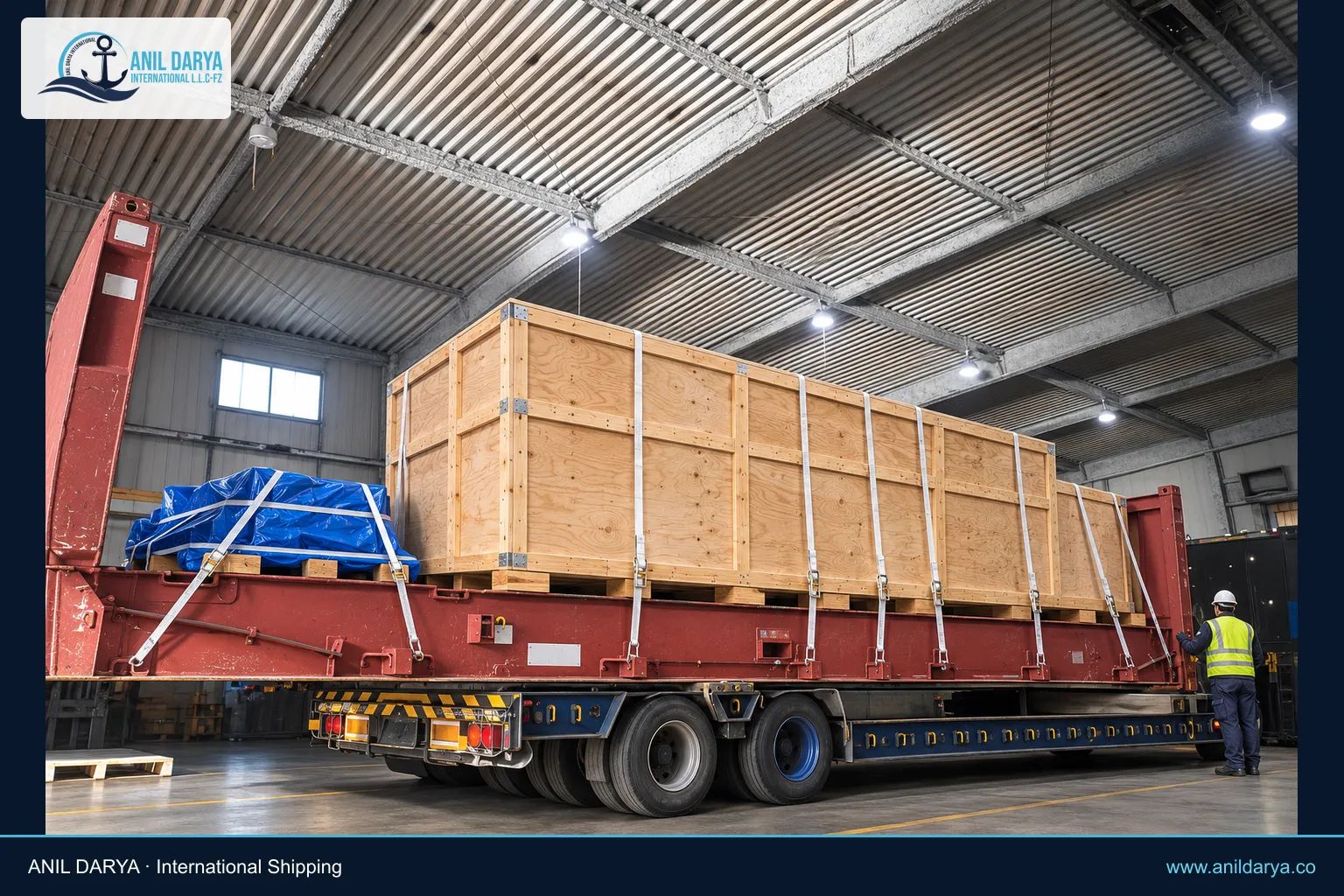
German plant for Qatar's utilities, industry and building projects often travels in pieces too large for any container. Hamburg's multipurpose terminals handle single units of just over 400 tonnes, and Hamad's general cargo terminal receives them at the Qatar end. We need drawings, weights, centre of gravity and lifting points from the manufacturer before we approach a line. If a piece fits a flat rack, a container service usually gives more sailing dates than a breakbulk ship. See our break bulk and project cargo service and the heavy-lift shipping guide.
Vehicles and machines on wheels
Cars and trucks can move Ro-Ro or inside containers. Ro-Ro needs a service that discharges at Hamad, directly or after a relay, and a clean unit with no personal goods inside. Ask the Qatari broker which vehicle rules apply before loading.
Chemicals and other dangerous goods
Paints, adhesives, solvents, aerosols, lithium batteries and many industrial chemicals are dangerous goods at sea. The IMDG Code 2024 edition, Amendment 42-24, has been mandatory since 1 January 2026, so the seller's DG declaration and safety data sheet must match it. Invest Qatar lists flammable goods, explosives and radioactive material among prohibited imports, so we ask the broker to confirm the product can be imported before we request DG acceptance from the carrier. Our dangerous goods team checks the papers against both the mainline and any feeder.
How long does shipping from Germany to Qatar take?
Port to port, it depends on whether the ship calls Hamad or relays at a hub, and how long the box waits for its feeder. Until we confirm a live sailing, plan the door-to-door time stage by stage:
| Stage | What sets the time |
|---|---|
| Production and pickup | Factory ready date, crating, truck or rail slot to the port |
| German export | ATLAS declaration accepted, IHK certification, legalisation if the broker asks for it |
| Main sea leg | Direct call at Hamad, or the leg to the hub |
| Relay | Connection time at the hub and the feeder to Hamad |
| Qatar clearance | Al Nadeeb declaration, permits, inspection if selected |
| Delivery | Truck from Hamad, empty return within free time |
Export clearance in Germany
The German side belongs to the seller or its customs agent. We agree cut-offs and documents with them, but we do not file in Germany. The rules come from German customs and the EU:
- An EORI number is mandatory for anyone exporting from the EU. It does not expire.
- Electronic export declarations through ATLAS-Ausfuhr are compulsory under EU law for every mode of transport, with narrow exceptions such as ATA carnet exports.
- In the usual two-step procedure, goods are declared at the export customs office (Ausfuhrzollstelle) and stay under supervision until the exit office (Ausgangszollstelle) confirms they left the EU.
- After exit is confirmed, the export office sends the Ausgangsvermerk. The seller keeps it as proof that the goods left the EU.
- If the safety data is not in the export declaration, the carrier files the exit summary declaration.
- Dual-use items need an authorisation, issued in Germany by BAFA. The seller should check its goods in TARIC and the dual-use list before production ends.
An EXW sale leaves no one in Germany able to file this, which is the main reason we steer Qatari buyers towards FCA or FOB.
Certificate of origin, invoice and legalisation for Qatar
Qatar wants papers that prove where the goods come from and what they cost, and it wants them stamped. Invest Qatar says importers must submit attested, translated and verified documents to clear goods. In Germany the first stamp comes from the local Chamber of Industry and Commerce (IHK).
| Step | What happens | Source of the rule |
|---|---|---|
| IHK certificate of origin | The IHK certifies a non-preferential certificate of origin; for Qatar extra declarations are needed on the back | IHK Düsseldorf country overview, August 2025 |
| IHK-certified invoice | The commercial invoice is certified by the IHK as well | IHK Düsseldorf country overview |
| Further legalisation | The same overview marks Ghorfa pre-legalisation and consular legalisation for Qatar | IHK Düsseldorf country overview |
| Attested papers at import | Documents must be attested, translated and verified | Invest Qatar |
Practice changes, so ask the Qatari broker exactly which stamps it needs, then pass that list to the German seller before the invoice is printed. Build the legalisation days into the timeline, because the originals travel only after the last stamp.

Is there a trade agreement between Germany and Qatar?
No. Trade policy for Germany is made at EU level, and the European Commission says the EU and the GCC started free trade talks in 1990 but suspended them in 2008. The Commission lists talks with the UAE launched in 2025, and no agreement with Qatar. So German goods enter Qatar without any tariff preference.
That has three practical effects:
- No EUR.1 or preferential origin declaration is needed for Qatar. Some sites suggest a EUR.1 cuts duty in the Gulf; on this lane it does not.
- The non-preferential certificate of origin from the IHK is the origin proof. It confirms where the goods were made, for statistics and the import file, not for a lower rate.
- Duty is the GCC common tariff, usually 5% of CIF, whatever the German origin.
With no preference to lose, storing or splitting German cargo in Dubai cannot cost you a lower rate. It can change where duty is paid, as the Dubai section explains.
Qatar import customs for German goods
The General Authority of Customs clears cargo at Hamad under Law No. 40 of 2002 and the GCC common customs law. Declarations go through Al Nadeeb, the web-based single window where importers and clearing agents submit declarations, calculate and pay duty, and authorise agents. The US government's Qatar guide says importers need an import licence registered with the Ministry of Commerce and Industry. That is why clearance stays with the consignee and its broker.
| Document | Issued by | What the broker checks |
|---|---|---|
| Commercial invoice, IHK-certified | German seller | HS code per line, value, Incoterm, consignee matching the B/L |
| Packing list | German seller | Pieces, marks, net and gross weights matching the invoice |
| Certificate of origin | IHK | Origin, goods and invoice number consistent |
| Bill of lading | Shipping line, released through us | Consignee, notify party, German load port, discharge at Hamad |
| Import licence | Qatari consignee | Valid and registered with the Ministry of Commerce and Industry |
| Permits and conformity papers | Seller or consignee | Food, telecom, chemicals, electrical goods |
Qatar has classified imports at 12 digits since January 2025, while a German invoice usually carries the 8-digit EU code. The first six digits match, so the broker should confirm the Qatari 12-digit line before anyone prices the duty. Every piece and carton should show the country of origin, such as "Made in Germany", matching the invoice and certificate. Goods that do not match their documents at inspection attract extra duty and a fine.
Duty and taxes on German goods in Qatar
Duty and taxes at destination are paid by the consignee or its broker. The rates below come from Invest Qatar and the US government's Qatar tariff guide.
| Goods from Germany | Qatar duty |
|---|---|
| Most goods, including machinery, vehicles, chemicals, electrical goods | 5% of CIF value |
| Iron bars and rods, non-alloy hot-rolled steel, 12 mm steel bars, cement | 20% |
| Urea | 30% |
| Alcohol, pork products, tobacco | 100%; cigarettes 100% or QAR 1,000 per 10,000, whichever is higher |
| Basic foods such as rice, wheat, flour, fresh produce | Exempt |
| Products for industrial projects; QIDB-funded projects | Exemption or waiver possible |
The industrial exemptions matter for German plant. Projects funded by the Qatar Industrial Development Bank can be granted a duty waiver on machinery and inputs, and products for industrial projects are on the GCC exemption list. The consignee must apply; we only make sure the shipping papers match the exemption file.
Rates do move. Amiri Decree No. 45 of 2026 raised duty on some chilled chicken and seasonal vegetables. Cabinet decisions in force since 17 September 2026 require excisable goods such as tobacco, energy drinks and sweetened drinks to be registered with the General Tax Authority before import. Qatar has not introduced VAT, according to a GCC customs guide checked in April 2026.
Product rules and restricted goods in Qatar
We found no general pre-shipment inspection scheme for German goods entering Qatar. Product rules apply instead, and they should be sorted before the box is booked:
| Cargo | Rule | Who handles it |
|---|---|---|
| Low-voltage electrical goods and toys | Gulf Conformity Mark (G-Mark) | German manufacturer, with a notified body |
| Routers, radio devices, phones | Import authorisation from the Communications Regulatory Authority | Qatari consignee |
| Food and drink | Ministry of Public Health certificate of conformity programme; Arabic or Arabic and English labels; at least half the shelf life left on arrival | Seller and consignee |
| Ammunition, explosives, narcotics, goods infringing trademarks or copyright | Prohibited | Do not ship |
| Flammable goods, radioactive material | Listed as prohibited | Broker confirms before booking |
Where Dubai fits on this lane
Most German cargo for Qatar does not need Dubai at all. It comes in for these reasons:
- Relay at Jebel Ali. The box stays on the carrier's through bill of lading and changes ship at Jebel Ali, which DP World says links more than 150 ports through over 80 weekly services. Dubai Customs lists transit among its declaration types.
- Consolidation. LCL from several German suppliers can be combined with goods from other countries in Dubai and sent on to Hamad as one lot.
- Stock in a free zone. A German manufacturer can hold spare parts in JAFZA and call them off for Qatari buyers. Our article on re-exporting through JAFZA explains the model. Free zone goods are outside the GCC customs territory, so Qatar charges duty when they arrive.
- Goods cleared into the UAE first. Under the GCC customs union, duty is collected at the first point of entry and is not charged again if payment is proven. If the goods paid duty in Dubai, the Qatari broker needs that import declaration.
When the cargo stops in Dubai for storage, consolidation or re-export, the UAE customs clearance is our work, for a fee. We file with Dubai Customs and send the Qatari broker papers that match the onward shipment. Since there is no trade preference on this lane, the choice is about time, stock and cash flow, not about keeping a lower rate.
[AMIR-FACT: whether we route German cargo for Qatar through Jebel Ali today (relay, LCL consolidation or JAFZA stock), which feeder we use to Hamad, and how many days it adds against a direct call]
What German cargo moves to Qatar?
Germany's Federal Foreign Office puts bilateral trade at about two billion euro in 2024 and calls Qatar the third-largest partner for German business in the Gulf. It names machinery and plant, motor vehicles, chemical products and electrical engineering products as the main German exports.
| Cargo group | Usual equipment | Qatar-side point |
|---|---|---|
| Machinery and plant | 40ft, flat rack, breakbulk | 5% duty unless an industrial exemption or QIDB waiver applies |
| Motor vehicles and parts | Ro-Ro, 40ft for parts | Broker confirms vehicle rules before loading |
| Chemicals and pharmaceuticals | 20ft, DG box, reefer for some medicines | IMDG papers; check prohibited and permit lists |
| Electrical engineering goods | 40ft, flat rack for large switchgear | G-Mark for low-voltage goods, CRA for radio parts |
How to ship from Germany to Qatar step by step
- Send us the cargo details: product, HS code, weight and dimensions, German pickup town, Qatar delivery address, Incoterm and ready date. Flag DG, reefer, vehicles and oversized pieces.
- Check product rules. G-Mark, CRA, food conformity or an industrial exemption file should start now, not after sailing.
- Agree destination clearance. The consignee names its broker and confirms its import licence. We speak to the broker and only confirm the booking once this is settled.
- We quote and book. The quote shows the carrier, the routing (direct or via a hub) and the German cut-off. For DG, reefer and out-of-gauge cargo we get the line's approval first.
- Origin work. The seller or its agent packs and stuffs the cargo, files in ATLAS and gets the IHK papers, plus any legalisation the broker asked for.
- Draft check. We compare the draft B/L with the invoice and packing list and share the set with the broker.
- Sailing. The line issues its B/L, released to you through us, and we track the box to Hamad, including any relay.
- Clearance and delivery. The broker files on Al Nadeeb, the consignee pays duty, and the container is collected and returned within free time.
[AMIR-FACT: one real Germany to Qatar cross-trade shipment we booked (cargo, German load port, routing and relay port, equipment, days to Hamad, and how the broker cleared it), cleared for publication]
What decides the cost of this lane
We do not publish rates because they change with every sailing. These are the parts that make up the total:
| Cost element | What moves it |
|---|---|
| German origin charges | Distance from the factory, terminal handling, ATLAS filing, IHK and legalisation fees |
| Ocean freight | Port pair, direct or relayed, equipment, season, surcharges |
| Special cargo | DG premiums, reefer plugs, flat rack lashing, breakbulk and heavy-lift rates |
| Hamad charges | Terminal handling, delivery order, inspection, trucking, broker fee |
| Duty and excise | 5% for most goods, higher rates for steel, urea and excise goods, waivers for industrial projects |
| Free time | Demurrage and detention after the free days; see our guide to demurrage and detention |
Checklist before the cargo leaves Germany
- Incoterm agreed in the sales contract, with the German export assigned to the seller.
- Qatari broker named, import licence confirmed, draft papers shared.
- 12-digit Qatar HS code agreed for each invoice line.
- IHK certificate of origin and certified invoice ordered, with the declarations Qatar needs.
- Legalisation requirements confirmed with the broker and passed to the seller.
- Country of origin marked on every carton and piece.
- G-Mark, CRA, food or exemption papers ready where they apply.
- Routing known, direct or via a named hub, and Hamad free time agreed.
Mistakes that cost money on this lane
- Shipping before destination clearance is agreed. Without a broker or licence the box waits at Hamad and storage grows.
- Buying EXW from a German factory. Nobody on the buyer's side can file the ATLAS export.
- Expecting EU preference. There is no agreement with Qatar, so a EUR.1 does nothing here.
- Starting legalisation too late. The originals cannot travel until the last stamp is on them.
- Using the 8-digit EU code on the import file instead of Qatar's 12-digit line.
- Pricing steel bars or cement at 5%. They pay 20%.
Frequently asked questions
Which port in Qatar receives cargo from Germany?
Hamad Port, south of Doha, run by Mwani Qatar. Containers, breakbulk, vehicles and reefer cargo from Hamburg, Bremerhaven or Wilhelmshaven all discharge there, and customs inspection takes place in the port's Centralised Customs Inspection Area.
How long does sea freight from Germany to Qatar take?
It depends on whether the ship calls Hamad or relays at a Gulf hub such as Jebel Ali. Published figures on rate sites range from about a week to six weeks, so we quote days from the live schedule for your port pair.
Do German goods get a lower duty in Qatar?
No. There is no trade agreement between the EU and Qatar or the GCC in force, so German goods pay the GCC tariff, 5% of CIF for most products. The consignee or its broker pays it.
Do I need a EUR.1 certificate for this lane?
No. A EUR.1 only matters where the EU has a preferential agreement. For Qatar the seller provides a non-preferential certificate of origin certified by its IHK, together with a certified invoice.
Do the documents need legalisation?
Qatar asks for attested documents, and German chamber overviews mark further legalisation for Qatar after IHK certification. Requirements change, so ask the Qatari broker which stamps it needs before the seller prints the invoice.
Does Qatar charge VAT on goods from Germany?
No VAT applies: a GCC customs guide checked in April 2026 confirms Qatar has not brought it in. Excise is charged on tobacco, energy drinks and sweetened drinks, and those goods must be registered before import.
Who clears the cargo in Qatar?
The consignee, under its import licence, through a customs broker on Al Nadeeb. We do not sell clearance in Qatar, but we agree the broker with the consignee before we confirm the booking.
Can German goods for Qatar go through Dubai?
Yes: on a through bill of lading with a relay at Jebel Ali, in a Dubai LCL consolidation, or from stock held in a free zone. If the cargo stops in Dubai we clear the UAE side for a fee.
Get a quote for shipping from Germany to Qatar
Send us the German pickup town, the cargo, the ready date and your broker in Qatar, and we will come back with the carrier, the routing to Hamad and a price. Use our freight rate inquiry form, or contact our team to plan a DG, Ro-Ro or project shipment first. You can also read more about our Dubai freight forwarding team.
Sources
- German Customs (Zoll): IT procedure ATLAS-Ausfuhr
- German Customs (Zoll): Dual-use items
- Your Europe (European Union): Customs procedures for exports
- European Commission: EU trade relations with the Gulf region
- IHK Düsseldorf: Certification of customs documents, country overview (August 2025)
- German Federal Foreign Office: Germany and Qatar, bilateral relations
- Port of Hamburg: Throughput figures 2025
- Port of Hamburg: Terminals
- bremenports: Container handling in Bremerhaven
- IHK Oldenburg: Seaport Wilhelmshaven, JadeWeserPort
- Mwani Qatar: Hamad Port
- QTerminals: Hamad Port terminals presentation (September 2020)
- a. hartrodt: Weekly LCL groupage Bremerhaven to Jebel Ali (June 2023)
- Milaha: Intra Gulf Express (MIG) service profile, January 2025
- DP World: Jebel Ali Port
- Invest Qatar: Customs laws, duty rates, documents, prohibited goods and Al Nadeeb
- US International Trade Administration: Qatar import tariffs
- US International Trade Administration: Qatar import requirements and documentation
- US International Trade Administration: Qatar labelling and marking requirements
- US International Trade Administration: Qatar moves to 12-digit HS codes
- EY Tax News: Qatar excise framework and tariff update (September 2026)
- Goods Across Borders: GCC customs union explainer (verified April 2026)
- UAE ICP: Customs union for GCC states
- Dubai Customs: Submit customs declaration (declaration types)
- QIMA: Gulf Conformity Mark (G-Mark)
- Gulf Times: CRA import authorisation for telecom equipment
- SGS: Qatar MoPH certificate of conformity for food (datasheet, February 2024)
- IMO: IMDG Code 2024 edition (Amendment 42-24)
Reviewed: 11 November 2026