
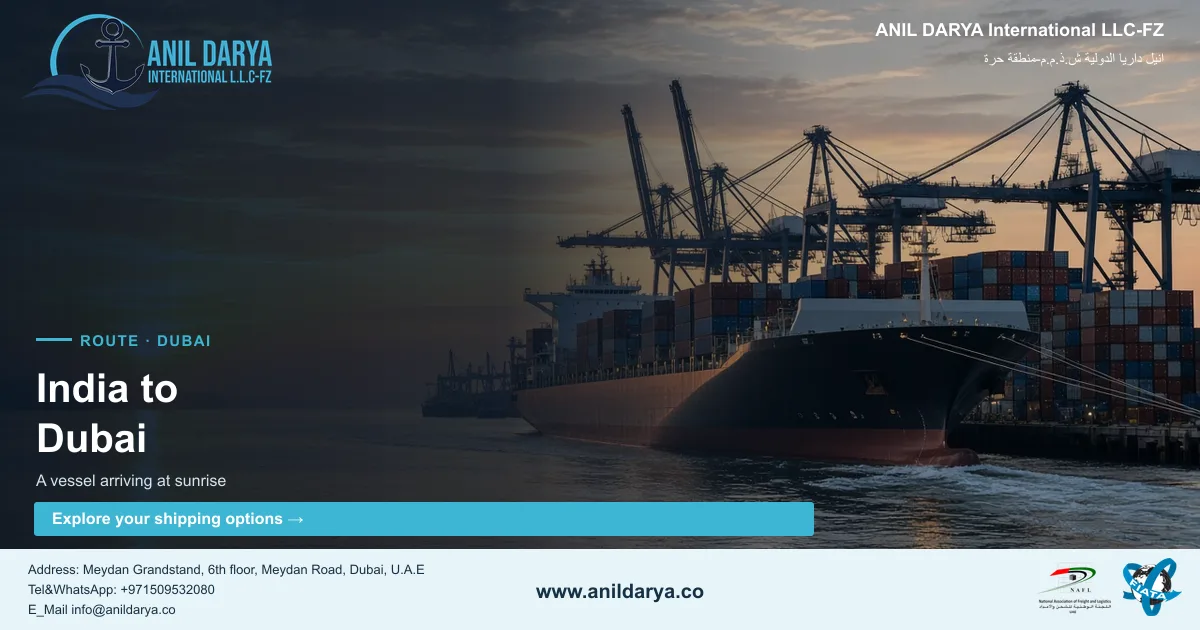
Shipping from India to Dubai is one of the shortest container routes out of India: most cargo sails from Nhava Sheva or Mundra into Jebel Ali. The part that decides how fast you get your goods is the Dubai end. You need a customs business code, a declaration with Dubai Customs, 5% duty on the CIF value, 5% import VAT, and, for Indian-made goods, a CEPA certificate of origin that can lower or remove the duty.
India to Dubai shipping at a glance
| Item | Detail |
|---|---|
| Main Indian load ports | Nhava Sheva (JNPA) and Mundra; also Hazira, Chennai, Cochin, Kolkata and Haldia |
| Main UAE discharge port | Jebel Ali (DP World), four container terminals |
| Other UAE ports | Khalifa Port (Abu Dhabi), Sharjah ports |
| Published transit indication | About 9.6 days average FCL transit India to UAE (Cogoport lane data, 12-week average, port to port) |
| Modes | FCL, LCL, breakbulk and project cargo, dangerous goods, air cargo |
| UAE customs authority (Dubai) | Dubai Customs |
| Importer ID in Dubai | Customs business code, registered online through Dubai Trade |
| Customs duty | 5% of CIF value for most goods; alcohol 50%, cigarettes 100% |
| Import VAT | 5%, deferred to the VAT return for registered importers who link their customs number with the FTA |
| Preferential duty | India-UAE CEPA, in force since 1 May 2022 |
| Indian export filing | Shipping bill on ICEGATE by the exporter, with IEC |
| Free zone next to the port | Jafza, over 11,000 businesses |
How the India to Dubai sea freight route works
Cogoport's lane data shows an average FCL transit of about 9.6 days from India to the UAE over 12 weeks, with some direct port pairs much shorter. Direct services from India's west coast are the fastest. Cargo from Chennai, Kolkata or Cochin often moves on longer rotations or with a transhipment.
The lane carries a wide mix: food and rice, textiles, machinery, steel, chemicals, building materials and project cargo for the UAE, plus goods that Dubai traders re-export to other markets. Whether your goods stay in the UAE or move on decides the customs route at the Dubai end, so settle it before you book.
What adds days to the India to Dubai transit?
| Factor | Why it matters | What to do |
|---|---|---|
| Port rotation | A service that calls other Gulf ports before Jebel Ali takes longer | Read the rotation, not just the sailing date |
| Transhipment | An extra port and vessel change, common from the east coast | Prefer direct west coast services when timing matters |
| Indian cut-offs | A missed documents or gate-in cut-off rolls the box to the next sailing | Finish the shipping bill and gate-in early |
| Holidays and peak weeks | Long holidays in India and the UAE slow factories, trucking and paperwork | Book space and permits earlier around them |
| Dubai clearance | Missing permits or a late declaration keep the box at the terminal | File before the vessel berths |
[AMIR-FACT: our real transit time Nhava Sheva to Jebel Ali and Mundra to Jebel Ali, and the carriers we usually book on this lane]
Which Indian port should you ship from?
Ship from the port closest to the factory. Indian inland trucking often costs more than the sea leg to Dubai.
| Indian port | What the operator says | Best for shippers in |
|---|---|---|
| Nhava Sheva (JNPA) | Five container terminals in Navi Mumbai; around 50% of the containerised cargo of India's major ports | Maharashtra, Mumbai, Pune, central India |
| Mundra (Adani Ports) | Four container terminals, 7.5 million TEU capacity, more than 35 services, rail sidings for 80 rakes a day | Gujarat, Rajasthan, Delhi NCR, Punjab and the north |
| Hazira (Adani Ports) | Container and liquid port near Surat | South Gujarat |
| Cochin (Vallarpadam ICTT) | Container terminal with 14.5 m maximum draft | Kerala |
| Chennai | Major port with container terminals | Tamil Nadu, Karnataka |
| Kolkata and Haldia | Syama Prasad Mookerjee Port: Kolkata Dock System and Haldia Dock Complex | East and north-east India |
| Kandla (Deendayal Port) | Port in Gujarat on the Gulf of Kutch | Kutch and north-west India |
For factories far from the coast, ask the carrier about a through bill of lading from an inland container depot. The exporter then clears Indian customs inland and the box moves to the port by rail or road under customs control.
Which UAE port should your cargo arrive at?
Jebel Ali is the default for Dubai and the free zone next to it. DP World runs four container terminals there with over 80 weekly services, and handles breakbulk, project cargo and IMDG dangerous goods. Our Jebel Ali port guide covers the terminals and port rules.
- Consignee in Dubai or Jafza: Jebel Ali.
- Site in Abu Dhabi: compare Khalifa Port in Abu Dhabi to cut the truck leg.
- Consignee in Sharjah or the northern emirates: compare Sharjah port shipping.
Sea freight from India to Dubai: FCL, LCL and special cargo
| Mode | Use it when | What to plan at the Dubai end |
|---|---|---|
| FCL (20ft, 40ft, high cube) | You fill most of a container | Declaration before arrival, delivery order, truck slot, empty return |
| LCL | A few pallets or cartons | Release after the shared box is unpacked; your documents and the consolidator's must match |
| Reefer | Fruit, vegetables, frozen food, pharma | Food or health permit before arrival, plug-in time at the terminal |
| Flat rack, open top, breakbulk | Machinery, steel, project pieces | Lifting plan, trailer, road permits for oversized loads |
| Dangerous goods | Chemicals, paints, gases, batteries | Carrier acceptance, UAE port storage limits for the class |
| Air cargo | Urgent goods, samples, perishables | Same Dubai Customs declaration and duty |
FCL or LCL from India?
FCL is sealed at origin and released as one unit in Dubai. LCL is cheaper for small loads, but your goods wait until the consolidator's container is unpacked and every consignee's paperwork is in order. If your volume is close to a 20ft, price both. Our guide to FCL vs LCL costs explains the break-even, and our sea freight service page shows how we handle containers.
Machinery, steel and project cargo into Dubai
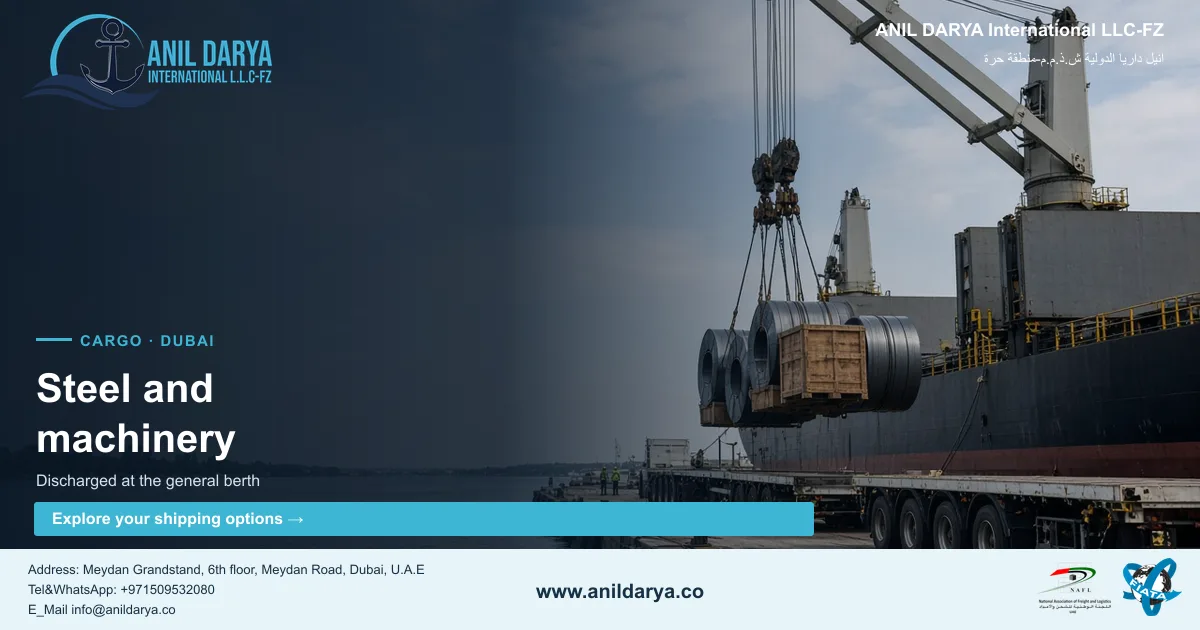
Mundra lists breakbulk, steel and project cargo among the cargo it handles, and Jebel Ali has terminals for breakbulk and heavy-lift cargo. For pieces that fit a 40ft flat rack, a container service gives you more sailings. Anything larger needs breakbulk or heavy-lift tonnage. At the Dubai end we plan the discharge, the trailer and any road permit before the vessel arrives. See our break bulk and project cargo service.
Dangerous goods from India to Dubai
Jebel Ali handles IMDG dangerous goods, but port safety rules limit how long some classes may stay in the port. That means the Dubai declaration and delivery must be ready when the ship berths. You need a Safety Data Sheet, a DG declaration, UN packaging and labels, and carrier approval at origin. Our guide to dangerous goods customs clearance in the UAE explains the Dubai side.
Air cargo from India to Dubai
For samples, spares, pharma and perishables, air is often worth the cost. The Dubai side is the same: a declaration with a customs code, 5% duty and import VAT. If the goods are going into Jafza, note that Jafza sits close to both Jebel Ali Port and Al Maktoum International Airport, so sea and air cargo end up in the same area. For small parcels, an express courier is usually simpler.
Dubai customs clearance for cargo from India
Dubai Customs handles cargo arriving at Jebel Ali and the other Dubai entry points. Declarations are filed online, and each one falls under a regime: import, export, transit, transfer or temporary admission.
Do you need a customs code to import into Dubai?
Yes. Dubai Customs says any business that uses its services must register and get a customs business code, which is done online on Dubai Trade with no office visit. Any company with a code can file a declaration. A clearing agent with a Dubai Economic Department clearing and forwarding licence can also file for you, using its own code and your authorisation. If you do not have a code yet, we arrange clearance through a licensed agent on your behalf.
Which documents does Dubai Customs need?
For cargo from India, Dubai Customs lists the supplier's invoice, a packing list, a certificate of origin (the CEPA certificate from the DGFT eCoO platform if you claim the reduced rate) and a permit from the relevant authority for restricted goods such as spices, medicines or seeds. A container from Nhava Sheva or Mundra also needs the bill of lading and the shipping line's delivery order.
| Document | Who provides it | Why Dubai needs it |
|---|---|---|
| Commercial invoice | Indian exporter | Customs value and HS code |
| Packing list | Indian exporter | Inspection and LCL release |
| Certificate of origin | Indian issuing agency (CEPA) or chamber | Origin and, for CEPA, the duty rate |
| Bill of lading or air waybill | Carrier or forwarder | Title to the goods |
| Delivery order | Shipping line in Dubai | Releasing the container |
| Permit | UAE authority for the product | Restricted goods only |
| SDS and DG declaration | Indian exporter | Dangerous goods only |
Which declaration should you use?
| What happens to the goods | Declaration | Duty and VAT |
|---|---|---|
| Sold or used in the UAE mainland | Import for local use | Duty and VAT at import |
| Delivered into Jafza | Transfer into the free zone | Due only if the goods later enter the mainland |
| Brought in for a time, then sent out | Temporary admission | Deposit equal to the duty, refunded on re-export within the allowed period |
| Passing through to another country | Transit | Not imported into the UAE |
Jafza, operating since 1985 and next to Jebel Ali Port, hosts over 11,000 businesses. Many Indian exporters ship to a Jafza company that stocks and re-exports. Our guide to Jafza re-export covers how that works for bulk and breakbulk cargo.
How much is customs duty and VAT on goods from India to Dubai?
Dubai Customs charges 5% of the CIF value for most goods. CIF means the goods' value plus insurance and freight up to the place of import. Alcohol pays 50% and cigarettes 100%. Some goods have other rates or are exempt, so check your HS code.
Import VAT is 5% on the customs value, including insurance, freight and any customs fees and excise tax paid on import. How you pay depends on your VAT status:
- VAT-registered importer whose customs registration number is linked with the Federal Tax Authority: no VAT is charged at the border. It appears in your VAT return and you can recover it as input tax if eligible.
- Importer not registered for VAT: VAT is paid before customs releases the goods.
| Charge | Rate | Base |
|---|---|---|
| Customs duty (most goods) | 5% | CIF value |
| Customs duty, alcohol | 50% | CIF value |
| Customs duty, cigarettes | 100% | CIF value |
| Import VAT | 5% | Customs value plus customs fees and excise tax |
| CEPA-qualifying Indian goods | Reduced or zero duty on covered tariff lines | With a valid certificate of origin |
Can CEPA reduce Dubai duty on Indian goods?
The India-UAE CEPA came into force on 1 May 2022. For goods made in India that meet the agreement's origin rules, the UAE applies a reduced or zero duty on covered tariff lines instead of the standard 5%. Check the UAE schedule for your HS code, as not every product is covered.
The CEPA origin rules, as published in India's implementing notification, include:
- Proof of origin is a certificate of origin from the exporting country's competent authority, a fully digitised certificate, or an origin declaration by an approved exporter.
- A certificate is valid for 12 months from issue and covers one import.
- Goods must travel directly between India and the UAE. A transhipment in a third country is allowed only if the goods stay under customs control and only unloading, reloading or storage takes place.
- Where a product rule uses value addition, the example given is 40% on an FOB basis.
- If the importer claims the preference without the original certificate, the importing customs may deny it or ask for a guarantee.
In India, DGFT issues preferential certificates for exports to the UAE through its online eCoO platform, used since 1 May 2022. The exporter registers with its IEC and signs with a Class III digital signature. Each eCoO carries a QR code so customs can check it. Ask your Indian supplier to apply before the goods sail, so the certificate is in hand when you file the Dubai declaration.
Re-exporting Indian goods from Dubai
Many shipments on this lane do not stay in the UAE. A Dubai or Jafza trader buys from India, stores the goods and sells them on to other markets. Plan three things before the cargo arrives.
- Declaration. Deliver into Jafza under a free zone transfer, or use transit if the goods only pass through. Duty then applies only if the goods later enter the UAE mainland.
- Origin. The goods stay Indian-origin. A CEPA certificate only works for the UAE market, so do not expect it to cut duty in the next country.
- Paperwork for the next buyer. Dubai Chambers issues certificates of origin for exported and re-exported goods. It charges AED 100 and quotes two hours, and for transhipment goods it asks for the transit bill from Dubai Customs.
If the next market is far from the Gulf, ask us to price a through routing from India as well. Sometimes a direct booking beats a stop in Dubai.
Temporary imports for exhibitions and projects
Equipment that comes to Dubai for an exhibition, a project or a repair and then goes back to India can enter under temporary admission. Dubai Customs takes a deposit equal to the duty and refunds it when the goods are re-exported within the allowed period. Goods covered by an ATA carnet need no deposit. Keep serial numbers on the packing list, as customs matches them on the way out.
What the Indian exporter must do
The Indian side is your supplier's job, but delays there land on your timeline. Under India's Customs Act, the exporter files a shipping bill electronically, and customs issues an order permitting clearance and loading once it is satisfied. ICEGATE handles the filing and, for IGST paid on exports, generates the scroll used for refunds. DGFT says an IEC is mandatory for any export. The usual Indian documents:
- IEC of the exporter.
- Commercial invoice and packing list.
- Shipping bill filed on ICEGATE.
- Bill of lading issued after loading.
- CEPA or other certificate of origin.
- Product certificates where the UAE requires them, such as health or phytosanitary certificates for food and plants.
Restricted and prohibited goods for the UAE
Restricted goods need a permit from the competent UAE authority before Dubai Customs clears them. Common groups on this lane:
- Food, spices, fruit and vegetables: food safety approvals and origin health certificates.
- Medicines and medical products: approval from the health authority.
- Seeds, plants and fertilisers: agricultural approvals.
- Chemicals and dangerous goods: permits for some products and port approvals for some classes.
- Telecom and wireless equipment: type approval.
- Cosmetics and personal care products: product registration.
Apply for permits before the vessel sails from India. A permit that arrives after the ship does means demurrage and storage at Jebel Ali.
Shipping from India to Dubai step by step
- Tell us about the cargo. Commodity, HS code, weight, volume, Indian pickup point and the delivery address in the UAE.
- Agree the Incoterm with the supplier. Under FOB we book the sea freight from India for you. Under CIF or CFR the supplier books it and we take over at Jebel Ali.
- Get your Dubai side ready. Customs business code, VAT number linked to the code, and any permits for restricted goods.
- Ask for the CEPA certificate. Your supplier applies on the DGFT eCoO platform if the goods qualify.
- Book space. We pick a direct service where we can and confirm the arrival terminal. DG, reefer and out-of-gauge cargo get carrier approval first.
- Indian export clearance. The supplier's customs broker files the shipping bill and the box is loaded.
- Check documents before arrival. Invoice, packing list, bill of lading and certificate must match on names, weights and HS codes.
- File the Dubai declaration. We file it through a licensed agent before the vessel berths.
- Pay duty, VAT if due and the line's charges, and collect the delivery order.
- Deliver and return the empty. We book the truck slot, deliver to your site or Jafza warehouse and return the container within free time.
[AMIR-FACT: one real India to Dubai shipment we handled, with cargo type, Indian load port, mode and how clearance went at Jebel Ali, cleared for publication]
What decides the cost of shipping from India to Dubai?
Rates move every week, so we quote each shipment. These are the cost drivers:
| Cost factor | Effect |
|---|---|
| Indian load port | West coast direct services cost less than longer rotations from the east |
| Container type | Reefer, flat rack and open top cost more than dry boxes |
| Incoterm | Decides who pays which leg and which local charges |
| Indian origin charges | Trucking, terminal handling, export clearance, certificate |
| Dubai destination charges | Terminal handling, delivery order, clearance, trucking, CFS for LCL |
| Duty and VAT | 5% duty and 5% VAT unless CEPA or VAT deferral applies |
| Free time | Demurrage and detention once free days run out |
Who pays the Dubai duty: DAP or DDP?
Under DAP and the other "D" terms except DDP, the Indian seller delivers and you, the buyer, clear the goods and pay duty and VAT in Dubai. Under DDP the seller pays them, but someone with a Dubai customs code still has to file the declaration and act as importer. A seller with no UAE entity usually cannot do that alone. If you agree DDP, decide in the contract whose code is used and who recovers the VAT.
The biggest avoidable cost is waiting at Jebel Ali. Our article on demurrage and detention explains how it adds up.
Checklist before cargo leaves India
- Your customs business code is active and your VAT registration is linked to it.
- HS code agreed with the supplier and checked for duty and restrictions.
- Permits for restricted goods applied for.
- CEPA certificate requested if the goods are Indian-made.
- Routing is direct, or the transhipment keeps the goods under customs control.
- Invoice, packing list and bill of lading match.
- Declaration type chosen: local import, free zone, temporary admission or transit.
- DG: SDS, DG declaration, carrier approval and a delivery plan that meets port storage limits.
- Free time at Jebel Ali agreed and delivery booked.
- Cargo insurance arranged.
Common mistakes when shipping from India to Dubai
- No customs code in the UAE. The goods wait at the port until someone authorised can file.
- VAT not linked to the customs code. You pay import VAT in cash at the border instead of deferring it.
- Missing or late CEPA certificate. You pay 5% duty that could have been lower or zero.
- Indirect routing that breaks the CEPA direct transport rule.
- Food or cosmetics shipped without UAE approvals. These are the most common holds on this lane.
- Wrong declaration type. Declaring for local use goods that are meant for re-export costs duty you may not owe.
- Mismatched documents. A different weight or HS code on the invoice and bill of lading holds the clearance.
Frequently asked questions
How long does shipping from India to Dubai take by sea?
Cogoport's lane data shows an average FCL transit of about 9.6 days from India to the UAE port to port, with some direct services much faster. Add time for clearance and delivery in Dubai.
Which Indian port is best for shipping to Dubai?
Nhava Sheva for Mumbai, Pune and central India, and Mundra for Gujarat and north India. Both have regular services to Jebel Ali. Ship from the port closest to the factory to keep Indian trucking costs down.
What is the customs duty on goods from India to Dubai?
Dubai Customs charges 5% of the CIF value for most goods, 50% on alcohol and 100% on cigarettes. Indian-origin goods with a valid CEPA certificate can get a reduced or zero rate on covered tariff lines.
Do I pay VAT on imports from India?
Yes, 5% import VAT applies. A VAT-registered importer that has linked its customs number with the Federal Tax Authority accounts for it in the VAT return instead of paying at the border.
Do I need a licence or customs code to import into Dubai?
Yes. Before your first container from Nhava Sheva or Mundra arrives, register for a Dubai Customs business code online through Dubai Trade, and link your VAT number to it. If you do not file yourself, a licensed clearing agent can file for you with your authorisation.
What is a CEPA certificate of origin and who issues it in India?
It proves the goods originate in India so the UAE applies the CEPA duty rate. Indian exporters apply on DGFT's eCoO platform, and the certificate is valid for 12 months and one import.
Can I ship from India to a Dubai free zone without paying duty?
Yes. Goods delivered into Jafza under a free zone declaration pay duty only if they later enter the UAE mainland.
What documents are needed to clear cargo from India in Dubai?
An invoice, packing list, certificate of origin, bill of lading and the delivery order, plus a permit for restricted goods. DG cargo also needs an SDS and a DG declaration.
Get a quote for shipping from India to Dubai
Send us the cargo, the Indian pickup point and your delivery address in the UAE, and we will come back with a routing and price, including clearance at the Dubai end. Use our freight rate inquiry form or contact our team. You can also read more about our Dubai freight forwarding team.
Sources
- DP World: Jebel Ali Port (terminals, services, cargo types)
- Dubai Customs: Submit customs declaration (regimes and documents)
- Dubai Customs: Frequently asked questions (duty rate, CIF, business code, clearing agents, deposits)
- UAE Government portal: Customs duty and tariff
- Federal Tax Authority: VAT guide (import VAT)
- Jafza: About Jebel Ali Free Zone
- Dubai Chambers: Issuing a certificate of origin (re-exports)
- UAE Ministry of Economy: UAE-India CEPA
- CBIC Notification 39/2022-Customs (N.T.): CEPA origin rules (text of the notification)
- DGFT Trade Notice 05/2022-23: eCoO for India-UAE CEPA
- DGFT: Foreign Trade Policy 2023, Chapter 2 (IEC)
- CBIC: Customs Act, 1962 (Sections 50 and 51)
- ICEGATE: Frequently asked questions
- Jawaharlal Nehru Port Authority: Overview
- Adani Ports: Mundra Port
- Adani Ports: Operational performance 2026 (Hazira)
- Cochin Port Authority: tender document (ICTT draft)
- Syama Prasad Mookerjee Port, Kolkata
- Cogoport: India to UAE trade lane data (transit indication)
Reviewed: 10 November 2026