
Shipping from Indonesia to Dubai usually means a container loaded at Tanjung Priok in Jakarta or Tanjung Perak in Surabaya and discharged at Jebel Ali, often after one transhipment. What decides your landed cost is the Dubai end: a customs business code, a Dubai Customs declaration, 5% duty on the CIF value, 5% import VAT, and a CEPA certificate of origin that can remove the duty on Indonesian-made goods.
Indonesia to Dubai shipping at a glance
| Item | Detail |
|---|---|
| Main Indonesian load ports | Tanjung Priok (Jakarta), Tanjung Perak (Surabaya), Belawan (Medan); also Semarang and Makassar |
| Main UAE discharge port | Jebel Ali (DP World), over 80 weekly services |
| Other UAE ports | Khalifa Port (Abu Dhabi), Sharjah ports including Khor Fakkan |
| Published sea transit indication | About 17.5 to 24 days port to port with one or two transhipments (Fluent Cargo schedule data) |
| Published air indication | Jakarta (CGK) to Dubai (DXB) 7h 53m direct (Fluent Cargo) |
| Modes | FCL, LCL, breakbulk and project cargo, dangerous goods, air cargo |
| Indonesian export filing | PEB export declaration, filed by the exporter with Indonesian customs (DJBC) |
| Importer ID in Dubai | Customs business code, registered online on Dubai Trade |
| UAE customs duty | 5% of CIF for most goods; alcohol 50%, cigarettes 100% |
| UAE import VAT | 5%, deferred to the VAT return for registered importers whose customs number is linked with the FTA |
| Trade agreement | UAE-Indonesia CEPA, in force since 1 September 2023 |
| Free zone next to the port | Jafza, over 11,000 businesses |
How sea freight from Indonesia to Dubai works
Your supplier, or its forwarder, trucks the goods to an Indonesian container terminal and files the export declaration. The box is loaded, usually moves through one or two transhipment hubs, and is discharged in the UAE. We book the space with the carrier, prepare the Dubai Customs declaration, arrange payment of the duty and VAT, and deliver the cargo to your site or free zone warehouse.
Fluent Cargo, which compiles carrier schedules, lists these quickest published sailings on the lane:
| Port pair | Published transit | Transfers |
|---|---|---|
| Jakarta to Khor Fakkan | 17 days 15 hours | 1 |
| Jakarta to Fujairah | 21 days 13 hours | 1 |
| Surabaya to Fujairah | 23 days 22 hours | 1 |
| Surabaya to Jebel Ali | 23 days 22 hours | 2 |
Treat these as indications. A schedule with a short connection at the hub can slip by a week if the box misses the feeder. Read the full rotation on the booking, not only the sailing date.
[AMIR-FACT: our real port-to-port transit time Tanjung Priok to Jebel Ali and Tanjung Perak to Jebel Ali, the transhipment hub used, and the carriers we usually book on this lane]
What adds days on the Indonesia to Dubai lane?
| Factor | Why it matters | What to do |
|---|---|---|
| Transhipment | Each hub adds a vessel change and a wait for the connecting service | Prefer one transfer when timing matters |
| Feeder from secondary ports | Belawan, Semarang and Makassar cargo may feed to a larger hub first | Compare a truck or feeder to Jakarta or Surabaya |
| Indonesian cut-offs | A late PEB or gate-in rolls the box to the next sailing | File the PEB before the box goes to the port |
| Holidays | Long holidays in Indonesia and the UAE slow factories, trucking and customs | Book space earlier around them |
| Dubai clearance | Missing permits or a late declaration keep the box at the terminal | File before the vessel berths |
Which Indonesian port should you ship from?
Ship from the port closest to the factory. Indonesian inland trucking is slow and adds cost, and island cargo may need a domestic leg first.
| Indonesian port | What sources say | Best for shippers in |
|---|---|---|
| Tanjung Priok, Jakarta | Indonesia's busiest container port (DP World); about 8.30 million TEU in 2025, reported by Pelindo Regional 2 | Jakarta, West Java, Banten |
| Tanjung Perak, Surabaya | Indonesia's second-largest container port (DP World); 4.49 million TEU in 2025 (Lloyd's List) | East Java and the eastern islands |
| Belawan, Medan | Main port for northern Sumatra (DP World) | North Sumatra |
| Tanjung Emas, Semarang | Container terminal on the north coast of Central Java | Central Java |
| Makassar | Main container port of South Sulawesi | Sulawesi and eastern Indonesia |
| Soekarno-Hatta Airport (CGK) | Indonesia's main international air freight gateway (DP World) | Urgent and high-value cargo |
Jakarta and Surabaya have the widest choice of mainline connections. From a smaller port, ask the carrier whether it quotes a through bill of lading with a feeder, or whether trucking to Jakarta or Surabaya gives a better date.
Which UAE port should your cargo arrive at?
Jebel Ali is the default for Dubai and Jafza. DP World runs four container terminals there with over 80 weekly services to more than 150 ports, plus breakbulk, project cargo, reefer and IMDG dangerous goods handling. Our Jebel Ali port guide covers the terminals and port rules.
- Consignee in Dubai or Jafza: Jebel Ali.
- Site in Abu Dhabi: compare Khalifa Port in Abu Dhabi to cut the truck leg.
- Consignee in Sharjah or the northern emirates: compare Sharjah port shipping. Some of the faster published Jakarta sailings end at Khor Fakkan or Fujairah on the east coast, so check the truck leg to your site before you choose them.
Sea freight from Indonesia to Dubai: FCL, LCL and special cargo
| Mode | Use it when | What to plan at the Dubai end |
|---|---|---|
| FCL (20ft, 40ft, high cube) | You fill most of a container | Declaration before arrival, delivery order, truck slot, empty return |
| LCL | A few pallets or cartons | Release after the shared box is unpacked; your documents must match the consolidator's |
| Reefer | Fruit, seafood, frozen food | Food permit before arrival, plug-in time at the terminal |
| Flat rack, open top, breakbulk | Machinery, steel, timber, project pieces | Lifting plan, trailer, road permits for oversized loads |
| Dangerous goods | Chemicals, paints, batteries, gases | Carrier acceptance, UAE port storage rules for the class |
| Air cargo | Urgent goods, samples, spares | Same Dubai Customs declaration and duty |
FCL or LCL from Indonesia?
FCL is sealed at origin and released as one unit in Dubai. LCL is cheaper for small loads, but on a lane with transhipment the shared box can wait longer at each hub, and your cargo is released only after the whole container is unpacked and every consignee's paperwork is in order. If your volume is close to a 20ft, price both. Our guide to FCL vs LCL costs explains the break-even, and our sea freight service page shows how we handle containers.
Machinery, timber and project cargo into Dubai
For pieces that fit a 40ft flat rack or open top, a container service gives you more sailings and one bill of lading through the hub. Anything larger needs breakbulk or heavy-lift tonnage, which sails less often on this lane. At the Dubai end we plan the discharge, the trailer and any road permit before the vessel arrives. See our break bulk and project cargo service.

Dangerous goods from Indonesia to Dubai
Jebel Ali handles IMDG dangerous goods, but some classes may stay in the port only for a limited time. The Dubai declaration and the truck must be ready when the ship berths. Your supplier provides a Safety Data Sheet, a DG declaration, UN packaging and labels, and gets carrier approval at origin for every leg, including the transhipment hub. Our guide to dangerous goods customs clearance in the UAE explains the Dubai side.
Air cargo from Indonesia to Dubai
Fluent Cargo lists a direct flight from Jakarta (CGK) to Dubai International (DXB) of 7 hours 53 minutes, and one-stop routings to Al Maktoum (DWC) and Sharjah (SHJ) of a little over 15 hours. From Surabaya, its quickest listed air routing to the UAE has one transfer and takes about 19 hours. Customs at the Dubai end is the same as for sea cargo: a declaration under a customs code, 5% duty and import VAT.
What the Indonesian exporter must do
The Indonesian side is your supplier's job, but delays there land on your timeline. Indonesian customs (DJBC) requires a PEB (Pemberitahuan Ekspor Barang), the export goods declaration, for goods leaving the country. Its published procedure runs in this order:
- The exporter prepares the goods and the supporting documents.
- The exporter files the PEB.
- Customs may select the cargo for a physical check through risk management.
- Customs reviews the documents.
- The goods move into the customs area and are loaded. Once the vessel leaves, they count as exported.
A few points that matter to you as the buyer:
- Physical checks are targeted. DJBC lists cases such as goods subject to export duty, goods that get exemption or refund facilities, and goods flagged by the tax office.
- Export duty (bea keluar) applies to some goods under PMK 106/PMK.04/2022. If your product is one of them, the duty is your supplier's cost but it may show up in the price.
- Restricted export goods are supervised under PMK 141/PMK.04/2020. Ask the supplier early whether your product needs an export permit.
- Misdeclared type or quantity can bring a fine of 100% to 1,000% of the underpaid export levies, so the PEB must match the invoice and packing list.
Under FOB, the supplier still files the PEB and delivers the box to the terminal. We book the main voyage and handle everything from loading onwards.
Dubai customs clearance for cargo from Indonesia
Containers from Tanjung Priok or Tanjung Perak are cleared by Dubai Customs once they land at Jebel Ali or another Dubai entry point. The declaration for your Indonesian cargo is filed online under one of five regimes: import, export, transit, transfer or temporary admission.
Do you need a customs code to import into Dubai?
Yes. Dubai Customs says a licence holder should obtain a customs business code, and the application is made on Dubai Trade with no office visit. Any company with a code can file a declaration. A clearing agent with a Dubai Economic Department clearing and forwarding licence can also file for you, using its own code and the goods owner's authorisation.
Which documents does Dubai Customs need?
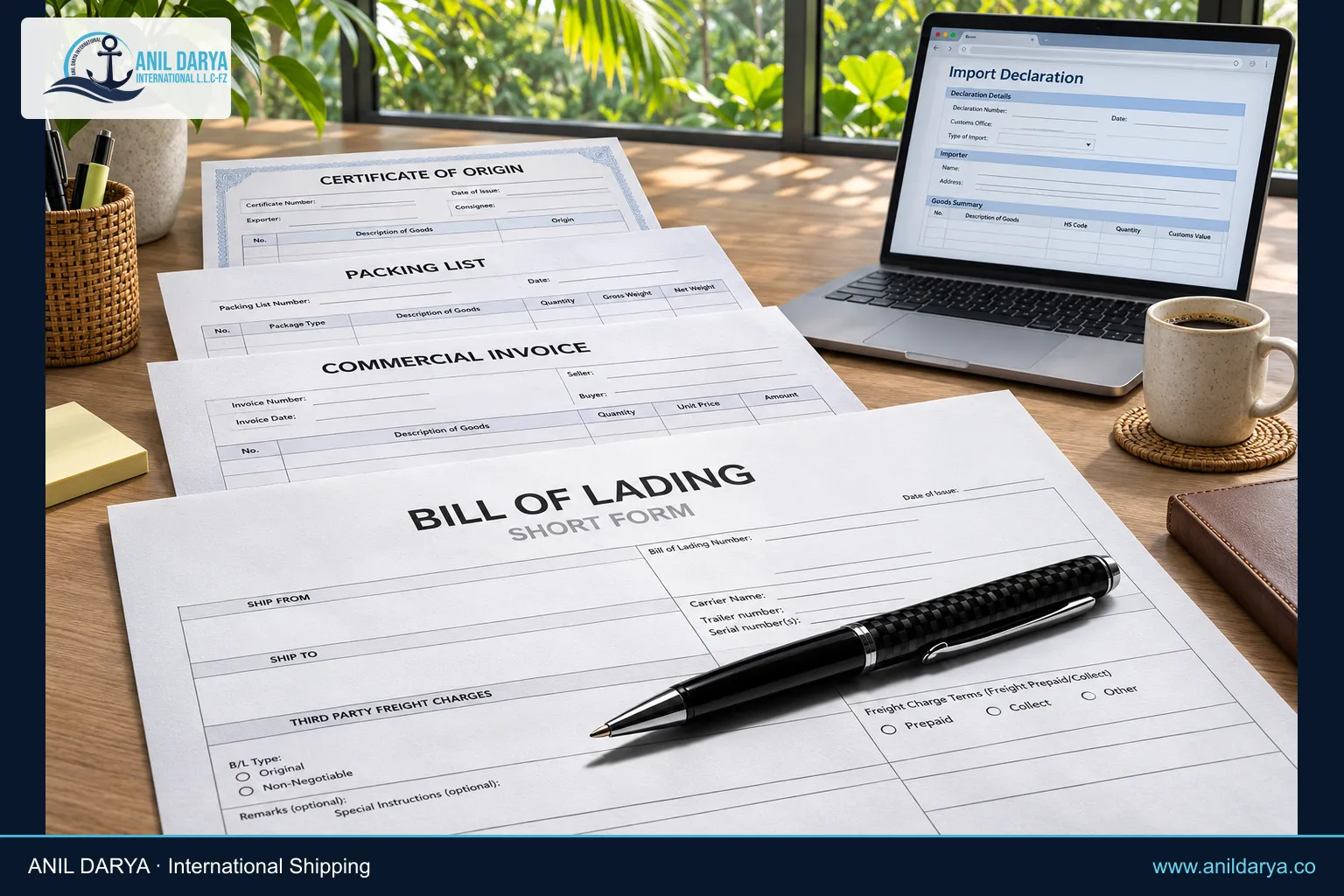
For an Indonesian shipment, Dubai Customs lists the supplier's invoice, a packing list that matches the PEB, a certificate of origin (the Form I-UAE CEPA certificate if you claim the CEPA exemption) and a permit from the relevant authority for restricted goods such as food, timber with bark or cosmetics. A container from Tanjung Priok or Tanjung Perak also needs the bill of lading and the shipping line's delivery order.
| Document | Who provides it | Why Dubai needs it |
|---|---|---|
| Commercial invoice | Indonesian exporter | Customs value and HS code |
| Packing list | Indonesian exporter | Inspection and LCL release |
| CEPA certificate of origin | Indonesian competent authority, applied for by the exporter | Origin and the CEPA duty exemption |
| Bill of lading or air waybill | Carrier or forwarder | Title to the goods |
| Delivery order | Shipping line in Dubai | Releasing the container |
| Permit | UAE authority for the product | Restricted goods only |
| SDS and DG declaration | Indonesian exporter | Dangerous goods only |
Which declaration should you use?
| What happens to the goods | Declaration | Duty and VAT |
|---|---|---|
| Sold or used in the UAE mainland | Import for local use | Duty and VAT at import, unless CEPA or VAT deferral applies |
| Delivered into Jafza | Transfer into the free zone | Due only if the goods later enter the mainland |
| Brought in for a time, then sent out | Temporary admission | Deposit equal to the duty, refunded on re-export in time |
| Passing through to another country | Transit | Not imported into the UAE |
Jafza, operating since 1985 next to Jebel Ali Port, hosts over 11,000 businesses. Traders who buy Indonesian goods for resale across the region often hold stock there. Our guide to Jafza re-export covers how that works for bulk and breakbulk cargo.
Import duty and VAT on goods from Indonesia
Dubai Customs charges 5% of the CIF value for most goods. CIF includes the cost of transport, insurance and other charges up to the place of import. Alcohol pays 50% and cigarettes 100%. The UAE government portal notes that tariffs range from 0 to 5%, so check your HS code.
Import VAT is 5%, and it still applies when a CEPA certificate removes the duty on Indonesian-made goods. The Federal Tax Authority says it is charged on the customs value, including insurance, freight and any customs fees and excise tax paid on import. How you pay depends on your status:
- VAT-registered importer that has registered its customs number with the FTA: no VAT at the border. The import VAT is prepopulated in your VAT return.
- Importer not registered for VAT: VAT is paid through the FTA's import declaration form before customs releases the goods.
| Charge | Rate | Base |
|---|---|---|
| Customs duty (most goods) | 5% | CIF value |
| Customs duty, alcohol | 50% | CIF value |
| Customs duty, cigarettes | 100% | CIF value |
| Import VAT | 5% | Customs value plus customs fees and excise tax |
| Indonesian-origin goods with a valid CEPA certificate | Exempt from customs duty when imported directly (Abu Dhabi Customs) | VAT still applies |
How the UAE-Indonesia CEPA cuts duty on imports to Dubai
The UAE Ministry of Economy says the agreement was signed on 1 July 2022 and entered into force on 1 September 2023. Abu Dhabi Customs explains how the UAE applies it to imports: goods of Indonesian origin are exempt from customs duty when imported directly from Indonesia, and the importer claims the exemption in the customs declaration. Confirm with your clearing agent how Dubai Customs wants the claim entered for your HS code.
| Rule | What it means for your shipment | Source |
|---|---|---|
| Proof of origin in English, on the agreed form | Your supplier applies for the CEPA certificate (Form I-UAE CEPA) | CEPA Arts 3.16, 3.17 |
| Issued before or at shipment, or within five days after | Ask for it before the vessel sails | CEPA Art 3.24 |
| Retroactive issue only in exceptional cases, up to 12 months | Do not rely on fixing it later | CEPA Art 3.24 |
| Valid 12 months from issue | Submit it to UAE customs within that period | CEPA Art 3.27; Abu Dhabi Customs |
| Submitted electronically, originals kept | Customs may ask to see the original | Abu Dhabi Customs |
| Direct transport | Transhipment is allowed only if the goods stay under customs control and are only handled to preserve them | Abu Dhabi Customs; CEPA Art 3.13 |
| Records kept at least four years | Your supplier must keep the origin file | CEPA Art 3.29 |
The transhipment rule matters on this lane, because most sailings stop at a hub. Keep the through bill of lading, and if customs asks, be ready to show the goods stayed under customs control at the hub.
[AMIR-FACT: how long Indonesian suppliers we work with usually take to obtain the Form I-UAE CEPA certificate, and whether Dubai Customs has queried any CEPA claim on transhipped cargo]
Re-exporting Indonesian goods from Dubai
Many shipments on this lane do not stay in the UAE. A Dubai or Jafza trader buys from Indonesia, stores the goods and sells them on. Plan three things before the cargo arrives.
- Declaration. Deliver into Jafza under a free zone transfer, or use transit if the goods only pass through. Duty then applies only if the goods later enter the UAE mainland.
- Origin. The goods stay Indonesian-origin. The CEPA certificate works for the UAE market only, so do not expect it to cut duty in the next country.
- Paperwork for the next buyer. Dubai Chambers issues certificates of origin for exported and re-exported goods. It charges AED 100 and quotes two hours, and for transhipment goods it asks for the transit bill from Dubai Customs.
Restricted and prohibited goods for the UAE
Restricted goods need a permit from the competent UAE authority before Dubai Customs clears them. Groups to check on this lane:
- Food, coffee, spices, seafood and fruit: food safety approvals and origin health certificates.
- Plants, seeds, timber with bark and fertilisers: agricultural approvals.
- Medicines, supplements and medical devices: health authority approval.
- Chemicals and dangerous goods: permits for some products and port approval for some classes.
- Cosmetics and personal care products: product registration.
- Telecom and wireless equipment: type approval.
Apply before the vessel leaves Indonesia. A permit that arrives after the ship means storage and demurrage at Jebel Ali.
Shipping from Indonesia to Dubai step by step
- Tell us about the cargo. Commodity, HS code, weight, volume, the Indonesian pickup city and the UAE delivery address.
- Agree the Incoterm. Under FOB we book the main voyage from Indonesia. Under CFR or CIF the supplier books it and we take over at the UAE port.
- Get your Dubai side ready. Customs business code, VAT registration linked to the code, and permits for restricted goods.
- Ask for the CEPA certificate. Your supplier applies so it is issued at or before shipment.
- Book space. We compare one-transfer and two-transfer routings and confirm the UAE discharge port. DG, reefer and out-of-gauge cargo get carrier approval first.
- Indonesian export. The supplier or its broker files the PEB and delivers the box to the terminal before the cut-off.
- Check documents before arrival. Invoice, packing list, bill of lading and certificate must match on names, weights and HS codes.
- File the Dubai declaration. We file it through a licensed agent before the vessel berths.
- Pay and release. We arrange payment of the duty, any VAT due and the line's charges, and collect the delivery order.
- Deliver and return the empty. We book the truck slot, deliver to your site or Jafza warehouse and return the container within free time.
[AMIR-FACT: one real Indonesia to Dubai shipment we handled, with cargo type, Indonesian load port, mode, routing and how clearance went in the UAE, cleared for publication]
What decides the cost of shipping from Indonesia to Dubai?
Rates change every week, so we quote each shipment. These are the drivers:
| Cost factor | Effect |
|---|---|
| Indonesian load port | Jakarta and Surabaya have more services than secondary ports, which may need a feeder |
| Routing | One or two transhipments, and which UAE port the service ends at |
| Container type | Reefer, flat rack and open top cost more than dry boxes |
| Incoterm | Decides who pays each leg and the local charges |
| Indonesian origin charges | Trucking, terminal handling, PEB filing, certificate |
| UAE destination charges | Terminal handling, delivery order, clearance, trucking, CFS for LCL |
| Duty and VAT | 5% duty unless CEPA applies; 5% VAT unless deferred |
| Free time | Demurrage and detention once free days run out |
The biggest avoidable cost is waiting at the UAE port for a permit or a missing document. Our article on demurrage and detention shows how it adds up.
Checklist before cargo leaves Indonesia
- Your customs business code is active and your VAT registration is linked to it.
- HS code agreed with the supplier and checked for UAE duty and restrictions.
- Permits for restricted goods applied for.
- CEPA certificate requested, to be issued at or before shipment.
- Through bill of lading covering the transhipment.
- Supplier confirms the PEB and any export permit.
- Invoice, packing list and bill of lading match.
- Declaration type chosen: local import, free zone, temporary admission or transit.
- DG: SDS, DG declaration and carrier approval for every leg.
- Free time at the UAE port agreed and delivery booked.
- Cargo insurance arranged.
Common mistakes when shipping from Indonesia to Dubai
- No customs code in the UAE. The goods wait until someone authorised can file.
- VAT not linked to the customs code. You pay import VAT up front instead of deferring it.
- CEPA certificate requested after sailing. It may not be issued in time, or at all, and you pay 5% duty.
- Separate bills of lading at the hub. That can break the direct transport rule for CEPA.
- Booking only on the sailing date. A cheap service with two transfers can arrive a week later.
- Choosing an east coast port for a Dubai consignee without pricing the truck leg.
- Food or plant products shipped without the UAE approval in hand.
Frequently asked questions
How long does shipping from Indonesia to Dubai take?
Fluent Cargo's schedule data shows quickest port-to-port sailings of about 17.5 days from Jakarta to Khor Fakkan and about 24 days from Surabaya to Jebel Ali, with one or two transhipments. Add time for Indonesian export filing, UAE clearance and delivery.
Which Indonesian port is best for exports to Dubai?
Tanjung Priok in Jakarta and Tanjung Perak in Surabaya have the most connections. Ship from the one closest to the factory, and compare a feeder or truck if you are near a smaller port.
What is the customs duty on goods from Indonesia to Dubai?
Dubai Customs charges 5% of the CIF value for most goods, 50% on alcohol and 100% on cigarettes. Indonesian-origin goods with a valid CEPA certificate, shipped under the direct transport rule, are exempt from customs duty according to Abu Dhabi Customs.
Do I pay VAT on imports from Indonesia?
Yes, 5% import VAT applies even when CEPA removes the duty. If you are VAT-registered and your customs number is registered with the FTA, it goes into your VAT return instead of being paid at the border.
Who files the export declaration in Indonesia?
The exporter, or a customs broker it authorises, files the PEB with Indonesian customs (DJBC). We book the voyage and handle the UAE side; we do not file Indonesian customs entries.
Does transhipment cancel the CEPA duty exemption?
Not if the goods stay under customs control at the hub and are only unloaded, reloaded or stored. Keep a through bill of lading so you can show that to UAE customs if asked.
Can I ship from Indonesia to a Dubai free zone without paying duty?
Yes. Goods delivered into Jafza under a free zone transfer pay duty only if they later enter the UAE mainland.
Can you ship by air from Indonesia to Dubai?
Yes. Fluent Cargo lists a direct Jakarta to Dubai flight of just under 8 hours. The Dubai Customs declaration, duty and VAT are the same as for sea cargo.
Get a quote for shipping from Indonesia to Dubai
Send us the cargo details, the Indonesian pickup point and your UAE delivery address, and we will come back with a routing and price, including clearance in Dubai. Use our freight rate inquiry form or contact our team. You can also read more about our Dubai freight forwarding team.
Sources
- DP World: Jebel Ali Port (terminals, weekly services, cargo types)
- Dubai Customs: Frequently asked questions (duty, CIF, business code, clearing agents, temporary admission)
- Dubai Customs: Submit customs declaration (regimes and documents)
- UAE Government portal: Customs duty and tariff
- Federal Tax Authority: VAT guide (import VAT)
- Jafza: About Jebel Ali Free Zone
- Dubai Chambers: Issuing a certificate of origin
- UAE Ministry of Economy: UAE-Indonesia CEPA
- Abu Dhabi Customs: UAE-Indonesia CEPA (duty exemption, certificate, direct transport)
- UAE-Indonesia CEPA text, rules of origin chapter (Arts 3.13 to 3.29)
- DJBC (Indonesian Customs): Export procedures (PEB, checks, export duty, sanctions)
- DP World: Shipping routes to Indonesia (main ports and airport)
- The Shipping Gazette: Tanjung Priok 2025 throughput (Pelindo Regional 2)
- Lloyd's List: Tanjung Perak 2025 throughput
- Fluent Cargo: Jakarta to Dubai schedules (sea and air)
- Fluent Cargo: Surabaya to Dubai schedules
- Fluent Cargo: Indonesia to UAE air routes
Reviewed: 10 November 2026