
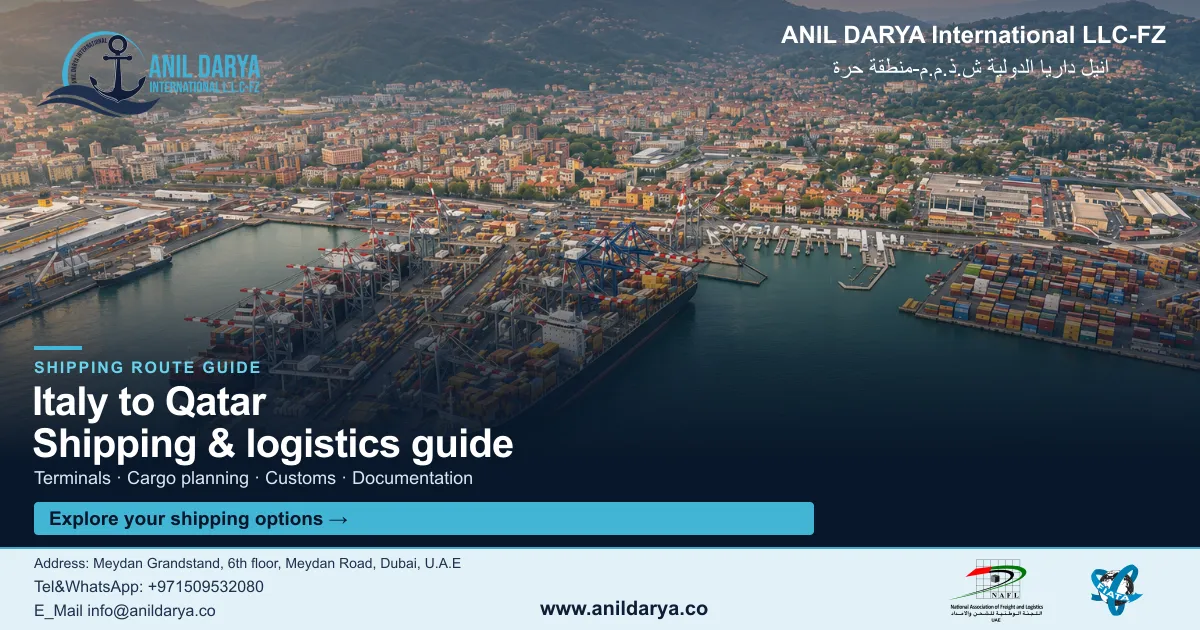
Shipping from Italy to Qatar means a container or breakbulk move from a port such as Genoa, La Spezia, Naples or Gioia Tauro to Hamad Port, the country's main gateway south of Doha. The Italian seller lodges the export declaration through ADM's AIDA system and has the invoice and certificate of origin stamped by its chamber of commerce. In Qatar the buyer's broker clears the goods on Al Nadeeb and pays duty, generally 5% of the CIF value, because no EU or Italian trade agreement with Qatar is in force. We book the ocean freight from Dubai and coordinate both ends.
Italy to Qatar shipping at a glance
| Item | Detail |
|---|---|
| Type of lane | Sea cross-trade from Italy to Qatar, booked and coordinated by Anil Darya from Dubai |
| Italian load ports | Genoa and Vado Ligure, La Spezia, Livorno, Naples and Salerno, Gioia Tauro; Venice, Trieste and Ravenna on the Adriatic |
| Qatar discharge port | Hamad Port, run by Mwani Qatar, about 29 square kilometres with three container terminals planned |
| Routing | A Mediterranean-Gulf mainline that calls Hamad, or a mainline to a Gulf hub such as Jebel Ali and a feeder on to Hamad |
| Published sea time | No carrier page we could open in November 2026 printed a port-to-port figure for this lane |
| Main Italian goods | Machinery and plant (57.8% of Italian exports to Qatar in 2024), fashion and accessories, semi-finished goods, furniture and building products, vehicles, food |
| Italian export filing | Electronic export declaration in the EU Automated Export System, lodged through ADM's AIDA |
| Origin papers for Qatar | Commercial invoice stamped and signed by the Italian chamber of commerce, plus a chamber certificate of origin quoting the invoice number and HS code |
| Trade agreement | None in force between the EU and Qatar; EU-GCC talks suspended since 2008 |
| Qatar duty | 5% of CIF for most goods; 15%, 20%, 30% and 100% exceptions |
| Qatar clearance | Al Nadeeb single window, by the consignee's licensed broker, agreed before we confirm the booking |
| Bill of lading | The shipping line's own B/L, released to you through us as agent for the line |
Who does what on an Italy to Qatar cross-trade
A cross-trade shipment never needs to touch the UAE. The box is loaded at an Italian quay and discharged at Hamad, while our Dubai desk holds the booking and checks that the Italian papers match what the Qatari broker will declare.
| Party | Job on an Italy to Qatar shipment |
|---|---|
| Italian seller or its spedizioniere | Picks up and stuffs the goods, lodges the export declaration, gets the invoice and certificate of origin stamped by the chamber of commerce |
| Anil Darya, Dubai | Books space with the carrier, sends the shipping instructions, checks the B/L draft against the invoice, follows the sailing and any transhipment, releases the carrier's B/L |
| Shipping line | Carries the container or breakbulk unit, issues its own bill of lading, files the manifest in Qatar |
| Qatari buyer | Holds the import licence, pays duty and port charges, arranges delivery to its site |
| Buyer's broker in Qatar | Lodges the declaration on Al Nadeeb, attends inspection at Hamad, takes customs release |
The bill of lading is the carrier's document. Anil Darya acts as agent for many shipping lines, so the line's B/L for, say, two 40ft boxes of marble slabs from Marina di Carrara or La Spezia is released to you from Dubai once freight is settled and we have checked that the consignee, the weights and the HS codes on the draft agree with the chamber-stamped invoice.
We do not clear cargo in Qatar, and we do not pay Qatari duty. Duty and taxes at destination are paid by the consignee or its broker. That is why we ask the Doha buyer, before we confirm any sailing, which broker will lodge the declaration, whether the importer's licence covers these goods, and whether any permit is needed for the product. A Genoa booking with no answer to those three points stays on hold.
Agree the Incoterm early. On FOB Genoa the buyer pays the ocean freight; on CIF Hamad the seller buys it, but Qatari duty and terminal charges stay with the buyer. Our Incoterms 2020 guide for sea freight shows where cost and risk pass.
Which Italian port should you load at?
Pick the port that has a good weekly connection to the Gulf, then check the trucking or rail cost from the factory. For a plant in Lombardy, Genoa, Vado and La Spezia are all within reach, so the sailing usually decides.
| Italian port | What the port authority or terminal reports | Fit for Qatar cargo |
|---|---|---|
| Genoa and Vado Ligure | Genoa handled 1,199,993 TEU in January to June 2026; PSA Genova Pra' has a 1,675 m quay with 15 m alongside | Piedmont, Lombardy and Liguria machinery, food and consumer goods |
| La Spezia | 1,217,461 TEU in 2025 across its two container terminals, with 7,352 trains in the year | Emilia-Romagna and Tuscany; Carrara marble and stone nearby |
| Livorno | 663,622 TEU and 485,190 ro-ro units in 2024 | Tuscan furniture, paper and vehicles |
| Naples and Salerno | Naples 638,585 TEU and Salerno 416,941 TEU in 2025 | Campania, Puglia and Basilicata food and industrial goods |
| Gioia Tauro | Seabed 14.5 to 18 m and 5,130 m of quays, a large Mediterranean transhipment hub | Southern cargo, and a relay point for some Gulf services |
| Trieste, Venice, Ravenna | Trieste lists 58 berths with depths up to 18 m | North-east Italy; steel, breakbulk and project units |
Adriatic ports suit steel, Veneto machinery and project units; for ordinary containers the Tyrrhenian ports usually offer more Gulf sailings.
Hamad Port: where Italian cargo arrives
Almost every Italian container for Qatar discharges at Hamad Port, south of Doha. Mwani Qatar, under the Ministry of Transport, manages it. Operations started in December 2016 and the port was inaugurated on 5 September 2017.
| Hamad Port feature | Figure published by Mwani Qatar or the terminal operator |
|---|---|
| Area | 29 square kilometres |
| Container capacity | Two container terminals in operation with an optimum 5 million TEU a year, rising to over 7.5 million TEU |
| General cargo | 7 million tonnes a year, plus 1 million tonnes of grain |
| Vehicles | A specialist terminal for around 500,000 vehicles a year |
| Customs inspection area | Built for 5,600 containers a day |
| General Cargo Terminal | 1,200 m berth with 14 m allowable draft, for breakbulk and project units |
| Free zone | A free zone next to the port |
Ask the buyer early for the delivery site: a valve skid for a southern industrial zone and a showroom order for West Bay leave the same quay but need different trucks and permits.
Direct call, transhipment or a Dubai relay
Two patterns reach Hamad from Italy. Some Mediterranean-Gulf mainline services call Hamad on the loop. Others discharge at a Gulf hub, and a feeder carries the box on to Qatar. Milaha's Intra Gulf Express, for example, is a weekly service that links Jebel Ali and Hamad with two ships of 1,015 TEU nominal and 90 reefer plugs, according to its January 2025 service sheet.
We could not open a carrier schedule page in November 2026 showing a current direct call from an Italian port to Hamad, so we name no mainline service here. Rotations change often; every quote we send names the vessel, the loop and any transhipment port.
[AMIR-FACT: the carriers we actually book from Genoa, La Spezia, Naples and Gioia Tauro to Hamad in 2026, whether each calls Hamad direct or tranships (and where), and our real port-to-port days for FCL and LCL]
Sea freight from Italy to Qatar: FCL, LCL and special cargo
| Option | Typical Italian cargo for Qatar | What to check first |
|---|---|---|
| FCL 20ft | Marble and stone slabs, tiles, valves and flanges, chemicals in drums | Weight limit before volume; lashing for stone |
| FCL 40ft / high cube | Furniture, lighting, packaging and food machines, fashion and textiles | Every carton marked "Made in Italy"; packing list matches the invoice |
| LCL | Spare parts, samples, small furniture and fashion orders | One set of chamber-stamped papers per consignee |
| Reefer | Cheese, chilled food, pharmaceuticals | Set point, health papers and Arabic labels ready before stuffing |
| Flat rack, open top, breakbulk | Turbine parts, pressure vessels, cranes, yachts | Lifting points, dimensions and Hamad General Cargo Terminal handling |
| Dangerous goods | Paints, resins, adhesives, lab chemicals, lithium batteries in equipment | IMDG declaration, safety data sheet and line acceptance |
If you are torn between a shared box and your own, read our FCL vs LCL guide. As a rule, once a Qatar order fills more than half a 20ft, a full container is often simpler for the broker because one set of papers covers it. You can also see how we book sea freight from Dubai on any lane.
Machinery, plant and project cargo
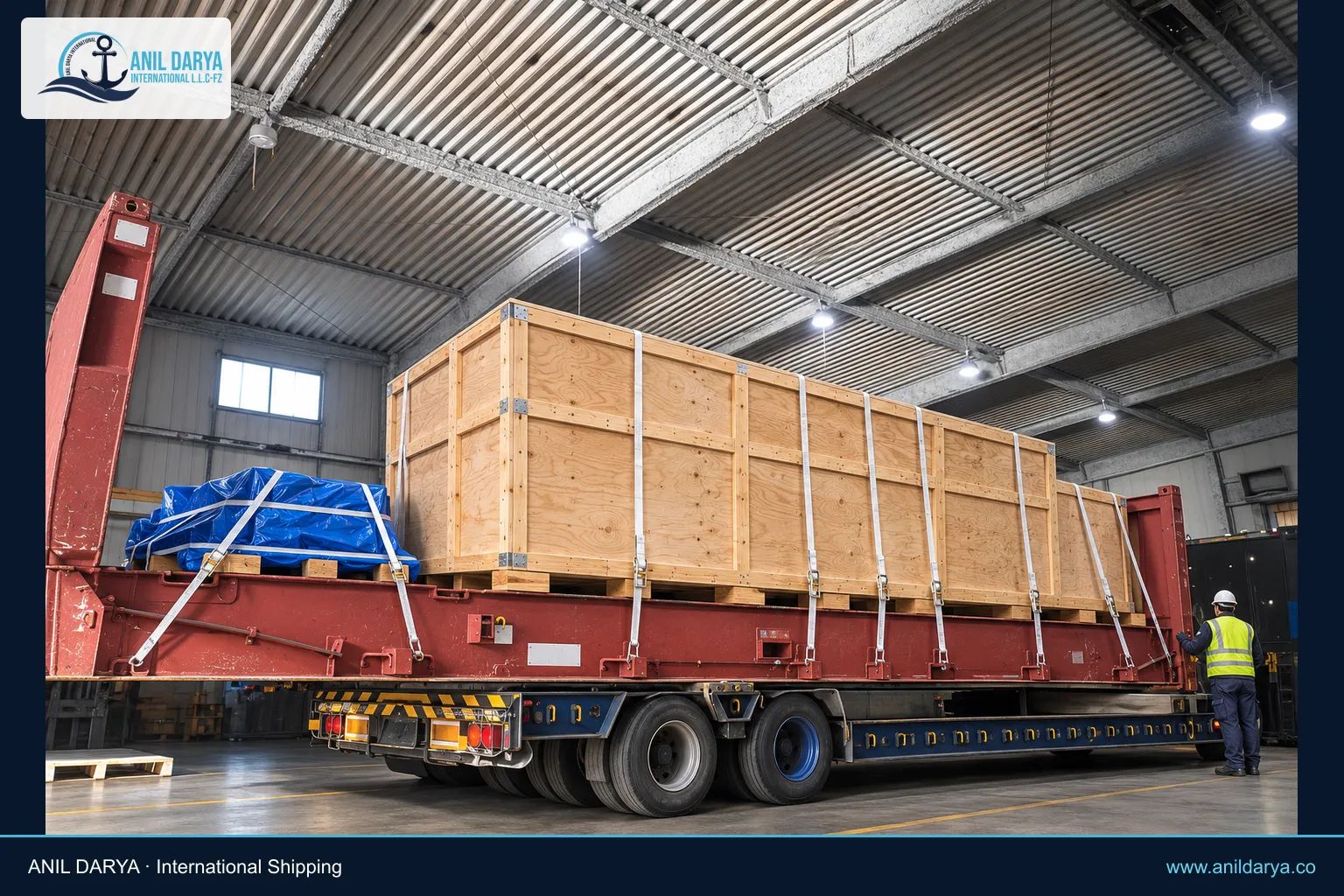
Machinery is the core of this lane. The Italian Embassy in Doha reports that 57.8% of Italian exports to Qatar in 2024 were capital machinery. Much of it goes to gas, utilities and building projects, and some of it does not fit a standard box. For out-of-gauge units we plan break bulk and project shipments with the line, check lifting plans, and agree with the buyer how the unit leaves the General Cargo Terminal. Our heavy-lift shipping guide lists the data the line asks for.
Ask the buyer early whether the project has a duty exemption. Qatar exempts machinery and raw materials for certain industrial and foreign investment projects, and projects funded by the Qatar Industrial Development Bank can get a duty waiver. The exemption is the importer's to claim, so the invoice must name the project in the way the broker needs.
Food, drink and reefer cargo
Italian food sells well in Doha hotels and shops. The embassy guide says food labels must show, in Arabic or Arabic and English, the brand, place of production, expiry date, country of origin, producer, net weight and the ingredient list, with fats and oils named. Halal certificates issued in Italy must be legalised at the Qatar Embassy in Rome. Pork products and alcoholic drinks face a 100% duty and tight controls, so check with the buyer before quoting.
Dangerous goods
Paints, resins and industrial chemicals move under the IMDG Code, edition 2024 (Amendment 42-24), mandatory from 1 January 2026. The embassy guide adds that a Qatari import of chemicals or hazardous products should quote the DG code and carry the safety data sheet. Our dangerous goods team checks class, packing and line acceptance before we file the booking.
How long does shipping from Italy to Qatar take?
We print no transit number for this lane, and we explain why. Marketplace and forwarder pages give 10 to 15 days, 18 days, 3 to 5 weeks and "37 days with transfers" for the same Genoa to Hamad move. None of those figures comes from a carrier schedule page that we could open, and they cannot all be right.
The real time depends on whether the loop calls Hamad or tranships, how long the box waits for a feeder at the hub, and how fast the Italian export and the Qatari clearance run. With a quote, we give the line's own schedule for the named vessel, not an average.
Export clearance in Italy: AES, AIDA and dual-use
Every export from Italy to Qatar leaves under an electronic export declaration in the EU Automated Export System. In Italy, the declaration is lodged through AIDA, the information system of the Agenzia delle Dogane e dei Monopoli (ADM). The seller or its customs agent files it; we do not.
- The exporter needs an EORI number.
- The declaration is lodged at the customs office where the exporter is established or where the goods are packed. That office releases the goods and sends the data to the office of exit.
- The office of exit, normally the port, supervises the physical departure and confirms exit to the office of export. That confirmation is the seller's proof that the goods left the EU.
- Dual-use items need an authorisation under Regulation (EU) 2021/821. In Italy, UAMA at the Ministry of Foreign Affairs issues it, and applications go through its e-licensing platform, mandatory since 1 July 2022.
Valves, pumps, instruments and some electronics can be dual-use. A missing licence stops the box at the Italian port, so check before booking.
Invoice and certificate of origin for Qatar
Qatar is strict about origin papers. The official guide "Fare affari in Qatar 2025", published by the Italian Embassy and the ICE office in Doha, sets out what the Italian supplier must provide.
| Document | What the Qatari side expects |
|---|---|
| Commercial invoice | On company letterhead, stamped and signed by the Italian chamber of commerce. It shows seller and buyer, total and unit values (never zero, no discounts shown), description, quantity, packing, net and gross weight, Incoterm, country of origin and HS code |
| Certificate of origin | Issued by the chamber. It quotes the invoice number and the HS code, and names the country, not a generic "EU" |
| Packing list | Signed in blue ink and stamped by the supplier; quantity, net and gross weight identical to invoice, B/L and certificate of origin |
| Bill of lading | The original carrier B/L, with the same quantity and weights as the other papers |
| Dangerous goods papers | DG code and safety data sheet where the goods are chemicals or hazardous |
The US Commercial Service adds two Qatari rules worth printing on your checklist. Since 1 April 2011 shipments without an official invoice, certificate of origin and packing list are not cleared and are returned to origin. The HS code must appear on the invoice and certificate, and "Made in" or country of origin must be marked on each piece and carton, matching the papers.
Settle two points with the buyer's broker before the chamber stamps anything: how the origin line should read (the embassy guide asks for the named country; US guidance shows a "European Community" prefix), and whether the broker or a letter of credit wants legalisation beyond the chamber stamp. Qatar uses 12-digit HS codes from January 2025, so the broker may also ask for the full Qatari code next to the 8-digit EU code.
[AMIR-FACT: whether Qatari brokers we work with in 2026 accept the Italian chamber-stamped invoice and certificate of origin alone, or still ask for Qatar Embassy legalisation in Rome for some goods, and how the origin line should read]
Does any trade agreement cut the duty?
No. The European Commission's Gulf page says the EU and the GCC opened free trade talks in 1990 and suspended them in 2008. The EU has since launched talks with the UAE, but nothing with Qatar is in force. Italian goods therefore pay the normal Qatari tariff, and an EUR.1 is not used on this lane.
Some forwarder pages say the GCC-EFTA agreement covers Italy. It does not: EFTA is Switzerland, Norway, Iceland and Liechtenstein.
The GCC customs union matters only if goods enter the GCC elsewhere first; see the Dubai section below.
Qatar import customs on Al Nadeeb
Qatar's customs law is Law No. 40 of 2002, alongside the GCC Unified Customs Law (Law No. 41 of 2002) and the Common Customs Law of the GCC States (Law No. 40 of 2004). The declaration goes through Al Nadeeb, the Customs Clearance Single Window, where the broker submits the declaration, the system routes it to other agencies and duty is paid online.
- Import licence. Every importer needs one, registered with the Ministry of Commerce and Industry. The embassy guide adds that importers are entered on the register of importers held at the Qatar Chamber.
- Documents. Invest Qatar lists the licence, customs declaration, manifest, invoice, certificate of origin and bill of lading, and says documents must be attested, translated and verified.
- Inspection. Goods are checked partly or fully, usually with the owner or its agent present, at the owner's cost.
- Mismatch. If the goods differ from the papers, extra duty and a fine apply, and goods can be held or sent back.
Plan the broker's work before arrival: storage and detention run from discharge, and our guide to demurrage and detention explains how those days add up.
Duty, excise and 2026 tariff changes
| Goods | Qatar customs duty (Invest Qatar; trade.gov, last published 20 August 2025) |
|---|---|
| Most goods, including machinery, furniture, fashion and most food | 5% of CIF value |
| Records and musical instruments | 15% |
| Steel (iron bars and rods, non-alloy hot-rolled steel, 12 mm bars) and cement | 20% |
| Urea and ammonia | 30% |
| Pork products, alcoholic beverages, tobacco | 100% (cigarettes 100% or QAR 1,000 per 10,000, whichever is higher) |
| Around 600 exempt goods | 0%, including basic food such as fresh fruit and vegetables, rice, wheat and flour, and machinery for certain investment projects |
The base is CIF, so freight and insurance count. Qatar has no VAT or sales tax on imports today.
Two 2026 changes, reported by EY Tax News on 28 September 2026, may matter for food and drink. Amiri Decree No. 45 of 2026 raises duty on specified fresh or chilled chicken to 18% and sets 15% on certain vegetables, effective 60 days after publication in the Official Gazette. Cabinet Decisions No. 30 and 31 of 2026, effective 17 September 2026, require excisable goods such as energy drinks and sweetened beverages to be registered with the General Tax Authority before import. We have not seen the Gazette text ourselves.
[AMIR-FACT: confirm with a Qatari broker the current effective dates of Amiri Decree 45/2026 and the excise product registration rule, and whether any Italian food or drink lines we ship are affected]
Product rules and restricted goods in Qatar
- Prohibited outright: ammunition and explosives, flammable goods, radioactive material, narcotic drugs, and goods that infringe trademarks, copyright or patents.
- Meat and poultry: a health certificate from the exporting country and a halal slaughter certificate from an approved Islamic centre.
- Food labels: Arabic, or Arabic and English, with the details listed earlier.
- Consumer electrical goods and toys: the embassy guide says CE-marked products are usually accepted with authenticated certificates. Low-voltage goods and toys may also need the Gulf G-Mark.
- Telecom and radio equipment: needs import approval from the Communications Regulatory Authority.
Where Dubai fits on this lane
Most Italian cargo can and should go straight to Hamad. Dubai helps in three cases, and in each one our team at Jebel Ali port is close to the cargo.
- Relay through Jebel Ali. Where the Italian loop calls Jebel Ali but not Hamad, a Gulf feeder such as Milaha's weekly Intra Gulf Express can carry the box on to Qatar.
- Consolidation. A Qatari buyer with small orders from several Italian suppliers can ship them to Dubai, then send one box on to Hamad.
- Stock in a free zone. A distributor can hold Italian stock in JAFZA and send smaller lots to Qatar and other Gulf markets. Our article on re-export from JAFZA explains the model.
If goods are imported into the UAE and cleared there first, GCC duty is paid at that first point of entry, and the Qatari broker then needs proof of payment so Qatar does not charge it again. We handle the Dubai customs clearance for a fee in that case. Ask your broker how the stamped Italian invoice and certificate of origin should travel with the goods when the papers are re-issued for the Dubai to Qatar leg.
[AMIR-FACT: whether we route Italian cargo for Qatar through Jebel Ali today (relay, consolidation or JAFZA stock), which feeder we use to Hamad, and how many days it adds against a direct call]
What Italian cargo goes to Qatar?
According to the embassy guide, Italian exports to Qatar reached EUR 1.72 billion in 2024 (ISTAT data), and Italy was Qatar's third-largest supplier that year with a 5.6% share.
| Sector (2024) | Share of Italian exports to Qatar | Sea freight angle |
|---|---|---|
| Capital machinery | 57.8% | FCL, flat racks and breakbulk; project exemptions |
| Fashion and accessories | 18.3% | FCL or LCL; often air for urgent stock |
| Semi-finished goods | 8.2% | FCL; steel lines at 20% duty |
| Furniture and building products | 5.6% | 40ft high cube; stone and tiles in 20ft |
| Transport equipment | 4.6% | Ro-ro, flat rack or container |
| Food and drink | 3.4% | Reefer and dry; Arabic labels |
How to ship from Italy to Qatar step by step
- Send us the goods, HS codes, weights, dimensions, Italian pickup town and the Qatari delivery address.
- Agree the Incoterm with your buyer or seller and decide who pays the ocean freight.
- Name the Qatari broker. We check that it will handle the cargo at Hamad and that the importer's licence covers the goods.
- Check permits in Qatar: food, telecom, G-Mark, excise registration or a project duty exemption.
- We quote named sailings, with the loop and any transhipment port, and confirm the booking once the broker is agreed.
- The Italian seller prepares the invoice and packing list, marks every carton "Made in Italy", and has the chamber stamp the invoice and issue the certificate of origin.
- The seller or its spedizioniere lodges the export declaration through AIDA, with any dual-use licence.
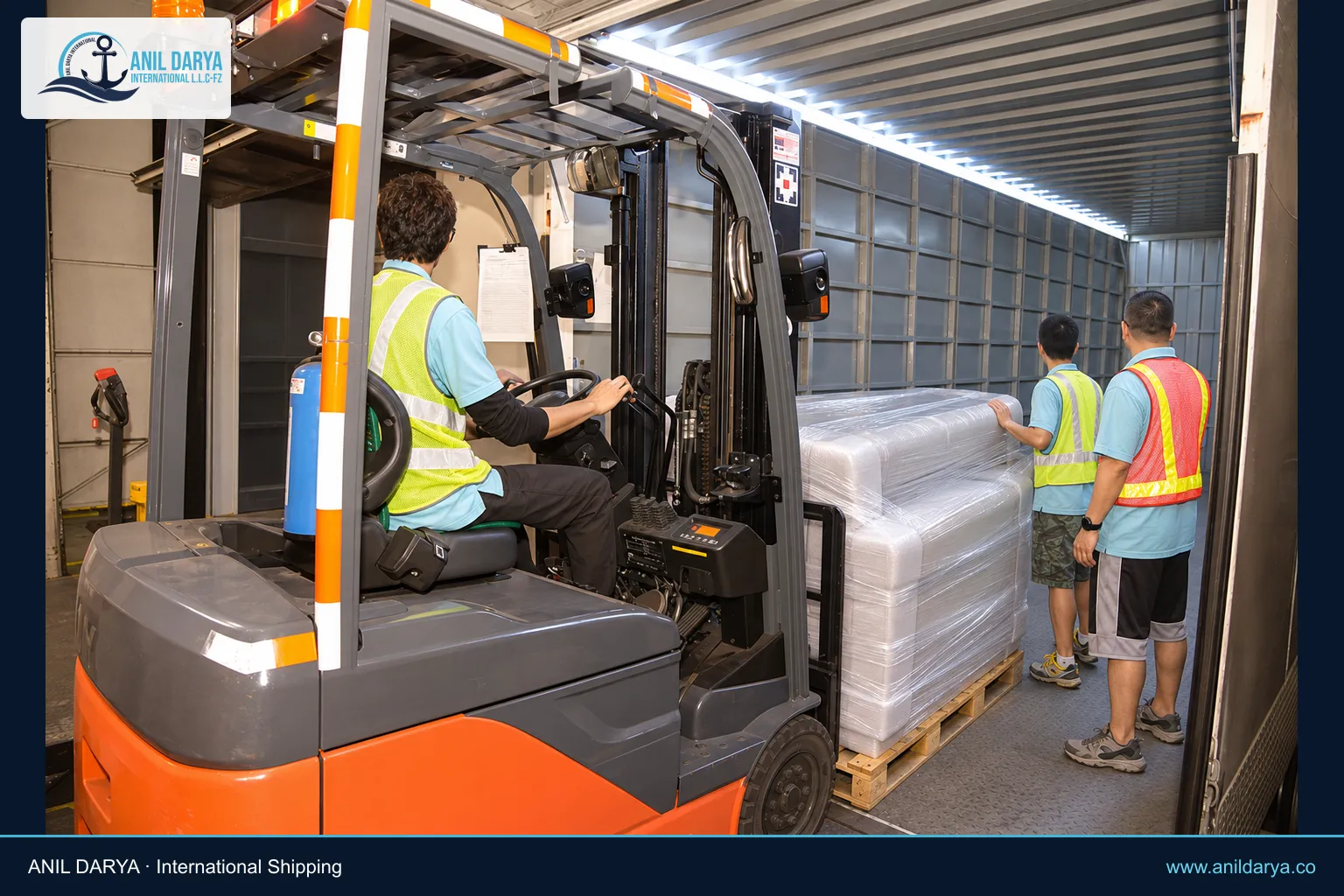
- The box is stuffed and gated in; we send shipping instructions and check the B/L draft against the invoice.
- The cargo sails; we follow it and send the papers to the broker. Once freight is settled, we release the carrier's B/L.
- The broker files on Al Nadeeb, the buyer pays duty, and the goods are inspected and released at Hamad.
- The buyer's trucker delivers and returns the empty box within free time.
What drives the cost
We do not publish rates, because they change each week. These are the items that move the price on this lane:
- Ocean freight for the loop you choose, and any feeder leg from a Gulf hub.
- Equipment: standard box, high cube, reefer, flat rack or breakbulk.
- Italian origin charges: trucking or rail to port, terminal handling, export declaration and chamber fees.
- DG and out-of-gauge surcharges.
- Qatari charges: terminal handling at Hamad, inspection, broker fees, duty at 5% or the exception rate.
- Storage, demurrage and detention if papers or permits are late.
Checklist before the cargo leaves Italy
- Qatari broker named and confirmed in writing.
- Importer's licence covers the goods.
- Any permit, G-Mark, telecom approval or excise registration in place.
- Invoice on letterhead, stamped and signed by the chamber, with HS codes and Incoterm.
- Certificate of origin quoting the invoice number and HS code, naming Italy.
- Packing list signed in blue ink; quantities and weights match all papers.
- "Made in Italy" on every piece and carton.
- Export declaration lodged; dual-use checked.
- DG declaration and safety data sheet where needed.
Mistakes that cost money
- Shipping before destination clearance is agreed. A box that lands at Hamad with no broker sits in storage while the buyer looks for one.
- Paying for an EUR.1. No preference applies, so it adds nothing in Qatar.
- Invoice without the chamber stamp, or with a zero or discounted value.
- Weights that differ between papers, or cartons with no "Made in" mark; either can send the shipment back.
- Food labels in Italian or English only.
- Booking a "fast" quote that relies on a transhipment no one has checked.
Frequently asked questions
Which port in Qatar receives cargo from Italy?
Hamad Port, south of Doha, run by Mwani Qatar, with container, general cargo and vehicle terminals.
How long does sea freight from Italy to Qatar take?
It depends on the loop and any transhipment. We found no carrier schedule page with a figure for this lane, so we quote the line's schedule for the named vessel rather than an average.
Do Italian goods get lower duty in Qatar?
No. There is no EU or Italian trade agreement with Qatar in force, so most goods pay 5% of CIF value, with higher rates for steel, urea, alcohol, pork and tobacco.
Do I need an EUR.1 certificate for Qatar?
No. An EUR.1 only works where an EU preference agreement applies. Qatar needs a chamber-issued certificate of origin and a chamber-stamped invoice instead.
Does Qatar charge VAT on Italian goods?
Qatar has no VAT or sales tax on imports today. Duty, and excise on goods such as tobacco and sweetened drinks, are the taxes to plan for.
Who clears the goods in Qatar?
The consignee's licensed broker files on Al Nadeeb and the consignee pays duty. We agree the broker with you before we confirm the booking.
Can Italian cargo for Qatar go through Dubai?
Yes: as a relay at Jebel Ali, by consolidating suppliers in Dubai, or from JAFZA stock. If goods are cleared in Dubai first, we handle that clearance for a fee.
Who issues the bill of lading?
The shipping line issues its own B/L. As agent for many lines, we release the carrier's B/L to you from Dubai.
[AMIR-FACT: one real Italy to Qatar cross-trade shipment we booked from Dubai (cargo, Italian load port, routing and any relay port, equipment, days to Hamad, and how the broker cleared it), cleared for publication]
Get a quote for shipping from Italy to Qatar
Send the goods, weights, Italian pickup point and the Doha delivery address through our freight rate inquiry form, or contact our team on +971 50 953 2080 or info@anildarya.co. Our Dubai freight forwarding team will come back with named sailings and the questions your broker will ask.
Sources
- Embassy of Italy in Doha and ICE Doha: Fare affari in Qatar, 6th edition 2025
- Invest Qatar: customs
- US International Trade Administration: Qatar import tariffs (last published 20 August 2025)
- US International Trade Administration: Qatar import requirements and documentation (last published 29 July 2024)
- US International Trade Administration: Qatar moves to 12-digit HS codes
- EY Tax News, 28 September 2026: Qatar excise and tariff changes
- UK Department for Business and Trade: exporting to Qatar (no sales tax)
- Mwani Qatar: Hamad Port
- QTerminals presentation: Hamad Port terminals
- Milaha: Intra Gulf Express service sheet (January 2025)
- European Commission: EU trade relations with the Gulf region
- European Commission: what is exportation
- ADM: AIDA customs information system
- Assolombarda: dual-use e-licensing
- Ports of Genoa: traffic January to June 2026
- Ports of Genoa: PSA Genova Pra' terminal
- AdSP Mar Ligure Orientale: La Spezia 2025 traffic
- AdSP Mar Tirreno Settentrionale: Livorno 2024 statistics
- AdSP Tirreno Centrale: Naples traffic 2024-2025
- AdSP Tirreno Centrale: Salerno traffic 2024-2025
- Calabria Region: Gioia Tauro port area
- Port of Trieste: technical information
- UAE ICP: GCC customs union
- QIMA: Gulf G-Mark
- Gulf Times: telecom equipment import applications
- IMO: IMDG Code 2024 edition
Reviewed: 11 November 2026