
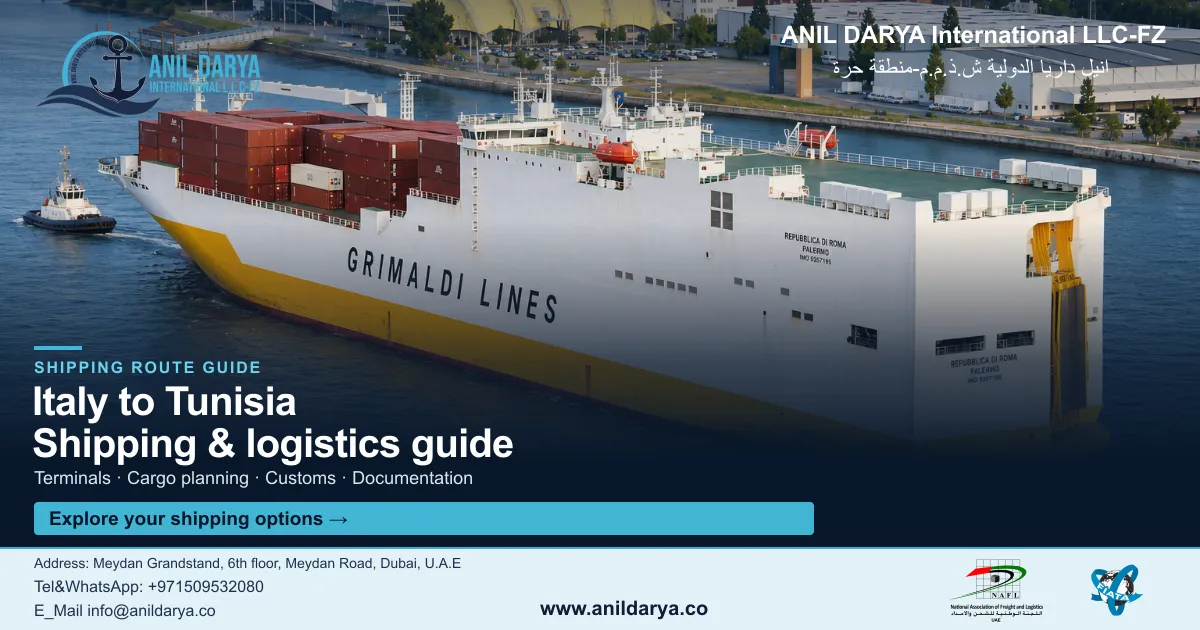
Shipping from Italy to Tunisia is one of the shortest container lanes in the Mediterranean: Tunisia's port authority lists direct calls at Radès from Genoa, Livorno, Salerno and Gioia Tauro, and Maersk publishes 2 days and 7 hours from Marina di Carrara to Tunis. Because the crossing is so short, the papers decide the timing. The Italian seller needs a valid EUR.1 or invoice declaration so the buyer keeps the duty-free rate on industrial goods, and the Tunisian importer must domicile the deal with its bank before the goods sail. We book the ocean freight from Dubai, release the carrier's bill of lading to you and agree the Tunisian broker's plan before we confirm the space.
Shipping from Italy to Tunisia at a glance
| Item | Detail |
|---|---|
| Kind of lane | Cross-trade by sea, Italy to Tunisia, booked and coordinated by Anil Darya from Dubai; the cargo does not need to touch the UAE |
| Italian load ports with direct Radès calls | Genoa, Livorno, Salerno, Gioia Tauro, Cagliari and Trapani (OMMP list); La Spezia direct to Sfax and Sousse |
| Main Tunisian gateway | Radès, the port of Tunis: 76% of Tunisia's container traffic in TEU and 80% of its ro-ro units |
| Published sea time | Marina di Carrara to Tunis 2 days 7 hours, departing Wednesdays, via a Ro-Ro connection at Cagliari (Maersk) |
| Italian export filing | Electronic export declaration in the EU Automated Export System, lodged through ADM's AIDA system; EORI number needed |
| Trade agreement | EU-Tunisia Association Agreement, in force since 30 March 1998: industrial goods trade duty-free both ways |
| Proof of origin | EUR.1, EUR-MED or an invoice declaration; revised PEM origin rules apply between the EU and Tunisia from 1 March 2025 |
| Taxes at import | Duty by HS code where no preference applies, 3% customs fee on duty, 1% FODEC, VAT 19% standard (13% and 7% reduced) |
| Bill of lading | The shipping line's own B/L, released to you through us as agent for the line |
How a cross-trade booking from Italy to Tunisia works
Three desks touch every box on this lane: the Italian seller or its spedizioniere, which stuffs the goods, files the export and supplies the origin proof; our Dubai desk, which books the line and releases the B/L; and the Tunisian importer with its broker, which handles the bank file, the declaration and the taxes. On a crossing of one or two days, none of them has time to fix the others' mistakes.
The bill of lading is always the shipping line's own document. Anil Darya acts as agent for many shipping lines, so once the freight is settled we release that carrier B/L to you from Dubai. Before we do, we compare the draft with the Italian invoice: Tunisian consignee or notify with full contact details, weights and package counts that match the packing list, and the same goods description the bank saw at domiciliation. The Tunisian bank also wants that B/L before it lets currency leave the country.
We do not clear goods in Tunisia, and we do not hold an office or agent there. Duty and taxes at destination are paid by the consignee or its broker. So before we confirm a Genoa or Salerno booking we ask the buyer three things: which broker will clear, at which port, and whether the bank domiciliation is done. If one answer is missing, the booking waits.
FCA or FOB at the Italian port leaves the buyer free to pick the carrier and the Tunisian port its broker prefers. Under CIF Radès the seller chooses the sailing, but Tunisian port charges, duty and VAT stay with the buyer. Our guide to Incoterms 2020 for sea freight shows where cost and risk pass under each term.
Which Italian port to ship from
Pick the port by the sailing that reaches your buyer's Tunisian port, not only by the kilometres from the factory. The Tunisian port authority (OMMP) lists the regular lines calling each port.
| Italian port | Direct Tunisian call on the OMMP lists | Usual catchment |
|---|---|---|
| Genoa | Radès: Cotunav twice a week; Messina Line weekly via Salerno | Piedmont, Lombardy, Liguria |
| Livorno | Radès: Cotunav twice a week | Tuscany, Emilia-Romagna, Umbria |
| Marina di Carrara | Tunis (Radès) via Cagliari, weekly, Maersk Ro-Ro express | Tuscany coast, marble and stone district, north-west Italy |
| La Spezia | Sfax and Sousse: Sahel Line, Sousse weekly, Sfax twice a month | Emilia-Romagna, Lombardy by rail |
| Salerno | Radès: Messina Line weekly (Genoa, Salerno, Radès) | Campania, Basilicata, Puglia |
| Gioia Tauro | Radès: MSC weekly | Calabria; a possible MSC connection for other Italian ports (not a published routing) |
| Cagliari and Trapani | Radès: UFS every 10 days | Sardinia and western Sicily |
Naples, Trieste and Venice do not appear on the OMMP lists we read. A plant in Veneto or Friuli can still truck to Genoa or Livorno, or book a carrier that connects through Gioia Tauro. Ask for the full routing in writing.
Radès, Sfax or Sousse: where your cargo lands in Tunisia
Radès, the port of Tunis
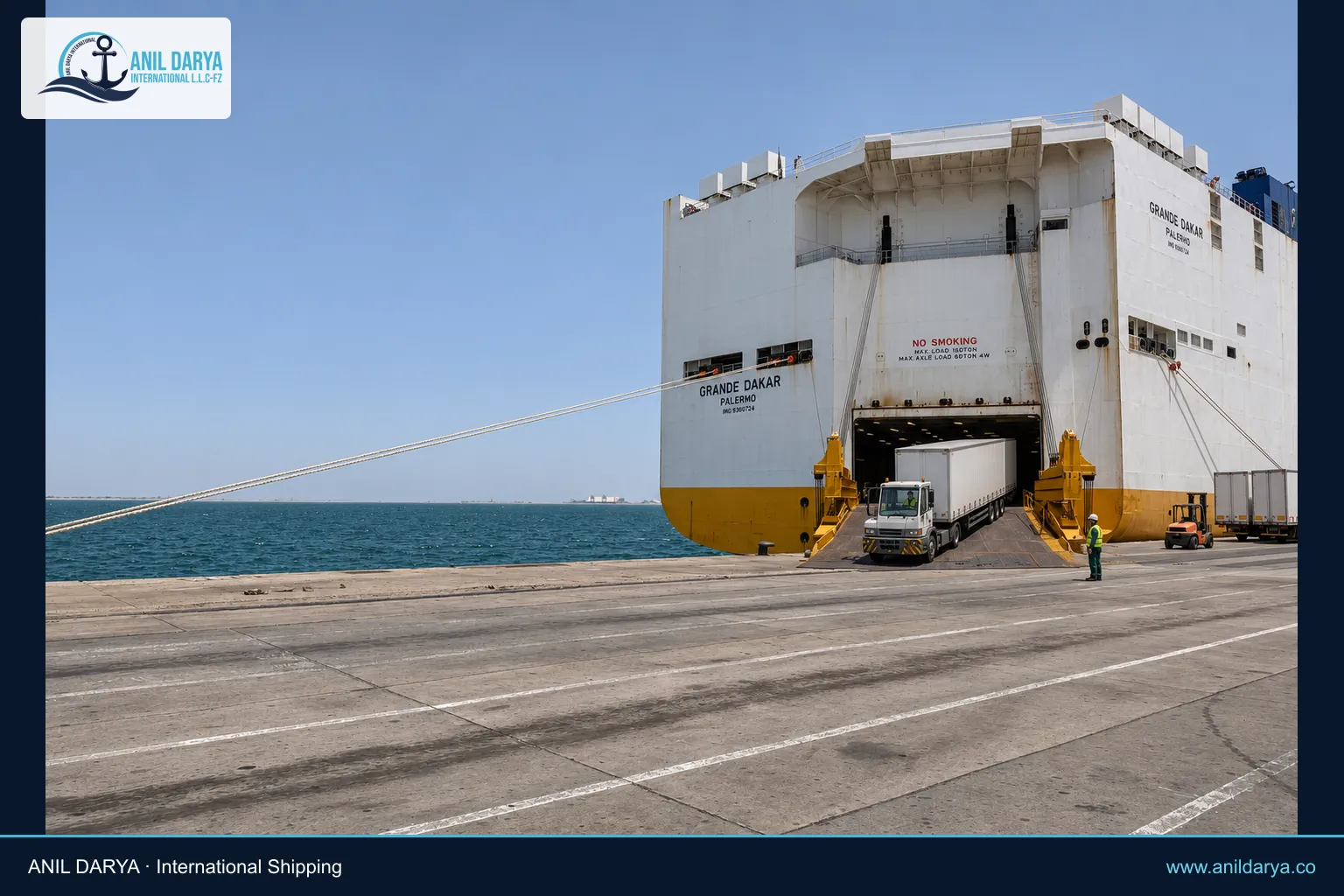
Radès is the container and ro-ro port of Tunis. OMMP says it handles 76% of Tunisia's container traffic in TEU, 79% of containerised tonnage and 80% of rolling-unit traffic. Its main basin has two container berths (1 and 6, 350 m), four ro-ro berths (2 to 5) and a mixed berth 7, with 8.8 m alongside at the container and main ro-ro berths and a 12 m approach channel. Most Italian cargo for Tunis and the north lands here.
Sfax
Sfax is the southern multi-purpose port: an 11 m channel and 2,704 m of quay at 10.5 m. OMMP lists Sahel Line from La Spezia twice a month and Med Express Line calling Pozzallo in Sicily on its way to Sfax. It suits buyers in Sfax, Gabès and the south.
Sousse
Sousse has berths at 8.5 m and serves the Sahel industrial belt around Sousse and Monastir. Sahel Line runs a weekly loop from La Spezia to Sousse and Sfax and back.
Bizerte is mainly an oil port, with no Italian port on its OMMP list.
Sea freight from Italy to Tunisia: direct services and transit time
This lane is almost entirely direct: short-sea container loops, Ro-Ro ships that carry boxes and trailers together, and MSC feeders from Gioia Tauro. The port table above shows the OMMP frequencies, from twice a week to every 10 days.
The Maersk service is the only one where we found a published port-to-port time we could check. Boxes leave Marina di Carrara on Wednesdays, move on a daily Ro-Ro to Cagliari and connect with Maersk's weekly Ro-Ro to Tunis, arriving on Fridays. The weekdays match the 2 days 7 hours Maersk prints. The Radès to Cagliari Ro-Ro itself started in November 2023, run with the Grendi group, which operates at Cagliari. Maersk says the express takes dry boxes of all sizes, IMO cargo, reefers and out-of-gauge units.
OMMP gives no days at sea for the other services, so we print none. Plan the Tunisian paperwork as if the box arrives the day after it sails.
[AMIR-FACT: the carriers and services we actually book from Genoa, Livorno, La Spezia, Salerno and Gioia Tauro to Radès, Sfax and Sousse, with the real port-to-port days and cut-offs we see in 2026]
FCL, LCL, Ro-Ro trailers and special cargo
| Option | Typical Italian cargo for Tunisia | What to check first |
|---|---|---|
| 40ft or 40ft high cube | Machinery parts, electrical panels, fabrics and trims, furniture | One domiciled pro forma for the whole box, matching the final invoice |
| Ro-Ro trailer or rolling unit | Garment inputs and finished goods for factories, urgent components, machinery on wheels | Trailer cut-off, driver or unaccompanied, Tunisian consignee on the B/L |
| Flat rack, open top, mafi | Production lines, presses, tanks, steel structures | Drawings, weights and lifting points; Maersk accepts OOG and breakbulk into Tunisia after approval |
| Reefer | Cheese, cured meat, frozen food, pharmaceuticals | Maersk's Tunisia page lists 5 free days on reefers (tariff effective 1 January 2025); clearance must be ready on arrival |
A Tunisian distributor buying from several Italian suppliers usually does better with one consolidated FCL out of Genoa or Livorno than with several LCL bills, because every bill needs its own bank file. See our FCL vs LCL comparison and sea freight service, and send drawings for production lines to our break bulk team.
Dangerous goods into Tunisia
Paints, resins, solvents, adhesives and lithium batteries travel under the IMDG Code. Maersk's import rules for Tunisia say class 1 and class 7 are not accepted, IMO units go by direct delivery from the ship because Tunisian ports have no fire park, and the consignee must confirm in writing before the booking is accepted. DG and non-DG goods may not be combined in one shipment for Tunisia under local customs rules. Our dangerous goods team gets the line's acceptance before stuffing.
Export clearance in Italy: AIDA, EORI and dual-use checks
The export side belongs to the Italian seller or its customs agent. We coordinate with them, but we do not file Italian declarations.
- EORI. Any business lodging customs declarations in the EU needs an EORI number.
- Export declaration. EU law requires an electronic declaration in the Automated Export System at the customs office where the exporter is established. In Italy this runs through AIDA, the system of the Agenzia delle Dogane e dei Monopoli (ADM). The office of exit at Genoa, Livorno or Salerno confirms the goods left the EU, which also supports the seller's VAT-exempt export invoice.
- Dual-use goods. Machine tools, valves, sensors and some chemicals can fall under EU Regulation 2021/821. In Italy UAMA at the Ministry of Foreign Affairs issues the licence through its e-licensing platform.
Finish the export declaration and the origin proof before the box gates in. A missing EUR.1 can be issued retrospectively, but the broker cannot claim the preference without it.
EU-Tunisia Association Agreement: EUR.1 and the revised origin rules
The European Commission says the EU-Tunisia Association Agreement was signed in July 1995, entered into force on 30 March 1998, and that all two-way trade in industrial products is free of tariffs. Farm products are opened only for selected lines, and talks on a deeper agreement (DCFTA) are on hold. The preference is not automatic: the goods must qualify as EU-originating and the broker must show the proof.
| Proof of origin | When you use it | Who issues it |
|---|---|---|
| EUR.1 or EUR-MED movement certificate | Any consignment of EU-originating goods | Italian customs (ADM) endorses it on the exporter's application |
| Invoice declaration | Any value for an approved exporter; otherwise consignments up to 6,000 euros | The Italian exporter, on the invoice |
The WTO confirms Tunisian customs ask for one of these proofs on EU goods. A proof is valid for 10 months from issue, the Commission says.
What changed in 2025 and 2026
The EU-Tunisia Association Council replaced the origin protocol (Protocol 4) by Decision 1/2025 of 22 January 2025, and the Commission states that the revised PEM rules apply between the EU and Tunisia from 1 March 2025. The Commission's Access2Markets page adds that, pending Tunisia's ratification of the revised PEM Convention, Tunisia exports to the EU under transitional rules, while EU exports go under the revised rules.
Some PEM partners reject proofs that do not carry the words "REVISED RULES". We found no official Tunisian or EU instruction requiring that wording for EU exports to Tunisia, so ask your broker before the first shipment which wording it wants and have the Italian seller use it on every proof.
Non-Italian goods sold by an Italian company
Origin follows the goods, not the seller. A Chinese pump resold by a Milan distributor is not EU-originating, and Tunisia charges the normal rate on it. A non-preferential certificate of origin for such goods must be in Arabic, English or French and is valid for six months.
Before the order: importer set-up, bank domiciliation and payment
- The importer is registered in the National Business Register and has a customs code, its identity on TTN.
- The deal is domiciled with an intermediary approved by the Central Bank of Tunisia, using the pro forma or final invoice. The WTO notes that domiciliation can be fully paperless.
- Foreign currency cannot leave Tunisia to pay for imports until the bank holds documents confirming shipment, such as the carrier's B/L. An Italian seller asking for full payment before loading needs to know this before it quotes.
- Goods outside the free-import regime need an import authorisation, issued within one month of a complete application.
If the price or quantity changes after domiciliation, tell the bank before the goods ship.
Technical control and the prior-check list
Both checks apply even when the duty is zero under the Association Agreement.
Technical control at import
Products on the 2005 lists fall into three regimes: list A (systematic control), list B (certification) and list C (compliance with specifications). List A alone covers 2,034 tariff lines, including 228 for electrical machinery and electronics. The control happens at the port of clearance and takes at least 24 hours; file it on TTN before the ship arrives. Inputs for the importer's own production, samples and returned goods are exempt.
The 2022 prior-check system
Since 17 October 2022 about 497 tariff lines, mainly machinery, electrical equipment and prepared foods, need prior authorisation and must be imported directly from the foreign production plant. Spare parts, renewable energy equipment and industrial raw materials are exempt. If your code is listed, the invoice must come from the Italian factory, not a distributor.
Tunisian customs clearance for Italian cargo
Clearance runs on Tunisie TradeNet (TTN) and the customs system SINDA, and the manifest has been filed electronically in advance since 2018. A new system, NSID, is being phased in next to SINDA, with the full switch due by the end of 2026.
- The line's agent validates the manifest, and the broker registers the detailed declaration (DDM) on TTN.
- The invoice, the EUR.1 or invoice declaration and any technical control approval are attached.
- Customs picks a channel: green for about 71% of imports, amber (documents) for 20%, red (physical check) for 9%.
- The box is scanned, duty and taxes are paid electronically, and customs issues the release order.
- Port charges are paid, the truck is cleared to enter, and the box leaves for the consignee.
Customs brokerage in Tunisia is reserved for Tunisian nationals, so the buyer's broker is a local firm. Maersk's Tunisia page adds: every consignment needs a Tunisian recipient on the B/L, changes to the B/L, destination or weight must be made at least 3 days before arrival to avoid customs fines, and cargo left uncleared is auctioned by customs after 4 months and 15 days from discharge. On a 2-day sailing that window closes before the ship leaves Italy.
Import duty, VAT and other taxes on Italian goods
All Tunisian duties are ad valorem on the CIF value. Without a preference, the tariff has rates from 0% to 50%, and the simple average applied rate was 23.8% in 2025. With a valid EU proof of origin, industrial goods enter duty-free, but the other import taxes still apply.
| Tax | Rate | Applies to Italian industrial goods with EUR.1? |
|---|---|---|
| Customs duty | By HS code, 0% to 50% | No, duty-free under the Association Agreement |
| Customs formality fee | 3% of the duty paid | Only where duty is paid |
| FODEC | 1% of the declared value | Yes |
| VAT | 19% standard, 13% and 7% for listed goods, on customs value plus duties and taxes | Yes; base raised by 25% for importers not registered for VAT |
| Advance tax | 10% of customs value plus duties on about 819 consumer lines (15% for non-compliant importers) | Yes, for those lines |
Farm and processed food lines are not all duty-free. Check wine, cheese, cured meat and pasta by HS code before you price the order. Duty and taxes at destination are paid by the consignee or its broker.
Factories that export: suspension regimes
The WTO counts 376 Italian-invested manufacturing companies in Tunisia, many of them re-exporting to Europe. Under inward processing, duties and taxes on goods imported for processing are suspended, and the finished products must be re-exported or warehoused within 12 months (extendable up to two years). Companies in the Bizerte and Zarzis business parks are exempt from duty on imported raw materials and equipment, and wholly export-oriented companies and park companies are exempt from the advance tax.
Restricted goods and items that need authorisation
Goods excluded from the free-import regime under Decree 94-1742 include:
- Used machinery, used motor vehicles and retreaded tyres. Second-hand Italian equipment needs an import authorisation before it ships.
- Pharmaceutical products, which go through the Central Pharmacy, explosives, ammonium nitrate and several chemical groups.
- Arms, spent batteries, metal and plastic waste, precious metals, art and antiques.
Passenger vehicles and some farm products are under quota, and CITES species need permits.
Typical cargo from Italy to Tunisia and the check each needs
Italy is one of Tunisia's two largest European suppliers. The WTO puts Italy at 12.5% of Tunisia's imports in 2023, the largest single country share, and Tunisia's statistics institute (INS, reported by AGI) recorded Italian sales of 6.66 billion dinars in January to July 2026, up 16.6%. The main Italian exports are refined oil products, metals, fabrics, hides, electrical parts, industrial machinery, and chemical and pharmaceutical products.
Fabrics and hides for garment and shoe plants usually move on Ro-Ro trailers under inward processing. Electrical parts for automotive suppliers skip technical control as inputs for own production. Machinery must be new unless authorised, chemicals need DG direct delivery, and food needs a health certificate.
Step by step: shipping from Italy to Tunisia with Anil Darya
- Send us the supplier's city, goods, HS codes, weights, ready date, Tunisian city and the broker's name.
- The importer domiciles the pro forma, and the broker confirms taxes, technical control, the prior-check list and any authorisation. Destination clearance is arranged with the consignee's broker before the cargo ships, and we coordinate this before we confirm the booking.
- We quote the carrier, the Italian load port and the Tunisian discharge port, and book once you accept.
- The seller lodges the export declaration in AIDA, arranges the EUR.1 or invoice declaration and delivers the box or trailer before the cut-off.
- We check the draft B/L (Tunisian consignee or notify, matching weights) at booking, not at arrival, and release the carrier's B/L to you through us once freight is settled.
- The broker files the DDM on TTN and any technical control file while the ship is at sea.
- At Radès, Sfax or Sousse the box is scanned, the channel is set, duty and taxes are paid and the release order is issued.
[AMIR-FACT: one real Italy to Tunisia cross-trade shipment we handled (cargo, Italian load port, carrier, Radès, Sfax or Sousse, what we coordinated with the Italian seller and the Tunisian broker, and the outcome), cleared for publication]

Routing via Dubai: when it makes sense on this lane
The direct crossing takes days, so Dubai only makes sense when your stock or other suppliers are already there.
| Option | How it works | What to check for Tunisia |
|---|---|---|
| Jafza stock and re-export | You hold Italian goods in the Jebel Ali Free Zone for several Middle East and African markets and ship Tunisian orders from there | Dubai Chambers certifies re-export origin, but the EU preference depends on the Association Agreement's non-alteration rule; storing or splitting in Dubai can cost the duty-free rate |
| Consolidation in Dubai | Italian goods join goods from Asia in one box for Radès | Separate proofs of origin by origin; Asian goods pay the normal Tunisian rate; prior-check goods must still come from the factory |
Protocol 4, as replaced in 2025, keeps a non-alteration article. Ask the Tunisian broker first what evidence it accepts that the goods stayed unchanged under customs control. When cargo is landed, consolidated or re-exported in Dubai, we handle the UAE customs clearance for a fee. See our Jebel Ali port guide and our article on re-exporting through Jafza.
[AMIR-FACT: whether we have moved Italian goods to Tunisia through Dubai (Jafza stock or consolidation), the carrier and routing used from Jebel Ali, and whether the buyer kept the EU preference]
What drives the cost of container shipping from Italy to Tunisia
We do not publish rates, because they change with each sailing. Your landed cost is built from these parts:
| Cost part | What moves it | Usually paid by |
|---|---|---|
| Italian origin charges | Trucking or rail to the port, export filing, terminal handling, EUR.1 | Seller under FCA or FOB |
| Ocean or Ro-Ro freight | Carrier, box or trailer type, season, surcharges, DG or OOG | Buyer under FOB; seller under CFR or CIF |
| Tunisian port and line charges | Terminal handling, delivery order, storage paid to the port | Consignee |
| Duty, FODEC, VAT, advance tax | HS code, origin proof, CIF value, VAT registration | Consignee or its broker |
| Demurrage and detention | Days beyond free time; Maersk's Tunisia page shows 12 days for dry and 5 for reefer (tariff effective 1 January 2025; confirm with the line at booking) | Whoever caused the delay, under your contract |
The most expensive surprise on this lane is a missing EUR.1: the buyer pays full duty or waits for a retrospective certificate. Our article on demurrage and detention explains how those charges build.
Checklist before the cargo leaves Italy
- Pro forma domiciled at an approved bank, values matching the final invoice.
- HS code checked against the exclusion list, technical control lists and the 2022 prior-check list.
- Tunisian broker named and the clearance plan agreed before booking.
- EUR.1 or invoice declaration ready, with the wording the broker asked for.
- Draft B/L with a Tunisian consignee or notify and full contacts, checked before sailing.
- EORI in place, AIDA export declaration lodged, dual-use licence if needed.
Mistakes that hold Italian cargo at Radès
- Shipping before destination clearance is agreed. On a 2-day crossing the box lands before the broker has the papers.
- No EUR.1 or invoice declaration with the documents, so the buyer loses the duty-free rate or waits for a retrospective certificate.
- Assuming every product from an Italian seller is EU-originating. Resold Asian goods pay the normal rate.
- Buying a prior-check product from a distributor instead of the factory.
- Asking for full payment before loading when the buyer's bank pays only against shipping documents.
Frequently asked questions
Which Tunisian port receives cargo from Italy?
Mostly Radès, the port of Tunis, which handles about three quarters of Tunisia's containers and 80% of its ro-ro units. Sfax and Sousse suit buyers in the Sahel and the south.
How long does sea freight from Italy to Tunisia take?
Maersk publishes 2 days and 7 hours from Marina di Carrara to Tunis via Cagliari. Services from Genoa, Livorno and Salerno run weekly or twice a week, with no published days at sea.
Do Italian goods pay import duty in Tunisia?
EU-originating industrial goods enter duty-free under the EU-Tunisia Association Agreement, if a valid EUR.1, EUR-MED or invoice declaration is presented. FODEC at 1% and VAT at 19% (or a reduced rate) still apply. Some food lines and non-EU goods pay duty.
Does the EUR.1 for Tunisia need the words "REVISED RULES"?
We found no official instruction requiring it for EU exports to Tunisia, where the revised rules have applied since 1 March 2025. Ask the broker which wording it wants.
Does Anil Darya clear customs in Tunisia?
No. The consignee's Tunisian broker files the declaration on TTN, and duty and taxes at destination are paid by the consignee or its broker. We agree the plan with that broker before we confirm the booking.
Can I ship used machinery from Italy to Tunisia?
Only with an import authorisation, because used machinery is excluded from Tunisia's free-import regime. Apply before you book.
Can Italy to Tunisia cargo go through Dubai?
Yes, for Jafza stock or consolidation with goods from other origins, but it adds weeks and can cost the EU preference unless the non-alteration rule is met. We handle UAE customs clearance for a fee whenever the cargo is landed in Dubai.
Get a quote for shipping from Italy to Tunisia
Send the supplier's city, the goods and HS codes, the ready date, the Tunisian city and your broker's name, and we will come back with a carrier, a load port and a price. Use our freight rate inquiry form, or contact our team to plan DG, Ro-Ro or project cargo first. Or meet our Dubai freight forwarding team.
Sources
- OMMP: Port of Radès, berths, depths, traffic shares and regular lines
- OMMP: Port of Sfax, quays and regular lines
- OMMP: Port of Sousse, depths and regular lines
- Maersk: Express service Tunisia to Italy, 2 days and 7 hours (18 November 2025)
- The Maritime Executive: Maersk RoRo container service between Radès and Cagliari (21 December 2023)
- Maersk: Tunisia import rules, B/L, DG and free time
- European Commission: EU trade relations with Tunisia
- European Commission: Pan-Euro-Mediterranean cumulation and the PEM Convention
- Access2Markets: Pan-Euro-Mediterranean Convention
- EU Delegation to Tunisia: revised origin rules from 1 March 2025 (4 April 2025)
- Decision No 1/2025 of the EU-Tunisia Association Council replacing Protocol 4 (table of contents)
- WTO: Trade Policy Review of Tunisia, November 2025
- WTO Secretariat report WT/TPR/S/479/Rev.1: customs, origin, taxes, regimes, ports, import shares
- trade.gov: Tunisia import tariffs, customs fee and VAT (26 February 2026)
- trade.gov: Tunisia import requirements and payment rules
- AGI: Italian exports to Tunisia, January to July 2026 (INS data)
- AGI: Italy-Tunisia trade and main Italian exports (INS data)
- European Commission: EORI number
- ADM: AIDA customs information system
- European Commission: Export procedure and AES
- Assolombarda: UAMA dual-use e-licensing
- Dubai Chambers: Certificates of origin for re-exported goods
- Jafza: About the Jebel Ali Free Zone
Reviewed: 14 November 2026