
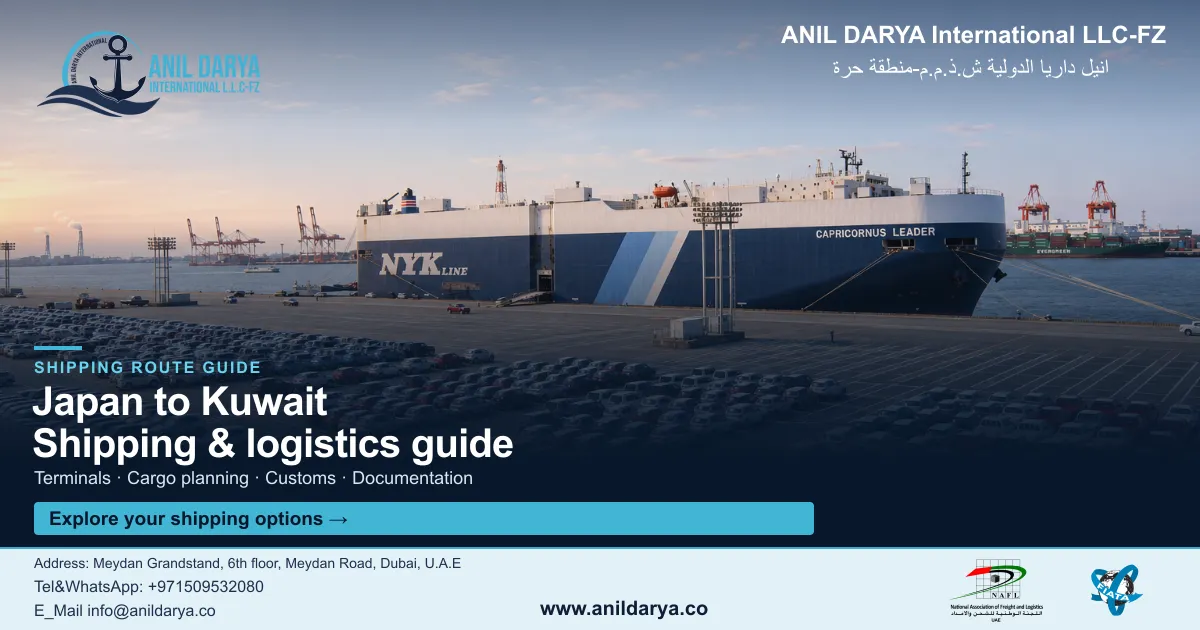
Shipping from Japan to Kuwait is mostly a vehicle and spare parts trade: cars, buses and parts leave Nagoya, Yokohama or Kobe and arrive at Shuwaikh near Kuwait City, with heavier industrial cargo going to Shuaiba. We found no published container loop that runs straight from Japan to a Kuwaiti port, so most boxes change ships at an Asian hub, a Gulf hub or both. We book the ocean freight from Dubai and keep the Japanese seller, the line and the Kuwaiti broker on one plan.
Japan to Kuwait shipping at a glance
| Topic | What applies on this lane |
|---|---|
| Main cargo | New and used vehicles, auto parts, tyres, machinery, electronics, chemicals |
| Japanese load ports | Nagoya, Yokohama, Tokyo, Kobe, Osaka, with Shimizu and Hakata for regional lots |
| Kuwaiti discharge ports | Shuwaikh (main commercial port) and Shuaiba (main industrial port) |
| Routing | Transhipment: Japan feeder to an Asian hub, a mainline to the Gulf, a Gulf feeder to Kuwait |
| Japanese export filing | Form C-5010, filed by the exporter or its customs broker, processed through NACCS |
| Used car export paper | Certificate of Registration Deletion or Certificate of Notice of Planned Export (MLIT) |
| Document legalisation | Chamber of Commerce and Industry, then the Embassy of Kuwait in Tokyo |
| Kuwaiti customs | Kuwait General Administration of Customs, through a licensed Kuwaiti broker |
| Duty | 5% of the CIF value for most goods; 100% on tobacco |
| VAT and excise | None in force (PwC, reviewed 22 July 2026) |
| Product conformity | KUCAS (PAI): TER and TIR before shipment for regulated goods, including vehicles and new tyres |
| Trade agreement | None in force between Japan and Kuwait or the GCC |
How we run shipping from Japan to Kuwait from Dubai
The goods go from Japan to Kuwait and are never imported into the UAE. We handle the booking and the follow-up.
| Party | Job on a Japan to Kuwait shipment |
|---|---|
| Japanese seller, dealer or its origin agent | Prepares the cars or crates, trucks them to the terminal, files the export declaration, deregisters used vehicles |
| Japanese chamber and the Kuwait embassy in Tokyo | Certify and then legalise the invoice, packing list and certificate of origin |
| Shipping line | Carries the cargo across each leg under its own bill of lading |
| Anil Darya, Dubai | Books the space, aligns the documents, releases the carrier's bill of lading, tracks the hub connections |
| Kuwaiti importer and its broker | Holds the import licence, arranges KUCAS reports, files the declaration, pays duty, collects the cargo |
You will not get a house bill from us. The bill of lading is the carrier's own, and since we act as agent for many shipping lines, the original or the express release for your Nagoya or Yokohama loading passes to you through our Dubai desk once the agreed payment terms are met. For Kuwait this matters more than usual: the bill has to name the holder of the Kuwaiti import licence, so we check the consignee field against the licence before the bill is issued.
Kuwaiti dealers usually buy FOB Japan and control the freight through us; a seller quoting CFR Shuwaikh can book with us too. Whatever the Incoterm, duty and taxes at destination are paid by the consignee or its broker. Our guide to Incoterms 2020 for sea freight shows where the risk passes.
Japanese load ports and what they handle
Load at the port nearest the goods. The Nagoya Port Authority describes Nagoya as Japan's number one car export port, with about 1.46 million completed vehicles a year, and lists the UAE among its main export partners. In 2024 it handled 156.71 million tons of cargo and 2.76 million TEU. That makes Nagoya the natural start for vehicles and parts from the Chubu car belt.
| Port | Region | Typical cargo for Kuwaiti buyers |
|---|---|---|
| Nagoya | Aichi, Gifu, Mie | New cars, auto parts, machine tools, steel products |
| Yokohama | Kanagawa and greater Tokyo | Used cars from Kanto auctions, electronics, mixed LCL |
| Tokyo | Tokyo and north Kanto | Consumer goods, parts, small industrial lots |
| Kobe and Osaka | Kansai | Chemicals, machinery, tyres, medical equipment |
| Shimizu | Shizuoka | Motorcycles, parts and regional cargo |
| Hakata | Fukuoka and Kyushu | Vehicles and parts from Kyushu plants, often fed to a larger port |
Shuwaikh or Shuaiba: choosing the discharge port
Kuwait's two main cargo ports, both run by the Kuwait Ports Authority, do different jobs.
| Item (KPA figures for 2024) | Shuwaikh | Shuaiba |
|---|---|---|
| Location | Shuwaikh industrial area, near Kuwait City | Ahmadi Governorate, south Kuwait |
| Role | Main commercial port | Main industrial port |
| Berths | 21 | 20 |
| Containers | 613,093 TEU | 282,870 TEU |
| Cars | 177,394 | 2,972 |
| General cargo | 3,230,749 tonnes | 23,688,110 tonnes |
The car count settles most bookings. Shuwaikh took 177,394 cars in 2024, so vehicles from Japan should be planned for Shuwaikh unless the line says otherwise. Plant for refineries, chemical drums and large project pieces for southern sites fit Shuaiba, and so do most dangerous goods, as the next sections explain. Agree the port with the buyer before booking, because a container landed at the wrong port then has to be trucked across the country.
Sea freight from Japan to Kuwait: hubs, feeders and transit
Japanese ports sit at the far end of the Asia to Gulf network, and Kuwait sits at the far end of the Gulf. In the carrier material we opened, no container service links the two on one ship. A box therefore usually moves on three legs: a feeder from Japan to an Asian hub, a mainline to a Gulf hub, and a Gulf feeder to Shuwaikh or Shuaiba.
ONE's announcement of its 2026 East-West network, effective April 2026, lists dedicated feeders from Tokyo, Kobe and Nagoya that connect through Pusan to its main loops. Its AG1 loop then runs from Pusan via Chinese ports and Singapore to Jebel Ali, Dammam, Jubail, Hamad, Abu Dhabi and Sohar. Kuwait is not a call on that loop. ONE's Middle East service brochure of January 2025 shows a separate Upper Gulf Service Kuwait loop that sails Jebel Ali, Shuaiba, Shuwaikh and back to Jebel Ali on a rolling schedule.
| Leg (ONE published figures) | Port-to-port days | Source date |
|---|---|---|
| AG1 westbound, Pusan to Jebel Ali | 22 | Brochure, January 2025 |
| UGS Kuwait loop, Jebel Ali to Shuaiba | 2 | Brochure, January 2025 |
| UGS Kuwait loop, Jebel Ali to Shuwaikh | 4 | Brochure, January 2025 |
| Japan feeder to Pusan | Not published on the pages we opened | Press release, December 2025 |
This table shows legs one carrier publishes, not a through routing. Joining a Japan feeder, AG1 and the Kuwait loop is a possible connection that we put together ourselves, and the wait at each hub comes on top of the sailing days. The brochure is from January 2025 and the AG1 rotation changed in 2026, so we confirm the live schedule with the line before quoting any date. Other lines run their own Kuwait feeders, and a Japanese box may change ships at a Chinese or Southeast Asian hub instead.
[AMIR-FACT: the carriers and services we actually book from Nagoya, Yokohama and Kobe to Shuwaikh and Shuaiba in 2026 (container and Ro-Ro), the hubs each one uses, and our real port-to-port days]
On a transhipped lane, one FCL filled by a consolidator in Japan is often safer than several LCL lots that get restowed at each hub. Our article on when FCL beats LCL works through the decision, and the sea freight service page lists the equipment we book.
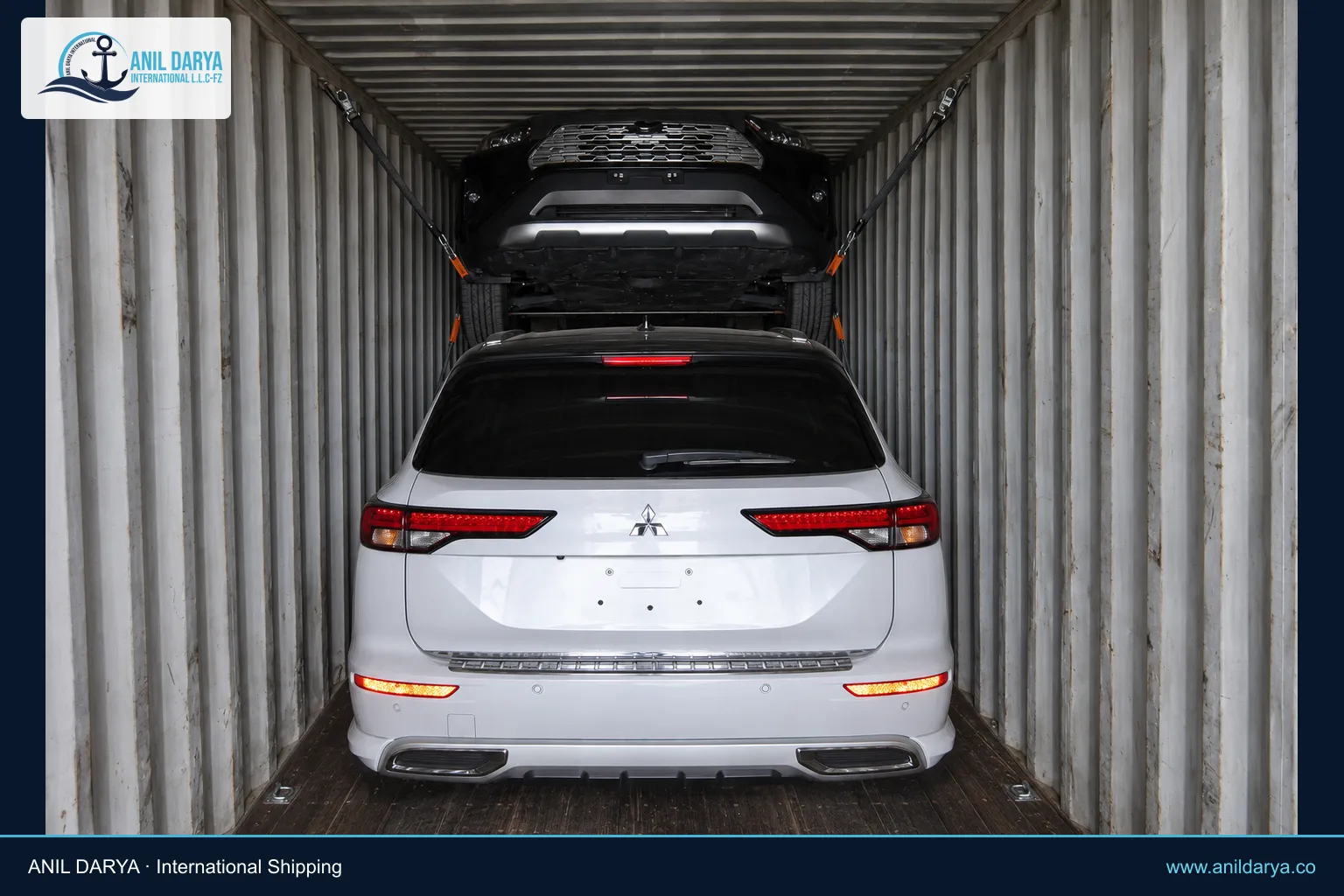
Cars and used vehicles on this lane
Japanese export papers for used cars
Japan Customs asks for one of two documents from the Ministry of Land, Infrastructure, Transport and Tourism at the export inspection. If the car is still registered, the owner first obtains a Certificate of Registration Deletion. If the registration was already deleted, the owner returns that certificate and receives a Certificate of Notice of Planned Export. Either document is valid for six months from issue, and the rule has applied to export declarations since 1 July 2005. Auction exporters handle this routinely; a private seller may not, so ask early.
Kuwaiti rules for imported vehicles
The official sources we could open do not give one clear answer, so treat this section as a checklist for your broker, not as a final rule.
- Age. The US International Trade Administration's Kuwait guide, last published 29 April 2026, lists automobiles more than ten years old among prohibited imports. Several private shipping guides say five years for passenger cars. We could not reach the Kuwaiti customs site to settle the difference.
- New regulation. Arab Times reported on 24 November 2025 that Kuwait's Public Authority for Industry (PAI) approved new technical regulations for imported used vehicles and motorcycles, cancelling the earlier ones and taking effect six months after publication in Kuwait Al-Youm. The article does not state the age or drive-side terms.
- Conformity. KUCAS, run by PAI, covers new and used vehicles, motorcycles and new tyres. Each consignment needs a Technical Evaluation Report and a Technical Inspection Report from a PAI-approved body before shipment.
- Drive side. Cars built for the Japanese home market are right-hand drive, and Kuwait drives on the right. Private guides say right-hand-drive cars are not accepted, but we found no official text. Do not buy a domestic-market car for Kuwait until the broker confirms in writing.
[AMIR-FACT: the current Kuwaiti rules for imported used cars in 2026 under the new PAI regulation (age limit and how age is counted, right-hand-drive acceptance, salvage rules), confirmed with a Kuwaiti broker or customs]
For Ro-Ro, we ask the line for its current acceptance and the transhipment port it uses.
Machinery, project cargo and dangerous goods
For machine tools, generators and cranes, the seller should supply drawings, weights, the centre of gravity and lifting points before we ask for space. Out-of-gauge units must be accepted by every vessel in the chain, and southern project pieces usually land at Shuaiba. Our break bulk and project cargo team plans the stowage and the line approvals.
Industrial machinery and its spare parts also need an import licence from PAI in Kuwait, according to the ITA guide. The buyer should hold that licence before the machine leaves Japan.
Dangerous goods rules at the Kuwaiti end
Lithium batteries in tools and hybrid parts, paints, adhesives, refrigerant gases and lab chemicals are common in Japanese consignments. Kuwait is strict about them. Emirates Shipping Line's Kuwait notice sets out the local practice:
- Classes 1, 2, 6 and 7, and any radioactive material, need approval from the Kuwaiti authorities before the cargo is loaded at origin.
- Other classes must be notified to the port before arrival.
- IMDG containers are discharged on direct delivery only, at Shuaiba in all seasons, and cannot be stored in the port. Shuwaikh restricts them in summer.
- Cargo that arrives without approval stays on board, at the cost of the port of loading side.
The Kuwaiti broker must apply while the goods are still in Japan, with the UN number, class and flash point. The Japanese shipper provides the Safety Data Sheet and a signed DG declaration under the IMDG Code, whose 2024 edition became mandatory on 1 January 2026. Our dangerous goods desk checks the file against each line's rules, because acceptance at the hub matters as much as at Kuwait.
Export customs in Japan: what the seller files
The goods first go into a customs (Hozei) area or a specially permitted place. The exporter, or a licensed customs broker acting as its proxy, then lodges Export Declaration form C-5010 with the invoice and any permit needed under another law, such as a METI approval. Customs reviews the papers, may examine the cargo and grants the export permit. NACCS, Japan's customs and port system, processes the declaration, permit and loading electronically.
Japan Customs lists 15 laws and regulations that apply at export. Under Article 70 of the Customs Law, cargo that needs a permit under another law is not released until the exporter proves it has that permit. Some machine tools, electronic parts and chemicals fall under export control, so ask the seller to confirm the status before the sailing is fixed. Pickup and the C-5010 filing stay with the seller or its origin agent; we work with them on the terminal cut-off and the shipping papers.
Chamber and embassy legalisation
Kuwait still asks for legalised trade documents, and the Embassy of Kuwait in Tokyo sets out how it handles them. Build the time into the plan, because a Kuwaiti broker cannot lodge the file without the stamped papers.
| Document | Step 1 in Japan | Step 2 |
|---|---|---|
| Commercial invoice | Chamber of Commerce and Industry, original signature (a rubber signature is refused) | Embassy of Kuwait, Tokyo |
| Packing list | Chamber of Commerce and Industry | Embassy of Kuwait, Tokyo |
| Certificate of origin | Chamber of Commerce and Industry | Embassy of Kuwait, Tokyo |
| Other documents | Ministry of Foreign Affairs of Japan (embassy notice in force since 22 June 2023) | Embassy of Kuwait, Tokyo |
| Letter naming the Kuwaiti recipient | None; company letterhead, signed by a person in charge | Embassy of Kuwait, Tokyo |
The embassy accepts only documents for goods shipped to Kuwait, returns them two days after application and accepts corrections only with a chamber correction stamp. Fees are on its own page. Kuwait's Ministry of Foreign Affairs checks the papers again on arrival (Middle East Briefing, August 2025).
The ITA guide asks for the invoice and certificate of origin in one original and two copies each, a stamped packing list and three copies of the bill of lading.
Kuwaiti import customs for goods from Japan
We do not clear cargo in Kuwait, and the rules would not let us anyway: only local agents may clear goods at Kuwait Customs, with a letter of representation and a letter from the end user. So before we confirm a booking from Japan, we take the name of the Kuwaiti broker, contact it and make sure it will handle the file. A car landed at Shuwaikh with no broker ready earns port storage while the papers are sorted out.
Who may import, and what the broker needs
- Import licence. For licensed products, the importer must be a Kuwaiti citizen or a Kuwait-based firm registered with the Ministry of Commerce and Industry. The licence is valid for one year.
- Licence holder on the bill of lading. The name of the Kuwaiti licence holder must appear on the bill.
- Timing. Middle East Briefing reports that import documents for sea cargo must be submitted at least five days before the vessel arrives.
- Tariff codes. Kuwait moved to the 12-digit GCC Integrated Customs Tariff on 1 January 2025, so a code that worked in 2024 may need updating.
- Other ministries. Medicines, food supplements and some chemicals need licences from the relevant ministry.
KUCAS and product standards
KUCAS covers toys, appliances, automotive products, chemicals such as paints and brake fluids, building materials and a few other groups. Each regulated consignment needs a Technical Evaluation Report and a Technical Inspection Report from a PAI-approved body before shipment; PAI then issues its clearance certificate on the inspection report.
One trap is specific to Japan. Kuwait has adopted GCC standards under which household appliances run at 240V/50Hz without a transformer, and manuals for durable goods must be in Arabic. Appliances made for the Japanese home market are built for 100V, so export models are the safe choice for anything that plugs in.
Duty and taxes on Japanese goods
Kuwait applies the GCC common external tariff of 5% to most imports, on the CIF value, and 100% on tobacco. The ITA lists 417 basic foodstuffs and some agricultural, medical and pharmaceutical items as exceptions. PwC's tax summary, reviewed on 22 July 2026, says Kuwait has no VAT and no excise taxes; a GCC VAT framework is still before parliament.
| Charge in Kuwait | Basis | Paid by |
|---|---|---|
| Customs duty | 5% of the CIF value for most goods; 100% tobacco | Consignee or its broker |
| VAT | Not in force | Not applicable |
| KUCAS reports and PAI certificates | Per regulated consignment | Importer, through its inspection body |
| Port and handling charges | Per container, car or tonne | Consignee, as agreed with its broker |
Is there a Japan-Kuwait trade agreement?
No. The Japan Customs list of economic partnership agreements in force includes ASEAN, the EU, the UK, India, CPTPP and RCEP among others, but nothing with Kuwait or the GCC. Japanese goods therefore pay the normal Kuwaiti rate, and the certificate of origin is the ordinary chamber certificate described above, not a preferential form. If an agreement enters into force later, its origin rules will apply only from that date, so ask the broker before you rely on one.

Prohibited and restricted goods in Kuwait
The ITA guide lists pork, alcoholic drinks, gambling machines, pornographic material, narcotics, used medical equipment and cars over ten years old as prohibited, and says firearms and explosives need special import procedures. The items that most often catch Japanese consignments are:
- Older used cars, under whatever age limit the broker confirms for 2026.
- Used medical equipment, such as refurbished scanners or dental units.
- Regulated goods without KUCAS reports: tyres, appliances, paints and building materials.
- Dangerous goods in classes 1, 2, 6 or 7 without prior approval from Kuwait.
Where Dubai fits on this lane
Many Gulf feeders to Kuwait start at Jebel Ali, so Dubai often sits on this lane in one of three ways.
- Transhipment. A container from Japan may come off the mainline at Jebel Ali and continue on a feeder to Shuaiba or Shuwaikh. Dubai Customs lists transit as a declaration type separate from import, so cargo that only changes ships moves under transit, not a UAE import.
- Consolidation. Parts bought in Japan, Korea and China can be combined at Jebel Ali into one load.
- Free zone stock. Jafza calls itself the largest customs bonded zone in the Middle East; a distributor can hold Japanese parts there and send smaller orders to Kuwait.
If the goods stop in Dubai for consolidation or stock, our Dubai customs clearance is a paid service. Ask the Kuwaiti broker beforehand how duty is treated if the goods are imported into the UAE first, because a GCC duty already paid at the first point of entry needs the right proof. The Jebel Ali port guide and our article on re-exporting from Jafza cover the Dubai side.
[AMIR-FACT: whether we route Japanese cargo for Kuwait through Jebel Ali today (transhipment, Dubai consolidation or Jafza stock), which feeder we use to Shuwaikh or Shuaiba, how many days it adds, and whether transhipped cargo needs any UAE customs step]
What sets the cost of shipping from Japan to Kuwait?
We price each quote with the carrier on the day, so we publish no rates. The total is built from these parts.
| Cost part | What moves it |
|---|---|
| Japanese origin charges | Truck from the auction yard or factory, export filing, deregistration, terminal handling, car racking |
| Document legalisation | Chamber and embassy steps for each invoice, packing list and certificate |
| Ocean freight | Container or Ro-Ro, number of hubs, feeder availability, season, surcharges |
| Special cargo | DG approvals, flat racks, breakbulk lifts, lashing and survey |
| Conformity | KUCAS reports and PAI certificates for vehicles, tyres and appliances |
| Kuwaiti port charges | Terminal handling, delivery order, inspection handling |
| Duty | 5% of the CIF value for most goods |
| Waiting time | Demurrage and detention when papers or approvals are late |
With two or three ship changes, delays cost more than rate differences. See how quickly demurrage and detention build up.
How to ship from Japan to Kuwait: step by step
- Agree the Incoterm and the discharge port with the buyer: Shuwaikh for cars and most containers, Shuaiba for heavy, industrial or DG cargo.
- Send us the cargo details: description, 12-digit HS code, weights and sizes, Japanese pickup city, ready date, DG data and, for cars, model year and drive side.
- Give us the Kuwaiti broker's name. We confirm with the broker that it will clear the file before we confirm the booking.
- The broker checks the import licence, KUCAS needs, vehicle rules, DG approval and the duty.
- The seller confirms export control status and, for used cars, obtains the deregistration paper.
- We quote the carrier, the hubs and the sailing, then book. DG, Ro-Ro and out-of-gauge cargo get the line's acceptance first.
- The seller has the invoice, packing list and certificate of origin certified by the chamber and legalised at the Kuwait embassy in Tokyo.
- The seller or its origin agent delivers to the terminal and files form C-5010 before the cut-off.
- We check that the invoice, packing list and draft bill of lading match, with the Kuwaiti licence holder named.
- The carrier's bill of lading is released to you through us, and the documents go to the broker at least five days before arrival.
- The broker clears the cargo, the consignee pays duty and collects, and the empty box goes back within free time.
[AMIR-FACT: one real Japan to Kuwait shipment we coordinated from Dubai (cargo, Japanese port, hubs, carrier, Kuwaiti port, door-to-door days and one problem solved), cleared for publication, or confirm we have none yet]
Checklist before the cargo leaves Japan
- Kuwaiti broker named and confirmed in writing.
- Importer holds a valid Ministry of Commerce and Industry licence, and a PAI licence for machinery or spares.
- Discharge port chosen: Shuwaikh or Shuaiba.
- Used cars checked against the 2026 age, drive-side and salvage rules.
- Deregistration certificate in hand for every used vehicle.
- KUCAS reports arranged for vehicles, new tyres, appliances and other regulated goods.
- Appliances are 240V/50Hz export models with Arabic manuals.
- Invoice, packing list and certificate of origin certified by the chamber and legalised in Tokyo.
- Kuwaiti licence holder named on the bill of lading.
- DG approval from Kuwait received before loading for classes 1, 2, 6 and 7.
Mistakes to avoid on this lane
- Shipping before destination clearance is agreed. Without a Kuwaiti broker ready, cars and boxes sit at Shuwaikh and charges grow.
- Buying a right-hand-drive or older used car first and asking about Kuwaiti rules later.
- Leaving legalisation to the last week. Chamber and embassy steps take days, and the broker cannot file without them.
- Sending a dangerous goods box without Kuwaiti approval. It can stay on board and travel on at the shipper's cost.
- Shipping 100V home-market appliances to a 240V market.
- Using an 8-digit tariff code. Kuwait has used 12-digit codes since 1 January 2025.
Frequently asked questions
How long does sea freight from Japan to Kuwait take?
It depends on the hubs. ONE's January 2025 brochure shows 22 days Pusan to Jebel Ali and 4 days Jebel Ali to Shuwaikh on separate services, before the Japan feeder and hub waits. Ask for an arrival estimate on each quote.
Is there a direct ship from Japan to Kuwait?
We found no published container loop calling both countries on one ship. Containers usually change at an Asian hub and a Gulf hub such as Jebel Ali. Ask the line about current Ro-Ro routings.
Can I import a used Japanese car into Kuwait?
Possibly, if it meets Kuwait's current age, conformity and drive-side rules. The ITA guide lists cars over ten years old as prohibited, private guides cite five years, and new PAI rules for used vehicles were approved in November 2025. Confirm with the Kuwaiti broker before you buy.
What duty does Kuwait charge on goods from Japan?
Most goods pay 5% of the CIF value, and tobacco pays 100%. Kuwait has no VAT or excise tax in force. There is no trade agreement with Japan, so the normal rate applies. The consignee or its broker pays at destination.
Do Japanese export documents need legalising for Kuwait?
Yes. The invoice, packing list and certificate of origin are certified by the Chamber of Commerce and Industry and then legalised at the Embassy of Kuwait in Tokyo. Other documents need Japan's Ministry of Foreign Affairs first.
Do you clear customs in Kuwait?
No. Only local Kuwaiti agents may clear goods there. We agree the arrangement with the consignee's broker before we confirm the booking and send the broker the papers during the voyage.
Who issues the bill of lading for a Japan to Kuwait shipment?
The shipping line issues its own bill of lading; we do not issue a house bill. As agent for many lines, we release the carrier's bill to you from Dubai, with the Kuwaiti import licence holder named as Kuwait requires.
Get a quote for shipping from Japan to Kuwait
Send us the Japanese pickup point, the cargo, the ready date and the name of the Kuwaiti broker, and we will come back with the carrier, the hubs and a price. Use the freight rate inquiry form, or contact our team to plan cars, DG or project pieces first. You can also read how our Dubai freight forwarding team handles cross-trade lanes.
Sources
- Japan Customs: export procedures (C-5010, Hozei area, 15 laws, Article 70)
- Japan Customs: documents for exporting used vehicles
- Japan Customs: economic partnership agreements in force
- NACCS: about the Nippon Automated Cargo and Port Consolidated System
- Nagoya Port Authority: port profile (car exports, 2024 cargo)
- Embassy of the State of Kuwait in Tokyo: legalization for commercial documents
- Embassy of the State of Kuwait in Tokyo: notice on authentication by MOFA Japan (22 June 2023)
- Kuwait Ports Authority: Shuwaikh Port (2024 statistics)
- Kuwait Ports Authority: Shuaiba Port (2024 statistics)
- US International Trade Administration: Kuwait import requirements and documentation (29 April 2026)
- US International Trade Administration: Kuwait import tariffs (29 April 2026)
- US International Trade Administration: Kuwait prohibited and restricted imports (29 April 2026)
- US International Trade Administration: Kuwait standards for trade (27 April 2026)
- Public Authority for Industry, Kuwait: conformity of imported products
- Intertek: Kuwait Conformity Assurance Scheme (KUCAS)
- Arab Times: new Kuwait rules for used car imports (24 November 2025)
- Middle East Briefing: Kuwait customs tariffs and procedures (26 August 2025)
- PwC Worldwide Tax Summaries: Kuwait other taxes (reviewed 22 July 2026)
- ONE: updated East-West service network for 2026 (15 December 2025)
- ONE: Middle East service brochure, AG1 and Upper Gulf Service Kuwait loop (January 2025)
- Emirates Shipping Line: dangerous goods rules for Kuwait
- IMO: IMDG Code 2024 edition
- Dubai Customs: declaration types including transit
- Jafza: about the free zone
Reviewed: 14 November 2026