
Shipping from Kenya to Dubai usually means a container from the Port of Mombasa to Jebel Ali, with air cargo from Nairobi for flowers, fresh produce and urgent goods. Your Kenyan supplier's clearing agent files the export entry with the Kenya Revenue Authority, and in Dubai the goods clear through Dubai Customs at 5% duty on the CIF value plus 5% import VAT. This guide covers the ports, the published sailings, the paperwork on both ends and the order in which to do things.
Shipping from Kenya to Dubai at a glance
| Item | Detail |
|---|---|
| Main Kenyan load port | Port of Mombasa (Kenya Ports Authority), 22 berths, two container terminals with 2.3 million TEU a year of capacity |
| Inland export option | Exports can be consolidated at the Nairobi, Naivasha or Eldoret inland depots and railed to Mombasa |
| Main UAE discharge port | Jebel Ali (DP World), four container terminals |
| Published carrier transit | Mombasa to Jebel Ali 21 days on Emirates Shipping Line's weekly GIA service, which calls Dar es Salaam and two Indian ports first |
| Modes | FCL, LCL, reefer, bulk and breakbulk, dangerous goods, air cargo |
| Kenyan export filing | Export entry lodged in KRA's iCMS by a clearing agent, with the exporter's KRA PIN and an eTIMS zero-rated invoice number |
| Plant and produce exports | KEPHIS inspection and phytosanitary certificate |
| UAE customs authority (Dubai) | Dubai Customs; importer needs a customs business code |
| UAE customs duty | 5% of CIF value for most goods; alcohol 50%, cigarettes 100% |
| UAE import VAT | 5%, deferred to the VAT return for registered importers that link their customs number with the FTA |
| Free zone next to the port | Jafza, over 11,000 companies |
How the northbound route from Mombasa works
Northbound cargo from Kenya leaves Mombasa on container services that link East Africa with the Gulf and India. The rotation decides the transit, not the distance. Emirates Shipping Line publishes the clearest example: its Gulf India Africa Express (GIA) runs weekly with five ships of 2,800 TEU, on a 35-day round trip of Nhava Sheva, Mundra, Jebel Ali, Mombasa, Dar es Salaam and back to Nhava Sheva.
On that loop, Mombasa is not the last call before the UAE. A box loaded in Mombasa goes south to Dar es Salaam first, then across to India, then to Jebel Ali. That is why the carrier's own eastbound table shows a long transit for this direction.
Published transit times from Mombasa (ESL GIA)
| From Mombasa to | Published days | What it tells you |
|---|---|---|
| Dar es Salaam | 3 | The first call after Mombasa on this loop |
| Nhava Sheva | 14 | The ship crosses to India before the Gulf |
| Mundra | 16 | Second Indian call |
| Jebel Ali | 21 | Port to port, before UAE clearance and delivery |
Southbound on the same service, ESL lists Jebel Ali to Mombasa at 10 days. The gap between 10 days in and 21 days out is the rotation, so ask every carrier for its northbound routing before you compare prices. A service with a more direct return leg can save more than a week. Port-to-port days also exclude the wait for a berth, customs at both ends and the truck to your site.
[AMIR-FACT: our real port-to-port and door-to-door transit Mombasa to Jebel Ali on recent bookings, and the carriers or services we actually book northbound on this lane]
Which Kenyan port or depot should you ship from?
Almost all Kenyan sea exports to the UAE load at Mombasa. The Kenya Ports Authority says Mombasa connects directly to over 80 ports and links by rail to inland container depots. That inland link matters for Nairobi exporters.
| Origin point | What KPA says | Best for |
|---|---|---|
| Port of Mombasa | 22 berths, two container terminals, dedicated berths for bulk grain, soda ash, clinker, titanium and petroleum products | All sea exports, especially coastal shippers and bulk cargo |
| Inland Container Depot Nairobi | Linked to Mombasa by the Standard Gauge Railway; yard throughput of over 450,000 TEU a year; exports can be consolidated there and railed to the port | Nairobi and central Kenya exporters |
| Inland Container Depot Naivasha | Served by the SGR; set up for the northern corridor and the Rift Valley farming areas | Rift Valley produce and transit cargo |
| Inland Container Depot Eldoret | One of the three KPA depots linked by rail-tainer service | Western Kenya |
| Port of Lamu | KPA port on the north coast; check which carriers call before you plan on it | Cargo already near Lamu, if a carrier calls in your window |
A decision rule for Nairobi shippers: if the factory is near Nairobi, ask whether the carrier accepts the box at ICD Nairobi. Stuffing and clearing the export there, then railing it to Mombasa, can beat a long truck run to the coast.
Which UAE port should your cargo arrive at?
Jebel Ali is the default for Dubai and for Jafza. DP World runs four container terminals there with over 80 weekly services to more than 150 ports, and handles breakbulk, out-of-gauge project cargo and IMDG dangerous goods. Our Jebel Ali port guide covers the terminals and port rules.
- Consignee in Dubai or Jafza: Jebel Ali.
- Site in Abu Dhabi: compare Khalifa Port in Abu Dhabi to cut the truck leg.
- Consignee in Sharjah or the northern emirates: compare Sharjah port shipping.
The carrier's rotation often decides this for you. GIA, for example, calls Jebel Ali only. If your cargo needs to end up elsewhere in the UAE, price the truck from Jebel Ali against a service that calls closer to the site.
Sea freight from Kenya to Dubai: FCL, LCL and special cargo
| Mode | Typical Kenyan cargo | What to plan |
|---|---|---|
| FCL (20ft, 40ft, high cube) | Tea, coffee, packaged food, building materials, manufactured goods | Stuffing at the factory, ICD or a CFS; export entry before gate-in |
| LCL | Samples, small trade orders, mixed retail goods | Release in Dubai after the shared box is unpacked; your papers and the consolidator's must match |
| Reefer | Fruit, vegetables, chilled food | KEPHIS certificate, set temperature, UAE food approvals before arrival |
| Dry bulk and breakbulk | Soda ash, titanium minerals, bagged cargo, steel and machinery being returned | Mombasa's specialised berths, vessel nomination, discharge plan in the UAE |
| Dangerous goods | Chemicals, gases, batteries | SDS, DG declaration, carrier acceptance, UAE port storage limits for the class |
| Air cargo | Cut flowers, vegetables, chilled meat, spares, documents | KEPHIS or veterinary paperwork, same Dubai declaration and duty |
FCL or LCL from Kenya?
FCL is sealed once and released in Dubai as one unit. LCL is cheaper for a few cubic metres, but your goods wait until the consolidator's box is unpacked and every consignee's paperwork is in order. With a 21-day published transit on the main direct loop, a few extra days of LCL handling can matter for food. If your volume is near a 20ft, price both. Our guide to FCL vs LCL costs shows where the break-even usually falls.
Bulk and breakbulk exports from Mombasa
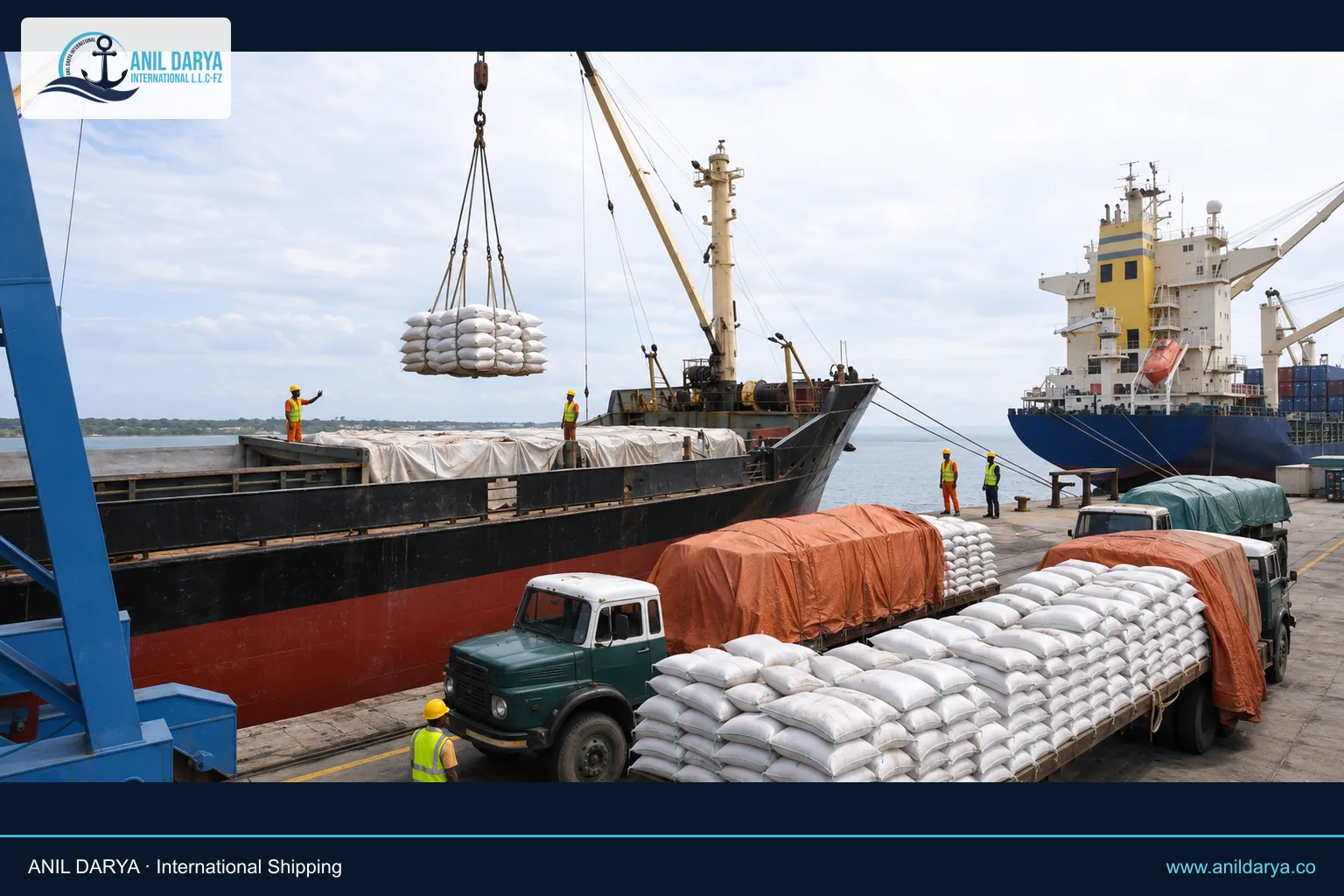
Kenya exports minerals as well as farm goods, and Mombasa is set up for them. KPA lists dedicated berths for bulk soda ash, clinker and coal, and titanium, and says berths 5, 11 and 12 serve conventional and container ships with their own gear. For a full parcel to the UAE you need a vessel nomination, a loading plan at origin and a discharge berth in the UAE that suits the cargo. Our dry and liquid bulk shipping team books that tonnage and plans the UAE discharge.
Dangerous goods from Kenya to Dubai
DG cargo needs the right UN number, proper shipping name, class and packing group, a Safety Data Sheet, a signed DG declaration, UN packaging and labels, and carrier acceptance before it loads in Mombasa. The Dubai end needs just as much planning: Jebel Ali handles IMDG cargo, but port safety rules limit how long some classes may stay, so the declaration and delivery must be ready when the ship berths. See our dangerous goods shipping service.
Air cargo from Nairobi to Dubai
Much of Kenya's trade with the UAE is perishable: flowers, vegetables, fruit and chilled meat. Those go by air from Jomo Kenyatta International Airport in Nairobi, where KEPHIS has inspectors at the exit point. The Dubai side is the same as for sea cargo: a declaration with a customs code, 5% duty and import VAT, plus the food approvals the product needs. Ask us about air cargo into the UAE when shelf life matters more than freight cost.
What the Kenyan exporter must do
The export side is your supplier's job, or its clearing agent's, but every delay there pushes back your arrival in Dubai. We book space with the carrier and handle the UAE end. The shipper or its origin agent arranges pickup and files the export.
The KRA export entry
KRA's customs brochure describes the export process. Clearing agents transmit the export declaration electronically, lodged against the manifest that the shipping line or airline registers. Before release, a customs export officer verifies or supervises the stuffing of the cargo, and a Certificate of Export is issued once the export is confirmed. KRA lists these documents for a typical export:
- Commercial invoice.
- Bill of lading or air waybill.
- Packing list.
- Certificate of origin.
- All necessary permits.
One newer rule affects the invoice. From May 2026, KRA requires exporters and their clearing agents to enter the exporter's KRA PIN and a valid TIMS or eTIMS zero-rated invoice number when lodging export documents in iCMS. Only export values validated this way feed into the exporter's VAT return. A supplier who skips this will find the export entry hard to complete, so ask about it early.
KEPHIS certificates for plants and produce
For plants and plant products, the Kenya Plant Health Inspectorate Service (KEPHIS) issues phytosanitary certificates for export consignments that meet the importing country's requirements. KEPHIS inspectors visit export farms during the growing season and inspect consignments at Jomo Kenyatta, Mombasa and Eldoret airports, the port of Mombasa and border points. Produce that fails the standards is not allowed to leave. KEPHIS also tells exporters to get the importing country's phytosanitary requirements first, so check the UAE requirement for your product before harvest.
Prohibited and restricted exports
The Third Schedule of the East African Community Customs Management Act lists prohibited and restricted exports, as KRA's brochure notes. Wildlife products and some minerals fall in this area. If your product is close to any such list, the supplier's agent should confirm the permit before you pay a deposit.
Dubai customs clearance for cargo from Kenya
Dubai Customs clears cargo arriving at Jebel Ali and the other Dubai entry points. Each declaration falls under one regime: import, export, transit, transfer or temporary admission.
Do you need a customs code to import into Dubai?
Yes. Dubai Customs says any business that uses its services must register with it, and registration is online through Dubai Trade. Any company with a customs business code can file a declaration. A clearing agent with a Dubai Economic Department clearing and forwarding licence can also file, using its own code and the goods owner's authorisation. If you do not have a code yet, we arrange clearance through a licensed agent with your authorisation.
Which documents does Dubai Customs need?
Dubai Customs lists an invoice, a packing list, a certificate of origin and a permit from the relevant authority for restricted goods. For sea cargo you also need the bill of lading and the shipping line's delivery order.
| Document | Who provides it | Why Dubai needs it |
|---|---|---|
| Commercial invoice | Kenyan exporter | Customs value and HS code |
| Packing list | Kenyan exporter | Inspection and LCL release |
| Certificate of origin | Kenyan issuing body | Origin of the goods |
| Bill of lading or air waybill | Carrier | Title to the goods |
| Delivery order | Shipping line's agent in Dubai | Releasing the container |
| Phytosanitary or health certificate | KEPHIS or the Kenyan veterinary authority | Plants, produce and food of animal origin |
| UAE permit | UAE authority for the product | Restricted goods only |
| SDS and DG declaration | Kenyan exporter | Dangerous goods only |

Which declaration should you use?
| What happens to the goods | Declaration | Duty and VAT |
|---|---|---|
| Sold or used in the UAE mainland | Import | Duty and VAT at import |
| Delivered into Jafza | Transfer into the free zone | Due only if the goods later enter the mainland |
| Brought in for a time, then sent out | Temporary admission | Deposit equal to the duty, refunded on re-export in time; no deposit under an ATA carnet |
| Passing through to another country | Transit | Not imported into the UAE |
How much is customs duty and VAT on goods from Kenya to Dubai?
Dubai Customs charges 5% of the CIF value for most goods, with 50% on alcohol and 100% on cigarettes. CIF means the goods' value plus insurance and freight to the UAE, so a long or expensive freight leg raises the duty base too.
Import VAT is 5%. The Federal Tax Authority says it is charged on the customs value, including insurance, freight and any customs fees and excise tax paid on import. How you pay depends on your status:
- VAT-registered importer that has registered its customs number with the FTA: no VAT is charged at the border. It is prepopulated in your VAT return.
- Importer not registered for VAT: VAT is paid before customs releases the goods.
| Charge | Rate | Base |
|---|---|---|
| Customs duty, most goods | 5% | CIF value |
| Customs duty, alcohol | 50% | CIF value |
| Customs duty, cigarettes | 100% | CIF value |
| Import VAT | 5% | Customs value plus customs fees and excise tax |
Plan your landed cost on the standard 5% rate. Do not count on a lower rate for Kenyan goods unless your clearing agent confirms one for your HS code in writing before the goods ship.
Re-exporting Kenyan goods through Jafza
Dubai is a trading hub, so a lot of Kenyan tea, coffee and other goods arrive to be stored and sold on. Jafza, next to Jebel Ali Port and close to Al Maktoum International Airport, has operated since 1985 and hosts over 11,000 companies. Plan three things before the cargo arrives:
- Declaration. Deliver into Jafza under a free zone transfer, or use transit if the goods only pass through. Duty then applies only if the goods later enter the mainland.
- Origin. The goods stay Kenyan-origin. Keep the Kenyan certificate of origin with the file.
- Paperwork for the next buyer. Dubai Chambers issues certificates of origin for exported and re-exported goods for AED 100 and quotes two hours. For transhipment goods it asks for the transit bill from Dubai Customs.
Our guide to Jafza re-export for bulk and breakbulk explains the free zone route in more detail.
Restricted and prohibited goods for the UAE
Dubai Customs says some goods need special approval from the competent authority, and that approval goes in with the other documents for release. Goods that go against the country's values and morals are banned, and printed and recorded media are released only after inspection. On the Kenya lane the groups that most often need approvals are:
- Fresh produce, flowers and plants.
- Meat and other food of animal origin.
- Packaged food and beverages.
- Medicines and health products.
- Chemicals and dangerous goods.
Get the UAE approval in place before the cargo leaves Kenya. An approval that arrives after the ship means storage and container charges at Jebel Ali.
Shipping from Kenya to Dubai step by step
- Send us the cargo details. Commodity, HS code, weight, volume, Kenyan pickup point and the delivery address in the UAE.
- Agree the Incoterm. Under FOB Mombasa we book the sea freight for you. Under CFR or CIF the supplier books it and we take over at Jebel Ali.
- Prepare your UAE side. Customs business code, VAT number linked to it, and any UAE approvals for the product.
- Check the Kenyan side. The supplier confirms its KRA PIN, eTIMS invoice, KEPHIS inspection and any export permit.
- Book space. We compare northbound services from Mombasa, confirm the routing and the arrival port. DG, reefer and out-of-gauge cargo get carrier approval first.
- Stuff and file the export. The shipper or its agent stuffs at the factory, ICD or CFS under customs supervision and lodges the export entry in iCMS.
- Check documents before sailing. Invoice, packing list, certificate of origin and draft bill of lading must match on names, weights and descriptions.
- File the Dubai declaration. We file it before the vessel berths.
- Pay and release. We arrange payment of the duty and VAT and collect the delivery order from the line's agent.
- Deliver and return the empty. We truck the cargo to your site or Jafza warehouse and return the container inside free time.
[AMIR-FACT: one real Kenya to Dubai shipment we handled, with cargo type, load port or ICD, mode and how clearance went in the UAE, cleared for publication]
What decides the cost of shipping from Kenya to Dubai?
Rates change every week, so we quote each shipment. These are the parts of the total:
| Cost factor | What moves it |
|---|---|
| Ocean or air freight | Container type, carrier, routing, season, weight for air |
| Kenyan origin charges | Trucking or SGR rail to Mombasa, terminal handling, export entry, KEPHIS fees |
| Special cargo | Reefer power, DG surcharges, flat rack or breakbulk premiums |
| UAE destination charges | Terminal handling, delivery order, clearance, trucking, CFS fees for LCL |
| Duty and VAT | 5% duty on CIF, 5% VAT unless deferred |
| Free time | Demurrage and detention once the line's free days run out |
Under FOB you pay the ocean freight and the UAE costs. Under CFR or CIF the supplier pays the freight, but you still pay the Dubai destination charges, duty and VAT. The biggest avoidable cost is waiting at Jebel Ali for a missing approval. Our article on demurrage and detention shows how those charges build up.
Checklist before cargo leaves Kenya
- Your Dubai customs business code is active and your VAT number is linked with the FTA.
- HS code agreed with the supplier and checked for UAE approvals.
- Supplier's export entry ready in iCMS with its KRA PIN and eTIMS zero-rated invoice number.
- KEPHIS phytosanitary certificate for plants and produce.
- Certificate of origin issued in Kenya.
- Northbound routing and arrival port confirmed with the carrier.
- Invoice, packing list and bill of lading match.
- Declaration type chosen: import, free zone transfer, temporary admission or transit.
- DG: SDS, DG declaration and carrier acceptance in hand.
- Cargo insurance arranged for the sea or air leg.
Common mistakes on this lane
- Comparing southbound and northbound transit as if they were the same. On GIA they are 10 and 21 days.
- No eTIMS zero-rated invoice number on the export. The iCMS entry cannot be validated against the exporter's VAT records.
- Produce shipped before the KEPHIS inspection. Without the certificate it does not leave Kenya.
- No UAE approval for food or plants. The cargo waits at Jebel Ali while storage runs.
- Late Dubai declaration. File before arrival, not after the box is discharged.
- Declaring goods for local use when they are meant for re-export. That costs duty you may not owe.
Frequently asked questions
How long does shipping from Kenya to Dubai take by sea?
Emirates Shipping Line's GIA service lists 21 days from Mombasa to Jebel Ali, because the ship calls Dar es Salaam and two Indian ports first. Other services may route differently, so ask for the northbound rotation. Add time for clearance and delivery in the UAE.
Which port in Kenya do ships to Dubai leave from?
The Port of Mombasa, run by the Kenya Ports Authority. Exporters near Nairobi can consolidate at the Nairobi inland container depot and rail the box to Mombasa on the SGR.
What is the customs duty on goods from Kenya to Dubai?
Dubai Customs charges 5% of the CIF value for most goods, 50% on alcohol and 100% on cigarettes. Import VAT of 5% applies on top.
What documents do I need to import from Kenya into Dubai?
An invoice, packing list, certificate of origin, bill of lading or air waybill and the delivery order, plus a UAE permit for restricted goods. Plants and produce also need a KEPHIS phytosanitary certificate, and DG cargo needs an SDS and DG declaration.
Who files the export declaration in Kenya?
The Kenyan exporter's clearing agent lodges the export entry in KRA's iCMS. Since May 2026 it must carry the exporter's KRA PIN and a valid TIMS or eTIMS zero-rated invoice number.
Can I ship Kenyan flowers or vegetables to Dubai?
Yes, usually by air from Nairobi. KEPHIS inspects the produce and issues a phytosanitary certificate, and the UAE importer needs the food or plant approvals for the product before arrival.
Do I need a customs code to import into Dubai?
Yes. Any business using Dubai Customs services needs a customs business code, registered online through Dubai Trade. A licensed clearing agent can file for you with your authorisation.
Can goods from Kenya go into a Dubai free zone without duty?
Yes. Goods delivered into Jafza under a free zone declaration pay duty only if they later enter the UAE mainland.
Get a quote for shipping from Kenya to Dubai
Send us the cargo, the pickup point in Kenya and your delivery address in the UAE, and we will come back with a routing and a price, including clearance at the Dubai end. Use our freight rate inquiry form or contact our team. You can also read more about our Dubai freight forwarding team.
Sources
- Emirates Shipping Line: GIA service advisory and brochure, 25 July 2025 (rotation, transit tables)
- Kenya Ports Authority: Port of Mombasa (berths, capacity, specialised terminals, connectivity)
- Kenya Ports Authority: Inland Container Depots (exports consolidated and railed to the port)
- Kenya Revenue Authority: Customs brochure, import and export processes
- KRA public notice: Integration of the export process in iCMS with the VAT return (April 2026)
- KEPHIS: Phytosanitary services (export certification and inspection)
- DP World: Jebel Ali Port
- Dubai Customs: Submit customs declaration (regimes and documents)
- Dubai Customs: FAQ (duty, business code, clearing agents, temporary admission, restricted goods)
- UAE Government portal: Customs duty
- Federal Tax Authority: VAT guide, section 3.5 (import VAT)
- Jafza: About Jebel Ali Free Zone
- Dubai Chambers: Issuing a certificate of origin
Reviewed: 10 November 2026