
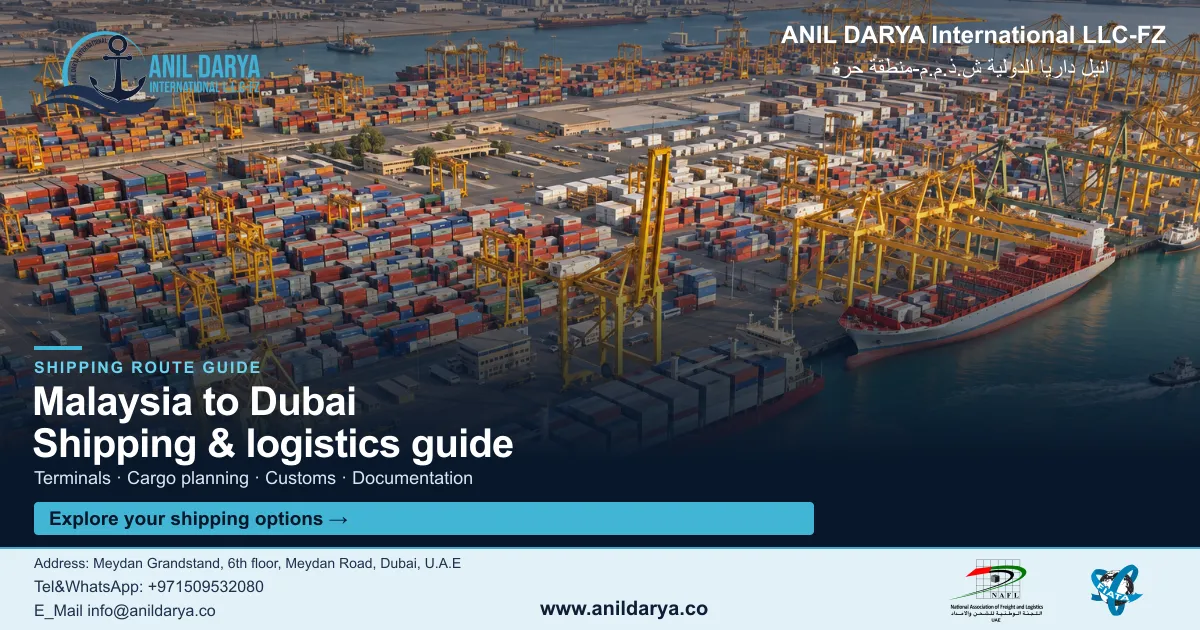
Shipping from Malaysia to Dubai usually means a container from Port Klang or Tanjung Pelepas to Jebel Ali, with direct flights from Kuala Lumpur for urgent cargo. The Malaysian exporter files a K2 export declaration with Royal Malaysian Customs, and the Dubai end decides how fast you get the goods: a customs code, a Dubai Customs declaration, 5% duty on the CIF value and 5% import VAT. Since 1 October 2025, the Malaysia-UAE CEPA also lets Malaysian exporters issue a preferential certificate of origin for goods shipped to the UAE.
Malaysia to Dubai shipping at a glance
| Item | Detail |
|---|---|
| Main Malaysian load ports | Port Klang (Westports and Northport) and Port of Tanjung Pelepas; also Penang, Johor Port, Kuantan and Bintulu |
| 2025 container volume | Port Klang 15.14 million TEU; Tanjung Pelepas 14.03 million TEU (Ministry of Transport) |
| Main UAE discharge port | Jebel Ali; Khalifa Port and Sharjah are alternatives |
| Modes | FCL, LCL, reefer, flat rack and breakbulk, liquid bulk in flexitanks or tankers, dangerous goods, air cargo |
| Malaysian export filing | CUSDEC K2 or K8 export declaration, filed online by the exporter or its forwarding agent |
| Export permits | Strategic Trade Act 2010 permits for listed strategic goods, applied for on myTRADELINK |
| UAE customs authority (Dubai) | Dubai Customs; importer needs a customs business code |
| Customs duty in Dubai | 5% of CIF value for most goods; alcohol 50%, cigarettes 100% |
| Import VAT | 5%, deferred to the VAT return for registered importers whose customs number is registered with the FTA |
| Trade agreement | Malaysia-UAE CEPA, in force 1 October 2025; certificate on Form MY-UAE issued by MITI |
| Free zone next to the port | Jafza, operating since 1985, over 11,000 businesses |
How the Malaysia to Dubai sea freight route works
Malaysia has two of the world's busiest container gateways. The Ministry of Transport reported 15.14 million TEU at Port Klang and 14.03 million TEU at Port of Tanjung Pelepas in 2025, both records. Most Gulf services load at one of these two ports. Schedule data from Fluent Cargo lists both direct services and transshipment services from Port Klang and Tanjung Pelepas to the UAE, with some discharging at Jebel Ali and others at Khor Fakkan or Fujairah on the east coast of the UAE.
The lane carries palm oil and other edible oils, rubber and latex goods, electronics and electrical parts, furniture, food products, chemicals, steel and building materials. Much of it is bought by Dubai and Jafza traders who sell it on to other markets. Whether your goods stay in the UAE or move on decides the customs route at the Dubai end, so settle that before you book.
What adds days to the Malaysia to Dubai transit?
| Factor | Why it matters | What to do |
|---|---|---|
| Direct or transshipment service | A relay adds a wait for the connecting vessel | Ask whether the service is direct to the UAE |
| Discharge port in the UAE | Khor Fakkan or Fujairah need a feeder or truck to Dubai | Confirm the final port of discharge on the booking |
| Secondary load port | Penang, Kuantan, Johor Port and Bintulu cargo often feeds into a hub first | Compare a feeder against trucking or rail to Port Klang |
| Malaysian cut-offs and permits | A missing K2 or permit number stops loading | Get permits before the export declaration |
| Dubai clearance | Missing permits or a late declaration keep the box at the terminal | File before the vessel berths |
[AMIR-FACT: our real port-to-port transit time from Port Klang and from Tanjung Pelepas to Jebel Ali in 2026, direct or transshipped, and the carriers we usually book on this lane]
Which Malaysian port should you ship from?
Ship from the port that gives the lowest total cost to Dubai. A direct sailing from Port Klang can beat a cheaper feeder from a regional port once you add the extra handling and days.
| Malaysian port | What the operator or ministry says | Best for shippers in |
|---|---|---|
| Port Klang (Westports, Northport) | 15.14 million TEU in 2025; Westports 11.33 million, Northport 3.8 million | Klang Valley, Kuala Lumpur, Selangor and central Peninsular Malaysia |
| Tanjung Pelepas (PTP) | 14.03 million TEU in 2025, up 14% | Johor and the south |
| Penang (North Butterworth Container Terminal) | Capacity of 2.3 million TEU a year, with a CFS, reefer services and rail | Penang, Kedah, Perak and the north |
| Johor Port (Pasir Gudang) | Container, liquid bulk and breakbulk port with a free zone | Pasir Gudang industrial area |
| Kuantan | East coast port for bulk, breakbulk and containers | Pahang and the east coast |
| Bintulu | Lists only intra-Asia, regional feeder and coastal services; most weekly calls go to Port Klang and Pasir Gudang | Sarawak |
For East Malaysia, plan on a feeder leg. Bintulu's own service list shows no direct service to the Middle East, so cargo from Sarawak moves to a Peninsular hub or Singapore first and joins a Gulf service there.
Which UAE port should your cargo arrive at?
Jebel Ali is the default for Dubai and for Jafza next to it. Our Jebel Ali port guide covers the terminals and port rules.
- Consignee in Dubai or Jafza: Jebel Ali.
- Site in Abu Dhabi: compare Khalifa Port in Abu Dhabi to cut the truck leg.
- Consignee in Sharjah or the northern emirates: compare Sharjah port shipping.
- Offered a discharge at Khor Fakkan or Fujairah: ask who pays the onward feeder or truck to Dubai and how the customs transit is handled.
Sea freight from Malaysia to Dubai: FCL, LCL and special cargo
| Mode | Use it when | What to plan at the Dubai end |
|---|---|---|
| FCL (20ft, 40ft, high cube) | You fill most of a container | Declaration before arrival, delivery order, truck slot, empty return |
| LCL | A few pallets or cartons | Release after the shared box is unpacked; your documents and the consolidator's must match |
| Reefer | Frozen food, seafood, fruit, some chemicals | Food approvals before arrival, plug-in time at the terminal |
| Flexitank or ISO tank | Edible oils, latex, non-hazardous liquids | Carrier approval for the flexitank, a discharge plan at the receiver's site |
| Flat rack, open top, breakbulk | Machinery, steel structures, project pieces | Lifting plan, trailer, road permits for oversized loads |
| Dangerous goods | Chemicals, paints, gases, lithium batteries | Carrier acceptance on every leg, UAE port storage limits for the class |
| Air cargo | Urgent goods, samples, electronics, perishables | Same Dubai Customs declaration, duty and VAT |
FCL or LCL from Malaysia?
FCL is sealed in Malaysia and released as one unit in Dubai. LCL costs less for small loads, but your goods wait until the consolidator's box is unpacked and every consignee's paperwork is in order. If your volume is close to a 20ft, price both. Our guide to FCL vs LCL costs explains the break-even, and our sea freight service page shows what we book.
Machinery, steel and project cargo from Malaysia
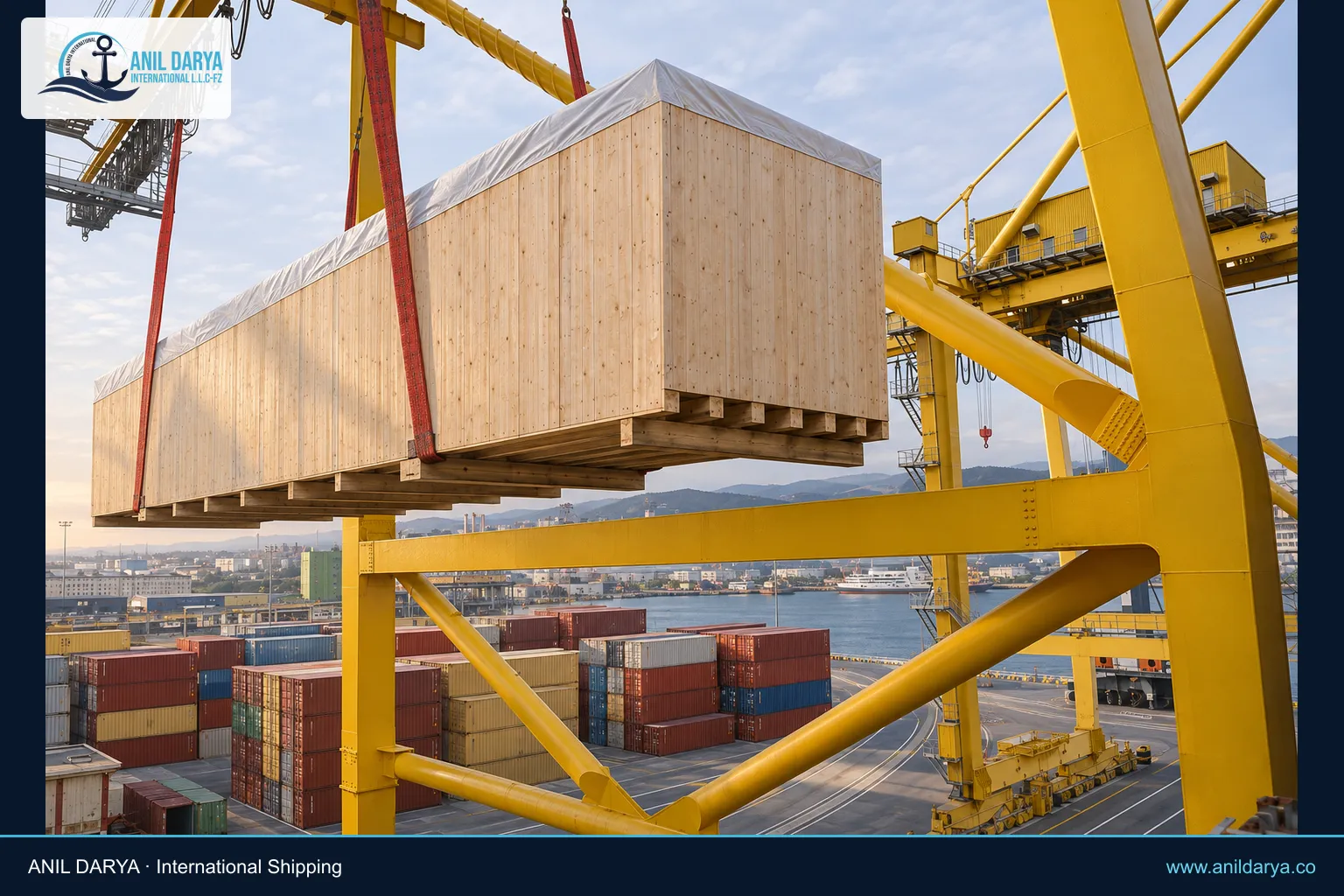
Port Klang's Westports and Northport both run conventional terminals for breakbulk, bulk and Ro-Ro cargo, and Johor Port and Kuantan handle breakbulk as well. Pieces that fit a 40ft flat rack get more sailings on container services. Anything larger needs breakbulk tonnage, and that sailing date drives the whole plan. At the Dubai end we plan the discharge, the trailer and any road permit before the vessel arrives. See our break bulk and project cargo service.
Dangerous goods from Malaysia to Dubai
DG cargo needs a correct UN number, proper shipping name, class and packing group, a safety data sheet, a signed DG declaration and UN-approved packaging. On the Malaysian side, some chemicals and items such as certain electronics may also be strategic goods that need a Strategic Trade Act permit before export. Each carrier decides which classes it accepts on each service and hub. In the UAE, some classes may stay in port only for a limited time, so the Dubai declaration and delivery must be ready when the ship berths. Our dangerous goods shipping team checks acceptance before booking.
Air cargo from Malaysia to Dubai
For electronics, spare parts, samples and perishables, air is often worth the cost. Fluent Cargo's schedule data lists direct flights from Kuala Lumpur International (KUL) to Dubai International (DXB) two to four times a day, with Emirates as the main carrier. Air freight is priced on chargeable weight, the higher of actual and volume weight. The Dubai declaration, duty and VAT are the same as for sea. Jafza sits close to both Jebel Ali Port and Al Maktoum International Airport, so sea and air cargo for a Jafza company end up in the same area. See our air cargo service.
What the Malaysian exporter must do
The Malaysian side is your supplier's job, but delays there land on your timeline. We book the space with the carrier; the export filing and the delivery of the box to the terminal stay with the shipper or its Malaysian forwarding agent.
- Export declaration. Royal Malaysian Customs says exports are declared online on the CUSDEC K2 or K8 export form, by the exporter or its forwarding agent.
- Strategic goods. Goods listed in the Strategic Trade (Strategic Goods) Order 2010 need a permit before export. The filer ticks Yes or No on the declaration and enters the permit number, which the customs system checks. An invalid number is rejected.
- Permit agencies. MITI, the Atomic Energy Licensing Board, the Malaysian Communications and Multimedia Commission and the Pharmaceutical Services Division of the Ministry of Health issue these permits, applied for on myTRADELINK after registering with Dagang Net.
- Certificate of origin. For the CEPA rate, the exporter applies to MITI for a preferential certificate on Form MY-UAE. For a non-preferential certificate, Malaysian exporters apply to chambers and associations authorised by MITI.
- Product certificates. Food, plant and animal products need the health or phytosanitary certificates the UAE asks for.
- Terminal delivery. The shipper or its haulier delivers the box to the terminal before the cut-off.
UAE customs clearance for Malaysian cargo
Containers from Port Klang or Tanjung Pelepas that land at Jebel Ali are cleared by Dubai Customs under one of five regimes: import, export, transit, transfer or temporary admission. Palm oil, electronics or furniture bought by a Jafza trader for re-export need a different regime from goods sold in the UAE mainland, so decide which one before the Malaysian supplier ships.
Do you need a customs code to import into Dubai?
Yes. The Malaysian seller cannot file the Dubai declaration for you. Dubai Customs says the licence holder needs a customs business code, which it applies for online on Dubai Trade with no office visit. An agent with a Dubai Economic Department clearing and forwarding licence can clear the cargo instead. If you have no code yet, we arrange clearance of the Malaysian shipment through a licensed agent with your authorisation.
Which documents does Dubai Customs need?
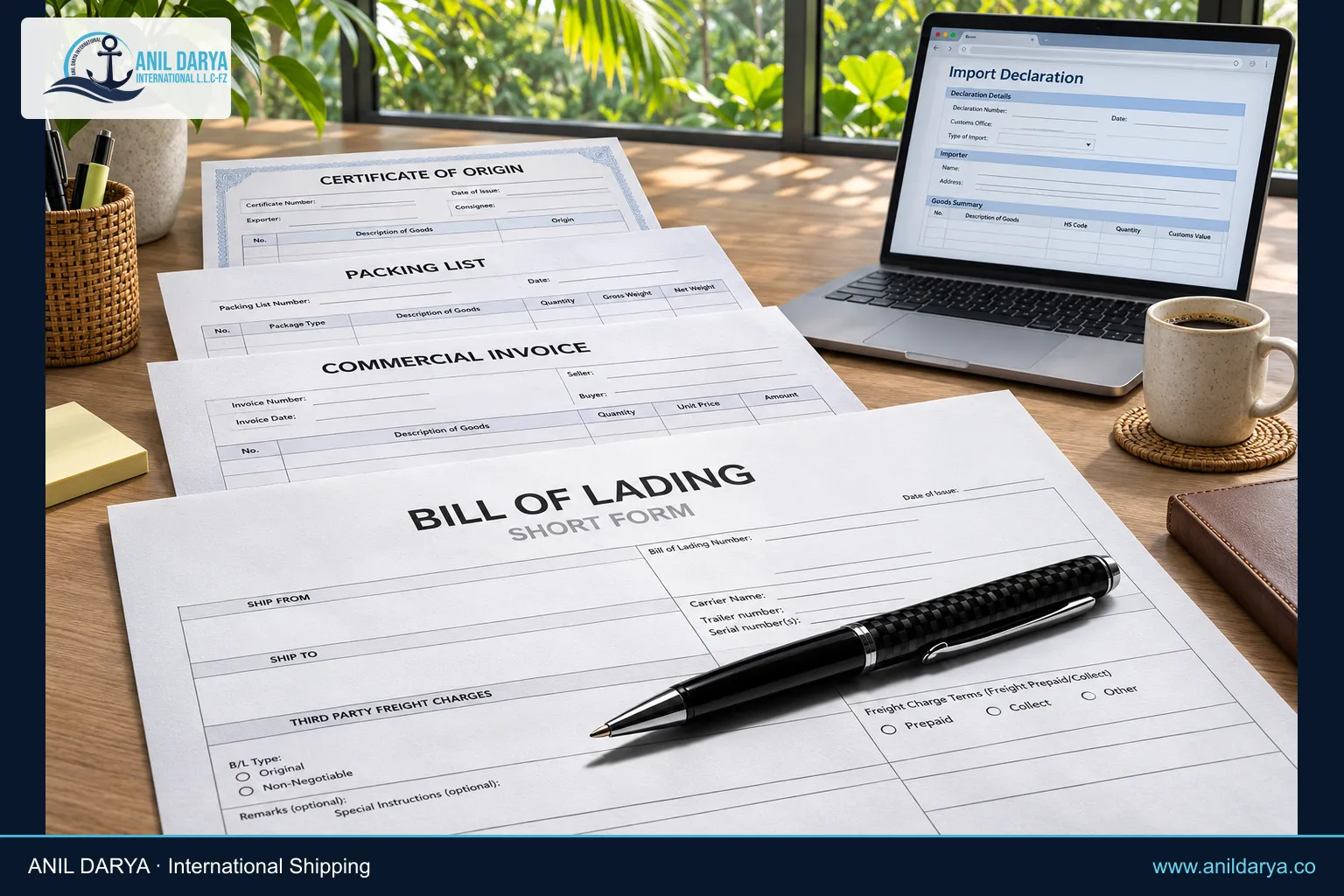
For goods from Malaysia, Dubai Customs asks for the supplier's invoice, the packing list, the certificate of origin (Form MY-UAE if you claim the CEPA) and, for restricted goods, a permit from the UAE authority. For sea cargo add the bill of lading and the carrier's delivery order. Check that the HS code on the Malaysian invoice matches the one on the K2 and the certificate.
| Document | Who provides it | Why Dubai needs it |
|---|---|---|
| Commercial invoice | Malaysian exporter | Customs value and HS code |
| Packing list | Malaysian exporter | Inspection and LCL release |
| Certificate of origin | MITI (Form MY-UAE) or an authorised chamber | Origin and, for the CEPA, the preferential rate |
| Bill of lading or air waybill | Carrier, via us | Title to the goods |
| Delivery order | Carrier in Dubai | Releasing the container |
| Permit | UAE authority for the product | Restricted goods only |
| SDS and DG declaration | Malaysian exporter | Dangerous goods only |
Which declaration should you use?
| What happens to the goods | Declaration | Duty and VAT |
|---|---|---|
| Sold or used in the UAE mainland | Import for local use | Duty and VAT at import |
| Delivered into Jafza | Transfer into the free zone | Due only if the goods later enter the mainland |
| Brought in for a time, then sent out | Temporary admission | Deposit equal to the duty, refunded on re-export within the allowed period; no deposit under an ATA carnet |
| Passing through to another country | Transit | Not imported into the UAE |
Jafza reached official operating status in 1985, sits next to Jebel Ali Port and hosts over 11,000 businesses. Many Malaysian manufacturers sell to a Jafza trader that stocks and re-exports. Our guide to Jafza re-export covers how that works for bulk and breakbulk cargo.
How much is customs duty and VAT on goods from Malaysia to Dubai?
Malaysian goods pay Dubai Customs duty of 5% of the CIF value for most products: the invoice value plus insurance and freight up to the UAE port. Alcohol pays 50% and cigarettes 100%, and some goods have other rates or are exempt. Goods that qualify under the CEPA with a Form MY-UAE certificate can get a lower rate on covered lines, so check each HS code.
The Federal Tax Authority also charges 5% import VAT on the customs value of goods from Malaysia, including insurance, freight and any customs fees and excise tax paid on import. The CEPA does not change VAT. Your VAT status decides when you pay it:
- VAT-registered importer that has registered its customs number with the FTA: no VAT is charged at import. The amount is prepopulated in your VAT return.
- Importer not registered for VAT: VAT is paid to the FTA before customs releases the goods.
| Charge | Rate | Base |
|---|---|---|
| Customs duty (most goods) | 5% | CIF value |
| Customs duty, alcohol | 50% | CIF value |
| Customs duty, cigarettes | 100% | CIF value |
| Import VAT | 5% | Customs value plus customs fees and excise tax |
| CEPA-qualifying Malaysian goods | Preferential rate on covered tariff lines | With a valid Form MY-UAE certificate |
Can the Malaysia-UAE CEPA reduce UAE duty?
It can, for goods that are really of Malaysian origin. MITI lists the Malaysia-UAE economic partnership agreement as in force from 1 October 2025, Malaysia's first free trade agreement with a Middle Eastern country. From that date, MITI says, Malaysian exporters can apply for the preferential certificate of origin for exports to the UAE.
- The certificate is Form MY-UAE, applied for on MITI's ePCO system, with the same procedure as Malaysia's other free trade agreements.
- The approved form is printed on white A4 paper with an electronic signature and official seal.
- The exporter keeps a copy for at least three years and submits endorsed copies to MITI each month.
- Royal Malaysian Customs lists Form MY-UAE CEPA as the proof of origin for this agreement.
The certificate is what the UAE importer presents with the Dubai declaration to claim the CEPA rate. We could not open an official UAE page with the UAE tariff schedule under this agreement, so check the rate for your HS code with Dubai Customs or the clearing agent before you price the landed cost. Goods made in another country and only shipped from Malaysia do not qualify.
Restricted and prohibited goods for the UAE
Dubai Customs says some goods need special approval from the competent authority before release. Groups that come up on this lane:
- Food, seafood, edible oils and food ingredients: food safety approvals and origin health certificates.
- Medicines, medical devices and health supplements: approval from the health authority.
- Seeds, plants and fertilisers: agricultural approvals.
- Chemicals and dangerous goods: permits for some products and port approvals for some classes.
- Telecom and wireless equipment: type approval.
- Cosmetics and personal care products: product registration.
Apply for permits before the vessel sails from Malaysia. A permit that arrives after the ship means storage and demurrage at Jebel Ali.
Shipping from Malaysia to Dubai step by step
- Tell us about the cargo. Commodity, HS code, weight, volume, the pickup point in Malaysia and the delivery address in the UAE.
- Agree the Incoterm with the supplier. Under FOB we book the sea freight from Malaysia. Under CFR or CIF the supplier books it and we take over at Jebel Ali.
- Get your Dubai side ready. Customs business code, VAT number registered with the FTA, and permits for restricted goods.
- Ask for the Form MY-UAE certificate if the goods are made in Malaysia and qualify under the CEPA.
- Book space. We pick a direct service where we can, confirm the UAE discharge port and send the booking and cut-offs to the shipper. DG, reefer, flexitank and out-of-gauge cargo get carrier approval first.
- Malaysian export clearance. The shipper or its forwarding agent files the K2 with any permit number and delivers the box before the cut-off.
- Check documents before arrival. Invoice, packing list, bill of lading and certificate must match on names, weights and HS codes.
- File the Dubai declaration. We file it through a licensed agent before the vessel berths.
- Pay duty and VAT. We arrange payment of the duty and VAT and collect the delivery order from the carrier.
- Deliver and return the empty. We book the truck slot, deliver to your site or Jafza warehouse and return the container within free time.
[AMIR-FACT: one real Malaysia to Dubai shipment we handled, with cargo type, Malaysian load port, mode, transit and how clearance went at Jebel Ali, cleared for publication]
What decides the freight cost on this lane?
Rates change every week, so we quote each shipment. These are the parts of the price:
| Cost factor | Effect |
|---|---|
| Malaysian load port | Direct services from Port Klang or Tanjung Pelepas versus a feeder from a regional port |
| Container type | Reefer, flexitank, flat rack and open top cost more than dry boxes |
| UAE discharge port | An east coast discharge adds an onward leg to Dubai |
| Incoterm | Decides who pays each leg and each set of local charges |
| Malaysian origin charges | Haulage, terminal handling, export declaration, permits, certificates |
| Dubai destination charges | Terminal handling, delivery order, clearance, trucking, CFS for LCL |
| Duty and VAT | 5% duty and 5% VAT unless the CEPA or VAT deferral applies |
| Free time | Demurrage and detention once the free days run out |
Who pays the Dubai duty: DAP or DDP?
Under DAP the Malaysian seller delivers and you, the buyer, clear the goods and pay duty and VAT in Dubai. Under DDP the seller pays them, but someone with a Dubai customs code still has to file the declaration as importer. A seller with no UAE company usually cannot do that alone, so agree in the contract whose code is used and who recovers the VAT.
Checklist before cargo leaves Malaysia
- Your customs business code is active and your customs number is registered with the FTA for VAT.
- HS code agreed with the supplier and checked for duty and restrictions.
- Strategic Trade Act permit checked for chemicals, electronics and other listed goods.
- Permits for UAE restricted goods applied for.
- Form MY-UAE certificate requested if the goods are made in Malaysia.
- Load port and UAE discharge port confirmed, direct or transshipped.
- Invoice, packing list and bill of lading match.
- Declaration type chosen: local import, free zone, temporary admission or transit.
- DG: SDS, DG declaration, carrier acceptance and a delivery plan that meets port storage limits.
- Free time at Jebel Ali agreed, delivery booked and cargo insurance arranged.
Common mistakes when shipping from Malaysia to Dubai
| Mistake | What happens | How to avoid it |
|---|---|---|
| No customs code in the UAE | The goods wait at the port until someone authorised can file | Register on Dubai Trade or appoint a licensed agent before arrival |
| Customs number not registered with the FTA | You pay import VAT before release instead of deferring it | Register the number with the FTA before the first import |
| Missing or late Form MY-UAE | You pay the normal duty that could have been lower | Ask the supplier to apply on ePCO before the box sails |
| Missing strategic goods permit | The K2 is rejected and the box misses the vessel | Check the Strategic Goods Order before booking |
| Accepting an east coast discharge without a plan | Extra cost and days to bring the box to Dubai | Confirm the onward leg and who pays it |
| Food or cosmetics shipped without UAE approvals | Goods held until the approval is issued | Apply for permits while the cargo is still in Malaysia |
| Wrong declaration type | Duty paid on goods that were meant for re-export | Choose free zone or transit before arrival |
Frequently asked questions
How long does shipping from Malaysia to Dubai take by sea?
It depends on the load port, the carrier and whether the service is direct or transshipped. Confirm the arrival date and discharge port on the booking, and add time for clearance and delivery in Dubai.
Which Malaysian port is best for shipping to Dubai?
Port Klang for Kuala Lumpur, Selangor and central Peninsular Malaysia, and Tanjung Pelepas for Johor and the south. Both handled over 14 million TEU in 2025. Cargo from Sarawak or the east coast usually feeds into a hub first.
What is the customs duty on goods from Malaysia to Dubai?
Dubai Customs charges 5% of the CIF value for most goods, 50% on alcohol and 100% on cigarettes. Malaysian-origin goods with a valid Form MY-UAE certificate can claim the CEPA rate on covered tariff lines.
Do I pay VAT on imports from Malaysia?
Yes. Malaysian goods pay 5% import VAT in the UAE, even when the CEPA lowers the duty. If you are VAT-registered and your customs number is registered with the FTA, it goes into your VAT return. If not, you pay it before Dubai Customs releases the cargo.
Is the Malaysia-UAE CEPA in force?
Yes. MITI lists it as in force from 1 October 2025. Malaysian exporters apply for the preferential certificate on Form MY-UAE through MITI's ePCO system.
Who files the export declaration in Malaysia?
The exporter or its forwarding agent files the K2 or K8 export declaration online with Royal Malaysian Customs, including any Strategic Trade Act permit number. We book the space and handle the UAE side.
Can I ship from Malaysia to a Dubai free zone without paying duty?
Yes. Goods delivered into Jafza under a free zone transfer pay duty only if they later enter the UAE mainland.
Can I send air cargo from Malaysia to Dubai?
Yes. Schedule data lists direct flights from Kuala Lumpur (KUL) to Dubai International (DXB) two to four times a day. Customs, duty and VAT in Dubai are the same as for sea freight.
Get a quote for shipping from Malaysia to Dubai
Send us the cargo, the pickup point in Malaysia and your delivery address in the UAE, and we will come back with a routing and price, including clearance at the Dubai end. Use our freight rate inquiry form or contact our team. You can also read more about our Dubai freight forwarding team.
Sources
- The Star: Port Klang and PTP set container records in 2025 (Ministry of Transport statement)
- Penang Port Commission: North Butterworth Container Terminal
- Bintulu Port: List of shipping services
- Fluent Cargo: Malaysia to United Arab Emirates schedules
- Fluent Cargo: Kuala Lumpur to Dubai schedules
- Royal Malaysian Customs: Export procedure (K2/K8, Strategic Trade Act permits)
- Royal Malaysian Customs: Rules of origin FAQ (proof of origin forms, PCO and NPCO)
- MITI: Malaysia's free trade agreements and entry into force dates
- MITI: Entry into force of the MY-UAE CEPA and Form MY-UAE (notice, 29 September 2025)
- Dubai Customs: Submit customs declaration (regimes and documents)
- Dubai Customs: Frequently asked questions (duty, CIF, business code, clearing agents, deposits)
- UAE Government portal: Customs duty and tariff
- Federal Tax Authority: VAT guide, section 3.5 (import VAT)
- Jafza: About Jebel Ali Free Zone
Reviewed: 10 November 2026