
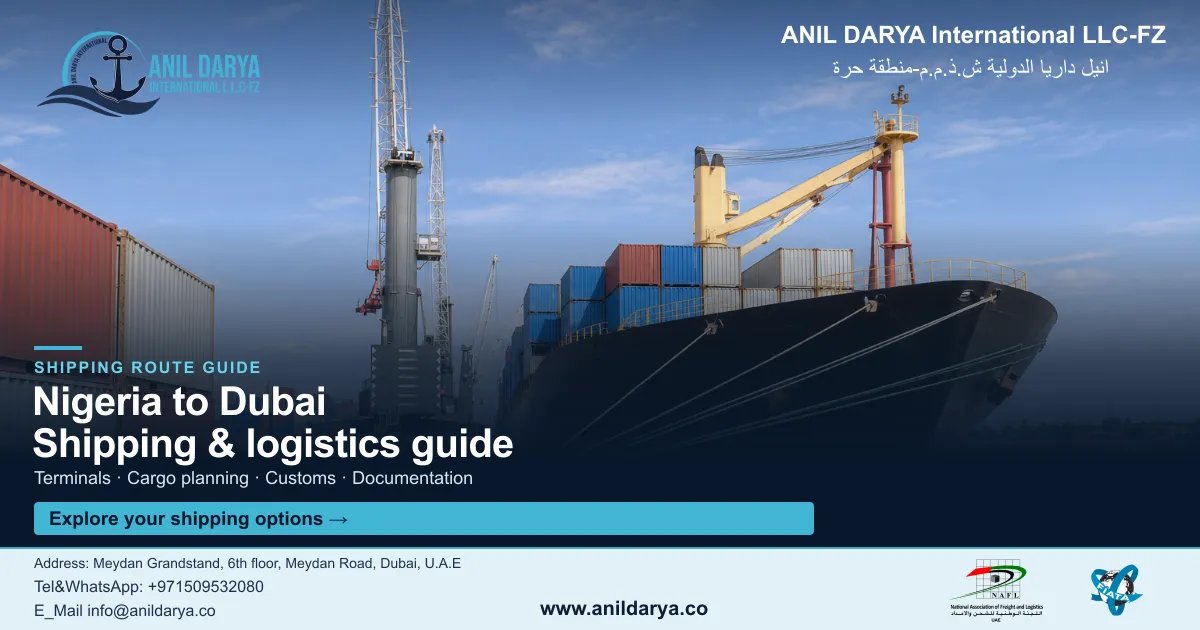
Shipping from Nigeria to Dubai starts with the Nigerian paperwork: an NEPC exporter registration, an NXP form from the exporter's bank and an export declaration on the B'Odogwu customs system. Containers then leave Lagos, Lekki or Onne and usually transship before reaching Jebel Ali. In Dubai you clear the goods with a customs business code, pay 5% duty on the CIF value for most goods and 5% import VAT.
Nigeria to Dubai shipping at a glance
| Item | Detail |
|---|---|
| Main Nigerian load ports | Lagos (Apapa and Tin Can Island), Lekki Deep Sea Port, Onne |
| Export-heavy port | Onne: NPA says it handles over 65% of the export cargo through Nigerian seaports |
| Main UAE arrival port | Jebel Ali (DP World); Khalifa Port and Sharjah ports as alternatives |
| Routing | Transshipment is normal; some services discharge at Khor Fakkan or Fujairah |
| Modes | FCL, LCL, reefer, breakbulk and project cargo, dangerous goods, air cargo |
| Exporter registration | Nigerian Export Promotion Council (NEPC) exporter's certificate |
| Export proceeds form | NXP, issued through the exporter's commercial bank, CBN-approved |
| Export declaration | Nigeria Customs Service, B'Odogwu UCMS; published target 2 working days |
| UAE customs (Dubai) | Dubai Customs, importer needs a customs business code |
| UAE duty | 5% of CIF for most goods; alcohol 50%, cigarettes 100% |
| UAE import VAT | 5%, deferred to the VAT return for registered importers linked with the FTA |
How the Nigeria to Dubai sea freight route works
There is no simple shuttle between Nigeria and the UAE. Fluent Cargo's schedule data shows Lagos to UAE sailings with one or two transshipments, and some services that discharge at Khor Fakkan or Fujairah on the UAE east coast rather than at Jebel Ali. So the questions to ask at booking are the hub, the onward vessel and the UAE port, not just the sailing date.
Cargo on this lane ranges from farm produce and processed food to machinery and equipment going back to the UAE after a project. The Nigerian side treats each group differently: farm produce needs NAQS quarantine certificates, food needs NAFDAC, and manufactured goods need an SON product certificate.
What adds days to the Nigeria to Dubai transit?
| Factor | Why it matters | What to do |
|---|---|---|
| Transshipment | Each hub adds waiting time and a risk of a missed connection | Ask for the hub and the second-leg frequency |
| NXP and certificates | The export declaration cannot be completed without them | Start the NXP and inspections before the booking |
| Gate-in at the terminal | A truck that reaches the terminal after the cut-off misses the vessel | Book the gate-in slot early and keep a margin before cut-off |
| UAE discharge port | A box landing on the east coast needs a longer truck leg to Dubai | Match the discharge port to your warehouse |
| Dubai clearance | Food without UAE approval waits at the terminal | Get UAE permits before the ship arrives |
[AMIR-FACT: our real port-to-port transit time from Apapa, Tin Can, Lekki or Onne to Jebel Ali, the transshipment hub and the carriers we actually book in this direction]
Which Nigerian port should you ship from?
Ship from the port nearest the goods. Trucking across Nigeria is slow and often costs more than you expect.
| Port | What the operator or NPA says | Best for |
|---|---|---|
| Lagos Port Complex (Apapa) | Five private terminals concessioned in 2006, including APM Terminals and ENL | Lagos and the south-west, general containers |
| Tin Can Island | Next to Apapa, often treated as one Lagos gateway in schedules | Lagos containers and vehicles |
| Lekki Deep Sea Port | About 65 km east of Lagos in the Lagos Free Zone; fully operational since 1 April 2023 | Larger container services, Lekki and the free zone |
| Onne | Near Port Harcourt; over 65% of Nigeria's seaport export cargo; oil and gas free zone | Niger Delta cargo, oilfield equipment, re-exports from the free zone |
| Murtala Muhammed International Airport, Lagos | Main air cargo gateway | Samples, perishables, urgent spares |
Nigerian ports handled 602,392 TEU of containers in the second quarter of 2026, according to the Nigerian Ports Authority. Most of that is imports, so confirm with the carrier that it has empties at your load port before you promise a date to your buyer.
Which UAE port should your cargo arrive at?
For a buyer in Dubai or a company in Jafza, Jebel Ali is the natural port. DP World runs four container terminals there and handles breakbulk, project cargo and IMDG dangerous goods. Our Jebel Ali port guide covers the terminals.
- Warehouse in Dubai or Jafza: Jebel Ali.
- Site in Abu Dhabi: compare Khalifa Port in Abu Dhabi.
- Buyer in Sharjah or the northern emirates, or a service via Khor Fakkan: read our Sharjah port shipping guide.
Sea freight from Nigeria to Dubai: FCL, LCL and special cargo
| Mode | Typical cargo | What to plan |
|---|---|---|
| FCL dry | Agricultural commodities, processed food, textiles, materials | NAQS or NAFDAC certificates, fumigation, Dubai declaration before arrival |
| LCL | Small food lots, samples, trade fair goods | Your papers and the consolidator's must match before release in the UAE |
| Reefer | Frozen fish and seafood, fresh produce | Health certificates, UAE food approval, plug-in time at both ends |
| Breakbulk and project | Rigs, pipes, heavy equipment returning from oil and gas work | Flat rack or breakbulk space, UAE berth and lifting plan |
| Dangerous goods | Chemicals, oilfield materials, batteries | SDS, DG declaration, carrier approval, UAE port storage limits |
| Air cargo | Samples, perishables, spares | Same Dubai declaration, duty and VAT |
FCL or LCL from Nigeria?
Commodity shipments usually fill a container, so FCL is the default. LCL works for small orders, but consolidation services from West Africa to the Gulf are fewer than from Asia, and one late document from another shipper can hold the whole box. Our guide to FCL vs LCL costs explains the break-even, and our sea freight service shows how we handle containers into the UAE.
Oil and gas equipment back to the UAE
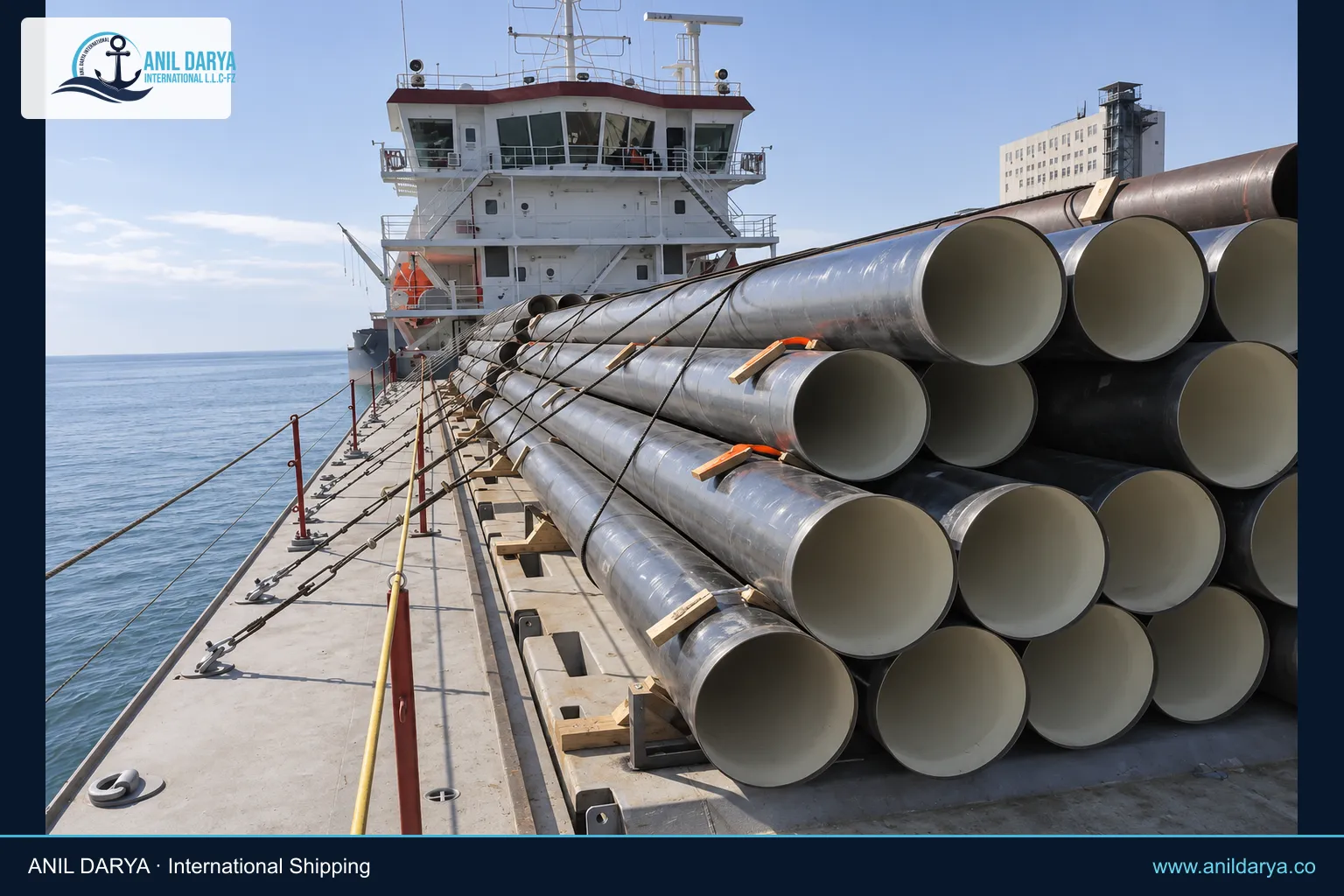
A lot of equipment goes from the UAE to Nigerian oil and gas projects, and much of it comes back for repair, recertification or the next job. Onne is the main base for this cargo, with heavy-lift quays at the Onne Multipurpose Terminal and an oil and gas free zone. OGFZA lists no customs duty on goods sent from the zone to other countries. At the UAE end, returning equipment may qualify for a different customs treatment from new goods, so send us the original export papers before it sails. See our break bulk and project cargo service.
Dangerous goods from Nigeria
Chemicals and oilfield materials need a Safety Data Sheet, a DG declaration, UN-approved packaging and labels, and carrier acceptance at origin. Jebel Ali limits how long some IMDG classes may stay in the port, so the Dubai declaration and the truck must be ready when the ship berths. Our guide to dangerous goods customs clearance in the UAE explains the UAE side.
Air cargo from Lagos to Dubai
Lagos has direct passenger flights to Dubai International and freighter connections into Al Maktoum International and Sharjah, according to Fluent Cargo's schedule data. Air suits samples, perishables and urgent spares. The Dubai side is the same as for sea cargo: a declaration under a customs code, 5% duty and import VAT.
What the Nigerian exporter must do
We book the space with the carrier. The pickup and the Nigerian export formalities are done by the shipper or its Nigerian clearing agent. This is what they need.
NEPC registration
NEPC says the first step of any export is registration as an exporter with the council. It issues an exporter's certificate, applied for through its e-registration portal.
The NXP form
The Nigeria Export Proceeds (NXP) form is issued through the exporter's commercial bank and records the value of the export. The Nigeria Customs Service lists a CBN-approved NXP form as the first requirement for export clearance, so the exporter should start it as soon as the sale is agreed.
The export declaration on B'Odogwu
The Nigeria Customs Service processes export declarations on B'Odogwu, its Unified Customs Management System. Its published service standards list these requirements for export clearance:
- CBN-approved NXP form.
- Export declaration through B'Odogwu UCMS.
- SON product quality certificate for manufactured goods.
- NAFDAC export certificate for food and drugs.
- Packing list and commercial invoice.
The target time is 2 working days from the point customs receives a complete application. An incomplete file does not start the clock, and the clock pauses while a partner agency such as NAQS or NAFDAC is reviewing it.
Certificates by product
| Document | Needed for | Issued by |
|---|---|---|
| Phytosanitary certificate | Agricultural commodities | Nigeria Agricultural Quarantine Service (NAQS) |
| Health certificate | Processed and semi-processed food | NAFDAC |
| International veterinary certificate | Animals and animal products | Department of Veterinary and Pest Control Services |
| Fumigation certificate | Agricultural commodities | Federal Produce Inspection Service |
| Clean Certificate of Inspection | Shipments covered by pre-shipment inspection | Government-appointed inspection agencies |
| Certificate of weight and quality | Commodity contracts | Independent inspector agreed by buyer and seller |
| Certificate of origin | Proof of Nigerian origin | NACCIMA |
NAQS issues electronic phytosanitary certificates and offers an online check for them, so ask the seller for the certificate number and verify it before the ship sails. Some goods are on Nigeria's export prohibition list. The customs website could not be read when we checked, so have the seller's clearing agent confirm the current list for your HS code.
Dubai customs clearance for cargo from Nigeria
Dubai Customs handles cargo arriving at Jebel Ali and the other Dubai entry points. Declarations are filed online under one of several regimes: import for local use, transfer into a free zone, transit or temporary admission.
Who can file the declaration in Dubai?
Dubai Customs says every business using its services must register for a customs business code, done online through Dubai Trade. Any code holder can file a declaration, and an agent with a Dubai Economic Department clearing and forwarding licence can file it with the owner's authorisation. If you do not have a code, we arrange clearance through a licensed agent.
Documents for the Dubai declaration
| Document | Who provides it | Purpose in Dubai |
|---|---|---|
| Commercial invoice | Nigerian exporter | Customs value and HS code |
| Packing list | Nigerian exporter | Inspection and LCL release |
| Certificate of origin | NACCIMA | Origin of the goods |
| Bill of lading or air waybill | Carrier | Title and release |
| Delivery order | Shipping line's agent in the UAE | Releasing the container |
| UAE permit | UAE authority for the product | Food, chemicals and other restricted goods |
| Phytosanitary or health certificate | NAQS or NAFDAC | Food, plants and animal products |

Free zone, local import or transit?
| Your plan for the goods | Declaration | Duty and VAT |
|---|---|---|
| Sell or use in the UAE mainland | Import for local use | Paid at import |
| Store and re-export from Jafza | Transfer into the free zone | Due only if the goods later enter the mainland |
| Repair, exhibit or test, then send back | Temporary admission | Deposit equal to the duty, refunded on re-export in time; none with an ATA carnet |
| Move on to another country | Transit | Not imported into the UAE |
Jafza is next to Jebel Ali Port and has over 11,000 businesses. Traders often land Nigerian goods there and sell them on to other markets. Our guide to Jafza re-export covers bulk and breakbulk.
How much duty and VAT do you pay on goods from Nigeria?
Dubai Customs charges 5% of the CIF value for most goods: the price of the goods plus freight and insurance to the UAE. Alcohol pays 50% and cigarettes 100%. Some goods are exempt or have their own rate, so check the HS code.
Import VAT is 5% of the customs value, including freight, insurance and any duty and excise paid. If you are VAT-registered and your customs number is linked with the Federal Tax Authority, you do not pay it at the border. It goes on your VAT return and you may recover it. If you are not registered, you pay it before customs releases the goods.
| Charge | Rate | Base |
|---|---|---|
| Customs duty, most goods | 5% | CIF value |
| Customs duty, alcohol | 50% | CIF value |
| Customs duty, cigarettes | 100% | CIF value |
| Import VAT | 5% | Customs value plus duty and excise |
Does a UAE trade agreement with Nigeria cut the duty?
We did not find an official UAE source confirming that a trade agreement with Nigeria is in force and lowers UAE duty. Until it is confirmed for your HS code, plan on 5%. Keep the NACCIMA certificate of origin anyway, as banks and re-export buyers often ask for it.
Restricted and prohibited goods for the UAE
Restricted goods need an approval from the relevant UAE authority, and that approval goes with the other documents for clearance. On this lane, check these groups early:
- Food, fish, seafood and spices: UAE food safety approval and a NAFDAC or NAQS certificate.
- Seeds, nuts, grains and plants: agricultural approval and a phytosanitary certificate.
- Chemicals and oilfield materials: permits for some products and port approvals for some IMDG classes.
- Herbal products, medicines and cosmetics: health authority approval or product registration.
- Jewellery and diamonds: Dubai Customs asks for stamped and signed origin invoices, a packing list and stone-setting details.
Apply for UAE permits while the cargo is still in Nigeria. A permit that arrives after the ship does means storage and demurrage.
How to ship from Nigeria to Dubai, step by step
- Send us the cargo details: commodity, HS code, weight, volume, the pickup point in Nigeria and the delivery address in the UAE.
- Agree the Incoterm with the seller. Under FOB we book the sea freight from Lagos, Lekki or Onne. Under CFR or CIF the seller books it and we take over in the UAE.
- Prepare the UAE side: customs business code, VAT number linked to it, and UAE permits for food or restricted goods.
- The seller confirms its NEPC certificate, opens the NXP form with its bank and books inspections with NAQS, NAFDAC or SON as needed.
- We book space with the carrier and confirm the hub and the UAE discharge port. DG, reefer and out-of-gauge cargo need carrier approval first.
- The seller or its trucker collects the empty, loads it and delivers it to the terminal before the cut-off.
- The seller's clearing agent files the export declaration on B'Odogwu with the NXP and certificates.
- We check the draft bill of lading against the invoice and packing list before the line issues it.
- We file the Dubai Customs declaration before the vessel berths.
- We arrange payment of the duty and VAT, collect the delivery order, deliver to your site and return the empty inside free time.
[AMIR-FACT: one real Nigeria to Dubai shipment we handled: cargo type, Nigerian load port, mode, UAE arrival port and how clearance went, cleared for publication]
What decides the cost of shipping from Nigeria to Dubai?
Prices move with transshipment capacity and empty container supply in Nigeria, so we quote each shipment. These are the cost drivers:
| Cost factor | Effect |
|---|---|
| Load port | Lagos, Lekki and Onne have different services and local costs |
| Routing | Number of transshipments and the UAE discharge port |
| Equipment | Reefer, flat rack and open top cost more; empty supply varies by port |
| Nigerian origin charges | Trucking, terminal handling, inspections, certificates, export clearance |
| Incoterm | Decides who pays each leg and which local charges |
| UAE destination charges | Terminal handling, delivery order, clearance, trucking, CFS for LCL |
| Duty and VAT | 5% duty on CIF and 5% import VAT unless deferred |
| Free time | Demurrage and detention when documents arrive late |
The cost you can control most is waiting time at the UAE port. Original documents that travel separately from the cargo should be couriered as soon as the bill of lading is issued. Our article on demurrage and detention shows how the charges build.
Checklist before cargo leaves Nigeria
- UAE customs business code active and linked to your VAT registration.
- HS code agreed with the seller and checked for UAE duty and restrictions.
- Seller's NEPC exporter's certificate valid.
- NXP form opened through the seller's bank.
- NAQS, NAFDAC or SON certificates booked for the product.
- Item checked against Nigeria's current export prohibition list.
- UAE permits applied for: food, plants, chemicals or cosmetics.
- Hub and UAE discharge port confirmed with the carrier.
- Invoice, packing list, certificate of origin and bill of lading match.
- Declaration type chosen: local import, free zone, temporary admission or transit.
Common mistakes with Nigerian export cargo
- Booking the vessel before the NXP form is ready. Customs lists it first for a reason.
- Food or produce shipped without a UAE food approval. This is the most common hold at the Dubai end.
- Assuming the box lands at Jebel Ali when the service discharges on the east coast.
- Different weights or descriptions on the invoice, NXP and bill of lading.
- No plan for returning equipment. Repairs and temporary imports need the right declaration, or you pay duty you could have avoided.
- Late gate-in at Lagos. A missed cut-off rolls the box to the next sailing on the service.
Frequently asked questions
How do I ship goods from Nigeria to Dubai?
The Nigerian seller registers with NEPC, opens an NXP form with its bank and files the export declaration on B'Odogwu. We book the space from Lagos, Lekki or Onne, then clear the goods in Dubai with 5% duty on CIF and 5% import VAT for most goods.
What is the NXP form?
The Nigeria Export Proceeds form, issued through the exporter's commercial bank, records the value of the export. The Nigeria Customs Service lists a CBN-approved NXP as the first requirement for export clearance.
Which Nigerian port is best for shipping to Dubai?
Lagos (Apapa or Tin Can) or Lekki for cargo from the south-west, and Onne for the Niger Delta and oil and gas equipment. Pick the port closest to the goods.
How long does export clearance take in Nigeria?
The Nigeria Customs Service publishes a target of 2 working days for export clearance, counted from a complete application on B'Odogwu. Time spent by partner agencies such as NAQS or NAFDAC is not included.
What is the customs duty in Dubai on goods from Nigeria?
Dubai Customs charges 5% of the CIF value for most goods, 50% on alcohol and 100% on cigarettes. Import VAT of 5% also applies.
Can I send food from Nigeria to Dubai?
Yes, with the right papers on both sides: a NAFDAC health certificate or NAQS phytosanitary certificate in Nigeria, and a UAE food safety approval before the goods arrive.
Can goods from Nigeria go into a Dubai free zone without duty?
Yes. Goods transferred into Jafza pay duty only if they later enter the UAE mainland.
Does Anil Darya handle the export side in Nigeria?
No. We book the space with the carrier and run the UAE side. Pickup, the NXP and the export declaration stay with the shipper or its Nigerian clearing agent.
Get a quote for shipping from Nigeria to Dubai
Tell us the cargo, the pickup point in Nigeria and your UAE delivery address. We will send a routing, the UAE arrival port and a price that includes clearance at our end. Use our freight rate inquiry form or contact our team, and learn more about our Dubai freight forwarding team.
Sources
- Nigerian Export Promotion Council: Export documents and procedures (registration, NXP, CCI, certificates)
- Nigerian Export Promotion Council: Exporter registration
- Nigeria Customs Service: Service timelines and requirements (export clearance, B'Odogwu UCMS)
- Nigeria Agricultural Quarantine Service: Export certification and phytosanitary verification
- Nigerian Ports Authority: Terminals and operators
- Nigerian Ports Authority: Lekki Deep Sea Port
- Lekki Port: Port facts
- Nigerian Ports Authority: Onne Port Complex (export share)
- OGFZA: Free zone incentives
- Nigerian Ports Authority: Q2 2026 operational performance
- Fluent Cargo: Lagos to Dubai sea and air schedules
- Fluent Cargo: Nigeria to UAE schedules (routing)
- DP World: Jebel Ali Port
- Dubai Customs: FAQ (duty, business code, agents, deposits, jewellery documents)
- Dubai Customs: Submit customs declaration
- UAE Government portal: Customs duty and tariff
- Federal Tax Authority: VAT guide (import VAT)
- Jafza: About Jebel Ali Free Zone
Reviewed: 10 November 2026