
Shipping from Pakistan to Qatar is a short sea lane: containers load at Karachi or Port Qasim and discharge at Hamad Port, south of Doha, which handles almost all of Qatar's container cargo. The Pakistani shipper files the export Single Declaration on Pakistan Single Window, and the Qatari importer or its clearing agent clears the box on Al Nadeeb and pays duty, usually 5% of the CIF value. We book the sea freight from Dubai and line up both ends before the box moves.
Pakistan to Qatar shipping at a glance
| Item | Detail |
|---|---|
| Main mode | Sea: FCL, LCL, reefer, flat rack; dangerous goods only where the line accepts them |
| Pakistani load ports | Karachi (PKKHI) and Port Qasim (PKBQM) |
| Qatari discharge port | Hamad Port (QAHMD), run by Mwani Qatar |
| Published direct example | ONE's Pakistan Gulf Express (PGX): Karachi to Hamad in 4 days, with a call at Jebel Ali on the way (carrier brochure, January 2025) |
| Export filing in Pakistan | Single Declaration on Pakistan Single Window (PSW), by the exporter or its customs agent |
| Import filing in Qatar | Customs declaration on Al Nadeeb, by the importer's licensed clearing agent |
| Qatar duty | 5% of CIF for most goods; fresh fruit and vegetables, rice, wheat and flour are exempt |
| Sales tax in Qatar | No VAT has been introduced (third-party guide checked April 2026) |
| Trade deal | No Pakistan-GCC free trade agreement in force; it was still unsigned in October 2026 |
| Bill of lading | The shipping line's own B/L, issued and released to you through us |
How shipping from Pakistan to Qatar works when we book it from Dubai
This is a cross-trade: the container goes from a Pakistani terminal to Hamad and is never cleared in the UAE. We coordinate three parties from Dubai, and each job must be done before the ship sails.
| Task | Who handles it | Our part |
|---|---|---|
| Trucking to the port, stuffing, Pakistani export Single Declaration | The Pakistani shipper or its origin agent | We send them the booking number, the cut-off and the B/L instructions |
| Sea leg from Karachi or Port Qasim to Hamad | The shipping line | We book the space from Dubai and track the box to discharge |
| Bill of lading | The shipping line's own B/L | We are agent for many shipping lines, so the line's B/L is issued and released to you through our office |
| Qatar customs, duty, delivery to the warehouse | The consignee's clearing agent in Qatar | We check that the agent has accepted the job and knows the document set before we confirm space |
We do not sell customs clearance in Qatar. Duty and taxes at destination are paid by the consignee or its broker. In practice, a box of onions or garments that reaches Hamad with no clearing agent in place simply waits at the terminal while storage and container charges add up. So the Qatari buyer names its agent first, and only then do we confirm the booking.
The Incoterm sets who pays for what. Qatari buyers have long priced imports on a cost and freight basis, according to the US trade guide on Qatar, which means CFR Hamad is common: the Pakistani seller pays the sea freight, and the Qatari buyer pays the Hamad charges, clearance and duty. Under FOB Karachi the buyer books the freight, which is where we usually come in. Our guide to Incoterms 2020 for sea freight shows where risk passes in each case.
Karachi or Port Qasim: which Pakistani port to use
Both gateways are on the Karachi coast. The right one depends on the line's terminal, the cargo and where it is stuffed.
| Port | Facts from the port authorities | Fits best for |
|---|---|---|
| Karachi Port | Karachi Port Trust: three wharves with 34 berths, three container terminals (KICT, KGTL and SAPT), designed depth 13 to 16 m, 2.28 million TEU handled in FY 2023-24 | General containers from Karachi's textile, leather and food firms; ONE's PGX loads at KGTL |
| Port Qasim | Port Qasim Authority: 49 km buoyed channel, ships up to 13 m draught, 18 berths; DP World's QICT terminal has a design capacity of 1.4 million TEU a year; a marginal wharf for machinery and project pieces | Reefers, heavy and out-of-gauge cargo, factories in the Bin Qasim industrial zone |
Lines also set their own yard rules. Maersk's Pakistan export page, for example, says it takes reefers only at its Port Qasim yard and will not move dangerous goods by rail or truck to inland depots. If your cargo is chilled meat or paint, ask for the line's yard and DG rules at the quote stage.
What to expect at Hamad Port
Hamad Port replaced the old Doha port for commercial cargo. Mwani Qatar, the port authority, says it began operations in December 2016 and was opened officially on 5 September 2017. It covers about 29 square kilometres, has a planned capacity of 7.5 million TEU a year and a free zone next to it.
- Container terminal 1 has a container freight station for LCL unpacking and a separate store for dangerous goods, according to a 2020 presentation by QTerminals, the terminal operator.
- The general cargo terminal has a 1,200 m quay with 14 m allowable draught for steel, pipes and project pieces.
Direct sailings or a relay through Jebel Ali?
A box reaches Hamad either on a loop that calls Karachi and Hamad, or by relay on a feeder from a Gulf hub. Your quote should say which.
A published direct loop: ONE's PGX
Ocean Network Express announced the weekly Pakistan Gulf Express in November 2024, with the first ship due at Karachi on 2 December 2024. ONE's January 2025 Middle East brochure gives the westbound rotation as Karachi (Karachi Gateway Terminal), Jebel Ali (Terminal 2), Hamad and Dammam. It lists 3 days from Karachi to Jebel Ali, 4 days to Hamad and 5 to Dammam.
The brochure's day windows agree: the ship leaves Karachi on Wednesday and reaches Hamad on Sunday. Your box stays on board at Jebel Ali. The brochure is almost two years old, so ask the line to confirm the current rotation.
Relay through a Gulf hub
When the line has no direct call, it discharges the box at its hub and moves it on a feeder. Jebel Ali has more than 80 weekly services, and several Gulf feeders run from there to Hamad. Milaha's Intra Gulf Express (MIG), for example, is a weekly Jebel Ali to Hamad service with two ships of about 1,015 TEU and 90 reefer plugs, according to its January 2025 profile. A relay adds handling time, and reefers need power at the hub.
Third-party sites print sea times from 3 to more than 27 days for this lane. We do not repeat them.
[AMIR-FACT: the shipping lines we actually book from Karachi and Port Qasim to Hamad in 2026, whether each calls Hamad direct or relays at a hub (which one), and our real port-to-port days for dry and reefer boxes]
Sea freight from Pakistan to Qatar by type of cargo
| Equipment | Pakistani cargo it suits | Rule of thumb |
|---|---|---|
| 20ft dry | Rice, salt, stone, cement products, bagged sesame | Dense cargo hits the weight limit before the box is full; check the CSC plate and Qatari road limits |
| 40ft or 40ft high cube | Bed linen, towels, garments, leather goods, furniture | Use when volume, not weight, is the limit |
| LCL | Sample orders, surgical instruments, sports goods, small lots of apparel | Fine for a few cubic metres; expect CFS handling and a later release at Hamad |
| Reefer | Frozen meat, fish, mangoes, kinnow | Set point, pre-cooling and health papers must be ready before loading |
| Ventilated or reefer at a set point | Onions and potatoes | Ask the line which box and setting it accepts for fresh produce |
| Flat rack or breakbulk | Machinery, steel structures, generators | If it fits a flat rack, container services give more sailings |
Our FCL vs LCL comparison helps when a lot is on the border between a shared and a full box. The equipment we book is listed on our sea freight service page.
Reefer cargo: meat, fish and fruit
Meat is the largest item Pakistan sells to Qatar by value. Frozen product moves well in reefers on a 4-day loop. Chilled meat has a short life, so work out whether sea time, clearance and delivery fit inside it before you choose sea over air. Either way, the health certificate must exist before the ship sails.
Dangerous goods
Paints, resins, some cleaning chemicals and lithium batteries are dangerous goods. The shipper must give the UN number, class and a Safety Data Sheet, and the line must accept the booking before the box is stuffed. The 2024 edition of the IMDG Code (Amendment 42-24) became mandatory on 1 January 2026. Qatar's prohibited list also names flammable goods and explosives, so the Qatari buyer should confirm the product is allowed before you pack. Our dangerous goods team checks the papers and line acceptance first, and our article on dangerous goods classes explains the nine classes.
Machinery and project cargo
For pieces too big for a flat rack, we need drawings, weights and lifting points for each one. See our break bulk and project cargo service.
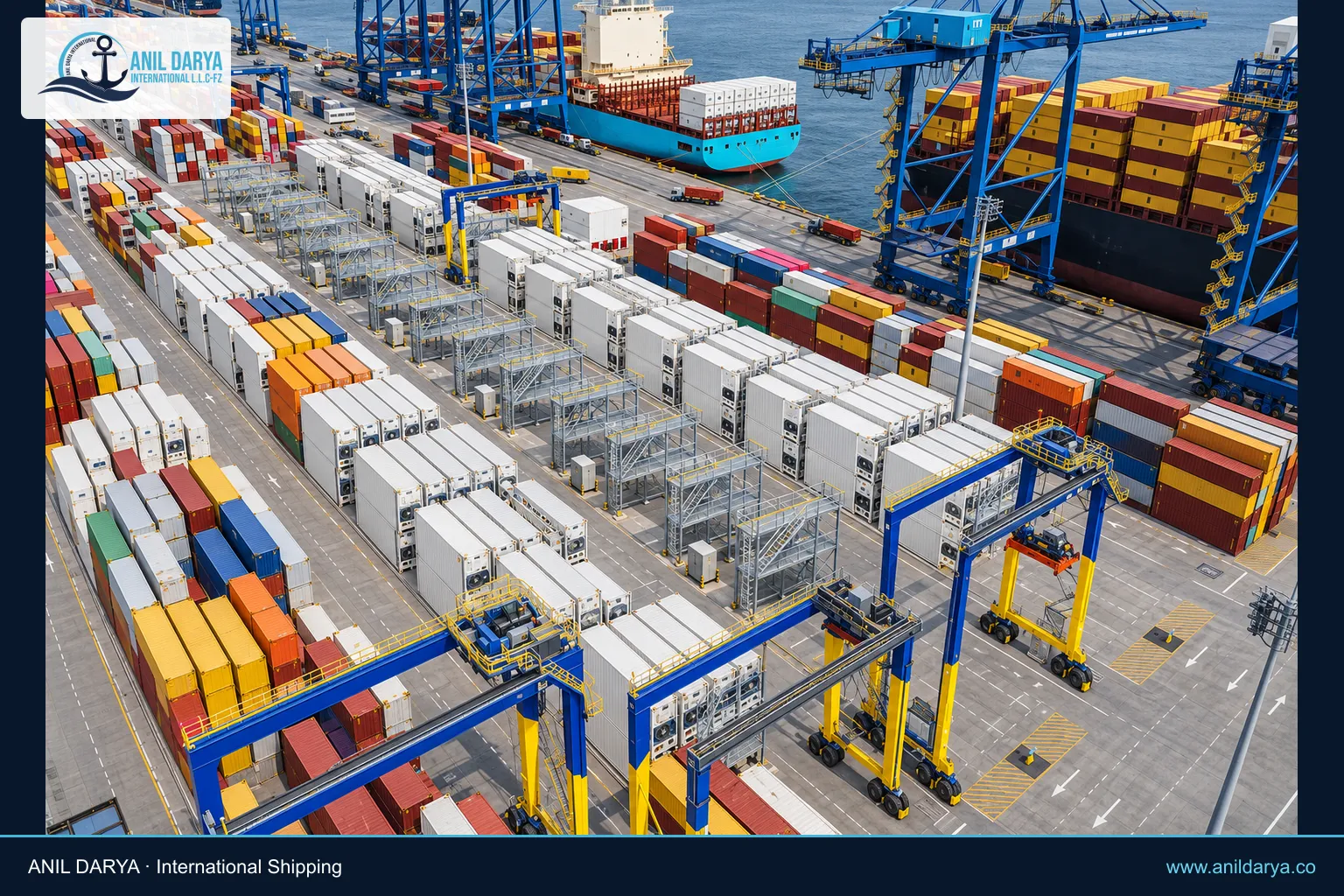
Typical cargo on this lane
The FPCCI country brief on Qatar, based on International Trade Centre data, puts Pakistan's exports to Qatar at US$105.0 million in 2025, down from US$139.7 million in 2024. UN Comtrade figures shown by Trading Economics give a similar 2025 total and this split:
| Product group (2025) | US$ million | What it means for the shipment |
|---|---|---|
| Meat and edible offal | 29.2 | Reefer or air, health certificate, MoPH checks at Hamad |
| Vegetables, roots and tubers | 13.6 | Onions and potatoes; phytosanitary certificate; duty-exempt as fresh vegetables |
| Made-up textiles and worn clothing | 12.0 | 40ft high cube; origin marks on every piece and carton |
| Oil seeds and fruits | 5.8 | Bagged in dry boxes; phytosanitary certificate |
| Salt, stone, lime and cement | 5.7 | Weight-limited 20ft boxes |
| Cereals (incl. rice) | 5.2 | Dry FCL; rice is duty-exempt |
| Plastics | 5.0 | Dry FCL; check HS code for duty |
| Fruit and nuts | 3.7 | Mangoes and kinnow in reefers in season |
Most of the trade is food, so health papers, not the sea leg, usually decide when a box is released.
The Pakistani export side: PSW, certificates and the B/L
Exports from Pakistan are declared on Pakistan Single Window. PSW's export page says the trader or customs agent must be registered on PSW, hold an active account with an authorised dealer bank and link that bank profile to the business profile. Each export Single Declaration carries a financial instrument: letter of credit, contract or collection, or advance payment. The bank settles it after the goods are cleared. PSW routes the declaration to other agencies where a certificate is needed, so the exporter files once.
- Pickup and the export declaration are the shipper's job or its origin agent's. We coordinate the booking number, cut-off and B/L draft with them.
- Meat and animal products: on PSW, submitting the export Single Declaration triggers an export certificate request to the Animal Quarantine Department, which can call for documents and inspect before it approves.
- Rice, onions, potatoes, mangoes and seeds need a phytosanitary certificate from the Department of Plant Protection.
- Under the National Agri-trade and Food Safety Authority Act (Act IV of 2026, published 12 January 2026), both departments will be abolished and their work moved to the new authority on a date the government notifies. Until then, check on PSW which body issues your certificate.
[AMIR-FACT: confirm whether NAFSA has taken over export health and phytosanitary certificates from the Animal Quarantine Department and the Department of Plant Protection by the time of publishing, and how Pakistani shippers on our bookings obtain them now]
Two carrier rules affect the bill of lading. Maersk notes that changing the destination country after export needs prior approval from Pakistan Customs, which is slow. It also notes that, under State Bank of Pakistan FE Circular No. 02, it can give telex release on exports only when the cargo moves on the line's master bill of lading with bank documents. That suits this lane, because what we release to you is the shipping line's own B/L.
Qatar import customs and Al Nadeeb
Qatar's customs work runs through Al Nadeeb, the clearance single window. Invest Qatar describes it as the platform where declarations are filed, sent on to other agencies, and duty is calculated and paid online. Clearing agents are authorised on the same system. The importer needs a valid import licence; the US trade guide (published 29 July 2024) says licences are registered with the Ministry of Commerce and Industry, including for foreign-owned companies.
Documents for clearance at Hamad
| Document | From | Watch for |
|---|---|---|
| Commercial invoice | Pakistani seller | HS code for each line, value, Incoterm, quantities |
| Certificate of origin | Authorised issuing body in Pakistan | HS codes shown, matching the invoice |
| Packing list | Pakistani seller | Cartons, weights and marks match the cargo |
| Bill of lading | Shipping line, released through us | Consignee and notify party exactly as on the import licence |
| Import licence and customs declaration | Qatari importer and its agent | Licence valid for the product |
| Health, phytosanitary and halal papers | Pakistani authorities and halal bodies | Issued before sailing, details match the invoice |
Invest Qatar asks for documents that are "attested, translated and verified". The US guide adds three practical rules, in place since 1 April 2011: the official invoice, certificate of origin and packing list are required, or the cargo is returned to origin; the HS code must be on the invoice and the certificate of origin; and "MADE IN" or "COUNTRY OF ORIGIN" must be marked on every piece and carton. Under a letter of credit, the certificate of origin may also need certifying by an Arab embassy or chamber in Pakistan. Ask the clearing agent which attestation it needs before the papers are printed.
Since January 2025 Qatar uses 12-digit HS codes, so a Pakistani 8-digit code on the invoice may need the agent to extend it.
Food rules: MoPH, halal and labels
Qatar's Ministry of Public Health (MoPH) checks food at the port. These are the rules we found, with the date of each source:
- Health certificate: MoPH's halal import guideline (second issue, January 2022) says meat imports need health certificates stating the plants are under the control of the exporting country's authorities.
- Halal: the same guideline exempts Muslim countries from issuing halal and halal slaughter certificates, though MoPH can still verify. The US guide (July 2024) asks for a halal slaughter certificate on beef and poultry. Ask the buyer what MoPH will want.
- Conformity: MoPH runs a certificate of conformity programme for food and beverage shipments, in force since 25 January 2024, according to the datasheet of an appointed inspection body (February 2024).
- Labels: Arabic, or Arabic and English; dates printed by the maker, not stickered; and at least half the shelf life left on arrival (US labelling guide).
- Banned foods: MoPH keeps a list of banned foodstuff by country. The copy we opened (updated 1 November 2020) does not name Pakistan; check the current one.
[AMIR-FACT: confirm with a Qatari clearing agent what MoPH asks for in 2026 on Pakistani frozen meat and on onions and potatoes at Hamad (halal slaughter certificate or not, conformity certificate, attestation of the health certificate)]

Duty and tax at Hamad
Qatar applies the GCC common tariff. Invest Qatar gives the general rate as 5% of the CIF value, with exceptions: 20% on steel, 30% on urea and ammonia, and 100% on alcohol and tobacco. More than 600 goods are exempt under the GCC customs union, and basic foods (fresh fruit and vegetables, rice, wheat, flour and feed grains) are among them.
| Pakistani cargo | Duty in Qatar | Note |
|---|---|---|
| Rice | Exempt | Basic food |
| Onions, potatoes, fresh fruit | Exempt | Basic food; seasonal rises apply only to listed vegetables (see below) |
| Bed linen, towels, garments | 5% of CIF | Check the 12-digit HS code |
| Steel products | 20% of CIF | Invest Qatar exception |
| Meat | Check the HS code | Chicken rose from 5% to 18% under Amiri Decree 45 of 2026 |
Two 2026 changes matter. EY's tax news (September 2026) reports that Amiri Decree 45 of 2026 raised duty on chicken from 5% to 18%, and on tomatoes, eggplants and zucchini from 0% to 15% in peak local seasons. It also reports that importers of excise goods must register with the General Tax Authority before import, from 17 September 2026. Ask the agent to confirm the current rate for your HS code.
Qatar has not brought in VAT, according to a GCC customs guide verified in April 2026, so there is no import VAT line on the duty bill. The freight from Pakistan is part of the CIF value, so give the agent the real freight figure. Duty and any fees are paid by the consignee or its broker.
Is there a Pakistan-GCC trade agreement?
Not one that is in force. Pakistan and the GCC finished negotiating a free trade agreement in 2023, but Arab News Pakistan reported on 8 October 2026 that it had still not been signed, with one GCC state's approval pending. Until it is signed and in force, Pakistani goods pay the normal Qatari rate, and a Pakistani certificate of origin brings no duty cut. Once it starts, storing or splitting the cargo in Dubai on the way could affect proof of origin, so check with your broker first.
Restricted and prohibited goods in Qatar
Invest Qatar lists goods that may not be imported, including explosives and ammunition, flammable goods, radioactive material, narcotics and goods that infringe trademarks or other intellectual property. For Pakistani cargo the usual checks are:
- Meat, fish, dairy and other food: MoPH papers, halal rules and labels.
- Fresh produce and seeds: phytosanitary certificate issued before sailing.
- Pork and alcohol: not allowed in normal trade, or at 100% duty for licensed alcohol.
- Counterfeit goods: stopped at the border.
Where Dubai fits when shipping from Pakistan to Qatar
PGX already calls Jebel Ali before Hamad. Beyond that, Dubai can help in three ways.
| Option | How it works | When it helps |
|---|---|---|
| Relay at Jebel Ali | The box changes ship at Jebel Ali on the line's through B/L to Hamad | When your line has no direct Hamad call |
| Consolidation in Dubai | Small lots from several Pakistani suppliers come to Dubai, are combined and go on to Hamad | A Qatari buyer ordering from many small sellers |
| Stock in Jafza | Goods sit in the free zone and are sent to Qatar in smaller calls | A buyer selling across several GCC markets |
Read our Jebel Ali port guide for the terminals, and our article on re-export through Jafza for how free zone stock moves out again. Under GCC rules, duty is paid at the first point of entry into the customs union. Goods cleared into the UAE can then move to Qatar without paying again, as long as the papers prove it. Goods held in a free zone are outside GCC customs territory and pay full duty when they enter Qatar. When cargo is cleared, moved or re-exported in Dubai, the Dubai customs clearance is our service, for a fee.
[AMIR-FACT: whether we route Pakistan to Qatar cargo through Jebel Ali in practice (relay, Dubai consolidation or Jafza stock), which feeder we use to Hamad, how many days it adds, and what UAE customs filing we make for these boxes]
How to arrange shipping from Pakistan to Qatar, step by step
- Buyer and seller agree the Incoterm, the load port and the payment terms.
- The Qatari buyer names its clearing agent and checks the import licence, MoPH and other permits for each HS code.
- Send us the commodity, HS code, weight, volume, ready date and load port, and tell us if it is reefer, DG or out of gauge.
- We quote the line, the routing (direct to Hamad or via a hub) and the free time at Hamad.
- We confirm with the agent that clearance is agreed and the papers are clear. Then we confirm the booking.
- The shipper collects the empty, stuffs the cargo and files the PSW Single Declaration, with health or phytosanitary certificates where needed.
- We check the draft B/L against the invoice, packing list and certificate of origin.
- Papers are attested as the Qatari agent asked.
- The line's B/L is issued and released through us, as original or telex release.
- The agent files on Al Nadeeb, the consignee pays duty, collects the box and returns the empty within free time.
Our Dubai freight forwarding team handles steps 3 to 9.
What decides the cost of shipping from Pakistan to Qatar?
We do not print rates, because they change by sailing and season. These are the parts of the bill and what moves each one.
| Cost line | What drives it |
|---|---|
| Pakistani origin charges | Trucking to Karachi or Port Qasim, terminal handling, export filing, reefer power |
| Sea freight | Box type, direct loop or relay, season, line surcharges |
| Special cargo | DG surcharge, flat rack premium, lashing and survey |
| Papers | Certificate of origin, attestation, health and phytosanitary certificates |
| Hamad charges | Terminal handling, delivery order, LCL unpacking, inspection |
| Duty | HS code and CIF value |
| Delays | Storage, reefer power, demurrage and detention after free time |
Our article on demurrage and detention explains free time.
Checklist before the box leaves Pakistan
- Incoterm and Hamad as discharge port written in the contract.
- Qatari clearing agent named and the job accepted.
- Importer's licence valid for the product.
- 12-digit Qatari HS code checked for duty and permits.
- Invoice and certificate of origin both show the HS codes.
- "MADE IN PAKISTAN" on every piece and carton.
- Health, phytosanitary or halal papers issued before sailing.
- PSW Single Declaration filed with the right financial instrument.
- For DG: SDS, UN number, DG declaration and line acceptance.
- Free time at Hamad and cargo insurance confirmed.
Mistakes that cost money on this lane
- Shipping before destination clearance is agreed. With no agent lined up, the box sits at Hamad and charges grow daily.
- No HS code on the certificate of origin. The US guide says shipments without it are not accepted.
- Missing origin marks. Cartons without "MADE IN" can be returned to origin.
- Late food papers. A reefer waiting for a health certificate burns power and storage.
- Expecting a Pakistan-GCC duty cut. No agreement is in force yet.
- Changing the destination after export. Pakistan Customs must approve it first.
Frequently asked questions
How long does sea freight from Pakistan to Qatar take?
On a direct loop it is short. ONE's January 2025 brochure lists 4 days from Karachi to Hamad on its PGX service, which calls Jebel Ali on the way. A relay through a hub takes longer. Add time for export filing, cut-off, clearance at Hamad and delivery.
Which port in Qatar receives containers from Pakistan?
Hamad Port, south of Doha, run by Mwani Qatar. It has container terminals, a CFS for LCL, a DG store and a general cargo terminal for heavy pieces.
Do Pakistani goods pay customs duty in Qatar?
Most pay 5% of the CIF value. Rice, fresh fruit and vegetables, wheat and flour are exempt. Steel pays 20%, and chicken now pays 18%. No Pakistan-GCC trade deal is in force to lower these rates.
Who files the export declaration in Pakistan?
The shipper or its customs agent files a Single Declaration on Pakistan Single Window. Both must be registered on PSW with a linked authorised dealer bank profile.
Who clears the cargo in Qatar?
The consignee's licensed clearing agent files on Al Nadeeb, and the consignee pays the duty. We do not sell clearance in Qatar, so we confirm the agent before we confirm your booking.
Do you issue your own bill of lading?
No. The bill of lading is the shipping line's own. We act as agent for many shipping lines, so the line's B/L is issued and released to you through us.
Can Pakistani cargo for Qatar go through Dubai?
Yes. Some ships call Jebel Ali before Hamad, some lines relay there, and you can consolidate lots or hold stock in Jafza. If the cargo is cleared or re-exported in Dubai, we handle that Dubai clearance for a fee.
Get a quote for shipping from Pakistan to Qatar
Send us the load port, cargo, HS code, weight, ready date and the name of the Qatari clearing agent. We will come back with the line, the routing to Hamad and a price. Use our freight rate inquiry form, or contact our team if you want to talk through a reefer, DG or heavy-lift shipment first.
[AMIR-FACT: one real Pakistan to Qatar cross-trade shipment we booked from Dubai (cargo, load port, direct or relay, equipment, days to Hamad, how the Qatari agent was lined up and the problem we solved), cleared for publication]
Sources
- ONE: Pakistan Gulf Express (PGX) launch notice (14 November 2024)
- ONE: Middle East service brochure, PGX rotation, day windows and transit (January 2025)
- Milaha: Intra Gulf Express (MIG) service profile (January 2025)
- Pakistan Single Window: Single Declaration for export
- Pakistan Single Window: Animal Quarantine Department export certificates
- Gazette of Pakistan: National Agri-trade and Food Safety Authority Act, Act IV of 2026 (12 January 2026)
- Maersk: Pakistan export information (yards, DG, change of destination, telex release)
- Ministry of Maritime Affairs: Karachi Port Trust Year Book 2023-24
- Port Qasim Authority: introduction
- DP World Karachi: Qasim International Container Terminal
- Mwani Qatar: Hamad Port
- QTerminals: Hamad Port terminals presentation (September 2020)
- Invest Qatar: Customs laws, duty rates, documents, exemptions, Al Nadeeb and prohibited goods
- US International Trade Administration: Qatar import requirements and documentation (29 July 2024)
- US International Trade Administration: Qatar labelling and marking requirements
- US International Trade Administration: Qatar moves to 12-digit HS codes
- Qatar Ministry of Public Health: Guideline for importing halal food, second issue (January 2022)
- Qatar Ministry of Public Health: List of banned imported foodstuff (updated 1 November 2020)
- SGS: Qatar MoPH food conformity programme datasheet (February 2024)
- EY Tax News: Qatar excise framework and tariff changes (September 2026)
- Goods Across Borders: GCC customs union explainer (verified April 2026)
- UAE ICP: Customs union for GCC states (duty at the first point of entry)
- FPCCI: Qatar country brief, Pakistan's trade with Qatar (ITC data, May 2026)
- Trading Economics: Pakistan exports to Qatar by product, 2025 (UN Comtrade)
- Arab News Pakistan: Pakistan-GCC trade deal awaits one state's approval (8 October 2026)
- DP World: Jebel Ali Port
- IMO: IMDG Code 2024 edition (Amendment 42-24)
Reviewed: 11 November 2026