
Shipping from Qatar to Dubai is usually a short sea leg from Hamad Port to Jebel Ali: Milaha's published schedule shows one day on that leg. The other option is a truck that leaves Qatar at Abu Samra, crosses Saudi Arabia in transit and enters the UAE at Al Ghuwaifat. Either way, the Qatari exporter files the export in Al Nadeeb, and you clear the goods in Dubai with a customs code, the right origin papers, any duty due and 5% import VAT.
Qatar to Dubai shipping at a glance
| Item | Detail |
|---|---|
| Main Qatari load port | Hamad Port, managed by Mwani Qatar; 7.5 million TEU annual capacity |
| Main UAE discharge port | Jebel Ali, over 80 weekly services |
| Published sea transit, Hamad to Jebel Ali | 1 day on Milaha's weekly MIG service (schedule updated January 2025) |
| Other published direct service | CargoGulf AGA, weekly Jebel Ali and Hamad, 36 hours between the two (March 2021) |
| Road route | Abu Samra (Qatar), Salwa (Saudi Arabia), Saudi transit, Al Batha (Saudi exit), Al Ghuwaifat (UAE entry) |
| Modes | FCL, LCL, reefer, breakbulk and project cargo, dangerous goods, road, air |
| Qatari export filing | Al Nadeeb, the customs single window of the General Authority of Customs |
| Qatar HS codes | 12 digits, required for all imports and exports |
| Certificate of origin in Qatar | Qatar Chamber, QR 50; MOCI issues Gulf National Product Certificates to factories |
| UAE duty, GCC-origin goods | Treated as UAE local goods when the origin rule is met |
| UAE duty, other goods | 5% of CIF; alcohol 50%, cigarettes 100%; not charged twice if GCC duty was paid in Qatar and you can prove it |
| UAE import VAT | 5%, deferred to the VAT return for registered importers with a linked customs number |
Sea, road or air: which mode fits cargo from Qatar to Dubai?
| Mode | Best for | Watch out for |
|---|---|---|
| Sea FCL | Full containers, heavy goods, steady volumes | Weekly sailing days, free time at Jebel Ali |
| Sea LCL | A few pallets that can wait for a consolidation | Unpacking at a Dubai container freight station adds days on a one-day sailing |
| Reefer | Chilled and frozen food, pharma | Limited reefer plugs on feeder vessels; UAE food approvals |
| Breakbulk and project | Steel, machinery, modules | Vessel availability, lifting plan, UAE road permits |
| Road | Pallets you want door to door with one booking | Three customs points and Saudi transit rules |
| Air | Urgent, light or high-value goods | Chargeable weight, DG acceptance by the airline |
A simple rule: if you can fill a container and the next sailing fits your date, ship by sea. A one-day sea leg is hard to beat. Road makes sense for palletised cargo when the buyer wants delivery to the door without a port in the chain. Price air for samples, spares and anything urgent.
Sea freight from Qatar to Dubai: Hamad Port to Jebel Ali
Almost all sea cargo on this lane loads at Hamad Port, south of Doha. Mwani Qatar manages the port under the Ministry of Transport. Operations began in December 2016, and Mwani gives an annual capacity of 7.5 million TEU across container, general cargo and multi-use terminals.
Published carrier services between Hamad and Jebel Ali
| Service | What the carrier publishes | Direction relevant to you |
|---|---|---|
| Milaha Intra Gulf Express (MIG) | Weekly, 14-day rotation, 2 vessels of 1,015 TEU nominal, 90 reefer plugs; calls Hamad Q-Terminal then Jebel Ali DP World Terminal 1 | Eastbound table: Hamad to Jebel Ali 1 day (updated January 2025) |
| CargoGulf AGA | Weekly direct sailing to and from Jebel Ali and Hamad | 36 hours between the two ports (announced March 2021) |
Carrier schedules change, so we check the current sailing for each booking. A port-to-port day on the water is only part of the trip. Add the Qatari export filing and gate-in before the cut-off, the Dubai declaration, and the truck from Jebel Ali to your site.
[AMIR-FACT: our real port-to-port and door-to-door transit time Hamad to Jebel Ali/Dubai by sea, and which carriers or feeder services we actually book on this lane]
Which UAE port should Qatari cargo arrive at?
Jebel Ali is the default for Dubai and the Jebel Ali Free Zone. DP World says it handles over 80 weekly services, with breakbulk, Ro-Ro, project cargo and IMDG dangerous goods. Our Jebel Ali port guide covers terminals and port rules. If the goods are for Abu Dhabi, ask about Khalifa Port in Abu Dhabi, which saves the truck leg along the coast.
FCL or LCL from Qatar?
FCL is sealed at Hamad and released as one unit at Jebel Ali. LCL waits until the consolidator's box is unpacked and every consignee has cleared. On a one-day sailing, that handling can take longer than the voyage. If you are close to half a container, price both. Our guide to FCL vs LCL costs explains the break-even, and our sea freight service page shows how we handle containers.
Reefer cargo from Qatar
Chilled and frozen goods need reefer plugs on the vessel. Milaha lists 90 reefer plugs per MIG vessel, so book reefer space early, before the dry cargo cut-off. At the Dubai end, food needs approval from the emirate's food safety authority before release. A reefer box waiting for a permit at Jebel Ali runs up plug-in and storage charges every day.
Breakbulk, project cargo and dangerous goods from Qatar
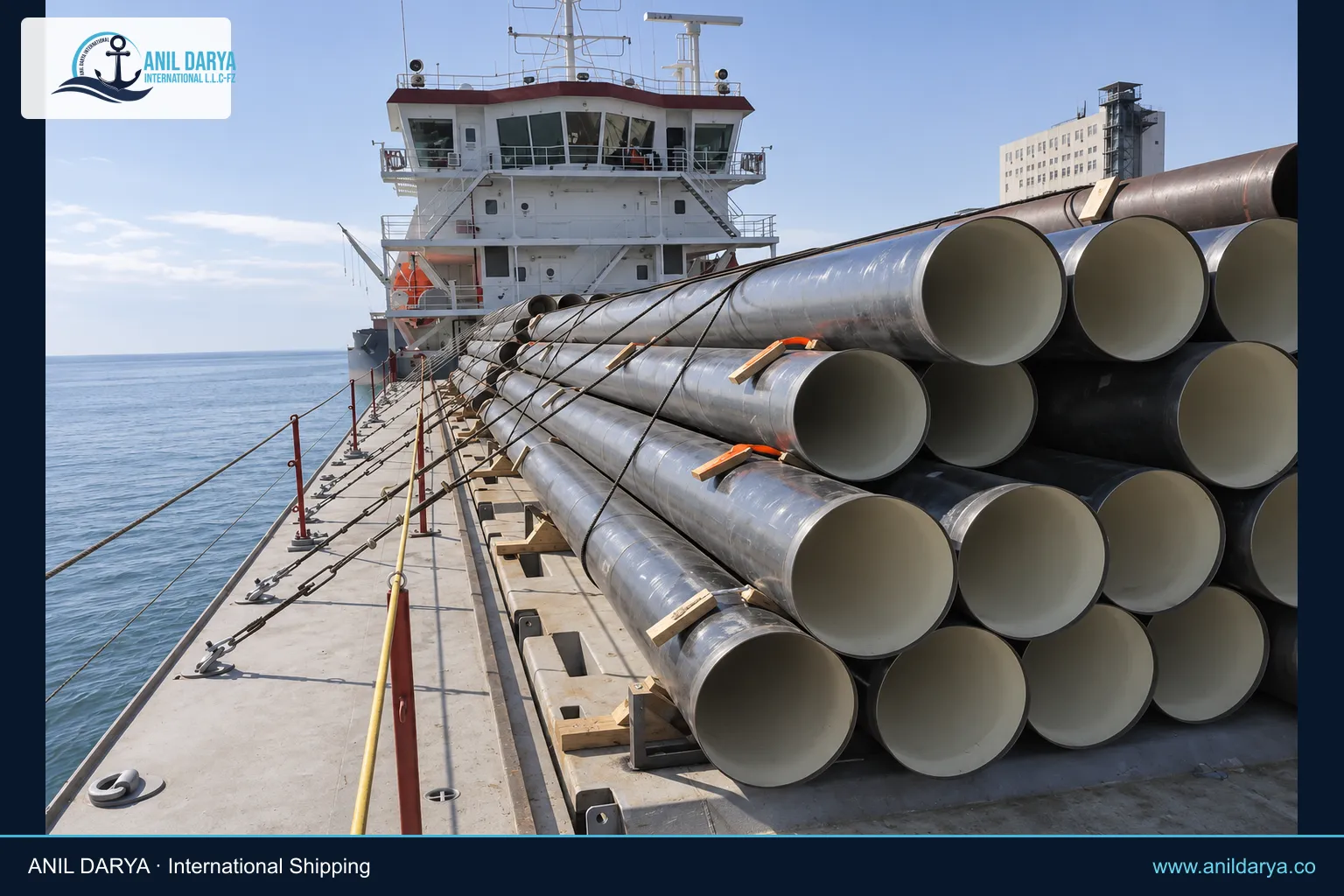
Steel, pipes, machinery and plant modules move on this lane, often after projects finish in Qatar and equipment returns to the UAE. Hamad Port has a general cargo terminal and a multi-use terminal for this kind of cargo. Pieces that fit a 40ft flat rack or open top can go on a container service, which sails more often. Bigger pieces need conventional breakbulk tonnage. At the Dubai end we plan discharge, trailers and any road permit before the vessel berths. See our break bulk and project cargo service.
Dangerous goods follow the IMDG Code by sea. You need the UN number, proper shipping name, class and packing group, a Safety Data Sheet, a signed DG declaration and UN-approved packaging with labels. The feeder carrier must accept the booking first, because small vessels have their own DG limits. Jebel Ali handles IMDG cargo, but some classes may only stay in the port for a limited time, so the Dubai declaration and truck must be ready at berthing. Our guide to dangerous goods customs clearance in the UAE explains the Dubai side.
Road freight through Saudi Arabia
Qatar and the UAE have no shared land border. A truck from Qatar leaves at Abu Samra, enters Saudi Arabia at Salwa, crosses the Eastern Province in transit, leaves Saudi Arabia at Al Batha and enters the UAE at Al Ghuwaifat in Abu Dhabi. Saudipedia describes Al Batha as the only land port connecting Saudi Arabia with the UAE, linked north to Salwa by Route 95.
| Point | Country | What happens |
|---|---|---|
| Pickup in Qatar | Qatar | Loading; export declaration in Al Nadeeb by the exporter or its agent |
| Abu Samra | Qatar | Exit from Qatar |
| Salwa | Saudi Arabia | Entry into Saudi Arabia for transit; Saudi clearance through the Fasah platform |
| Al Batha | Saudi Arabia | Exit from Saudi Arabia |
| Al Ghuwaifat | UAE | Entry into the UAE; Abu Dhabi Customs clearance with a truck transit permit |
| Delivery in Dubai | UAE | Delivery, or Dubai clearance if the goods moved under transit |
The UAE side: pre-arrival clearance at Al Ghuwaifat
Abu Dhabi Customs requires the customs declaration to be prepared in advance for trucks at Al Ghuwaifat, with goods data and attachments entered before arrival. For trucks entering the UAE, a loaded truck transit permit is issued automatically with the completed declaration, before the truck leaves the opposite crossing. In practice, your UAE clearing agent must have a clean document set while the truck is still in Saudi Arabia.
The Saudi transit leg has its own rules and paperwork, and the trucking company handles it. Qatar Chamber's services include TIR carnets, which some carriers use for sealed transit. Ask which arrangement your trucker uses and who files the Saudi transit, because it changes the document list.
[AMIR-FACT: our real door-to-door road transit time Doha to Dubai via Abu Samra, Salwa, Al Batha and Al Ghuwaifat, and whether we use our own trucking partner or the seller's truck]
Air cargo from Qatar to Dubai
Air cargo flies from Hamad International Airport in Doha to UAE airports. It suits samples, spare parts, medical goods and urgent stock. Airlines charge on the greater of actual and volumetric weight. The Dubai declaration, duty and VAT are the same as for sea cargo. Our air cargo service covers general and DG air freight as an IATA-approved agent.
The Qatari export side: Al Nadeeb, HS codes and origin
The General Authority of Customs (GAC) is Qatar's authority for import and export regulations. Its Al Nadeeb single window handles import and export procedures electronically, including declarations, approvals from other agencies, clearing agent authorisation and payment. Your Qatari supplier or its clearing agent files the export. We send them the consignee details, the Dubai delivery plan and the booking, so names, weights and marks match on both sides.
Since January 2025, Qatar requires 12-digit HS codes for all imports and exports. The UAE declaration uses the UAE tariff code. Make sure both codes describe the same goods, because a mismatch between the export and import descriptions is a common reason for questions at Jebel Ali.
Certificate of origin from Qatar
Qatar Chamber issues certificates of origin for exports and re-exports. It asks for a commercial invoice that shows:
- Invoice number and date.
- Consignee and address.
- Method of transport: land, air or sea.
- Specifications of the goods.
- Total and net weight, number and type of packages.
- Country of origin and value.
- Company seal and signature of the authorised signatory.
For industrial products made in Qatar, the Chamber asks for a letter from the industry department stating the products and the local added value achieved. For re-exported transit cargo it asks for a copy of the customs statement. The certificate fee is QR 50, and authenticating the invoice costs another QR 50. Separately, Qatar's Ministry of Commerce and Industry issues Gulf National Product Certificates to factories through its Industry Services Portal. If your goods are Qatari-made, ask the supplier which document it holds, because it decides your UAE duty.
Temporary exports from Qatar
Qatar has applied the ATA Carnet system since 2018, with Qatar Chamber and the ICC, for temporary duty-free import and export of certain goods for up to one year. Exhibition goods and professional equipment travelling to Dubai and back can use it. Dubai Customs takes no deposit for goods covered by an ATA carnet.
Import from Qatar to Dubai: UAE customs clearance
Dubai Customs clears goods under five regimes: import, export, transit, transfer and temporary admission. Any company with a customs business code can file a declaration. A clearing agent with a Dubai Economic Department clearing and forwarding licence can also file, using its own code and your authorisation. The code is registered online through Dubai Trade. Dubai Customs lists an import declaration fee of AED 15 to AED 100, depending on type and channel.
Documents for clearing Qatari cargo in Dubai
| Document | Who provides it | Why Dubai needs it |
|---|---|---|
| Commercial invoice | Qatari seller | Customs value and HS codes |
| Packing list | Qatari seller | Inspection and LCL release |
| Certificate of origin | Qatar Chamber, or MOCI for Gulf national products | GCC origin treatment, or the origin of foreign goods |
| Bill of lading, air waybill or truck consignment note | Carrier or trucker | Transport document; consignee must match |
| Delivery order | Shipping line in Dubai | Sea cargo only |
| Proof of GCC duty paid in Qatar | Qatari importer of record | Foreign goods first imported into Qatar |
| UAE permit | UAE importer | Restricted goods only |
| SDS and DG declaration | Qatari shipper | Dangerous goods only |

UAE duty and VAT on Qatari goods
Qatar and the UAE are both in the GCC customs union, in force since 1 January 2003. Goods produced in a member state are treated as national goods in all member states, and duty on foreign goods is collected once, at the first point of entry. The UAE government portal, quoting Sharjah Customs, says GCC-origin goods are treated as UAE local goods provided 40% of the raw materials used originate in the GCC.
| Your goods | Likely UAE duty | What proves it |
|---|---|---|
| Made in Qatar and meeting the GCC origin rule | Treated as local goods, no duty | Certificate of origin or Gulf national product certificate, and invoice |
| Foreign goods imported into Qatar, duty paid there | Not re-assessed for duty | Copy of the Qatari import declaration showing duty paid |
| Foreign goods without proof of Qatari duty | 5% of CIF in the UAE | Normal import declaration |
| Goods leaving a Qatari free zone | Duty due, as free zone goods pay duty on exit | Free zone exit papers |
| Alcohol and cigarettes | 50% and 100% in Dubai | Licensed importer only |
Watch the rate differences. Qatar charges more than 5% on some goods, such as steel. If foreign steel paid Qatar's higher rate on entry, that does not change what the UAE charges; what matters in Dubai is proof that GCC duty was paid at first entry. Keep the Qatari import declaration with the shipment.
Import VAT on goods from Qatar
The UAE charges 5% import VAT on the customs value plus insurance, freight, customs fees and any excise tax. The FTA's guide states that no GCC state is an "Implementing State" for UAE VAT, so cargo from Qatar is treated as an import like any other.
- VAT-registered importer whose customs registration number is linked with the FTA: no VAT at the border; it is prepopulated in the next VAT return.
- Importer not registered for VAT: VAT is paid before release.
Jafza, re-export and transit through Dubai
Many Qatari goods pass through Dubai on their way to other markets. Jafza, next to Jebel Ali Port and operating since 1985, hosts over 11,000 businesses. Goods delivered into Jafza under a transfer declaration pay duty only if they later enter the UAE mainland. Goods that only pass through can move under a transit declaration. The FTA treats goods in transit, in a customs warehouse, or brought in to be re-exported by the same person as not imported for VAT, against a financial guarantee. Our guide to Jafza re-export explains the free zone route.
Restricted and prohibited goods in the UAE
Restricted goods need prior approval from the competent UAE authority. From the UAE list published by Abu Dhabi Customs:
| Goods | UAE approving authority |
|---|---|
| Food products | The food safety authority of the emirate |
| Live animals and animal products | Ministry of Climate Change and Environment |
| Medicines and medical devices | Ministry of Health and Prevention |
| Communication and GPS devices | Telecommunications and Digital Government Regulatory Authority |
| Paints, lubricants, tyres, cosmetics, household electrical goods, air conditioners | Ministry of Industry and Advanced Technology |
| Radioactive materials, large transformers, heat exchangers | Federal Authority for Nuclear Regulation |
Prohibited goods include narcotics, counterfeit currency, gambling machines, asbestos sheets and pipes, hazardous waste and used tyres. Apply for any UAE permit before the cargo leaves Qatar.
How to ship from Qatar to Dubai, step by step
- Send us the cargo details. Commodity, HS code, weight, dimensions, pickup point in Qatar, delivery address in the UAE and the Incoterm.
- Choose the mode. We compare the next sailing from Hamad with a truck through Saudi Arabia, and air for urgent goods.
- Get your UAE side ready. Customs business code, VAT number linked to it, and any UAE permit.
- Agree origin papers. Qatar Chamber certificate or Gulf national product certificate for Qatari goods, or the Qatari import declaration for foreign goods.
- Book space. We book with the carrier and get DG, reefer or out-of-gauge acceptance first. Pickup and the Qatari export filing are done by the seller or its agent.
- Qatari export clearance. The seller's agent files in Al Nadeeb with 12-digit HS codes.
- Check documents before departure. Invoice, packing list, certificate and transport document must match.
- File the UAE declaration before the vessel berths or the truck reaches Al Ghuwaifat. We arrange payment of the duty and VAT if they are due.
- Deliver to your site or Jafza warehouse, and return the empty container within free time.
[AMIR-FACT: one real Qatar to Dubai shipment we handled (cargo, mode, route, transit time and how clearance went), cleared for publication]
What decides the cost of shipping from Qatar to Dubai?
| Cost factor | Effect |
|---|---|
| Mode and container size | FCL, LCL, truck and air each price differently |
| Cargo type | Reefer, DG and out-of-gauge cost more and have fewer slots |
| Origin and destination port charges | Terminal handling, documentation and delivery order fees at Hamad and Jebel Ali |
| Road transit | Three borders and Saudi transit paperwork for trucks |
| Customs fees | Qatari export filing, Chamber certificate, Dubai declaration fee, agent fees |
| Duty and VAT | Zero duty for qualifying GCC goods; 5% otherwise; 5% import VAT unless deferred |
| Free time | Demurrage and detention after the line's free days |
Rates change with the carrier and the week, so we quote each shipment. Under DAP the Qatari seller delivers and you clear and pay in Dubai. Under DDP the seller pays, but someone with a UAE customs code must still act as importer, so agree whose code is used.
Checklist before cargo leaves Qatar
- Your customs business code is active and your VAT number is linked to it.
- HS code agreed with the seller, both the Qatari 12-digit code and the UAE code.
- Certificate of origin or Gulf national product certificate for Qatari goods.
- Qatari import declaration for foreign goods that already paid GCC duty.
- UAE permit for restricted goods.
- Invoice, packing list and transport document show the same consignee, weights and counts.
- Reefer or DG acceptance from the carrier.
- For road: trucker confirms the Saudi transit arrangement and the Al Ghuwaifat pre-arrival filing.
- Declaration type chosen: local import, free zone transfer, temporary admission or transit.
- Cargo insurance arranged.
Common mistakes on this lane
- Assuming all goods from Qatar are duty-free. Only GCC-origin goods that meet the rule, or foreign goods with proof of GCC duty paid, avoid UAE duty.
- No copy of the Qatari import declaration for re-shipped foreign goods.
- Choosing LCL for nearly a full container on a one-day sailing.
- Booking a truck without a UAE declaration ready. At Al Ghuwaifat the declaration is prepared before arrival.
- Descriptions that differ between the Qatari export and the Dubai import.
- Food shipped without UAE approval, leaving a reefer box on power at the port.
- VAT number not linked to the customs code, so import VAT is paid in cash.
Frequently asked questions
How long does shipping from Qatar to Dubai take by sea?
Milaha's MIG schedule shows 1 day from Hamad to Jebel Ali, and CargoGulf announced a 36-hour direct service in 2021. Add the export filing, gate-in cut-off, Dubai clearance and delivery to get a door-to-door time.
Can I send cargo from Qatar to Dubai by road?
Yes, through Saudi Arabia. Trucks leave Qatar at Abu Samra, cross Saudi Arabia from Salwa to Al Batha in transit and enter the UAE at Al Ghuwaifat, where the declaration must be prepared before arrival.
Is there customs duty on goods imported from Qatar to Dubai?
Goods of GCC origin are treated as UAE local goods when they meet the origin rule. Foreign goods that already paid GCC duty in Qatar are not charged again if you can prove it. Other goods pay 5% of the CIF value.
Do I pay VAT on imports from Qatar?
Yes, 5% UAE import VAT applies, as no GCC state is treated as an Implementing State for UAE VAT. A registered importer with a linked customs number accounts for it in the VAT return.
Who issues a certificate of origin in Qatar?
Qatar Chamber issues certificates of origin for exports and re-exports for QR 50. Qatar's Ministry of Commerce and Industry issues Gulf National Product Certificates to factories through its Industry Services Portal.
What documents do I need to import from Qatar to Dubai?
A commercial invoice, packing list, certificate of origin, bill of lading or truck consignment note, and a Dubai Customs declaration. Sea cargo also needs the line's delivery order, and restricted goods need a UAE permit.
Is there a direct road from Qatar to the UAE?
No. The two countries do not share a land border, so every truck crosses Saudi Arabia in transit between Salwa and Al Batha.
Can cargo from Qatar go into Jafza without paying duty?
Yes. Goods delivered into Jafza under a free zone transfer pay UAE duty only if they later enter the mainland.
Get a quote for shipping from Qatar to Dubai
Send us the cargo, the pickup point in Qatar and your delivery address in the UAE. We will come back with the mode, the routing and a price that includes clearance in Dubai. Use our freight rate inquiry form or contact our team.
Sources
- Milaha: Intra Gulf Express (MIG) service profile and transit tables, updated January 2025
- CargoGulf: Direct sailing between the UAE and Qatar (March 2021)
- Mwani Qatar: Hamad Port
- Invest Qatar: Customs (GAC, Al Nadeeb, ATA Carnet)
- US International Trade Administration: Qatar transitions to 12-digit HS codes
- Qatar Chamber: Certificate of origin (requirements and fees)
- Qatar News Agency: MOCI guide on Gulf National Product Certificates (January 2026)
- Saudipedia: Al-Batha Port
- Abu Dhabi Customs: Pre-arrival clearance and truck permits at Al Ghuwaifat
- ZATCA: Import instructions (Fasah platform)
- DP World: Jebel Ali Port
- UAE Federal Authority for Identity, Citizenship, Customs and Port Security: Customs union for GCC states
- UAE Government portal: Customs duty and tariff
- Dubai Customs: Submit customs declaration
- Dubai Customs: Frequently asked questions
- Federal Tax Authority: VAT guide (import VAT)
- Abu Dhabi Customs: Restricted and prohibited goods in the UAE
- Jafza: About Jebel Ali Free Zone
Reviewed: 10 November 2026