
Shipping from Saudi Arabia to Dubai mostly runs by road: trucks leave the Kingdom at Al Batha, the only land port between Saudi Arabia and the UAE, and enter at Al Ghuwaifat in Abu Dhabi. Sea freight from Dammam or Jubail suits heavy and containerised cargo from the Eastern Province, and Jeddah covers the west coast. Your Saudi supplier files the export through ZATCA, and you clear the goods in Dubai with a customs code, GCC origin papers where they apply, and 5% import VAT.
Saudi Arabia to Dubai shipping at a glance
| Item | Detail |
|---|---|
| Land border | Al Batha (Saudi side) to Al Ghuwaifat (UAE side, Abu Dhabi) |
| UAE entry rule at Al Ghuwaifat | Customs declaration prepared before arrival; truck transit permit issued with it |
| Eastern Province ports | King Abdulaziz Port Dammam (43 berths); Jubail container port (1.5 million TEU) |
| Red Sea port | Jeddah Islamic Port; RSGT terminal 6.2 million TEU capacity |
| Published sea transit example | Dammam to Jebel Ali 7 days on Milaha's MIG, via Kuwait, Iraq and Qatar calls (January 2025) |
| Saudi customs platform | Fasah (ZATCA) |
| Saudi certificate of origin | Ministry of Industry and Mineral Resources e-service |
| Saudi VAT on the sale | Transport to another GCC state treated as a zero-rated export during the transitional period |
| UAE duty, GCC-origin goods | Treated as UAE local goods when the origin rule is met |
| UAE duty, other goods | 5% of CIF; alcohol 50%, cigarettes 100%; no second charge with proof of GCC duty paid in Saudi Arabia |
| UAE import VAT | 5%, deferrable for registered importers with a linked customs number |
Road, sea or air from Saudi Arabia: which mode fits?
Saudi Arabia is large, so the pickup city often picks the mode for you.
| Saudi origin | Usual mode to Dubai | Why |
|---|---|---|
| Dammam, Khobar, Jubail, Al Ahsa | Truck via Al Batha, or sea from Dammam or Jubail | Closest region to the UAE border; two container ports |
| Riyadh and central region | Truck via Al Batha | A direct road run; the rail link from Riyadh dry port to Dammam is an option for containers |
| Jeddah, Makkah, the west coast | Sea from Jeddah, or a long truck run | Jeddah has the Kingdom's largest container terminal |
| Any city, urgent goods | Air | Samples, spares, medical goods |
The decision rule we use: for palletised or general cargo from the Eastern Province or Riyadh, price a truck first. For heavy loads, petrochemicals in containers, or cargo from the west coast, price sea first.
Mode comparison for cargo from Saudi Arabia to Dubai
| Mode | Best for | What to plan |
|---|---|---|
| Road, full truck (FTL) | Building materials, food, steel, retail stock | Truck type, ZATCA export filing, UAE declaration before Al Ghuwaifat |
| Road, shared truck (LTL) | A few pallets | Consolidation day, one packing list per consignee |
| Sea FCL | Full containers, polymers, heavy goods | Carrier rotation, free time at Jebel Ali |
| Sea LCL | Small, non-urgent sea loads | Unpacking at a Dubai container freight station |
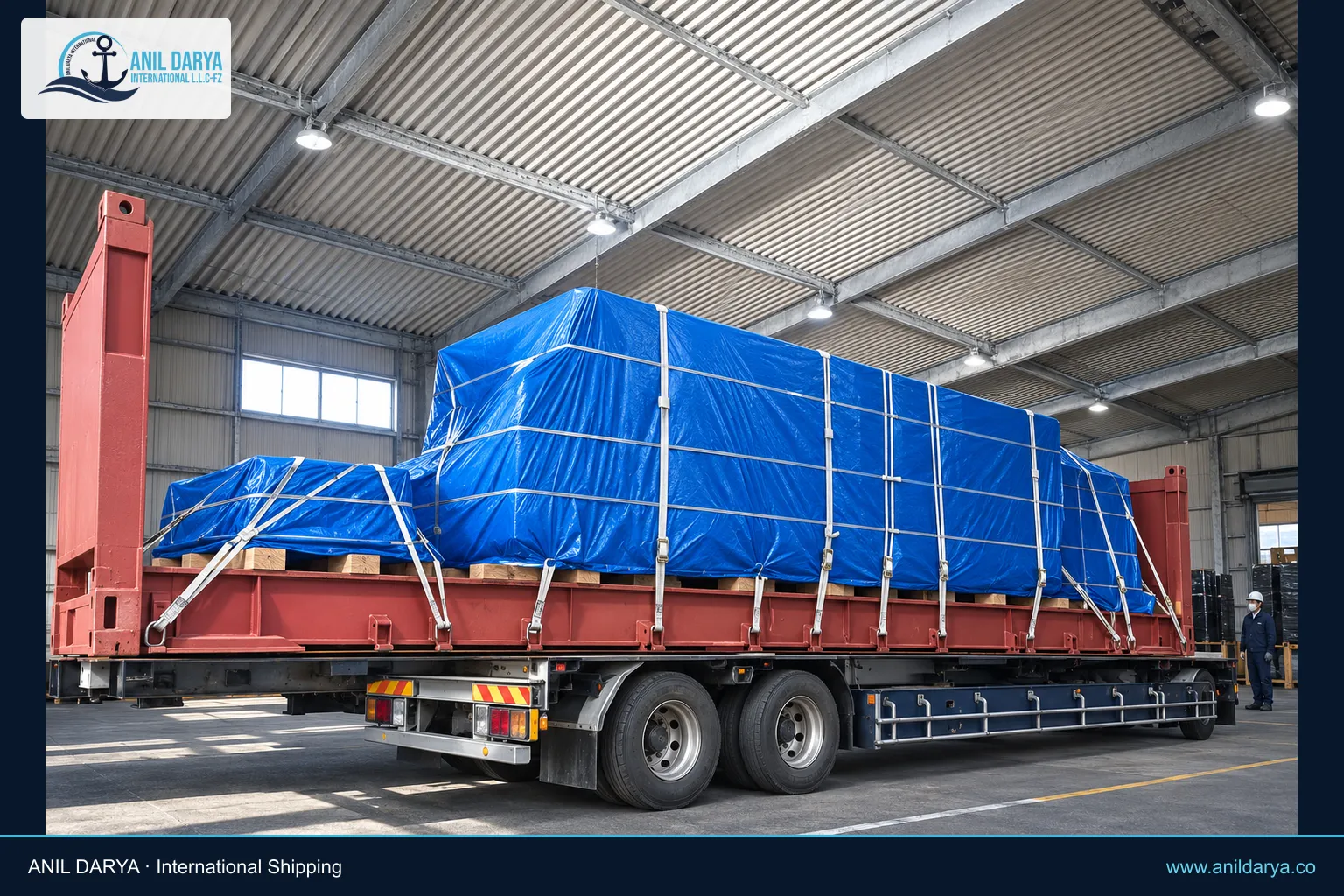
| Breakbulk and project | Plant, modules, oversized steel | Lowbed with permits, or vessel and lifting plan |
| Air | Urgent or high-value goods | Chargeable weight, airline DG acceptance |
Road freight via Al Batha and Al Ghuwaifat
Saudipedia describes Al Batha as a land port in Al Udayd Governorate, in the Eastern Province, and the only land port that connects Saudi Arabia with the UAE. It is one of the Kingdom's fourteen land ports. On the UAE side, the truck enters at Al Ghuwaifat, in the far west of Abu Dhabi, and then drives on to Dubai.
Since 18 September 2023, Abu Dhabi Customs has required customs declarations at Al Ghuwaifat to be prepared before the truck arrives, with goods data and attachments entered in advance. For a truck entering the UAE, a loaded truck transit permit is issued automatically once the declaration is complete, before the truck leaves the Saudi side. This means your UAE clearing agent needs the invoice, packing list and origin certificate while the truck is still loading in Saudi Arabia.
| Stage | Who acts | What is needed |
|---|---|---|
| Loading in Saudi Arabia | Saudi seller and trucker | Invoice, packing list, certificate of origin |
| Saudi export declaration | Saudi exporter or its customs broker | Bill of lading or consignment note, invoice, manifest, filed with ZATCA |
| Al Batha exit | Trucker | Export clearance complete in Fasah |
| Al Ghuwaifat entry | UAE importer or clearing agent | Declaration prepared in advance; truck transit permit |
| Delivery in Dubai | Trucker | Delivery to your site, or Dubai clearance if the goods moved under transit |
[AMIR-FACT: our real door-to-door road transit time Riyadh to Dubai and Dammam to Dubai via Al Batha and Al Ghuwaifat, including border time, and whether we use Saudi or UAE trucks on this lane]
Sea freight from Saudi Arabia to Dubai: Dammam, Jubail and Jeddah
| Saudi port | What the operator or official source says | Best for |
|---|---|---|
| King Abdulaziz Port, Dammam | 43 berths, a container terminal and two general cargo terminals, 105 million tonnes capacity; railway to the Riyadh dry port | Eastern Province and Riyadh shippers, containers and general cargo |
| Jubail Commercial Port (Gulftainer) | Container terminal of 1.5 million TEU a year, next to Jubail's petrochemical industry; gateway for the Eastern Province and Riyadh | Polymers and petrochemical products in containers |
| Jeddah Islamic Port (RSGT) | 6.2 million TEU annual capacity; about 39% of Saudi container throughput in 2024 | Western region shippers |
Gulf feeder rotations are not always direct. Milaha's MIG service, for example, publishes 7 days from Dammam to Jebel Ali because its eastbound loop calls Kuwait, Iraq and Qatar first. A direct service, where one runs, is much shorter. Read the rotation, not just the sailing day. From Jeddah, cargo for Dubai sails around the Arabian Peninsula, so it takes far longer than a Gulf feeder; for small loads a truck across the Kingdom may be worth pricing.
[AMIR-FACT: the carriers and services we actually book from Dammam, Jubail and Jeddah to Jebel Ali, with real port-to-port transit times]
Which UAE port should Saudi cargo arrive at?
Jebel Ali is the default for Dubai and the Jebel Ali Free Zone. DP World says it handles over 80 weekly services, with breakbulk, Ro-Ro, project cargo and IMDG dangerous goods. See our Jebel Ali port guide. If your site is in Abu Dhabi, Khalifa Port in Abu Dhabi may be closer.
FCL or LCL from Saudi ports?
Petrochemical exporters usually ship full containers, sealed at origin and released as one unit at Jebel Ali. For a few pallets, compare LCL with a shared truck: on this lane the truck often wins on time because there is no unpacking at a freight station. Our article on FCL vs LCL costs explains the break-even, and our sea freight service page shows how we handle containers into Dubai.
Project cargo and dangerous goods from Saudi Arabia
Plant equipment, steel structures and machinery move from Saudi projects to the UAE and back. A piece that fits a lowbed and both countries' road rules can travel by road. Larger pieces go by sea from Dammam's general cargo terminals. At the Dubai end we plan discharge, trailers and road permits before arrival. See our break bulk and project cargo service.
Chemical cargo from the Jubail and Dammam industrial areas may or may not be dangerous goods; the Safety Data Sheet decides. For DG by sea you need the UN number, class, packing group, a signed DG declaration and UN packaging, plus the carrier's acceptance. Jebel Ali handles IMDG cargo but limits how long some classes may stay in the port, so the Dubai declaration and truck must be ready at berthing. Our dangerous goods team checks the class and the carrier rules before booking.
The Saudi export side: ZATCA, Fasah and certificates
ZATCA's export instructions ask the exporter for a bill of lading, an invoice and a manifest to complete the export declaration. Saudi customs work runs through the Fasah platform, directly or through a customs broker. Your Saudi supplier or its broker files the export. We send them the consignee details and the Dubai plan so the documents match.
Some goods cannot leave Saudi Arabia freely. ZATCA says regulations ban the export of several goods or limit their export procedures, giving petroleum derivatives, merit goods and natural resources as examples. Ask the supplier to check its HS code against ZATCA's list of goods prohibited or restricted for export before you sign the contract.
Certificate of origin from Saudi Arabia
The Ministry of Industry and Mineral Resources runs a certificate of origin e-service for local exporters and manufacturers. Exporters apply and follow the certificate online, without visiting the ministry. For Saudi-made goods this certificate is what lets the UAE treat them as GCC national products, so ask for it at the same time as the invoice.
Does the Saudi seller charge VAT?
ZATCA's VAT guideline says that, as a transitional measure, a supply that involves transporting goods out of the Kingdom to another GCC state is treated as a zero-rated export. The supplier must keep evidence of the export, such as transport documents, and obtain it within 90 days of the supply. If the seller cannot prove the goods left, it may have to charge 15% Saudi VAT. Make sure your seller gets the export documents it needs from the trucker or carrier.
UAE customs clearance for Saudi goods
Dubai Customs clears goods under five regimes: import, export, transit, transfer and temporary admission. To import, you need a customs business code, registered online through Dubai Trade. A clearing agent with a Dubai Economic Department clearing and forwarding licence can file for you under its own code with your authorisation. Dubai Customs lists an import declaration fee of AED 15 to AED 100. Trucks that enter at Al Ghuwaifat are cleared by Abu Dhabi Customs, so agree with your agent whether the goods clear at the border or move under transit to Dubai.
Documents for Saudi cargo arriving in Dubai
| Document | Who provides it | Why the UAE needs it |
|---|---|---|
| Commercial invoice | Saudi seller | Customs value and HS codes |
| Packing list | Saudi seller | Inspection and partial-load release |
| Certificate of origin | Ministry of Industry and Mineral Resources e-service | GCC origin treatment |
| Saudi export declaration | Saudi exporter or broker | Shows the goods left the Kingdom; supports the seller's zero-rating |
| Truck consignment note or bill of lading | Trucker or carrier | Transport document |
| Proof of GCC duty paid in Saudi Arabia | Saudi importer of record | Foreign goods first imported into Saudi Arabia |
| UAE permit | UAE importer | Restricted goods |
| SDS and DG declaration | Saudi shipper | Dangerous goods |

Duty and VAT on imports from Saudi Arabia
Both countries belong to the GCC customs union, in force since 1 January 2003. Goods produced in a member state are treated as national goods across the union, and duty on foreign goods is collected at the first point of entry. The UAE government portal, quoting Sharjah Customs, says GCC-origin goods are treated as UAE local goods provided 40% of the raw materials used originate in the GCC.
| What you import from Saudi Arabia | Likely UAE duty | Evidence |
|---|---|---|
| Saudi-made goods meeting the GCC origin rule | None; treated as local goods | Saudi certificate of origin and invoice |
| Foreign goods that paid GCC duty on entry to Saudi Arabia | Not re-assessed | Copy of the Saudi import declaration |
| Foreign goods without that proof | 5% of CIF | Normal UAE import declaration |
| Goods from a Saudi free or special zone | Duty due, as free zone goods pay duty on exit | Zone exit documents |
| Alcohol and cigarettes | 50% and 100% in Dubai | Licensed importer |
Saudi Arabia's own GCC origin decision, as summarised by EY, says packing, assembly or mixing alone does not give GCC origin. If your supplier only repacks foreign goods, do not expect local-goods treatment in the UAE either.
Import VAT on Saudi goods
The UAE charges 5% import VAT on the customs value plus insurance, freight, customs fees and any excise. The FTA states that no GCC state is an "Implementing State" for UAE VAT, so goods from Saudi Arabia are taxed as imports. A VAT-registered importer whose customs registration number is linked with the FTA reports the VAT in its next return instead of paying at the border. An unregistered importer pays before release.
Jafza and re-export of Saudi goods
Dubai traders often buy Saudi products and sell them on to other markets. Jafza, next to Jebel Ali Port, has operated since 1985 and hosts over 11,000 businesses. Goods transferred into Jafza pay UAE duty only if they later enter the mainland. Goods in transit, in a customs warehouse, or brought in for re-export by the same person are not treated as imported for UAE VAT, against a guarantee. Read our guide to Jafza re-export for bulk and breakbulk cargo.
Goods the UAE restricts or bans
Restricted goods need prior approval from the competent UAE authority before release. From the UAE list published by Abu Dhabi Customs, the groups most often seen on Saudi cargo:
| Saudi export | UAE approval from |
|---|---|
| Dates, dairy, poultry and other food | The food safety authority of the emirate |
| Live animals and animal products | Ministry of Climate Change and Environment |
| Fertilisers and pesticides | Ministry of Climate Change and Environment |
| Lubricants, fuel oils, paints, tyres | Ministry of Industry and Advanced Technology |
| Cosmetics and household electrical goods | Ministry of Industry and Advanced Technology |
| Medicines and medical devices | Ministry of Health and Prevention |
The UAE bans, among others, narcotics, counterfeit currency, gambling machines, asbestos sheets and pipes, hazardous waste, and used or refurbished tyres. Get any UAE approval before the truck leaves the Kingdom, so it does not wait at Al Ghuwaifat.
How to ship from Saudi Arabia to Dubai, step by step
- Share the cargo details: commodity, HS code, weight, dimensions, Saudi pickup city, UAE delivery address and the Incoterm.
- We compare a truck via Al Batha with a sailing from Dammam, Jubail or Jeddah.
- Prepare your UAE side: customs business code, VAT number linked to it, any UAE permit.
- Ask the seller for the Saudi certificate of origin, or the Saudi import declaration for foreign goods.
- Book the truck or the vessel. We book space with the carrier or trucking company; the pickup and the Saudi export filing are done by the seller or its broker.
- The seller's broker files the export through ZATCA and Fasah.
- We check that the invoice, packing list, certificate and transport document match.
- We file the UAE declaration before the truck reaches Al Ghuwaifat or the vessel berths, and arrange payment of the duty and VAT if due.
- Delivery to your site or Jafza warehouse, and return of empty containers within free time.
[AMIR-FACT: one real Saudi Arabia to Dubai shipment we handled (cargo, origin city, mode, border or port, and how clearance went), cleared for publication]
What decides the cost of shipping from Saudi Arabia to Dubai?
| Cost factor | Effect |
|---|---|
| Pickup city | Jeddah and the west are far from the UAE by road; the Eastern Province is close |
| Mode | Truck, FCL, LCL and air price differently |
| Truck type | Reefers, lowbeds and flatbeds cost more than dry trucks |
| Carrier rotation | An indirect feeder loop adds days and can change the price |
| Border waiting | A truck held for a missing document pays daily charges |
| Customs and agent fees | Saudi export filing, UAE declaration fee, agents on both sides |
| Duty and VAT | Zero duty for qualifying Saudi goods; 5% otherwise; 5% import VAT unless deferred |
We quote each load because fuel, truck supply and carrier capacity move every week. Under DAP the Saudi seller delivers and you clear in the UAE. Under DDP the seller pays duty and VAT, but a party with a UAE customs code must still act as importer.
Checklist before cargo leaves Saudi Arabia
- UAE customs business code active, VAT number linked.
- HS code agreed and checked against ZATCA's export restrictions and UAE permits.
- Saudi certificate of origin from the ministry e-service for Saudi-made goods.
- Saudi import declaration for foreign goods that already paid GCC duty.
- Seller's export declaration filed, so it can zero-rate the sale.
- UAE declaration ready before the truck reaches Al Ghuwaifat.
- Invoice, packing list and transport document match on names, weights and counts.
- For DG: SDS, DG declaration and carrier acceptance.
- Cargo insurance arranged.
Mistakes we see on Saudi cargo
- Sending the truck before the UAE declaration is prepared. At Al Ghuwaifat it must be ready before arrival.
- Treating repacked foreign goods as Saudi-made. Packing or mixing does not give GCC origin.
- No Saudi import declaration for foreign goods, so UAE duty is charged again.
- A seller without export evidence charging 15% Saudi VAT on top of UAE import VAT.
- Booking from Jeddah without checking the rotation; the sea route to Dubai is long.
- Food shipped without UAE approval, waiting at the border.
Frequently asked questions
How long does shipping from Saudi Arabia to Dubai take?
By road it depends on the pickup city and time at Al Batha and Al Ghuwaifat. By sea it depends on the rotation; Milaha's MIG, for example, shows 7 days from Dammam to Jebel Ali because it calls other Gulf ports first. Ask us for a current transit for your origin.
Which border do trucks from Saudi Arabia use to reach Dubai?
Al Batha on the Saudi side and Al Ghuwaifat on the UAE side. Al Batha is the only land port between the two countries.
Do I pay UAE customs duty on Saudi products?
Saudi-made goods that meet the GCC origin rule are treated as UAE local goods, so no duty applies. Foreign goods that already paid GCC duty in Saudi Arabia are not charged again with proof. Other goods pay 5% of CIF.
Is there VAT on goods from Saudi Arabia to the UAE?
The Saudi seller can zero-rate the sale if it holds export evidence. On arrival, the UAE charges 5% import VAT, which a registered importer with a linked customs number can account for in its VAT return.
Who issues a certificate of origin in Saudi Arabia?
The Ministry of Industry and Mineral Resources, through an online certificate of origin service for local exporters and manufacturers.
Which Saudi port is best for shipping to Dubai?
Dammam or Jubail for the Eastern Province and Riyadh, because they are on the Gulf. Jeddah serves the west coast but has a much longer sea route to Dubai.
What documents does the Saudi exporter need?
ZATCA asks for a bill of lading, an invoice and a manifest to complete the export declaration, filed through Fasah. Add a certificate of origin and any export permit for restricted goods.
Can I import from Saudi Arabia into Jafza without paying duty?
Yes. Goods transferred into Jafza pay UAE duty only when they later enter the mainland.
Get a quote for shipping from Saudi Arabia to Dubai
Tell us the cargo, the Saudi pickup city and the UAE delivery address, and we will send a routing and price that include UAE clearance. Use our freight rate inquiry form or contact our team. You can also read about our Dubai freight forwarding team.
Sources
- Saudipedia: Al-Batha Port
- Abu Dhabi Customs: Pre-arrival clearance and truck permits at Al Ghuwaifat
- ZATCA: Export instructions
- ZATCA: Import instructions (Fasah platform)
- ZATCA: Guideline on imports and exports under VAT (zero-rated GCC exports, 90-day evidence)
- Ministry of Industry and Mineral Resources: Certificate of origin service
- EY: Saudi Arabia clarifies GCC origin of goods
- Saudipedia: King Abdulaziz Port in Dammam
- Gulftainer: Jubail Commercial Port
- Red Sea Gateway Terminal: About us (Jeddah)
- Milaha: Intra Gulf Express (MIG) transit tables, January 2025
- DP World: Jebel Ali Port
- UAE Federal Authority for Identity, Citizenship, Customs and Port Security: Customs union for GCC states
- UAE Government portal: Customs duty and tariff
- Dubai Customs: Submit customs declaration
- Dubai Customs: Frequently asked questions
- Federal Tax Authority: VAT guide (import VAT)
- Abu Dhabi Customs: Restricted and prohibited goods in the UAE
- Jafza: About Jebel Ali Free Zone
Reviewed: 10 November 2026