
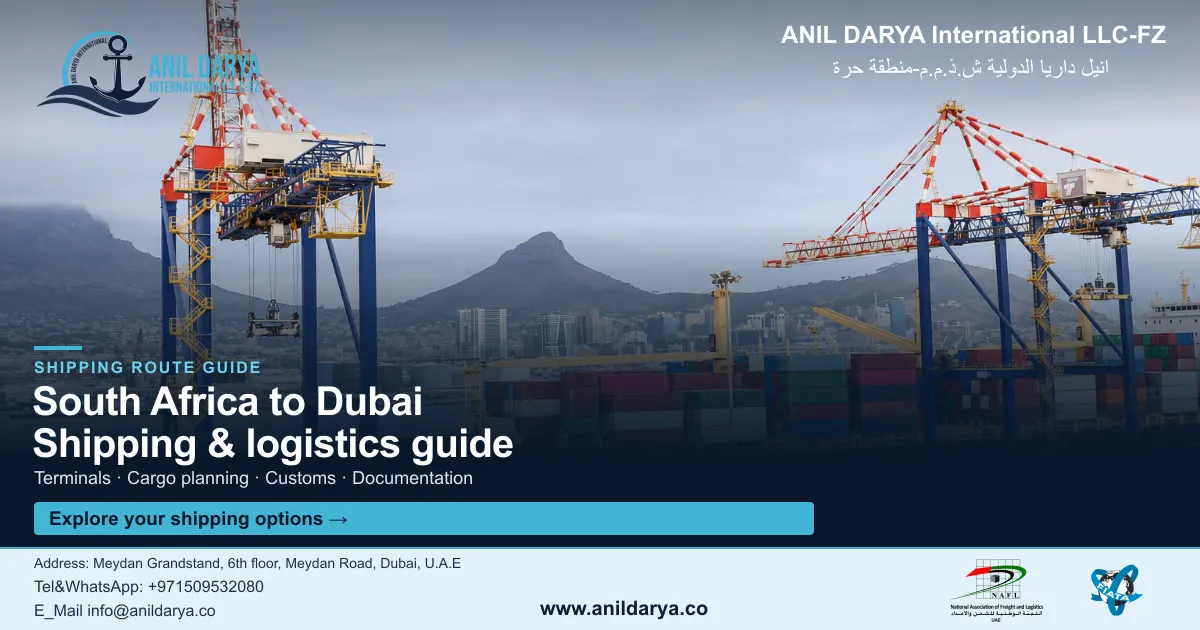
Shipping from South Africa to Dubai usually means a container from Durban, Cape Town or Ngqura to Jebel Ali, with breakbulk for steel and machinery and air cargo for urgent or high-value goods. The South African exporter registers with SARS and gets any ITAC export permit before the goods leave. In Dubai you need a customs business code, a declaration with Dubai Customs, 5% duty on the CIF value and 5% import VAT, or a free zone route if the goods will be sold on.
South Africa to Dubai shipping at a glance
| Item | Detail |
|---|---|
| Main South African load ports | Durban, Cape Town, Ngqura and Port Elizabeth, all under Transnet National Ports Authority |
| Busiest load port | Durban, 2,732,190 TEU handled in 2025 |
| Inland rail link | 688 km container corridor from Durban to Gauteng terminals such as City Deep |
| Main UAE discharge port | Jebel Ali, four container terminals and over 80 weekly services |
| Other UAE ports | Khalifa Port (Abu Dhabi), Sharjah ports; some services use Khor Fakkan |
| Modes | FCL, LCL, reefer, breakbulk and project cargo, dangerous goods, air cargo |
| South African export filing | Registered exporter, goods declaration to SARS, ITAC permit for controlled goods |
| Goods under South African export control | 177 tariff lines, including ferrous and non-ferrous scrap and used vehicles |
| Fresh produce | PPECB export inspection for perishable products |
| UAE customs duty | 5% of CIF for most goods; alcohol 50%, cigarettes 100%; rough diamonds exempt with a Kimberley Process certificate |
| UAE import VAT | 5%, deferred to the VAT return for registered importers whose customs number is linked with the FTA |
| Free zone next to the port | Jafza, over 11,000 businesses |
How the South Africa to Dubai sea freight route works
Most cargo for the UAE is loaded at Durban or Cape Town and sails up the east coast of Africa to the Gulf. Some services run direct to Jebel Ali. Others call at East African ports on the way, or move the box onto a second vessel at a hub. Schedule aggregators also list services from Durban that discharge at Khor Fakkan on the UAE east coast, so check the discharge port on the booking before you agree delivery dates with your buyer.
The lane carries a mixed load. Fruit, wine and other food leave Cape Town in reefers, while steel, machinery, chemicals, paper and mining equipment leave Durban and the Eastern Cape ports. Dubai buyers often re-export part of what they receive to other Gulf, African and Asian markets, which changes the customs route at the UAE end.
What adds days on this lane?
| Factor | Why it matters | What to do |
|---|---|---|
| Port rotation | Calls at East African ports before the Gulf add days at sea | Read the full rotation, not only the sailing date |
| Transhipment | A box that changes vessel can wait for the next connection | Ask which hub and how long the planned connection is |
| Export stack cut-off | A container that misses the stack closing rolls to the next sailing | Gate in early and file the export declaration before cut-off |
| Export permits | ITAC scrap permits take longer than other permits | Apply before you book space |
| Dubai clearance | A missing permit or code keeps the box at the terminal | File before the vessel berths |
[AMIR-FACT: our real port-to-port transit Durban to Jebel Ali and Cape Town to Jebel Ali (days), and the carriers or services we actually book on this lane]
Which South African port should you ship from?
Start with the factory or packhouse address. Inland transport to the wrong port can cost more than the time you save at sea. These are the four container ports on the lane, with 2025 volumes from Transnet National Ports Authority.
| Port | What the port authority reports | Best for shippers in |
|---|---|---|
| Durban | 2,732,190 TEU in 2025; 58 berths; container, automotive and liquid bulk port; rail corridor to Gauteng | Gauteng, KwaZulu-Natal, Free State, Mpumalanga |
| Cape Town | 843,599 TEU in 2025, of which 416,287 TEU shipped out; 42 berths; multipurpose terminal with temperature-controlled facilities for fresh produce | Western Cape fruit, wine and food exporters |
| Ngqura | 747,847 TEU in 2025; deepwater container terminal with four berths at 16 m in Algoa Bay | Eastern Cape manufacturers and the Coega zone |
| Port Elizabeth | 130,715 TEU in 2025; 15 berths; containers, bulk, breakbulk and vehicles | Eastern Cape automotive and component suppliers |
Gauteng exporters have two choices: truck the container to Durban, or load it at an inland terminal such as City Deep and rail it down the 688 km corridor. Ask the carrier which inland terminals it serves before you pick a route. Road haulage in South Africa has weight limits too. Maersk lists a maximum gross weight of 30 t for a 20ft container and 31.5 t for a 40ft, and says 45ft containers are not accepted in South Africa.
Which UAE port should your cargo arrive at?
Jebel Ali is the usual port for Dubai and for Jafza. DP World runs four container terminals there with over 80 weekly services to more than 150 ports, and it handles IMDG dangerous goods, reefers and project cargo. Our Jebel Ali port guide covers the terminals and port rules.
- Consignee in Dubai or Jafza: Jebel Ali.
- Site or warehouse in Abu Dhabi: compare Khalifa Port in Abu Dhabi to shorten the truck leg.
- Consignee in Sharjah or the northern emirates: ask about Sharjah port shipping.
- Booking shows Khor Fakkan: plan the road leg across to Dubai and who arranges it.
Sea freight from South Africa to Dubai: FCL, LCL and reefer
| Mode | Use it when | What to plan at the Dubai end |
|---|---|---|
| FCL (20ft, 40ft, high cube) | You fill most of a container | Declaration before arrival, delivery order, truck slot, empty return |
| LCL | A few pallets or cartons | Release after the shared container is unpacked at a freight station |
| Reefer | Citrus, grapes, apples, meat, wine in temperature control | Food approvals before arrival and plug-in time at the terminal |
| Flat rack, open top, breakbulk | Mining equipment, steel, machinery, project pieces | Lifting plan, trailer and road permit for oversized loads |
| Dangerous goods | Chemicals, paints, gases, batteries | Carrier acceptance and UAE port storage limits for the class |
| Air cargo | Samples, spares, urgent stock, high-value goods | Same Dubai Customs declaration, duty and VAT |
FCL or LCL for South African cargo?
FCL is sealed at the packing point and released in Dubai as one unit. LCL costs less for small loads, but your cargo waits until the consolidator's container is unpacked and every consignee's papers are in order. If your volume is close to a 20ft, price both. Our guide to FCL vs LCL costs shows where the break-even sits, and our sea freight service explains how we book space and handle the Dubai end.
Fresh produce and reefer cargo from Cape Town
Perishable exports from South Africa go through the Perishable Products Export Control Board (PPECB). It has inspected perishable products for export since 1991, covers more than 200 product types at over 1,500 locations, and checks quality, phytosanitary aspects and marking. Book the PPECB inspection with the packhouse before the reefer is loaded. At the Dubai end, food needs its UAE approvals before release, so send the health and phytosanitary certificates to the consignee as soon as the ship sails.
[AMIR-FACT: our typical booking lead time for reefer space from Cape Town or Durban to Jebel Ali in the peak fruit season, and the carriers we use for reefers]
Machinery, steel and project cargo
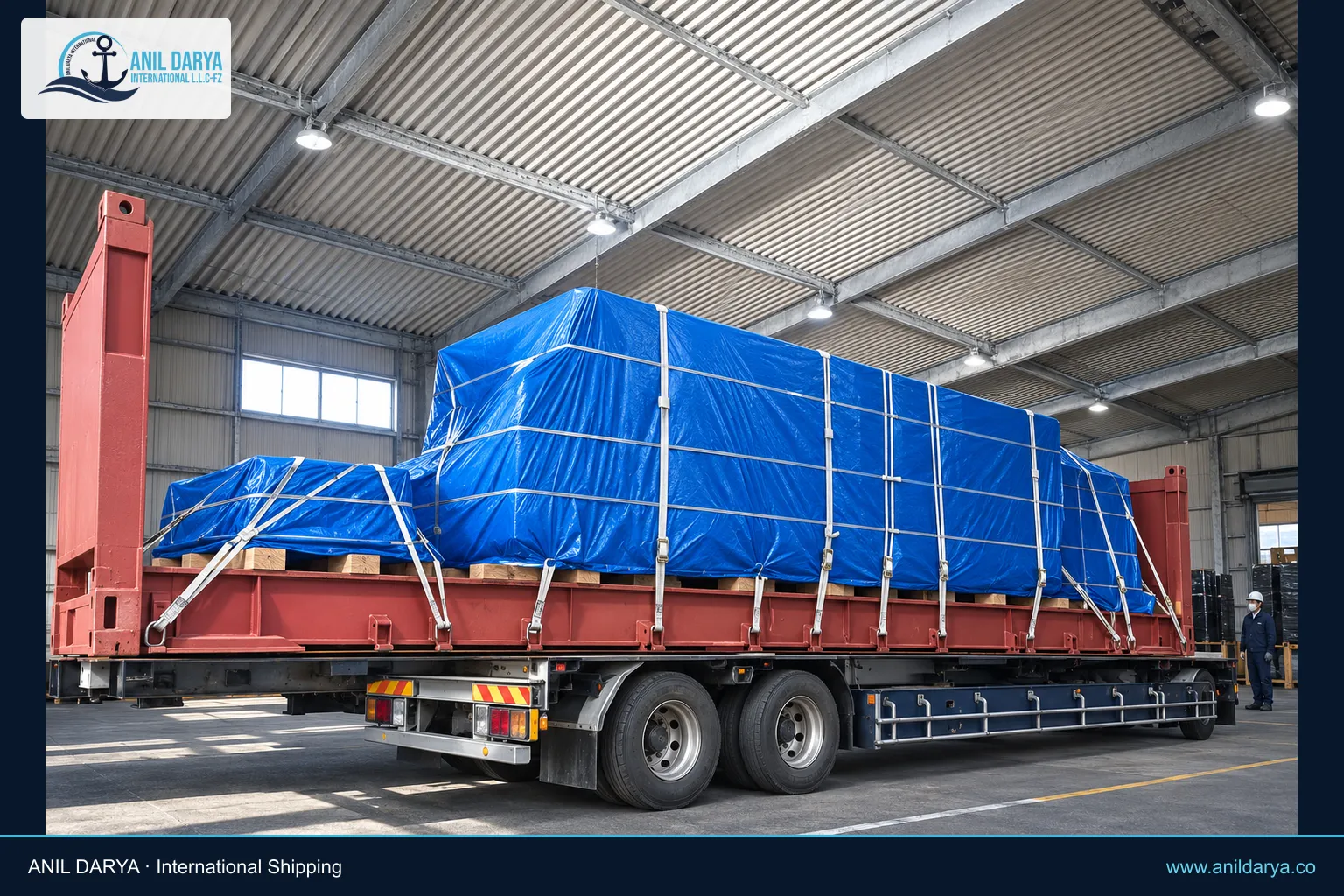
Transnet Port Terminals runs multipurpose terminals at Durban, Maydon Wharf, Port Elizabeth, East London, Cape Town, Richards Bay and Saldanha that handle steel, timber, abnormal and project cargo. Pieces that fit a 40ft flat rack ride a container service with more sailings. Larger pieces need a breakbulk or heavy-lift vessel. In Dubai we plan the discharge, the trailer and any road permit before the ship arrives. See our break bulk and project cargo service.
Dangerous goods from South Africa to Dubai
Chemicals, paints, batteries and gases ship under the IMDG Code. The exporter supplies a Safety Data Sheet, a signed Dangerous Goods Declaration, UN packaging, labels and placards, and the carrier must accept the booking before the box is packed. Jebel Ali handles IMDG cargo, but port safety rules limit how long some classes may stay, so the Dubai declaration and the truck must be ready on arrival. Our article on dangerous goods customs clearance in the UAE covers the Dubai side.
Air cargo from South Africa to Dubai
Johannesburg's OR Tambo airport is the main air cargo gateway, with Cape Town and King Shaka in Durban for coastal shippers. Air suits samples, spare parts, electronics and goods that cannot wait for a vessel. The paperwork at both ends is the same as for sea cargo. Ask us to compare air and sea through our air cargo service when the cargo is light, valuable or late.
The South African export side: SARS and ITAC
Export clearance in South Africa is the seller's job, or the job of the seller's clearing agent. We book the space with the carrier, but we do not file South African declarations. Delays on that side still land on your delivery date, so check that your supplier has these in place.
Exporter registration with SARS
SARS says any person, local or foreign, who exports goods from South Africa must register as an exporter. A foreign exporter must also nominate a registered agent in South Africa, who takes on full liability for the foreign principal's dealings with Customs. An exporter that submits its own declarations must also register as an EDI user. An exporter that uses a licensed clearing agent does not need to.
The export declaration
The goods are declared to SARS on a customs goods declaration, and SARS keeps the export declaration for its records and trade statistics. Customs may ask for the transport documents and other papers. Some goods need endorsed documents, and goods under export control need a permit, which must be produced at clearance. SARS also has separate rules for unpolished diamonds and the diamond export levy, so a rough diamond shipment needs its own plan.
Which goods need an ITAC export permit?
ITAC says 177 of about 6,650 tariff lines are under export control. Common cases on the Dubai lane:
- Ferrous and non-ferrous waste and scrap. Exports are controlled so local foundries can buy first. ITAC says scrap permits take 10 working days for circulation, plus processing time.
- Used motor vehicles. Exports are controlled to help police stop stolen vehicles leaving the country, and the application needs police support documents.
- Some precious stones, such as tiger's eye, to support local beneficiation.
- Goods covered by international agreements on ozone-depleting substances, hazardous waste and drug precursors.
For other controlled goods, ITAC gives an average turnaround of two working days. It also says applications are often rejected when no stock is available to inspect, or when the applicant has no tax or company registration in South Africa.
Dubai customs clearance for cargo from South Africa
Dubai Customs clears cargo at Jebel Ali and the other Dubai entry points. Every declaration is filed online under a regime: import for local use, transfer into a free zone, transit, or temporary admission.
Do you need a customs code to import into Dubai?
Yes. Dubai Customs says a licence holder needs a customs business code, and the declaration is filed under that code. Any company with a code can file. A clearing agent with a Dubai Economic Department clearing and forwarding licence can also file, using its own code and your written authority. If you do not have a code yet, we arrange clearance through a licensed agent with your authorisation.
Which documents does Dubai Customs need?
| Document | Who provides it | Why Dubai needs it |
|---|---|---|
| Commercial invoice | South African seller | Customs value and HS code |
| Packing list | South African seller | Inspection and LCL release |
| Certificate of origin | Issued in South Africa | Dubai Customs lists it with every declaration |
| Bill of lading or air waybill | Carrier | Title to the goods |
| Delivery order | Shipping line in Dubai | Releasing the container |
| Permit | UAE authority for the product | Restricted goods only |
| Kimberley Process certificate | Exporting country authority | Rough diamonds only; without it the shipment is impounded |
| SDS and DG declaration | South African seller | Dangerous goods only |
Dubai Customs charges an AED 500 fine for amending goods details at invoice level, so check the invoice against the packing list and bill of lading before you file.

How much is UAE duty and VAT on goods from South Africa?
Dubai Customs charges 5% of the CIF value for most goods. CIF means the cost of the goods plus insurance and freight to the UAE port. Alcohol pays 50% and cigarettes 100%, which matters for wine exporters. Rough diamonds are exempt from duty if the shipment carries a Kimberley Process certificate, and loose coloured gemstones pay 5% of CIF.
Import VAT is 5% of the customs value, including insurance, freight and any customs fees and excise tax paid on import.
- VAT-registered importer whose customs registration number is registered with the Federal Tax Authority: no VAT is charged at the border. It appears in your next VAT return and you can recover it as input tax if eligible.
- Importer not registered for VAT: the VAT is paid before customs releases the goods.
| Charge | Rate | Base |
|---|---|---|
| Customs duty, most goods | 5% | CIF value |
| Customs duty, alcohol including wine | 50% | CIF value |
| Customs duty, cigarettes | 100% | CIF value |
| Rough diamonds with KP certificate | Exempt | Shipment impounded without the certificate |
| Import VAT | 5% | Customs value plus customs fees and excise tax |
This guide uses the standard Dubai tariff. Some goods carry other rates or exemptions, so check your HS code before you price the landed cost. If someone tells you a preferential rate applies to South African goods, ask for written confirmation of the rate for your HS code from Dubai Customs before you rely on it.
Who pays the Dubai duty: DAP or DDP?
Under DAP, the South African seller delivers to your address and you clear the goods and pay duty and VAT in Dubai. Under DDP the seller pays them, but someone with a Dubai customs code still has to file the declaration and act as importer. A seller with no UAE company usually cannot do that alone, so agree in the contract whose code is used and who recovers the VAT. We arrange payment of the duty and VAT as part of the clearance, and you see each amount on the declaration.
Free zone and re-export: shipping South African goods through Jafza
Many shipments on this lane are not sold in the UAE. A Dubai trader buys from South Africa, stores the goods, and sells them on to other markets. Jafza, next to Jebel Ali Port and operating since 1985, hosts over 11,000 businesses. Goods delivered into Jafza under a free zone transfer pay UAE duty only if they later enter the mainland.
| What happens to the goods | Declaration | Duty and VAT |
|---|---|---|
| Sold or used in the UAE mainland | Import for local use | Paid at import, or VAT deferred if registered |
| Stored in Jafza for resale abroad | Transfer into the free zone | Due only if the goods later enter the mainland |
| Exhibition, project or repair, then sent back | Temporary admission | Deposit equal to the duty, refunded on re-export |
| Passing through to another country | Transit | Not imported into the UAE |
For the onward sale, Dubai Chambers issues certificates of origin for re-exported goods. It charges AED 100, quotes two hours, and for transhipment goods asks for the transit bill from Dubai Customs. The goods keep South African origin on that certificate. Our guide to Jafza re-export for bulk and breakbulk cargo explains the free zone side in more detail.
Restricted and prohibited goods for the UAE
Dubai Customs says some goods need approval from the relevant authority before release. Apply before the vessel leaves South Africa. Groups that come up on this lane:
- Fresh fruit, meat and other food: food safety approvals, plus the health or phytosanitary certificates from South Africa.
- Wine and spirits: 50% duty and alcohol import rules.
- Rough diamonds: a Kimberley Process certificate, or the shipment is impounded.
- Medicines and medical devices: health authority approval.
- Seeds, plants and fertilisers: agricultural approvals.
- Chemicals and dangerous goods: permits for some products and port approval for some classes.
Shipping from South Africa to Dubai step by step
- Send us the cargo details. Commodity, HS code, weight, volume, the South African pickup address and the delivery address in the UAE.
- Agree the Incoterm. Under FOB or FCA we book the main freight. Under CFR or CIF the seller books it and we take over at Jebel Ali.
- Check export controls. The seller confirms whether the goods need an ITAC permit, a PPECB inspection or diamond formalities.
- Get your Dubai side ready. Customs business code, VAT registration linked to it, and any UAE permits for restricted goods.
- Book space. We book with the carrier and confirm the load port, the discharge port and the transit plan. DG, reefer and out-of-gauge cargo get carrier acceptance first.
- Pickup and export clearance. The seller or its clearing agent trucks or rails the box to the port, files the SARS declaration and gates in before the stack closes.
- Check documents while the ship sails. Invoice, packing list, bill of lading and certificate of origin must match on names, weights and HS codes.
- File the Dubai declaration. We file through a licensed agent before the vessel berths.
- Pay charges and collect the delivery order. We arrange payment of the duty and VAT, plus the line's local charges.
- Deliver and return the empty. We book the truck, deliver to your site or Jafza warehouse and return the container within free time.
[AMIR-FACT: one real South Africa to UAE shipment we handled, with cargo type, load port, mode and how clearance went at Jebel Ali, cleared for publication]
What decides the cost of shipping from South Africa to Dubai?
Rates move every few weeks, so we quote each shipment. These factors change the price:
| Cost factor | Effect | How to control it |
|---|---|---|
| Load port | Durban, Cape Town and Ngqura have different services and inland costs | Price the port nearest the factory or packhouse |
| Inland leg in South Africa | Road or rail from Gauteng adds a cost the sea rate does not show | Compare truck to Durban with rail from an inland terminal |
| Container type | Reefers, flat racks and open tops cost more than dry boxes | Use a dry box when the cargo allows |
| Direct or transhipped service | Transhipment can be cheaper but adds days and handling | Weigh the price against the delivery date |
| Dubai destination charges | Terminal handling, delivery order, clearance, trucking, freight station fees for LCL | Ask for them in the quote, not after arrival |
| Duty and VAT | 5% duty on CIF, 5% VAT, higher duty on alcohol | Link your VAT number to your customs code; use Jafza for re-export |
| Free time | Demurrage and detention start once free days run out | Have permits and the declaration ready before arrival |
Checklist before cargo leaves South Africa
- Seller is registered with SARS as an exporter, or uses a licensed clearing agent.
- ITAC export permit in hand for scrap, used vehicles or other controlled goods.
- PPECB inspection booked for fresh produce.
- Kimberley Process certificate and SARS diamond formalities for rough diamonds.
- Your Dubai customs business code is active and your VAT number is linked with the FTA.
- UAE permits applied for if the goods are restricted.
- Declaration type chosen: local import, Jafza transfer, temporary admission or transit.
- Invoice, packing list, bill of lading and certificate of origin match.
- Container weight within South African road limits.
- DG: SDS, DG declaration, packaging and carrier acceptance.
- Free time at the UAE port agreed, delivery booked and cargo insurance arranged.
Common mistakes when importing from South Africa
- Booking scrap before the ITAC permit. The permit takes longer than for other goods, and the box cannot be cleared for export without it.
- No customs code in Dubai. The goods wait at Jebel Ali until someone authorised can file.
- VAT number not linked to the customs code. You pay import VAT at the border instead of deferring it.
- Pricing wine at 5% duty. Alcohol pays 50% in Dubai.
- Rough diamonds without a Kimberley Process certificate. Dubai Customs impounds the shipment.
- Declaring goods for local use that are meant for re-export. You pay duty you might not owe.
- Assuming every sailing ends at Jebel Ali. A Khor Fakkan discharge needs a road leg you did not plan.
- Overweight containers. A box above the South African road limit cannot move legally to the port.
Frequently asked questions
How long does shipping from South Africa to Dubai take?
It depends on the service, the port rotation and whether the box is transhipped. Ask for the port-to-port days of the actual vessel when you book, then add time for export clearance in South Africa and clearance and delivery in Dubai.
Which South African port is best for shipping to Dubai?
Durban for Gauteng and KwaZulu-Natal, as it handled 2,732,190 TEU in 2025 and has a 688 km rail corridor to Gauteng. Cape Town for Western Cape fruit and wine, and Ngqura or Port Elizabeth for the Eastern Cape.
What documents do I need to import from South Africa to Dubai?
Dubai Customs asks for the invoice, packing list, certificate of origin and any permit for restricted goods. For sea cargo you also need the bill of lading and the shipping line's delivery order. DG cargo needs an SDS and a DG declaration.
What is the customs duty on goods from South Africa to Dubai?
Dubai Customs charges 5% of the CIF value for most goods, 50% on alcohol and 100% on cigarettes. Rough diamonds are exempt if the shipment carries a Kimberley Process certificate. Import VAT of 5% applies on top.
Does the South African supplier need an export permit?
Only for controlled goods. ITAC lists 177 tariff lines under export control, including ferrous and non-ferrous scrap and used motor vehicles. The permit must be produced to SARS at clearance.
Can I ship fresh fruit from South Africa to Dubai?
Yes, in reefer containers, mostly from Cape Town. The PPECB inspects perishable exports for quality, phytosanitary aspects and marking, and the UAE consignee needs food approvals before release in Dubai.
Can I import from South Africa into a Dubai free zone without paying duty?
Yes. Goods delivered into Jafza under a free zone transfer pay UAE duty only if they later enter the mainland. Dubai Chambers can then issue a certificate of origin for the re-export.
Do I need a licence to import into Dubai?
You need a trade licence and a Dubai Customs business code. A clearing agent with a clearing and forwarding licence can file the declaration for you with your authorisation.
Who handles customs in South Africa when I buy from a South African supplier?
The supplier or its clearing agent. SARS requires every exporter to register, and a foreign exporter must nominate a registered agent in South Africa. We book the freight and handle the Dubai end.
Get a quote for shipping from South Africa to Dubai
Send us the commodity, HS code, weight, volume, the South African pickup address and your UAE delivery address, and we will come back with a routing and a price, including clearance at the Dubai end. Use our freight rate inquiry form or contact our team. You can also read more about our Dubai freight forwarding team.
Sources
- SARS: Exports (export declaration, permits from ITAC, unpolished diamonds and diamond export levy policies)
- SARS: Exporter registration (local and foreign exporters, registered agent, EDI users)
- SARS: Goods declaration (SAD 500 and related forms)
- ITAC: Export control (177 tariff lines, scrap, used vehicles, turnaround times, rejections)
- ITAC: Price Preference System for scrap metal
- PPECB: Product inspection services for perishable exports
- Transnet National Ports Authority: Our ports (berths, cargo, Cape Town multipurpose terminal, Ngqura)
- Transnet National Ports Authority: Containers handled by port, 2025
- Transnet Port Terminals: Break-bulk services
- Transnet Freight Rail: Container corridor Durban to Gauteng
- Maersk: South Africa local information (road weight limits, 45ft containers)
- Fluent Cargo: Durban to Dubai route data (UAE discharge ports)
- DP World: Jebel Ali Port (terminals, weekly services, cargo types)
- Dubai Customs: Submit customs declaration (documents, amendment fine)
- Dubai Customs: FAQ (duty rates, CIF, business code, clearing agents, diamonds, temporary admission)
- UAE Government portal: Customs duty and tariff
- Federal Tax Authority: VAT guide, section 3.5 (import VAT and deferral)
- Jafza: About Jebel Ali Free Zone
- Dubai Chambers: Issuing a certificate of origin (re-exports)
Reviewed: 10 November 2026