
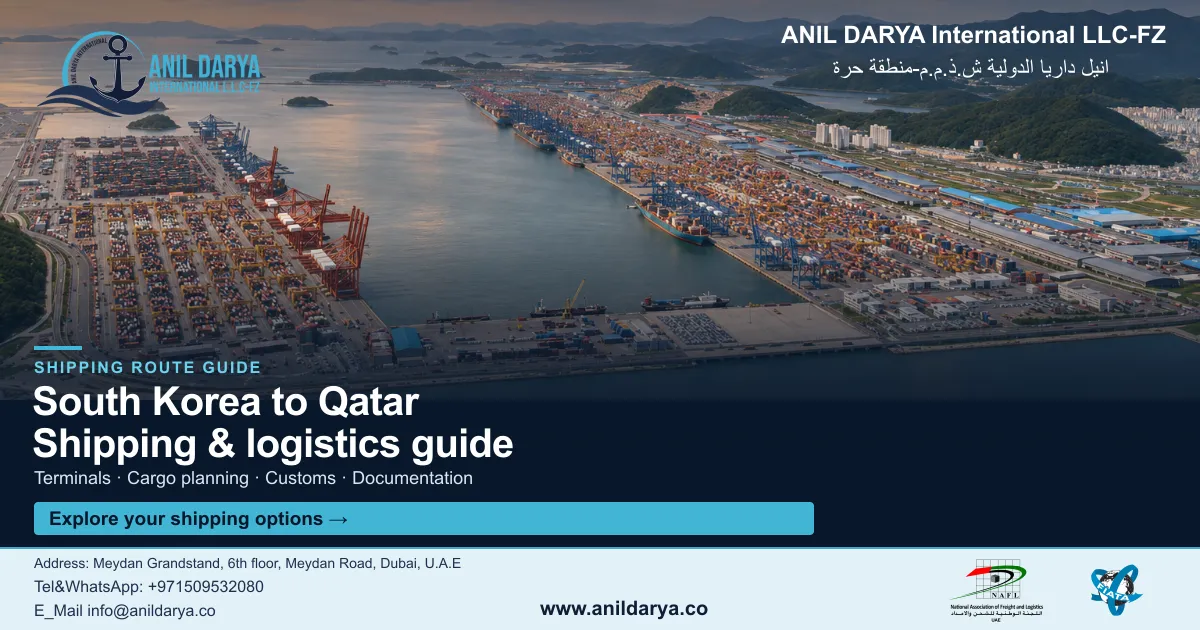
Shipping from South Korea to Qatar is mostly a container move from Busan to Hamad Port, the deep-water gateway south of Doha, with steel, plant and vehicles also moving from Gwangyang, Ulsan and Pyeongtaek. The Korean seller files the export declaration through UNI-PASS, and the Qatari buyer's broker clears the goods on Al Nadeeb, where most lines pay 5% duty on the CIF value. No Korea-Qatar trade preference is in force yet. We book the ocean freight from Dubai and coordinate both ends.
South Korea to Qatar shipping at a glance
| Item | Detail |
|---|---|
| Type of lane | Sea cross-trade from Korea to Qatar, booked and coordinated by Anil Darya from Dubai |
| Main Korean load ports | Busan for most containers; Gwangyang for steel and heavy pieces; Ulsan for plant, chemicals and new cars; Pyeongtaek and Incheon for vehicles and North-region cargo |
| Port of discharge | Hamad Port, run by Mwani Qatar, with a vehicle terminal and a central customs inspection area |
| Published transit | 31 days Pusan to Hamad on ONE's weekly AG1 loop (brochure dated January 2025), with Jebel Ali called first |
| Korean export filing | Export declaration on UNI-PASS to the customs house that controls the storage place; load within 30 days |
| Qatari import system | Al Nadeeb single window, filed by a broker for a licensed importer |
| Duty | 5% of CIF for most goods; 20% on some steel bars and hot-rolled steel; 100% on tobacco and alcohol |
| VAT or sales tax | None in Qatar today |
| Trade agreement | Korea-GCC FTA concluded in December 2023 but listed by Korea as signed, not in force |
| Key papers | Commercial invoice and certificate of origin with HS codes, packing list, carrier B/L, "Made in Korea" on goods and cartons |
How a Korea to Qatar cross-trade works with us
A cross-trade is a shipment where neither end is in the UAE. Your Korean supplier loads in Busan, your buyer collects in Doha, and our desk in Dubai holds the booking together. Three parties do the work, and it helps to know who owns each piece before the first quote.
- The Korean seller, or its forwarder or customs broker in Korea, collects the goods, files the export declaration and delivers the container to the terminal.
- We book the space with the shipping line, check the cargo details the line needs, and follow the box from gate-in at Busan to discharge at Hamad.
- The Qatari consignee's customs broker files the import declaration, pays duty from the buyer's account and arranges delivery inside Qatar.
The bill of lading you receive is the shipping line's own B/L. Because Anil Darya acts as agent for many lines, the carrier's B/L is issued and released to you through our office. We do not issue a house bill on this lane, so the document your bank or buyer sees carries the carrier's name and terms.
We do not clear goods in Qatar and we have no office there. Before we confirm a booking, we ask who the buyer's broker is, whether the importer holds a valid licence, and whether any product needs a certificate before it sails. If those answers are missing, we hold the booking until they arrive.
Which Korean port should you load at?
Busan Port Authority describes Busan as linked to 500 ports in 100 countries, and most Gulf services load there. The other ports matter when the cargo is steel, plant or vehicles, or when the factory sits far from the south-east coast.
| Port | Typical Qatar-bound cargo | What to check |
|---|---|---|
| Busan | Machinery, electrical equipment, parts, appliances, consolidated LCL | ONE's AG1 loads at Hyundai Pusan Newport Terminal; ask which terminal your sailing uses |
| Gwangyang | Steel coil, plate, pipe and heavy lifts | Containers may relay via Busan; breakbulk needs a liner or project vessel |
| Ulsan | Process plant, petrochemicals, new vehicles | DG and oversized pieces need early approval from the line |
| Pyeongtaek | New and used vehicles, plus some containers | The port corporation's route page lists a Gulf car carrier service that includes Hamad and Doha |
| Incheon | Cargo from the Seoul area, used cars and parts | Gulf containers usually connect through a larger hub |
If your supplier sits near Seoul, compare the trucking cost to Busan with a feeder from Incheon. A truck to Busan often joins a direct Gulf sailing sooner, while a feeder adds a transhipment and a few days.
Hamad Port, the arrival point in Qatar
Almost all Korean containers for Qatar discharge at Hamad Port. Mwani Qatar says the port began operations in December 2016 and was inaugurated on 5 September 2017. It covers 29 square kilometres, with container capacity quoted at 7.5 million TEU a year.
- General cargo: 7 million tonnes a year, which covers steel, pipe and project pieces off Korean breakbulk calls.
- Vehicles: a specialist terminal for about 500,000 vehicles a year, used by car carriers from Korea.
- Grain: 1 million tonnes a year.
- Inspection: a Centralized Customs Inspection Area that can handle 5,600 containers a day.
- Free zone: a zone sits next to the port, useful when a buyer wants to hold Korean stock before paying duty.
Your broker should know the terminal and inspection slot before the ship arrives. Storage and container detention start counting from discharge, and our guide to demurrage and detention explains how fast those days add up.
Direct loop, Jebel Ali relay or Dubai stock
There is no short hop from Korea to Qatar. Every service we found sails through South-East Asia and calls Jebel Ali or other Gulf ports before Hamad, so the real choice is between staying on one ship and changing ships at a hub.
ONE's Middle East brochure, dated January 2025, shows the weekly AG1 loop calling Pusan, then Shanghai, Ningbo, Kaohsiung, Shekou and Singapore, then Jebel Ali and several Gulf ports, with Hamad on the same ship. In August 2025 HMM, Yang Ming and ONE announced a restructured GS2/KMP service whose Asia-Middle East rotation includes Busan, Jebel Ali, Dammam, Jubail and Hamad. That announcement gives no transit days, so we do not quote any.
A relay through Jebel Ali is the other option. The mother vessel discharges at Jebel Ali port and a Gulf feeder carries the box to Hamad. Milaha's Intra Gulf Express sheet (January 2025) shows a weekly service with two ships of 1,015 TEU nominal that links Hamad and Jebel Ali. If we join a Korean mother vessel to a feeder like this ourselves, it is a possible connection, not a published through routing, and the line confirms it on the booking.
[AMIR-FACT: the carriers we actually book from Busan to Hamad, whether each sails direct or relays at Jebel Ali, and the real port-to-port days we see]
How long does shipping from South Korea to Qatar take?
Only one carrier table we opened gives a day count for this pair, so treat it as a planning figure, not a promise.
| Service and source | Leg | Published days |
|---|---|---|
| ONE AG1, brochure dated January 2025 | Pusan to Jebel Ali | 22 |
| ONE AG1, brochure dated January 2025 | Pusan to Hamad | 31 |
| ONE AG1, brochure dated January 2025 | Jebel Ali to Hamad on the same ship | 9 |
We checked these figures against the port rotation in the same brochure. The ship leaves Pusan on a Sunday, reaches Jebel Ali on a Monday and Hamad on a Wednesday, which matches 22 and 31 days. The westbound table sits next to an eastbound table, so read the right one if you open the PDF yourself. Rotations change, so ask for the current schedule at booking.
Add time at both ends: trucking and export clearance in Korea, and the broker's filing, inspection and delivery in Qatar. Competitor pages quote anything from two weeks to six weeks for this lane without a carrier source, which is why we print only the dated table.
Sea freight from South Korea to Qatar: FCL, LCL and special cargo
Most Korean cargo for Qatar moves in full 20ft and 40ft containers. A full box keeps one shipper, one invoice and one set of papers, which makes the broker's job in Doha simpler and cuts the risk of a mismatch hold.
LCL works for parts, samples and small machinery lots. The consolidator stuffs your pallets with other shippers' cargo in Korea, and the box is opened at a container freight station after discharge. Expect extra handling time at both ends. Our FCL vs LCL guide shows where the break-even usually falls, and you can see how we book sea freight from Dubai on any lane.
Steel pipe, plant and project cargo
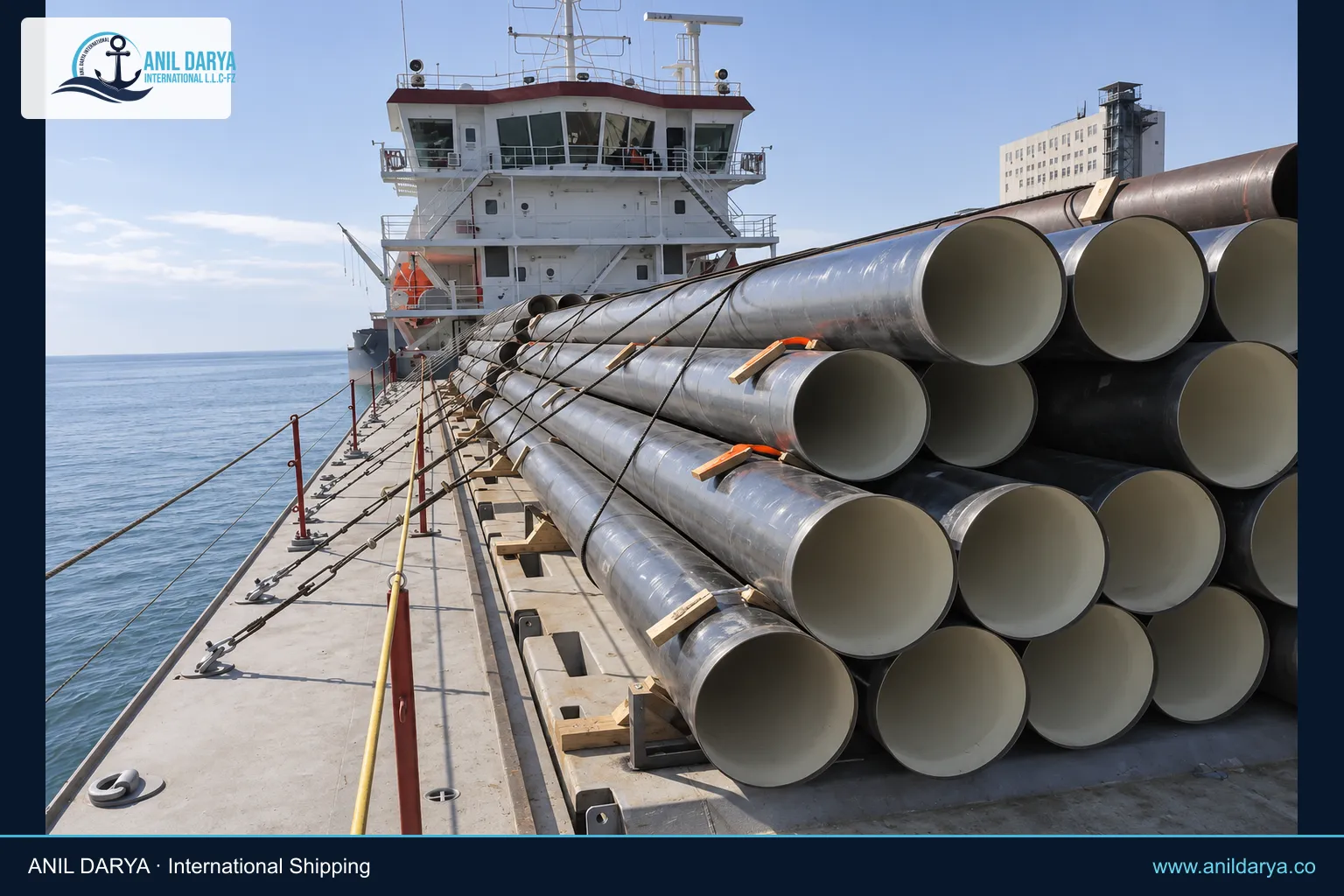
Steel and plant are a big part of this lane. Line pipe, fittings, tanks, pressure vessels and modules often exceed a standard box. For these we look at flat racks and open tops, or a breakbulk liner call at Hamad, and ask the shipper for weights, centre of gravity and lifting points before we request space. Our break bulk and project team plans these pieces with the line.
Vehicles
New cars and buses can go on a car carrier or inside containers. The Pyeongtaek port corporation's route page lists a Glovis and EUKOR car carrier service whose Gulf calls include Hamad and Doha. Used cars must have their Korean registration cancelled before export, and Korea Customs requires a report once they enter the bonded area.
Dangerous goods
Chemicals, paints, resins, batteries and some machinery spares are regulated. They move under the IMDG Code 2024 edition (Amendment 42-24), mandatory from 1 January 2026. The shipper needs a dangerous goods declaration and safety data sheet, and the line must accept the class for both Jebel Ali and Hamad if the box relays. Our dangerous goods team checks this before we file the booking.
What Korea sells to Qatar
Trading Economics, quoting UN Comtrade data, puts Korean exports to Qatar at USD 832.68 million in 2025. The Qatari side reported total two-way trade of almost USD 8.44 billion in 2025, with Korea fourth among Qatar's trading partners, so most of that value flows from Qatar to Korea.
| Korean export group to Qatar, 2025 | Value (USD) | Shipping note |
|---|---|---|
| Machinery, boilers and equipment | 335.34 million | FCL, flat rack or breakbulk |
| Electrical and electronic equipment | 146.32 million | FCL or LCL; check G-Mark and CoC rules |
| Mineral fuels and oils | 88.89 million | Mostly bulk or tank; DG if packed |
| Articles of iron or steel | 66.05 million | Pipe, tanks and fittings; often out of gauge |
| Vehicles | 64.07 million | Car carrier or container |
| Iron and steel | 30.99 million | Check the 20% duty lines |
The mix tells you where the risk sits: heavy, valuable engineering cargo bound for projects, where a wrong HS code or a missing certificate costs more than the freight.
Korean export side: UNI-PASS and loading rules
Korea Customs Service runs export clearance through UNI-PASS, its online system for declarations and payments. Users log in with a digital certificate from an accredited body. The export rules on the KCS page are short and strict.
- File the export declaration with the head of the customs house that controls the place where the goods are stored.
- Customs may clear it on the papers or call a physical inspection. Low-risk exports get expedited clearance.
- Load the goods within 30 days after the declaration is accepted. The period can be extended up to one year.
- Goods covered by Article 226 of the Customs Act or by export controls under Article 19 of the Foreign Trade Act need approval from the competent body first.
- A false declaration, or exporting with none, can be treated as false reporting, smuggling or price manipulation.
The seller or its Korean broker does this filing, not us. Ask your supplier to send the export declaration number and acceptance date with the shipping instructions, so we can match them to the booking.
Invoice, origin and marking rules for Qatar
Qatar is strict on paper, and most holds on this lane start with the invoice. The US trade guide for Qatar, last published in July 2024, lists the rules that have applied since 1 April 2011.
- An official commercial invoice, an official certificate of origin and a packing list. Shipments without them are not cleared and can be sent back.
- The HS code written on the invoice and on the certificate of origin. Qatar has used 12-digit HS codes for imports and exports since January 2025, so ask the buyer's broker for the full code.
- "Made in Korea" or a country-of-origin field on each piece, on the material and on every carton. Origin must match across the invoice, certificate and goods.
- Where a letter of credit asks for it, the certificate of origin and shipping certificate notarised in the exporting country by an Arab embassy or consulate or an Arab chamber of commerce.
In Korea, non-preferential certificates of origin are issued through the Korea Chamber of Commerce and Industry. Invest Qatar adds that import documents must be attested, translated and verified, so ask the broker which papers need legalisation before the seller sends originals.
[AMIR-FACT: whether the Qatari brokers we work with ask for Korean invoices and certificates of origin to be legalised by the Embassy of Qatar in Seoul, and how long that takes]
Does any trade agreement cut the duty?
Not yet. The GCC and Korea concluded a free trade agreement in Seoul on 28 December 2023. Korea's official FTA portal still lists the Korea-GCC FTA under signed or concluded agreements, not under agreements in force, when we checked on 14 November 2026. Until it enters into force, Korean goods pay the normal GCC tariff in Qatar.
Korea's CEPA with the UAE did enter into force on 1 May 2026, with a rule of origin based on a change of tariff heading or a value content of at least 40% of the FOB price. Qatar is not a party to it, so it gives no Qatari duty relief. If you clear Korean goods into the UAE first and then send them on to Qatar, the duty position changes, so ask both brokers before you pick that route.
Qatar import customs on Al Nadeeb
Qatar's customs law is Law No. 40 of 2002, applied alongside the GCC Unified Customs Law (Law No. 41 of 2002) and Law No. 40 of 2004. The broker lodges the declaration on Al Nadeeb, the customs clearance single window, which routes it to other agencies and takes the duty payment online.
- Importer: must hold an import licence registered with the Ministry of Commerce and Industry.
- Documents: Invest Qatar lists the licence, the detailed declaration, the manifest, the invoice, the certificate of origin and the bill of lading.
- Inspection: partial or full, usually with the owner or its representative present. Where an examination is warranted, the owner bears the transport and repacking cost.
- Mismatch: if goods differ from the papers, extra duty and a fine apply.
Duty and taxes at destination are paid by the consignee or its broker. We send the broker the carrier's arrival notice and the B/L release details so the filing can start before discharge.
Duty and taxes on Korean goods in Qatar
| Goods | Qatar customs duty (Invest Qatar; trade.gov, last published 20 August 2025) |
|---|---|
| Most goods: machinery, electronics, vehicles, parts, most steel products | 5% of CIF value |
| Iron bars and rods, non-alloy hot-rolled steel, 12 mm bars, cement | 20% |
| Urea and ammonia | 30% |
| Records and musical instruments | 15% |
| Pork products, alcohol, tobacco | 100%; cigarettes 100% or QAR 1,000 per 10,000, whichever is higher |
| About 600 exempt items, plus machinery and raw materials for qualifying projects | 0% |
The base is CIF, so ocean freight and insurance from Korea add to the duty. Korean steel shipments need a careful HS check: pipes, fittings and tanks are classified differently from bars, rods and hot-rolled steel, and only the lines in the 20% group take the higher rate. Projects funded by the Qatar Industrial Development Bank can be granted a duty waiver on machinery and inputs.
Qatar has no VAT or sales tax today. Excise applies to goods such as tobacco and energy drinks, so check it if you ship consumer goods.
Product rules and restricted goods in Qatar
- Prohibited: ammunition and explosives, flammable goods, radioactive material, narcotic drugs, and goods that infringe trademarks, copyright or patents.
- Low-voltage electrical goods and toys: the Gulf G-Mark applies in Qatar, and products under a Gulf technical regulation carry the GSO Conformity Tracking Symbol.
- Car parts and some appliances: Intertek's Qatar page lists tyres, safety belts, wheel rims, brake pads, exhaust fans, electric irons and hair dryers as products needing a certificate of conformity for customs. The page is undated, so confirm the current list with the broker.
- Food: labels in Arabic, or Arabic with English, and at least half the shelf life left on arrival. Meat needs a health certificate and a halal slaughter certificate.
Certificates are issued in Korea before loading, so these checks belong at quotation stage, not after the ship sails.
Agree clearance in Qatar before the box leaves Busan
The most expensive mistake on this lane is a box that reaches Hamad with no one ready to clear it. We will not confirm a Korea to Qatar booking until we know four things: the broker's name and contact, that the importer's licence is valid, the 12-digit HS code for each line, and whether any certificate of conformity or G-Mark is needed. Once those are confirmed, the broker can prepare the Al Nadeeb filing while the ship is still at sea.
Where Dubai fits on this lane
Most Korean cargo should go straight to Hamad. Dubai helps in three cases.
- Relay at Jebel Ali. When a direct sailing is full or skips Hamad, a mother vessel to Jebel Ali and a Gulf feeder to Hamad can work. Dubai Customs lists transit and transfer among its declaration types for goods that pass through Dubai.
- Consolidation. Buyers who order from several Korean and other Asian suppliers can collect the goods in Dubai and send one load to Doha. Here the cargo enters the UAE, and our customs clearance in Dubai is charged as a fee.
- Free zone stock. Jafza, next to Jebel Ali Port, calls itself the largest customs bonded zone in the Middle East. A distributor can hold Korean stock there and send smaller lots to Qatar. Our article on re-export from JAFZA explains how that works.
[AMIR-FACT: whether we route Korean cargo for Qatar through Jebel Ali or a Dubai consolidation today, the feeder used for the Hamad leg, and the extra days compared with a direct call]
Shipping from South Korea to Qatar step by step
- Send us the goods, HS codes, weights, dimensions, Korean pickup point and the Doha delivery address.
- Agree the Incoterm. Our Incoterms 2020 guide for sea freight shows where cost and risk pass on FOB Busan or CFR Hamad.
- Confirm the Qatari broker, the importer's licence and any certificate the goods need.
- We book the sailing, direct or via Jebel Ali, and send the booking to the shipper.
- The seller prepares the invoice, packing list and certificate of origin with HS codes and "Made in Korea" marks.
- The seller or its broker files the UNI-PASS export declaration and delivers the box to the terminal within the loading window.
- The vessel sails; we track it and send the broker the arrival details.
- The carrier's B/L is released through us once freight terms are met.
- The broker files on Al Nadeeb, the buyer pays duty, and the box is inspected if selected.
- The broker arranges delivery and returns the empty container on time.

What decides the cost on this lane
- Ocean freight for the sailing you choose, and whether it is direct or relays at Jebel Ali.
- Container type: dry, high cube, flat rack or open top. Out-of-gauge pieces cost more per tonne.
- Terminal handling and documentation charges at Busan and at Hamad.
- Trucking in Korea from the factory to the port, and delivery in Qatar.
- Certificates: CoC, G-Mark and any legalisation of papers.
- Qatari duty on the CIF value, plus the broker's fee.
- Storage and detention if the broker cannot clear quickly.
- Insurance, which also enters the CIF base for duty.
We quote only on named sailings and current tariffs. Ask us for a figure for your cargo rather than relying on a published rate table.
Checklist before the cargo leaves Korea
- Qatari broker named and briefed; importer licence confirmed.
- Full 12-digit HS code agreed for every line.
- Invoice, certificate of origin and packing list match on quantity, weight and origin.
- "Made in Korea" on every piece and carton.
- CoC or G-Mark issued where the product needs one.
- Export declaration accepted on UNI-PASS and the loading deadline noted.
- DG declaration and safety data sheet for any regulated cargo.
- Lifting data and drawings for any out-of-gauge piece.
- Consignee and notify details on the B/L match the Qatari importer.
Mistakes that hold Korean cargo at Hamad
- Shipping before destination clearance is agreed. With no broker and no licence ready, storage and detention build up from day one.
- Leaving the HS code off the invoice or certificate of origin, or using an 8-digit code.
- Marking "Made in Korea" on the cartons but not on the goods, or the reverse.
- Assuming the Korea-GCC FTA already cuts the duty.
- Classing all steel as 5% without checking whether a line falls in the 20% group.
- Sending a relay box through Jebel Ali without checking that the feeder accepts its DG class.
- Letting the 30-day Korean loading window lapse after a rolled booking.
[AMIR-FACT: one real South Korea to Qatar cross-trade shipment we coordinated (cargo, Korean port, carrier, routing, days from booking to collection at Hamad), or confirm we have none yet]
Frequently asked questions
How long does sea freight from Korea to Qatar take?
ONE's AG1 brochure, dated January 2025, shows 31 days from Pusan to Hamad on the same ship, with Jebel Ali called at day 22. Add export clearance in Korea and import clearance in Qatar, and ask for the current schedule when you book.
Which port in Qatar receives Korean cargo?
Hamad Port, south of Doha. It handles containers, general cargo, grain and vehicles, and has a central customs inspection area and a free zone next to it.
Is there a free trade agreement between Korea and Qatar?
Not one in force. The Korea-GCC FTA was concluded in December 2023, but Korea's FTA portal lists it as signed, not in force, as of 14 November 2026. Korean goods pay the normal Qatari duty, mostly 5% of CIF.
Does Qatar charge VAT on imports from Korea?
No. Qatar has no VAT or sales tax today. Customs duty applies, and excise applies to goods such as tobacco and energy drinks.
What documents does the Qatari broker need?
A commercial invoice and certificate of origin that both show the HS code, a packing list, the carrier's bill of lading and the importer's licence. Goods and cartons must be marked with Korean origin.
Who clears the goods in Qatar?
The consignee's own customs broker, on Al Nadeeb. We do not clear in Qatar, so we confirm the broker before we confirm the booking.
Can Korean cargo for Qatar go through Dubai?
Yes. It can relay at Jebel Ali onto a Gulf feeder, be consolidated in Dubai, or be held in Jafza and re-exported. If the goods enter the UAE, Dubai clearance is our service, charged as a fee.
What bill of lading will I get?
The shipping line's own B/L, issued and released to you through Anil Darya as agent for the line. We do not issue a house bill on this lane.
Get a quote for shipping from South Korea to Qatar
Send the cargo list, weights, Korean pickup point and Doha address through our freight rate inquiry form, or contact our team on +971 50 953 2080 or info@anildarya.co. Our Dubai freight forwarding team will reply with named sailings and the questions your Qatari broker will ask.
Sources
- ONE: Middle East Service brochure, AG1 rotation and transit table (January 2025)
- JCtrans: HMM, Yang Ming and ONE restructure Middle East services, GS2/KMP rotation (22 August 2025)
- Milaha: Intra Gulf Express service sheet (January 2025)
- Gyeonggi Pyeongtaek Port Corporation: container and car carrier routes
- Busan Port Authority: port overview
- Mwani Qatar: Hamad Port
- Korea Customs Service: export declaration guideline
- Invest Korea: customs clearance and UNI-PASS
- Korea Chamber of Commerce and Industry: certificate of origin centre
- Korea FTA portal (MOTIR): FTAs in force and signed (consulted 14 November 2026)
- Ajel: GCC and Korea conclude FTA in Seoul (28 December 2023)
- EY: UAE-Korea CEPA takes effect (7 May 2026)
- Invest Qatar: customs
- US International Trade Administration: Qatar import tariffs (last published 20 August 2025)
- US International Trade Administration: Qatar import requirements and documentation (last published 29 July 2024)
- US International Trade Administration: Qatar moves to 12-digit HS codes
- UK Department for Business and Trade: exporting to Qatar
- Intertek: certificate of conformity for exports to Qatar
- QIMA: Gulf G-Mark certification
- IMO: IMDG Code 2024 edition
- Trading Economics: South Korea exports to Qatar, 2025 (UN Comtrade)
- The Peninsula: Qatar and Korea trade in 2025 (15 June 2026)
- Dubai Customs: declaration types
- Jafza: about the free zone
Reviewed: 14 November 2026