
Shipping from Spain to Morocco is one of the shortest container runs in our network: a box can leave Valencia, Almeria or Cartagena and be alongside in Nador or Casablanca within days. Because the sailing is so short, delays almost always come from paper, not from the sea. The Moroccan buyer needs a bank-domiciled import commitment before the order, and the Spanish seller needs an EUR.1 or a valid origin declaration so the goods enter duty-free under the EU-Morocco Association Agreement. We book the sea freight from Dubai, release the carrier's bill of lading through us and agree the Moroccan clearance plan before the box is loaded.
Spain to Morocco shipping at a glance
| Item | Detail |
|---|---|
| Type of lane | Cross-trade by sea, Spain to Morocco, booked and coordinated by Anil Darya from Dubai |
| Main Spanish load ports | Valencia, Algeciras, Barcelona and Bilbao; Alicante, Cartagena and Almeria on short-sea loops |
| Main Moroccan discharge ports | Casablanca for most importers, Tanger Med in the north, Nador in the north-east |
| Published carrier days | Valencia to Casablanca 6 days (ONE SPM, advisory of 5 September 2025); Valencia to Nador 3 days, Almeria to Nador 20 hours (WEC Lines ISS PT flyer, July 2026) |
| Spanish export filing | Electronic export declaration in the AEAT's AES system, by the exporter or its customs representative |
| Trade agreement | EU-Morocco Association Agreement, in force since 1 March 2000; industrial goods fully liberalised |
| Proof of origin | EUR.1 endorsed by Spanish customs, or an origin declaration on the invoice (any exporter up to 6,000 euros, above that an approved exporter) |
| Before the order | Engagement d'importation domiciled at a Moroccan bank, or an import licence |
| Morocco customs system | BADR; the DUM is lodged by an approved transitaire or other authorised declarant |
| Import taxes | Duty by HS code (zero on most EU industrial goods with proof of origin), parafiscal import tax, VAT 20% (10% on designated goods) |
| Bill of lading | The shipping line's own B/L, released to you through us as agent for the line |
| Destination clearance | The consignee's transitaire in Morocco, agreed before we confirm the booking |
Why the Spain to Morocco lane is different
The EU is Morocco's largest trade partner. The European Commission puts EU-Morocco goods trade at 62.2 billion euros in 2025, with EU exports to Morocco of 36.7 billion euros, led by machinery and transport equipment. Spain's agriculture ministry said in December 2025 that Spanish agri-food exports to Morocco had doubled since 2020 to 1,223 million euros.
Much of that trade crosses the Strait of Gibraltar as trucks on ferries rather than as boxes on ships. Algeciras handled 398,323 trucks in the first nine months of 2026, and 93.6% of them moved on the Tanger Med route. This page covers the container side: full and part loads, reefers, dangerous goods and project cargo booked with a shipping line.
Who does what on a cross-trade booking
The cargo never touches the UAE; our Dubai desk runs the booking and the paper trail.
| Party | Job on a Spain to Morocco shipment |
|---|---|
| Spanish seller or its customs representative | Stuffs the box, lodges the export declaration in AES, obtains the EUR.1 or signs the origin declaration |
| Anil Darya, Dubai | Books space with the line, checks the documents against the Moroccan import commitment, releases the carrier's B/L |
| Shipping line | Carries the box; its Moroccan agent lodges the summary declaration before arrival |
| Moroccan importer | Domiciles the import commitment, arranges any conformity check, pays duty and VAT |
| Importer's transitaire | Lodges the DUM in BADR with the proof of origin and collects the release |
The bill of lading is always the carrier's own. Anil Darya acts as agent for many shipping lines, so when a Castellon tile maker ships two 20ft boxes to a Casablanca distributor, the line issues its B/L and we release it to you from Dubai. Before release we check that the consignee name, goods description and invoice value match what the Moroccan bank domiciled.
Customs clearance in Morocco is not a service we sell. Duty and taxes at destination are paid by the consignee or its broker. Before we confirm a sailing from Valencia or Bilbao, we ask for the transitaire's name, the discharge port it works at and confirmation that the import commitment carries the bank stamp.
Agree the Incoterm in the sales contract. On FCA or FOB Valencia the Spanish seller clears export and the buyer chooses the line; on CFR Casablanca the seller books the freight, but Moroccan port charges, duty and VAT stay with the buyer. Our guide to Incoterms 2020 in sea freight explains where risk passes.
Which Spanish port should you ship from?
Start with the factory location, then pick the port with a loop that reaches your Moroccan port in the fewest calls.
| Spanish port | Usual hinterland | Why it matters for Morocco cargo |
|---|---|---|
| Valencia | Valencia region, Castellon tile cluster, Madrid by rail | Record 5.66 million TEU in 2025; ONE runs its Spain Portugal Morocco shuttle from the CSP Iberian Valencia terminal; also first call on WEC's ISS PT loop to Nador |
| Algeciras | Andalusia, plus transhipment from deep-sea services | 3,566,055 TEU from January to September 2026, about 78% of it transhipment; the main truck ferry link with Tanger Med |
| Barcelona | Catalonia, Aragon, Zaragoza | About 3.7 million TEU in 2025 and 14 rail connections inland |
| Bilbao | Basque Country, Navarre, La Rioja, northern Castile | Steel, machinery and paper exporters; on WEC's Euro Maroc loop to Casablanca |
| Alicante, Cartagena, Almeria | Murcia, Alicante, Almeria greenhouse belt | Short legs to Nador on the ISS PT loop; useful for fresh produce in reefers and for chemicals from Murcia |
Casablanca, Tanger Med or Nador: where to discharge
Casablanca
Casablanca is where most Moroccan importers of Spanish machinery, tiles, chemicals and food keep their warehouses. Maersk put the port's share at about 35% of Morocco's port traffic, with 17 million tonnes in the first half of 2026, and noted congestion at its berths. Landing there saves an inland leg, but plan for berth waiting time and free days.
Tanger Med
Tanger Med handled 10,241,392 TEU in 2024, up 18.8% on 2023. Its container terminals have 18 m of water, and a rail terminal links the port with Moroccan cities. It suits buyers in the Tangier industrial zones; much Spain-Tanger Med trade moves as trucks on ferries, so ask us for the current container option.
Nador
Nador, on the north-east coast, is a call on WEC Lines' ISS PT loop from Valencia, Alicante, Cartagena and Almeria. For buyers in Nador, Oujda and the eastern region it avoids a long truck run from Tanger Med or Casablanca.
Sea freight from Spain to Morocco: services and transit days
Three carrier documents we opened publish Spain to Morocco calls and day counts. Each one is dated, and every carrier says schedules change, so we confirm the vessel and cut-off on every booking.
| Service | Carrier and document date | Calls | Published days to Morocco |
|---|---|---|---|
| Spain Portugal Morocco (SPM) | ONE, customer advisory of 5 September 2025; first sailing 16 October 2025 | Valencia, Lisbon, Casablanca, Valencia; bi-weekly | Valencia to Casablanca 6 days |
| ISS PT | WEC Lines, flyer dated July 2026 | Valencia, Alicante, Cartagena, Almeria, Nador, then Malaga and on to Portugal; weekly, two 868 TEU ships on a 14-day rotation | Valencia 3 days, Alicante 2 days, Cartagena 1 day, Almeria 20 hours to Nador |
| Euro Maroc | WEC Lines, flyer dated March 2024 | Northern Europe, Montoir, Bilbao, Vigo, Leixoes, Setubal, Casablanca; weekly | Bilbao 5 days, Vigo 3 days to Casablanca |
ONE's sheet shows the ship leaving Valencia on a Thursday, calling Lisbon on the Monday and reaching Casablanca the following Wednesday or Thursday, which fits six days. The Euro Maroc flyer is from 2024, so check that the loop still runs before you promise a date.
Aggregator sites list more loops calling both countries, but their day counts are third-party data, so we leave them out. A deep-sea call at Algeciras followed by a feeder is a possible connection built from two services, not a published routing, so we confirm it each time.
[AMIR-FACT: the carriers and services we actually book from Valencia, Algeciras, Barcelona and Bilbao to Casablanca, Tanger Med and Nador, direct or transhipped (and where), with the real port-to-port days and sailing frequency we see in 2026]
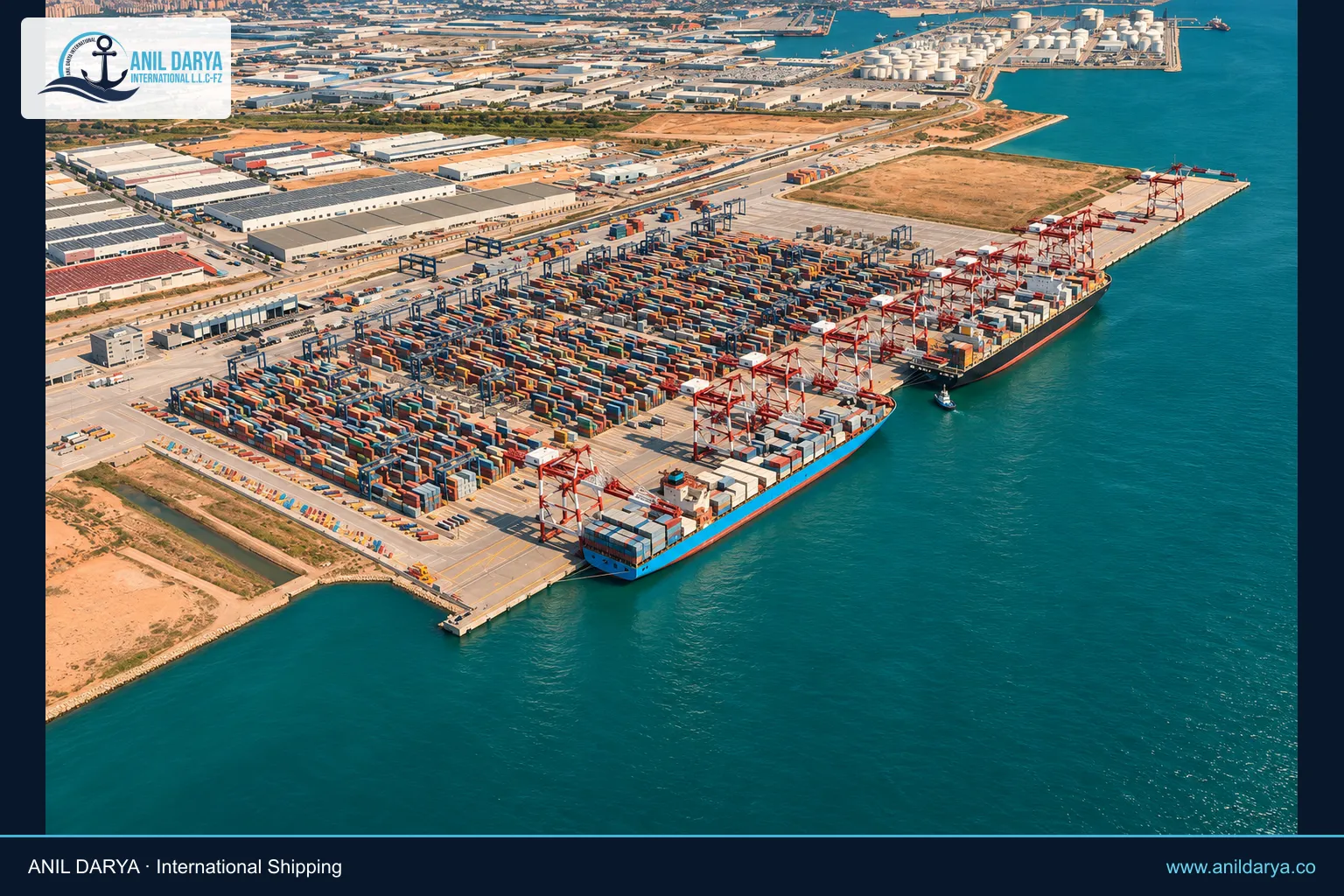
Container shipping Spain to Morocco: FCL, LCL, reefer, DG and project cargo
| Option | Typical Spanish cargo for Morocco | What to watch |
|---|---|---|
| 20ft dry | Ceramic tiles, steel, chemicals in drums, olive oil in cartons | Tiles and steel hit the weight limit long before the box is full |
| 40ft or 40ft high cube | Machinery parts, car components, furniture, packaging, paper | Invoice values and quantities must match the domiciled import commitment |
| LCL | Spare parts, samples, small retail orders | Each consignee in the shared box needs its own import title and transitaire |
| Reefer | Frozen fish, meat, dairy, fresh fruit and vegetables | Health or phytosanitary certificates from Spain and Moroccan sanitary control on arrival; WEC lists reefers on ISS PT |
| Flat rack or open top | Generators, transformers, agricultural machinery | Lashing survey, lifting points and the inland leg from the port |
| Breakbulk | Plant modules, wind parts, steel structures | Port equipment at discharge, survey and a route study inland |
If you buy from three Spanish suppliers, one consolidated FCL usually costs less than three LCL lots, and it means one bank file and one DUM in Morocco. Our comparison of FCL and LCL shows where the break-even sits, and our sea freight service handles the booking.
Spanish paints, solvents, adhesives, fertilisers and industrial gases ship as dangerous goods under the IMDG Code 2024 edition, Amendment 42-24, mandatory since 1 January 2026. In Spanish ports, Royal Decree 145/1989 governs how dangerous goods are admitted and handled. The seller supplies the UN number, class, packing group, safety data sheet and DG declaration, and the line must accept the booking before stuffing. Speak to our dangerous goods team before you give the buyer a date. Oversized machinery goes to our break bulk desk with drawings, weights and lifting points.
What the Spanish exporter files
The export side belongs to the seller or its customs representative. We coordinate the timing so the box is not left at the gate.
- Registration: the declarant needs an EORI number and a Spanish NIF, and as a rule must be established in the EU customs territory.
- Export declaration: lodged electronically in AES, the AEAT's export system. AES has been the only system for export since May 2023, and its definitive data set has applied since 15 December 2025. The old paper DUA export copy no longer exists.
- Exit: AES records the exit and issues proof that the goods left the EU.
- Controlled goods: dual-use items fall under EU Regulation 2021/821 and need a licence from the Secretary of State for Trade.
- Animal products: meat, dairy and fish for Morocco need a veterinary export certificate issued through the agriculture ministry's CEXGAN system.
Moroccan transitaires work in French. Ask the seller for a French or bilingual commercial invoice that shows HS codes, unit values and the Incoterm, so the DUM can be built straight from it.
EU-Morocco Association Agreement: duty and proof of origin
The EU-Morocco Association Agreement entered into force on 1 March 2000. The European Commission says trade in industrial products between the EU and Morocco is entirely liberalised, so Spanish-origin industrial goods enter Morocco without customs duty when they come with a valid proof of origin. Farm, processed food and fish products follow a separate agreement on further liberalisation, in force since October 2012, which still keeps quotas or reduced rates on some lines. Check your HS code in ADIL, the Moroccan tariff tool, before you price.
Which proof of origin to send
| Proof of origin | When it is used | Who issues it |
|---|---|---|
| EUR.1 movement certificate | Any consignment of Spanish-origin goods | Requested by the exporter, endorsed by Spanish customs (AEAT) before export |
| Origin declaration on the invoice | Consignments up to 6,000 euros by any exporter | The exporter, with the agreed text on the invoice |
| Origin declaration by an approved exporter | Any value | An exporter with AEAT approved exporter status; its authorisation number starts with ES |
The AEAT's guide on approved exporters explains that this status is separate from the REX registered exporter system, and that an origin declaration has the same legal value as an EUR.1. REX is not the proof used for Spain to Morocco trade under this agreement.
Old and revised Pan-Euro-Mediterranean rules
The EU-Morocco origin protocol was amended by Association Council Decision 1/2025, in force since 2 October 2025. From that date the EU and Morocco apply the transitional rules of origin in parallel with the rules of the Pan-Euro-Mediterranean Convention, and the Commission says exporters can choose the set that suits their supply chain. The choice matters when Spanish goods contain inputs from outside the EU, such as Asian components in a machine.
In early 2026 some Moroccan offices questioned proofs of origin that did not carry the words "REVISED RULES". Trade advisers reported in February 2026 that Moroccan authorities had confirmed EU proofs remain valid without the wording. Ask your transitaire what it expects and fix the certificate before sailing, because a rejected EUR.1 is paid for in storage days.
[AMIR-FACT: confirm with a Moroccan transitaire we work with whether EU EUR.1s and origin declarations from Spain are being accepted without "REVISED RULES" today, and which rule set Spanish exporters on our lane are using]
Moroccan import rules for Spanish goods
ADII, Morocco's customs administration, tells importers not to order goods abroad before they hold an import title. Its question-and-answer pages carry no version date.
Commercial register and import commitment
The importer needs a commercial register (RC) number and a place on the file of foreign trade operators. For goods free to import, the import title is the engagement d'importation (EI), filed in five copies with the Spanish seller's pro forma invoice and domiciled at an approved bank. Customs will not clear goods without the bank's stamp. The EI is valid for six months; a late one can still be accepted if a shipped-on-board B/L naming the vessel proves the goods left for Morocco before it expired. Goods on the licence list need an import licence instead.
Verification of conformity
Under Law 24-09, regulated industrial products have been subject to Morocco's verification of conformity since 1 February 2020. Depending on the product, the check happens in the exporting country before shipment or in Morocco after arrival, through approved bodies such as SGS, with the certificate handled on PortNet, the national single window. Spanish electrical appliances, building products, textiles and toys are typical lines to check before production.
[AMIR-FACT: confirm with a Moroccan transitaire whether the verification of conformity list or procedure changed in 2026, and which common Spanish exports (tiles, sanitary ware, electrical goods, auto parts) are checked at origin versus on arrival]
Customs clearance at Casablanca, Tanger Med and Nador
In BADR, the ship's agent lodges an electronic summary declaration at least 24 hours before the vessel arrives. With a crossing as short as Almeria to Nador, that deadline can fall before the box is even loaded, so the line's documentation cut-off is often earlier than the cargo cut-off. The transitaire then lodges the detailed declaration (DUM) in BADR, within 45 days of the summary declaration for sea cargo. At Tanger Med the port community system runs the import port passage from the DUM data.
| Document | Why Moroccan customs needs it |
|---|---|
| Commercial invoice from the Spanish seller | Customs value, HS codes, currency and Incoterm |
| Bank certificate and import title | The domiciled engagement d'importation, or the import licence |
| EUR.1 or origin declaration | Needed for duty-free entry; without it the full MFN rate applies |
| Conformity, sanitary or phytosanitary certificate | Where the product is regulated |
| Bill of lading and packing list | Transport proof, package count, weights and marks |
Since 1998 ADII selects DUMs by risk, so most are released on the documents; removal follows payment or a guarantee of duty and taxes.

Duty, import tax and VAT on Spanish cargo
Customs value is the price of the goods plus costs up to import, such as commissions, packing and containers. The rate is the one in force when the DUM is registered.
| Charge | Basis | Notes for Spanish goods |
|---|---|---|
| Customs duty | HS code, mostly ad valorem | Zero on EU-origin industrial goods with a valid EUR.1 or origin declaration; farm and food lines may still pay duty or fall under quotas |
| Parafiscal import tax (TPI) | Value of imported goods | Applies on top of duty; confirm the rate for your code in ADIL |
| Import VAT | 20% standard, 10% on designated goods | The Association Agreement does not cover VAT |
Duty and taxes at destination are paid by the consignee or its broker, normally before removal. ADII also offers a removal credit of up to 180 days and a deposit option, which the transitaire can request if the importer qualifies.
Restricted goods and special formalities
ADII treats imports as free in principle, with exceptions on grounds of public health, the economy, the environment, heritage and public order. It lists as prohibited weapons of war and their munitions, printed matter and recordings contrary to public morals or order, and some plants and plant products that may carry harmful organisms.
Special formalities cover food, health, plant and animal products, goods under mandatory standards and dangerous products. For Spanish olive oil, seafood, cosmetics and paints, the transitaire should check approvals in ADIL before production.
Routing via Dubai: when it makes sense
Dubai is far off the direct path between Spain and Morocco, so a Spanish box for Casablanca normally sails straight across. A Dubai stop pays only in two cases: a trader who consolidates Spanish goods with Gulf or Asian goods into one box for Morocco, or a trader who holds Spanish stock in Jafza and ships to Morocco as orders come in. Where cargo is landed or re-exported in Dubai, we handle UAE customs clearance for a fee.
Weigh the duty first. The UAE is not part of the Pan-Euro-Mediterranean origin system, and the UAE-Morocco FTA, in force since 9 July 2003, uses Arab rules of origin, so storing or repacking Spanish goods in Jafza does not make them UAE-origin and can cost the EU preference. Ask the Moroccan broker before you plan a Dubai stop. See our Jebel Ali port guide and the article on re-exporting through Jafza.
[AMIR-FACT: whether we have routed Spanish cargo for Morocco through Dubai (consolidation or Jafza stock), on which carrier from Jebel Ali to Casablanca or Tanger Med, and how the EUR.1 question was handled]
Step by step: shipping from Spain to Morocco with Anil Darya
- Send us the factory city, goods, HS codes, weights, volumes, ready date and the Moroccan delivery city.
- Name the Moroccan transitaire. It confirms duty, any licence, the conformity route and the origin wording it wants. Destination clearance is arranged with the consignee's broker before the cargo ships, and we coordinate this before we confirm the booking.
- The Moroccan importer domiciles the engagement d'importation at its bank against the Spanish pro forma.
- If the product is inspected at origin, the Spanish seller books the conformity inspection during production.
- We propose the load port, line and Moroccan port with a named vessel, and book when you accept.
- The seller issues the French or bilingual invoice and packing list, obtains the EUR.1 or signs the origin declaration, and lodges the export declaration in AES.
- The box sails. We send the B/L draft for checking and release the carrier's B/L through us.
- At Casablanca, Tanger Med or Nador the transitaire lodges the DUM, duty and taxes are paid or guaranteed, and the box is released.
[AMIR-FACT: one real Spain to Morocco cross-trade shipment we handled (cargo, Spanish load port, Moroccan port, carrier, how the EUR.1 and the transitaire were lined up, and door-to-door days), cleared for publication]
What drives the cost of shipping from Spain to Morocco?
Short-sea rates change each sailing, so we quote per booking. Here is who usually pays each part on FOB terms.
| Cost part | What moves it | Usually paid by (FOB) |
|---|---|---|
| Origin charges in Spain | Trucking or rail to the port, stuffing, export declaration, terminal handling | Seller |
| Origin documents | EUR.1 endorsement, health certificates, origin inspection | Seller, unless agreed otherwise |
| Ocean freight | Box type, load port, direct or transhipped, reefer or DG surcharges | Buyer |
| Moroccan port and line charges | Terminal handling, delivery order, container deposit, rail or truck from Tanger Med | Consignee |
| Duty, TPI and VAT | HS code, customs value, proof of origin | Consignee or its broker |
| Storage and demurrage | Missing bank stamp, rejected EUR.1, missing conformity certificate, late DUM | Whoever caused the delay, under the contract |
On a crossing this short, free days at destination start almost as soon as you book. Our article on demurrage and detention shows how quickly the daily charges build.
Checklist before the box leaves Spain
- Moroccan importer holds an RC number and is on the foreign trade operators file.
- Engagement d'importation domiciled, with values matching the pro forma.
- HS code checked in ADIL: duty with proof of origin, any food quota, TPI and VAT.
- Conformity route confirmed, and any origin inspection done before the box is sealed.
- Transitaire named, discharge port confirmed and clearance plan agreed before booking.
- EUR.1 endorsed or origin declaration signed, with the wording the transitaire asked for.
- French or bilingual invoice, packing list and a value per line.
- For DG: UN number, SDS, DG declaration and line approval. For reefers: set point and health certificate.
Mistakes that hold Spanish cargo in Morocco
- Shipping before destination clearance is agreed. A box with no transitaire ready sits at Casablanca while the free days run out.
- Ordering or loading before the import commitment carries the bank stamp.
- Assuming the EU agreement makes every product duty-free; food, farm and fish lines can still pay duty.
- Writing an origin declaration on a consignment over 6,000 euros without approved exporter status.
- Sealing a box of regulated appliances or building products before the origin conformity check.
- Missing the documentation cut-off on a one-day crossing because the summary declaration deadline came first.
- Booking "to Casablanca" when the cheapest loop discharges at Tanger Med, with no rail or truck leg priced.
Frequently asked questions
How long does sea freight from Spain to Morocco take?
Carrier documents show Valencia to Casablanca in 6 days on ONE's SPM service, Valencia to Nador in 3 days and Almeria to Nador in 20 hours on WEC Lines' ISS PT, and Bilbao to Casablanca in 5 days on WEC's Euro Maroc. Add time for export filing, Moroccan clearance and delivery.
Which Spanish port is best for shipping to Morocco?
The one closest to the factory that has a loop calling your Moroccan port. Valencia has the most options to Casablanca and Nador, Almeria and Cartagena have the shortest legs to Nador, and Bilbao suits northern Spain.
Do Spanish goods pay customs duty in Morocco?
Most Spanish industrial goods enter Morocco duty-free under the EU-Morocco Association Agreement with a valid EUR.1 or origin declaration. Agricultural, food and fish products follow separate rules and can still pay duty or fall under quotas. Import VAT of 20% (10% on designated goods) applies either way.
Is an EUR.1 needed for shipping from Spain to Morocco?
You need either an EUR.1 endorsed by Spanish customs or an origin declaration on the invoice. Any exporter can make the declaration up to 6,000 euros per consignment; above that only an approved exporter can, otherwise use an EUR.1.
Does Anil Darya clear the cargo in Morocco?
No. We book the sea freight, coordinate with the Spanish seller and release the carrier's bill of lading. The consignee's transitaire clears the goods in Morocco, and we agree that with you before we confirm the booking.
Can Spain to Morocco cargo go through Dubai?
Yes, if you consolidate it with Gulf or Asian goods or ship it from Jafza stock, but it adds distance and can cost the EU duty preference, because the UAE is outside the Pan-Euro-Mediterranean system. When cargo is landed in Dubai, we handle UAE customs clearance for a fee.
Get a quote for shipping from Spain to Morocco
Send us the factory city, goods and HS codes, ready date, Moroccan delivery city and your transitaire's name, and we will reply with a routing, a named vessel and a price. Use our freight rate inquiry form, or contact our team to plan reefer, DG or project cargo first. You can also read about our Dubai freight forwarding team.
Sources
- ONE: Spain Portugal Morocco (SPM) service launch, customer advisory of 5 September 2025
- WEC Lines: ISS PT service flyer, July 2026 (Spain to Nador transit times)
- WEC Lines: Euro Maroc service flyer, March 2024 (Bilbao and Vigo to Casablanca)
- European Commission: EU trade relations with Morocco (Association Agreement, 2025 trade)
- European Commission: Pan-Euro-Mediterranean cumulation and PEM Convention (EU-Morocco Decision 1/2025, proofs of origin)
- AEAT: Guide on approved exporters (origin declarations, 6,000 euro limit, ES authorisation number)
- AEAT: Electronic export system AES P1
- Secretary of State for Trade: Spanish export control legislation (Regulation 2021/821)
- MAPA: Export of animal products and CEXGAN certificates
- MAPA: Press note of 3 December 2025 on Spanish agri-food exports to Morocco
- BOE: Royal Decree 145/1989 on dangerous goods in ports
- Valenciaport: 2025 traffic figures
- Port of Barcelona: 2025 traffic release
- El Estrecho Digital: Port of Algeciras traffic to September 2026
- Tanger Med: Port facilities and 2024 traffic
- Tanger Med PCS: Import port passage
- Maersk: Tangier to Casablanca rail service and Casablanca traffic (August 2026)
- ADII: Import title needed before ordering
- ADII: Filing an import commitment
- ADII: Bank domiciliation of the import commitment
- ADII: Prohibited imports
- ADII: Goods subject to special import formalities
- ADII: Summary declaration deadline for sea cargo
- ADII: 45-day deadline for the detailed declaration
- ADII: Documents attached to the declaration
- ADII: Risk-based selection for inspection
- ADII: Removal credit and deposit of duties
- ADII: ADIL import tariff tool
- trade.gov: Morocco import requirements and the VoC programme
- SGS: Morocco product conformity assessment (Law 24-09, PortNet)
- PwC: Morocco import VAT and TPI (reviewed 30 April 2026)
- Pincvision: "REVISED RULES" wording and Morocco, update of 11 February 2026
- IMO: IMDG Code 2024 edition (Amendment 42-24)
- WIPO Lex: UAE-Morocco free trade agreement, in force 9 July 2003
Reviewed: 14 November 2026