
Shipping from the UK to Dubai usually means a container from Felixstowe, Southampton or London Gateway to Jebel Ali, or air cargo from Heathrow or Manchester. The UK side needs a GB EORI number and an export declaration on HMRC's Customs Declaration Service. The Dubai side needs a customs business code, a declaration with Dubai Customs and assessment of applicable duty and VAT. Most goods attract 5% duty on CIF value; standard-rated imports attract 5% VAT on the relevant tax base.
UK to Dubai shipping at a glance
| Item | Detail |
|---|---|
| Main UK load ports | Felixstowe, Southampton, London Gateway; also Liverpool, Tilbury, Immingham and Teesport |
| Main UAE discharge port | Jebel Ali (DP World), over 80 weekly services |
| Other UAE ports | Khalifa Port (Abu Dhabi), Sharjah ports |
| Modes | FCL, LCL, breakbulk and project cargo, dangerous goods, air cargo |
| UK export filing | Export declaration on CDS by the exporter or its UK agent, GB EORI required |
| CDS deadline for deep-sea containers | At least 24 hours before the container is loaded on the ship |
| UK export licences | Needed for controlled goods such as military and dual-use items, chemicals, medicines and some others |
| UAE customs authority (Dubai) | Dubai Customs |
| Importer ID in Dubai | Customs business code, registered through Dubai Trade |
| Customs duty | 5% of CIF value for most goods; alcohol 50%, cigarettes 100% |
| Import VAT | 5%, deferred to the VAT return for registered importers that link their customs number with the FTA |
| UK-GCC trade deal | Concluded 20 May 2026, not yet in force |
| Free zone next to the port | Jafza, over 11,000 businesses |
How the UK to UAE sea freight lane works
The UAE is a large market for British goods. UK government figures put total UK exports to the UAE at £15.7 billion for the four quarters to the end of 2025, making it the UK's 18th largest export market. The top goods exported over the four quarters to the end of Q1 2026 were mechanical power generators (£1.7 billion), cars (£0.7 billion), medicines and pharmaceuticals (£0.7 billion), telecoms and sound equipment (£0.5 billion) and jewellery (£0.3 billion).
That mix tells you what moves on this lane: engines and generator sets, vehicles, pharma that needs temperature control, electronics and high-value goods. Much of it is containerised. Heavy power equipment often needs a flat rack or breakbulk. Pharma and jewellery often fly.
A booking may use a through service or transshipment at a hub port. Confirm whether the cargo changes vessels and whether the quoted transit includes the connection. Read the full routing on the booking, not only the sailing date.
What adds days to the UK to Dubai transit?
| Factor | Why it matters | What to do |
|---|---|---|
| Transshipment | A missed connection at the hub port can add a week or more | Ask for the hub and the connecting vessel when you book |
| CDS and gate-in cut-offs | A container without export clearance in time stays on the quay and rolls to the next sailing | File the export declaration early, at least 24 hours before loading |
| Inland haulage in the UK | Rail and truck slots to the port fill up in peak weeks | Book the haulier when you book the vessel |
| Export licences | A controlled item without a licence is held at the border | Check the licence before the goods leave the factory |
| Dubai clearance | Missing permits or a late declaration keep the box at the terminal | File the Dubai declaration before the vessel berths |
Ask for a dated itinerary showing the loading port, carrier, any transshipment hub, estimated port-to-port transit and a separate door-to-door estimate. These are booking-specific estimates, not a guaranteed company performance record.
Which UK port should you ship from?
Pick the port that keeps UK haulage short. A long truck run to a distant port can cost more than you save on the ocean rate.
| UK port | What the operator says | Usually suits shippers in |
|---|---|---|
| Felixstowe (GBFXT) | Two container terminals, 9 container berths, 28 quay cranes; rail links to inland destinations; confirm the current service for your depot | East of England, the Midlands and the North by rail |
| Southampton (GBSOU) | DP World terminal with 5 container berths and 22 daily rail services; more than 2 million TEU handled in 2025 | South and South West England, inland terminals by rail |
| London Gateway (GBLGP) | DP World terminal on the Thames, about 28 miles from London; 3 million TEU handled in 2025; over 3,000 reefer points | London and the South East, reefer cargo |
| Liverpool (GBLIV) | Peel Ports' Liverpool2 and Royal Seaforth terminals; road and rail connections to northern and Midlands markets | North West England, Wales and the North |
| Tilbury (GBTIL) | Forth Ports; Northfleet Hope container terminal; 5 million sq ft of warehousing cited in Forth Ports’ 2023 brochure | London and Essex, cargo that needs storage near the port |
| Immingham (GBIMM) | ABP; the UK's largest port by tonnage, about 46 million tonnes a year; short-sea container feeders | Yorkshire, the Humber and Lincolnshire, bulk and heavy cargo |
| Teesport (GBTEE) | PD Ports; two container terminals, over 20 vessel calls a week, short-sea and feeder | North East England |
Ports such as Immingham and Teesport mainly run short-sea and feeder services. Cargo for Dubai from these ports usually connects with a deep-sea vessel at a European hub, or moves by rail to a deep-sea port. Ask which option the carrier offers before you choose.
Which UAE port should your cargo arrive at?
Jebel Ali is the default for Dubai and for Jafza next to it. DP World says the port has over 80 weekly services linking more than 150 ports, and handles containers, breakbulk, Ro-Ro, project cargo and IMDG dangerous goods. Our Jebel Ali port guide covers the terminals and port rules.
- Consignee in Dubai or Jafza: Jebel Ali.
- Site or warehouse in Abu Dhabi: compare Khalifa Port in Abu Dhabi to cut the truck leg.
- Consignee in Sharjah or the northern emirates: compare Sharjah port shipping.
Customs works emirate by emirate. A box discharged in Abu Dhabi is cleared there, not by Dubai Customs, so tell us the final delivery address before you book.
Sea freight from the UK to Dubai: FCL, LCL and special cargo
| Mode | Use it when | What to plan at the Dubai end |
|---|---|---|
| FCL (20ft, 40ft, high cube) | You fill most of a container | Declaration before arrival, delivery order, truck slot, empty return |
| LCL | A few pallets or cases | Release after the shared box is unpacked; your paperwork and the consolidator's must agree |
| Reefer | Pharma, food, chilled goods | Health or food approval before arrival, power at the terminal |
| Flat rack, open top, breakbulk | Generator sets, engines, vehicles, steelwork | Lifting plan, trailer, road permits for oversized loads |
| Dangerous goods | Chemicals, paints, aerosols, batteries | Carrier acceptance at origin, UAE port rules for the class |
| Air cargo | Urgent spares, pharma, jewellery, samples | Air-cargo customs procedures and applicable duty and VAT |
FCL or LCL from the UK?
FCL is sealed in the UK and released as one unit in Dubai. LCL can cost less for small loads, but release depends on unpacking, the consolidation documents and clearance of your consignment. A hold affecting the shared container can delay availability; clearance of every other consignee is not a universal release requirement. If your volume is close to a 20ft, price both. Our guide to FCL vs LCL costs shows where the break-even usually falls, and our sea freight service books both.
Before confirming LCL, request the consolidation provider, UK receiving depot, cargo cut-off, planned departure and destination handling charges in writing.
Generator sets, machinery and project cargo from the UK
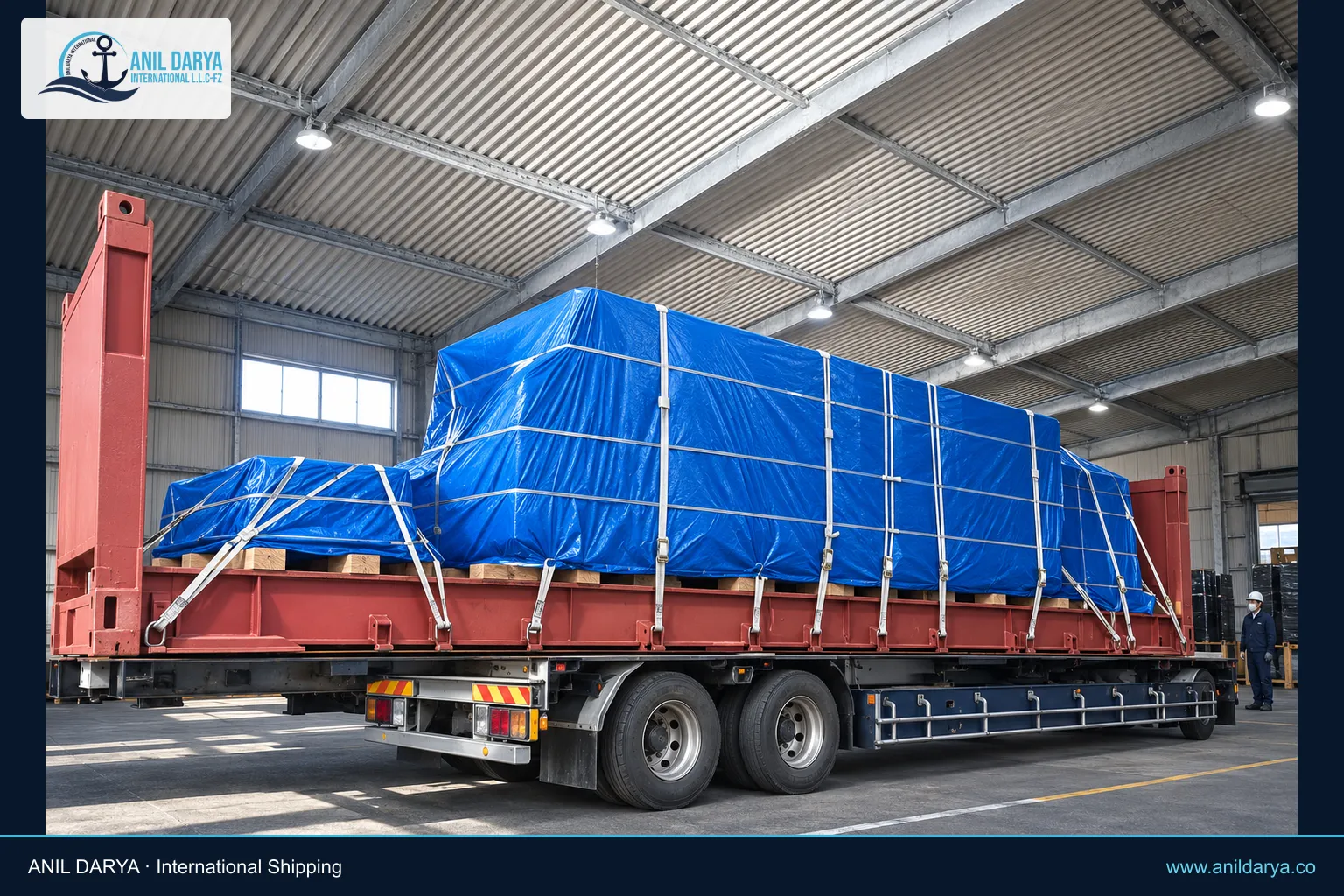
Power generators are the UK's biggest goods export to the UAE, and many units do not fit a standard container. Pieces accepted on a 40ft flat rack may use a container service, subject to dimensions, weight and carrier approval. Larger pieces need breakbulk or heavy-lift space. The UK exporter supplies drawings, weights, lifting points and the centre of gravity. At the Dubai end we plan discharge, the trailer and any road permit before the vessel arrives. See our break bulk and project cargo service.
Dangerous goods from the UK to Dubai
DG by sea follows the IMDG Code and by air the IATA Dangerous Goods Regulations. The UK shipper must confirm the classification, applicable declaration, packaging, marking and labelling requirements and obtain carrier acceptance. Supply an SDS where relevant; UN specification packaging and a signed dangerous-goods declaration depend on the classification and applicable provisions or exemptions. Jebel Ali handles IMDG cargo, but some classes may only stay in the port for a short time, so the Dubai declaration and the truck must be ready when the ship berths. Our dangerous goods shipping team checks the Dubai side before you book.
Air cargo from the UK to Dubai
Air suits spares, pharma, jewellery and samples. Request the current flight itinerary and cargo acceptance cut-off. Door-to-door transit also includes collection, screening, handling and clearance at both ends. Air is priced on chargeable weight, the higher of actual and volumetric weight. In Dubai, air-cargo customs procedures and the applicable duty and VAT apply, with an air waybill instead of a sea bill of lading. Our air cargo service handles the Dubai arrival.
What the UK exporter must do
The UK side is your supplier's job, or its UK customs agent's. We book the space with the carrier, and the pickup and export filing are done by the shipper or its origin agent. Delays there still land on your timeline, so check these points with the supplier.
- EORI. A GB EORI number is needed to export goods from England, Wales or Scotland.
- Licences. HMRC lists special rules and licences for animals and animal products, plants, drugs and medicines, medical devices, chemicals, ozone-depleting substances and F-gases, radioactive substances, diamonds, art and antiques, waste, firearms, military goods and dual-use items.
- Commodity code. Every line needs the right code for the export declaration.
- Invoice. Use the selling price, and list any freight or export insurance included in the price separately. The invoice and any licence must travel with the goods.
- VAT. UK exporters can zero rate exports, but only with valid evidence of export.
- Records. Keep invoices and customs paperwork after shipment.
When must the UK export declaration be filed?
The exporter or its agent submits the declaration and gets customs clearance before the goods may leave the UK. HMRC sets these minimum times:
| Cargo | File the export declaration at least |
|---|---|
| Container by sea to the UAE (deep-sea) | 24 hours before the container is loaded on the vessel |
| Non-containerised cargo by sea (breakbulk) | 2 hours before the goods leave the port |
| Air cargo | 30 minutes before departure from the UK airport |
At the border, the transporter needs the master reference number (MRN) from the declaration, the invoice and any licences. A departure message then tells HMRC the goods have left. If goods are held, HMRC's National Clearance Hub is the contact.
Do UK export controls apply to goods for Dubai?
They can. Controlled goods such as weapons require the appropriate export authorisation. Use the current GOV.UK application route for the licence type: some applications use LITE while others remain on SPIRE. Dual-use items, for example some electronics, sensors, chemicals and machine tools, can need a licence depending on their technical specification. Ask your supplier to confirm the control status before you place the order, not after the goods are packed.
Certificates of origin and Arab League documents
Dubai Customs lists a certificate of origin among the documents for a declaration, so ask your UK supplier for one. The Arab-British Chamber of Commerce offers export document certification and legalisation services. If your buyer, bank or letter of credit asks for chamber-certified documents, plan the time for it before the goods ship.
Customs clearance in Dubai: what British cargo needs
Dubai Customs clears cargo arriving at Jebel Ali and the other Dubai entry points. Declarations are filed online under a regime: import, export, transit, transfer or temporary admission.
Do you need a customs code to import from the UK into Dubai?
Yes. Dubai Customs says a licence holder should get a customs business code, and the declaration is filed under it. Any company with a business code can file. A clearing agent with a Dubai Economic Department clearing and forwarding licence can also clear the cargo with its own code and your authorisation. If you do not hold a code, we arrange clearance through a licensed agent.
Which documents does Dubai Customs need?
Dubai Customs lists an invoice, a packing list, a certificate of origin and a permit from the authority concerned for restricted goods. For sea cargo you also need the bill of lading and the shipping line's delivery order.
| Document | Who provides it | Why Dubai needs it |
|---|---|---|
| Commercial invoice | UK exporter | Customs value and HS code |
| Packing list | UK exporter | Inspection and LCL release |
| Certificate of origin | UK exporter, via a chamber of commerce | Origin of the goods |
| Bill of lading or air waybill | Carrier or forwarder | Transport and release information; an air waybill is not a document of title |
| Delivery order | Shipping line in Dubai | Releasing the container |
| Permit | UAE authority for the product | Restricted goods only |
| SDS and DG declaration | UK exporter | Dangerous goods only |
Get the invoice right first time. Dubai Customs charges an AED 500 fine to amend invoice-level goods information on a declaration, and AED 300 to cancel an import declaration in order to file an import for re-export instead.

Which declaration should you use?
| What happens to the goods | Declaration | Duty and VAT |
|---|---|---|
| Sold or used in the UAE mainland | Import for local use | Duty and VAT at import |
| Delivered into Jafza | Transfer into the free zone | Customs duty may be suspended under the approved free-zone procedure; VAT treatment depends on designated-zone conditions and the transaction |
| In for a time, then back to the UK | Temporary admission | Customs approval and security normally required; refund subject to compliant re-export and claim. Eligible ATA carnet goods may use the carnet guarantee |
| Passing through to another country | Transit | Under customs transit control; security and completion requirements may apply |
How much is import duty and VAT on goods from the UK to Dubai?
Dubai charges 5% duty on the CIF value for most goods. CIF is the value of the goods plus insurance and freight to the UAE. Alcohol pays 50% and cigarettes 100%. The UAE government says tariffs range from 0 to 5%, so check your HS code for exemptions.
Standard-rated import VAT is 5% on the customs value, including freight and insurance, plus customs duty and applicable excise tax. Do not add freight or insurance again if already included in that value. How you pay it depends on your VAT status.
| Your situation | Duty | Import VAT |
|---|---|---|
| Mainland importer, VAT-registered, customs number registered with the FTA | 5% of CIF at clearance | No VAT at the border; it appears in your next VAT return |
| Mainland importer, not VAT-registered | 5% of CIF at clearance | Paid through the FTA's VAT301 form before release |
| Clearing agent importing for a registered importer | 5% of CIF | Agent declares the importer's TRN so the importer accounts for the VAT |
| Goods moved into Jafza | Duty suspension depends on the approved customs procedure | Depends on designated-zone conditions, the goods and the transaction; not a blanket VAT exemption |
Freight from the UK is part of the duty base. A long sea leg adds more to CIF than a short one, so use the real freight cost in your landed-cost sums.
Does the UK-GCC trade deal cut UAE duty on British goods?
Not yet. The UK concluded a trade deal with the Gulf Cooperation Council on 20 May 2026. The UK government's summary, updated 10 June 2026, says it enters into force only once the UK and the GCC member states finish ratification. Until then, UK goods pay the normal UAE duty.
What the UK summary says the deal will do once in force:
- Remove tariffs on around 93% of UK exports to the GCC, with most trade liberalised at entry into force and some lines after 5 or 10 years.
- Fully liberalise 90% of GCC tariff lines 10 years after entry into force.
- Remove duty at entry into force on 90% of current UK car exports to the GCC; electric vehicles and batteries after 10 years.
- Apply rules of origin: goods must be wholly obtained or significantly transformed in the UK or the GCC.
- Provide for clearance within 48 hours, or 6 hours for perishables, when all requirements are met and no physical checks are needed.
So keep origin paperwork from your UK suppliers clean now. When the deal applies, a valid proof of UK origin will decide whether you get the lower rate.
Re-exporting British goods through Dubai
Many UK shipments are bought by Dubai traders who sell on to other markets. Jafza, next to Jebel Ali Port, calls itself the largest customs bonded zone in the Middle East and hosts over 11,000 businesses. Goods admitted under an approved free-zone procedure can remain under customs duty suspension for storage and re-export. Mainland release normally triggers applicable import charges; designated-zone VAT rules must be assessed separately. Our guide to Jafza re-export explains the flow for bulk and breakbulk cargo.
Equipment for a temporary purpose may qualify for temporary admission, subject to Customs approval of the goods, use and period. A duty-equivalent deposit is normally required and may be reclaimed after compliant re-export within the authorised period. For eligible goods covered by an accepted ATA carnet, Dubai Customs states that no separate deposit applies; admission is limited to six months or the remaining carnet validity, whichever is shorter.
Restricted and prohibited goods in the UAE
Dubai Customs says some goods need approval from the authority concerned before release, and the approval goes in with the other documents. Goods that go against the country's values and morals are banned. Books, discs and other media are released only after inspection by the information authority. Points that catch UK shippers:
- Medicines and medical products need approval from the health authority.
- Food, cosmetics and other consumer products may need a permit or registration before release; ask the authority concerned before you ship.
- Rough diamonds need a Kimberley Process certificate, or the shipment is impounded.
- Chemicals, pesticides and telecom or wireless equipment often need a permit.
Apply for the permit before the goods sail. A permit sought after arrival means storage and container charges while you wait.
What affects the cost of UK to UAE freight?
We do not publish prices because they change with every booking. These are the parts of the total and what moves them.
| Cost part | What moves it |
|---|---|
| UK collection and export | Haulage distance, rail or road, customs agent's fee for the CDS declaration |
| UK terminal and origin charges | Port, container type, LCL consolidation |
| Sea or air freight | Container size or chargeable weight, season, carrier, surcharges, special equipment |
| DG and out-of-gauge | DG surcharges, flat rack or breakbulk premiums, lashing and survey |
| Dubai terminal and delivery order | Terminal handling, documentation, LCL unpacking |
| Duty and VAT | CIF value and HS code |
| Delivery in the UAE | Distance, truck type, unloading equipment |
| Delays | Demurrage and detention when free time runs out |
Agree the Incoterm with the UK seller first. On EXW the buyer's side must arrange the UK export filing, which a UK seller can do far more easily. For container cargo handed to a carrier at a terminal, consider FCA with the named delivery place. FOB is for sea or inland-waterway delivery on board the vessel; choose the rule to match the actual handover.
How to ship from the UK to Dubai: step by step
- Agree the Incoterm and who files the UK export declaration.
- Send us the cargo details: commodity, HS code, weight, volume or drawings, UK pickup address, ready date and any DG.
- Get the routing and quote. We compare UK ports, FCL, LCL and air.
- Check controls both ways: UK export licence status and any UAE permit.
- Book space. For DG, reefer or out-of-gauge cargo we get carrier acceptance first.
- The supplier or its UK agent collects the goods and files the export declaration on CDS before the cut-off.
- We check the invoice, packing list, certificate of origin and draft bill of lading against each other before sailing.
- We file the Dubai declaration before arrival so it is ready when the vessel berths.
- We arrange payment of the duty and VAT if due, and collect the delivery order.
- Deliver to your site or Jafza warehouse, and return the empty within free time.
Our Dubai freight forwarding team handles the UAE end of each step.
Checklist before your UK supplier ships
- Incoterm agreed in writing, with the UK exporter of record named.
- GB EORI of the exporter and the CDS filing arranged.
- UK export licence status checked for every line.
- HS code confirmed and the UAE duty rate checked.
- Invoice, packing list and bill of lading show the same weights, pieces and consignee.
- Certificate of origin requested from the supplier.
- UAE permits applied for if the goods are restricted.
- Dubai Customs business code ready, or a licensed agent authorised.
- Customs number registered with the FTA if you want to defer import VAT.
- For DG: classification, applicable transport documents and packaging, and carrier acceptance; SDS where relevant.
- For project cargo: drawings, weights, lifting points and a UAE road plan.
- Free time agreed and cargo insurance in place.
Common mistakes British shippers make
- EXW with no UK exporter of record. Nobody is set up to file the CDS export declaration.
- Late export filing. The deep-sea container declaration must normally be submitted at least 24 hours before loading; customs permission and the carrier’s separate cut-offs must also be met.
- Assuming the UK-GCC deal already applies. It is not in force yet, so budget for 5% duty.
- Undeclared lithium batteries, aerosols or perfumes booked as general cargo.
- Invoice details that need amending in Dubai, which brings a fine.
- Wrong UAE port. Discharging in Dubai for an Abu Dhabi site adds trucking and may change who clears the cargo.
- No truck booked for arrival, so the box sits at the terminal and free time runs out.
Frequently asked questions
Which UK port is best for shipping to Dubai?
Felixstowe, Southampton and London Gateway have the most deep-sea services. Choose the one closest to your supplier to keep UK haulage short, and compare rail from Felixstowe or Southampton if the goods are in the Midlands or the North.
Who files the UK export declaration?
The UK exporter or its customs agent files it on HMRC's Customs Declaration Service, using a GB EORI number. For a deep-sea container it must be filed at least 24 hours before loading.
What is the customs duty on goods from the UK to Dubai?
Dubai Customs charges 5% of the CIF value for most goods, 50% on alcohol and 100% on cigarettes. Some goods are exempt, so check the HS code.
Is the UK-GCC free trade agreement in force?
No. It was concluded on 20 May 2026 and enters into force only after the UK and the GCC states complete ratification. Until then the standard UAE duty applies to UK goods.
Do I pay VAT when I import from the UK to Dubai?
Standard-rated imports attract 5% VAT; confirm whether an exemption or other treatment applies to your goods. A VAT-registered importer that has registered its customs number with the FTA accounts for it in the VAT return. An unregistered importer pays before release.
Do I need a licence or customs code to import into Dubai?
Yes. The importer needs a Dubai Customs business code based on its trade licence. A licensed clearing agent can file with its own code and your authorisation.
Can I ship UK goods into Jafza without paying duty?
Goods admitted under an approved free-zone procedure may benefit from customs duty suspension for storage and re-export. Mainland release normally attracts import charges. Confirm the separate designated-zone VAT treatment for the transaction.
How long does air cargo from the UK to Dubai take?
Ask for a dated itinerary and door-to-door estimate for your cargo. Flight time alone excludes collection, screening, terminal handling and customs clearance.
Get a quote for shipping from the UK to Dubai
Send us the cargo, the UK pickup point and the UAE delivery address, and we will reply with a routing and price, including clearance in Dubai. Use our freight rate inquiry form or contact our team.
Sources
- GOV.UK: Export goods from the UK, step by step (EORI, licences, invoice, proof of origin, records)
- GOV.UK: Get UK customs clearance when exporting goods (MRN, SPIRE, licences, National Clearance Hub)
- HMRC: Making a full export declaration (filing times, departure message)
- HMRC: VAT on goods exported from the UK (Notice 703)
- GOV.UK: UK-Gulf Cooperation Council trade deal (concluded 20 May 2026)
- GOV.UK: UK-GCC trade deal conclusion summary (updated 10 June 2026)
- Business.gov.uk: Exporting from the UK to the UAE, market guide (trade figures, top goods)
- Arab-British Chamber of Commerce: Export documentation
- Port of Felixstowe: Container terminals
- Port of Felixstowe: Connectivity and rail
- DP World Southampton: Infrastructure facts
- DP World London Gateway: Infrastructure facts
- Peel Ports: Port of Liverpool
- Thames Freeport: Port of Tilbury and London Gateway
- ABP: Port of Immingham
- PD Ports: Teesport containers
- DP World: Jebel Ali Port (services, cargo types)
- Dubai Customs: Submit customs declaration (regimes, documents, fines)
- Dubai Customs: Frequently asked questions (duty, business code, agents, temporary admission, ATA carnet)
- UAE Government portal: Customs duty and tariff
- Federal Tax Authority: VAT guide (import VAT, deferral, clearing agents)
- Jafza: About Jebel Ali Free Zone
Reviewed: 16 November 2026