
Shipping from USA to Bahrain is a long sea voyage from an East Coast, Gulf Coast or West Coast port to Khalifa Bin Salman Port at Hidd, usually with a change of ship at a Gulf hub. The big difference from most Gulf lanes is the US-Bahrain Free Trade Agreement: goods that qualify as US-originating and are imported directly can enter Bahrain without customs duty, while everything else pays the GCC rate of 5% on CIF value. Anil Darya books this lane from Dubai as a cross-trade and keeps the shipping line, the American shipper and the Bahraini clearing agent working to one plan.
USA to Bahrain shipping at a glance
| Question | Short answer |
|---|---|
| US load ports | Baltimore, Jacksonville, Newark, Norfolk, Charleston, Savannah, Houston; Los Angeles and Long Beach for cargo made in the western states |
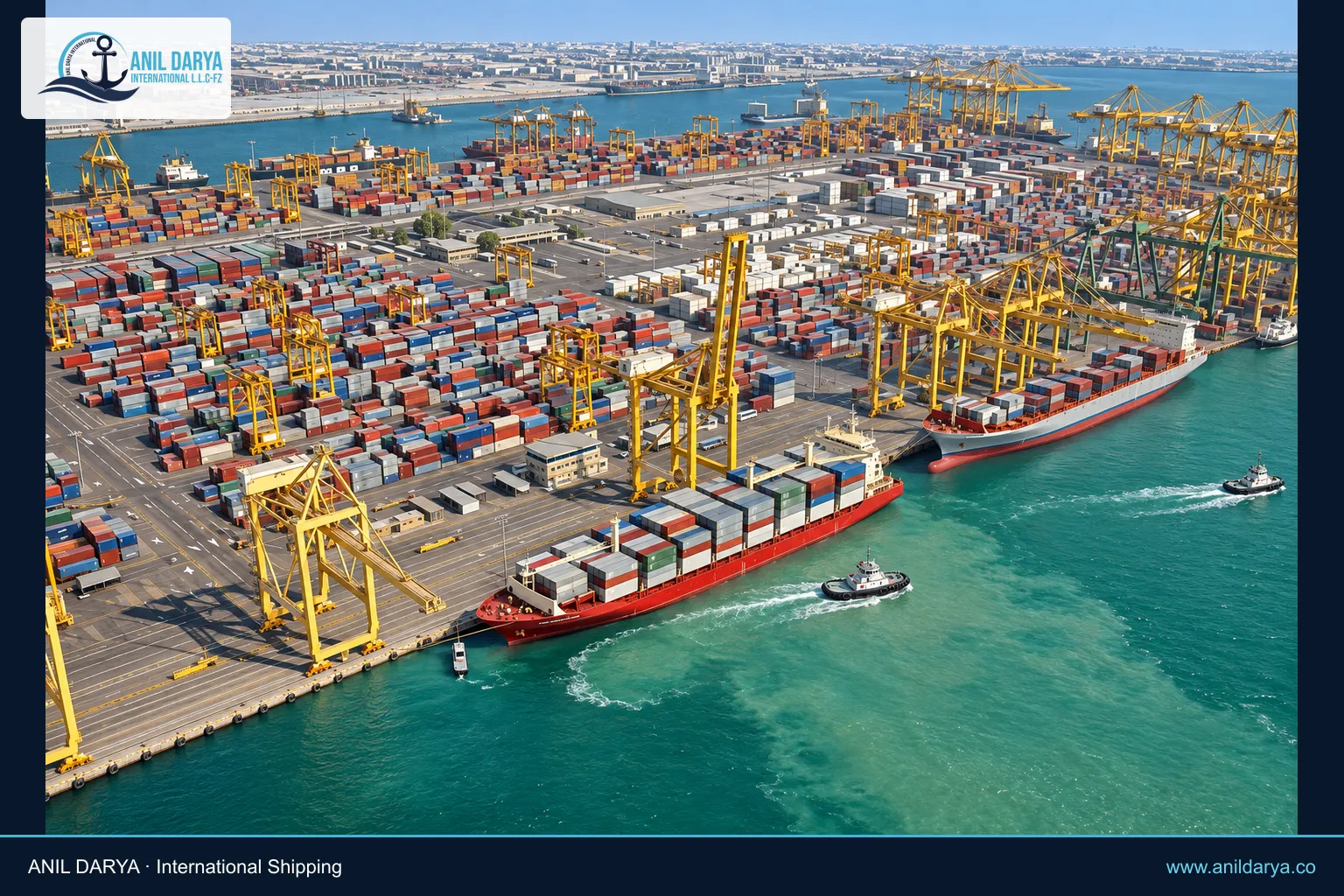
| Bahrain discharge port | Khalifa Bin Salman Port (KBSP), described by its operator APM Terminals Bahrain as the only general commercial port facility in the country |
| Routing | Mainline ship to a hub, then a feeder; NYK RoRo's February 2026 sheet marked Bahrain "T/S via JEA" (Jebel Ali) |
| US export filing | Electronic Export Information in AES; the ITN goes to the carrier at least 24 hours before loading |
| Bahrain declaration | Filed in OFOQ, the Customs Affairs system, by the importer or its licensed clearing agent |
| Duty | 0% for qualifying US-origin goods under the FTA; otherwise 5% of CIF for most goods, with much higher rates on alcohol and tobacco |
| VAT | 10% standard rate since 1 January 2022, administered by the National Bureau for Revenue |
| Who pays duty and VAT | The consignee or its clearing agent in Bahrain |
How shipping from USA to Bahrain works as a cross-trade
The cargo touches the UAE only if you choose a Dubai option. The work is split like this:
| Task | Who handles it |
|---|---|
| Choosing the carrier, the hub and the equipment; booking the space | Anil Darya, with the shipping line |
| Pickup at the factory or warehouse, trucking or rail to the US terminal, stuffing the container | The American shipper or its US forwarder, working to the cut-offs we pass on |
| AES filing, export licence checks, origin statements on the invoice | The US exporter (the USPPI) or its filing agent |
| Bill of lading | The shipping line's own B/L, released to you through us |
| OFOQ declaration, FTA claim, ministry approvals, duty and VAT, delivery from KBSP | The Bahraini importer and its clearing agent |
Anil Darya acts as agent for many shipping lines. On a Bahrain booking that means the line's bill of lading, written from the US load port through the hub to KBSP, is drafted against your invoice, checked by our Dubai desk and released once the agreed freight terms are met. We have no office, yard or agent in the United States or in Bahrain, and we do not issue a house bill of lading on this lane.
Decide the Incoterm before anything else. A Manama distributor that wants to pick the line and control the free time at KBSP buys FOB Houston or FOB Savannah, and we book the ocean leg for the buyer. If the American seller sells CFR Khalifa Bin Salman, the seller pays the freight, but terminal charges in Bahrain, duty and VAT stay with the buyer. Our guide to Incoterms 2020 for sea freight sets out who carries which cost.
Which US port should you load at?
Pick the port nearest the factory or warehouse that has a Middle East service; inland US rail and trucking can cost more than the gap between two ocean quotes.
| US gateway | What we checked | Bahrain cargo it suits |
|---|---|---|
| Baltimore | The Maryland Port Administration ranks it the number one US port for roll-on/roll-off cargo; NYK RoRo loads at its Dundalk and Fairfield terminals | Vehicles, trucks, construction and aluminium-plant machinery |
| Jacksonville (Blount Island) | A load port on NYK RoRo's US to Middle East sheets | Rolling equipment from the Southeast |
| Houston | Port Houston ranks first in the US for foreign waterborne tonnage, 220.1 million short tons in 2024, and handles 75% of Gulf Coast container traffic | Oil and gas tools, valves, pipe, refinery spares, resins |
| Newark, Norfolk, Charleston, Savannah | The main Atlantic container gateways, all on Maersk's MECL eastbound rotation from July 2026 together with Houston | FCL and LCL from the Northeast, the Carolinas and Georgia |
| Los Angeles, Long Beach | West Coast container gateways | Goods made or warehoused in the western states |
Khalifa Bin Salman Port: where American cargo lands
Several forwarder pages still send Bahrain cargo to Mina Salman or Sitra. For containers, book KBSP. APM Terminals Bahrain has run it under an exclusive government concession since 2009 and lists these facts for the terminal:
| Item | KBSP figure |
|---|---|
| Quay length | 1,800 m |
| Maximum quayside depth | 15 m |
| Ship-to-shore cranes | 4 post-Panamax, plus 12 rubber-tyred gantries in the yard |
| Reefer plugs | 840 |
| Largest vessel | 14,000 TEU and 360 m, larger by prior arrangement |
| Capacity | 1 million TEU a year initially, with potential for 3 million |
The Ministry of Transportation and Telecommunications lists general cargo and Ro-Ro facilities beside the container terminal, and the operator publishes gate rules for container moves over the King Fahd Causeway to and from Saudi Arabia.
Sea freight from USA to Bahrain: hubs and published schedules
We found no carrier schedule from a US port straight into KBSP. Carriers publish a mainline voyage to a larger port, then an onward leg.
| Carrier source we opened | US side | What it shows for Bahrain |
|---|---|---|
| NYK RoRo USEME sheet, week 8, 20 February 2026 | Jacksonville, Baltimore (Dundalk and Fairfield), Freeport, Newark | Calls at Jebel Ali, Khalifa (Abu Dhabi), Dammam and Sohar; Bahrain marked "T/S via JEA" on all three sailings |
| NYK RoRo USEME sheet, week 15, 7 April 2026 | Same port list | "Service suspended until further notice"; this is still the only USEME sheet on NYK's schedule page in November 2026 |
| Bahri multipurpose liner | US East Coast, Gulf Coast and Canada | Direct to Jeddah, Dubai, Dammam and Mumbai on an 18-day frequency; Bahrain is not named |
| Maersk MECL (eastbound from July 2026) | Charleston, Savannah, Houston, Norfolk, Newark | Calls Tangiers, Jeddah, Salalah and Indian ports; no Gulf port named, so Bahrain needs a feeder from another hub |
| Emirates Shipping Line JBX advisory, February 2024 | None (feeder) | A weekly Jebel Ali, Bahrain, Jebel Ali shuttle |
On the February NYK sheet, Selene Leader was due at Baltimore Fairfield on 19 March 2026 and at Jebel Ali on 9 May, with Bahrain units relayed from there. Those were estimates, and the April sheet shows the service suspended, so ask us for the current position before buying vehicles for this lane.
A Bahri sailing to Dammam plus a truck over the causeway, or MECL plus a feeder from Salalah, are possible connections we inferred from the sheets, not published through routings.
[AMIR-FACT: the carriers and services Anil Darya actually books from US East Coast, Gulf Coast and West Coast ports to KBSP in 2026 (container and Ro-Ro), the hub each one relays at, and our real port-to-port days]
The Dammam and causeway option
A box discharged at Dammam can be trucked over the King Fahd Causeway to Bahrain in transit through Saudi Arabia. The Saudi leg needs a transit declaration on ZATCA's Fasah platform, filed by a customs broker, and the Bahraini agent then clears the goods at the causeway. For FTA cargo, nothing may be done to the goods in Saudi Arabia except transport.
FCL, LCL, vehicles, project cargo and DG
Full and part containers
A 20ft box suits heavy drilling spares, valves and pallets of lubricants; a 40ft high cube suits medical devices, IT hardware, furniture and retail stock. LCL suits first orders, but each lot needs its own invoice and Bahraini declaration. APM Terminals Bahrain wants the LCL delivery order and payment receipt by 15:30 on the day before the collection booking. Our FCL vs LCL guide helps you find the break-even, and our sea freight service lists the equipment we book.
Vehicles and machinery on wheels
American SUVs and construction machines usually move Ro-Ro to a Gulf hub, then on a feeder. US Customs and Border Protection needs the title or a certified copy plus two copies, with the vehicle presented at least 72 hours before export by sea. We found no official Bahraini source on used-car age limits, and competitor pages disagree, so confirm the model year with the importer's agent before you bid at a US auction.
[AMIR-FACT: Bahrain's current rules for importing used passenger cars and trucks from the US (age limits, registration conditions, which authority), with the official source and date]
Breakbulk and project pieces
Compressors, transformers, pump skids and parts for Bahrain's refinery, aluminium and petrochemical plants often exceed a container. Flat racks and open tops take moderate pieces on a container line; heavier units need multipurpose tonnage such as Bahri's, which carries heavy-lift, Ro-Ro and containers on one ship. Leaving KBSP, any load over 5 m high must be notified to the traffic department for an escort. See our note on flat rack, open top and out-of-gauge cargo.
Dangerous goods
Paints, oilfield chemicals, aerosols and lithium batteries move under the IMDG Code. At KBSP, Class 1 and Class 7 cargo needs government approval shared with the terminal 72 hours before the ship arrives, and the agent must send the SDS and the hazardous manifest 72 hours ahead for every DG box. On a hub routing, the relay port and the feeder must accept the class too. Our dangerous goods desk checks the declaration against each line's rules before we request space.
The US export side: AES, licences and origin papers
The American exporter or its forwarder files with US agencies; we file nothing in the US.
- EEI must be filed in AES, the export module of ACE, when any Schedule B line is worth more than $2,500 or when the goods need an export licence. ACE AESDirect is free to use.
- For ocean cargo, the ITN or exemption legend must reach the carrier at least 24 hours before loading.
- Check each item against the Commerce Control List. Unlisted items are EAR99. A listed item needs a licence for Bahrain only if the Country Chart shows an "X" for its reason for control and no licence exception applies.
For the FTA, the commercial invoice matters more than any certificate. Bahrain Customs asks for an invoice showing the country of origin as "USA" and goods clearly marked "USA". The Bahrain.bh customs service page lists the B/L, invoices and a certificate of origin "if required". Ask the clearing agent whether it also wants a chamber-certified certificate for non-FTA goods before the American shipper orders one.
Is US cargo duty-free in Bahrain under the FTA?
Often, yes. The US-Bahrain Free Trade Agreement has been in force since 2006, and US trade officials say all two-way trade in industrial and consumer products became tariff-free on day one. Some agricultural items are the exception, so check food lines in Bahrain's FTA schedule.
The agreement text (Chapter Four, Article 4.1) sets three tests. The good must be imported directly from the US into Bahrain, and it must be either wholly obtained in the US or Bahrain, or a new or different article made there in which US and Bahraini materials plus direct processing costs reach at least 35% of the appraised value at import. Article 4.3 says simple combining, packaging or dilution with water does not make a good originating. Textiles and apparel follow their own rules in Chapter Three, generally yarn forward, and the tariff preference level for non-qualifying fabric expired in 2016.
| US product | Likely FTA result |
|---|---|
| Valves machined in Texas from US steel | Originating; 0% if shipped directly |
| Machinery assembled in Ohio with imported parts | Originating only if US and Bahraini content plus processing reaches 35% |
| Asian-made electronics repacked in a US warehouse | Not originating; 5% of CIF |
| US-made garments from imported yarn | Not originating under the yarn-forward rule; check with the agent |
How the importer claims the preference in Bahrain
The claim belongs to the Bahraini importer, not the US exporter. Under Article 4.10, an importer that claims the preference is deemed to certify that the goods qualify and must give Bahrain Customs, on request, a declaration on how the goods were produced, with invoice numbers, the bills of lading and the origin and value of materials. Bahrain Customs asks the importer to write this phrase on the customs declaration: "The goods satisfy the provisions of the FTA between the Kingdom of Bahrain and the USA". The importer keeps the supporting papers for five years, and Bahraini officials may verify a claim for five years after import.
When a Dubai stop or a split can cost the preference
Article 4.9 says goods are not imported directly if they undergo production or "any other operation" outside the two countries, other than unloading, reloading or work needed to keep them in good condition or transport them. A container relayed at Jebel Ali on the carrier's through B/L fits that wording. Opening the container in Dubai, splitting the lots, relabelling or repacking may not. If you plan to store American goods in JAFZA or split them in Dubai for several Gulf buyers, agree it with the Bahraini clearing agent first, and assume the 0% rate is at risk until the agent confirms it in writing.
Bahrain customs: OFOQ, documents and approvals
Bahrain's Customs Affairs, part of the Ministry of Interior, runs declarations in OFOQ. The US International Trade Administration says importers or their local agents complete a customs bill of entry, and strongly advises a registered, licensed clearing agent. The declaration can be lodged before the goods arrive.
| Document | What the Bahraini agent checks |
|---|---|
| Bill of lading | Bahraini importer as consignee, KBSP as port of discharge, through routing that shows the hub |
| Commercial invoice | Country of origin "USA", values, quantities, weights, HS codes, and the US exporter's details |
| Packing list | Contents of each package; HS and UN numbers for chemicals and DG |
| Certificate of origin | Only if the agent or the product rules require one |
| FTA production declaration | Prepared in advance from the US maker's data, handed over on request |
| Proof of conformity | For products regulated by the MOIC Testing and Metrology Directorate |
For products under the Ministry of Industry and Commerce's Testing and Metrology Directorate, the agent raises a separate OFOQ clearance request with invoices, packing lists and proof of conformity, and the decision comes back in OFOQ. Ask which certificate MOIC wants before the US factory ships.
Food needs a Ministry of Health import permit, applied for with a packing list, the B/L and a health certificate, and US beef and poultry also need a halal slaughter certificate from an approved Islamic centre. Medicines may be imported only by an MOIC-licensed pharmacy or drug store after Ministry of Health approval, from a maker whose product is registered in at least two other GCC states, one of them Saudi Arabia.

Duty, VAT and excise on American goods in Bahrain
Goods that do not qualify under the FTA pay the GCC common external tariff: 5% of CIF for most goods, and CIF includes the long ocean freight from America. Alcohol and tobacco pay far higher rates, and published sources disagree on the exact figures, so ask the agent for the current rate on those lines. Excise also applies at 100% on tobacco and energy drinks and 50% on soft drinks, according to PwC's summary reviewed on 26 July 2026.
VAT is 10% from 1 January 2022 and is administered by the National Bureau for Revenue. A Bahrain VAT guide explains that import VAT is calculated on the customs value including duty and excise, is normally paid with the duty before release, and can be deferred to the VAT return by a registered importer that the NBR approves. Duty and taxes at destination are paid by the consignee or its broker.
| How the US goods reach Bahrain | Duty position |
|---|---|
| Through B/L, US port to KBSP, relay at a hub, originating goods | 0% with the FTA claim; VAT still due |
| Same routing, non-originating goods | 5% of CIF plus VAT |
| Stored or split in a Dubai free zone, then shipped on | FTA preference at risk; agree with the agent first |
| Cleared and duty paid into mainland UAE first | GCC duty already paid at first entry; trade.gov says first-entry certificates prove it, so the FTA saving is lost |
Restricted and prohibited goods in Bahrain
The US International Trade Administration's list, last published 1 December 2025, prohibits narcotics including CBD oil, used and reconditioned tyres, cultured pearls, cigarette advertising, radio-controlled model aircraft, toy guns that fire projectiles, asbestos, raw ivory and rhino horn, live swine and material against public morals. Used tyres sent with vehicles and CBD products legal in many US states catch American exporters most.
Agree the Bahraini clearing agent before the cargo leaves the US
We do not sell customs clearance in Bahrain. The importer uses its own licensed clearing agent, and we confirm the booking only once that agent has accepted the job and seen the draft invoice. Finding out at KBSP that nobody can file the FTA claim is the most expensive mistake on this lane.
The agent confirms the HS codes, the FTA position and any approvals before we send the US shipper its cut-offs. A box that lands without a ready agent sits in the terminal while charges grow; our guide to demurrage and detention explains how they start.
Where Dubai fits on the US to Bahrain lane
Jebel Ali is often the hub already, and you can also use Dubai on purpose if you weigh the FTA rule above.
| Option | How it works | Who it suits |
|---|---|---|
| Relay at Jebel Ali on the line's through B/L | The box or vehicle changes ship and continues to KBSP, for example on a Jebel Ali to Bahrain feeder | Most container and Ro-Ro shipments that need the FTA rate |
| Consolidation in Dubai | US cargo joins goods from Europe or Asia and leaves for Bahrain in one container | Bahraini buyers with suppliers in several countries, where the US goods are non-originating or small |
| Stock in JAFZA, released in lots | American goods wait in the free zone and go to Bahrain as orders come in | Distributors covering several Gulf markets, after checking the FTA effect |
Jebel Ali has over 80 weekly services to more than 150 ports and handles Ro-Ro, breakbulk, reefer and IMDG cargo, as our Jebel Ali port guide shows. For the free zone route, read our note on re-exporting through JAFZA. When goods are cleared into, or re-exported from, Dubai, we handle the Dubai customs clearance for a fee.
[AMIR-FACT: whether Anil Darya routes USA to Bahrain cargo through Jebel Ali in practice (relay, consolidation or JAFZA stock), which feeder we use to KBSP, how many days the relay adds, and whether any relayed or stored US cargo kept its FTA rate in Bahrain]
What American cargo goes to Bahrain?
USTR puts US goods exports to Bahrain at $1.3 billion in 2025, down 22.1% from 2024. Typical loads are valves, pumps and drilling spares from Houston, machinery and vehicles from Baltimore and Jacksonville, and medical, IT and consumer goods in FCL and LCL from the Atlantic ports.
What decides the cost of shipping from USA to Bahrain?
Ocean rates change with each sailing, so we do not publish them. Your landed cost is built from these parts:
| Cost part | Usually paid by | What moves it |
|---|---|---|
| Inland US trucking or rail, terminal charges, AES filing, CBP vehicle checks | Seller on FOB, buyer on EXW | Distance to the port, rail ramp, filer fees |
| Ocean freight and the feeder to KBSP | Set by the Incoterm | Coast, hub, Ro-Ro or container, DG or reefer, season |
| KBSP terminal charges, storage, clearing agent fee | Buyer or its agent | Days in the terminal, inspection, DG class, LCL handling |
| Duty, excise and VAT | Consignee | FTA status, HS code, CIF value |
Free time and KBSP charges change often, so confirm the dated tariff with the line before you ship, and check that each quote covers the feeder leg into Bahrain.
Shipping from USA to Bahrain step by step
- Agree the Incoterm, the delivery site in Bahrain and whether the goods should be shipped under the FTA.
- Send us the commodity, HS code, weights and sizes, US pickup city, ready date, and any vehicle, DG, reefer or oversized detail.
- We propose the US load port, the carrier and hub, and any Dubai or Dammam option, with the FTA effect of each.
- The importer names its clearing agent, and we agree the clearance plan with that agent before the booking is confirmed.
- The US maker prepares the origin data for the FTA declaration, and MOIC, food or DG approvals start.
- We book the space; the US shipper delivers to the terminal, presents any used vehicle to CBP 72 hours ahead, and files EEI so the ITN reaches the carrier 24 hours before loading.
- We check the draft B/L against the invoice and packing list, and the line's B/L is issued and released to you through us.
- The agent lodges the OFOQ declaration with the FTA phrase before arrival, the consignee pays any duty and VAT, and the cargo leaves KBSP.
[AMIR-FACT: one real USA to Bahrain cross-trade shipment Anil Darya booked (cargo, US load port, carrier and hub, days taken, whether the FTA rate was granted, and one problem we solved), cleared for publication]
Our Dubai freight forwarding team runs these steps with the American shipper and the Bahraini agent.
Checklist before the cargo sails from the US
- Incoterm, delivery site and FTA intention written into the sales contract.
- Bahraini clearing agent confirmed; importer named as consignee on the draft B/L.
- Invoice states country of origin "USA"; goods and cartons marked "USA".
- US maker's origin data ready: materials, values, processing, 35% test where it applies.
- MOIC conformity proof, food permit, health and halal certificates where needed.
- ECCN or EAR99 checked, EEI filed and the ITN with the carrier.
- DG: SDS, IMDG declaration, Class 1 or 7 approvals, acceptance by the hub and feeder.
Mistakes that cost money on this lane
- Shipping before destination clearance is agreed. With no agent in place, the box waits at KBSP and charges build.
- Assuming every product shipped from America is duty-free. Goods only stored or repacked in the US are not US-originating.
- Opening and splitting FTA cargo in Dubai, then expecting the 0% rate in Bahrain.
- Leaving the FTA phrase off the Bahraini declaration, or throwing away the cost records the importer must keep for five years.
Frequently asked questions
How long does shipping from the USA to Bahrain take by sea?
It depends on the coast, carrier and hub. On NYK RoRo's February 2026 sheet, a ship due at Baltimore on 19 March reached Jebel Ali on 9 May, with Bahrain cargo relayed from there. Our quotes carry the carrier's own dates.
Is there a direct ship from the US to Bahrain?
Not in the carrier schedules we opened. US cargo changes ship at a hub such as Jebel Ali, or lands at Dammam and crosses the King Fahd Causeway by truck.
Do American goods pay import duty in Bahrain?
Goods that originate in the US under the FTA rules and are imported directly pay no duty. Other goods pay 5% of CIF for most items. VAT at 10% applies either way, paid by the consignee or its agent.
Do I need a certificate of origin for the US-Bahrain FTA?
The agreement does not require one. The importer claims the preference on the declaration, the invoice shows "USA" as origin, and a production declaration is given if customs asks.
Can US cargo stop in Dubai and keep the FTA rate?
A relay at Jebel Ali on a through B/L is transport, which the agreement allows. Splitting, repacking or relabelling in Dubai can break the direct-import rule, so confirm with the Bahraini agent first.
Which port in Bahrain receives US containers?
Khalifa Bin Salman Port at Hidd, run by APM Terminals Bahrain, the country's only general commercial port facility.
Does Anil Darya clear customs in Bahrain?
No. The importer's licensed clearing agent files in OFOQ. We agree that arrangement before we confirm the booking.
Get a quote for shipping from the USA to Bahrain
Send us the US pickup city, the Bahrain delivery site, the cargo and HS code, the ready date and your clearing agent's name if you have one. Use our freight rate inquiry form, or contact our team to talk through an FTA, vehicle or project move first.
Sources
- USTR: US-Bahrain FTA, Chapter Four, Rules of Origin
- USTR: Bahrain trade summary (2025 goods exports)
- US International Trade Administration: US-Bahrain FTA
- US International Trade Administration: Bahrain FTA textiles and Bahrain Customs requirements
- US International Trade Administration: Bahrain import tariffs (1 December 2025)
- US International Trade Administration: Bahrain import requirements (1 December 2025)
- US International Trade Administration: Bahrain prohibited and restricted imports (1 December 2025)
- Bahrain.bh: Pay the customs declaration (Customs Affairs, OFOQ)
- Bahrain.bh: Customs clearance for products regulated by the Testing and Metrology Directorate
- Bahrain.bh: Permit for imported food products
- Bahrain.bh: Value Added Tax in Bahrain (10% standard rate)
- Zoho Books: VAT on import and export of goods in Bahrain
- PwC Worldwide Tax Summaries: Bahrain other taxes (reviewed 26 July 2026)
- APM Terminals Bahrain: Our terminal
- APM Terminals Bahrain: General information (gates, LCL, hazardous cargo, causeway)
- Bahrain Ministry of Transportation and Telecommunications: Khalifa Bin Salman Port
- ZATCA: Transit transport declaration (Fasah)
- NYK RoRo: USEME trade schedule, week 8, 20 February 2026
- NYK RoRo: USEME trade schedule, week 15, 7 April 2026
- Bahri: Integrated logistics, multipurpose liner service
- Kuehne+Nagel: Carrier services update, 4-22 July 2026 (Maersk MECL rotation)
- Emirates Shipping Line: JBX service advisory (Jebel Ali to Bahrain)
- Maryland Port Administration: Port of Baltimore
- Port Houston: Statistics
- US Census Bureau: Automated Export System
- 15 CFR 30.4: EEI filing time limits
- 15 CFR 30.37: EEI exemptions
- 15 CFR 732.3: EAR99 and the Commerce Country Chart
- 19 CFR 192.2: Export of used self-propelled vehicles
- DP World: Jebel Ali Port
Reviewed: 14 November 2026