
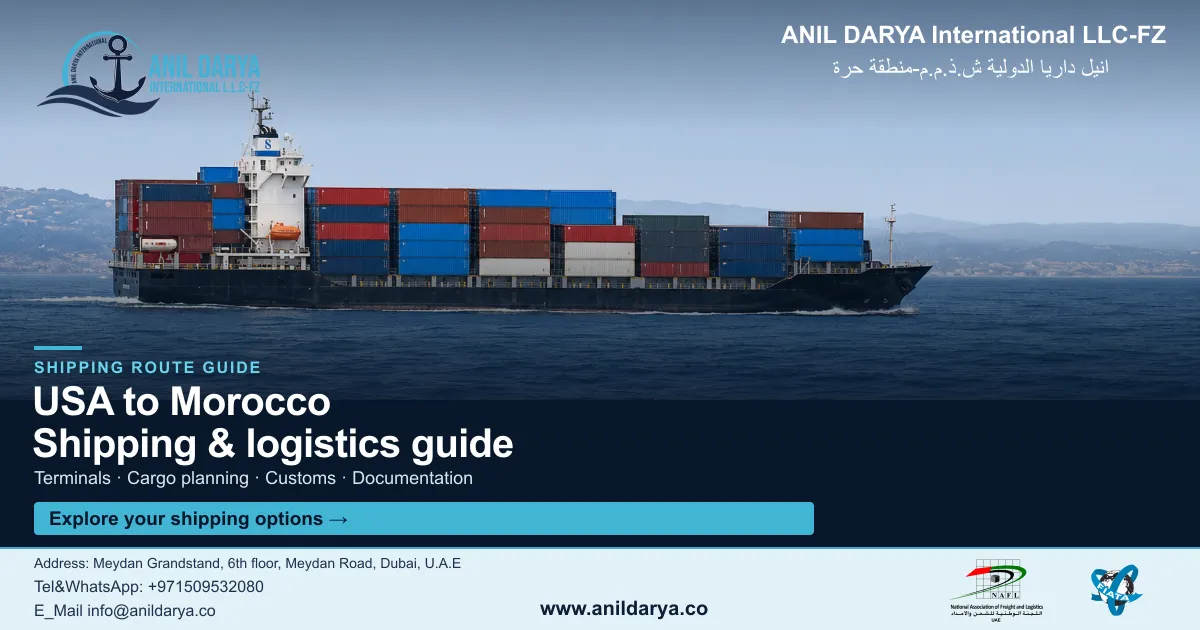
Shipping from USA to Morocco is a transatlantic container run that usually ends at Tanger Med: several weekly loops from Savannah, Charleston, Norfolk, Baltimore, New York and Houston call the Tangier hub on their way into the Mediterranean, and cargo for Casablanca continues by rail, truck or feeder. Most American industrial goods now enter Morocco duty-free under the US-Morocco Free Trade Agreement, but only if the box travels directly and the importer can back the origin claim. We book the ocean freight from Dubai, release the carrier's bill of lading through us and agree the Moroccan clearance plan with the buyer's transitaire before the box is loaded.
Shipping from USA to Morocco at a glance
| Item | Detail |
|---|---|
| Type of lane | Cross-trade by sea, United States to Morocco, booked and coordinated by Anil Darya from Dubai |
| Main US load ports | Savannah, Charleston, Norfolk, Baltimore, New York and New Jersey (Newark), Port Everglades, Houston |
| Main Moroccan discharge port | Tanger Med; Casablanca reached by rail, truck or feeder from Tangier |
| Published days (Tanger Med booklet 2025) | Savannah to Tanger Med 13 days on TA12/AL6 and on TEX/TA10/ZCT; Newark 9 days on MECL; Houston 18 days on MECL |
| US export filing | Electronic Export Information in AES, by the US exporter (USPPI) or its authorized agent |
| Trade agreement | US-Morocco FTA, signed 15 June 2004, in force 1 January 2006 |
| Proof of origin | No set certificate form; the importer's claim is a deemed certification, backed by a declaration on request |
| Before the order | Engagement d'importation domiciled at a Moroccan bank, or an import licence |
| Morocco customs system | BADR; the DUM is lodged by a transitaire or other authorised declarant |
| Import taxes | Duty by HS code (FTA rate for originating goods), parafiscal import tax 0.25%, VAT 20% (10% on designated goods) |
| Bill of lading | The shipping line's own B/L, released to you through us as agent for the line |
| Destination clearance | The consignee's transitaire in Morocco, agreed before we confirm the booking |
Who does what on a USA to Morocco booking
The container never touches the UAE; our Dubai desk runs the booking and the paperwork.
| Party | Job on a US to Morocco shipment |
|---|---|
| US exporter or its US forwarder | Delivers the box to the terminal, files EEI in AES, supplies invoice, packing list and origin data |
| Anil Darya, Dubai | Books space with the line, checks that B/L, invoice and import commitment agree, releases the carrier's B/L |
| Shipping line | Carries the box; its Moroccan agent lodges the summary declaration before arrival |
| Moroccan importer | Domiciles the import commitment, makes the FTA claim, pays duty and VAT |
| Importer's transitaire | Lodges the DUM in BADR, presents the documents and takes delivery at Tanger Med or Casablanca |
The bill of lading on this lane belongs to the carrier. Anil Darya acts as agent for many shipping lines, so for a Savannah box of tractor spares the line issues its own B/L and our Dubai team releases it to you. Before release we check that the B/L names the United States as the place of loading and a Moroccan port as the destination, because that wording matters for the FTA claim (see below).
Clearance inside Morocco is not something we sell. Before we accept a booking from an American port, the Moroccan buyer names its transitaire and that transitaire confirms three things: the import commitment is stamped by the bank, the HS code and FTA eligibility are checked, and any conformity or sanitary control is planned. Duty and taxes at destination are paid by the consignee or its broker.
Agree the Incoterm in the sales contract. On FOB Savannah, the American seller handles export and you choose the line; on CFR Tanger Med the seller books the ship, but Moroccan port charges, duty and VAT stay with you. Our guide to Incoterms 2020 in sea freight sets out the split.
US load ports for Moroccan cargo
Choose the port by where the goods are made and by which loop calls it last before crossing. A port called late in the rotation spends fewer days on board.
| US port | Usual cargo base | Morocco services named in the Tanger Med 2025 booklet |
|---|---|---|
| Savannah | Georgia, the Carolinas, Tennessee, Alabama | TA12/AL6, TEX/TA10/ZCT and MECL |
| Charleston | South Carolina auto, aerospace and machinery plants | TA12/AL6 and MECL |
| Norfolk | Virginia, the Midwest by rail | TA12/AL6, TEX/TA10/ZCT and MECL |
| Baltimore | Mid-Atlantic; also a vehicle and machinery port | TA12/AL6 |
| New York and New Jersey (Newark) | The Northeast and the inland rail network | TEX/TA10/ZCT and MECL |
| Port Everglades | Florida | TEX/TA10/ZCT |
| Houston | Texas resin, chemicals, oilfield and farm equipment | MECL |
West Coast and inland shippers usually rail the box to an East Coast or Gulf terminal. Price that inland leg with the ocean quote.
Tanger Med or Casablanca: where your cargo lands
Tanger Med
All the US services we found in carrier and port documents discharge at Tanger Med, on the Mediterranean coast east of Tangier. The port handled 10,241,392 TEU in 2024, 18.8% more than in 2023, across four container terminals with 18 m of water and 9 million TEU of capacity. A rail terminal rated at 400,000 TEU a year links the port with Moroccan cities, and the general cargo terminal has a 13.5 m draft and cranes up to 100 t for project lifts.
Casablanca and the rest
Casablanca is still where most importers of American machinery, chemicals and food ingredients keep their warehouses. Maersk puts the port at about 35% of Morocco's port traffic, 17 million tonnes in the first half of 2026, and says berths there are often congested. Maersk also runs a Tangier to Casablanca rail service, which is the usual way to discharge at Tanger Med and still deliver in Casablanca. Agadir and other ports are reached by feeder.
Sea freight from USA to Morocco: services and transit days
The Tanger Med Port Authority's 2025 maritime connections booklet lists four weekly services that bring cargo from US ports into Tanger Med. Its "Import" rows count days from the US port to Tangier; we checked that the days fall call by call in the order of each loop.
| Service | Lines named | Days from US port to Tanger Med |
|---|---|---|
| TA12 (Maersk) / AL6 (Hapag-Lloyd) | Maersk, Hapag-Lloyd | Norfolk 21, Baltimore 19, Charleston 16, Savannah 13 |
| TEX (Hapag-Lloyd) / TA10 (Maersk) / ZCT (ZIM) | Hapag-Lloyd, Maersk, ZIM | New York 18, Norfolk 16, Savannah 13, Port Everglades 12 |
| MECL | Maersk, APL | Charleston 23, Savannah 22, Houston 18, Norfolk 11, Newark 9 |
MECL is still calling Tangier in 2026. A Kuehne+Nagel carrier update dated July 2026 gives its rotation as Charleston, Savannah, Houston, Norfolk, Newark, Tangiers and then onward to Jeddah and India, with the first sailing on the revised loop on 9 July 2026. The booklet is a 2025 document, so treat its days as a guide and ask for the vessel's own dates with every quote.
No service in the sources we opened calls a US port and Casablanca on the same voyage. A Casablanca delivery is therefore Tanger Med plus rail or truck, or a change of ship onto a feeder. If we join two services ourselves through a hub, we tell you it is a possible connection, not a published routing. Aggregator day counts differ by weeks, so we do not repeat them.
[AMIR-FACT: the carriers and services we actually book from US East Coast and Gulf ports to Tanger Med and on to Casablanca, with the real port-to-port days, the rail or feeder leg used, and the sailing frequency we see]
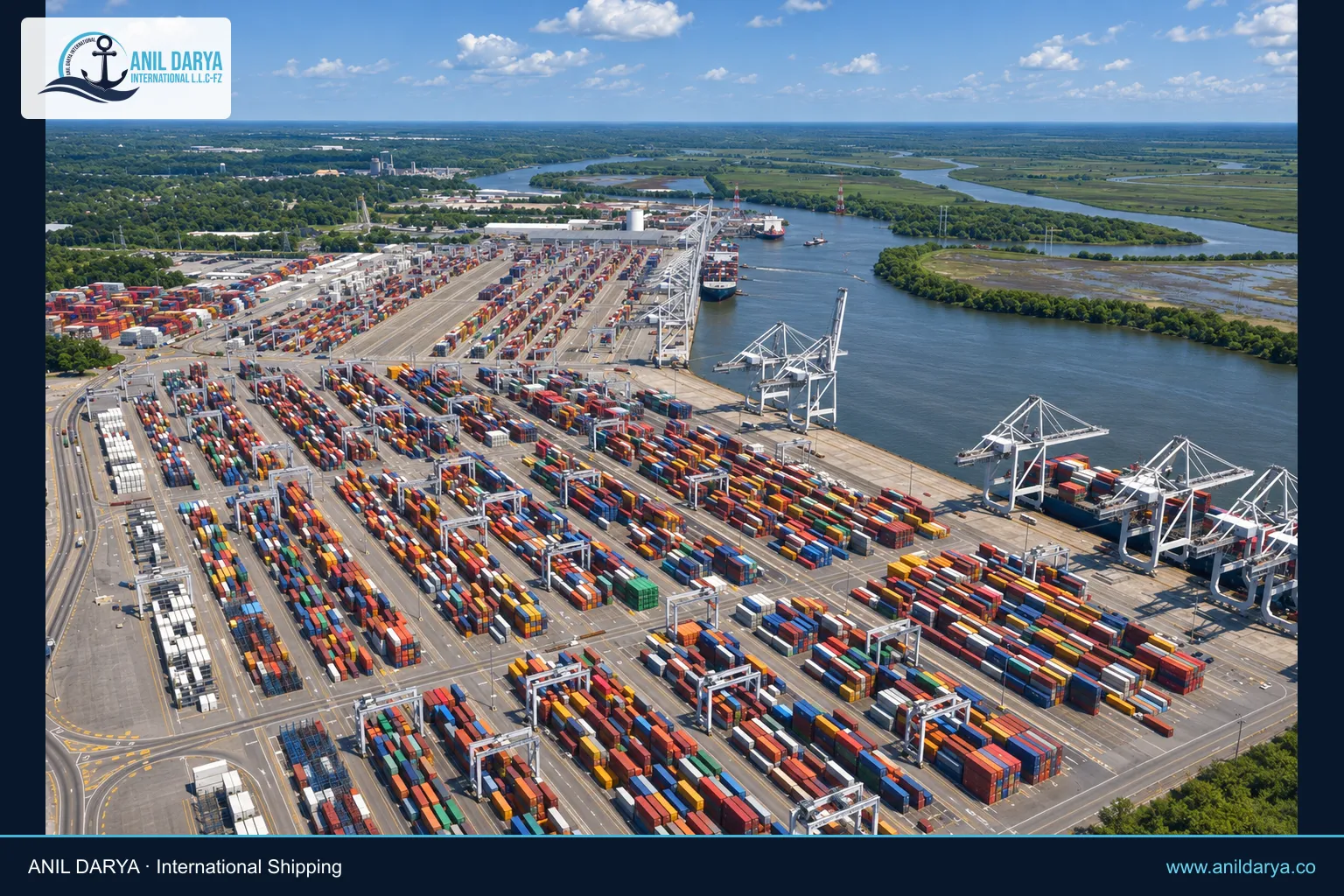
FCL, LCL, reefer, dangerous goods and project cargo
| Option | Typical US cargo for Morocco | What to watch |
|---|---|---|
| 20ft dry | Chemicals in drums, resin, lubricants, seed, spare parts | Heavy cargo hits the weight limit before the box is full |
| 40ft or 40ft high cube | Machinery parts, IT equipment, cotton, used clothing for recycling, furniture | Invoice value must match the domiciled import commitment |
| LCL | Samples, spares, small industrial orders | Each Moroccan consignee needs its own import title and transitaire |
| Reefer | Meat, dairy ingredients, frozen food | ONSSA sanitary control on arrival; set point and certificates agreed before loading |
| Flat rack or open top | Construction equipment, tractors, generators | Lashing survey, lifting points and the inland leg from Tangier |
| Breakbulk | Plant modules, tanks, heavy steel | Tanger Med general cargo terminal: 13.5 m draft, cranes up to 100 t |
When a Moroccan buyer orders from three American suppliers, one consolidated FCL often beats three LCL lots: one import commitment, one DUM and one FTA file. Our article on FCL versus LCL shows where the break-even sits, and our sea freight service handles the booking.
US chemicals, paints, aerosols and lithium batteries travel under the IMDG Code, 2024 edition (Amendment 42-24), mandatory since 1 January 2026. The shipper supplies the UN number, class, packing group, safety data sheet and DG declaration, and the line approves before the box is stuffed. Speak to our dangerous goods team before you promise a sailing date. For machinery that will not fit a box, send drawings, weights and lifting points to our break bulk desk.
For vehicles, the title, VIN and proof of EEI filing go to CBP at the port of export at least 72 hours before export. USTR reported that Morocco has recognised US FMVSS standards as equivalent to UNECE since 3 June 2013, with some items, mostly lighting, still needing changes.
What the American exporter files
US export formalities sit with the US principal party in interest (USPPI) or its authorized agent. We coordinate the timing with them but do not file with US agencies.
- EEI goes into AES, through the free ACE AESDirect portal or a certified direct connection.
- Filing is required when any Schedule B or HTS line is worth more than $2,500, and for licensed goods whatever the value.
- For vessel cargo the EEI is due at least 24 hours before loading; the carrier needs the ITN or the exemption citation before it loads the box.
- The exporter makes the licence determination. Most consumer and industrial goods need no licence, but controlled items do.
For Morocco, ask the seller for a French or bilingual invoice on its letterhead with HS codes, values, the payment currency and dates written day/month/year. The US International Trade Administration lists these points for Moroccan imports, and the transitaire will copy the invoice straight into the DUM.
The US-Morocco FTA: duty-free entry for American goods
What the agreement removed
The agreement was signed on 15 June 2004 and entered into force on 1 January 2006. USTR's 2015 trade barriers report says duties on 95% of two-way trade in industrial and consumer goods ended on entry into force, and most remaining duties on those goods were phased out by 1 January 2015. Some sensitive farm products have longer schedules or tariff-rate quotas; check those lines in ADIL.
When a good counts as American
Under Article 5.1, a good is originating if it is wholly produced in the US or Morocco, or if it is a new or different article made there and the value of US or Moroccan materials plus direct processing costs reaches at least 35% of its appraised value at import. Textiles, apparel and some other goods follow product rules in Annex 4-A or 5-A instead. Simple combining, packaging or dilution with water does not make a foreign good American (Article 5.3). A US trader reselling Asian-made goods will usually not qualify.
The direct import rule and transhipment
Origin also needs the good to be imported directly. Article 5.9 says a good loses that status if it undergoes production or any other operation outside the two countries, other than unloading, reloading or what is needed to keep it in good condition or carry it to Morocco. A relay at a hub is allowed; repacking, labelling or selling from stock on the way is not.
A USDA report from the Rabat post (December 2017) adds the practical side: Moroccan customs want the bill of lading to show the United States as origin and Morocco as destination, and for transhipped cargo they may ask for evidence that the goods were meant for Morocco when they left the US. A through B/L from the US port to Tanger Med gives you that evidence.
[AMIR-FACT: confirm with a Moroccan transitaire we work with what Moroccan customs ask for today to accept a US-Morocco FTA claim (B/L wording, through B/L on transhipment, any origin statement from the exporter), and whether any common US goods on our lane still pay duty]
Paperwork for the claim
No certificate of origin form is prescribed. Under Article 5.10, the importer who claims the FTA rate is deemed to certify that the good qualifies, and must give customs a signed declaration on production, materials and costs if asked. Records are kept for five years. Send the buyer an origin statement with the invoice and keep the cost breakdown on file. Chapter 6 also asks both sides to release goods within 48 hours of arrival where possible and to issue advance rulings, which the transitaire can request for a doubtful HS code or origin.
Moroccan import rules for American goods
ADII, Morocco's customs administration, tells importers to hold an import title before ordering abroad. Its Q&A pages carry no version date; we last read them on 11 November 2026.
Commercial register and import commitment
The importer needs a commercial register (RC) number and a listing on the file of foreign trade operators. For goods that are free to import, the title is the engagement d'importation (EI): five copies with the pro forma invoice, domiciled at an approved bank. Customs will not clear without the bank's stamp. An EI is valid for six months; a shipped-on-board B/L dated before expiry can save one that lapses at sea. Goods on the licence list need an import licence instead.
Verification of conformity and sanitary control
Since 1 February 2020, regulated industrial products have been subject to verification of conformity under Law 24-09, run by the ministry of industry and trade. Depending on the product, the check is done in the US before shipment or in Morocco after arrival, and approved bodies such as SGS issue certificates managed on PortNet, the national single window. Food and agricultural products pass ONSSA's sanitary control at the port of entry, and customs will not release them without its certificate.
Customs clearance at Tanger Med and Casablanca
The ship's agent lodges an electronic summary declaration in BADR at least 24 hours before the vessel arrives. The declarant, usually an approved transitaire, then enters the detailed declaration (DUM) in BADR within 45 days of the summary declaration for sea cargo. At Tanger Med the port community system runs import port passage from the DUM data and issues the exit voucher checked at the gate.
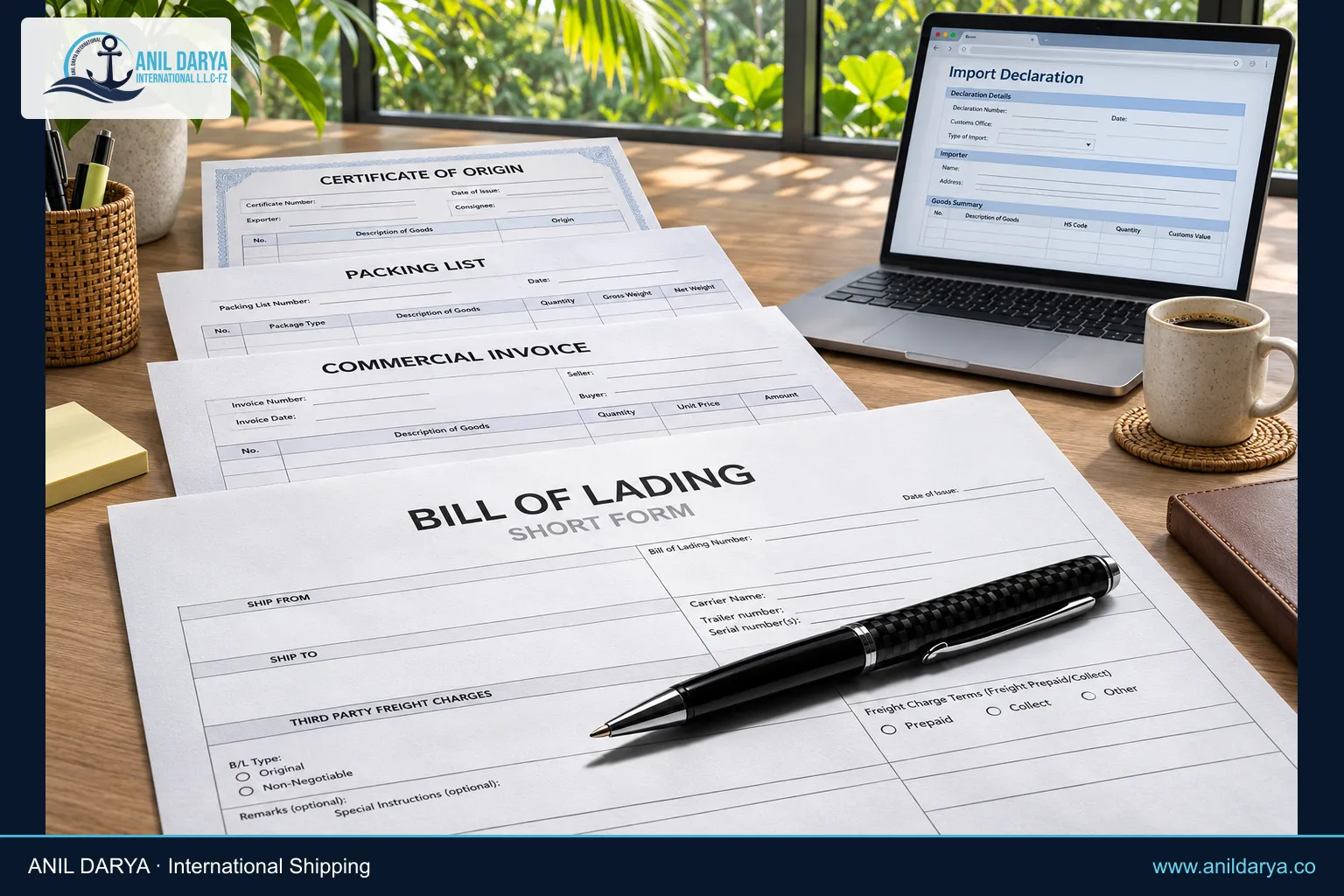
| Document | Why it is needed for US cargo |
|---|---|
| Commercial invoice from the US seller | Customs value, HS codes, currency; French or bilingual |
| Bank certificate and import title | The domiciled engagement d'importation, or the import licence |
| Bill of lading | Transport proof; showing US origin and Moroccan destination supports the FTA claim |
| Origin statement and cost data | Backs the importer's FTA claim if customs asks |
| Conformity or sanitary certificate | Law 24-09 products, food and plant products |
Since 1998 ADII has used risk-based selection instead of checking every entry, so a DUM is released on the documents or picked for a physical check. Removal is allowed once duty and taxes are paid or guaranteed.
Duty, TPI and VAT on US cargo
Customs value is the price plus costs up to import, such as commissions and packing, at the rate in force when the DUM is registered.
| Charge | Basis | Notes for American goods |
|---|---|---|
| Customs duty | HS code, mostly ad valorem | Usually zero for goods meeting the FTA origin and direct import rules; full rate otherwise; farm lines may have quotas |
| Parafiscal import tax (TPI) | 0.25% of the value of imported goods (PwC, reviewed 30 April 2026) | Check ADIL for your code |
| Import VAT | 20% standard, 10% on designated goods | The FTA does not remove VAT |
Duty and taxes at destination are paid by the consignee or its broker, normally before removal. ADII offers a removal credit of up to 180 days, or a deposit of the amount, which the transitaire can request for an importer that qualifies.
Restricted goods and special formalities
ADII starts from free import, with exceptions for public health, the economy, the environment, heritage and public order. Its list of prohibitions includes weapons of war and their munitions, printed matter and recordings contrary to public morals or order, and some plants and plant products that can carry pests.
Special formalities apply to food and health products, plants and animal products, goods under mandatory standards, arms, heritage items and dangerous products. Check meat, cosmetics, medical devices, seeds and electrical goods in ADIL before you buy.
Typical cargo on the USA to Morocco lane
USTR puts US goods exports to Morocco at $5.3 billion in 2024, up 37.3% on 2023. Its 2015 report named IT, machinery, construction equipment, chemicals and textiles as US sectors with duty-free or preferential access, alongside farm goods under quotas.
| US cargo | Usual equipment | Extra papers to plan |
|---|---|---|
| Machinery and spare parts | 40ft, flat rack | Cost data for the 35% test if foreign parts are used |
| Chemicals and resin | 20ft dry, ISO tank | SDS, DG declaration, line approval |
| IT and electrical goods | 40ft high cube | Verification of conformity under Law 24-09 |
| Vehicles | Container or Ro-Ro | Title at CBP 72 hours before export; Moroccan registration rules |
Routing via Dubai: when it helps and when it costs the FTA
Dubai is far off the Atlantic route. A Dubai stop makes sense only for US stock held in a Jebel Ali free zone for several markets, or a mixed box of American and Asian goods for Casablanca.
Both options carry an FTA risk. Goods that are landed, stored, split or relabelled in Dubai have undergone operations outside the two countries, so under Article 5.9 they may no longer be imported directly and can pay full Moroccan duty. Nor can Dubai help with origin: the UAE-Morocco FTA, in force since 9 July 2003, uses Arab rules of origin, so storing American goods in Jafza does not make them UAE-origin. Ask the Moroccan transitaire before you plan any Dubai stop.
Where it does fit, see our Jebel Ali port guide and the article on re-exporting through Jafza. Dubai Customs treats transit as its own regime, separate from import. When cargo is landed or re-exported in Dubai, we handle the UAE customs clearance for a fee.
[AMIR-FACT: whether we have moved US-origin cargo to Morocco through Dubai (Jafza stock or consolidation with Asian goods), the line used from Jebel Ali to Tanger Med or Casablanca, and whether the Moroccan transitaire accepted or refused the FTA claim]
Step by step: shipping from USA to Morocco with Anil Darya
- Send us the US pickup city, goods, HS codes, weights, volumes, ready date and the Moroccan delivery city.
- Name the Moroccan transitaire. It confirms the duty line, FTA eligibility, any licence and the conformity or sanitary route. Destination clearance is arranged with the consignee's broker before the cargo ships, and we coordinate this before we confirm the booking.
- The Moroccan importer domiciles the engagement d'importation at its bank against the pro forma.
- If the product is checked before shipment, the US seller books the conformity inspection during production.
- We propose the load port, the service and the Moroccan delivery leg, and book when you accept.
- The US seller issues the French or bilingual invoice and packing list, prepares the origin statement and cost data, and files EEI in AES at least 24 hours before loading.
- The box sails. We send the B/L draft for checking, with the US load port and Moroccan destination shown, and release the carrier's B/L through us.
- At Tanger Med or Casablanca the transitaire lodges the DUM with the FTA claim, duty and taxes are paid or guaranteed, and the box is released.
[AMIR-FACT: one real USA to Morocco cross-trade shipment we handled (cargo, US load port, carrier, Tanger Med or Casablanca, how the FTA claim and the transitaire were lined up, and door-to-door days), cleared for publication]
What drives the cost of shipping from USA to Morocco?
Ocean rates change with each sailing, so we price every booking on its own. These are the parts of the bill and who usually pays them under FOB.
| Cost part | What moves it | Usually paid by (FOB) |
|---|---|---|
| US inland and origin charges | Truck or rail to the port, terminal handling, EEI filing | Seller |
| Ocean freight | Box type, load port, service, season, surcharges | Buyer |
| Moroccan port and line charges | Terminal handling, delivery order, container deposit | Consignee |
| Tangier to Casablanca leg | Rail, truck or feeder, and who booked it | Consignee, unless the quote is to Casablanca |
| Duty, TPI and VAT | HS code, customs value, FTA status | Consignee or its broker |
| Storage and demurrage | Missing EI stamp, refused FTA claim, missing conformity certificate | Whoever caused the delay, under the contract |
A refused FTA claim means full duty and a held box. Our article on demurrage and detention shows how quickly daily charges add up. Free time changes often, so confirm it with each quote.
Checklist before the box leaves the US
- Importer has an RC number and is on the foreign trade operators file.
- Engagement d'importation domiciled, with values matching the pro forma.
- HS code checked in ADIL: FTA rate, TPI, VAT and any quota.
- Goods meet the FTA origin rule, with cost data on file.
- Through B/L planned, showing the US load port and Moroccan destination.
- Conformity or sanitary route confirmed; any pre-shipment check done.
- Transitaire named and clearance agreed before booking.
- EEI filed in AES and the ITN with the carrier 24 hours before loading.
Mistakes on US cargo for Morocco
- Shipping before destination clearance is agreed: the box reaches Tangier with no transitaire ready and free days run out.
- Ordering before the bank has stamped the import commitment.
- Claiming the FTA rate on goods made in a third country and only resold from the US.
- Landing, splitting or relabelling FTA goods in a hub or free zone on the way.
- Issuing a B/L that hides the US origin or the Moroccan destination on a transhipped box.
- Booking "to Casablanca" when the service discharges at Tanger Med, with no inland leg priced.
- Buying a vehicle in the US before Moroccan registration rules are confirmed.
Frequently asked questions
How long does sea freight from the USA to Morocco take?
The Tanger Med Port Authority's 2025 booklet lists 9 days from Newark and 22 from Savannah on MECL, 13 from Savannah on TA12/AL6 and TEX/TA10/ZCT, and 18 from Houston on MECL, all to Tanger Med. Add the inland leg for Casablanca, plus clearance time.
Which Moroccan port do US containers arrive at?
Mostly Tanger Med. We found no published US service calling Casablanca directly, so Casablanca cargo usually moves from Tangier by rail or truck, or changes to a feeder.
Do American goods pay customs duty in Morocco?
Most US industrial and consumer goods enter duty-free under the FTA if they meet the origin rules and travel directly. Some farm products have quotas or longer schedules. Import VAT of 20% (10% on designated goods) and the 0.25% parafiscal tax still apply.
Do I need a certificate of origin for the US-Morocco FTA?
No form is prescribed. The importer's claim counts as a certification and must be backed by a signed declaration if customs asks. A USDA report notes that Moroccan customs look for a B/L showing US origin and Moroccan destination.
Does Anil Darya clear the cargo in Morocco?
No. We book the ocean freight, coordinate the American seller and release the carrier's bill of lading. The consignee's transitaire clears the goods, and we agree that with you before confirming the booking.
Can USA to Morocco cargo go through Dubai?
Yes, for Jafza stock or a mixed box with Asian goods, but it adds distance and can cost the FTA rate if the goods are stored or split in Dubai. We handle UAE customs clearance for a fee when cargo is landed there.
Get a quote for shipping from USA to Morocco
Send the US pickup city, goods and HS codes, ready date, Moroccan delivery city and your transitaire's name, and we will come back with a service, a named vessel and a price. Use our freight rate inquiry form, or contact our team at info@anildarya.co or +971 50 953 2080 to plan DG or project cargo first. You can also read about our Dubai freight forwarding team.
Sources
- Tanger Med Port Authority: Maritime connections booklet 2025 (America table)
- Kuehne+Nagel: carrier services update, July 2026 (Maersk MECL rotation)
- Tanger Med: Port facilities and 2024 traffic
- Tanger Med PCS: Import port passage
- Maersk: Tangier to Casablanca rail service and Casablanca traffic (August 2026)
- USTR: United States-Morocco Free Trade Agreement (2024 export figures)
- USTR: US-Morocco FTA final text, Chapter 5 Rules of Origin
- USTR: US-Morocco FTA final text, Chapter 6 Customs Administration
- USTR: 2015 National Trade Estimate, Morocco (tariff elimination, vehicle standards)
- US International Trade Administration: US-Morocco FTA
- trade.gov: Morocco import requirements and documentation, VoC programme
- USDA FAS GAIN, Rabat: FAIRS export certificate report, 31 December 2017 (B/L and origin for FTA goods)
- US Census Bureau: Automated Export System and AESDirect
- US Census Bureau: Quick guide to the Foreign Trade Regulations (15 CFR Part 30)
- ADII: Import title needed before ordering
- ADII: Filing an import commitment
- ADII: Bank domiciliation of the import commitment
- ADII: Prohibited imports
- ADII: Goods subject to special import formalities
- ADII: Summary declaration deadline for sea cargo
- ADII: Who may lodge the detailed declaration
- ADII: 45-day deadline for the detailed declaration
- ADII: Risk-based selection for inspection
- ADII: Removal credit and deposit of duties
- ADII: The BADR clearance system
- ADII: ADIL import tariff tool
- SGS: Morocco product conformity assessment (Law 24-09, PortNet)
- PwC: Morocco import VAT and TPI (reviewed 30 April 2026)
- IMO: IMDG Code 2024 edition (Amendment 42-24)
- WIPO Lex: UAE-Morocco free trade agreement, in force 9 July 2003
- Dubai Customs: Customs declaration regimes
Reviewed: 14 November 2026