
Shipping from Vietnam to Egypt means a long container voyage from Cai Mep, Cat Lai or Hai Phong to Sokhna on the Red Sea coast, or on to Port Said, Damietta or Alexandria on the Mediterranean. Most boxes change ship at an Asian hub, and none may load until the Egyptian buyer holds a valid ACID for the shipment. We book the sea freight from Dubai, release the carrier's bill of lading to you, and agree the buyer's Egyptian broker before we confirm the space.
Vietnam to Egypt shipping at a glance
| Item | Detail |
|---|---|
| Type of lane | Cross-trade by sea, Vietnam to Egypt, booked and coordinated by Anil Darya from Dubai |
| Main Vietnamese load ports | Cai Mep and Cat Lai for the south, Hai Phong (Lach Huyen) for the north, Da Nang and Quy Nhon for the centre |
| Main Egyptian discharge ports | Sokhna on the Red Sea coast; Port Said, Damietta and Alexandria with Dekheila on the Mediterranean |
| Typical routing | Transhipment at an Asian hub onto an Asia-Mediterranean loop; a Dubai routing via Jebel Ali to Sokhna is also possible |
| Vietnam export filing | Customs declaration on VNACCS/VCIS by the exporter; Form B certificate of origin from the Ministry of Industry and Trade |
| Egypt pre-shipment rule | Advance Cargo Information: the importer gets a 19-digit ACID on Nafeza before loading |
| Trade agreement | None in force between Vietnam and Egypt; a feasibility study for one was agreed in 2026 |
| Egypt duty and VAT | Duty mostly 0% to 60% of CIF value; VAT 14%, or 5% on production-line machinery |
| Bill of lading | The shipping line's own B/L, released to you through us as agent for the line |
| Destination clearance | The consignee's licensed broker in Egypt, agreed before we confirm the booking |
Who does what on this cross-trade
This is a cross-trade: the box leaves Vietnam and is cleared in Egypt, and it touches Dubai only if you choose a Dubai routing. Five parties share the work.
| Party | Its job on a Vietnam to Egypt shipment |
|---|---|
| Vietnamese exporter or its local forwarder | Packs and stuffs the box, trucks or barges it to the terminal, files the VNACCS declaration, gets the Form B, uploads the ACI documents on CargoX |
| Anil Darya, Dubai | Compares sailings and hubs, books the space, checks the ACID before the cut-off, follows the relay, releases the carrier's B/L |
| Shipping line | Checks the ACID, loads, relays the box at the hub, lodges the manifest with Egyptian Customs |
| Egyptian importer | Holds its importer registration, requests the ACID, confirms the exporter's data, pays duty and VAT |
| Importer's broker in Egypt | Files the declaration, attends inspection and sampling, takes delivery from the terminal |
The bill of lading belongs to the carrier. We act as agent for many shipping lines, so when a line carries, say, a 40ft reefer of frozen pangasius from Cat Lai to Port Said, its B/L is issued and released to you from our Dubai office. Before release we hold the draft against the Vietnamese invoice: the consignee, the Egyptian tax number and the ACID must match letter for letter.
Clearance in Egypt is not something we sell. Duty and taxes at destination are paid by the consignee or its broker. So the first question we ask an Egyptian buyer of Vietnamese coffee or phones is which broker will clear the box, and at which port it has staff. If a box is routed to Sokhna but the broker only works in Alexandria, the buyer loses days. We confirm the booking only once that answer is clear.
Under CFR or CIF Sokhna the Vietnamese seller books the ship, yet Egyptian terminal charges, duty and VAT stay with the buyer. Our guide to Incoterms 2020 for sea freight shows where risk passes.
Which Vietnamese port to ship from
Pick the port nearest the factory, then check which carriers call there. Vietnam's three biggest container gateways all ranked in the world's top 31 in 2025.
| Vietnamese port | Fact we checked | Typical cargo for Egypt |
|---|---|---|
| Ho Chi Minh City (Cat Lai) | Over 8.9 million TEU in 2025, 22nd in the world; Cat Lai takes ships of up to 45,000 DWT with 12.5 m at the berth | Coffee, pepper, cashews, garments, frozen fish from the Mekong Delta |
| Cai Mep | Over 7.6 million TEU in 2025, 31st in the world; the deep-water terminals take mainline ships | Phones and electronics from the southern industrial parks, furniture, reefer cargo |
| Hai Phong (Lach Huyen) | Over 8.2 million TEU in 2025, 26th in the world; the deep-water berths are at Lach Huyen | Phones and computer parts from the northern provinces, machinery, yarn |
| Da Nang and Quy Nhon | Central ports; ask which hub the feeder connects to | Wood products, seafood, farm goods |
A box loaded at Cat Lai often goes by barge or feeder to a deep-water berth or a hub before the long leg. Cai Mep can save that step if your carrier's mainline ship calls there.
Which Egyptian port to arrive at
An Asian ship reaches Sokhna first, then the Mediterranean ports after the canal. Choose by the buyer's warehouse and by where its broker works.
| Egyptian port | What we found | Usually suits |
|---|---|---|
| Sokhna (DP World) | Berth 1 of 750 m and Berth 2 of 1,350 m, 17 m alongside, 904 reefer points in all | Cairo, Suez and the eastern industrial zones |
| Port Said (Suez Canal Container Terminal) | 3,355 m of quay, 17 m draft, 7 million TEU capacity, 6,400 reefer plugs | Transhipped boxes, reefers, the canal cities |
| Damietta | Damietta Alliance Container Terminals began commercial work on 14 February 2026 with a 1,670 m quay and 18 m depth | Damietta, Mansoura and the eastern Delta |
| Alexandria and Dekheila | The Alexandria Port Authority says its two ports carry about 60% of Egypt's trade volume | Alexandria, the western Delta and many Cairo importers |
For a Cairo buyer of Vietnamese phones, Sokhna is often the natural choice. For frozen fish going to a cold store in the Delta, Port Said or Damietta may be closer by road.
Direct sailing or transhipment: what the carriers publish
We found no carrier page showing a single loop that loads in Vietnam and discharges in Egypt. In practice, Vietnamese boxes join an Asia-Mediterranean loop at a hub. Two carrier sources show how that can work:
- Maersk's Asia-Europe network update of February 2026 gives the new AE15 rotation as Qingdao, Gwangyang, Ningbo, Tanjung Pelepas, Port Said, Damietta, Colombo and Singapore. A Vietnamese box on this loop would first move by feeder to a hub such as Tanjung Pelepas.
- RCL's RGA loop, in its August 2023 press release, runs from Cai Mep through Laem Chabang, Port Klang and Nhava Sheva to Jebel Ali. From Jebel Ali, Emirates Shipping Line's GRC service, in its October 2024 launch advisory, calls Jeddah, Aqaba and Sokhna and lists Jebel Ali to Sokhna at 11 days, with Jebel Ali as its relay point for Asian cargo.
Both are dated sources, and carriers reshape their networks every year. Every quote we send names the first vessel, the hub, the second vessel and whether the B/L runs through to the Egyptian port.
How long does sea freight from Vietnam to Egypt take?
We print no port-to-port figure for this lane, because we found no carrier transit table we could check against a rotation. Forwarder pages disagree widely: one gives 35 to 40 days, another 20 to 35, a third shows ranges from 17 to 56 days depending on the port pair. The spread comes from the hub and the waiting time there. Take the carrier's schedule for your vessel, then add Vietnamese export time and Egyptian clearance.
[AMIR-FACT: the carriers and services we actually book from Cai Mep, Cat Lai and Hai Phong to Sokhna, Port Said, Damietta and Alexandria, the hub each one relays at, and the real port-to-port days and sailing frequency we see]
Sea freight from Vietnam to Egypt: FCL, LCL, reefer and DG
| Option | Typical Vietnamese cargo for Egypt | Point to check |
|---|---|---|
| FCL 20ft | Coffee, pepper, cashews in bags; yarn | Weight limit on Vietnamese roads and on the box |
| FCL 40ft / high cube | Phones and electronics, garments, furniture, machinery | Invoice, packing list and Nafeza entry must show the same counts |
| LCL | Spare parts, samples, mixed orders from several suppliers | Each Egyptian consignee in the shared box needs its own ACID |
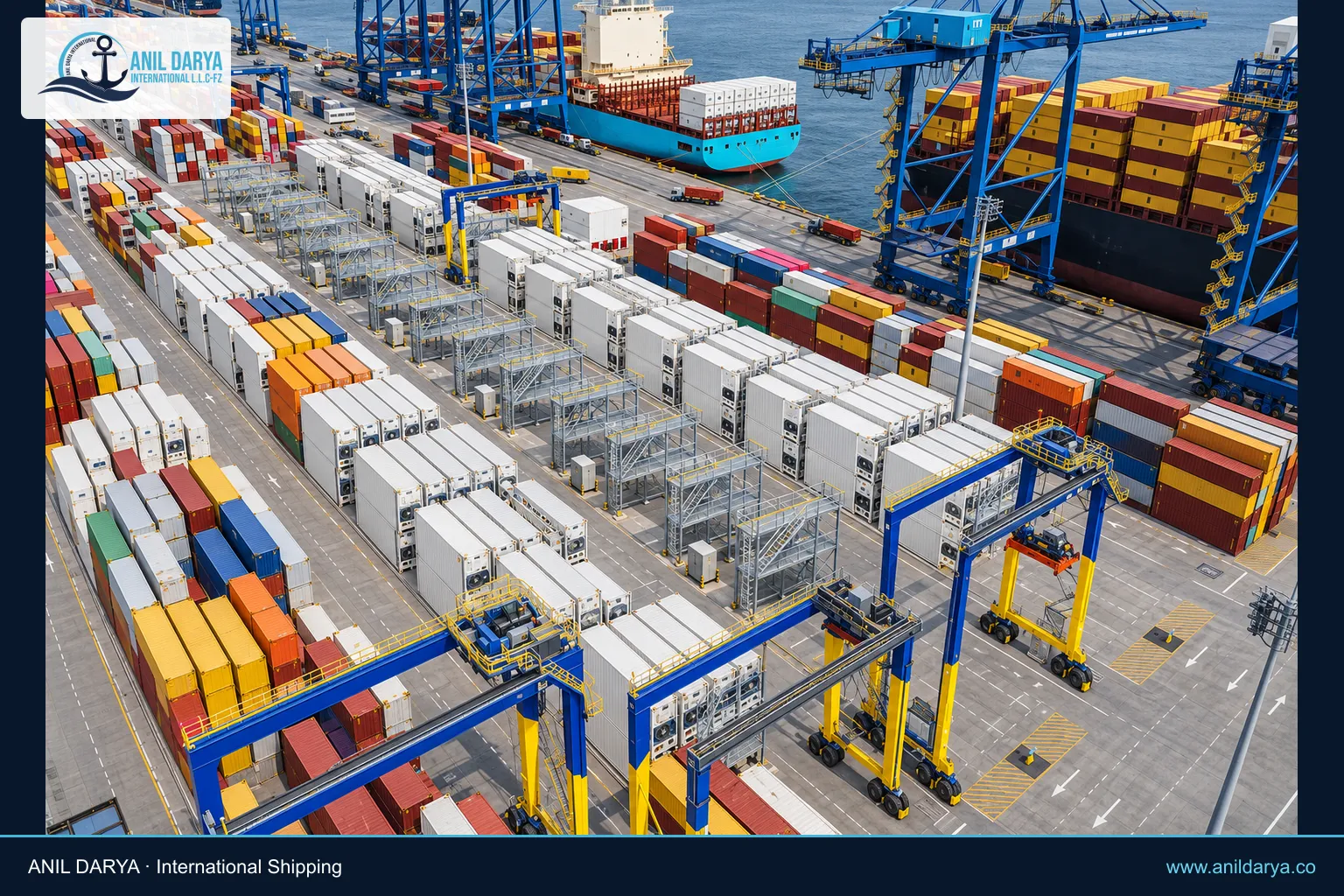
| Reefer | Frozen pangasius, shrimp and other seafood; some fruit | Health certificate, set temperature, plugs at the hub and at the Egyptian terminal |
| Flat rack / open top | Transport equipment, large machine parts | Dimensions and lifting points, and whether the hub accepts out-of-gauge relays |
With three Vietnamese suppliers and one Egyptian buyer, one consolidated FCL usually beats three LCL lots: one ACI file, one inspection, one delivery. Our FCL vs LCL comparison explains the break-even, and our sea freight service covers the booking itself.
Reefer seafood and farm goods
Fishery products were Vietnam's second-largest export line to Egypt in 2025 by value, so reefers are common here. A transhipped reefer sits on a quay at the hub, so ask the line for plug capacity and monitoring there. Egypt's food regulator, the National Food Safety Authority, has laboratories at the main ports, and imported food can be sampled on arrival. Coffee, pepper and cashews travel in dry boxes but need a Vietnamese phytosanitary certificate.
Phones, electronics and lithium batteries
Phones, computers and parts are the top value lines on this lane. Devices with lithium cells, and spare batteries above all, move as dangerous goods under the IMDG Code 2024 edition, Amendment 42-24, which became mandatory on 1 January 2026. The Vietnamese shipper gives the UN number, class, packing group and safety data sheet, and the line must accept the booking before stuffing. Our dangerous goods team gets that acceptance first, and our article on dangerous goods classes explains where batteries fit.
The Vietnam export side: VNACCS and Form B
Export filing in Vietnam belongs to the exporter or its Vietnamese forwarder; we do not file there. The Vietnam Trade Portal of the Ministry of Industry and Trade sets out the steps:
- The exporter registers the declaration on VNACCS (EDA). The data can be changed for up to 7 days (EDB), and the exporter then submits the final declaration (EDC).
- The system routes the file to a green, yellow or red channel. Yellow means a document check; red means documents plus a physical check of the goods.
- Typical papers: the declaration, the commercial invoice, any export licence or inspection certificate, and a raw timber statement for wood goods. The legal basis cited includes Decree 206/2025/ND-CP and Circulars 38/2015 and 39/2018.
Certificate of origin and legalization
Since 5 May 2025 the Ministry of Industry and Trade has been the single body issuing certificates of origin in Vietnam. Non-preferential certificates such as Form B, which is what Egypt receives since no preferential form applies, come from its 18 regional Export-Import Management Offices, with issuance moving onto the eCoSys platform. VCCI no longer issues Form B.
The US International Trade Administration's Egypt guide, last published on 21 November 2025, says the certificate of origin must be authenticated by the Egyptian consulate in the country of origin and that the commercial invoice needs legalization in most cases, each in two copies plus the original. Ask the Egyptian broker what it will accept before the seller prints anything.
[AMIR-FACT: whether Egyptian brokers still ask for Egyptian embassy legalization of the Vietnamese Form B and invoice in 2026, how long that takes in Vietnam, and what the brokers we work with accept instead]
Is there a trade agreement between Vietnam and Egypt?
No. The ITA list of Egypt's trade agreements, published November 2025, names the EU association agreement, EFTA, the Turkey and Mercosur agreements, GAFTA, Agadir, COMESA and AfCFTA, and no agreement with Vietnam or ASEAN. In September 2026 the two governments agreed the terms of reference for a group studying a Vietnam-Egypt free trade agreement, but a study is not a tariff cut.
So Vietnamese goods pay Egypt's normal rates, and the Form B simply proves where they were made. Two traps come up on this lane:
- Routing through Dubai does not turn Vietnamese goods into Arab-origin goods, so no GAFTA rate applies in Egypt.
- The UAE-Vietnam CEPA, in force since 3 February 2026, cuts UAE duty on Vietnamese goods sold into the UAE. It gives nothing in Egypt.
Import customs at the Egyptian end: ACI, ACID and Nafeza
Egypt's Advance Cargo Information system runs on Nafeza, the national single window. It became mandatory for sea cargo in October 2021 under Ministry of Finance Decree 38 of 2021. The ACI guide for shipping lines (version 1.5, by Misr Technology Services) sets the ACI request at least 48 hours before loading, gives Customs up to 48 hours to issue the ACID, tells lines never to load cargo with an invalid ACID, and asks them to lodge the manifest at least 48 hours before berthing.
Every page needs three items: the 19-digit ACID, the importer's 9-digit Egyptian tax number, and the exporter's ID (country code VN, the ID type and the number).
| Step | Who | What happens |
|---|---|---|
| 1 | Egyptian importer or broker | Enters the shipment and the Vietnamese supplier on Nafeza |
| 2 | Egyptian Customs | Issues the ACID within 48 hours and notifies both sides |
| 3 | Vietnamese exporter | Completes verification on CargoX and uploads the invoice, packing list, Form B and B/L copy under the ACID |
| 4 | Importer | Confirms the exporter's data on Nafeza |
| 5 | Shipping line | Checks the ACID and loads in Vietnam; the relay at the hub carries the same ACID |
| 6 | Importer and broker | Pay duty and VAT; inspection and sampling; Customs releases the box |
The ITA's Egypt customs guide warns that cargo arriving without an ACID is refused and re-exported at the shipper's cost. On CargoX only fully verified companies can file; a forwarder registers but does not upload. A filing cannot be recalled, so a correction goes as a new filing under the same ACID.
Documents Egypt expects for goods from Vietnam
| Document | Issued by | What Egypt checks |
|---|---|---|
| Commercial invoice | Vietnamese exporter, legalized if the broker asks | ACID, tax number, exporter ID, HS codes, values |
| Certificate of origin (Form B) | MoIT regional office | Vietnamese origin matching the invoice |
| Packing list | Vietnamese exporter | Same weights, cartons and descriptions as the invoice and Nafeza |
| Bill of lading | Shipping line, released through us | Consignee, notify party, ACID, the right port of discharge |
| Health or phytosanitary certificate | Vietnamese authority | Seafood, coffee, pepper, cashews, fruit |
| Safety data sheet | Manufacturer | Batteries, chemicals and other DG |
| GOEIC registration proof | Vietnamese factory or brand owner | Products on the Decree 43 list |

Duty, VAT and GOEIC registration on Vietnamese cargo
PwC's Egypt tax summary, reviewed on 17 August 2026, reports customs duty of 0% to 60% of CIF value for most goods, up to 135% for passenger cars, non-essential luxury goods and alcohol. Industrial machinery usually pays 0% to 5%, trucks and heavy equipment 10% to 20%. Import VAT is 14% on the CIF value plus duty and other taxes; machinery for production lines pays 5%, and Law 3 of 2022 lets VAT on industrial machinery be suspended for a year, extendable once.
| Vietnamese cargo | Duty range reported by PwC | VAT | Watch for |
|---|---|---|---|
| Machinery and tools | 0% to 5% for industrial use | 14%, or 5% for a production line | Proof of industrial use; Arabic catalogue |
| Phones, computers and parts | By HS code, within 0% to 60% | 14% | DG rules for batteries; any sector approval the broker names |
| Garments, footwear, furniture | By HS code | 14% | Decree 43 registration of the factory or brand |
| Seafood, coffee, pepper, cashews | By HS code | As the broker confirms | Health papers, shelf life, Arabic labels for retail packs |
| Transport equipment and parts | 10% to 20% for trucks and heavy equipment; cars far higher | 14% | Data plates matching the invoice |
Decree 43 of 2016 matters a lot for Vietnamese consumer goods. Factories and brand owners exporting listed products to Egypt must first register with GOEIC; the list covers clothing, textiles, footwear, furniture, household appliances, toys, tableware and many packaged foods. The buyer must also be on the importers register, whose rules Decree 271 of 2026 updated from 22 July 2026.
Labels, shelf life and restricted goods
The ITA's Egypt guides add rules the Vietnamese seller must meet at the factory, not in Egypt:
- Goods for retail carry Arabic labels with the country of origin, the maker and a description; labels cannot be added after import.
- Food should arrive with at least half of its shelf life left, and clearance takes at least two weeks, which counts heavily after a long transhipped voyage.
- Machines need the origin marked on each item and an Arabic catalogue.
- Wooden crates and pallets need a certificate showing they are free of wood pests.
- Used goods and some chemicals are restricted; the broker checks the HS code first.
Which goods move on this lane?
A Vietnamese forwarder's table built from Vietnam Customs statistics puts exports to Egypt at USD 574.7 million in 2025, up from 472.6 million in 2024. The largest lines in 2025 were phones and parts (83.8 million), fishery products (70.5 million), other transport equipment and parts (68.7 million), coffee (61.9 million), machinery (48.6 million), computers and electronics (44.7 million) and pepper (41.2 million).
When does Dubai help with shipping from Vietnam to Egypt?
Dubai is not the shortest path from Vietnam to Egypt, but it helps in three cases:
- A relay at Jebel Ali onto a Gulf to Red Sea service such as GRC, when the buyer is near Cairo and a Sokhna discharge suits it. Our Jebel Ali port guide covers the terminal.
- Consolidation: Vietnamese cartons combined in Dubai with Gulf or Indian goods into one FCL for Egypt.
- Stock held in a Dubai free zone and released in smaller lots to Egyptian buyers. Our article on JAFZA re-export explains the set-up.
Where cargo is unloaded, stored or re-packed in Dubai, the Dubai to Egypt leg needs its own ACID, and Dubai Chambers issues certificates of origin for re-exported foreign goods. That customs work in Dubai is a service we provide for a fee through our Dubai freight forwarding team.
[AMIR-FACT: whether we route Vietnam cargo for Egypt through Jebel Ali today (relay to Sokhna, consolidation or JAFZA stock), whether the ESL GRC service still runs, on which carriers, and the real extra or saved days against a through B/L via an Asian hub]
What drives the cost of shipping from Vietnam to Egypt?
Rates on this lane move with the hub and the season, so we quote per sailing and print none here. The table splits the bill and shows the usual payer under FOB.
| Cost part | What moves it | Usually paid by (FOB) |
|---|---|---|
| Vietnamese inland leg | Truck or barge from the factory, empty pickup, terminal gate | Exporter |
| Vietnamese export costs | VNACCS filing, terminal handling, any inspection | Exporter |
| Documents | Form B, legalization, CargoX filing and document fees | Exporter, unless agreed otherwise |
| Ocean freight | Box type, load port, hub, season, surcharges | Importer |
| Special cargo | Reefer, DG batteries, flat rack | Importer |
| Egyptian port charges | Terminal handling, delivery order, LCL unpacking, storage | Importer |
| Duty and taxes | HS code, CIF value, 14% or 5% VAT | Consignee or its broker |
| Delay charges | Missing ACID, unregistered factory, lab sampling, late originals | Whoever caused the delay, by contract |
The costliest delays on this lane are usually a missed relay at the hub and a GOEIC hold on an unregistered brand. Our article on demurrage and detention shows how fast those charges grow.
How to ship from Vietnam to Egypt step by step
- Agree the Incoterm with the Vietnamese seller and write it on the contract and the invoice.
- Send us the product, HS code, weight, volume, pickup province, ready date, special needs and the Egyptian port.
- Name the Egyptian broker. We check with the broker that the importer is registered, the products clear GOEIC, and it works at the chosen port. Only then do we confirm the booking.
- Get the ACID. The importer applies on Nafeza at least 48 hours before loading and shares the number with the seller and with us.
- Book the space. We compare hubs and sailings and get reefer, DG or out-of-gauge acceptance first.
- Prepare the Vietnamese papers. The seller puts the ACID, tax number and exporter ID on every page, obtains the Form B, and arranges legalization if the broker needs it.
- File the VNACCS declaration and the ACI documents on CargoX, then gate the box in before the cut-off.
- Release the bill of lading. We check the draft against the invoice and ACID and release the carrier's B/L once freight is settled.
- Clearance in Egypt. The consignee's broker files the declaration, attends inspection, pays duty and VAT and takes delivery.
[AMIR-FACT: one real Vietnam to Egypt cross-trade shipment we handled (cargo, Vietnamese load port, hub, Egyptian port, carrier, how the ACID and broker were lined up, door-to-door days), cleared for publication]
Checklist before the box leaves Vietnam
- Incoterm agreed and written on the contract and invoice.
- Egyptian importer registered and holding a valid ACID for this shipment.
- Broker named, agreed and working at the discharge port.
- Products checked against the Decree 43 list, with GOEIC registration in place where needed.
- Exporter verified on CargoX; ACID, tax number and exporter ID on every document.
- Form B issued by the MoIT office, legalized if the broker requires it.
- Arabic labels on retail goods; Arabic catalogue for machines; pest certificate for wood packing.
- For seafood and farm goods: health or phytosanitary certificate and enough shelf life. For batteries: UN number, SDS and carrier approval.
- Hub, relay vessel and free time at the Egyptian port confirmed in writing.
Common mistakes on this lane
- Shipping before destination clearance is agreed. A reefer of fish that reaches Port Said with no broker in place burns power and storage charges every day.
- Loading before the ACID exists, or quoting it wrongly on the B/L.
- Assuming an FTA rate. There is none, and a Dubai routing does not create one.
- Unregistered brands. Garments, footwear, furniture and appliances on the Decree 43 list cannot be released without GOEIC registration.
- Phones with batteries booked as general cargo instead of DG.
- Food packed with too little shelf life for a transhipped voyage plus two weeks of clearance.
- Choosing Sokhna or Alexandria without asking where the buyer's broker works.
Frequently asked questions
How long does shipping from Vietnam to Egypt take by sea?
It depends on the hub and the waiting time there. Forwarder estimates range from under three weeks to about eight. Ask for the carrier's schedule for the named vessels, then add Vietnamese export time and at least two weeks of Egyptian clearance.
Is there a direct ship from Vietnam to Egypt?
We found no carrier page showing one loop that calls both countries. Most boxes relay at an Asian hub onto an Asia-Mediterranean service, or at Jebel Ali onto a Gulf to Red Sea service calling Sokhna.
Which Egyptian port is best for cargo from Vietnam?
Sokhna is the first Egyptian port an Asian ship reaches and is close to Cairo. Port Said, Damietta and Alexandria suit buyers in the Delta and the canal cities. Pick the port where the buyer's broker works.
Do Vietnamese goods pay customs duty in Egypt?
Yes. There is no Vietnam-Egypt free trade agreement, so Vietnamese goods pay Egypt's normal rates, mostly 0% to 60% of CIF value, plus 14% import VAT, or 5% for production-line machinery.
Who requests the ACID for a shipment from Vietnam?
The Egyptian importer or its broker, on Nafeza, at least 48 hours before loading. The Vietnamese exporter then verifies its company on CargoX and uploads the documents under that ACID.
Which certificate of origin does Egypt need for Vietnamese goods?
A non-preferential Form B, issued since 5 May 2025 by the Ministry of Industry and Trade's regional offices. The broker tells you whether it must also be legalized by the Egyptian embassy.
Does Anil Darya clear the cargo in Egypt?
No. We book the sea freight, coordinate the Vietnamese shipper and release the carrier's bill of lading. The consignee's licensed broker clears the goods in Egypt, and we agree that with you before confirming the booking.
Get a quote for shipping from Vietnam to Egypt
Send us the pickup province, the cargo and HS code, the ready date, the Egyptian port and the name of the buyer's broker, and we will come back with sailing options, the hub and a price. Use our freight rate inquiry form, or contact our team to talk through a reefer, battery or mixed-supplier shipment first.
Sources
- Saigon Newport Corporation: Three Vietnamese seaports in global rankings (2025 throughput)
- Saigon Newport Corporation: Tan Cang-Cat Lai Terminal
- Vietnam Trade Portal (MOIT): Export customs procedure on VNACCS
- Viet Nam News: MoIT sole issuer of certificates of origin from 5 May 2025
- Viet Nam News: Viet Nam and Egypt agree terms of reference for FTA feasibility study (18 September 2026)
- HP Global: Vietnam to Egypt export turnover by commodity, from Vietnam Customs statistics
- Maersk: Asia-Europe network update 2026 (AE15 rotation)
- RCL: RGA service press release (August 2023)
- Emirates Shipping Line: IEX and GRC service launch advisory (October 2024)
- DP World: Sokhna infrastructure facts
- APM Terminals: Suez Canal Container Terminal
- Baird Maritime: Damietta Alliance Container Terminals launches commercial operations
- Alexandria Port Authority: About the port
- US International Trade Administration: Egypt import requirements and documentation (21 November 2025)
- US International Trade Administration: Egypt customs regulations
- US International Trade Administration: Egypt trade agreements (21 November 2025)
- US International Trade Administration: Egypt labeling and marking requirements
- Misr Technology Services via SCZONE: ACI Shipping Lines/Agents Guide v1.5
- CargoX: Advance Cargo Information Egypt
- PwC Worldwide Tax Summaries: Egypt, other taxes (reviewed 17 August 2026)
- AHK Egypt: Registration of manufacturers with GOEIC (Decree 43 of 2016)
- Baker McKenzie: Egypt importers register, Decree 271 of 2026
- USDA FAS Cairo: Egypt FAIRS country report EG2025-0025 (19 December 2025)
- UAE Ministry of Economy and Tourism: UAE-Vietnam CEPA
- IMO: IMDG Code 2024 edition (Amendment 42-24)
- Dubai Legislation Portal: Dubai Chambers Resolution No. 7 of 2024 on certificates of origin
Reviewed: 11 November 2026