
Transformer shipping: nitrogen fill, impact recorders and oil for power transformers
How large power transformers travel by sea: gas fill and pressure checks, impact recorders and alert limits, oil and bushings shipped separately, and what to check before unloading.
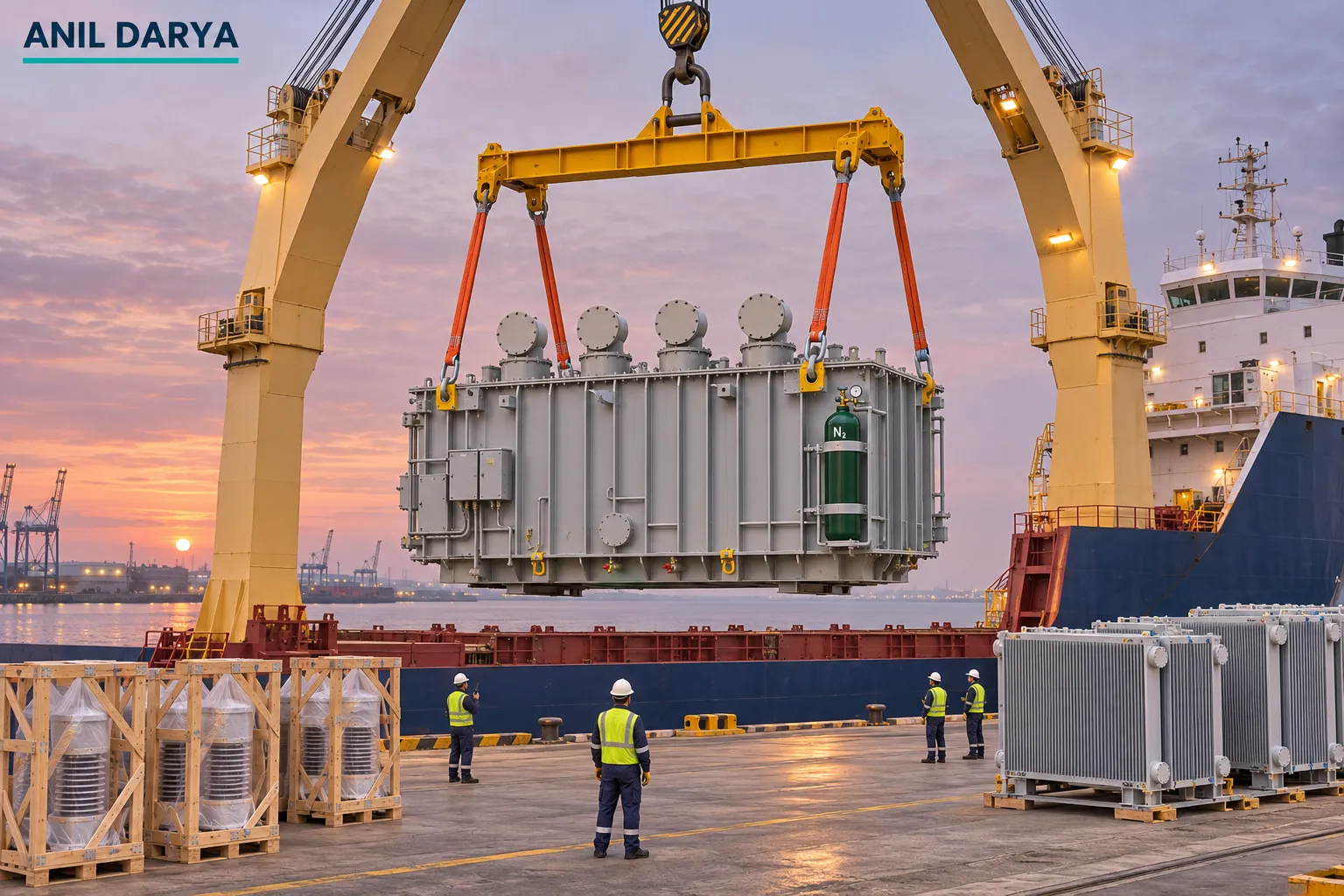
Transformer shipping looks simple on paper: one heavy steel tank, a few crates of parts, some drums of oil. In practice a large power transformer is one of the most damage-sensitive pieces of project cargo there is. The core and windings are clamped inside a tank that you cannot open on the quay, so the only evidence of what happened in transit comes from the gas pressure gauge, the impact recorders and the inspection on arrival. This guide explains how large units are prepared for a sea voyage, what the impact data means, and what to check before the tank leaves the trailer.
It is written for utility and EPC engineers, substation contractors and buyers of transformers for oil, gas and power projects. The transformer maker's shipping instruction and your purchase specification rule over anything general written here.
How large power transformers are configured for shipping
A transformer rarely ships the way it will run. To keep weight and height within what ships, cranes and roads can take, the maker strips it down. Virginia Transformer's installation manual lists three typical shipping configurations, and EC&M describes the same set.
| Configuration | What travels in the tank | What ships separately |
|---|---|---|
| Welded radiators, tank charged with oil | Oil | Small accessories |
| Demounted radiators, tank filled with oil | Oil, with part of the fluid drained into radiators at site | Radiators, top-off fluid, bushings, accessories |
| Demounted radiators, tank charged with dry gas | Dry nitrogen or dry air under positive pressure | All the oil, radiators, bushings, arresters, accessories |
The third row is the usual case for the large units that go by sea. Bushings, radiators, auxiliary cooling equipment, arresters and accessory devices are removed and shipped separately, and the tank openings are sealed with gasketed plates. The bill of lading notes the separate items, so the receiving crew can count them against the list.
Nitrogen or dry air fill and pressure monitoring
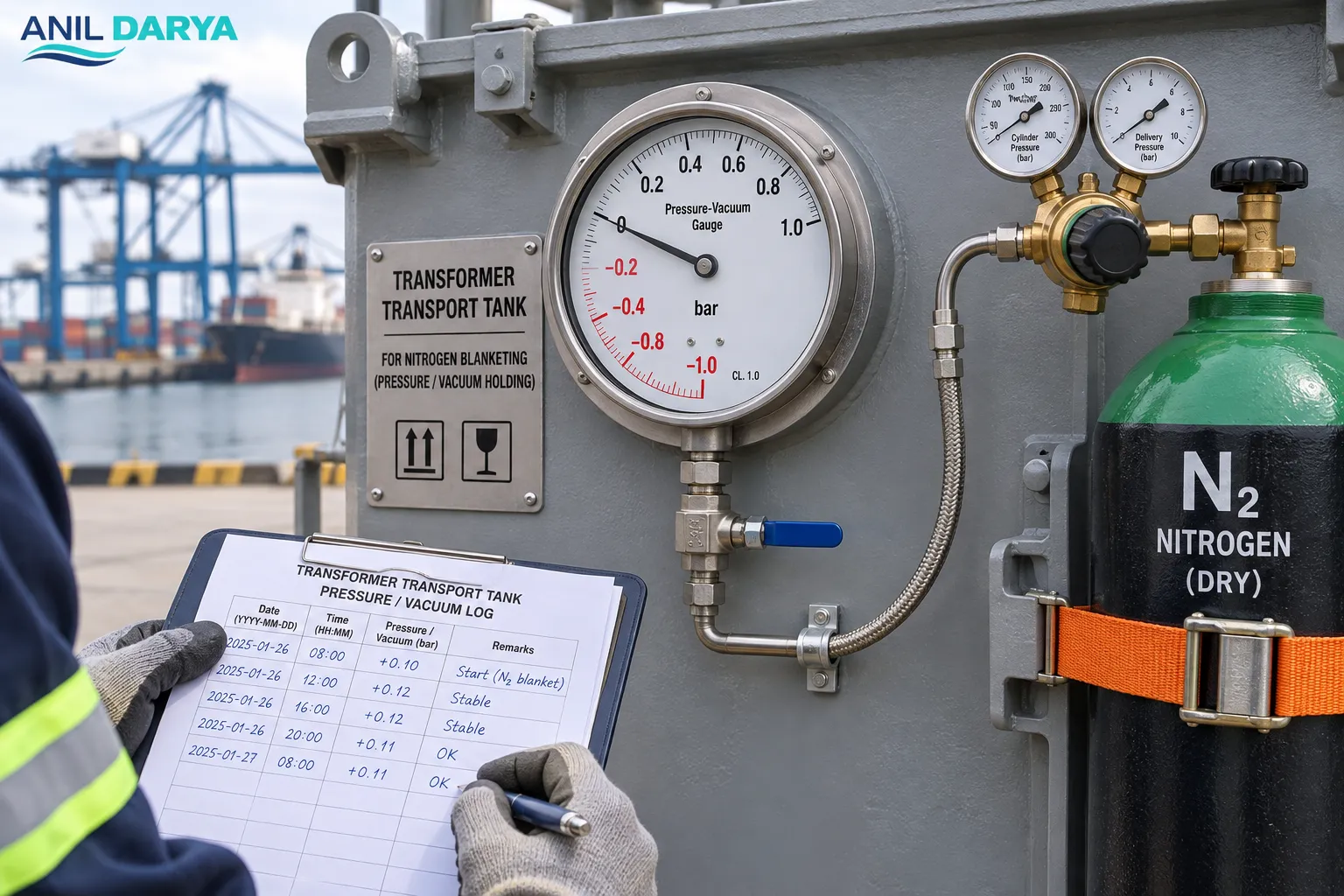
With the oil out, the insulation inside the tank must stay dry for the whole trip. The tank is filled with dry gas at a small positive pressure, so that any leak pushes gas out rather than letting humid air in. Makers use either dry nitrogen or dry air.
Manufacturer figures vary, so use your own unit's instruction. As examples, the Virginia Transformer manual and the EC&M article both call for keeping a positive pressure of 1 to 2 psi in storage at all times, even in cold weather, and recording pressure with the ambient temperature. EC&M describes a leak test at 5 psi with dry nitrogen, monitored for about 24 hours, and notes that pressure also changes with temperature. Ask the maker whether the unit travels with a gas cylinder connected and who may top it up.
For the sea leg, that turns into a few practical points:
- Record the gauge reading and ambient temperature at the factory, at port loading, after discharge and at site.
- Make sure the gauge and the cylinder valve are reachable on board, not buried behind lashing.
- Agree in advance who reads the gauge in port and who tops it up if it drops.
- Treat a zero or negative reading as a reason to call the maker before going any further.
Nitrogen has a safety side. Nitrogen does not support life, and both manuals say the gas space must be purged with dry air before anyone enters, for about half an hour. EC&M gives an oxygen range of 19.5% to 23.5% before entry. The UK HSE describes asphyxiation as a major risk with inert gas, particularly in confined spaces, and calls for oxygen monitoring and a permit to work.
Impact recorders on a transformer shipping job
An impact recorder is a data logger bolted to the tank that records acceleration on three axes with the date and time. SpotSee describes its units recording direction, amplitude and duration on the X, Y and Z axes, and some add GPS location. The point is to find out whether the transformer took a shock large enough to move the core or windings, which an external look cannot show.
How many and where:
- POWER magazine reports that Siemens attaches two recorders to each transformer to represent impacts across the whole unit.
- A ShockWatch paper summarising IEEE C57.150 says the guide calls for two recorders mounted on diagonally opposite ends, because a long tank damps a shock before it reaches the far end.
- SpotSee describes the monitor going into a steel box that is bolted onto the transformer itself, so it measures what the transformer felt rather than what the trailer or ship felt.
- Agree with the maker when and where the data is read, and who sends it on.
Acceptance limits and what an alert means
There is no single number that applies to every unit. The limit comes from the transformer maker or the purchase specification. Published figures give a sense of scale:
- POWER magazine reports that Siemens uses 1g, 2g or 3g alert thresholds for its transformers, set below the level known to cause damage.
- SpotSee states that impacts of about 2.5 to 3 g can damage very large transformers.
- According to the same POWER article, only about 10% of transformers that exceed the threshold turn out to be damaged.
So an alert is a trigger for review, not a verdict. The maker reads the impact waveform, compares it with factory test results and decides whether site tests are enough or an internal inspection is needed. What the logistics side owes the maker is clean data: the recorder file, the time of the event, and a record of what was happening at that moment, such as a lift, a road section or bad weather at sea.
Transformer shipping by sea: stowage, lifting and lashing
Large units go on heavy-lift ships, multipurpose ships with heavy cranes, or ro-ro ships. Atlantic Container Line moved three 161-ton transformers from Antwerp to Norfolk by rolling them onto its main deck on an SPMT, with 7.45 m internal height available. Heavy-lift ships load at quays without strong shore cranes. For UAE deliveries, units can discharge at Khalifa Port or Jebel Ali and book them under our break bulk service. For the vessel options, see our guide.
The lift goes through the maker's lifting lugs only, at the sling angles on the shipping drawing, and the centre of gravity marked on the tank. Our specialists issue the lift plan, stowage and lashing calculation from that drawing. An independent marine warranty surveyor approves them where the insurer or a charterer requires it; the article explains that step. The IMO CSS Code is the general reference for stowing and securing non-standard cargo like this.
Shipping braces inside or on the unit are part of the maker's design. Virginia Transformer paints them a different colour and says they come off only after the unit is in its permanent location. Brief the receiving crew so nobody removes them on the quay.
Oil, bushings and the separate crates
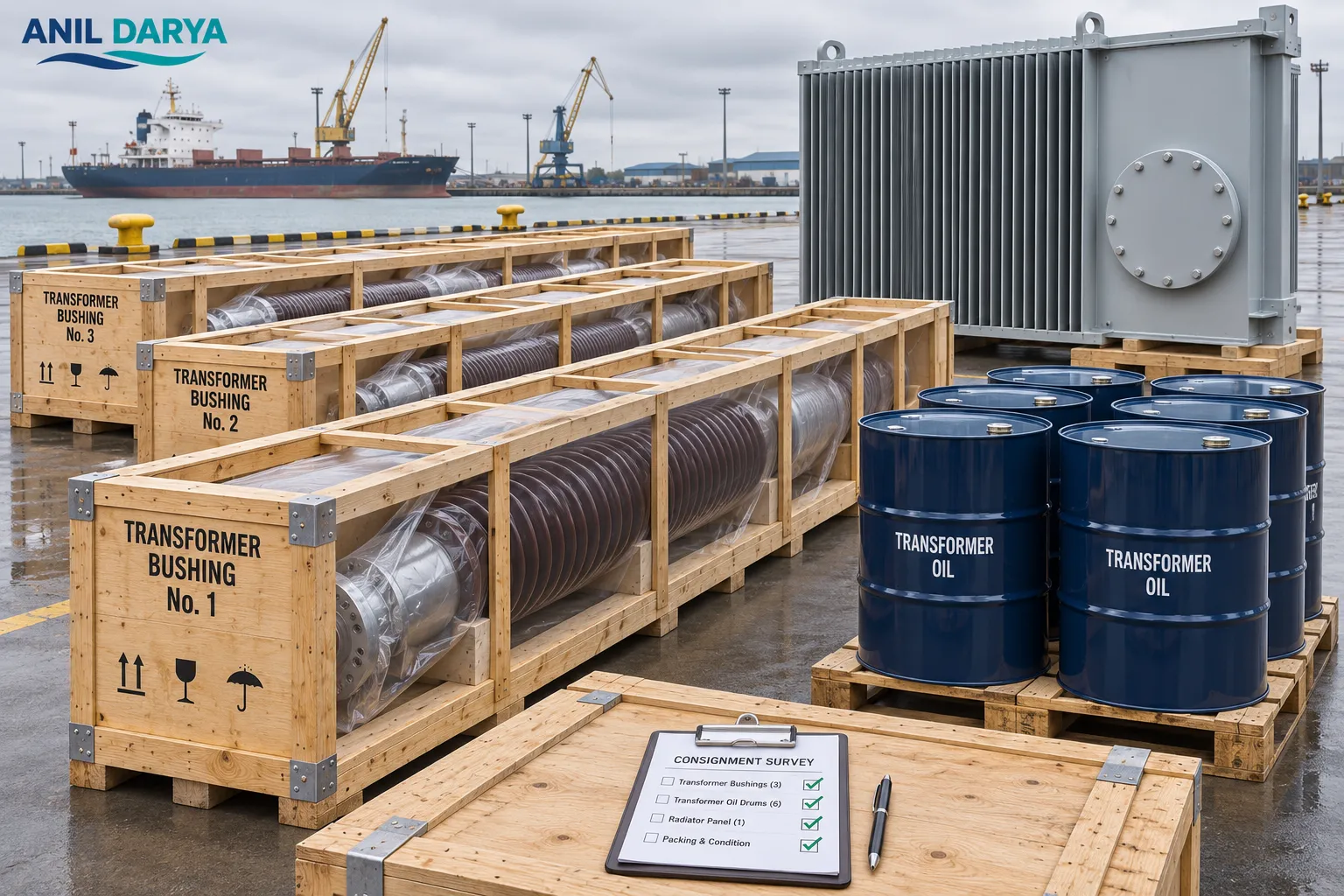
The tank is only part of the shipment. The oil travels in drums or tanks as its own cargo line, with its own entry on the packing list and the bill of lading. The bushings are the most fragile items in the set. EC&M recommends checking bushing crates and porcelain skirts for chips and cracks on arrival, and storing oil-filled bushings at a minimum of about 10 degrees above horizontal so the nitrogen blanket stays at the top.
Radiators and coolers arrive with blanked flanges. EC&M advises checking the flanges and headers for moisture or contamination and flushing them with clean insulating fluid if needed before they are connected. Keep every crate on the same numbering as the packing list and the bill of lading.
Inspection on arrival, before unloading
Virginia Transformer is clear that the inspection happens before the transformer comes off the truck. Its checklist and the EC&M list cover:
- Tank and radiators for leaks, dents, scratches and signs of rough handling, such as load shift or broken welds on attachments.
- External accessories for breakage, loss and leaks; scratched paint can point to other damage.
- Readings of the pressure-vacuum gauge, liquid level, top liquid temperature and ambient temperature.
- Separately shipped items counted against the bill of lading and checked for damage.
- Impact recorder data downloaded and sent to the maker.
If there is visible damage, note it on the delivery documents, file a claim with the carrier and contact the maker. An internal inspection, if needed, is coordinated with the maker. Our project cargo insurance article covers what the underwriter will want to see, and break bulk damage prevention covers handling at the port.
Standards worth knowing
IEEE C57.150-2023 is the IEEE guide for the transportation of transformers and reactors rated 10 000 kVA or higher. The IEEE describes it as information for reducing the risk of damage and delays. It superseded the 2012 edition and was published in March 2024. IEC 60076-1 is the general IEC standard for power transformers, covering three-phase and single-phase units including auto-transformers; it is usually the base of the purchase specification that sets the shipping requirements. CIGRE Technical Brochure 673, Guide on transformer transportation (2016, Working Group A2.42), reviews past transport incidents and gives recommendations on load securing, transport drawings and centre of gravity marking. Ask your maker which of these its transport procedure follows.
[AMIR-FACT: Have we shipped a power transformer, and if so, the vessel type and port used (no client name or figures we cannot confirm)]
Free transformer shipping consultation
Send us the maker's shipping drawing with the tank weight, dimensions and centre of gravity, the list of separate crates and oil drums, the shipping configuration (oil or gas filled), the factory or yard, the substation or plant, and your required delivery date. If the maker has a transport specification with impact limits, include it.
Our specialists reply straight away by email, and we meet in person when the project needs it. We send back the ship types that suit the tank, the lift planning and surveys required, the documents list for both ends including the oil, the checks we would run at the discharge port such as quay and crane capacity and the road to the substation, and a suggested route into the UAE, out of Dubai or cross-trade between two other countries. Gas fill, impact limits and arrival tests stay with the maker. You can also reach us through the contact page.
Frequently asked questions
Why are large transformers shipped without oil?
To cut shipping weight. The tank is filled with dry nitrogen or dry air under positive pressure instead, and the oil travels separately to be filled at site under the maker's procedure.
What pressure should a nitrogen-filled transformer hold in transit?
Whatever the maker specifies. Two published manuals call for 1 to 2 psi positive pressure in storage. A zero or negative reading means you call the maker before unloading.
What is a transformer impact recorder?
A logger fixed to the tank that records shocks on three axes with date and time. It shows whether the unit took an impact that could have moved the core or windings.
What g-force damages a transformer?
The maker sets the limit. Published figures include Siemens alert thresholds of 1g, 2g or 3g and a SpotSee statement that about 2.5 to 3 g can damage very large transformers.
How many impact recorders should a transformer have?
Two is common for large units. Siemens fits two per transformer, and a summary of IEEE C57.150 places them at diagonally opposite ends.
Are bushings shipped on the transformer?
Not on large units. Bushings, radiators, arresters and accessories are removed and shipped in their own crates, with the openings sealed.
Is it safe to enter a nitrogen-filled transformer tank?
Not until the gas space has been purged with dry air and the oxygen level checked. Follow the maker's entry procedure and your site's confined space rules.
Can you ship a transformer between two countries without passing through the UAE?
Yes. On a cross-trade move the unit travels on the shipping line's bill of lading, issued and released through us as agent for the line, with destination clearance agreed with the consignee's broker first. See our sea freight page for how we book.
Sources
- IEEE: C57.150-2023 Guide for the Transportation of Transformers and Reactors Rated 10 000 kVA or Higher
- IEC: IEC 60076-1:2011 Power transformers, Part 1: General
- UK HSE: Inerting, technical measures
- IMO: Code of Safe Practice for Cargo Stowage and Securing (CSS Code)
- Virginia Transformer: Liquid filled installation and operation manual
- EC&M: Getting the most from your transformer installation
- POWER: Innovative tool monitors for damaging impacts and vibration
- SpotSee: Impact recorders for transformers
- ShockWatch: Why transformers need impact recorders (summary of IEEE C57.150 guidance)
- Atlantic Container Line: Transformer transport
- CIGRE: Technical brochure 673, Guide on transformer transportation
Reviewed: 16 November 2026