
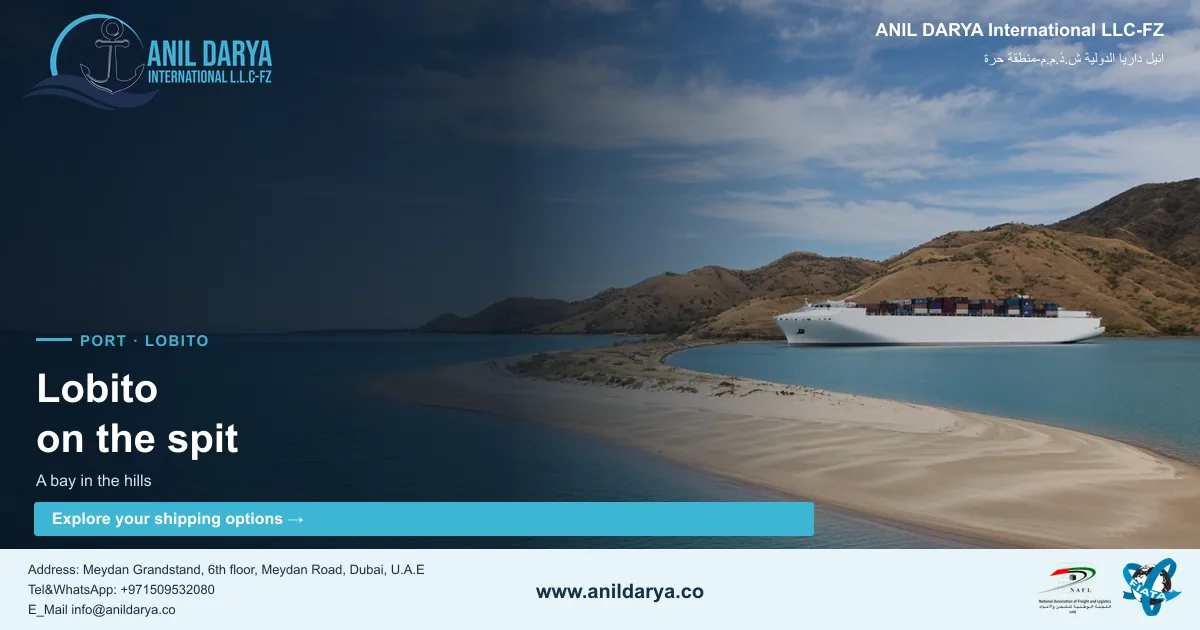
Port of Lobito shipping is the route into central and southern Angola and the sea end of the rail corridor that runs east to the DR Congo. The port sits in a sheltered natural bay in Benguela province, is owned by the state company Porto do Lobito, and handles containers, general cargo, vehicles and minerals through a multipurpose terminal run by Africa Global Logistics (AGL) and a mineral terminal linked to the railway. This guide covers what is specific to Lobito: the terminals, depths, the corridor rail, cargo and how we ship your cargo there from Dubai. We ship both ways: from Dubai to Lobito and from Lobito to Dubai.
Port of Lobito guide: key facts at a glance
| Item | Detail |
|---|---|
| Port authority | Porto do Lobito E.P. (Empresa Portuaria do Lobito), a state-owned public company |
| UN/LOCODE | AOLOB |
| Location | Lobito Bay, Benguela province, about 30 km north of Benguela city |
| Bay | Natural deep bay about 5 km long, 600 m wide at the entrance, up to about 1.5 km wide |
| Water depth in the bay | 15 to 36 m (port authority) |
| Largest tidal range | 1.90 m |
| Terminals | Multipurpose terminal (containers, general cargo, vehicles, dry bulk) and mineral terminal |
| Multipurpose and container operator | AGL Lobito Terminal, concession signed 11 December 2023, operations launched March 2024 |
| AGL terminal quay | 1,200 m, 14 m deep |
| AGL container storage | 12,000 TEU |
| AGL stated capacity | More than 100,000 TEU and more than 1 million tonnes of bulk a year |
| Cargo handled | About 1.8 million tonnes in 2024; about 900,000 tonnes and 177 ships in the first half of 2025 |
| Rail | Benguela railway (Cape gauge, 1,067 mm) to Luau on the DR Congo border, run by Lobito Atlantic Railway |
| Road | EN-100 coastal highway |
| Nearest airport | Catumbela, about 13 km |
| Hours | 24 hours a day, 365 days a year, in shifts |
| Customs | AGT (Administracao Geral Tributaria) |
| Lobito to Dubai | Export declaration with the AGT; 5% UAE duty on CIF for most goods plus 5% VAT |
Where is the Port of Lobito and what does it serve?
Lobito is on Angola's Atlantic coast, roughly halfway down the country. The port lies inside Lobito Bay, which is closed off from the open sea by a sandspit about 5 km long. That gives ships calm water without a long dredged channel. The port authority describes a natural bay about 5 km long, 600 m wide at the entrance and up to about 1.5 km wide, with depths of 15 to 36 m.
The port has two hinterlands. The first is Angola's central and southern plateau: Benguela, Huambo, Kuito and the farming and industrial towns along the railway. The second lies across the border, in the copper and cobalt mining region of the DR Congo, and in future Zambia, reached by the Benguela railway. Exports of copper, cobalt and other minerals leave through Lobito, and mining inputs such as sulphur come in.
A simple rule: if your consignee is in Luanda or the north, ship to Luanda. If it is in Benguela, Huambo or further east along the railway, or across the border in the mining region, price Lobito.
Which terminals does the Port of Lobito have?
The port authority lists two terminals. The table shows what each one takes.
| Terminal | Operator | Cargo | Relevance for UAE cargo |
|---|---|---|---|
| Multipurpose terminal | AGL Lobito Terminal | Containers, loose general cargo, vehicles, dry bulk, other goods | Where your containers, breakbulk and vehicles land |
| Mineral terminal | Linked to Lobito Atlantic Railway | Mineral cargo, containerised minerals, bulk | Mineral exports and mining inputs such as sulphur |
Other services in the port come from separate companies: tug services from Timoneiro, ship repair from Lobinave and marine fuel from Sonangol.
AGL Lobito Terminal: the multipurpose and container terminal
AGL Ports and Terminals signed the concession for Lobito's multipurpose terminal, including containers, on 11 December 2023, after an international tender decided in October 2023. AGL launched operations in late March 2024 and took over the port company's staff at the terminal; it reports 730 employees. A later report gives the concession as 20 years.
AGL lists 1,200 m of quay with 14 m of water and direct sea access, storage for 12,000 TEU and new handling equipment, information systems and yards for containers and conventional cargo. It states a capacity of more than 100,000 TEU of containers and more than 1 million tonnes of bulk a year. AGL names its cargo as bulk goods, containers, strategic minerals such as copper and cobalt, and agricultural products, with multimodal transport as part of its offer.
What this means for you: Lobito now has one container operator with a deep quay. Luanda has several terminals and more services, so check which carriers offer Lobito from the UAE before you promise a delivery date.
The mineral terminal
The mineral terminal is used by the railway's mineral traffic. The first ship to berth there for the Lobito Atlantic Railway was the bulk carrier MV Lindsaylou on 12 July 2024, carrying sulphur used to refine copper in the DR Congo. For general cargo from the UAE, this terminal matters only if your consignee is a mining company importing bulk inputs by charter.
How deep is Lobito and what ships can berth?
Depth at Lobito depends on where you look. The table sets out what each source says.
| Point | Depth | Source |
|---|---|---|
| Bay waters | 15 to 36 m | Port authority |
| AGL multipurpose quay | 14 m | AGL |
| Anchorage | 14 to 15.2 m | Port directories |
| Older cargo piers | 9.4 to 10 m | Port directories (older data) |
For a container ship at the AGL quay, 14 m is the figure to plan around. For a breakbulk or bulk charter, confirm the berth first. Directory data still list 9.4 to 10 m at some cargo piers, and the port reports that dredging is under way so larger ships can call. Ask the carrier or charterer to confirm the arrival draft against the berth.
The Lobito corridor: rail from the port to the DR Congo
Lobito is the coastal end of the Benguela railway. The line runs inland from Lobito through Benguela, Huambo, Kuito and Luena to Luau on the DR Congo border, where it crosses to Dilolo and continues to Kolwezi in the mining region. It is built to Cape gauge (1,067 mm), the same as other lines in central and southern Africa.
| Item | Detail |
|---|---|
| Operator | Lobito Atlantic Railway (LAR), a joint venture of Trafigura, Mota-Engil and Vecturis |
| Concession | 30 years, awarded in 2022; handover held in Lobito on 4 July 2023 |
| Route in Angola | About 1,300 km of the Benguela railway, Lobito to Luau |
| Route in the DR Congo | About 400 km, Dilolo to Kolwezi |
| Lobito to Kolwezi | About 1,700 km |
| Gauge | 1,067 mm (Cape gauge) |
| Main cargo | Copper, cobalt and other minerals out; mining inputs and general cargo in |
| Planned extension | A line towards Zambia |
For a UAE shipper, the railway changes two things. First, Lobito is now a real option for cargo to towns along the line in Angola, not only for coastal Benguela. Second, cargo for the mining region of the DR Congo can move through Lobito and by rail instead of a long truck route from another port. That cargo stays under customs transit through Angola, so the consignee needs a clearing agent who handles transit at Lobito and the border.
Our view as a forwarder: rail capacity, wagon types and container acceptance on the corridor change as the operator adds rolling stock. Before you sell a delivered price to a DR Congo buyer, get the rail booking, wagon type and transit time in writing from the consignee's agent.
What cargo moves through the Port of Lobito?
Lobito handled about 1.8 million tonnes in 2024, up from about 1.4 million tonnes a year before the terminal concession. In the first half of 2025 it handled about 900,000 tonnes and 177 ships.
| Direction | Main cargo | Where it goes |
|---|---|---|
| Exports | Copper, cobalt and other mineral products | Europe, Asia and North America |
| Imports | Raw materials, equipment and accessories for manufacturing and agriculture | Benguela province, the plateau and the mining region |
| Imports in containers | General goods, spare parts, food, building materials | Consignees along the railway and coast |
What this means for cargo from the UAE
Typical cargo you might ship from the UAE to Lobito: machinery, spare parts and consumables for mines and factories, vehicles, building materials, and general goods for Benguela and Huambo. Much of it is project-style cargo for industry, so breakbulk and flat racks come up more often here than on a pure consumer lane.
Shipping from Dubai to Lobito: FCL, LCL and transit
Containers for Lobito usually load at Jebel Ali. Our Jebel Ali port shipping guide covers the export side in the UAE. Confirm the routing on a current carrier quotation. If the service involves transhipment, the hub and connection affect the transit time.
Ask for a dated quotation confirming the carrier, ports, any transhipment, estimated transit time and cargo acceptance before booking. Availability depends on the shipment and departure date.
| Option | When it fits | What to watch at Lobito |
|---|---|---|
| FCL 20ft or 40ft | A full box, or cargo that will go on by rail | Fewer carriers than Luanda; check the service |
| Reefer | Chilled or frozen food | Plug space at the terminal; food needs lab testing at entry |
| Flat rack or open top | Machinery and out-of-gauge pieces | Special gear at the hub; lashing survey |
| Breakbulk | Large pieces, steel, mining equipment | Berth depth and ship's gear |
| LCL | A few pallets | Few consolidators unpack at Lobito; ask where the box is opened |
For small volumes, an LCL quote may end in Luanda with a long truck ride south. Ask where your cargo leaves the shared box. Our guide to FCL vs LCL costs explains the trade-off, and our sea freight service page shows what we book.
Breakbulk, project cargo and dangerous goods at Lobito
The 1,200 m multipurpose quay and the conventional yard at Lobito are set up for non-containerised cargo as well as boxes. Mining and industrial projects in the hinterland bring heavy pieces. For a breakbulk or project shipment from the UAE, we plan it in this order:
- Collect drawings, weights, dimensions, centre of gravity and lifting points.
- Choose between flat racks on a container service and a breakbulk or heavy-lift ship.
- Confirm the berth, its depth and whether the ship's gear or shore cranes discharge the cargo.
- Agree the lashing and stowage plan with the carrier and survey at loading.
- Agree the onward move with the consignee's agent: trailer and permits, or a rail wagon on the corridor.
Our break bulk and project cargo team handles the UAE side, and our article on the project cargo logistics process walks through each stage.
Mining inputs can include dangerous goods such as acids, gases and other chemicals. DG to Lobito must follow the IMDG Code with the correct UN number, proper shipping name, class, packing group where assigned, applicable safety data sheet and signed DG declaration. Each transshipment port on the route must accept the class too, and if the cargo goes on by rail, ask the consignee's agent whether the railway accepts that class. Our dangerous goods shipping team gets acceptance for the sea route before you commit.
Customs at the Port of Lobito: a short summary
Customs at Lobito follow the same national rules as Luanda. The AGT clears imports on the Documento Unico (DU), filed by the importer or an approved customs agent. Our Luanda guide covers the full process. Here is the short version and what to watch at Lobito.
| Item | What applies | What to watch at Lobito |
|---|---|---|
| Loading certificate | Certificado de Embarque, issued under ARCCLA (Presidential Decree 326/20) | Apply as soon as the booking is confirmed |
| Main documents | Commercial invoice, packing list, bill of lading, DU, customs value declaration | Invoice and packing list must match |
| Import licence | For sensitive goods such as food, medical devices, pharmaceuticals and agricultural inputs | Importer registered for the product category |
| Duty | Rates depend on the HS code and customs value. For 2026, the minimum import duty is 5%, subject to duty-free treatment, fiscal/customs benefits and State-import exceptions under Article 31 of Law 14/25 | Check the HS code before shipping |
| VAT | 14% standard; 5% for qualifying food and agricultural inputs listed in the VAT Code | Base includes duty, taxes and ancillary costs |
| Other charges | General customs fees and any applicable stamp duty or other charges depend on the customs regime and sector; request an itemised assessment from the broker | Budget these on top of duty and VAT |
| Laboratory testing | Food and pharmaceuticals tested at the port of entry (Decree 140/16) | Allow extra time for reefer and food cargo |
| Transit to the DR Congo | Bonded transit through Angola | Consignee's clearing agent handles transit and the border |
Pre-shipment inspection has not been mandatory since Presidential Decree 63/13, although some buyers ask for it for a letter of credit. Our article on Incoterms 2020 for sea freight explains who pays what on each term.
How to ship from Dubai to the Port of Lobito: step by step
- Confirm Lobito (AOLOB) is the right port for the consignee, and whether the cargo stays in Angola or goes on to the DR Congo.
- Check that the importer is registered for the product and holds any import licence needed.
- Send us the cargo details: commodity, HS code, weight, volume, packing, Incoterm and UAE pickup point.
- We quote the available options and confirm the carrier and any transhipment before booking space.
- Start the loading-certificate application as soon as the booking is confirmed. Confirm the issuance deadline and any bill-of-lading number requirement with the booked carrier and authorised issuing agent.
- We arrange trucking to Jebel Ali and UAE export clearance.
- For DG, we get carrier and hub acceptance before loading.
- The consignee's agent files the DU in Angola, or the transit documents for the DR Congo.
- After release, the cargo leaves the AGL terminal by truck or rail.
For cargo loading in Abu Dhabi, see our Khalifa Port guide.
How to ship from the Port of Lobito to Dubai
We also handle the other direction: cargo from the AGL terminal at Lobito to Jebel Ali, Khalifa Port or Sharjah port. We book the space with the carrier, check the papers and run the UAE side. The Angolan export formalities stay with the shipper or its Angolan customs broker (despachante).
The Angola export side
- Registration. Traders must be registered in the Registo de Exportadores e Importadores (REI), valid for 5 years. Registration gives access to the SICOEX platform used for trade licensing.
- Export declaration. The declaration is lodged with the AGT by the exporter or a representative with powers to act, under the definitive export regime (code EX1). Official customs brokers (despachantes oficiais) do this for third parties, and their chamber has a Lobito circumscription.
- Processing. Declarations run in ASYCUDA World and are routed to a green, yellow, red or blue channel, from release to document check, physical inspection or post-clearance control.
- Export duty. Goods produced and certified in Angola leave free of customs duty and general customs fees, except in the oil and mining sectors. Under the AGT guide, definitive exports of nationalised goods pay 20% on the customs value (70% for specified food, medicines and medical equipment), plus a 0.5% fee. This differs from the re-export regime for goods that have not been nationalised; confirm the correct regime and any sector-specific rules with the customs broker. Unprocessed mineral resources pay 5%.
The UAE import side
Before arrival, coordinate the import declaration with the customs authority for the entry port: Dubai Customs for Jebel Ali, Abu Dhabi Customs for Khalifa Port, or Sharjah Customs for Sharjah ports. Dubai Customs lists the documents as the commercial invoice, the packing list, the certificate of origin and a permit from the controlling authority for restricted goods. The original or released bill of lading is what the carrier needs before it issues the delivery order. Customs duty in Dubai is 5% of the CIF value for most goods, with 50% on alcohol and 100% on cigarettes. Standard import VAT is 5% on the customs value, including freight and insurance, plus applicable customs duty and excise tax; exemptions and zero-rating depend on the goods. A VAT-registered importer accounts for it on its VAT return under the reverse charge; an importer that is not registered settles it at import.
- Send us the shipper's details in Angola, the cargo, the HS code and the UAE delivery address.
- We confirm the routing from Lobito, book space and send the booking and cut-offs to the shipper.
- The shipper or its trucker delivers the loaded box or cargo to the AGL terminal before the cut-off.
- The shipper or its despachante lodges the export declaration with the AGT and pays any export duty that applies.
- We check the draft bill of lading against the invoice and packing list.
- We coordinate the import declaration with the customs authority for the agreed UAE entry port before arrival.
- We arrange payment of the duty and VAT and collect the delivery order from the carrier's UAE agent.
- We truck the cargo to your site and return the empty to the carrier's depot inside free time.
Ask for a dated quotation confirming the carrier, ports, any transhipment, estimated transit time and cargo acceptance before booking. Availability depends on the shipment and departure date.
Free time, storage and demurrage at Lobito
Each carrier sets its own free time for containers at Lobito, and the terminal charges storage on its own tariff. We do not quote a figure because it changes by carrier and contract. Ask for both on the quote.
Cargo going on by rail adds a risk: if the wagon is not ready when the box is released, storage and detention keep running. Agree the rail booking before the ship arrives. Our article on demurrage and detention explains how these charges build up.
Lobito or Luanda: which Angolan port fits your cargo?
| Question | Lobito | Luanda |
|---|---|---|
| Where is the consignee? | Benguela, Huambo, the railway towns, the DR Congo mining region | Luanda, Bengo, the north |
| Container operators | One (AGL) | Several |
| Carrier choice from the UAE | Narrower | Wider |
| Inland link | Rail corridor to the DR Congo border and beyond | Mostly road |
| Quay depth at the main terminal | 14 m at AGL | Varies by terminal |
If both ports could work, ask us to price both. A cheaper ocean rate to Luanda can be lost on a long truck run south.
Checklist before you ship to the Port of Lobito
- Port code AOLOB on the booking and bill of lading.
- Loading certificate arranged, with the carrier’s issuance and bill-of-lading requirements confirmed.
- Importer registered and import licence in hand where needed.
- HS codes checked, invoice and packing list matching.
- For food or medicines, lab testing time allowed for.
- For DG, IMDG documents ready and hub ports approved.
- For breakbulk, berth depth and discharge gear confirmed.
- For DR Congo cargo, transit agent, rail booking and border plan agreed.
- Free time and storage terms known before sailing.
Common mistakes when shipping to Lobito
- Failing to arrange the loading certificate or follow the booked carrier’s documentation requirements.
- Assuming every carrier that serves Luanda also calls Lobito.
- Selling a delivered price to the DR Congo before the rail leg is booked.
- Planning a breakbulk ship for an old berth without checking its depth.
- Forgetting that each hub and the railway must accept a DG class.
- Accepting an LCL quote without asking where the box is unpacked.
Frequently asked questions
Who operates the port in Lobito?
The port is owned by the Angolan state through the public company Porto do Lobito E.P. Its multipurpose and container terminal has been run by AGL Lobito Terminal, part of Africa Global Logistics, since March 2024 under a concession signed in December 2023.
What is the port code for Lobito?
The UN/LOCODE for the Port of Lobito is AOLOB. Use it on every booking and bill of lading.
How deep is the port at Lobito?
AGL gives 14 m of water at its 1,200 m multipurpose quay. The port authority describes depths of 15 to 36 m in the bay, while directories list 9.4 to 10 m at some older cargo piers, so confirm the berth for each ship.
How much cargo does Lobito handle?
Lobito handled about 1.8 million tonnes in 2024, and about 900,000 tonnes and 177 ships in the first half of 2025. AGL states a capacity of more than 100,000 TEU and more than 1 million tonnes of bulk a year at its terminal.
What is the Lobito corridor?
It is the rail route from the Port of Lobito along the Benguela railway to Luau on the DR Congo border and on to Kolwezi, about 1,700 km in total. Lobito Atlantic Railway runs it under a 30-year concession, mainly for minerals out and mining inputs and general cargo in.
Can I ship cargo to the DR Congo through Lobito?
Yes. Cargo can land at Lobito and move by rail under customs transit to the DR Congo mining region. The consignee needs a clearing agent who handles transit at Lobito and the border, and the rail booking should be agreed before the ship arrives.
Is there a direct ship from Dubai to Lobito?
Check a current carrier schedule for your departure date. The booking should identify whether the service is direct or uses a transhipment hub, together with the planned connections and arrival date.
Do I need a loading certificate to ship to Lobito?
Yes. Arrange the ARCCLA loading certificate (Certificado de Embarque) for customs clearance. Carrier instructions differ on recording its number on the bill of lading, so confirm the deadline and document requirements for your booking with the carrier and authorised issuing agent.
Can you ship cargo from Lobito to Dubai?
Yes. The shipper or its Angolan despachante lodges the export declaration with the AGT, and we book the space, coordinate clearance with the customs authority for the agreed entry port and deliver the cargo in the UAE. Most goods pay 5% UAE duty on the CIF value plus 5% import VAT.
Get a quote for Port of Lobito shipping
Send us your cargo details and we will come back with a routing and price for shipping to Lobito from the UAE. Use our freight rate inquiry form, or contact our team to talk through a project, DG or DR Congo transit shipment first.
Sources
- Porto do Lobito: port authority site (bay, depths, tidal range, terminals, services, hours)
- AGL: Lobito multipurpose and container terminal concession signed (December 2023)
- AGL: AGL Lobito Terminal launches operations (March 2024)
- Logupdate Africa: AGL and Lobito Port sign concession contract (December 2023)
- 360 Mozambique: Lobito port volumes, cargo, dredging, concession term
- Wikipedia: Port of Lobito (UN/LOCODE, authority, road link)
- Wikipedia: Lobito Atlantic Railway (partners, concession, route length, mineral terminal first ship)
- Wikipedia: Benguela railway (stations, gauge, DR Congo connection)
- Wikipedia: Lobito (Catumbela airport distance)
- Africa Ports: Lobito (location, sandspit, depths, gauge)
- MagicPort: Lobito port (channel, anchorage and pier depths)
- US Commercial Service: Angola import tariffs (duty range, VAT, customs fee, stamp duty)
- US Commercial Service: Angola import requirements and documentation
- Presidential Decree 326/20: statute of ARCCLA
- AGT: Taxpayer guide on the entry and exit of persons, goods and assets (January 2025; despachantes, REI, export regime, export duties)
- Dubai Customs: Submit customs declaration (documents)
- UAE Government portal: Customs duty (5% of CIF, alcohol 50%, cigarettes 100%)
- Federal Tax Authority: VAT Decree-Law No. 8 of 2017 as amended (5% rate, import value, reverse charge, unregistered importers)
- Angola: 2026 Budget Law, Article 31 (minimum import duty)
- CMA CGM: Angola CNCA documentation advisory
- Maersk: ECTN certificate overview
- Trafigura: First vessel at Lobito mineral terminal
- Federal Tax Authority: VAT importers guide
- Abu Dhabi Customs: Customs centres
- Sharjah Customs: Import procedures
Reviewed: 16 November 2026