
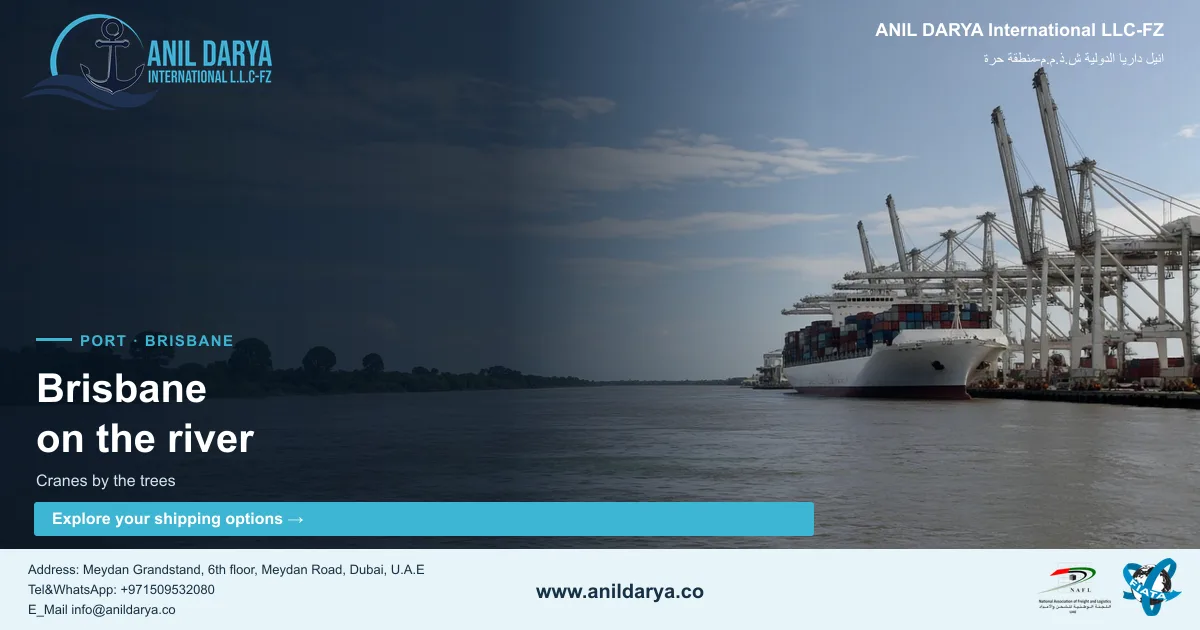
Port of Brisbane shipping covers Queensland's main gateway for containers, vehicles and bulk cargo. The port sits at the mouth of the Brisbane River on Fisherman Islands, moved about 1.62 million TEU in 2024/25 and carries around 95% of Queensland's containerised trade. This guide explains the three container terminals, the vehicle and bulk berths, the port's dangerous goods notice, customs at Brisbane and how to ship there from Dubai, step by step. We ship both ways: from Dubai to Brisbane, and from Brisbane to Dubai.
Port of Brisbane at a glance
| Item | Detail |
|---|---|
| Location | Fisherman Islands, at the mouth of the Brisbane River on Moreton Bay, Queensland |
| UN/LOCODE | AUBNE |
| Port manager | Port of Brisbane Pty Ltd (PBPL), on 99-year leases since the 2010 privatisation |
| Containers in 2024/25 | About 1,620,000 TEU |
| Total trade in 2024/25 | 34.9 million tonnes, about AUD 73.5 billion of international trade |
| Vessel movements in 2024/25 | 5,473 |
| Operating berths | 27, with more than 8,200 m of quay line |
| Container berths | 9, run by DP World, Patrick and Brisbane Container Terminals (Hutchison Ports) |
| Shipping channel | 90 km long, maintained by PBPL; dredged to 14 m at the lowest tide |
| Liner services | Over 20 shipping lines on regular services |
| Share of Queensland trade | About 95% of containerised trade and 90% of motor vehicles |
| Brisbane to Dubai | Export declaration in ICS by the exporter or its agent for goods over AUD 2,000; UAE duty 5% of CIF, with CEPA cuts for qualifying Australian goods |
| Other cargo | Vehicles and ro-ro, breakbulk, grain, coal, cement and clinker, woodchip, fuels, chemicals, cruise |
What is the Port of Brisbane and who runs it?
Brisbane's trade used to move through wharves up the river. In 1974 a Queensland Government plan picked Fisherman Islands for a purpose-built deepwater port, because the river was too tight for growing ships. The Fisherman Islands port opened on 15 November 1980, the first container ship berthed in August 1981, and two container terminals were working by the end of 1983.
In 2010 the Queensland Government privatised the port. Port of Brisbane Pty Ltd now manages and develops it under 99-year leases, maintains the 90 km shipping channel and leases land to terminal operators and logistics companies.
The port is next to Brisbane Airport and is still growing. PBPL plans to reclaim a 230-hectare Future Port Expansion area over the next 10 to 30 years as trade and ship size grow.
Port precincts you will see on paperwork
PBPL splits its land into five precincts: Port Bris, Port Central, Port Gate, Port North and Port West. Port Bris, also called Fisherman Islands, is the main operating area. It holds the cargo wharves, vehicle storage and processing, warehouses, container parks, logistics centres and the Brisbane Multimodal Terminal for rail. If your delivery order names a container park or depot "at the port", it is most likely in this precinct.
Which container terminals does the Port of Brisbane have?
PBPL lists nine container berths at Fisherman Islands, split between three stevedores. The carrier's service decides which one your box uses.
DP World Brisbane (Berths 4 to 7)
PBPL's berth list places DP World Brisbane at Berths 4 to 7. DP World itself lists a 37.5-hectare terminal with three working berths, a 929 m quay and 14 m depth, using straddle carriers and post-Panamax cranes, and calls it semi-automated with automated cranes and rail tracks into the terminal.
Patrick Brisbane AutoStrad (Berths 8 to 10)
Patrick lists three berths (8, 9 and 10), a 930 m quay line with a maximum draft of 14 m, 40 hectares with 5,705 ground slots, 1,352 reefer plugs and capacity of about 1 million TEU.
Brisbane Container Terminals, Hutchison Ports (Berths 11 and 12)
Hutchison Ports Australia runs Berths 11 and 12 through Brisbane Container Terminals, under a 42-year agreement signed in 2008. Berths 11 and 12 were the last container berths built, with construction contracts awarded in 2010 and 2011.
| Terminal | Berths (PBPL list) | Published figures |
|---|---|---|
| DP World Brisbane | 4 to 7 | 37.5 ha, 3 working berths, 929 m quay, 14 m depth, semi-automated |
| Patrick Brisbane AutoStrad | 8 to 10 | 930 m quay, 14 m max draft, 40 ha, 1,352 reefer plugs, about 1 million TEU |
| Brisbane Container Terminals (Hutchison) | 11 and 12 | 42-year agreement from 2008 |
Reefer capacity matters on this lane because much of Brisbane's trade is food and agriculture. Patrick alone lists 1,352 reefer plugs. For chilled or frozen food from the UAE, the limit is usually the import conditions in BICON, not plugs at the terminal.
Vehicles, breakbulk and bulk berths at Brisbane
Brisbane is more than a container port. Ports Australia says about 90% of Queensland's motor vehicles move through it, and PBPL lists a range of general cargo, dry bulk and wet bulk berths.
| Cargo | Where at the port | Notes for a shipper from the UAE |
|---|---|---|
| Vehicles and ro-ro | Three berths for general cargo, motor vehicles and containers; the Grain Berth can take some car carriers | Vehicles must be clean of soil and plant material; vehicle import rules apply |
| Breakbulk and project cargo | 696 m of general cargo wharves; the PBPL General Purpose Berth | Lifting plan, cleanliness, carrier acceptance |
| Grain, cottonseed, sugar | GrainCorp terminal; Pinkenba common-user berth upriver | Mostly an export trade |
| Cement and clinker | Sunstate Cement and Bulwer Island clinker berths | Bulk vessel chartering, not liner booking |
| Coal and woodchip | Queensland Bulk Handling; Queensland Commodity Exports | Export trades |
| Crude, refined fuels, chemicals | Lytton, Luggage Point, Pinkenba, Colmslie and Fisherman Islands berths | Tanker trades with terminal acceptance |
| Cruise | Brisbane International Cruise Terminal at Pinkenba | Opened in 2022, takes ships over 270 m |
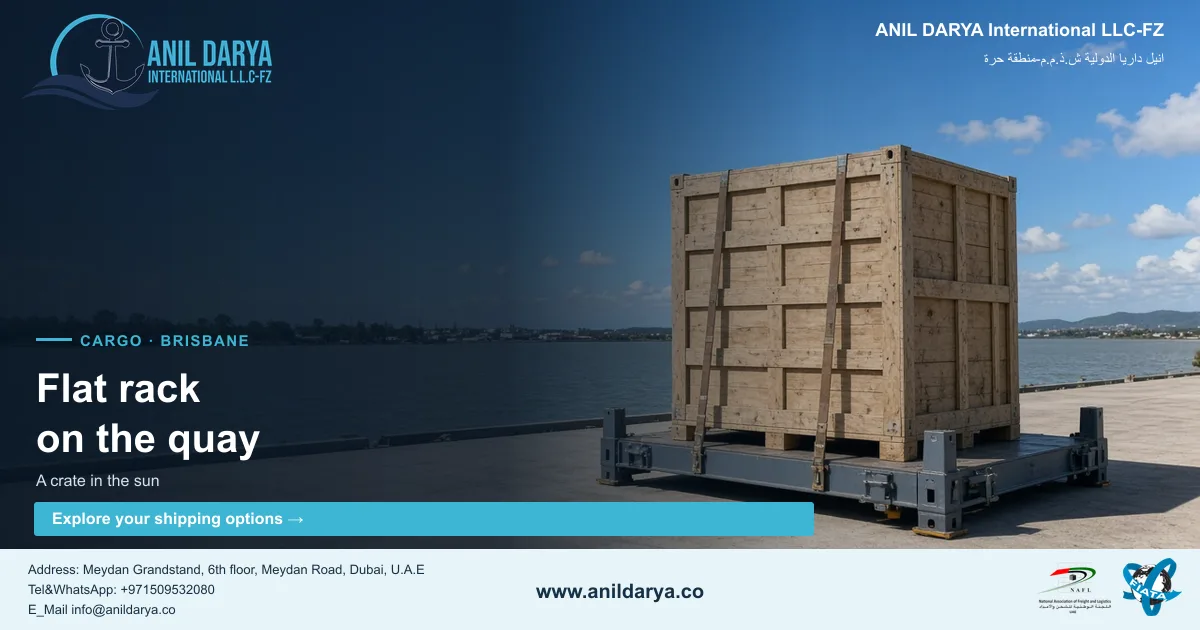
For machinery, steel structures and plant from the UAE, the decision is between a flat rack or open top on a container service and a breakbulk or ro-ro carrier to the general cargo wharves. Flat racks go through the container terminals and usually sail more often. Breakbulk suits units too large or heavy for a rack. Either way, the cargo must arrive clean of soil and plant material, and seasonal biosecurity measures can apply to machinery made in certain countries. We collect drawings, weights and lifting points, agree lashing with the carrier and plan the UAE road leg to the quay through our break bulk and project cargo service.
How cargo leaves the Port of Brisbane
Most containers leave Fisherman Islands by truck along the port's road corridor into the Brisbane metropolitan area. Rail exists but carries little import freight. The Fisherman Islands rail line opened in 1980 and became dual gauge in 1997, linking the port to the national standard gauge network, and the Brisbane Multimodal Terminal sits inside the Port Bris precinct. Even so, only about 2% of freight arrived at the port by rail in 2019.
| If your consignee is | Usual way out of the port | What to check |
|---|---|---|
| In Brisbane, Ipswich, Logan or the Gold Coast | Truck from the terminal or a nearby depot | Terminal slot, warehouse receiving hours |
| In regional Queensland | Truck or rail inland | Biosecurity rules for rural unpacking, empty return cost |
| In northern New South Wales | Often Brisbane, then truck | Compare the road leg with landing at Port Botany |
Empty containers go back to the park or terminal named by the shipping line, by the line's date. Detention runs after that date. See our guide to demurrage and detention.
Port of Brisbane shipping for FCL and LCL
Our sea freight service books both full and part loads to Brisbane. FCL is released to one consignee and can go straight to the warehouse once customs and biosecurity clear it. LCL is unpacked at a depot, and the whole container is managed for biosecurity before your share is released. For urgent goods, LCL can cost you days. Our guide to FCL vs LCL costs shows how to compare them.
Dangerous goods at the Port of Brisbane
PBPL controls dangerous goods at its berths through a port notice under Queensland's Transport Infrastructure Act 1994. It covers DG loaded, unloaded, waiting, transiting or transhipped at Berths 1 to 12. These are the rules that change how you plan a DG shipment.
| Rule | Requirement |
|---|---|
| Notice for DG arriving by ship | The shipping company sends an electronic notification at least 48 hours before the ship enters the pilotage area |
| Notice for DG to be loaded | At least 24 hours before the goods arrive at the berth |
| How to notify | IFTDGN EDI message or manual entry in PBPL's DGTrac system |
| Daily update | Required for as long as DG stay at a berth |
| Explosives (Class 1) | Containers only; no more than 2 hours at a berth; NEC limits per berth |
| Security sensitive ammonium nitrate | Containers only; no more than 72 hours at a berth; 400 tonnes per berth |
| Potentially high consequence DG | Containers only; no more than 24 hours at a berth |
| Radioactive substances | Containers only; licence evidence sent with the notification |
The potentially high consequence list includes chlorine, ammonia, LP gases, hydrogen, oxygen, formaldehyde, sodium chlorate and toluene diisocyanate, among others. PBPL can vary a time or quantity limit on written application with a risk assessment, made before the goods arrive. Breaking the notice is an offence with a maximum penalty of 50 penalty units.
The carrier lodges the notification, but you control the data that goes into it. We get carrier acceptance in Dubai, check segregation and send the UN number, class and packing group early so the consignee can book collection inside the berth limit. Read more about our dangerous goods shipping team and our guide to IMDG segregation in containers.
Customs and biosecurity at Brisbane in short
Customs at Brisbane follows the national rules used at every Australian port, and our Port of Melbourne guide covers biosecurity in detail. These are the points that decide when your cargo leaves Fisherman Islands.
- The Australian Border Force clears imports through the Integrated Cargo System. The importer, or a licensed customs broker, lodges an Import Declaration or a Self-Assessed Clearance Declaration.
- For most goods worth AUD 1,000 or less there are no duties, taxes or charges. Alcohol and tobacco pay at any value.
- GST is 10% of the value of the taxable importation: customs value, plus duty, plus transport and insurance to Australia.
- The Australia-UAE CEPA has been in force since 1 October 2025. Schedule 16 of the Customs Tariff lists the lines where UAE-originating goods do not get a free rate. Goods made elsewhere and re-exported from Dubai pay the rate for their real origin.
- DAFF checks the container, packaging and goods. Check BICON, use treated or no timber packaging, ship in a clean box and send a packing declaration.
- Seasonal brown marmorated stink bug measures can apply to goods made in a target risk country, even when they sail from the UAE.
| Document | Who uses it at Brisbane |
|---|---|
| Commercial invoice and packing list | The broker, for the declaration and HS code |
| Bill of lading | The carrier, for release; DAFF, for the shipped date |
| Packing declaration | DAFF, for packaging and container cleanliness |
| Evidence of UAE origin | The broker, only to claim the CEPA rate |
| DG declaration and safety data sheet | Carrier, terminal and the DGTrac notification |
How to ship from Dubai to the Port of Brisbane: step by step
Sea freight to Brisbane usually loads at Jebel Ali or Khor Fakkan and tranships once or twice. Our Jebel Ali port shipping guide covers the UAE side. Fluent Cargo's schedule data shows its quickest option from Khor Fakkan to Brisbane at about 27 days 13 hours with one transfer, sailing 2 to 4 times a week with Maersk and Hapag-Lloyd. Its Jebel Ali option shows about 52 days with two transfers. Use these as indications and check the arrival date on your booking.
[AMIR-FACT: the carriers or services we actually book from Jebel Ali or Khor Fakkan to Brisbane, the transhipment port, which Brisbane terminal they use, and our typical port-to-port days]
- Confirm the HS code, the real country of manufacture and the Incoterm.
- Check BICON for import conditions, and check whether seasonal stink bug measures apply.
- Name the importer of record and the licensed customs broker in Queensland.
- Decide container, flat rack or breakbulk, and FCL or LCL.
- We book space with the carrier and confirm the Jebel Ali or Khor Fakkan cut-off.
- Pack in a clean container with compliant packaging and prepare the packing declaration.
- We arrange UAE trucking, export customs clearance and gate-in.
- For DG, we send the data so the carrier can lodge the DGTrac notice in time and the consignee can collect inside the berth limit.
- After sailing, we send the bill of lading, invoice, packing list and certificates to the broker.
- The broker lodges the declaration and answers any biosecurity direction.
- Once released, the trucker collects from the right terminal and returns the empty by the line's date.
How to ship from the Port of Brisbane to Dubai
We also handle the other direction: shipping from Brisbane to Dubai, with arrival at Jebel Ali, Khalifa Port or Sharjah port. We book the space with the carrier and run the UAE side. The Australian export papers stay with the shipper or its Australian customs broker.
The Australia export side
- Export declaration. Goods worth more than AUD 2,000, goods that need an export permit (whatever their value), drawback goods and goods with unpaid duty must be reported to the ABF on an export declaration.
- Who files. The exporter or its agent lodges it in the Integrated Cargo System, up to 6 months before export. ICS returns an Export Declaration Number (EDN) and a status that says whether the goods may be exported.
- No export duty. Australia charges no customs duty on exports, and exports are generally GST-free if the conditions are met.
- Controlled goods. The Australian Government controls the export of certain goods, so check the prohibited and permit list for your product.
- Pickup. The shipper or its trucker delivers the box to the terminal the carrier names before the cut-off, quoting the EDN.
The UAE import side
On arrival, the declaration goes to Dubai Customs with the commercial invoice, packing list, bill of lading, certificate of origin and any permit for restricted goods. Customs duty in Dubai is 5% of the CIF value for most goods, with 50% on alcohol and 100% on cigarettes. Austrade says the Australia-UAE CEPA, in force since 1 October 2025, removes over 99% of tariffs on Australian exports to the UAE by value. Only Australian-origin goods that meet the CEPA rules qualify, so the shipper should confirm the origin paperwork with its broker. Import VAT is 5%, and a VAT-registered importer that meets the Federal Tax Authority's conditions can account for it on its VAT return.
- Send us the shipper's details in Queensland, the cargo, the HS code and the UAE delivery address.
- We book space ex Brisbane and send the booking, terminal and cut-offs to the shipper.
- The shipper or its trucker collects the empty, loads it and delivers it to the terminal.
- The shipper or its broker lodges the export declaration in ICS and passes the EDN to the carrier.
- We check the draft bill of lading against the invoice and packing list.
- We file the UAE declaration before arrival and arrange payment of the duty and VAT.
- We collect the delivery order, truck the box to your site and return the empty inside free time.
[AMIR-FACT: the carriers we actually use from Brisbane to Jebel Ali, Khalifa Port or Sharjah, and our real transit days in this direction]
Checklist before you ship to Brisbane
- Terminal confirmed: DP World, Patrick or Brisbane Container Terminals.
- Broker in Queensland appointed and holding copies of the documents before arrival.
- Origin documents ready if you claim the CEPA rate.
- Container or machinery clean, timber treated or not used.
- Packing declaration signed.
- Delivery address checked: metropolitan or rural.
- For DG: potentially high consequence status checked and collection booked inside 24 hours.
- For vehicles: import eligibility checked before shipping.
- Empty return point and date known.
Common mistakes when shipping to the Port of Brisbane
- Sending DG data late, so the 48-hour notice before the pilotage area is missed.
- Assuming a chlorine, ammonia or LP gas container can wait at the berth for days. The limit is 24 hours.
- Planning rail delivery inland without checking that a service runs for your box.
- Choosing LCL for urgent goods without allowing for depot unpacking.
- Shipping used machinery with soil on the tracks or frame.
- Claiming CEPA duty-free entry for goods only re-exported through Dubai.
- Sending documents to the broker after the vessel berths.
Brisbane or another Australian port?
| If your consignee is in | Usually ship to |
|---|---|
| South-east Queensland | Brisbane |
| Northern New South Wales | Brisbane or Port Botany, by road distance |
| Sydney and most of New South Wales | Port Botany |
| Victoria or Tasmania | Melbourne |
| Western Australia | Fremantle |
Interstate road or rail adds cost and days, so land the box at the port nearest your consignee. For urgent goods, our air cargo service books Dubai to Brisbane, where Fluent Cargo lists direct flights of about 14 hours.
Frequently asked questions
What is the port code for Brisbane?
The UN/LOCODE used for the Port of Brisbane on bookings is AUBNE.
Where exactly is the port located?
It is on Fisherman Islands, a reclaimed island at the mouth of the Brisbane River on Moreton Bay, next to Brisbane Airport.
Which container terminals are at the Port of Brisbane?
DP World Brisbane (Berths 4 to 7), Patrick Brisbane AutoStrad (Berths 8 to 10) and Brisbane Container Terminals, run by Hutchison Ports (Berths 11 and 12). Ask your carrier which one your vessel uses.
How much cargo does the port handle?
In 2024/25 it handled about 1.62 million TEU, 34.9 million tonnes of trade and 5,473 vessel movements. It carries about 95% of Queensland's containerised trade.
How long does shipping from Dubai to Brisbane take?
Fluent Cargo's schedule data shows about 27 days 13 hours from Khor Fakkan with one transfer, and longer routings from Jebel Ali. Check your carrier's schedule.
How much notice does the port need for dangerous goods?
The shipping company must notify PBPL at least 48 hours before a ship carrying DG enters the pilotage area, and 24 hours before DG for loading arrive at a berth, through DGTrac.
Can I ship vehicles and machinery to Brisbane?
Yes. The port has berths for vehicles and general cargo, and about 90% of Queensland's motor vehicles come through it. Vehicles and machinery must be clean of soil and plant material.
Do I need a customs broker to import through Brisbane?
No, the importer can lodge the declaration, but most use a licensed customs broker who files in the ABF Integrated Cargo System and handles biosecurity questions.
How do I ship from Brisbane to Dubai?
The shipper or its broker lodges an export declaration in ICS for goods over AUD 2,000 and delivers the box to the terminal. We book the space, file the Dubai Customs declaration, arrange payment of the duty and 5% VAT, and deliver. Australian-origin goods that meet the CEPA rules may pay less duty.
Is cargo from Dubai duty-free in Australia?
UAE-origin goods enter duty-free under the CEPA except for the lines in Schedule 16. GST of 10% still applies, and goods made elsewhere pay the duty for their real origin.
Get a quote for Port of Brisbane shipping
Send us the cargo details, the delivery address in Queensland, the Incoterm and the country where the goods were made, and we will come back with a routing and a price. Use our freight rate inquiry form, or contact our team to talk through a DG, vehicle or breakbulk shipment first. You can also read more about our Dubai freight forwarding team.
Sources
- Port of Brisbane: Home (2024/25 TEU, tonnes, trade value, vessel movements, shipping lines, channel)
- Port of Brisbane: Berths and terminals
- Port of Brisbane: History
- Port of Brisbane: Port Bris precinct and Future Port Expansion
- Port of Brisbane: Dangerous goods port notice
- Ports Australia: Port of Brisbane (share of Queensland trade, lease)
- DP World: DP World Brisbane terminal facts
- Patrick Terminals: Brisbane AutoStrad
- Wikipedia: Port of Brisbane (location, channel depth, Hutchison agreement, rail)
- Ship Technology: Port of Brisbane project profile (Berths 11 and 12 contracts)
- MarineLink Ports Directory: Brisbane (AUBNE)
- Australian Border Force: Import declarations
- Australian Border Force: GST and other taxes
- Australian Border Force: Current tariff (Schedule 16, UAE)
- Austrade: Australia-UAE CEPA (in force 1 October 2025; over 99% of tariffs on Australian exports to the UAE removed by value)
- Australian Border Force: Export requirements (AUD 2,000, permits, no export duty)
- Australian Border Force: ICS export overview (exporter or agent lodges, EDN, 6 months)
- Dubai Customs: Submit customs declaration (documents)
- Dubai Customs: FAQ (5% of CIF, alcohol 50%, cigarettes 100%)
- UAE Government portal: Customs duty
- Federal Tax Authority: VAT guide (import VAT at 5%, deferral to the VAT return)
- Fluent Cargo: Dubai to Brisbane (sea and air schedules)
Reviewed: 10 November 2026